An INXY expert read on Finery Markets' "Stablecoin 2035: Back to the Future" report (H1 2026)
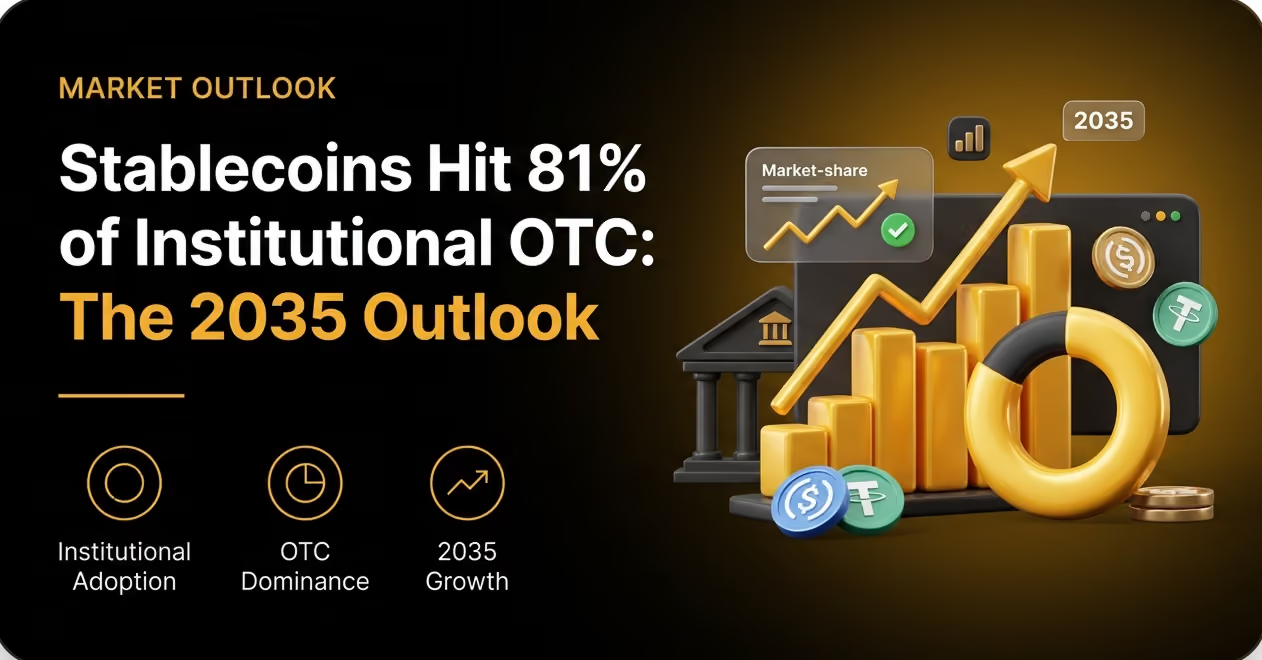
Finery Markets just published its "Stablecoin 2035" report, and the headline number is hard to ignore: stablecoins reached 81% of all institutional OTC trades in H1 2026, up from 26% in 2023. The debate about whether stablecoins have product-market fit is over. The interesting questions now are operational — and they land squarely on the businesses that move money for a living.
Here is how our team reads the data, and what it changes for anyone building on stablecoin rails.
The numbers that matter
- OTC is the only growing segment. In H1 2026, OTC trading volumes grew +76% YoY, while the top-20 DEXs fell -38% and the top-20 CEXs -13%. Institutional flow is consolidating into OTC, and it is settling in stablecoins — stablecoin OTC volume nearly doubled (+94% YoY).
- The dollar owns the rail. USD-pegged tokens accounted for 99.87% of OTC stablecoin volume. EUR stablecoins grew 32x year over year, but off a base so small it changes nothing structurally — yet.
- The market is deep and diversifying. Total supply is now north of $300B (~$319B). Tether sits around $190B and USDC around $76B, but their combined share slipped from ~89% to ~83% as issuers multiplied from 30 in 2020 to 215+ in 2025.
- Real assets are following. Tokenized U.S. Treasuries crossed $15B (+150% YoY); tokenized equities are near $1.5B (+400%). Roughly two-thirds of stablecoin supply is held in emerging markets — savings demand, not speculation.
Three signals for payment businesses
1. Payments and treasury — not trading — are the real entry point. The report's contributors converge on one idea: stablecoins become "ordinary" inside a company through the treasury and payments desk, not the trading floor. Cross-border corridors that took 2–5 business days now settle in minutes, with all-in costs compressing from 3–5% (correspondent banking) toward ~1%. For a payments provider, that is the pitch: released working capital and removed friction on flows that recur every single day.
2. The winning infrastructure is invisible. Multiple authors describe the same 2035 endpoint — the word "stablecoin" disappears from the enterprise vocabulary because the rails sit beneath familiar fintech interfaces. Users initiate value in stablecoins; merchants and counterparties receive local fiat without ever touching a wallet, chain, or bridge. The value isn't the token. It's the compliance-first connective layer that hides complexity while preserving speed and 24/7 availability.
3. "Regulated" is the moat. Across every contribution, the common thread is regulation. By 2035, regulated coins — dollar and local alike — are expected to hold the dominant share of supply and activity. Licensing, compliance translation across jurisdictions (MiCA, VARA, Singapore's PSA), and a single clean interface across a fragmented patchwork of currency regimes become the real competitive edge — not raw settlement speed.
The INXY takeaway
The report describes a world where money movement runs on stablecoin rails without the end user ever needing to know it. That is exactly the layer payment infrastructure providers should be building toward: regulated on/off-ramps, stablecoin-to-fiat settlement in the currencies clients actually need, and an interface that treats "any currency, any chain" as a non-issue.
The strategic mistake would be to read this as a race to launch yet another stablecoin. The report is explicit that by 2035, "the truly savvy stablecoin strategy may be not launching one at all." The durable advantage is not issuance — issuance is easy. It is liquidity, compliance, and distribution wired into the systems businesses already use.
For merchants, PSPs, and treasuries evaluating stablecoin payments today, the question the report leaves us with is the right one to steal: not how do we add stablecoins to our stack — but what does our business look like when settlement is instant, always-on, and fiat never needs to leave the chain in the first place?
This commentary is informational and not investment advice.