An INXY expert read on Finery Markets' "Stablecoin 2035: Back to the Future" report (H1 2026)
Finery Markets just published its "Stablecoin 2035" report, and the headline number is hard to ignore: stablecoins reached 81% of all institutional OTC trades in H1 2026, up from 26% in 2023. The debate about whether stablecoins have product-market fit is over. The interesting questions now are operational — and they land squarely on the businesses that move money for a living.
Here is how our team reads the data, and what it changes for anyone building on stablecoin rails.
The numbers that matter
OTC is the only growing segment. In H1 2026, OTC trading volumes grew +76% YoY, while the top-20 DEXs fell -38% and the top-20 CEXs -13%. Institutional flow is consolidating into OTC, and it is settling in stablecoins — stablecoin OTC volume nearly doubled (+94% YoY).
The dollar owns the rail. USD-pegged tokens accounted for 99.87% of OTC stablecoin volume. EUR stablecoins grew 32x year over year, but off a base so small it changes nothing structurally — yet.
The market is deep and diversifying. Total supply is now north of $300B (~$319B). Tether sits around $190B and USDC around $76B, but their combined share slipped from ~89% to ~83% as issuers multiplied from 30 in 2020 to 215+ in 2025.
Real assets are following. Tokenized U.S. Treasuries crossed $15B (+150% YoY); tokenized equities are near $1.5B (+400%). Roughly two-thirds of stablecoin supply is held in emerging markets — savings demand, not speculation.
Three signals for payment businesses
1. Payments and treasury — not trading — are the real entry point. The report's contributors converge on one idea: stablecoins become "ordinary" inside a company through the treasury and payments desk, not the trading floor. Cross-border corridors that took 2–5 business days now settle in minutes, with all-in costs compressing from 3–5% (correspondent banking) toward ~1%. For a payments provider, that is the pitch: released working capital and removed friction on flows that recur every single day.
2. The winning infrastructure is invisible. Multiple authors describe the same 2035 endpoint — the word "stablecoin" disappears from the enterprise vocabulary because the rails sit beneath familiar fintech interfaces. Users initiate value in stablecoins; merchants and counterparties receive local fiat without ever touching a wallet, chain, or bridge. The value isn't the token. It's the compliance-first connective layer that hides complexity while preserving speed and 24/7 availability.
3. "Regulated" is the moat. Across every contribution, the common thread is regulation. By 2035, regulated coins — dollar and local alike — are expected to hold the dominant share of supply and activity. Licensing, compliance translation across jurisdictions (MiCA, VARA, Singapore's PSA), and a single clean interface across a fragmented patchwork of currency regimes become the real competitive edge — not raw settlement speed.
The INXY takeaway
The report describes a world where money movement runs on stablecoin rails without the end user ever needing to know it. That is exactly the layer payment infrastructure providers should be building toward: regulated on/off-ramps, stablecoin-to-fiat settlement in the currencies clients actually need, and an interface that treats "any currency, any chain" as a non-issue.
The strategic mistake would be to read this as a race to launch yet another stablecoin. The report is explicit that by 2035, "the truly savvy stablecoin strategy may be not launching one at all." The durable advantage is not issuance — issuance is easy. It is liquidity, compliance, and distribution wired into the systems businesses already use.
For merchants, PSPs, and treasuries evaluating stablecoin payments today, the question the report leaves us with is the right one to steal: not how do we add stablecoins to our stack — but what does our business look like when settlement is instant, always-on, and fiat never needs to leave the chain in the first place?
This commentary is informational and not investment advice.
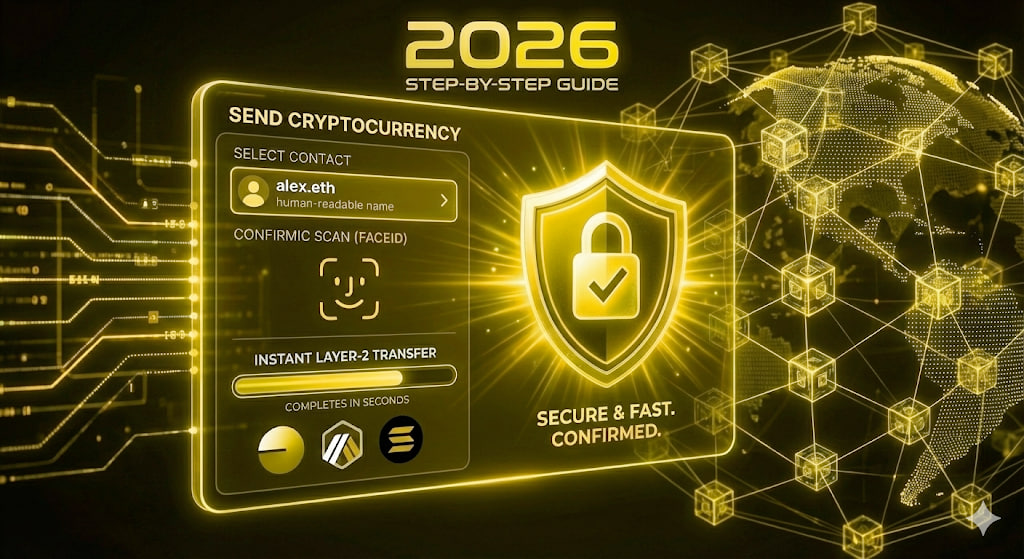
Sending crypto in 2026 is faster and more accessible thanks to improved wallets, lower network fees, and advanced blockchain technologies. This step-by-step guide explains how to send BTC, USDT, USDC, and ETH securely, compare transaction fees, track transfers, and stay ahead of future crypto transaction trends.
Cryptocurrency might sound complicated, but it's quite straightforward once you get the hang of it. At its core, cryptocurrency is a type of digital money. Unlike traditional currencies like the dollar or euro, crypto doesn't rely on banks. Instead, it uses technology called blockchain to keep track of transactions. This technology is like a digital ledger that records every transaction made.
Bitcoin is the most famous cryptocurrency, but there are many others like Ethereum, USDT, and USDC. Each has its own features and uses. For instance, Bitcoin is often used as a store of value, like gold. Ethereum, on the other hand, is known for its smart contracts. These are like self-executing contracts with the terms directly written into code.
Sending crypto involves creating a digital wallet. This wallet is a bit like a bank account but only for digital currencies. To send crypto, you need the recipient's wallet address. It's important to double-check this address because once you send crypto, you can't get it back if the address is wrong. Crypto transactions are generally fast and can be cheaper than traditional money transfers.
Choosing the Right Crypto Payment Platform
When it comes to sending crypto, picking the right payment platform is crucial. The options have expanded greatly by 2026, offering more choices than ever. But with choice comes the challenge of finding the best fit for your needs. Let's break down what to look for in a crypto payment platform.
First, consider the transaction fees. Different platforms charge varying fees for sending crypto. Some offer lower fees for particular cryptocurrencies like BTC, USDT, USDC, or ETH. It's smart to compare these fees as they can affect the overall cost of your transactions. A platform with lower fees can save you money in the long run.
Next, think about ease of use. Not all platforms are user-friendly. If you're new to crypto, look for a platform that offers a straightforward interface. Tutorials and customer support can also be a big help. A good platform should make the process of sending crypto as simple as possible.
Security is another key factor. You need a platform that keeps your funds safe. Look for platforms with strong security measures, such as two-factor authentication and encryption. You want assurance that your crypto won't fall into the wrong hands.
Consider the platform's reputation and reviews. A platform with positive reviews from other users can be a good sign. Check forums and social media for feedback. Sometimes, the experiences of others can guide you toward the right choice.
Finally, look at the supported cryptocurrencies. If you plan to send BTC, USDT, USDC, or ETH, make sure the platform supports these. Some platforms offer a wider range of cryptocurrencies, which can be useful if you plan to diversify your holdings.
In essence, selecting the right crypto payment platform involves balancing fees, usability, security, reputation, and currency support. By focusing on these aspects, you'll be well on your way to finding a platform that suits your needs.
Setting Up Your Crypto Wallet (ссылка на блог)
Setting up a crypto wallet is a crucial step in sending crypto. It's like having a digital bank account where you store your cryptocurrencies. Let's break down the process into simple steps.
First, you'll need to choose the type of wallet. There are several options like hardware wallets, mobile wallets, and desktop wallets. Each has its own benefits. For instance, hardware wallets are secure because they store your crypto offline. Mobile wallets are convenient for everyday use.
Once you've picked a wallet type, it's time to download or purchase it. If you're going for a software wallet, visit the official website or app store to download it. Be cautious of fake sites and apps. For hardware wallets, buy from a trusted source to avoid counterfeit products.
After installing your wallet, you'll need to create an account. During this step, you'll set up a strong password. This is vital for your wallet's security. You might also be required to set up two-factor authentication for an extra layer of protection.
You'll then receive a recovery phrase. This is a set of words you'll need if you ever lose access to your wallet. Write it down and store it somewhere safe. Never share this phrase with anyone.
Finally, add some crypto to your wallet. You can do this by purchasing crypto from an exchange or receiving it from someone else. Make sure to double-check wallet addresses when sending or receiving crypto to avoid mistakes. With these steps, you're ready to manage your crypto securely.
How to Send BTC, USDT, USDC, and ETH
Sending crypto can seem tricky, but it's quite simple once you get the hang of it. Let's break it down. First, you need a wallet. There are many options, like hardware wallets, mobile apps, or online platforms. Choose one that fits your needs and create an account.
When you're ready to send crypto, you'll need the recipient's wallet address. It's a long string of letters and numbers, so double-check it to avoid mistakes. For example, if you're sending Bitcoin (BTC), make sure the address is a BTC address. Sending crypto to the wrong type of address can result in a loss.
Next, enter the amount you want to send. Most platforms let you choose how much you want to pay in fees. Lower fees mean slower transactions, while paying more can speed things up. It's a balance between cost and time.
Once everything looks good, confirm the transaction. Some platforms may ask for additional verification, like a code sent to your phone or email. This step helps keep your crypto safe. After confirmation, the transaction is processed. Depending on the network, it can take a few minutes to complete.
Keeping track of the transaction is easy. You can use a blockchain explorer to see its status. Just enter your transaction ID or wallet address to follow its progress.
Comparing Transaction Fees
When sending crypto, transaction fees can vary greatly depending on the network you choose. Let’s break this down with a few clear examples.
Imagine you’re sending Bitcoin (BTC). The Bitcoin network can have relatively high fees, especially during periods of high demand. This often makes small transactions less cost-effective.
Now consider Ethereum (ETH). Ethereum transaction fees, known as gas fees, fluctuate depending on network congestion. During peak activity—such as popular NFT launches or intense DeFi usage—these fees can increase significantly.
The same principle applies to stablecoins like USDT and USDC. While their value remains stable, transaction fees depend entirely on the blockchain network used. An important detail to keep in mind is that gas fees are always paid in the native token of the blockchain, not in the stablecoin itself.
For example, if you send USDT on the Ethereum network (ERC-20), you must have enough ETH in your wallet to cover the gas fee. Similarly, when sending USDT on the Tron network (TRC-20), you need to hold TRX in addition to USDT. Without the native token on your balance, the transaction cannot be processed.
This is why networks like Tron are often chosen for USDT transfers—fees there are usually much lower. However, it’s essential to monitor your balance of native coins (ETH, TRX, etc.) to avoid failed transactions.
When choosing how to send crypto, always compare current network fees and make sure you have enough of the required native token. This approach helps keep your transactions smooth, predictable, and cost-effective.
Tracking Your Crypto Transactions
Keeping tabs on your crypto transactions can seem like a puzzle at first. Yet, with a few simple steps, it can become second nature. When you send crypto, each transaction gets recorded on a public ledger called a blockchain. This ledger is like a big book that everyone can see but no one can change. It helps ensure transparency and security.
To start tracking, you'll need a wallet. This is like your digital pocket for holding cryptocurrencies. Each wallet has a unique address, much like your house address, but for crypto. When you send crypto, it gets recorded with this address. Many wallets offer features allowing you to see your full transaction history. This is handy for checking past transfers or seeing who you've sent crypto to.
For those who like visuals, some platforms provide charts and graphs that show your transaction activity over time. These can help you spot patterns or unusual activity. If you're using a crypto payment platform, they might offer additional tools for managing and viewing your transactions. Some even offer alerts to notify you of any new activity, ensuring you're always in the loop.
If you're dealing with several types of crypto like BTC, USDT, USDC, or ETH, separate wallets might be needed. This keeps things organized and prevents confusion. For those wanting to dive deeper, blockchain explorers are available. These are online tools that let you search a transaction by entering your wallet address. They offer detailed info, such as transaction status and fees paid.
Tracking your crypto transactions isn't just about staying organized. It's a way to protect your crypto and understand your spending habits. With these tools, you can manage your crypto finances in a smart and secure way.
Future Trends in Crypto Transactions
The world of cryptocurrency is always on the move. As we look to 2026, several exciting trends are shaping how people send crypto. These changes are not just about technology but also about how we use crypto in everyday life.
One major trend is the rise of decentralized finance, or DeFi. DeFi platforms allow users to conduct financial transactions without a central authority, like a bank. This means lower fees and more control over your money when you send crypto. DeFi is growing fast, and more people are using it for everything from loans to savings accounts.
Another trend to watch is the integration of crypto into traditional financial systems. More banks and financial institutions are starting to accept and use cryptocurrencies. This means you might soon be able to send crypto directly from your bank account. It's a big step towards making crypto a part of everyday financial activities.
In addition to these changes, there is also a focus on improving the speed and efficiency of crypto transactions. Technologies like the Lightning Network for Bitcoin and Ethereum 2.0 are being developed to make transactions faster and cheaper. This could make sending crypto as quick and easy as sending a text message.
Security is another important area of development. As more people use crypto, the need for secure transactions becomes even more critical. New security measures, such as multi-signature wallets and advanced encryption techniques, are being introduced. These tools help protect users' funds and personal information.
Moreover, the use of stablecoins like USDT and USDC is growing. These are cryptocurrencies pegged to stable assets like the US dollar. They offer the benefits of digital currencies without the volatility. This makes them an attractive option for people looking to send crypto with minimal risk.
Lastly, there is an increasing focus on regulation. Governments around the world are working on new laws to govern cryptocurrency use. While some fear that regulation could stifle innovation, it could also make crypto more reliable and accessible to everyone.
As we move forward, these trends will shape the future of crypto transactions. Whether you're a seasoned investor or a newcomer, keeping an eye on these developments can help you make informed decisions about how to send crypto. The landscape is evolving, and with it, new opportunities are emerging for everyone.
FAQ
What is cryptocurrency and why are BTC, USDT, USDC, and ETH commonly used for sending?
Cryptocurrency is a digital or virtual form of currency that uses cryptography for security. BTC (Bitcoin), USDT (Tether), USDC (USD Coin), and ETH (Ethereum) are commonly used due to their widespread acceptance, liquidity, and relatively stable values, making them ideal for transactions.
How do I choose the right crypto payment platform for sending crypto with low fees?
When selecting a crypto payment platform, consider factors such as transaction fees, user interface, security features, and supported cryptocurrencies. Platforms like Binance, Coinbase, and Kraken are popular due to their competitive fees and reliability.
What steps are involved in setting up a secure crypto wallet?
To set up a secure crypto wallet, first choose between a hardware wallet (for maximum security) or a software wallet (for convenience). Download the wallet app or set up the hardware device, create a strong password, and ensure you have a backup of your recovery phrase.
Can you provide a step-by-step guide on sending BTC, USDT, USDC, and ETH?
Open your crypto wallet and select the cryptocurrency you wish to send.
Enter the recipient's wallet address.
Specify the amount to send.
Review the transaction details, including network fees.
Confirm and authorize the transaction.
Wait for transaction confirmation on the blockchain.
How can I compare transaction fees across different networks and platforms?
To compare transaction fees, research and compare the fee structures of each platform, focusing on network fees, withdrawal fees, and any additional service charges. Tools like CoinGecko and CoinMarketCap provide up-to-date fee comparisons.
What methods are available for tracking my crypto transactions?
You can track your crypto transactions using blockchain explorers such as Etherscan for ETH and its tokens or Blockchain.com for BTC. These tools allow you to enter the transaction ID to view the status and confirmations.
What future trends can we expect in crypto transactions by 2026?
By 2026, expect increased adoption of Layer 2 solutions for faster and cheaper transactions, greater integration of AI for improved fraud detection, and wider acceptance of crypto payments in mainstream finance, enhancing user experience and security.
What Are Web3 Payments? Blockchain & Smart Contracts Explained
“Web3 payments” describe a new way to move money in which value travels directly across a blockchain network instead of through banks and card schemes. Unlike traditional online transactions, blockchain payments settle peer-to-peer on a public ledger, are verifiable by anyone, and can run without a central intermediary holding the funds. For businesses, this means faster settlement, lower cross-border costs, and programmable money that can enforce its own rules.
“Web3 payments” describe a new way to move money in which value travels directly across a blockchain network instead of through banks and card schemes. Unlike traditional online transactions, blockchain payments settle peer-to-peer on a public ledger, are verifiable by anyone, and can run without a central intermediary holding the funds. For businesses, this means faster settlement, lower cross-border costs, and programmable money that can enforce its own rules.
This guide explains what web3 payments are, how they work under the hood, where smart contracts fit in, and how they compare to the crypto checkout flows most merchants already know. It is written for founders, finance teams, and product managers evaluating whether on-chain rails belong in their stack.
What Are Web3 Payments?
Web3 payments are transactions executed on decentralized blockchain networks, where ownership of funds is tied to a cryptographic wallet rather than a bank account. The term “web3” refers to the third era of the internet — one built on open, user-owned protocols. In a payment context, web3 crypto payments let a payer send value (typically stablecoins such as USDC or USDT, or assets like ETH and BTC) straight to a recipient’s wallet, with the network itself confirming and recording the transfer.
Three properties separate web3 payments from conventional digital payments:
Self-custody. The payer controls the funds via private keys until the moment of transfer — there is no card issuer or bank acting as gatekeeper.
On-chain settlement. The transaction is final once confirmed by the network, usually in seconds to minutes, with no multi-day clearing cycle.
Programmability. Logic can be attached to the payment itself, so funds release only when predefined conditions are met.
The market context matters. According to recent industry analysis, fiat-backed stablecoins surpassed $300 billion in market capitalization in late 2025, with annualized on-chain settlement volumes in the mid-$20-trillion range — evidence that web3 rails are moving from experiment to real economic activity.
It helps to see where web3 payments sit relative to terms you already use. “Crypto payments” is the umbrella term for paying with digital assets at all. “Web3 payments” is the subset that runs on open, permissionless networks with user-held funds — as opposed to a closed processor that simply accepts coins and settles them to your bank. That difference in architecture is what unlocks the speed, reach, and automation covered below.
How Web3 Payments Work: Blockchain & Wallets
Blockchain payments rely on three components working together: a wallet that holds the keys, a blockchain network that validates transactions, and (for business use) a gateway that translates the on-chain event into something an accounting system can read. Here is the flow in plain terms.
The role of self-custody wallets
A crypto wallet does not “store” coins; it stores the private keys that prove ownership of a balance recorded on-chain. When a customer pays, their wallet signs the transaction with that key, authorizing the network to move the balance to the merchant’s address. Because the key never leaves the user, there is no card number to steal and no chargeback to reverse — a structural difference from card payments.
On-chain settlement vs. traditional rails
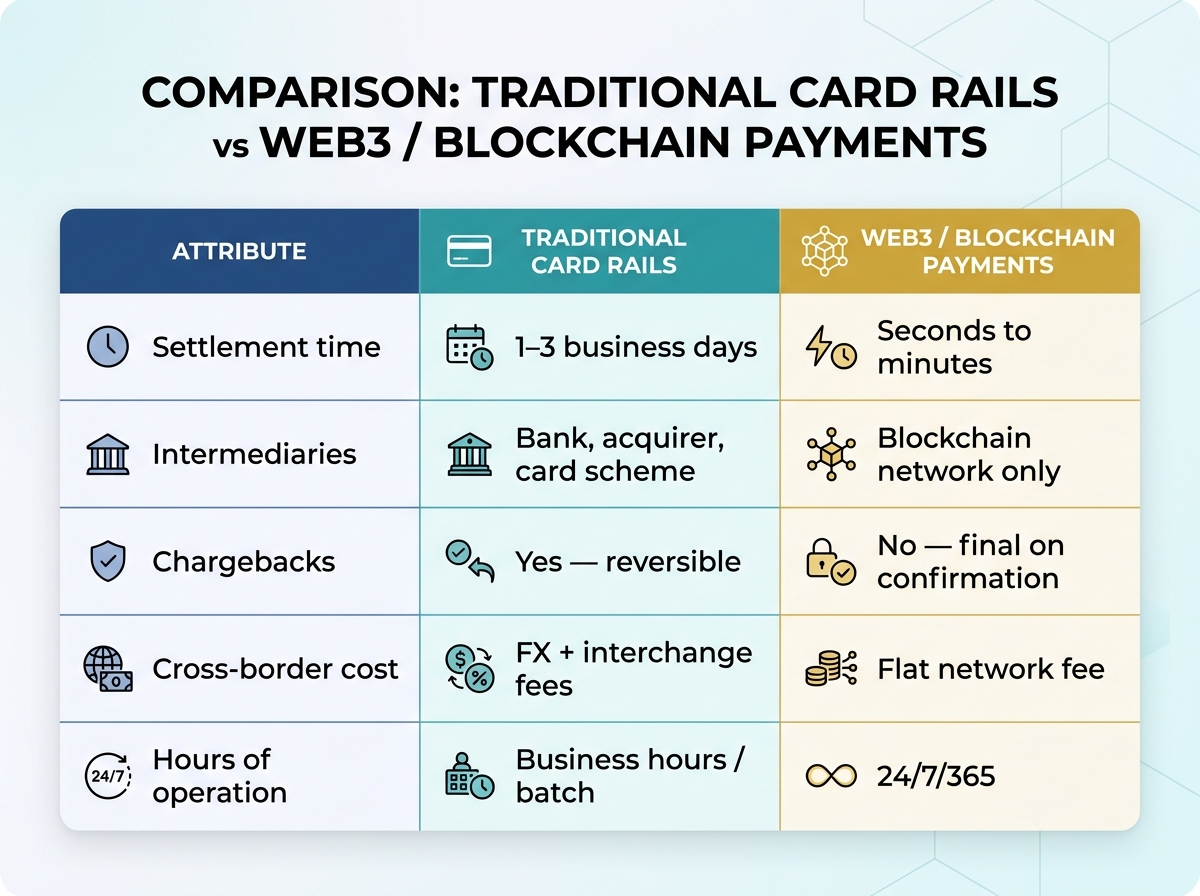
In a card transaction, authorization, clearing, and settlement happen across several institutions over one to three business days. With blockchain payments, validators confirm the transfer and write it to an immutable ledger in a single step. The table below summarizes the practical differences.
Smart Contract Payments Explained
Smart contract payments are blockchain transactions governed by self-executing code. A smart contract is a program deployed on-chain that automatically performs an action — release funds, split a payment, issue a refund — when its conditions are satisfied. No human has to intervene, and no party can alter the outcome once the contract is live.
Automated & programmable payments
This is where web3 moves beyond simple transfers. A smart contract can hold funds in escrow and release them only when a delivery is confirmed, automatically distribute revenue among several wallets, or stream a salary continuously over time. For businesses, programmable money reduces manual reconciliation and removes the trust gap in multi-party deals.
Consider a marketplace that owes three parties on every sale: the seller, an affiliate, and the platform itself. With cards, that single payment is captured, then split later through separate payout runs and reconciliation. A smart contract executes the split atomically — the moment funds arrive, each wallet receives its share in the same transaction. The same logic powers milestone-based contractor payments, automated refunds, and subscription renewals, all without a card on file or a manual approval step.
Escrow: funds lock until both sides meet their obligations.
Revenue splits: a single incoming payment is divided across partners in one transaction.
Recurring & usage-based billing: subscriptions and metered charges execute on-chain without a card on file.
Tokenized payment solutions
Tokenized payment solutions represent real-world value — a dollar, an invoice, a loyalty credit — as a transferable token on a blockchain. Stablecoins are the most widely used example: a token pegged 1:1 to fiat that combines the stability of a currency with the speed of crypto. Industry research estimates that B2B flows already account for roughly 40% of real-economy stablecoin payments and are growing about 65% per year, which is why tokenized settlement is becoming the default rail for cross-border business payments.
Web3 Payments vs. Traditional Crypto Checkout
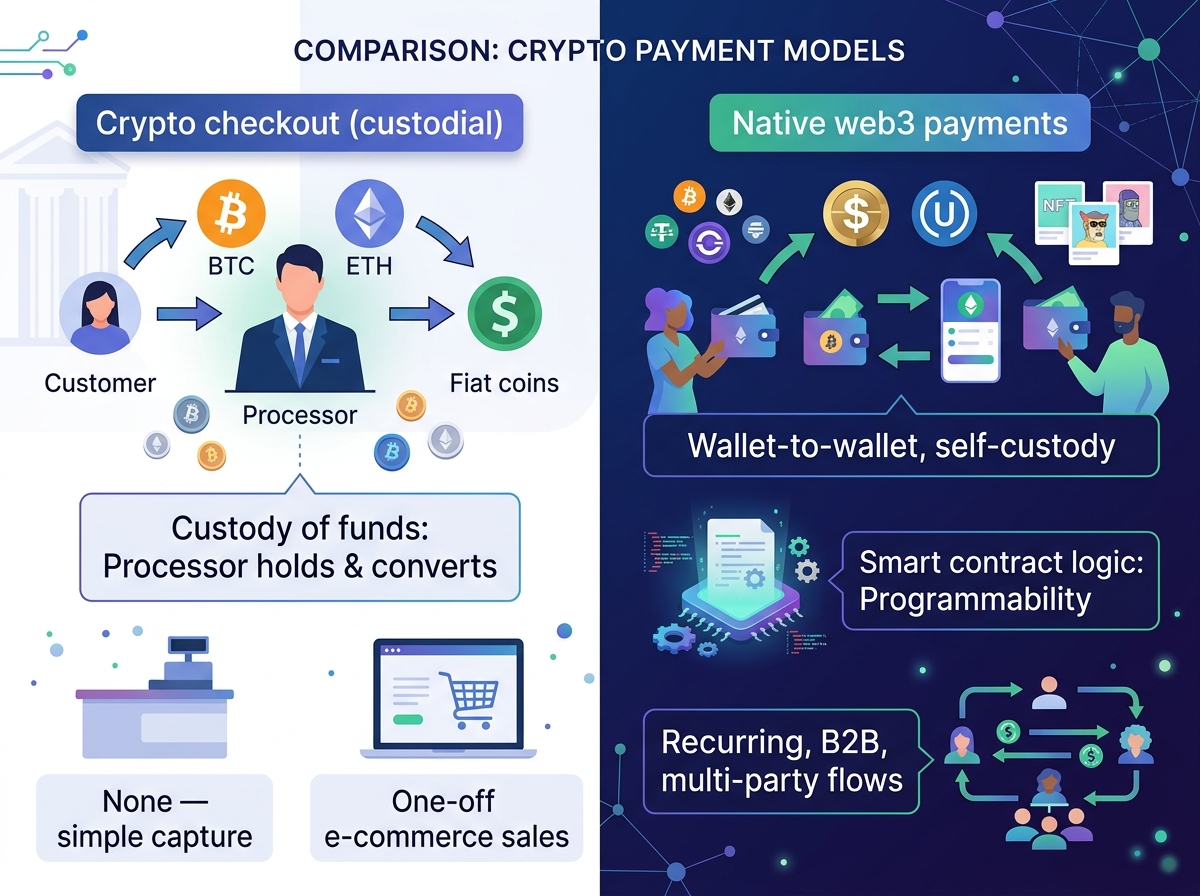
Many merchants already “accept crypto” through a hosted checkout that converts coins to fiat. That is a useful on-ramp, but it is not the same as a full web3 payment model. The distinction is about who controls the funds and whether the payment carries logic.
In practice the two coexist. A business might use a custodial checkout for retail customers while using native, programmable rails for supplier payouts and partner settlements. For a deeper breakdown of provider roles, see our guide on the difference between a crypto payment gateway and a processor.
Benefits & Risks for Businesses
Web3 payments — and the broader category of blockchain smart contracts for business — offer clear operational upside, but they come with trade-offs that finance and compliance teams should weigh.
Key benefits:
Near-instant, 24/7 settlement that frees up working capital.
Lower cross-border fees by removing correspondent-banking layers.
No chargebacks, reducing fraud exposure for digital goods.
Automation of escrow, splits, and recurring billing through smart contracts.
Risks to manage:
Price volatility on non-stablecoin assets — most businesses settle in stablecoins to neutralize this.
Irreversibility means errors and misdirected payments are hard to recover.
Regulatory obligations: under frameworks like the EU’s MiCA, you must work with a licensed VASP/CASP and apply KYC/AML and Travel Rule checks.
Smart-contract risk: poorly audited code can be exploited, so use vetted, audited contracts.
For most companies the practical answer is not to choose between safety and innovation, but to adopt web3 payments through a partner that has already solved custody, compliance, and key management. That keeps the operational benefits — speed, automation, global reach — while shifting the hardest security and regulatory work to infrastructure built for it.
How to Start Accepting Web3 Payments
You do not need to build blockchain infrastructure in-house. A compliant gateway abstracts the wallet, network, and conversion layers so you can accept on-chain payments with a standard integration. A practical path:
Choose your settlement asset. Stablecoins (USDC, USDT, DAI) are the standard for business to avoid volatility.
Select a regulated provider. Confirm licensing, multi-chain support, and KYC/AML coverage for your regions.
Integrate via API or plugin. Add the checkout or payout flow and connect webhooks to your back office.
Decide what to automate. Map which payments — escrow, splits, recurring — benefit from smart-contract logic.
INXY provides a regulated, EU-compliant gateway for exactly this. Explore the web3 payments solution and our smart-contract payment infrastructure, or read how to accept crypto payments in 2026 for the full setup walkthrough.
FAQ
What are web3 payments in simple terms? They are payments sent directly between crypto wallets over a blockchain, without a bank or card network in the middle. The network verifies and records the transfer.
Are web3 payments safe? The underlying blockchain settlement is highly secure and tamper-resistant. The main risks are user error, asset volatility, and smart-contract bugs — all manageable by using stablecoins, audited contracts, and a regulated gateway.
What is a smart contract payment? A payment controlled by on-chain code that executes automatically when set conditions are met — for example, releasing escrowed funds once delivery is confirmed.
How are web3 payments different from accepting Bitcoin at checkout? A standard crypto checkout is custodial and converts coins to fiat. Native web3 payments keep funds in self-custody and can carry programmable logic, making them better suited to recurring, B2B, and multi-party flows.
Annual vs. Monthly SaaS Billing: Why Upfront Crypto Payments Win on Cash Flow
For most SaaS companies, monthly billing is the unexamined default. It lowers the barrier to entry, so it feels like the safe choice. But for B2B and high-ticket software, that default quietly works against you: it spreads revenue thin, exposes every renewal to a payment failure, and hands a chunk of your SaaS billing and payments flow to card networks that were never built for recurring, cross-border charges.
For most SaaS companies, monthly billing is the unexamined default. It lowers the barrier to entry, so it feels like the safe choice. But for B2B and high-ticket software, that default quietly works against you: it spreads revenue thin, exposes every renewal to a payment failure, and hands a chunk of your SaaS billing and payments flow to card networks that were never built for recurring, cross-border charges.
There is a structurally better model for B2B: annual upfront billing settled in crypto. Paid in stablecoins, an annual plan lands the full year of revenue immediately, removes eleven future points of failure, and eliminates chargebacks entirely. This article makes the cash-flow and retention case for upfront annual billing, and shows how stablecoin payments make it easy to offer.
The Hidden Cost of Monthly Card Subscriptions
A monthly subscription is not one payment — it is twelve chances per customer, per year, for something to go wrong. Card-based SaaS payment processing carries failure rates that compound across a subscriber base:
Involuntary churn — customers lost to failed payments rather than active cancellation — accounts for 20–40% of total churn, and up to 48% in higher-risk sectors.
Left unmanaged, failed payments can quietly consume up to 9% of total revenue.
Expired cards alone cause roughly 42% of failed subscription payments; the customer never chose to leave, the card simply lapsed.
Cross-border recurring charges are frequently flagged or declined by issuing banks, and chargebacks on digital goods drain revenue plus dispute fees.
Each monthly cycle re-exposes you to all of this. Annual billing collapses twelve renewal events into one — shrinking the failure surface by an order of magnitude — and, just as importantly, pulls a full year of cash forward instead of metering it out month by month.
Why Annual Upfront Billing Changes the Math
Upfront annual plans are not just an accounting convenience; they change the unit economics of the business. The advantage is sharpest when the customer actually prefers to pay this way — and crypto buyers do.
Cash flow now, not later. Collecting twelve months upfront strengthens working capital and reduces dependence on outside funding to finance growth.
A smaller churn surface. One payment per year means one renewal decision per year — and far fewer involuntary drop-offs from card failures.
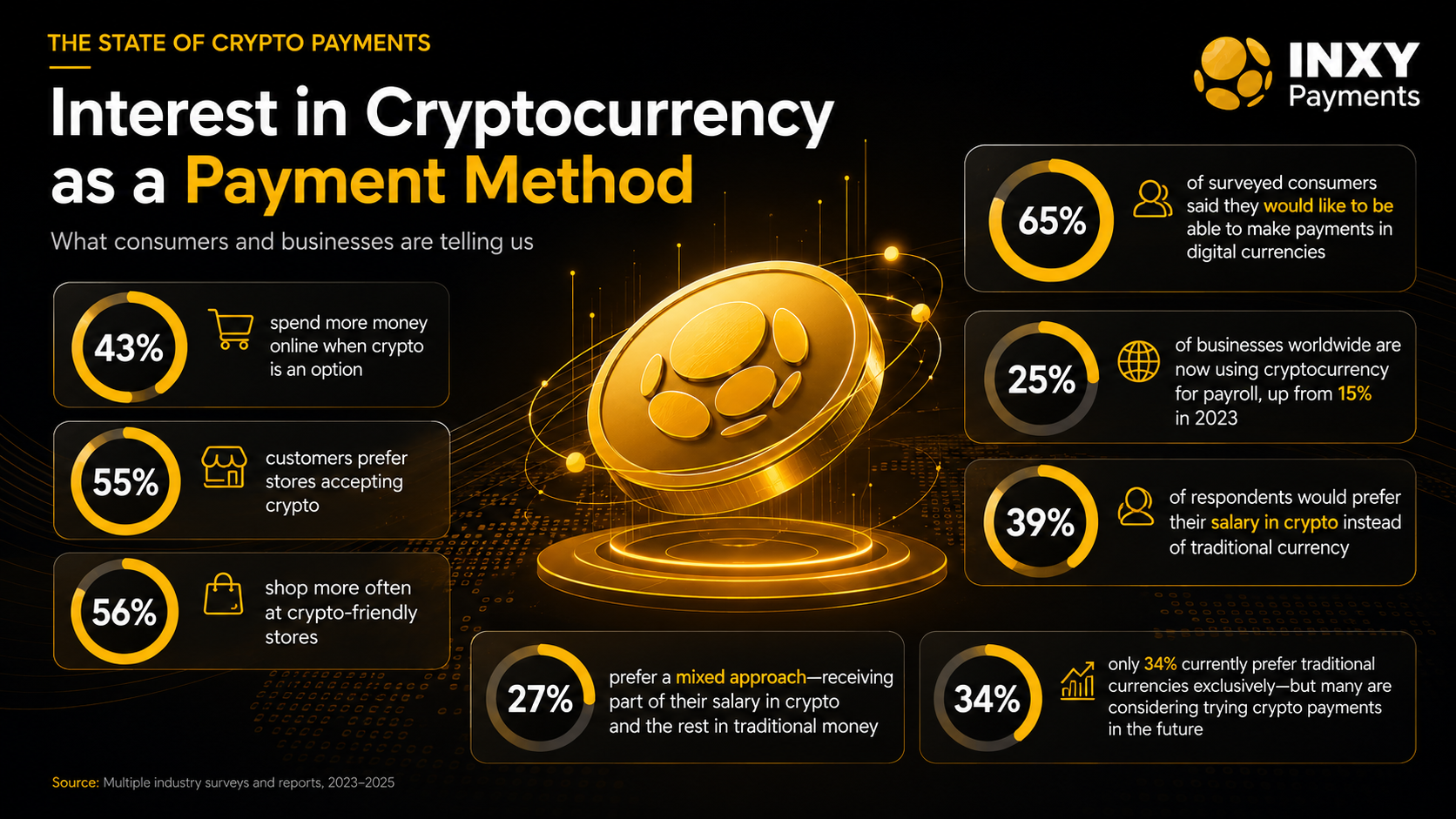
Higher lifetime value. Industry data shows crypto buyers spend roughly 2x more than traditional users, and around 43% spend more simply because crypto is offered as an option.
A buyer base that wants annual. About 60% of crypto users prefer to pay upfront for 12–36 month plans, versus only 20% of credit-card users — so offering crypto and annual pricing together is a natural fit.
With more than 824 million people globally owning crypto — over 10% of the world's population — the segment that prefers upfront, borderless payment is large and high-value, not niche.
Why Crypto Makes Annual Billing Easy to Sell
Blockchain payments are push-based and final — one confirmed transfer, no scheduled pulls. That property, which makes crypto awkward for monthly auto-billing, is exactly what you want for an annual upfront plan: a single, irreversible settlement that closes the deal.
Predictable Revenue Through Auto-Conversion
The usual objection — volatility — is solved at the gateway. When a client pays an annual license in a volatile asset, an auto-convert engine instantly settles it into stablecoins (USDT/USDC) or fiat (EUR/USD), so you book exact, predictable revenue. Stablecoins themselves are pegged 1:1 to the dollar, keeping SaaS payment management clean and auditable.
No Chargebacks, Global Reach, Instant Settlement
Zero chargebacks. On-chain payments are irreversible, eliminating friendly fraud and dispute fees on digital goods.
Borderless billing. A single settlement layer reaches customers who lack the international cards your checkout depends on, with no per-currency FX overhead.
Minutes, not days. Stablecoin payments settle in minutes instead of the 3–5 business days an international wire takes to clear.
Lower processing cost. Versus the typical 2.9% + $0.30 card fee plus cross-border markups, stablecoin transfers on networks like TRON (TRC-20) and Polygon cost a fraction of a percent.
How to Structure Annual Crypto Billing for Your SaaS
Adopting upfront annual crypto billing is a pricing-and-integration exercise, not a blockchain project:
Lead with discounted annual pricing. Make the annual plan the headline option and price the upfront discount so the cash-flow gain outweighs it.
Add crypto as a checkout option, not a replacement. Offer “Pay with Crypto” alongside fiat so you capture the high-LTV segment without disrupting existing customers.
Default to stablecoins on low-fee networks. Present USDT and USDC on TRC-20 and Polygon to keep customer-side network fees negligible and value stable.
Integrate via API or plugins, not smart contracts. Use a gateway's REST API or ready-made modules — including a native WHMCS module for hosting, cloud, and agency billing — to issue invoices and confirm payment automatically.
Auto-convert and reconcile. Convert incoming payments to stablecoins or fiat at the point of sale, and use transaction hashes plus CSV exports so finance can match every annual payment to an account.
Compliance and Accounting
Choosing a regulated gateway keeps annual crypto billing inside the regulatory perimeter rather than outside it. The essentials are KYC/AML on counterparties, transaction monitoring, and jurisdiction-aware handling — for example the EU's MiCA framework, which favors transparent, fully-backed stablecoins like USDC. Because stablecoins are dollar-pegged and settlements can auto-convert to fiat, your revenue stays denominated in a unit your accountants already use, with detailed reporting and exports for clean books.
How INXY Supports Annual Crypto Billing for SaaS
INXY is a regulated, enterprise-grade crypto payment gateway engineered for B2B and SaaS billing. Rather than forcing crypto into a monthly auto-billing mold, it leans into what the rail does best — high-value, upfront settlement:
Built for upfront cash flow. INXY deliberately bypasses standard auto-billing, making annual tariff plans the most profitable option for high-ticket B2B software — you receive the full yearly value immediately.
Auto-Convert Engine. Incoming payments in volatile assets convert instantly to stablecoins or fiat, so a $1,000 or $10,000 annual license books as predictable revenue.
Native SaaS integrations. Robust APIs and ready-made plugins, including a native WHMCS module tailored for hosting, cloud services, and digital agencies.
Zero chargebacks and built-in mass payouts. Irreversible settlement protects revenue, while CSV- or API-driven payouts handle affiliate and contractor disbursements.
A compliance-first stack. EU VASP (Poland), Canadian MSB, MiCA readiness, AML/KYT/KYC, and audit-friendly fiat reporting.
Does crypto support automatic monthly subscriptions?
Crypto payments are push-based, so they are not built for monthly card-style auto-charges. That is why the model that works best for B2B SaaS is annual upfront billing — a single, final payment that also improves cash flow.
How do we avoid volatility on a large annual payment?
A gateway with an auto-convert engine settles incoming crypto into stablecoins or fiat at the point of sale, so a five-figure annual license is booked at an exact, predictable value.
Will offering crypto cannibalize our fiat plans?
No — it is an additional checkout option. It tends to attract new, higher-LTV customers rather than shift existing ones, since a large share of crypto buyers are new to the merchant.
How hard is integration?
You connect a REST API or use ready-made plugins such as a native WHMCS module, rather than writing smart contracts. Most teams launch faster than opening a traditional merchant account.
Conclusion
Monthly card billing spreads SaaS revenue thin and re-exposes it to failed payments and chargebacks twelve times a year. Annual upfront billing — settled in crypto — flips that: a full year of cash collected now, one renewal decision instead of twelve, no chargebacks, and a high-LTV buyer base that prefers to pay this way. The rail's push-based finality is a feature here, not a limitation.
Ready to add upfront annual crypto billing to your checkout? See how INXY can power it at inxy.io.