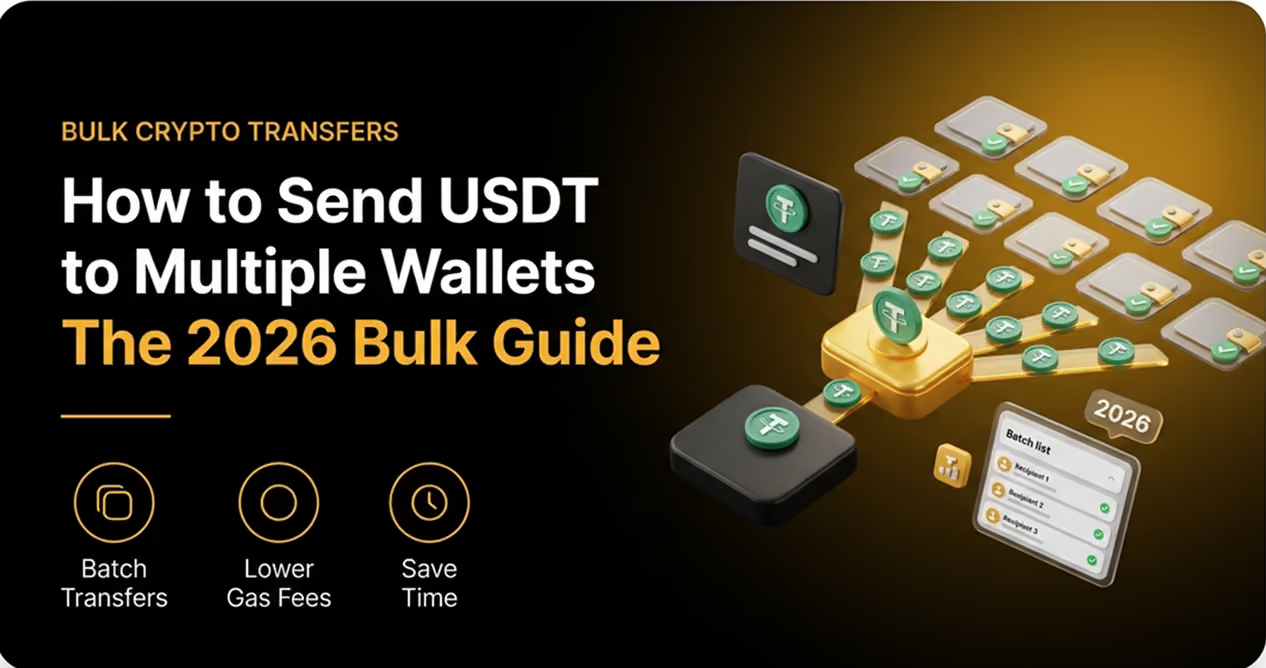
Paying twenty affiliates, two hundred contractors, or two thousand players one transaction at a time does not scale. If you need to send USDT to multiple wallets, the method you choose determines your cost, your error rate, and how much of your finance team's week disappears into copy-pasting addresses.
This guide covers the three practical ways to run a bulk USDT transfer in 2026 — manual, scripted, and platform-based — with the trade-offs of each, the mistakes that cost real money, and how to keep clean records for accounting.
What "mass USDT payout" actually means
A mass USDT payout is a single, structured operation that distributes Tether to many recipients at once. Instead of initiating each transfer by hand, you prepare a list of addresses and amounts and process them as a batch.
Three things make this harder than it looks:
- Network choice. USDT exists on Tron (TRC-20), Ethereum (ERC-20), BNB Chain (BEP-20), Solana, TON, Polygon and others. A recipient's address is network-specific — send TRC-20 USDT to an ERC-20 address and the funds are typically lost.
- Fees at volume. A fee that looks trivial for one transfer becomes a line item when multiplied across thousands of recipients.
- Reconciliation. Finance needs a fiat value, a timestamp, and a transaction hash for every payout — not just a wall of blockchain data.
Keep these three in mind; every method below is really a different answer to them.
Method 1: Manual transfers from a wallet or exchange
The simplest approach is to send USDT one recipient at a time from a self-custody wallet (MetaMask, Trust Wallet, Tronlink) or an exchange account.
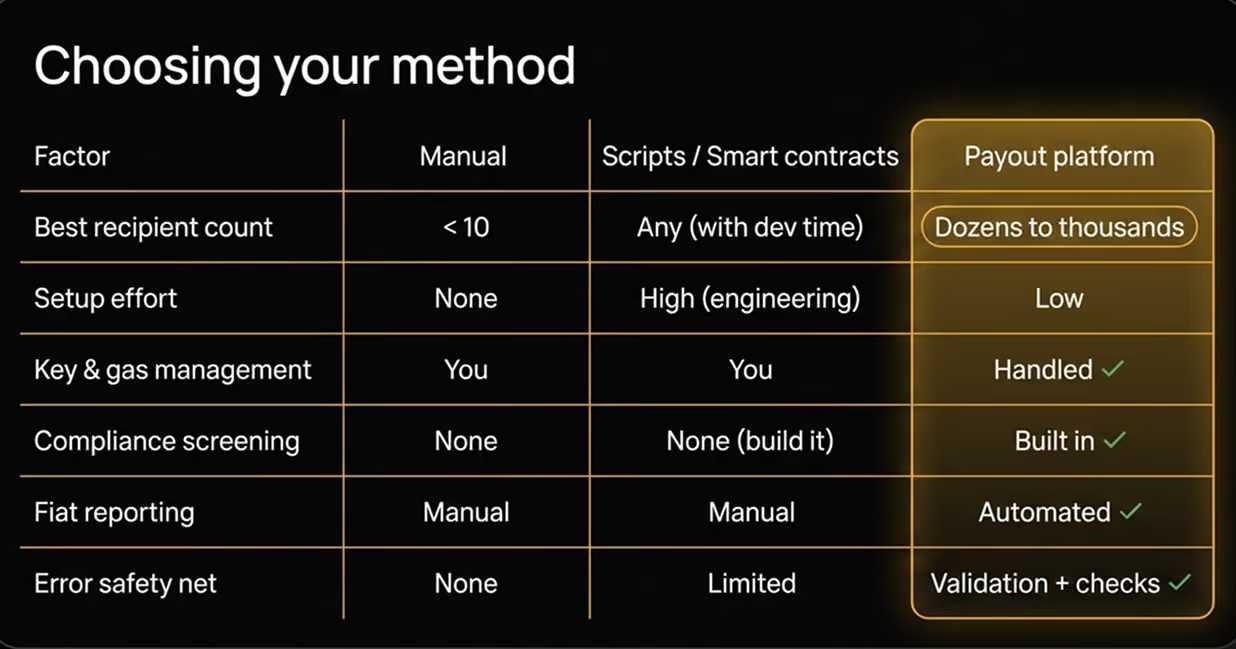
When it works: fewer than ~10 recipients, infrequent payouts, no automation budget.
Steps:
- Confirm each recipient's network and address in writing. Never assume the network.
- Fund your wallet with enough USDT and the native gas token (TRX for TRC-20, ETH for ERC-20, and so on).
- Send each transfer, double-checking the first and last four characters of every address.
- Save each transaction hash against the recipient's name for your records.
The catch: manual sending does not scale and has no safety net. A single mistyped address is irreversible. There is no batch confirmation, no built-in fiat reporting, and no sanctions screening. Beyond a handful of recipients, error risk climbs fast.
Method 2: Scripts and smart-contract batching
Technical teams can automate payouts with the blockchain's own tooling — a script that loops through a recipient list, or a "multisend" / "disperse" smart contract that pushes many transfers in one on-chain transaction.
When it works: you have engineering resources, a stable set of networks, and you want control over the flow.
What you gain:
- Batching efficiency. Multisend contracts bundle many recipients into a single transaction, which can reduce total gas versus sending individually on some networks.
- Full automation. A script can pull addresses from your database and fire payouts on a schedule.
What you take on:
- Key management. Your script needs access to a funded hot wallet holding private keys — an operational and security liability.
- Gas handling. You must monitor and top up the native token on every network you use.
- No compliance layer. Scripts don't screen recipients against sanctions lists or flag high-risk addresses. That's on you.
- Accounting glue. You still have to convert on-chain data into fiat-denominated records your auditors will accept.
Scripting trades human error for engineering overhead. It's powerful, but you are now running payment infrastructure as a side project.
Method 3: A payout platform (CSV or API)
A dedicated payout platform abstracts the wallet, keys, gas, and networks away. You upload a CSV of recipients or call an API, and the platform handles conversion, routing, screening, and delivery.
When it works: recurring payouts, dozens to thousands of recipients, finance teams that need clean fiat reporting, and businesses that don't want to become a crypto operation.
How a typical batch runs:
- Fund in fiat or stablecoin. Top up a balance — with a provider like INXY you can fund in EUR or USD via SEPA or SWIFT, so you never have to source crypto yourself.
- Upload or connect. Submit a CSV (recipient, amount, network) or send the batch through the API.
- Automated checks. The platform runs KYT and sanctions screening, auto-converts, and routes each payout to the right network.
- Recipients get paid. Delivery happens in minutes on supported low-fee networks.
- Report in fiat. You get batch-level exports with fiat values, fees, payout IDs, and transaction hashes — ready for reconciliation.
The trade-off is that you rely on a provider, but you remove key management, gas operations, compliance gaps, and accounting cleanup in one move.
Five mistakes that cost real money
- Wrong network. The most common irreversible loss. Always match the recipient's network to the address.
- Forgetting gas. A wallet full of USDT can't move without the native token for fees.
- No test transfer. For a new large recipient, send a small amount first and confirm receipt.
- Skipping screening. Paying a sanctioned or high-risk address is a legal and banking risk, not just a crypto one.
- Weak records. If you can't tie every hash to a fiat value and a recipient, month-end close becomes painful.
Frequently asked questions
Can I send USDT to many wallets in one transaction? On some networks, yes — a "multisend" smart contract bundles multiple recipients into one on-chain transaction. Otherwise, batching is handled off-chain by a platform that submits the transfers for you.
What's the cheapest way to send USDT in bulk? Low-fee networks such as Tron (TRC-20), Solana, and TON dramatically reduce per-transfer cost versus Ethereum. See our full USDT network fees comparison.
Do I need to hold crypto to run USDT payouts? Not with a fiat-native platform. You can fund in EUR or USD, keep your accounting in fiat, and let the provider handle conversion and delivery.
Is bulk USDT sending safe? The transfer itself is irreversible, so accuracy matters. Reputable platforms add address validation, KYT, and sanctions screening to reduce risk — protections that manual and script-based methods lack.
Scale it without the overhead
Manual works for a handful of payees; scripts work if you want to run infrastructure. If you'd rather send USDT to hundreds or thousands of recipients from a fiat balance — with screening and clean reporting built in — that's exactly what INXY's mass USDT payouts are built for.