
A fintech strategist with over 50 product launches in the payments and crypto space. Expert in scaling financial products, navigating international regulations, and leading high-performance teams. Successfully guided multiple ventures through major acquisitions and market expansions.
Specialized in:
- Product development and scaling in regulated markets
- Strategic growth and partnership execution
- Cross-functional team leadership in tech and fintech
- Blockchain, crypto payments, and enterprise financial solutions
- Focused on building systems that solve real-world business challenges.
More atricles by author

Stablecoins Just Took Over Institutional OTC
Stablecoins hit 81% of institutional OTC in H1 2026. INXY unpacks Finery Markets' Stablecoin 2035 report — key data and what it means for payments.

An INXY expert read on Finery Markets' "Stablecoin 2035: Back to the Future" report (H1 2026)
Finery Markets just published its "Stablecoin 2035" report, and the headline number is hard to ignore: stablecoins reached 81% of all institutional OTC trades in H1 2026, up from 26% in 2023. The debate about whether stablecoins have product-market fit is over. The interesting questions now are operational — and they land squarely on the businesses that move money for a living.
Here is how our team reads the data, and what it changes for anyone building on stablecoin rails.
The numbers that matter
- OTC is the only growing segment. In H1 2026, OTC trading volumes grew +76% YoY, while the top-20 DEXs fell -38% and the top-20 CEXs -13%. Institutional flow is consolidating into OTC, and it is settling in stablecoins — stablecoin OTC volume nearly doubled (+94% YoY).
- The dollar owns the rail. USD-pegged tokens accounted for 99.87% of OTC stablecoin volume. EUR stablecoins grew 32x year over year, but off a base so small it changes nothing structurally — yet.
- The market is deep and diversifying. Total supply is now north of $300B (~$319B). Tether sits around $190B and USDC around $76B, but their combined share slipped from ~89% to ~83% as issuers multiplied from 30 in 2020 to 215+ in 2025.
- Real assets are following. Tokenized U.S. Treasuries crossed $15B (+150% YoY); tokenized equities are near $1.5B (+400%). Roughly two-thirds of stablecoin supply is held in emerging markets — savings demand, not speculation.
Three signals for payment businesses
1. Payments and treasury — not trading — are the real entry point. The report's contributors converge on one idea: stablecoins become "ordinary" inside a company through the treasury and payments desk, not the trading floor. Cross-border corridors that took 2–5 business days now settle in minutes, with all-in costs compressing from 3–5% (correspondent banking) toward ~1%. For a payments provider, that is the pitch: released working capital and removed friction on flows that recur every single day.
2. The winning infrastructure is invisible. Multiple authors describe the same 2035 endpoint — the word "stablecoin" disappears from the enterprise vocabulary because the rails sit beneath familiar fintech interfaces. Users initiate value in stablecoins; merchants and counterparties receive local fiat without ever touching a wallet, chain, or bridge. The value isn't the token. It's the compliance-first connective layer that hides complexity while preserving speed and 24/7 availability.
3. "Regulated" is the moat. Across every contribution, the common thread is regulation. By 2035, regulated coins — dollar and local alike — are expected to hold the dominant share of supply and activity. Licensing, compliance translation across jurisdictions (MiCA, VARA, Singapore's PSA), and a single clean interface across a fragmented patchwork of currency regimes become the real competitive edge — not raw settlement speed.
The INXY takeaway
The report describes a world where money movement runs on stablecoin rails without the end user ever needing to know it. That is exactly the layer payment infrastructure providers should be building toward: regulated on/off-ramps, stablecoin-to-fiat settlement in the currencies clients actually need, and an interface that treats "any currency, any chain" as a non-issue.
The strategic mistake would be to read this as a race to launch yet another stablecoin. The report is explicit that by 2035, "the truly savvy stablecoin strategy may be not launching one at all." The durable advantage is not issuance — issuance is easy. It is liquidity, compliance, and distribution wired into the systems businesses already use.
For merchants, PSPs, and treasuries evaluating stablecoin payments today, the question the report leaves us with is the right one to steal: not how do we add stablecoins to our stack — but what does our business look like when settlement is instant, always-on, and fiat never needs to leave the chain in the first place?
This commentary is informational and not investment advice.
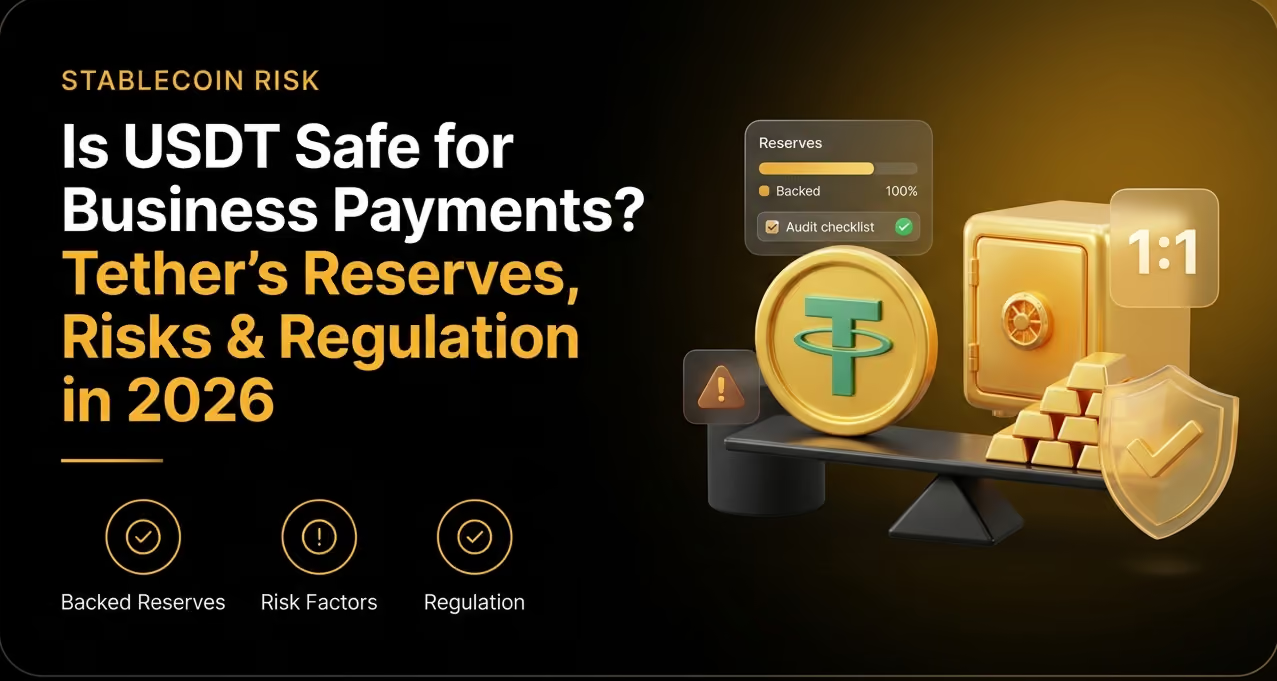
Is USDT Safe for Business Payments? Tether's Reserves, Risks & Regulation in 2026
If your business is about to move real money through USDT, "is USDT safe?" is the right question to ask first. Tether is the largest stablecoin in the world — roughly $188 billion in circulation and ~59% of the entire stablecoin market as of mid-2026 — but scale and safety aren't the same thing.
If your business is about to move real money through USDT, "is USDT safe?" is the right question to ask first. Tether is the largest stablecoin in the world — roughly $188 billion in circulation and ~59% of the entire stablecoin market as of mid-2026 — but scale and safety aren't the same thing.
This is a balanced look at what actually backs USDT, where the real risks sit, and how those risks apply specifically to a company using Tether for payouts rather than trading.
What USDT is — and what "safe" means here
USDT (Tether) is a stablecoin designed to hold a 1:1 peg to the US dollar. Each token is meant to be redeemable for one dollar, backed by reserves Tether holds. For a business, "safe" breaks into three practical questions:
- Peg risk — will 1 USDT still be worth ~$1 when my recipient cashes out?
- Counterparty risk — is the issuer solvent and are the reserves real?
- Operational and regulatory risk — can I legally and reliably use it where I operate?
Let's take them in order.
Peg stability: strong, with rare wobbles
In normal conditions, USDT trades within a fraction of a cent of $1. Its depth of liquidity is unmatched — it's the most traded crypto asset on earth, which makes the peg resilient.
It is not immune, though. During acute market stress (the 2022 Terra/UST collapse, the 2023 US regional-bank episode) USDT briefly de-pegged by a few percent before recovering. For a payout business, the takeaway is not "avoid USDT" but "don't sit on large idle balances." If you convert at payout time rather than warehousing Tether, short-lived wobbles rarely reach the recipient.
Reserves: what backs USDT in 2026
This is where scrutiny has historically been sharpest, and where transparency has improved.
Per Tether's Q1 2026 attestation (BDO Italia), the company reported roughly $191.8 billion in total assets against its liabilities, with a reserve mix heavily weighted toward liquid, low-risk holdings:
- ~$135 billion in US Treasuries — the bulk of reserves in the most liquid safe asset there is.
- ~$13 billion in gold, plus Bitcoin and other holdings.
- Reported net equity of around $8 billion, a buffer above the tokens in circulation.
Two honest caveats remain:
- Tether publishes attestations, not a full audit by a Big Four firm. An attestation confirms balances at a point in time; it's less rigorous than a continuous audit. Critics have pushed Tether on this for years.
- A minority of reserves has historically included assets beyond cash and Treasuries. The direction of travel is toward higher-quality, more liquid reserves, but it's worth knowing what you hold.
For most businesses, a reserve base dominated by US Treasuries is reassuring. The transparency gap versus a fully audited competitor is real but narrowing.
Regulatory risk: the biggest practical issue for EU businesses
Here's the risk that most directly affects where and how you can use USDT: Tether did not seek authorization under the EU's MiCA regulation.
The consequences are concrete. Through late 2024 and 2025, MiCA-regulated exchanges removed USDT for customers in the European Economic Area — Coinbase, Crypto.com, Binance (EEA) and others delisted or restricted it — because offering a non-authorized stablecoin put their own licenses at risk. USDT trading volumes on EU venues fell sharply, while MiCA-compliant alternatives like USDC and EURC gained share.
USDT is not banned to hold, but its regulated on/off-ramp availability in the EU has narrowed. Tether has instead pursued a US federal path (under the GENIUS Act) via a US-domiciled entity. If your recipients or your business are EU-based, this matters: a MiCA-compliant stablecoin may be the more durable choice for European corridors. (See "Is USDC regulated?" and our USDT vs USDC comparison.)
Operational risk: irreversibility and wrong-network errors
Independent of Tether the company, USDT carries the operational risks of any on-chain asset:
- Irreversibility. A payout sent to a wrong or wrong-network address is typically gone.
- Network fragmentation. USDT on Tron, Ethereum, Solana and others isn't interchangeable at the address level.
- Compliance exposure. Paying a sanctioned or high-risk wallet is a legal problem, not just a technical one.
These are managed with address validation, test transfers, and — at volume — KYT and sanctions screening built into your payout flow.
So, is USDT safe for business payouts?
A fair summary:
- Peg: Strong in normal conditions; convert at payout time to avoid stress-window exposure.
- Reserves: Large and Treasury-heavy, but attested rather than fully audited.
- Regulation: The real watch-item — limited MiCA standing constrains EU usage.
- Operations: Safe when you use validation, screening, and disciplined records.
For high-volume global payouts, USDT remains the most liquid and widely accepted stablecoin. The smart posture is to use it deliberately: don't warehouse it, screen your recipients, keep clean fiat records, and choose a MiCA-compliant asset where European regulation demands it.
Frequently asked questions
Is USDT backed by real dollars? USDT is backed by reserves that, per Tether's 2026 attestations, are dominated by US Treasuries plus cash equivalents, gold, and other assets. These are confirmed by attestation rather than a full independent audit.
Can USDT lose its peg? It can briefly deviate during extreme market stress, as it has a few times historically, but it has recovered each time. Deep liquidity supports the peg in normal conditions.
Is USDT legal in the EU? Holding USDT is not illegal, but Tether is not MiCA-authorized, and many EU-regulated exchanges have delisted it for EEA users. For EU corridors, a MiCA-compliant stablecoin is often more practical.
Is USDT safe enough for payroll and affiliate payouts? For most businesses, yes — provided you convert near payout time, screen recipients, and keep proper records. The controls matter as much as the asset.
Use USDT with the controls built in
The safest way to use USDT for business isn't to trust a single wallet — it's to run payouts through infrastructure that screens recipients, validates networks, and reports in fiat. That's how INXY's mass USDT payouts are designed: fund in EUR or USD, pay out globally, and keep audit-ready records — without warehousing crypto risk.
This article is general information, not financial or legal advice. Evaluate stablecoin exposure against your own jurisdiction and risk policy.
The Travel Rule for Crypto Payouts: What B2B Senders Must Know in 2026
The Travel Rule requires sender and recipient identity data to accompany crypto transfers, and in 2026 it directly affects any business paying contractors, suppliers, or partners in crypto. This guide breaks down the regulatory picture by region — the EU's no-threshold TFR, the US $3,000 BSA rule plus new GENIUS Act stablecoin obligations, and FATF's $1,000 baseline — and the exact originator/beneficiary data each payout must carry, including the extra step for self-hosted wallets. It then shows how a regulated crypto gateway runs pre-send screening, KYT/AML checks, and the Travel Rule inside the payout flow, so B2B senders stay compliant without building their own compliance stack.
If your business sends crypto payouts — to contractors, suppliers, affiliates, or partners — the crypto Travel Rule now sits between you and every transfer. It is the single piece of kyc aml crypto payments regulation most likely to delay, freeze, or return a B2B payout in 2026, and most senders only learn about it after a payment is held. This guide explains what the Travel Rule is, how the 2026 rules differ by region, what data must accompany each payout, and how a regulated crypto gateway runs the checks so you don't have to build a compliance stack yourself.
What the crypto Travel Rule is (and why it now applies to your payouts)
The Travel Rule is an anti-money-laundering standard that requires identifying information about the sender (originator) and recipient (beneficiary) to "travel" alongside a transfer of value. It originated in traditional banking and now applies to crypto.
FATF Recommendation 16, extended to crypto
The rule comes from the Financial Action Task Force (FATF), whose Recommendation 16 was extended in 2019 to cover virtual assets. The principle is simple: when a regulated provider moves crypto on a customer's behalf, it must collect, transmit, and retain originator and beneficiary details so that law enforcement can trace funds. FATF recommendations are influential but not law in themselves — each jurisdiction decides how to implement them, which is why the picture is fragmented (more on that below).
Who counts as a VASP — and when you are the originator
The obligation falls on Virtual Asset Service Providers (VASPs): exchanges, custodial wallet providers, and crypto payment gateways. When your business initiates a payout through such a provider, the provider is the "originating institution" and carries the Travel Rule duty — but it can only meet that duty with your data. In practice this means the gateway must know who you are paying and why, and you must be able to supply recipient details on demand. The compliance burden is shared: the provider operates the machinery, but incomplete sender data is the most common reason a payout stalls.
The 2026 regulatory picture: crypto compliance and regulations by region
By 2026, over 50 jurisdictions have enacted Travel Rule legislation — roughly 73% of FATF-assessed jurisdictions, up from a far smaller base two years earlier. Enforcement maturity, thresholds, and required data still vary widely, so a payout that is routine in one corridor can be blocked in another.
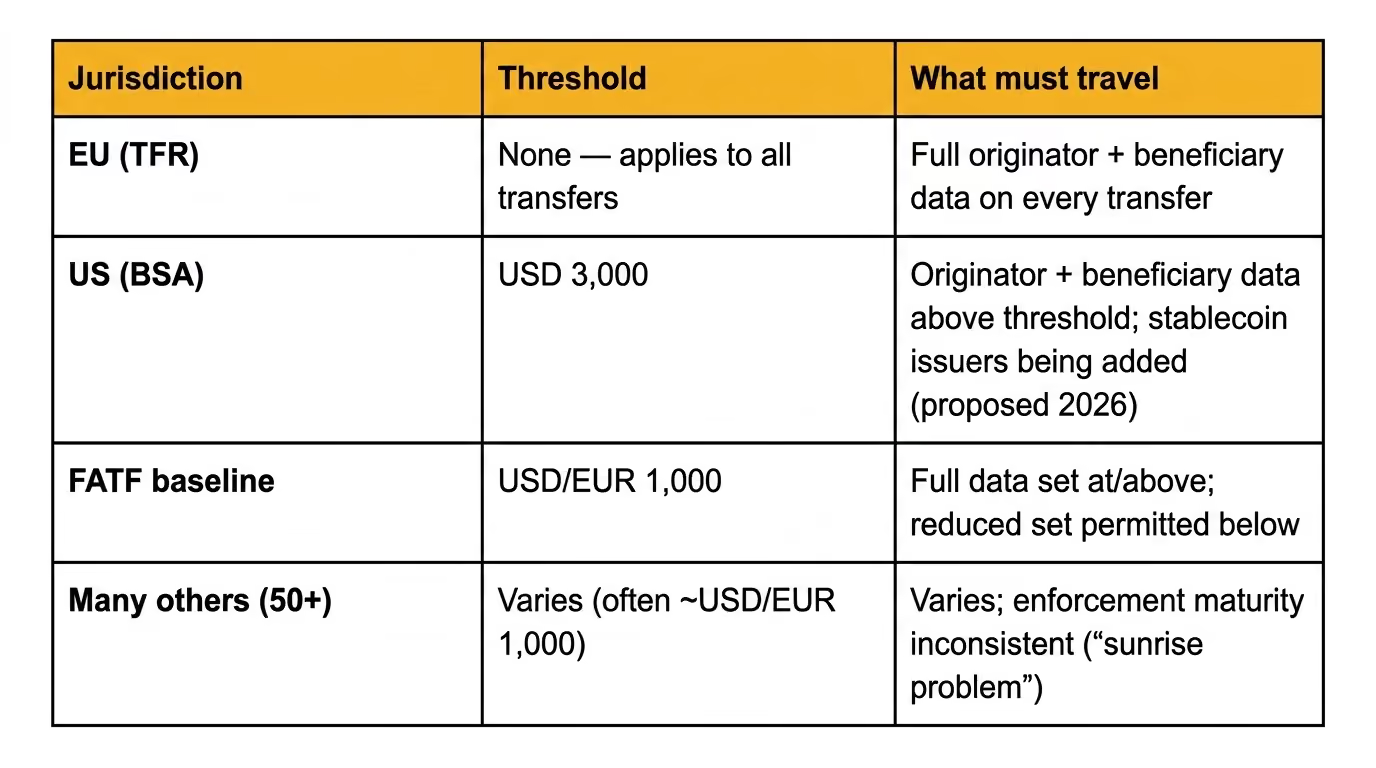
EU — Transfer of Funds Regulation (TFR), no de-minimis threshold
The EU's recast Transfer of Funds Regulation (TFR) took effect on 30 December 2024. It is the strictest major regime: full originator and beneficiary data must accompany every crypto-asset transfer handled by a regulated provider, with no minimum threshold. A €5 payout and a €500,000 payout carry the same data obligation. The TFR operates alongside MiCA, the EU's broader crypto-asset framework, which governs licensing of providers.
US — Bank Secrecy Act Travel Rule, USD 3,000 threshold
In the United States the Travel Rule lives under the Bank Secrecy Act (BSA), administered by FinCEN, with a threshold of USD 3,000 — notably higher than FATF's recommendation. A 2026 development matters for stablecoin senders: following the GENIUS Act (signed July 2025), the U.S. Treasury proposed a rule on 8 April 2026 treating permitted stablecoin issuers as BSA financial institutions, subject to AML programs, recordkeeping, and the Travel Rule, with compliance expected around April 2027. The direction of travel is clear — stablecoin rails are being pulled fully into the same compliance perimeter as the banking system.
FATF global threshold and the "sunrise problem"
FATF recommends a standard threshold of USD/EUR 1,000, below which a reduced data set may apply. Because jurisdictions adopt the rule at different speeds, the industry faces the "sunrise problem": a compliant provider in a regulated market may need to send Travel Rule data to a counterparty in a market that has not yet implemented the rule and cannot receive it. For B2B senders this means a payout's success can depend on the recipient platform's jurisdiction, not just your own.
What data must "travel" with a B2B crypto payout
The required data set is consistent across regimes, even where thresholds differ.
Required originator (sender) fields
- Name of the originator (your business or the paying entity).
- Wallet address used for the transfer (or a transaction reference).
- Physical/registered address, and in some regimes an official identifier or account number.
Required beneficiary (recipient) fields
- Name of the recipient.
- Wallet address receiving the funds.
In addition, the transaction amount, execution date, and a unique transaction identifier are recorded with every transfer. For your operations, the practical takeaway is that recipient name + wallet must be accurate and verifiable before you send — a mismatch is a hold.
Self-hosted (unhosted) wallet payouts — the extra step
Paying out to a self-hosted (non-custodial) wallet — common when paying contractors or partners who hold their own keys — changes the mechanics. There is no counterparty VASP to receive the Travel Rule message, so the data isn't transmitted onward; instead, your provider must still collect originator and beneficiary information from you, and above the relevant threshold may require verification of wallet ownership based on a risk assessment. Expect to attest that the recipient controls the destination address for larger payouts.
How a regulated crypto gateway runs the Travel Rule on outbound payouts
This is where a regulated crypto gateway earns its keep. Rather than connecting to Travel Rule messaging protocols, screening providers, and sanctions lists yourself, the gateway runs the controls inside the payout flow. Using INXY's outbound model as a concrete example, an outgoing payout passes through several gates before any transfer is created.
Pre-send checks — address risk and blacklist screening
A payout starts as a withdrawal request, not an immediate send. A pre-send validation stage runs first and can stop the operation with an error so that no transaction is ever formed. As part of this, the recipient address is looked up against historical risk data: a previously unseen address is treated cautiously, while a known address carries its last risk result. This means a problematic payout is caught at draft stage, not after funds have left.
KYT/AML screening of the recipient
Next is the outbound KYT (Know Your Transaction) sequence. The recipient address is checked against a blacklist; a match fails the request outright with no transaction created. If it clears, a risk provider screens the address and returns an outcome:
- Low or Medium → the payout draft passes and proceeds.
- High → the request fails, no transaction is created, and an error is returned.
This is the kyc aml crypto payments layer working in real time on the money leaving your account.
The Travel Rule message exchange
Only after screening passes does the Travel Rule step run, packaging and exchanging the required originator/beneficiary information with the counterparty provider where one exists. The payout then proceeds to settlement. The sequence matters: screen first, transmit data, then send.
Approved contacts and recipient allow-lists
Gateways typically maintain a contact list of approved recipients. A recipient flagged as declined blocks the payout regardless of other checks — a useful control for finance teams that want a vetted, reusable set of payees for recurring or mass payouts.

KYB is the gate to the platform; KYT is the gate to each transaction; the Travel Rule is the data that rides along with it. A gateway that handles all three is what "secure crypto payments" actually means in operational terms.
Compliance risks of getting payouts wrong
For a B2B sender, Travel Rule failures are not abstract — they hit cash flow and counterparties directly:
- Held or returned transfers. Missing or mismatched recipient data is the most common cause of a stalled payout. Funds can sit in review or be returned, delaying contractor and supplier payments.
- Counterparty refusal. If the receiving platform can't accept Travel Rule data (the sunrise problem) or flags your transfer, it may bounce the payment.
- Regulatory exposure. Operating outbound flows without proper screening and recordkeeping exposes the business to AML penalties — increasingly so as stablecoin issuers are folded into BSA-style obligations.
- Operational drag. Building and maintaining screening, sanctions, and Travel Rule messaging in-house is expensive and never "done," because rules and thresholds keep shifting.
How to automate crypto payouts without owning the compliance stack
The practical answer for most B2B senders is to run payouts through a regulated crypto gateway that treats the Travel Rule, KYT, and sanctions screening as part of the payout itself — not as something you bolt on.
With INXY, every outbound payout passes through pre-send validation, blacklist and KYT risk screening, and the Travel Rule step before settlement, and recurring payees can be managed through an approved contact list. Because the same flow is exposed via API and webhooks, you can run mass payouts — paying hundreds of contractors or partners at once — with compliance checks applied per recipient automatically, and receive status events back into your own systems. That is what "how to automate crypto payouts" looks like when compliance is built in rather than improvised.
If compliance posture is your priority, start with INXY's security & compliance capabilities; if payout mechanics are the focus, see crypto payouts and the cross-border and payroll options that build on the same rails.
FAQ
Does the Travel Rule apply to stablecoin payouts? Yes. Stablecoin transfers handled by a regulated provider are subject to the Travel Rule like any other virtual asset. In the EU, full data is required regardless of amount; in the US, stablecoin issuers are being brought explicitly into BSA Travel Rule obligations under a rule proposed in April 2026.
What is the Travel Rule threshold in 2026? It depends on the jurisdiction. FATF recommends USD/EUR 1,000; the US applies USD 3,000 under the BSA; the EU applies no threshold — every transfer carries full data.
Do I need to collect data for self-hosted (unhosted) wallet payouts? Yes. Even though there's no counterparty provider to receive the message, your gateway must still collect originator and beneficiary information, and above the relevant threshold may require proof that the recipient controls the destination wallet.
Is the Travel Rule the same as KYC? No. KYC/KYB verifies identity at onboarding. The Travel Rule governs the transmission of identity data alongside each transfer. They work together but are distinct obligations.
Who is responsible — the sender or the recipient platform? Both sides carry obligations. The originating provider must collect and transmit sender/recipient data; the beneficiary provider must receive and retain it. As the business initiating the payout, you're responsible for supplying accurate recipient information to your provider.

Annual vs. Monthly SaaS Billing: Why Upfront Crypto Payments Win on Cash Flow
For most SaaS companies, monthly billing is the unexamined default. It lowers the barrier to entry, so it feels like the safe choice. But for B2B and high-ticket software, that default quietly works against you: it spreads revenue thin, exposes every renewal to a payment failure, and hands a chunk of your SaaS billing and payments flow to card networks that were never built for recurring, cross-border charges.
For most SaaS companies, monthly billing is the unexamined default. It lowers the barrier to entry, so it feels like the safe choice. But for B2B and high-ticket software, that default quietly works against you: it spreads revenue thin, exposes every renewal to a payment failure, and hands a chunk of your SaaS billing and payments flow to card networks that were never built for recurring, cross-border charges.
There is a structurally better model for B2B: annual upfront billing settled in crypto. Paid in stablecoins, an annual plan lands the full year of revenue immediately, removes eleven future points of failure, and eliminates chargebacks entirely. This article makes the cash-flow and retention case for upfront annual billing, and shows how stablecoin payments make it easy to offer.
The Hidden Cost of Monthly Card Subscriptions
A monthly subscription is not one payment — it is twelve chances per customer, per year, for something to go wrong. Card-based SaaS payment processing carries failure rates that compound across a subscriber base:
- Involuntary churn — customers lost to failed payments rather than active cancellation — accounts for 20–40% of total churn, and up to 48% in higher-risk sectors.
- Left unmanaged, failed payments can quietly consume up to 9% of total revenue.
- Expired cards alone cause roughly 42% of failed subscription payments; the customer never chose to leave, the card simply lapsed.
- Cross-border recurring charges are frequently flagged or declined by issuing banks, and chargebacks on digital goods drain revenue plus dispute fees.
Each monthly cycle re-exposes you to all of this. Annual billing collapses twelve renewal events into one — shrinking the failure surface by an order of magnitude — and, just as importantly, pulls a full year of cash forward instead of metering it out month by month.
Why Annual Upfront Billing Changes the Math
Upfront annual plans are not just an accounting convenience; they change the unit economics of the business. The advantage is sharpest when the customer actually prefers to pay this way — and crypto buyers do.
- Cash flow now, not later. Collecting twelve months upfront strengthens working capital and reduces dependence on outside funding to finance growth.
- A smaller churn surface. One payment per year means one renewal decision per year — and far fewer involuntary drop-offs from card failures.
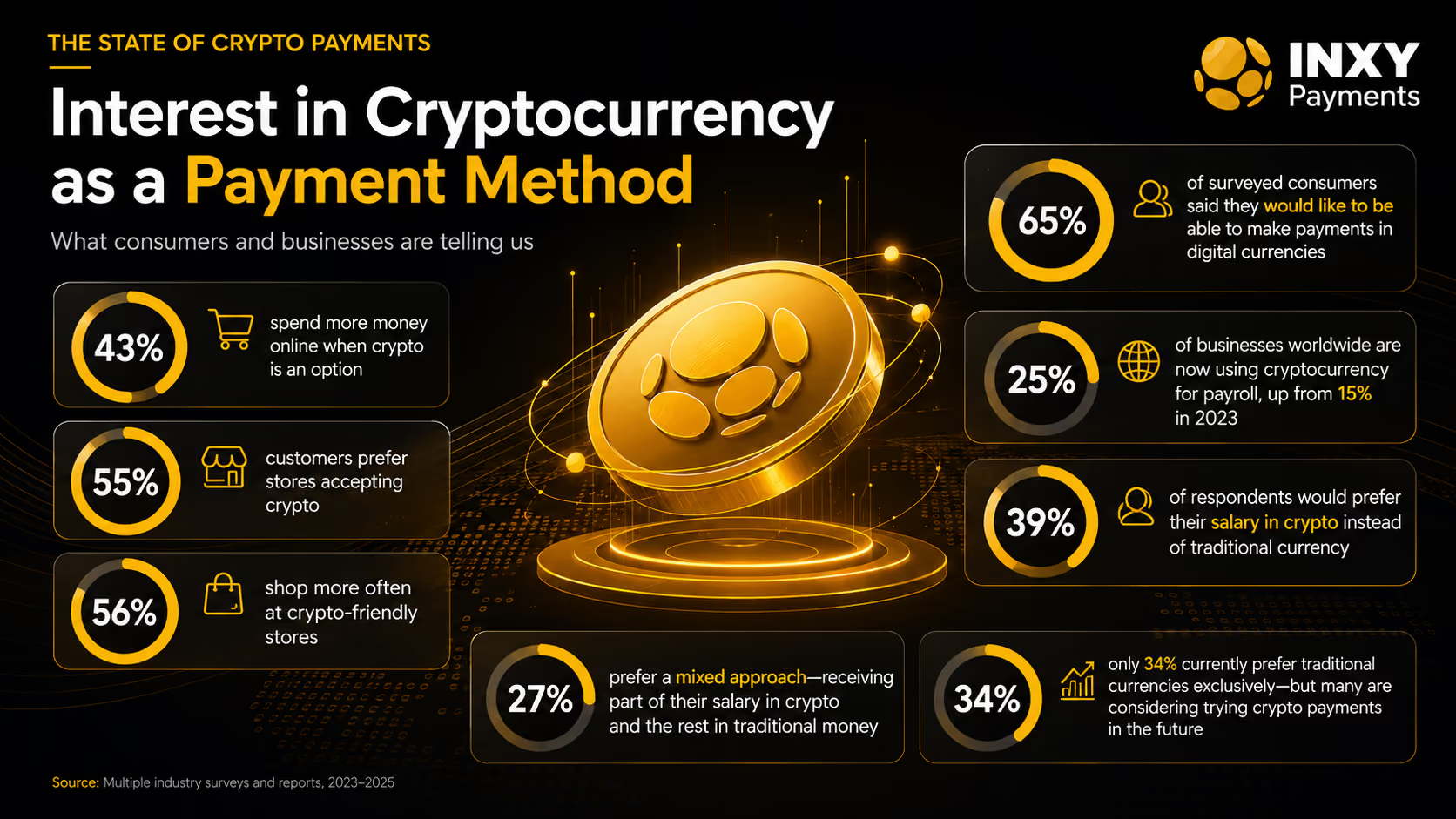
- Higher lifetime value. Industry data shows crypto buyers spend roughly 2x more than traditional users, and around 43% spend more simply because crypto is offered as an option.
- A buyer base that wants annual. About 60% of crypto users prefer to pay upfront for 12–36 month plans, versus only 20% of credit-card users — so offering crypto and annual pricing together is a natural fit.
With more than 824 million people globally owning crypto — over 10% of the world's population — the segment that prefers upfront, borderless payment is large and high-value, not niche.
Why Crypto Makes Annual Billing Easy to Sell
Blockchain payments are push-based and final — one confirmed transfer, no scheduled pulls. That property, which makes crypto awkward for monthly auto-billing, is exactly what you want for an annual upfront plan: a single, irreversible settlement that closes the deal.
Predictable Revenue Through Auto-Conversion
The usual objection — volatility — is solved at the gateway. When a client pays an annual license in a volatile asset, an auto-convert engine instantly settles it into stablecoins (USDT/USDC) or fiat (EUR/USD), so you book exact, predictable revenue. Stablecoins themselves are pegged 1:1 to the dollar, keeping SaaS payment management clean and auditable.
No Chargebacks, Global Reach, Instant Settlement
- Zero chargebacks. On-chain payments are irreversible, eliminating friendly fraud and dispute fees on digital goods.
- Borderless billing. A single settlement layer reaches customers who lack the international cards your checkout depends on, with no per-currency FX overhead.
- Minutes, not days. Stablecoin payments settle in minutes instead of the 3–5 business days an international wire takes to clear.
- Lower processing cost. Versus the typical 2.9% + $0.30 card fee plus cross-border markups, stablecoin transfers on networks like TRON (TRC-20) and Polygon cost a fraction of a percent.
How to Structure Annual Crypto Billing for Your SaaS
Adopting upfront annual crypto billing is a pricing-and-integration exercise, not a blockchain project:
- Lead with discounted annual pricing. Make the annual plan the headline option and price the upfront discount so the cash-flow gain outweighs it.
- Add crypto as a checkout option, not a replacement. Offer “Pay with Crypto” alongside fiat so you capture the high-LTV segment without disrupting existing customers.
- Default to stablecoins on low-fee networks. Present USDT and USDC on TRC-20 and Polygon to keep customer-side network fees negligible and value stable.
- Integrate via API or plugins, not smart contracts. Use a gateway's REST API or ready-made modules — including a native WHMCS module for hosting, cloud, and agency billing — to issue invoices and confirm payment automatically.
- Auto-convert and reconcile. Convert incoming payments to stablecoins or fiat at the point of sale, and use transaction hashes plus CSV exports so finance can match every annual payment to an account.
Compliance and Accounting
Choosing a regulated gateway keeps annual crypto billing inside the regulatory perimeter rather than outside it. The essentials are KYC/AML on counterparties, transaction monitoring, and jurisdiction-aware handling — for example the EU's MiCA framework, which favors transparent, fully-backed stablecoins like USDC. Because stablecoins are dollar-pegged and settlements can auto-convert to fiat, your revenue stays denominated in a unit your accountants already use, with detailed reporting and exports for clean books.
How INXY Supports Annual Crypto Billing for SaaS
INXY is a regulated, enterprise-grade crypto payment gateway engineered for B2B and SaaS billing. Rather than forcing crypto into a monthly auto-billing mold, it leans into what the rail does best — high-value, upfront settlement:
- Built for upfront cash flow. INXY deliberately bypasses standard auto-billing, making annual tariff plans the most profitable option for high-ticket B2B software — you receive the full yearly value immediately.
- Auto-Convert Engine. Incoming payments in volatile assets convert instantly to stablecoins or fiat, so a $1,000 or $10,000 annual license books as predictable revenue.
- Native SaaS integrations. Robust APIs and ready-made plugins, including a native WHMCS module tailored for hosting, cloud services, and digital agencies.
- Zero chargebacks and built-in mass payouts. Irreversible settlement protects revenue, while CSV- or API-driven payouts handle affiliate and contractor disbursements.
- A compliance-first stack. EU VASP (Poland), Canadian MSB, MiCA readiness, AML/KYT/KYC, and audit-friendly fiat reporting.
For a side-by-side look at how this compares with fiat processors, see Best Payment Gateways for SaaS in 2026. For platform-billing setups, INXY also documents accepting crypto payments on WHMCS.
FAQ
Does crypto support automatic monthly subscriptions?
Crypto payments are push-based, so they are not built for monthly card-style auto-charges. That is why the model that works best for B2B SaaS is annual upfront billing — a single, final payment that also improves cash flow.
How do we avoid volatility on a large annual payment?
A gateway with an auto-convert engine settles incoming crypto into stablecoins or fiat at the point of sale, so a five-figure annual license is booked at an exact, predictable value.
Will offering crypto cannibalize our fiat plans?
No — it is an additional checkout option. It tends to attract new, higher-LTV customers rather than shift existing ones, since a large share of crypto buyers are new to the merchant.
How hard is integration?
You connect a REST API or use ready-made plugins such as a native WHMCS module, rather than writing smart contracts. Most teams launch faster than opening a traditional merchant account.
Conclusion
Monthly card billing spreads SaaS revenue thin and re-exposes it to failed payments and chargebacks twelve times a year. Annual upfront billing — settled in crypto — flips that: a full year of cash collected now, one renewal decision instead of twelve, no chargebacks, and a high-LTV buyer base that prefers to pay this way. The rail's push-based finality is a feature here, not a limitation.
Ready to add upfront annual crypto billing to your checkout? See how INXY can power it at inxy.io.

The end of fiat friction: Why strategic merchants are switching to stablecoin payments
To accept crypto once meant exposure to price volatility. That is no longer the case. Stablecoins — pegged to the US Dollar or Euro — deliver the settlement efficiency of blockchain without the speculation. For C-level executives, the question is no longer whether to integrate digital assets, but how quickly legacy bottlenecks can be replaced with purpose-built infrastructure.
The legacy financial system imposes a structural tax on growth. For decades, merchants have absorbed correspondent banking fees, 3% interchange costs, and chargeback losses that erode margin on every transaction. In a global economy, waiting T+3 or T+5 for settlement is not an inconvenience — it is a liquidity problem.
To accept crypto once meant exposure to price volatility. That is no longer the case. Stablecoins — pegged to the US Dollar or Euro — deliver the settlement efficiency of blockchain without the speculation. For C-level executives, the question is no longer whether to integrate digital assets, but how quickly legacy bottlenecks can be replaced with purpose-built infrastructure.

1. Settlement velocity: From days to seconds
Traditional cross-border settlements move through a chain of intermediate banks, accumulating fees and losing transparency at every hop. SWIFT provides no real-time visibility into where funds are or when they will arrive.
Stablecoins operate on a 24/7/365 ledger with near-instant finality. Settling on Ethereum, Polygon, or TRON, merchants are no longer bound by banking hours or cut-off windows. Capital lands, clears, and is available for redeployment immediately — not in a pending queue.
inxy.io integrates directly into this settlement layer, giving merchants the operational continuity that traditional finance structurally cannot offer.
2. Eliminating the chargeback tax
Chargeback fraud costs merchants billions annually. Credit card networks are centralised by design, which means any transaction can be reversed — often at the merchant's expense, with little recourse.
Blockchain transactions are push-based and immutable. When a business chooses to accept crypto in the form of stablecoins, payment finality is guaranteed by the protocol, not by a bank's dispute resolution team.
- No chargebacks: Once confirmed on-chain, a transaction cannot be reversed by a third party.
- Reduced fraud overhead: No need for aggressive fraud filters that block legitimate customers.
- Revenue sovereignty: You control your income stream without intermediary intervention.
3. Technical infrastructure: Beyond the hype
A payment gateway needs to be a piece of production-grade fintech infrastructure, not just a wallet interface. High-volume merchants require an API that abstracts blockchain complexity without sacrificing control.
What inxy.io provides:
- 1. No crypto management overhead: Merchants do not handle tokens or gas fees. That layer is abstracted entirely.
- 2. Volatility protection: Pay-ins convert to stablecoins or fiat instantly, locking in value at the moment of transaction.
- 3. Multi-chain support: USDT, USDC, DAI, EURC, TON, BTC, ETH, LTC, TRX, BNB, DOGE across ERC-20, TRC-20, Polygon, and BSC — customers transact on the network that works best for them.
- 4. Real-time webhooks: Instant payment status notifications to your backend, enabling automated fulfilment or shipping triggers without polling.
- 5. Compliance stack: EU VASP (Poland), Canadian MSB, MiCA-ready, AML/KYT/KYC, sanctions screening via Elliptic and Sumsub, Big-4-friendly fiat reporting.

4. Drastic reduction in operational costs
Managing global payments typically means maintaining multiple local currency accounts and navigating FX spreads on every cross-border transfer. Stablecoins provide a single settlement layer that works across jurisdictions without currency conversion overhead.
Consolidating payment rails through inxy.io can reduce payment processing Opex by up to 80%. Instead of paying a chain of intermediaries for the movement of value, you pay for efficient infrastructure. That margin stays in the business.
FAQ: Navigating the stablecoin shift
Is it difficult to integrate a stablecoin gateway into an existing platform?
No. inxy.io integrates via a REST API or pre-built plugins for major e-commerce engines. Documentation and technical support are included, and most teams go live faster than a standard merchant bank account setup.
How do we handle gas fee volatility?
inxy.io routes transactions through high-throughput networks to keep fees minimal. Customers can select the most cost-effective network for their transaction — the infrastructure handles the routing logic.
How does accepting stablecoins affect our accounting?
USDT and USDC are pegged 1:1 to the dollar, which makes them materially simpler to account for than traditional cryptocurrencies. inxy.io provides detailed reporting and CSV exports compatible with standard accounting software and ERP systems.

What about regulatory compliance?
inxy.io is built with compliance as a core component, not an afterthought — EU VASP registration, MiCA readiness, AML/KYT screening, and Big-4-auditable reporting. Your business stays within the regulatory framework while operating at full velocity.
Scalability Without Compromise
The merchant of 2026 cannot run on 1970s banking rails. The competitive advantage belongs to businesses that eliminate payment friction and capture the full value of their transactions across borders.
inxy.io is the infrastructure layer for that transition — robust APIs, multi-chain settlement, and a compliance stack built for global scale.
Partner with INXY — secure your payment infrastructure and lead the market.

Best Payment Gateways for SaaS in 2026: From Traditional Fiat to Web3
Stop letting legacy payment bottlenecks kill your SaaS growth. 🚀 In 2026, relying solely on traditional credit card processing is a risk to your cash flow. High fees and chargebacks are outdated. Our latest guide breaks down the best payment gateways for B2B SaaS—from the reliability of Stripe to the borderless power of INXY Paygate. Inside this guide: Why crypto users have a 2x higher LTV and prefer annual plans. How the Auto-Convert Engine eliminates volatility risks for CFOs. The secret to Zero Chargebacks and instant global settlements. Future-proof your billing stack and tap into a global market of 800M+ digital asset users. Read more at INXY.io.
When closing high-ticket B2B SaaS deals or enterprise annual plans, traditional credit card processing often becomes a bottleneck rather than a solution. High cross-border fees and unexpected fund holds can paralyze your cash flow. In 2026, relying solely on legacy fiat processors is a risk. Your billing infrastructure needs to be as borderless and scalable as your software.
As we move deeper into 2026, SaaS billing has fundamentally evolved. While traditional fiat processors remain standard, the explosive demand for borderless, low-fee digital transactions makes cryptocurrency and stablecoin gateways a mandatory addition to any modern B2B tech stack. This guide breaks down the best payment gateways for SaaS businesses, comparing legacy providers with next-generation Web3 infrastructure to help you optimize your upfront revenue.
Key Features to Look for in a SaaS Payment Gateway
Before diving into the top providers, it is essential to define what makes a payment gateway effective for a SaaS and annual licensing model:
- Global Reach & Multi-Currency: Support for international clients without exorbitant cross-border foreign exchange (FX) fees.
- API & Native Integrations: Developer-friendly REST APIs and plugins for standard platforms (like WooCommerce, Shopify, or WHMCS).
- Chargeback Protection: Mechanisms to protect your business from fraudulent chargebacks that persistently plague the digital goods industry.
- Mass Payout Capabilities: Built-in tools to easily distribute affiliate commissions or international contractor payouts.
The Top Payment Gateways for SaaS in 2026
1. Stripe: The Traditional Fiat Giant
Stripe remains a dominant force in the SaaS ecosystem. Its robust API, advanced invoicing tools, and seamless checkout flows make it a default choice for many domestic startups.
- Pros: Incredible developer tools, widespread consumer trust, and deep analytics.
- Cons: High cross-border transaction fees and persistent vulnerability to chargeback fraud.
2. PayPal / Braintree: The Consumer Favorite
Braintree (owned by PayPal) offers extensive global brand recognition. It is an excellent choice for B2C software products looking for high conversion rates at checkout from everyday consumers.
- Pros: High consumer trust, easy integration, supports Venmo and Apple Pay.
- Cons: Strict compliance algorithms that can freeze funds without warning, high processing fees for international clients.

3. INXY Paygate: The Premier Web2 to Web3 Bridge
For modern SaaS companies, relying solely on traditional banking is a massive bottleneck. Enter INXY, a regulated, VC-backed cryptocurrency payment gateway that recently secured $3M from Flashpoint VC. INXY is specifically engineered for B2B enterprises and SaaS platforms looking to accept global payments without the friction of legacy banks. INXY acts as a seamless bridge, allowing you to offer a "Pay with Crypto" option while completely eliminating the technical risks normally associated with digital assets.
Boost Your Annual Payments: INXY Paygate strategically bypasses standard auto-billing. This is a massive advantage designed to boost your upfront cash flow. When dealing with high-ticket B2B software and large sums, utilizing stablecoins makes annual tariff plans the absolute most profitable option for both your business and your clients. You get the full yearly value immediately without the risk of monthly drop-offs.
- The Auto-Convert Engine: The biggest fear for SaaS CFOs is crypto volatility. With INXY, if a client pays a $1,000 or $10,000 annual software license in Ethereum, the gateway's Auto-Convert feature instantly converts the incoming volatile asset into stablecoins (USDT/USDC) or fiat (EUR/USD). You get exact, predictable revenue.
- Native SaaS Integrations: Instead of writing complex smart contracts, SaaS companies can use INXY’s robust APIs or ready-made plugins, including a native WHMCS module perfectly tailored for hosting, cloud services, and digital agencies.
- Zero Chargebacks: Blockchain transactions are irreversible, meaning your business is completely protected from friendly fraud.
- Built-in Mass Payouts: If you rely on an affiliate network, INXY allows you to automate global mass payouts via CSV uploads or API.
Feature Comparison Matrix
Choosing the right platform depends entirely on your target audience. Here is a high-level comparison of how these gateways stack up:

Why SaaS Businesses Are Adopting Crypto Invoicing
The shift toward stablecoin billing is not a temporary trend; it is a fundamental upgrade to global financial infrastructure. With over 824 million people globally owning crypto—representing more than 10% of the world's population—this is a massive, highly lucrative demographic ready to spend.
By integrating a Web3 gateway alongside your traditional fiat processors, you unlock several strategic advantages:
- Massive Upfront Cash Flow: 60% of crypto users prefer to pay upfront for 12–36 month plans, compared to only 20% of credit card users.
- Higher Spend & Unmatched LTV: Crypto buyers spend 2x more than traditional users. In fact, 43% of users spend more simply because crypto is offered as an option. Clients who pay in crypto consistently become the highest Lifetime Value (LTV) users—paying more and staying longer.
- New Customer Acquisition: 40% of crypto clients are entirely new to the merchant, and 56% of users actively choose to shop more frequently at crypto-friendly businesses.
- Lower Transaction Costs: Traditional gateways charge 2.9% + $0.30 per transaction, plus heavy cross-border fees. Crypto payments settle for fractions of a percent, saving high-volume companies thousands of dollars on annual contracts.
- Instant Global Settlement: Instead of waiting 3 to 5 business days for an international wire transfer to clear, stablecoin payments settle in minutes.

Conclusion: Future-Proof Your SaaS Billing
In an increasingly borderless digital economy, restricting your customers to legacy credit card processing is a critical mistake. While platforms like Stripe and Braintree excel in their respective domestic markets, the future of global SaaS billing relies on secure, instant, and borderless transactions.
By implementing a specialized gateway, you can bypass the traditional hurdles of international finance. You gain the ability to tap into a high-spending demographic, automate your affiliate mass payouts, and completely eliminate chargeback fraud—all while receiving predictable, auto-converted fiat or stablecoin settlements. It is time to expand your checkout options and embrace the next generation of digital payments.

How to Integrate a Crypto Payment API: A Developer’s Guide for 2026
Integrating crypto payments is no longer just about generating a wallet address—it’s about building a robust, scalable financial pipeline. In this 2026 Developer’s Guide, we strip away the complexity of blockchain interactions and provide a clear roadmap for API integration.
How to Integrate a Crypto Payment API: A Developer’s Guide for 2026
In the fast-moving world of fintech, the question is no longer if a business should accept cryptocurrency, but how seamlessly it can be integrated. As we move through 2026, the European market has reached a point of high maturity. With the full enforcement of MiCA (Markets in Crypto-Assets) regulations, crypto payments have transitioned from a niche experiment to a standardized financial tool for EU-based enterprises.
For developers and product managers, integrating a crypto payment API is now as streamlined as traditional fiat gateways, provided you follow the right architectural patterns.
1. Understanding the 2026 Integration Workflow
Modern crypto integration follows a predictable RESTful pattern. Unlike the early days of manual wallet monitoring, today’s gateways handle the blockchain's complexity, allowing your backend to interact with simple JSON payloads.
The standard lifecycle of a crypto payment includes:
- Initialization: Your server requests a unique payment address for a specific order.
- Monitoring: The gateway monitors the blockchain (Bitcoin, Ethereum, Tron, etc.) for incoming transactions.
- Confirmation: The gateway verifies the transaction depth (number of block confirmations).
- Webhook Notification: Your system receives an asynchronous callback to update the order status.

2. Step-by-Step API Integration
Phase A: Environment Setup
Before hitting production, high-quality gateways provide a Sandbox environment. This allows you to simulate successful payments, timeouts, and underpayments without risking real capital. You’ll typically need two headers for every request:
- X-API-KEY: Your unique identifier.
- X-PAY-SIGNATURE: A HMAC-SHA512 hash to ensure data integrity.
Phase B: Creating the Payment
To start a checkout, your backend sends a POST request to the /invoices or /payments endpoint.
JSON
{
"amount": 150.00,
"currency": "EUR",
"order_id": "ORDER-9921",
"callback_url": "https://yourstore.com/api/webhooks/crypto"
}
The gateway responds with a destination address and a QR code URL. In 2026, the best UX practice is to offer "Invisible Crypto"—where the user sees a familiar interface, and the gateway handles the real-time conversion behind the scenes.
Phase C: Handling the Webhook
This is the most critical part of the integration. Since blockchain transactions are asynchronous, your server must be ready to receive a POST callback.
Pro Tip: Always verify the webhook signature. Never update an order status based solely on the incoming payload without checking that the request actually originated from your provider.
3. Security and Compliance in the EU
In the 2026 fintech landscape, security isn't just about encryption; it's about regulatory alignment. Within the EU, businesses must ensure their payment partner adheres to Transfer of Funds Regulation (TFR) and AML (Anti-Money Laundering) standards.
When choosing a provider, look for features like:
- Auto-Conversion: Instantly swapping volatile assets into stablecoins or EUR to protect your margins.
- Audit-Ready Reporting: Financial statements that your accounting team can actually use for VAT and tax filings.
This is where specialized gateways like INXY (inxy.io) excel. Built specifically for the EU market, INXY acts as a regulated bridge. It doesn't just provide an API; it provides a compliant infrastructure that allows Web2 companies to scale into Web3 without the headache of managing private keys or worrying about crypto volatility. By integrating a solution like INXY, businesses can reduce processing fees by up to 70% compared to traditional card networks, while benefiting from instant SEPA settlements.

4. Testing and Optimization
Before going live, run "Chaos Tests" on your integration. What happens if a user sends too little? What if they pay after the 20-minute price-lock window? A robust API should provide clear error codes for these scenarios, allowing your frontend to guide the user toward a resolution—such as a partial refund or a top-up payment.
Conclusion
Integrating a crypto payment API in 2026 is a strategic move that opens your business to a global, tech-savvy audience. By utilizing professional gateways that handle the heavy lifting of compliance and conversion, your team can focus on what matters: the product.
Ready to modernize your payment stack? Would you like me to draft a technical checklist for your dev team to use during the INXY sandbox testing phase?

Crypto Withdrawals 2026: Fastest Exchanges
Crypto withdrawals in 2026 are faster, safer, and more user-friendly than ever, driven by instant fiat off-ramps, low commission fees, and reliable customer support. This article explores how modern exchanges, stablecoins, and regulatory standards are shaping seamless withdrawal experiences for users worldwide.
The Evolution of Crypto Withdrawals
Crypto withdrawals have come a long way in a few years. In the early days, you might have waited hours or even days to move your crypto from an exchange to your wallet. The process often felt like watching paint dry, with delays due to network congestion and slow processing times.
Fast forward to today, and things have changed drastically. Exchanges have improved their systems, often offering near-instant withdrawals. This speed boost is thanks to advancements in blockchain technology and increased competition among exchanges. Everyone wants to offer the fastest service.
Let’s not forget the role of stablecoins like USDT and USDC. These digital currencies provide a stable value, making it easier to convert crypto to fiat. Users can quickly exchange cryptocurrency for stablecoins and then withdraw them to traditional bank accounts.
Regulatory licenses play a part, too. A licensed crypto exchange has better systems in place to ensure smooth transactions, giving users peace of mind. Plus, with customer support available 24/7, any hiccup can be resolved quickly, ensuring a seamless withdrawal process.
Finally, low commission fees have made it more attractive to withdraw funds frequently, encouraging more users to engage with the system. Crypto withdrawals today are faster, cheaper, and more reliable than ever before.
What to Look for in an Exchange
When choosing a crypto exchange, there are several key factors to consider. These can make your experience smoother and safer. Let's dive into what's important.
First, look for a regulatory license. This ensures the exchange follows rules and protects your funds. Exchanges with a license are generally more trustworthy and are less likely to face legal issues.
Next, consider customer support. Reliable exchanges offer 24/7 support. This is crucial if you need help at an odd hour or face an urgent issue. Quick assistance can save you time and stress.
Another factor is the variety of cryptocurrencies available. A good exchange offers many options, including popular stablecoins like USDT and USDC. This ensures you can trade or withdraw the currencies you need.
Low commission fees are also important. High fees can eat into your profits, so look for exchanges that offer competitive rates. This is especially vital if you trade frequently or make large withdrawals.
Withdrawal limits can vary widely between exchanges. Ensure the exchange you choose allows for the withdrawal amounts you require. Some exchanges might have low limits, which can be frustrating.
Finally, consider the user interface. A clear and easy-to-navigate platform can make trading and withdrawing much simpler. An intuitive design helps you avoid mistakes and saves you time.
Choosing the right exchange can make your crypto journey more enjoyable. By keeping these factors in mind, you can find an exchange that meets your needs and offers a smooth experience.

Top Exchanges for Fast Withdrawals in 2026
Finding the best exchanges for quick crypto withdrawals can save time and provide peace of mind. In 2026, a few standout platforms offer impressive speed and efficiency. Let's take a look at some of the top contenders.
One such exchange is Binance. Known for its robust features, it offers fast transaction speeds, making it a favorite among traders. With its low commission rates, users can withdraw crypto without breaking the bank. The exchange supports stablecoins like USDT and USDC, which are popular choices for those seeking stability.
Coinbase is another popular platform. It has a strong reputation for security and ease of use. The exchange provides a seamless withdrawal process, which is vital for those needing quick access to their funds. It's especially attractive to users who value customer support available 24/7.
Kraken also makes the list. It's well-regarded for its regulatory licenses and high trust level. The platform's withdrawal limits are flexible, catering to both casual users and high-volume traders. Kraken's user-friendly interface ensures that even beginners can manage their withdrawals with ease.
Each of these exchanges offers unique benefits, but all share a common goal: making crypto withdrawal as fast and straightforward as possible. By choosing the right platform, users can enjoy a smooth experience while managing their crypto assets.
Instant Fiat Off-Ramp Options
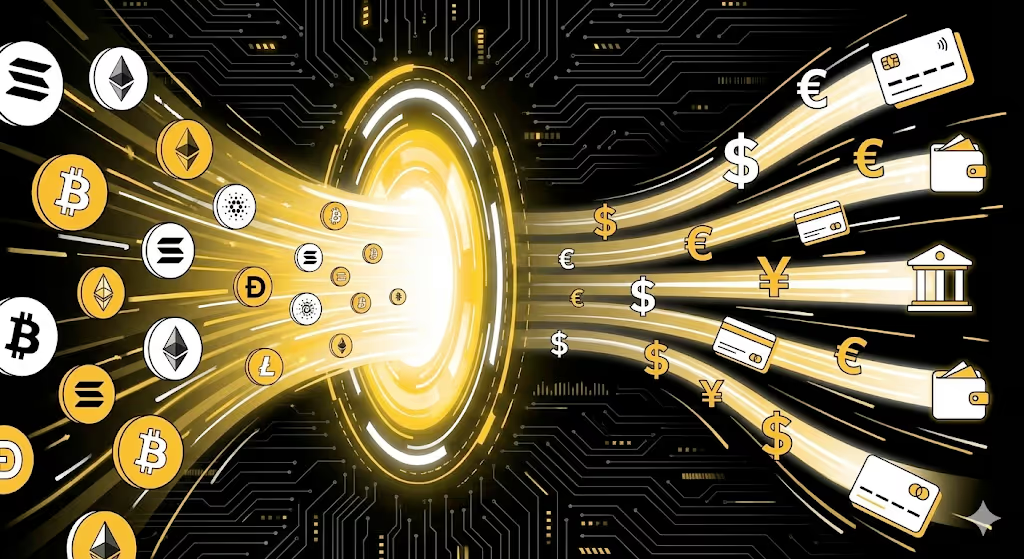
Navigating the crypto world can be tricky, especially when it comes to converting your digital coins into cash. This is where instant fiat off-ramp options come into play. These are services that let you switch your cryptocurrency to regular money like dollars or euros quickly and easily. Let’s break it down.
Imagine you've traded on a crypto exchange and now want your earnings in your bank account. Instant fiat off-ramps make this possible in a snap. They work by linking your crypto wallet to your bank account or card. Once connected, you can transfer funds swiftly and with minimal fuss.
Many exchanges offer this service, providing convenience for users. Some popular ones might include platforms that support stablecoins like USDT or USDC, known for their steady value. By using these stablecoins, you often enjoy lower fees and faster processing.
These off-ramps also come with various features. Some offer 24/7 customer support to help with any issues. Others have low commission rates, ensuring you keep more of your money. Keep an eye out for platforms with regulatory licenses for added security. This means they are approved by financial authorities and are safer to use.
In a nutshell, instant fiat off-ramps are a great option for those looking to access their money quickly. They simplify the process, making crypto withdrawals easier and faster than ever before.
Low Commission Fees Explained
Low commission fees are a key factor when choosing a crypto exchange for withdrawals. These fees are what the exchange charges you for using their service. They can vary widely between different platforms. Some exchanges might offer very low fees, while others could be more expensive.
When you withdraw your cryptocurrency, the commission fee is usually taken as a small percentage of the total amount you're moving. If you're new to this, think of it like a small toll you pay to use a road. The lower the toll, the cheaper your trip.
Let's take an example. Imagine you have 100 USDT and you want to withdraw it. If the exchange charges a 1% commission fee, you'd pay 1 USDT as the fee. This means you'd end up with 99 USDT after the withdrawal. In some cases, exchanges might have a fixed fee instead of a percentage.
It's important to check the fee structure before making a withdrawal. Some exchanges might look like they have low fees, but they could have hidden costs. Always read the fine print to avoid surprises. This way, you get to keep more of your money when withdrawing from your crypto exchange.
Stablecoins: A Safe Bet for Withdrawals
Stablecoins have become popular in recent years, especially for those looking to make crypto withdrawals. They provide stability in a market known for its wild swings. Unlike other cryptocurrencies, stablecoins are tied to a stable asset, like the US dollar. This link helps keep their value steady, making them a reliable option for users who want to avoid volatility.
There are many types of stablecoins, with USDT and USDC being among the most well-known. USDT, or Tether, is one of the first stablecoins and is widely used in exchanges. It's popular for its large market cap and liquidity. On the other hand, USDC is backed by actual US dollars held in reserve. This backing gives users confidence in its value, as it is regularly audited for transparency.
Using stablecoins for withdrawals can be a smart choice. Since they hold a stable value, you can withdraw your funds without worrying about losing money due to sudden price drops. Exchanges often support stablecoins, allowing easy conversion to fiat currency. This process is usually fast and can help users access their funds quickly.
Let me illustrate this with a simple example. If you have one Bitcoin and its value drops by $1,000 overnight, you lose $1,000 if you hold it. However, if you convert that Bitcoin to USDC before the drop, your value stays the same, protecting your investment. This security is why many users prefer stablecoins for withdrawals.
Stablecoins also often come with low transaction fees compared to other cryptocurrencies. This feature makes them appealing not just for withdrawals but for everyday transactions as well. They offer a cost-effective way to move money across borders, making them suitable for international users.
In the growing world of crypto exchanges, stablecoins provide an attractive solution for those looking to withdraw funds. Their stability, reliability, and low fees make them a go-to choice for many. As the crypto market evolves, stablecoins are likely to remain a key player in ensuring secure and efficient withdrawals.
Customer Support 24/7: Why It Matters
When you think about crypto exchanges, you might focus on fees or the variety of coins available. But there's another important aspect: customer support. Imagine trading in the middle of the night and facing a sudden problem. You don't want to wait for hours or even days to get help. That's where 24/7 customer support comes in.
Having access to assistance around the clock can make a big difference. Let's say you're trying to process a crypto withdrawal, but something goes wrong. Maybe the transaction is stuck, or you can't find your funds. With 24/7 support, you can get help immediately, no matter what time it is. This quick response can ease your stress and resolve issues faster.
Crypto trading doesn't follow a nine-to-five schedule. Markets are open 24 hours a day, seven days a week. So, it's only fair that support services match this availability. Whether you're in New York or Tokyo, or anywhere in between, having someone to turn to is crucial.
Now, you might wonder what makes good customer support. It's not just about being available. It's about having knowledgeable staff who understand crypto exchanges inside out. They should be able to guide you through complex processes, like how to exchange cryptocurrency or deal with withdrawal limits.
Good support teams also know how to help with regulatory license questions. This is important because crypto laws can vary widely between countries. You want someone who can explain these rules and help ensure you're compliant.
Then there's the matter of stablecoins like USDT and USDC. Sometimes, you might want to convert your crypto into these to avoid market volatility. If you're unsure how to do this, a good support team can walk you through it.
Lastly, let's talk about communication. A good support team will offer multiple contact methods. Whether you prefer email, chat, or phone, you should have options. This flexibility can make it easier to get the help you need.
In summary, 24/7 customer support is more than a convenience. It's a key part of a good crypto exchange experience. With it, you're not alone, no matter when you trade or where you are in the world. So, when choosing an exchange, consider how well they support their users. It might save you time and trouble later on.
FAQ
What are the key trends in crypto withdrawals in 2026?
In 2026, crypto withdrawals have evolved significantly with a focus on speed and convenience. Instant fiat off-ramps and low commission fees are prominent trends, driven by technological advancements and growing user demand for efficient transactions.
What factors should I consider when choosing a crypto exchange for withdrawals?
When selecting a crypto exchange, consider factors like withdrawal speed, limits, commission fees, security measures, and customer support availability. These elements can greatly impact your overall experience and costs.
Which exchanges are known for the fastest crypto withdrawals in 2026?
The top exchanges for fast withdrawals in 2026 include platforms that offer instant fiat off-ramps, low fees, and robust customer support. Specific names may vary, but look for exchanges with a reputation for speed and reliability.
Why are instant fiat off-ramps important for crypto withdrawals?
Instant fiat off-ramps allow users to quickly convert their crypto into fiat currency, enhancing the user experience by providing immediate access to funds. This feature is crucial for those who need fast liquidity.
How do low commission fees impact my crypto withdrawals?
Low commission fees reduce the overall cost of withdrawing crypto, making transactions more affordable. This is especially important for frequent traders or those dealing in large volumes, as it can lead to significant savings.
What role do stablecoins play in crypto withdrawals?
Stablecoins like USDT and USDC offer a stable value, making them a reliable option for quick and secure crypto withdrawals. They help mitigate volatility risks and facilitate smoother transactions.
Why is 24/7 customer support crucial for crypto exchanges?
24/7 customer support is vital as it ensures that users can resolve issues or get assistance at any time, enhancing trust and satisfaction. This can be particularly important during urgent transactions or when facing technical difficulties.
Pracujmy razem
Pomoc ekspertów w celu zapewnienia sukcesu weryfikacji biznesowej