The legacy financial system imposes a structural tax on growth. For decades, merchants have absorbed correspondent banking fees, 3% interchange costs, and chargeback losses that erode margin on every transaction. In a global economy, waiting T+3 or T+5 for settlement is not an inconvenience — it is a liquidity problem.
To accept crypto once meant exposure to price volatility. That is no longer the case. Stablecoins — pegged to the US Dollar or Euro — deliver the settlement efficiency of blockchain without the speculation. For C-level executives, the question is no longer whether to integrate digital assets, but how quickly legacy bottlenecks can be replaced with purpose-built infrastructure.
1. Settlement velocity: From days to seconds
Traditional cross-border settlements move through a chain of intermediate banks, accumulating fees and losing transparency at every hop. SWIFT provides no real-time visibility into where funds are or when they will arrive.
Stablecoins operate on a 24/7/365 ledger with near-instant finality. Settling on Ethereum, Polygon, or TRON, merchants are no longer bound by banking hours or cut-off windows. Capital lands, clears, and is available for redeployment immediately — not in a pending queue.
inxy.io integrates directly into this settlement layer, giving merchants the operational continuity that traditional finance structurally cannot offer.
2. Eliminating the chargeback tax
Chargeback fraud costs merchants billions annually. Credit card networks are centralised by design, which means any transaction can be reversed — often at the merchant's expense, with little recourse.
Blockchain transactions are push-based and immutable. When a business chooses to accept crypto in the form of stablecoins, payment finality is guaranteed by the protocol, not by a bank's dispute resolution team.
No chargebacks: Once confirmed on-chain, a transaction cannot be reversed by a third party.
Reduced fraud overhead: No need for aggressive fraud filters that block legitimate customers.
Revenue sovereignty: You control your income stream without intermediary intervention.
3. Technical infrastructure: Beyond the hype
A payment gateway needs to be a piece of production-grade fintech infrastructure, not just a wallet interface. High-volume merchants require an API that abstracts blockchain complexity without sacrificing control.
What inxy.io provides:
1. No crypto management overhead: Merchants do not handle tokens or gas fees. That layer is abstracted entirely.
2. Volatility protection: Pay-ins convert to stablecoins or fiat instantly, locking in value at the moment of transaction.
3. Multi-chain support: USDT, USDC, DAI, EURC, TON, BTC, ETH, LTC, TRX, BNB, DOGE across ERC-20, TRC-20, Polygon, and BSC — customers transact on the network that works best for them.
4. Real-time webhooks: Instant payment status notifications to your backend, enabling automated fulfilment or shipping triggers without polling.
5. Compliance stack: EU VASP (Poland), Canadian MSB, MiCA-ready, AML/KYT/KYC, sanctions screening via Elliptic and Sumsub, Big-4-friendly fiat reporting.
4. Drastic reduction in operational costs
Managing global payments typically means maintaining multiple local currency accounts and navigating FX spreads on every cross-border transfer. Stablecoins provide a single settlement layer that works across jurisdictions without currency conversion overhead.
Consolidating payment rails through inxy.io can reduce payment processing Opex by up to 80%. Instead of paying a chain of intermediaries for the movement of value, you pay for efficient infrastructure. That margin stays in the business.
FAQ: Navigating the stablecoin shift
Is it difficult to integrate a stablecoin gateway into an existing platform?
No. inxy.io integrates via a REST API or pre-built plugins for major e-commerce engines. Documentation and technical support are included, and most teams go live faster than a standard merchant bank account setup.
How do we handle gas fee volatility?
inxy.io routes transactions through high-throughput networks to keep fees minimal. Customers can select the most cost-effective network for their transaction — the infrastructure handles the routing logic.
How does accepting stablecoins affect our accounting?
USDT and USDC are pegged 1:1 to the dollar, which makes them materially simpler to account for than traditional cryptocurrencies. inxy.io provides detailed reporting and CSV exports compatible with standard accounting software and ERP systems.
What about regulatory compliance?
inxy.io is built with compliance as a core component, not an afterthought — EU VASP registration, MiCA readiness, AML/KYT screening, and Big-4-auditable reporting. Your business stays within the regulatory framework while operating at full velocity.
Scalability Without Compromise
The merchant of 2026 cannot run on 1970s banking rails. The competitive advantage belongs to businesses that eliminate payment friction and capture the full value of their transactions across borders.
inxy.io is the infrastructure layer for that transition — robust APIs, multi-chain settlement, and a compliance stack built for global scale.
Partner with INXY — secure your payment infrastructure and lead the market.
An INXY expert read on Finery Markets' "Stablecoin 2035: Back to the Future" report (H1 2026)
Finery Markets just published its "Stablecoin 2035" report, and the headline number is hard to ignore: stablecoins reached 81% of all institutional OTC trades in H1 2026, up from 26% in 2023. The debate about whether stablecoins have product-market fit is over. The interesting questions now are operational — and they land squarely on the businesses that move money for a living.
Here is how our team reads the data, and what it changes for anyone building on stablecoin rails.
The numbers that matter
OTC is the only growing segment. In H1 2026, OTC trading volumes grew +76% YoY, while the top-20 DEXs fell -38% and the top-20 CEXs -13%. Institutional flow is consolidating into OTC, and it is settling in stablecoins — stablecoin OTC volume nearly doubled (+94% YoY).
The dollar owns the rail. USD-pegged tokens accounted for 99.87% of OTC stablecoin volume. EUR stablecoins grew 32x year over year, but off a base so small it changes nothing structurally — yet.
The market is deep and diversifying. Total supply is now north of $300B (~$319B). Tether sits around $190B and USDC around $76B, but their combined share slipped from ~89% to ~83% as issuers multiplied from 30 in 2020 to 215+ in 2025.
Real assets are following. Tokenized U.S. Treasuries crossed $15B (+150% YoY); tokenized equities are near $1.5B (+400%). Roughly two-thirds of stablecoin supply is held in emerging markets — savings demand, not speculation.
Three signals for payment businesses
1. Payments and treasury — not trading — are the real entry point. The report's contributors converge on one idea: stablecoins become "ordinary" inside a company through the treasury and payments desk, not the trading floor. Cross-border corridors that took 2–5 business days now settle in minutes, with all-in costs compressing from 3–5% (correspondent banking) toward ~1%. For a payments provider, that is the pitch: released working capital and removed friction on flows that recur every single day.
2. The winning infrastructure is invisible. Multiple authors describe the same 2035 endpoint — the word "stablecoin" disappears from the enterprise vocabulary because the rails sit beneath familiar fintech interfaces. Users initiate value in stablecoins; merchants and counterparties receive local fiat without ever touching a wallet, chain, or bridge. The value isn't the token. It's the compliance-first connective layer that hides complexity while preserving speed and 24/7 availability.
3. "Regulated" is the moat. Across every contribution, the common thread is regulation. By 2035, regulated coins — dollar and local alike — are expected to hold the dominant share of supply and activity. Licensing, compliance translation across jurisdictions (MiCA, VARA, Singapore's PSA), and a single clean interface across a fragmented patchwork of currency regimes become the real competitive edge — not raw settlement speed.
The INXY takeaway
The report describes a world where money movement runs on stablecoin rails without the end user ever needing to know it. That is exactly the layer payment infrastructure providers should be building toward: regulated on/off-ramps, stablecoin-to-fiat settlement in the currencies clients actually need, and an interface that treats "any currency, any chain" as a non-issue.
The strategic mistake would be to read this as a race to launch yet another stablecoin. The report is explicit that by 2035, "the truly savvy stablecoin strategy may be not launching one at all." The durable advantage is not issuance — issuance is easy. It is liquidity, compliance, and distribution wired into the systems businesses already use.
For merchants, PSPs, and treasuries evaluating stablecoin payments today, the question the report leaves us with is the right one to steal: not how do we add stablecoins to our stack — but what does our business look like when settlement is instant, always-on, and fiat never needs to leave the chain in the first place?
This commentary is informational and not investment advice.
The Future of Global Commerce: Cross-Border Crypto Payments vs. Bank Transfers
The Future of Global Commerce: Crypto Payments vs. Traditional Banking The $190 trillion cross-border payment market is undergoing a systemic shift. While traditional SWIFT transfers remain the bedrock of trade, blockchain-based solutions are no longer just an alternative—they are a strategic imperative. Key Takeaways: Settlement Velocity: Moving from 3-5 business days to near-instant, 24/7/365 availability. Cost Optimization: Reducing transaction fees by 60% to 80% by removing intermediary "hops." Risk Mitigation: Eliminating chargeback fraud through blockchain immutability and transparent tracking. As we move toward a hybrid financial ecosystem, understanding these digital rails is essential for any global enterprise. Read our full analysis on how to future-proof your payment stack.
The global cross-border payment market is a staggering financial behemoth, moving approximately $190 trillion annually across the world's economies. For decades, this massive flow of capital has been heavily dominated by traditional financial institutions, operating on infrastructure originally designed in the pre-digital era. However, the legacy correspondent banking system is currently facing unprecedented, systemic disruption from blockchain technology and digital assets. As global commerce accelerates and borders become increasingly blurred in the digital age, the debate between Cross-Border Crypto Payments vs. Bank Transfers has become one of the most critical conversations in the fintech and crypto processing industry.
While traditional bank transfers remain the undisputed bedrock of global trade—largely due to their established regulatory frameworks, institutional trust, and systemic stability—crypto payments are rapidly gaining ground. Driven primarily by the rise of stablecoins and decentralized finance (DeFi) networks, these digital alternatives are emerging as a significantly faster, cheaper, and more inclusive alternative for businesses operating on an international scale.
For Chief Financial Officers, treasury managers, and e-commerce leaders, understanding the nuances of these two fundamentally different financial rails is no longer optional; it is a strategic business imperative. In this comprehensive, deep-dive guide, we will break down exactly how these two systems compare across key operational metrics, the roadblocks that remain, and how you can position your enterprise to leverage automated crypto processing for future growth.
Exploring the Great Divide: Cross-Border Crypto Payments vs. Bank Transfers
To truly understand the shifting paradigm in global finance, business leaders must look under the hood of how money actually moves across borders. The differences between legacy fiat rails and decentralized blockchain ledgers fundamentally alter how businesses manage cash flow, mitigate risk, and scale their operations globally. Let us examine the core operational differences.
1. The Mechanics of Speed and Settlement
Time is money, and in international trade, settlement delays can create cascading cash-flow bottlenecks that stifle growth, frustrate suppliers, and complicate supply chain management.
Traditional Bank Transfers: Traditional cross-border payments rely heavily on the SWIFT (Society for Worldwide Interbank Financial Telecommunication) messaging network and a highly complex "correspondent banking" model. Because it is logistically impossible for every bank in the world to hold direct, bilateral relationships with every other bank globally, a single international payment cannot simply travel from Point A to Point B. Instead, it often "hops" through multiple intermediary banks before reaching its final destination.
Timeframe: Because of these necessary intermediary hops, and the manual reconciliation required at each step, settlements typically take anywhere from 2 to 5 business days to clear.
Limitations: Traditional transactions are strictly bound by localized banking cut-off times, weekends, and regional bank holidays. If a company in London sends a payment to a supplier in Tokyo on a Friday afternoon, that payment will sit in limbo until the following Monday—or longer, if there is a local holiday. This creates highly unpredictable cash-flow gaps.
Crypto & Blockchain Payments: Blockchain networks operate on a fundamentally different, modern architecture: a decentralized, single-ledger system. This technology allows for direct, peer-to-peer (P2P) transfers that bypass traditional intermediary banks entirely.
Timeframe: Settlements on blockchain networks occur in a matter of seconds or minutes, regardless of the geographic distance between the sender and the receiver. For example, enterprise-grade networks like Ripple (XRP) or major fiat-backed stablecoins settle almost instantly.
Limitations (or lack thereof): Cryptocurrencies and blockchain networks operate 24/7/365. They do not sleep, they do not observe weekends, and they do not pause for national holidays. This effectively eliminates the delays caused by traditional operating hours, allowing businesses to execute just-in-time cross-border settlements.
Professional Takeaway: If your business relies on rapid inventory turnover or immediate supplier payments, integrating a crypto payment gateway to facilitate stablecoin settlements can drastically improve your working capital cycles.
2. Cost Efficiency and the Death of Intermediaries
Profit margins on international sales and B2B vendor payments are frequently eroded by the opaque and compounding costs associated with moving money across borders.
Traditional Bank Transfers: The multi-hop nature of correspondent banking means that each intermediary institution involved in the transfer process extracts its own toll. This can come in the form of a flat processing fee, an unfavorable foreign exchange (FX) spread, or a network messaging fee.
Impact: Transaction costs can be prohibitively high, especially for smaller retail payments, B2B micro-transactions, and remittances. According to recent data from the World Bank and the International Monetary Fund (IMF) [source: worldbank.org], high legacy banking fees remain one of the most significant barriers to global financial inclusion and frictionless international trade.
Crypto & Blockchain Payments: By systematically removing the middlemen from the transaction lifecycle, blockchain payments drastically reduce the costs associated with moving capital. The network validates the transaction programmatically, requiring only a small fraction of the fee traditionally charged by banks.
Impact: Comprehensive market research indicates that utilizing crypto or stablecoin rails can reduce cross-border transaction fees by a staggering 60% to 80%. This reduction is particularly transformative for the global remittance market and for small-to-medium enterprises (SMEs) that were previously priced out of efficient global trade due to prohibitive SWIFT fees. For businesses processing thousands of international transactions monthly, these savings directly, and heavily, impact the bottom line.
Professional Takeaway: Audit your current cross-border payment flows. Calculate the total annual cost of FX spreads and wire fees. For many e-commerce and SaaS platforms, migrating even 20% of cross-border volume to a crypto processing solution yields immediate, measurable ROI.
3. Security, Transparency, and Finality
How businesses track their funds in transit, and how they protect themselves from fraud, differs wildly between traditional banking and blockchain processing.
Traditional Bank Transfers: While the legacy banking system is highly secure, stringently regulated, and heavily insured, traditional transfers can be notoriously opaque for the end-user. Businesses often experience high levels of uncertainty regarding the exact status of a payment mid-transit. Furthermore, they frequently lack visibility into the final fees that will be deducted by intermediary banks before the funds arrive.
Additionally, traditional systems allow for chargebacks and settlement reversals. While designed to protect consumers, chargebacks pose significant administrative burdens and financial risks for online merchants who fall victim to "friendly fraud."
Crypto & Blockchain Payments: Blockchain ledgers are mathematically immutable. Once a transaction is algorithmically verified and recorded on the chain, it is permanent and cannot be altered, spoofed, or deleted.
Pros: This immutability provides total, unprecedented transparency. Anyone with the transaction hash can track the payment on the public ledger in real-time, eliminating the "where is my money?" anxiety. Furthermore, the irreversible nature of blockchain transactions entirely eliminates chargeback fraud—a massive relief for merchants, protecting businesses from unexpected revenue losses and malicious consumer behavior.
Cons: The absolute finality of the blockchain is a double-edged sword. If funds are mistakenly sent to the wrong wallet address due to human error, they are generally unrecoverable. Unlike a bank, there is no centralized customer service hotline to reverse an erroneous blockchain transaction.
Professional Takeaway: To mitigate the risk of lost funds via human error, utilize automated crypto payment gateways that generate dynamic, single-use QR codes and exact-amount payment links, removing the need for manual address entry by your clients.
Key Risks and Roadblocks to Mainstream Adoption
While crypto payments offer operational superiority in speed and cost, they face significant hurdles that prevent total mainstream displacement of traditional banking. A balanced fintech strategy must acknowledge and navigate these challenges.
1. The Volatility Dilemma Legacy cryptocurrencies like Bitcoin (BTC) or Ethereum (ETH) are highly speculative assets. A 10% price swing during a brief transaction window makes them highly impractical for standard corporate functions, such as payroll distribution or invoice settlements. This is exactly why the market is pivoting heavily toward stablecoins—digital assets pegged 1:1 to fiat currencies like the US Dollar, combining the technological speed of crypto with the economic stability of traditional money.
2. Regulatory Uncertainty & Compliance Protocols Traditional banks have spent decades building robust, globally recognized Anti-Money Laundering (AML) and Know Your Customer (KYC) compliance frameworks. The pseudonymous nature of foundational cryptocurrencies complicates these essential compliance measures. Inconsistent, fragmented regulatory frameworks across different global jurisdictions make enterprise-level adoption risky for heavily audited corporations. Processing platforms must provide built-in compliance tools to bridge this gap safely.
3. Wholesale Dominance and Institutional Inertia Traditional financial systems are purpose-built to safely handle massive, multi-billion-dollar wholesale transactions between sovereign nations and multinational conglomerates. Currently, crypto payments represent only a small fraction of total global volume, primarily capturing retail, SME, and remittance flows. Unseating a $190 trillion entrenched system takes time.
The Future: Convergence Over Replacement
The consensus among top economic researchers and fintech analysts is that blockchain will not immediately replace traditional bank transfers; rather, the two systems are destined to integrate. We are moving toward a hybrid financial ecosystem.
Major financial institutions are already adopting blockchain infrastructure to modernize their own rails. For instance, J.P. Morgan has developed its own blockchain networks to facilitate 24/7 cross-border settlements for institutional clients. Additionally, global authorities and central banks are heavily researching and piloting Central Bank Digital Currencies (CBDCs). These sovereign digital assets aim to combine the speed, transparency, and efficiency of blockchain technology with the absolute trust, stability, and regulatory backing of traditional fiat money.
The future of the fintech processing industry lies in interoperability—systems that allow a business to accept a payment in a stablecoin from a client in Brazil, and have it instantly settled as fiat in a corporate bank account in Europe, entirely seamlessly.
Automating Business Processes with INXY
Navigating the transition from legacy finance to digital assets doesn't have to be a logistical nightmare. To stay competitive, modern businesses need payment infrastructure that is as dynamic and global as their customer base.
At INXY, we understand that navigating the complexities of Cross-Border Crypto Payments vs. Bank Transfers requires robust, reliable, and secure technology. Our cutting-edge payment gateway solutions are designed specifically to help forward-thinking enterprises automate their business processes, effortlessly bridging the gap between traditional fiat banking and the emerging crypto economy.
Whether you are looking to eliminate exorbitant SWIFT fees, accept cross-border stablecoin payments with zero volatility risk, or implement comprehensive cross-domain tracking for your payment flows, INXY provides the enterprise-grade infrastructure to make it happen seamlessly.
Ready to modernize your financial stack and expand your global reach without the friction of traditional banking? Explore our comprehensive suite of payment gateway solutions atINXY.io and discover how we can tailor an automated crypto processing strategy for your specific business needs. Contact our integration team today to future-proof your payment operations.
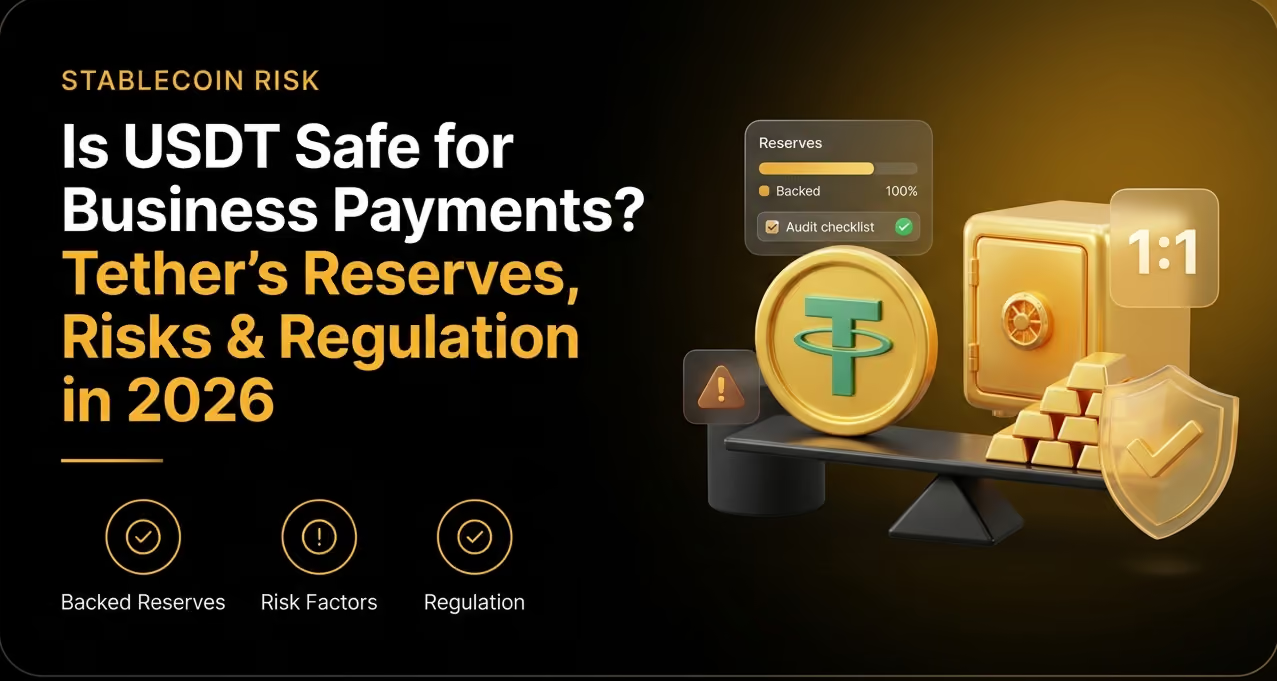
Is USDT Safe for Business Payments? Tether's Reserves, Risks & Regulation in 2026
If your business is about to move real money through USDT, "is USDT safe?" is the right question to ask first. Tether is the largest stablecoin in the world — roughly $188 billion in circulation and ~59% of the entire stablecoin market as of mid-2026 — but scale and safety aren't the same thing.
If your business is about to move real money through USDT, "is USDT safe?" is the right question to ask first. Tether is the largest stablecoin in the world — roughly $188 billion in circulation and ~59% of the entire stablecoin market as of mid-2026 — but scale and safety aren't the same thing.
This is a balanced look at what actually backs USDT, where the real risks sit, and how those risks apply specifically to a company using Tether for payouts rather than trading.
What USDT is — and what "safe" means here
USDT (Tether) is a stablecoin designed to hold a 1:1 peg to the US dollar. Each token is meant to be redeemable for one dollar, backed by reserves Tether holds. For a business, "safe" breaks into three practical questions:
Peg risk — will 1 USDT still be worth ~$1 when my recipient cashes out?
Counterparty risk — is the issuer solvent and are the reserves real?
Operational and regulatory risk — can I legally and reliably use it where I operate?
Let's take them in order.
Peg stability: strong, with rare wobbles
In normal conditions, USDT trades within a fraction of a cent of $1. Its depth of liquidity is unmatched — it's the most traded crypto asset on earth, which makes the peg resilient.
It is not immune, though. During acute market stress (the 2022 Terra/UST collapse, the 2023 US regional-bank episode) USDT briefly de-pegged by a few percent before recovering. For a payout business, the takeaway is not "avoid USDT" but "don't sit on large idle balances." If you convert at payout time rather than warehousing Tether, short-lived wobbles rarely reach the recipient.
Reserves: what backs USDT in 2026
This is where scrutiny has historically been sharpest, and where transparency has improved.
Per Tether's Q1 2026 attestation (BDO Italia), the company reported roughly $191.8 billion in total assets against its liabilities, with a reserve mix heavily weighted toward liquid, low-risk holdings:
~$135 billion in US Treasuries — the bulk of reserves in the most liquid safe asset there is.
~$13 billion in gold, plus Bitcoin and other holdings.
Reported net equity of around $8 billion, a buffer above the tokens in circulation.
Two honest caveats remain:
Tether publishes attestations, not a full audit by a Big Four firm. An attestation confirms balances at a point in time; it's less rigorous than a continuous audit. Critics have pushed Tether on this for years.
A minority of reserves has historically included assets beyond cash and Treasuries. The direction of travel is toward higher-quality, more liquid reserves, but it's worth knowing what you hold.
For most businesses, a reserve base dominated by US Treasuries is reassuring. The transparency gap versus a fully audited competitor is real but narrowing.
Regulatory risk: the biggest practical issue for EU businesses
Here's the risk that most directly affects where and how you can use USDT: Tether did not seek authorization under the EU's MiCA regulation.
The consequences are concrete. Through late 2024 and 2025, MiCA-regulated exchanges removed USDT for customers in the European Economic Area — Coinbase, Crypto.com, Binance (EEA) and others delisted or restricted it — because offering a non-authorized stablecoin put their own licenses at risk. USDT trading volumes on EU venues fell sharply, while MiCA-compliant alternatives like USDC and EURC gained share.
USDT is not banned to hold, but its regulated on/off-ramp availability in the EU has narrowed. Tether has instead pursued a US federal path (under the GENIUS Act) via a US-domiciled entity. If your recipients or your business are EU-based, this matters: a MiCA-compliant stablecoin may be the more durable choice for European corridors. (See "Is USDC regulated?" and our USDT vs USDC comparison.)
Operational risk: irreversibility and wrong-network errors
Independent of Tether the company, USDT carries the operational risks of any on-chain asset:
Irreversibility. A payout sent to a wrong or wrong-network address is typically gone.
Network fragmentation. USDT on Tron, Ethereum, Solana and others isn't interchangeable at the address level.
Compliance exposure. Paying a sanctioned or high-risk wallet is a legal problem, not just a technical one.
These are managed with address validation, test transfers, and — at volume — KYT and sanctions screening built into your payout flow.
So, is USDT safe for business payouts?
A fair summary:
Peg: Strong in normal conditions; convert at payout time to avoid stress-window exposure.
Reserves: Large and Treasury-heavy, but attested rather than fully audited.
Regulation: The real watch-item — limited MiCA standing constrains EU usage.
Operations: Safe when you use validation, screening, and disciplined records.
For high-volume global payouts, USDT remains the most liquid and widely accepted stablecoin. The smart posture is to use it deliberately: don't warehouse it, screen your recipients, keep clean fiat records, and choose a MiCA-compliant asset where European regulation demands it.
Frequently asked questions
Is USDT backed by real dollars? USDT is backed by reserves that, per Tether's 2026 attestations, are dominated by US Treasuries plus cash equivalents, gold, and other assets. These are confirmed by attestation rather than a full independent audit.
Can USDT lose its peg? It can briefly deviate during extreme market stress, as it has a few times historically, but it has recovered each time. Deep liquidity supports the peg in normal conditions.
Is USDT legal in the EU? Holding USDT is not illegal, but Tether is not MiCA-authorized, and many EU-regulated exchanges have delisted it for EEA users. For EU corridors, a MiCA-compliant stablecoin is often more practical.
Is USDT safe enough for payroll and affiliate payouts? For most businesses, yes — provided you convert near payout time, screen recipients, and keep proper records. The controls matter as much as the asset.
Use USDT with the controls built in
The safest way to use USDT for business isn't to trust a single wallet — it's to run payouts through infrastructure that screens recipients, validates networks, and reports in fiat. That's how INXY's mass USDT payouts are designed: fund in EUR or USD, pay out globally, and keep audit-ready records — without warehousing crypto risk.
This article is general information, not financial or legal advice. Evaluate stablecoin exposure against your own jurisdiction and risk policy.