
Best Payment Gateways for SaaS in 2026: From Traditional Fiat to Web3
Stop letting legacy payment bottlenecks kill your SaaS growth. 🚀 In 2026, relying solely on traditional credit card processing is a risk to your cash flow. High fees and chargebacks are outdated. Our latest guide breaks down the best payment gateways for B2B SaaS—from the reliability of Stripe to the borderless power of INXY Paygate. Inside this guide: Why crypto users have a 2x higher LTV and prefer annual plans. How the Auto-Convert Engine eliminates volatility risks for CFOs. The secret to Zero Chargebacks and instant global settlements. Future-proof your billing stack and tap into a global market of 800M+ digital asset users. Read more at INXY.io.
When closing high-ticket B2B SaaS deals or enterprise annual plans, traditional credit card processing often becomes a bottleneck rather than a solution. High cross-border fees and unexpected fund holds can paralyze your cash flow. In 2026, relying solely on legacy fiat processors is a risk. Your billing infrastructure needs to be as borderless and scalable as your software.
As we move deeper into 2026, SaaS billing has fundamentally evolved. While traditional fiat processors remain standard, the explosive demand for borderless, low-fee digital transactions makes cryptocurrency and stablecoin gateways a mandatory addition to any modern B2B tech stack. This guide breaks down the best payment gateways for SaaS businesses, comparing legacy providers with next-generation Web3 infrastructure to help you optimize your upfront revenue.
Key Features to Look for in a SaaS Payment Gateway
Before diving into the top providers, it is essential to define what makes a payment gateway effective for a SaaS and annual licensing model:
Global Reach & Multi-Currency: Support for international clients without exorbitant cross-border foreign exchange (FX) fees.
API & Native Integrations: Developer-friendly REST APIs and plugins for standard platforms (like WooCommerce, Shopify, or WHMCS).
Chargeback Protection: Mechanisms to protect your business from fraudulent chargebacks that persistently plague the digital goods industry.
Mass Payout Capabilities: Built-in tools to easily distribute affiliate commissions or international contractor payouts.
The Top Payment Gateways for SaaS in 2026
1. Stripe: The Traditional Fiat Giant
Stripe remains a dominant force in the SaaS ecosystem. Its robust API, advanced invoicing tools, and seamless checkout flows make it a default choice for many domestic startups.
Pros: Incredible developer tools, widespread consumer trust, and deep analytics.
Cons: High cross-border transaction fees and persistent vulnerability to chargeback fraud.
2. PayPal / Braintree: The Consumer Favorite
Braintree (owned by PayPal) offers extensive global brand recognition. It is an excellent choice for B2C software products looking for high conversion rates at checkout from everyday consumers.
Pros: High consumer trust, easy integration, supports Venmo and Apple Pay.
Cons: Strict compliance algorithms that can freeze funds without warning, high processing fees for international clients.

3. INXY Paygate: The Premier Web2 to Web3 Bridge
For modern SaaS companies, relying solely on traditional banking is a massive bottleneck. Enter INXY, a regulated, VC-backed cryptocurrency payment gateway that recently secured $3M from Flashpoint VC. INXY is specifically engineered for B2B enterprises and SaaS platforms looking to accept global payments without the friction of legacy banks. INXY acts as a seamless bridge, allowing you to offer a "Pay with Crypto" option while completely eliminating the technical risks normally associated with digital assets.
Boost Your Annual Payments: INXY Paygate strategically bypasses standard auto-billing. This is a massive advantage designed to boost your upfront cash flow. When dealing with high-ticket B2B software and large sums, utilizing stablecoins makes annual tariff plans the absolute most profitable option for both your business and your clients. You get the full yearly value immediately without the risk of monthly drop-offs.
The Auto-Convert Engine: The biggest fear for SaaS CFOs is crypto volatility. With INXY, if a client pays a $1,000 or $10,000 annual software license in Ethereum, the gateway's Auto-Convert feature instantly converts the incoming volatile asset into stablecoins (USDT/USDC) or fiat (EUR/USD). You get exact, predictable revenue.
Native SaaS Integrations: Instead of writing complex smart contracts, SaaS companies can use INXY’s robust APIs or ready-made plugins, including a native WHMCS module perfectly tailored for hosting, cloud services, and digital agencies.
Zero Chargebacks: Blockchain transactions are irreversible, meaning your business is completely protected from friendly fraud.
Built-in Mass Payouts: If you rely on an affiliate network, INXY allows you to automate global mass payouts via CSV uploads or API.
Feature Comparison Matrix
Choosing the right platform depends entirely on your target audience. Here is a high-level comparison of how these gateways stack up:
Why SaaS Businesses Are Adopting Crypto Invoicing
The shift toward stablecoin billing is not a temporary trend; it is a fundamental upgrade to global financial infrastructure. With over 824 million people globally owning crypto—representing more than 10% of the world's population—this is a massive, highly lucrative demographic ready to spend.
By integrating a Web3 gateway alongside your traditional fiat processors, you unlock several strategic advantages:
Massive Upfront Cash Flow: 60% of crypto users prefer to pay upfront for 12–36 month plans, compared to only 20% of credit card users.
Higher Spend & Unmatched LTV: Crypto buyers spend 2x more than traditional users. In fact, 43% of users spend more simply because crypto is offered as an option. Clients who pay in crypto consistently become the highest Lifetime Value (LTV) users—paying more and staying longer.
New Customer Acquisition: 40% of crypto clients are entirely new to the merchant, and 56% of users actively choose to shop more frequently at crypto-friendly businesses.
Lower Transaction Costs: Traditional gateways charge 2.9% + $0.30 per transaction, plus heavy cross-border fees. Crypto payments settle for fractions of a percent, saving high-volume companies thousands of dollars on annual contracts.
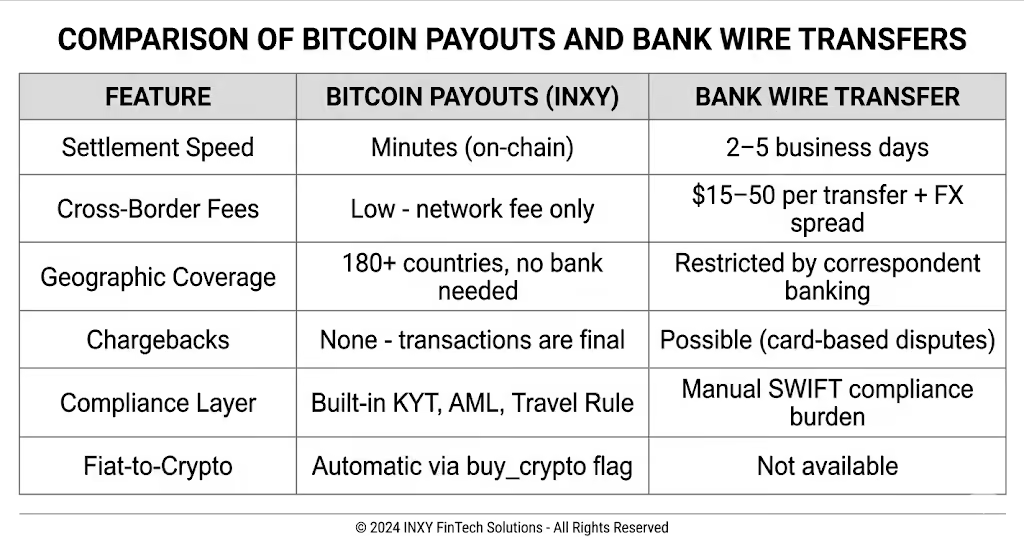
Instant Global Settlement: Instead of waiting 3 to 5 business days for an international wire transfer to clear, stablecoin payments settle in minutes.

Conclusion: Future-Proof Your SaaS Billing
In an increasingly borderless digital economy, restricting your customers to legacy credit card processing is a critical mistake. While platforms like Stripe and Braintree excel in their respective domestic markets, the future of global SaaS billing relies on secure, instant, and borderless transactions.
By implementing a specialized gateway, you can bypass the traditional hurdles of international finance. You gain the ability to tap into a high-spending demographic, automate your affiliate mass payouts, and completely eliminate chargeback fraud—all while receiving predictable, auto-converted fiat or stablecoin settlements. It is time to expand your checkout options and embrace the next generation of digital payments.

The Future of Global Commerce: Cross-Border Crypto Payments vs. Bank Transfers
The Future of Global Commerce: Crypto Payments vs. Traditional Banking The $190 trillion cross-border payment market is undergoing a systemic shift. While traditional SWIFT transfers remain the bedrock of trade, blockchain-based solutions are no longer just an alternative—they are a strategic imperative. Key Takeaways: Settlement Velocity: Moving from 3-5 business days to near-instant, 24/7/365 availability. Cost Optimization: Reducing transaction fees by 60% to 80% by removing intermediary "hops." Risk Mitigation: Eliminating chargeback fraud through blockchain immutability and transparent tracking. As we move toward a hybrid financial ecosystem, understanding these digital rails is essential for any global enterprise. Read our full analysis on how to future-proof your payment stack.
The global cross-border payment market is a staggering financial behemoth, moving approximately $190 trillion annually across the world's economies. For decades, this massive flow of capital has been heavily dominated by traditional financial institutions, operating on infrastructure originally designed in the pre-digital era. However, the legacy correspondent banking system is currently facing unprecedented, systemic disruption from blockchain technology and digital assets. As global commerce accelerates and borders become increasingly blurred in the digital age, the debate between Cross-Border Crypto Payments vs. Bank Transfers has become one of the most critical conversations in the fintech and crypto processing industry.
While traditional bank transfers remain the undisputed bedrock of global trade—largely due to their established regulatory frameworks, institutional trust, and systemic stability—crypto payments are rapidly gaining ground. Driven primarily by the rise of stablecoins and decentralized finance (DeFi) networks, these digital alternatives are emerging as a significantly faster, cheaper, and more inclusive alternative for businesses operating on an international scale.
For Chief Financial Officers, treasury managers, and e-commerce leaders, understanding the nuances of these two fundamentally different financial rails is no longer optional; it is a strategic business imperative. In this comprehensive, deep-dive guide, we will break down exactly how these two systems compare across key operational metrics, the roadblocks that remain, and how you can position your enterprise to leverage automated crypto processing for future growth.
Exploring the Great Divide: Cross-Border Crypto Payments vs. Bank Transfers
To truly understand the shifting paradigm in global finance, business leaders must look under the hood of how money actually moves across borders. The differences between legacy fiat rails and decentralized blockchain ledgers fundamentally alter how businesses manage cash flow, mitigate risk, and scale their operations globally. Let us examine the core operational differences.
1. The Mechanics of Speed and Settlement
Time is money, and in international trade, settlement delays can create cascading cash-flow bottlenecks that stifle growth, frustrate suppliers, and complicate supply chain management.
Traditional Bank Transfers: Traditional cross-border payments rely heavily on the SWIFT (Society for Worldwide Interbank Financial Telecommunication) messaging network and a highly complex "correspondent banking" model. Because it is logistically impossible for every bank in the world to hold direct, bilateral relationships with every other bank globally, a single international payment cannot simply travel from Point A to Point B. Instead, it often "hops" through multiple intermediary banks before reaching its final destination.
Timeframe: Because of these necessary intermediary hops, and the manual reconciliation required at each step, settlements typically take anywhere from 2 to 5 business days to clear.
Limitations: Traditional transactions are strictly bound by localized banking cut-off times, weekends, and regional bank holidays. If a company in London sends a payment to a supplier in Tokyo on a Friday afternoon, that payment will sit in limbo until the following Monday—or longer, if there is a local holiday. This creates highly unpredictable cash-flow gaps.
Crypto & Blockchain Payments: Blockchain networks operate on a fundamentally different, modern architecture: a decentralized, single-ledger system. This technology allows for direct, peer-to-peer (P2P) transfers that bypass traditional intermediary banks entirely.
Timeframe: Settlements on blockchain networks occur in a matter of seconds or minutes, regardless of the geographic distance between the sender and the receiver. For example, enterprise-grade networks like Ripple (XRP) or major fiat-backed stablecoins settle almost instantly.
Limitations (or lack thereof): Cryptocurrencies and blockchain networks operate 24/7/365. They do not sleep, they do not observe weekends, and they do not pause for national holidays. This effectively eliminates the delays caused by traditional operating hours, allowing businesses to execute just-in-time cross-border settlements.
Professional Takeaway: If your business relies on rapid inventory turnover or immediate supplier payments, integrating a crypto payment gateway to facilitate stablecoin settlements can drastically improve your working capital cycles.
2. Cost Efficiency and the Death of Intermediaries
Profit margins on international sales and B2B vendor payments are frequently eroded by the opaque and compounding costs associated with moving money across borders.
Traditional Bank Transfers: The multi-hop nature of correspondent banking means that each intermediary institution involved in the transfer process extracts its own toll. This can come in the form of a flat processing fee, an unfavorable foreign exchange (FX) spread, or a network messaging fee.
Impact: Transaction costs can be prohibitively high, especially for smaller retail payments, B2B micro-transactions, and remittances. According to recent data from the World Bank and the International Monetary Fund (IMF) [source: worldbank.org], high legacy banking fees remain one of the most significant barriers to global financial inclusion and frictionless international trade.
Crypto & Blockchain Payments: By systematically removing the middlemen from the transaction lifecycle, blockchain payments drastically reduce the costs associated with moving capital. The network validates the transaction programmatically, requiring only a small fraction of the fee traditionally charged by banks.
Impact: Comprehensive market research indicates that utilizing crypto or stablecoin rails can reduce cross-border transaction fees by a staggering 60% to 80%. This reduction is particularly transformative for the global remittance market and for small-to-medium enterprises (SMEs) that were previously priced out of efficient global trade due to prohibitive SWIFT fees. For businesses processing thousands of international transactions monthly, these savings directly, and heavily, impact the bottom line.
Professional Takeaway: Audit your current cross-border payment flows. Calculate the total annual cost of FX spreads and wire fees. For many e-commerce and SaaS platforms, migrating even 20% of cross-border volume to a crypto processing solution yields immediate, measurable ROI.
3. Security, Transparency, and Finality
How businesses track their funds in transit, and how they protect themselves from fraud, differs wildly between traditional banking and blockchain processing.
Traditional Bank Transfers: While the legacy banking system is highly secure, stringently regulated, and heavily insured, traditional transfers can be notoriously opaque for the end-user. Businesses often experience high levels of uncertainty regarding the exact status of a payment mid-transit. Furthermore, they frequently lack visibility into the final fees that will be deducted by intermediary banks before the funds arrive.
Additionally, traditional systems allow for chargebacks and settlement reversals. While designed to protect consumers, chargebacks pose significant administrative burdens and financial risks for online merchants who fall victim to "friendly fraud."
Crypto & Blockchain Payments: Blockchain ledgers are mathematically immutable. Once a transaction is algorithmically verified and recorded on the chain, it is permanent and cannot be altered, spoofed, or deleted.
Pros: This immutability provides total, unprecedented transparency. Anyone with the transaction hash can track the payment on the public ledger in real-time, eliminating the "where is my money?" anxiety. Furthermore, the irreversible nature of blockchain transactions entirely eliminates chargeback fraud—a massive relief for merchants, protecting businesses from unexpected revenue losses and malicious consumer behavior.
Cons: The absolute finality of the blockchain is a double-edged sword. If funds are mistakenly sent to the wrong wallet address due to human error, they are generally unrecoverable. Unlike a bank, there is no centralized customer service hotline to reverse an erroneous blockchain transaction.
Professional Takeaway: To mitigate the risk of lost funds via human error, utilize automated crypto payment gateways that generate dynamic, single-use QR codes and exact-amount payment links, removing the need for manual address entry by your clients.
Key Risks and Roadblocks to Mainstream Adoption
While crypto payments offer operational superiority in speed and cost, they face significant hurdles that prevent total mainstream displacement of traditional banking. A balanced fintech strategy must acknowledge and navigate these challenges.
1. The Volatility Dilemma Legacy cryptocurrencies like Bitcoin (BTC) or Ethereum (ETH) are highly speculative assets. A 10% price swing during a brief transaction window makes them highly impractical for standard corporate functions, such as payroll distribution or invoice settlements. This is exactly why the market is pivoting heavily toward stablecoins—digital assets pegged 1:1 to fiat currencies like the US Dollar, combining the technological speed of crypto with the economic stability of traditional money.
2. Regulatory Uncertainty & Compliance Protocols Traditional banks have spent decades building robust, globally recognized Anti-Money Laundering (AML) and Know Your Customer (KYC) compliance frameworks. The pseudonymous nature of foundational cryptocurrencies complicates these essential compliance measures. Inconsistent, fragmented regulatory frameworks across different global jurisdictions make enterprise-level adoption risky for heavily audited corporations. Processing platforms must provide built-in compliance tools to bridge this gap safely.
3. Wholesale Dominance and Institutional Inertia Traditional financial systems are purpose-built to safely handle massive, multi-billion-dollar wholesale transactions between sovereign nations and multinational conglomerates. Currently, crypto payments represent only a small fraction of total global volume, primarily capturing retail, SME, and remittance flows. Unseating a $190 trillion entrenched system takes time.
The Future: Convergence Over Replacement
The consensus among top economic researchers and fintech analysts is that blockchain will not immediately replace traditional bank transfers; rather, the two systems are destined to integrate. We are moving toward a hybrid financial ecosystem.
Major financial institutions are already adopting blockchain infrastructure to modernize their own rails. For instance, J.P. Morgan has developed its own blockchain networks to facilitate 24/7 cross-border settlements for institutional clients. Additionally, global authorities and central banks are heavily researching and piloting Central Bank Digital Currencies (CBDCs). These sovereign digital assets aim to combine the speed, transparency, and efficiency of blockchain technology with the absolute trust, stability, and regulatory backing of traditional fiat money.
The future of the fintech processing industry lies in interoperability—systems that allow a business to accept a payment in a stablecoin from a client in Brazil, and have it instantly settled as fiat in a corporate bank account in Europe, entirely seamlessly.
Automating Business Processes with INXY
Navigating the transition from legacy finance to digital assets doesn't have to be a logistical nightmare. To stay competitive, modern businesses need payment infrastructure that is as dynamic and global as their customer base.
At INXY, we understand that navigating the complexities of Cross-Border Crypto Payments vs. Bank Transfers requires robust, reliable, and secure technology. Our cutting-edge payment gateway solutions are designed specifically to help forward-thinking enterprises automate their business processes, effortlessly bridging the gap between traditional fiat banking and the emerging crypto economy.
Whether you are looking to eliminate exorbitant SWIFT fees, accept cross-border stablecoin payments with zero volatility risk, or implement comprehensive cross-domain tracking for your payment flows, INXY provides the enterprise-grade infrastructure to make it happen seamlessly.
Ready to modernize your financial stack and expand your global reach without the friction of traditional banking? Explore our comprehensive suite of payment gateway solutions atINXY.io and discover how we can tailor an automated crypto processing strategy for your specific business needs. Contact our integration team today to future-proof your payment operations.
How to Integrate Crypto Payments into Your Business: A Practical Guide
Adding a crypto payment gateway to your business can open new doors. It lets you accept crypto payments from customers worldwide, bringing faster transactions, lower fees, and no chargebacks. But it’s not as simple as flipping a switch. To truly make crypto work for your business, there’s a list of things you need to get right.
5 min read
2.5.2025
Adding a crypto payment gateway to your business can open new doors. It lets you accept crypto payments from customers worldwide, bringing faster transactions, lower fees, and no chargebacks. But it’s not as simple as flipping a switch. To truly make crypto work for your business, there’s a list of things you need to get right.
Set Up a Digital Wallet
A wallet is where digital assets are stored. For daily operations, software wallets can be enough. But for larger amounts, businesses usually choose hardware wallets for added security.
Choose and Integrate a Payment Solution
You'll need a payment gateway that supports digital currencies. This might be a plugin for your e-commerce platform or a custom API integration. The goal is to make payment easy for customers and seamless for your team.
Handle Pricing and Exchange Rates
Decide how to display prices-directly in digital currency or by converting from your local currency at the moment of purchase. Make sure exchange rates are transparent for your customers.
Manage Volatility
Digital currencies are known for price swings. Have a strategy for dealing with this, such as converting to stablecoins or fiat currency immediately after payment.
Monitor Transaction Fees
Network fees can change depending on demand. Regularly review these costs to ensure they remain acceptable for your business.
Stay Compliant
Digital payments are subject to different rules in different regions. Make sure you understand your obligations around KYC (Know Your Customer), AML (Anti-Money Laundering), and other regulatory requirements.
Educate Your Team
Everyone involved should know how the system works-especially your customer service team, who may need to help customers with payment questions.
Communicate with Customers
Let your customers know that you now accept digital payments. Add clear messaging across your website, marketing materials, and checkout flow.
Test Before Launching
Run test payments to ensure the process is smooth from start to finish. This helps catch any issues before customers experience them.
Strengthen Security
Security is a top priority. Use strong authentication, multi-signature wallets, and cold storage for long-term holdings. Keep your security protocols updated.
Set Up Accounting Processes
Track every transaction carefully. Many tax authorities require detailed reporting of digital currency transactions, and having a solid system in place is essential.
Prepare Customer Support
Expect questions and occasional payment issues. Make it easy for customers to contact you and resolve problems quickly.
Stay Informed
The digital payments landscape evolves rapidly. Keep an eye on regulatory changes, new technologies, and market trends to stay ahead.
Get Tax Advice
Digital currency can create tax liabilities. Consult a tax advisor who understands how digital payments are handled in your jurisdiction.
Review and Optimize
Regularly review how digital payments are working for your business. Gather customer feedback and monitor performance to make improvements as needed.
How INXY Payments Supports These Steps
At INXY Payments, we've built our platform to address all these challenges in one place. Our service is designed for businesses that want to add digital currency payments with minimal friction and maximum compliance. Here's how we help:
Auto-conversion: Incoming payments can be automatically converted to stablecoins or fiat currency to minimize volatility.
Full Compliance: Our platform is fully compliant with MiCA and other EU regulations, with built-in tools for KYC and AML checks.
Seamless Integration: Whether you use the API or our dashboard, setup is simple and fast.
No Wallet Management: You don't need to create and maintain wallets on different blockchains or hold extra coins to pay network fees-we handle that for you.
Custom Reports: We provide detailed, customized reports to simplify your accounting and tax filing.
Security First: Advanced security features protect your funds at every step.
Global Reach: We support payments worldwide and work across multiple industries.
Expert Support: Our team offers personalized onboarding and ongoing assistance, including tax consultations and compliance help.
Always Up-to-Date: We stay on top of blockchain updates and new infrastructure developments, so you don't have to worry about keeping up with tech changes.
Whether you want to accept bitcoin payments, send mass payouts in crypto, or add a seamless crypto billing option to your service, we've got you covered.
What is a Stablecoin? Complete Beginner’s Guide 2025
A beginner-friendly guide to stablecoins in 2025. Learn what stablecoins are, how they work, their main types, benefits, risks, and how to buy, store, and use them safely — plus a look at their future in digital finance
5 min read
25.11.2025
What is a Stablecoin? Complete Beginner’s Guide 2025
Stablecoins are one of the fastest-growing parts of the crypto market. In the last year alone, stablecoins processed tens of trillions of dollars in payments and moved value across borders faster than traditional bank rails. This guide explains what stablecoins are, how they work, and why more people and businesses are using them in 2025.
Understanding Stablecoins
Stablecoins are a type of cryptocurrency designed to maintain a stable value. Unlike other cryptocurrencies, whose prices can be unpredictable, stablecoins aim to stay consistent. They are often tied to real-world assets like the US dollar, gold, or even other cryptocurrencies.
Common examples are Tether (USDT), USD Coin (USDC), and DAI. All of them aim to keep a value close to 1 US dollar.This means 1 USDT should always equal 1 USD. People use stablecoins to avoid the wild swings of the crypto market while still enjoying the benefits of digital currency.
Stablecoins can be classified into three main types: fiat-collateralized, crypto-collateralized, and algorithmic. Fiat-collateralized stablecoins hold reserves in traditional currency. Crypto-collateralized ones use other cryptocurrencies as backing. Algorithmic stablecoins rely on smart contracts to manage supply and demand.
Stablecoins offer a bridge between the traditional financial world and the new age of digital currency, providing stability and trust. They're used for trading, payments, and as a store of value, making them popular among both crypto enthusiasts and businesses. People use stablecoins to send money abroad, pay freelancers, move funds between exchanges, or simply sit in “digital dollars” during volatile markets.
Types of Stablecoins
Stablecoins come in various forms, each with its own way of maintaining value. One type is fiat-collateralized stablecoins. These are backed by traditional currencies like the US dollar. For example, Tether (USDT) is a well-known fiat-backed stablecoin. You deposit one dollar into a bank, and you get one digital token.
Then, there are crypto-collateralized stablecoins. Instead of using traditional money, they use other cryptocurrencies as reserves. A popular example here is DAI, which is backed by Ethereum. It's a bit more complex, but it offers greater transparency through smart contracts.
Finally, we have algorithmic stablecoins. These don't use collateral. Instead, they rely on algorithms to control the supply of the coin, similar to how central banks manage currencies. If the price goes up, the system releases more coins to lower the price. If it drops, coins are taken out of circulation to raise it. This method is innovative but can be risky.
How Stablecoins Work
Stablecoins are a type of cryptocurrency designed to keep their value stable. Unlike other cryptocurrencies, which can have wild price swings, stablecoins aim to stay around a fixed value. This stability often comes from linking the stablecoin to a real-world asset like the US dollar.
One common method is to hold reserves. For example, if a stablecoin is tied to the dollar, the issuer might keep one dollar in reserve for every stablecoin issued. This ensures that users can exchange stablecoins for real dollars at any time.
Another method involves using algorithms to manage supply. If demand for the stablecoin rises, the system may release more coins to keep the price steady. If demand falls, it might buy back coins to maintain balance.
These strategies help stablecoins stay steady, making them useful for trading, accepting payments, or cashing out without worrying about losing value.
Benefits of Using Stablecoins
Stablecoins have gained popularity for several reasons. One major advantage is their price stability. Traditional cryptocurrencies like Bitcoin and Ethereum can have wild price swings, making them less reliable for day-to-day transactions. In contrast, stablecoins are usually tied to stable assets like the US dollar, ensuring their value remains relatively constant.
Another benefit is the ease of international transactions. If you need to send money across borders, stablecoins can be a faster and cheaper alternative to traditional bank transfers. They don't require high fees and middlemen, making the process more efficient.
Stablecoins also provide a way to enter the crypto market without the risk of losing value quickly. For those new to crypto, they offer a stepping stone, allowing you to participate in the digital economy without the stress of market fluctuations. Plus, businesses can accept stablecoins as payment, knowing their value won't drop overnight.
Stablecoins are also helpful in places where banks do not work well or many people do not have bank accounts. A phone and a simple wallet app are often enough to receive stablecoins, which makes them useful in many emerging markets.
Lastly, stablecoins can be easily exchanged for other cryptocurrencies or even cashed out to traditional money. This flexibility makes them a practical choice for both consumers and businesses looking to explore digital currencies with minimal risk.
How to Buy Stablecoins
Buying stablecoins can seem tricky at first, but it’s pretty simple once you break it down. First, you need a crypto wallet. This is a digital tool to store, send, and receive stablecoins. You can find many wallets online, so pick one that suits your needs.
Next, choose a crypto exchange. This is a platform where you can buy and sell stablecoins. Popular exchanges are user-friendly, making it easy to trade. Once you pick an exchange, create an account and verify your identity.
Now, you’re ready to buy. Deposit money into your exchange account. Then, search for the stablecoin you want and make a purchase. You can buy with cash, or exchange other cryptocurrencies. After buying, transfer the stablecoins to your wallet for safekeeping. This ensures your coins are secure and easy to access when you need them.
You do not always need to buy stablecoins directly. Some people earn them by doing freelance work, selling online services, or getting paid by friends and family abroad.
Exchanging Stablecoins for Cash
When you want to turn your stablecoins into cash, it's not as tricky as it may sound. First, you'll need to find a crypto exchange that accepts stablecoins. Many big exchanges do, like Binance or Coinbase. Once you're signed up, you can transfer your stablecoins to the exchange. It’s a bit like moving money from one bank to another.
After your stablecoins are on the exchange, you can find the option to cash out. This usually involves choosing a fiat currency like USD or EUR, and then selling your stablecoins for that currency. The exchange does the math and shows you how much money you'll receive.
Next, you need to decide how to receive your cash. Most exchanges offer a few ways: you can transfer it straight to your bank account, use a debit card linked to the exchange, or sometimes even get a physical check. Each method may have different fees, so it's wise to check those before you decide.
Lastly, be aware of the time it takes for the money to reach you. Some methods are quick, while others might take a few days. The speed often depends on your bank or the exchange. So, it's good to plan ahead, especially if you need the cash soon.
In some countries, people also use peer-to-peer (P2P) platforms or local fintech apps to swap stablecoins for local money.
Storing Stablecoins Safely
When it comes to keeping your stablecoins, safety is key. Let's break it down into simple steps. First, think about where you want to store them. A crypto wallet is your go-to option. There are two main types: hot wallets and cold wallets.
Hot wallets are online. They are easy to access, making them perfect for frequent transactions. If you often exchange or accept crypto, this might be your choice. But, online wallets can be more vulnerable to hacks.
Cold wallets, on the other hand, are offline. They're like a digital vault, keeping your coins away from the internet. This makes them safer from online threats. If you're planning to hold onto your stablecoins for a while, this is a solid option.
Now, let's talk about setting up a wallet. It's not as hard as it sounds! Most wallets come with user-friendly apps. You download the app, create an account, and you're set. You'll receive a private key, a kind of password, which is crucial. Keep it safe and never share it.
Another way to secure your coins is by using two-factor authentication. This adds an extra layer of security. Even if someone gets your password, they can't access your wallet without the second factor.
Choosing a reliable wallet provider is important, too. Look for reviews and ensure the provider has a good track record. Some popular options include Ledger, Trezor, and Coinbase.
You should also back up your wallet. Most wallets allow you to do this through a recovery phrase. Write it down and store it in a safe place. If you lose access to your wallet, this phrase can help you get back in.
Lastly, stay informed. The crypto world changes fast. New security features and threats can emerge. Keep an eye on updates from your wallet provider and the stablecoin community.
By following these steps, you can store your stablecoins safely and with confidence.
Stablecoins vs. Traditional Cryptocurrencies
When we talk about stablecoins and traditional cryptocurrencies, it's like comparing apples and oranges. Both are fruits, but they taste different. Stablecoins are designed to keep their value steady, usually tied to a stable asset like the US dollar. This makes them less wild in terms of price swings. On the flip side, traditional cryptocurrencies, like Bitcoin, are known for their roller-coaster prices, which can go up or down sharply in a short time.
Stablecoins are great when you want to avoid the crazy ups and downs of traditional crypto. Think of them as a safe harbor in a stormy sea. They give you a way to hold digital assets without worrying about losing value overnight. This stability is why some people prefer them for daily transactions or saving.
Traditional cryptocurrencies can be exciting for those who enjoy high-risk, high-reward scenarios. If you buy a cryptocurrency like Bitcoin at the right time, you could make a lot of money. But, you could also lose a lot if the value drops. This unpredictability makes them less appealing for regular transactions but more attractive for investment.
Both types of digital assets have their uses. Stablecoins are often used for things like remittances or when users want to cash out of a volatile market without going back to regular money. Traditional cryptocurrencies are used for things like long-term investments or when someone wants to participate in a decentralized financial system.
It's important to choose the right one based on your needs. If you want stability and predictability, stablecoins are a good choice. If you are looking for potential big gains and can handle the risk, traditional cryptocurrencies might be more your style.
The Future of Stablecoins
The future of stablecoins looks promising yet complex. As we step into 2025, stablecoins are playing a bigger role in the financial world. More businesses are starting to accept them as payment. This trend is likely to continue, making stablecoins a significant part of global trade. Stablecoins are unique because they combine the benefits of cryptocurrency with the stability of traditional money. They are not as volatile as other cryptocurrencies, which makes them attractive for everyday transactions.
Governments around the world are also paying attention to stablecoins. Some are considering creating their own versions, often called Central Bank Digital Currencies (CBDCs). These digital currencies could change how we use money. For instance, they might make international payments faster and cheaper. While this is an exciting development, it also brings challenges. Governments must ensure these digital currencies are secure and private.
Technology is another important factor shaping the future of stablecoins. Innovations in blockchain technology can make stablecoins more efficient and secure. For example, improvements in smart contracts might automate many financial processes. This could reduce the need for intermediaries, like banks, in certain transactions. However, these technological advancements also require careful management. Developers must ensure these systems are safe from hacking and other threats.
There are also social aspects to consider. As more people use stablecoins, they might change how we think about money. Younger generations, who are more comfortable with digital technology, may adopt stablecoins more quickly. This could lead to a shift away from traditional cash. Yet, not everyone has access to the internet or digital devices. This digital divide could create inequality if stablecoins become too widespread.
Lastly, the regulatory landscape for stablecoins is still evolving. Different countries have different rules, which can create confusion. Clear and consistent regulations are essential for stablecoins to thrive. These rules can help protect users and ensure the financial system remains stable.
New rules like the European Union’s MiCA framework, and similar proposals in other regions, aim to make sure stablecoins are properly backed, audited, and safe for everyday use.
As we navigate these changes, it's clear that stablecoins will continue to develop. How we adapt to these changes will determine the role stablecoins play in our everyday lives.
Risks Associated with Stablecoins
Stablecoins may seem like the safer side of crypto, but they come with their own risks. One major concern is regulatory risk. Governments around the world are still figuring out how to regulate these digital currencies. This means rules can change quickly, affecting the value and legality of stablecoins.
Another risk is the trust in the issuer. Stablecoins are usually backed by assets like dollars or gold. But if the issuer doesn't actually hold enough assets, the stablecoin might not be as stable as it seems. It's important to check if an issuer undergoes regular audits to verify their reserves.
Technology risk is also significant. Stablecoins rely on blockchain technology, which can have vulnerabilities. Hackers could exploit these to steal funds. While security measures improve over time, no system is completely safe.
There is also platform risk. If you keep stablecoins on an exchange or lending platform and that company fails or gets hacked, you can lose access to your funds even if the stablecoin itself still works.
Market risk is another factor to consider. Even if a stablecoin is backed by a strong asset, the market value of that asset can fluctuate. For example, if a stablecoin is pegged to the dollar, and the dollar's value drops, the stablecoin could lose value as well.
Finally, there's the risk of liquidity. In times of financial stress, there might not be enough buyers for the stablecoin. This can make it hard to exchange or cash out quickly. Always evaluate if a stablecoin has ample liquidity before investing.
Understanding these risks can help you make better decisions about using or investing in stablecoins. Being aware of potential pitfalls helps in navigating the world of crypto with more confidence.
Conclusion: Embracing Stablecoins
Stablecoins are becoming more important in the world of digital money. They offer a mix of the best things about traditional currency and cryptocurrencies. These coins are designed to keep a stable value. This makes them less risky than other cryptocurrencies like Bitcoin, which can change in value a lot.
Stablecoins are tied to something stable, often the US dollar or a similar asset. This link helps them keep their value steady. Stablecoins can be used for many things. You can use them to buy things, send money to friends, or even save money. They make it easy to trade goods and services without worrying about the value going up or down too much.
If you want to start using stablecoins, first you need a digital wallet. Many online platforms let you create one quickly. Once you have a wallet, you can buy stablecoins with your regular money. You can also exchange them with other cryptocurrencies. When you want to use your stablecoins, you can send them to someone else or cash them out to your bank account.
Stablecoins can be accepted by many online stores and businesses. Some people use them to pay for everyday things, like groceries or bills. Others might use them for bigger purchases, like electronics or travel. The flexibility of stablecoins makes them appealing to many people, especially those who regularly use digital money.
Stablecoins also have a role in the world of finance. They are often used in lending and borrowing. Some people use them to earn interest, similar to a savings account. Others might take loans in stablecoins, knowing the value won't change too much. This stability is one of the main reasons stablecoins are trusted by many.
As the popularity of stablecoins grows, more people and businesses will likely start accepting them. This trend could lead to a future where stablecoins become a common part of everyday life. They offer a bridge between traditional money and the digital world, making financial transactions easier and more secure.
They are also useful in places where banking is weak. A simple mobile phone is enough to receive stablecoins, so people in emerging markets can get paid or send money online even without a bank account.
FAQ
What exactly is a stablecoin?
A stablecoin is a type of cryptocurrency designed to have a stable value, often pegged to a fiat currency like the US dollar, a commodity like gold, or a basket of assets. This stability makes them unique compared to more volatile cryptocurrencies like Bitcoin.
How are stablecoins different from traditional cryptocurrencies?
Stablecoins are designed to maintain a consistent value, reducing volatility, while traditional cryptocurrencies like Bitcoin and Ethereum can experience significant price fluctuations. This makes stablecoins more suitable for transactions and savings.
What are the main types of stablecoins?
The main types of stablecoins include fiat-collateralized, which are backed by a reserve of fiat currency; crypto-collateralized, which use other cryptocurrencies as collateral; and algorithmic stablecoins, which rely on algorithms to manage supply and demand and maintain their peg.
Why should I use stablecoins?
Stablecoins offer the stability of fiat currencies with the advantages of cryptocurrencies, such as fast and low-cost transactions. They are useful for trading, remittances, and as a hedge against cryptocurrency volatility.
How can I buy stablecoins?
You can purchase stablecoins on cryptocurrency exchanges using other cryptocurrencies or fiat currency. Once bought, they can be stored in a digital wallet that supports stablecoins.
Can I exchange stablecoins for cash?
Yes, you can convert stablecoins back into fiat currency through various platforms, including cryptocurrency exchanges and some financial services. The process usually involves selling your stablecoins for fiat currency, which can then be withdrawn to a bank account.
What are the risks associated with using stablecoins?
While stablecoins offer stability, they also come with risks such as regulatory scrutiny, potential de-pegging from their intended value, and the reliability of the backing assets. It's important to research and choose reputable stablecoins to mitigate these risks.
Who uses stablecoins today?
Stablecoins are used by traders, online shops, freelancers, remittance senders, and people in emerging markets who want a simple way to hold “digital dollars”. Many crypto platforms and fintech apps also use them as a base currency for payments.