Most stablecoins track the US dollar. But if your revenue, costs, and recipients are in euros, paying in a dollar-pegged token means an FX round-trip on every transaction. EURC solves that: it's a euro-denominated stablecoin that lets euro-native businesses move money on blockchain rails without leaving the euro.
Here's what EURC is, how it works, and why it has become the default euro stablecoin for regulated business in 2026.
EURC in one sentence
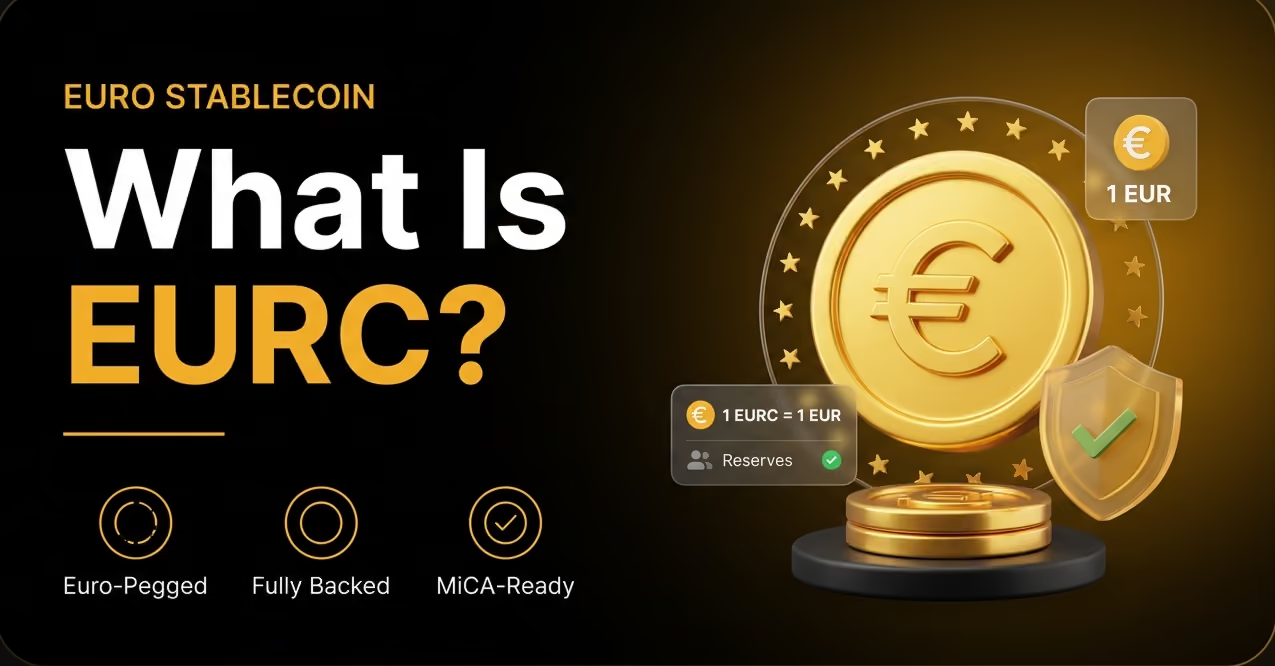
EURC (Euro Coin) is a stablecoin pegged 1:1 to the euro, issued by Circle — the same company behind USDC — and backed fully by euro-denominated reserves. One EURC is designed to always be redeemable for one euro.
Think of it as a digital euro you can send anywhere in minutes, 24/7, without a bank wire.
Who issues EURC, and why that matters
EURC is issued by Circle, a regulated financial technology company. That matters for one reason above all: regulation. Circle holds an EU Electronic Money Institution (EMI) license in France, and that single authorization passports EURC across all 27 EU member states under MiCA, the EU's crypto framework.
In practice, EURC is a MiCA-compliant e-money token. When MiCA's rules took full effect and non-compliant stablecoins were removed from EU-regulated exchanges, EURC was one of the assets that stayed — and it captured much of the resulting demand. By 2026 it had become the dominant euro stablecoin, holding roughly 41% of the euro-stablecoin market, up from about 17% a year earlier.
For a business, that means EURC isn't a fringe experiment — it's the euro stablecoin most likely to be accepted, supported, and compliant across Europe.
What backs EURC?
EURC is 100% backed by euro reserves held in cash and cash-equivalent instruments under Circle's full-reserve model. Circle publishes regular reserve reporting, the same transparency approach it applies to USDC. Each token in circulation is matched by euros held in reserve, which is what keeps the 1:1 peg dependable.
As of 2026, EURC's circulation sits in the range of roughly €400–460 million — smaller than dollar stablecoins, but by far the largest in the euro category.
Which blockchains support EURC?
EURC is a multi-chain asset. It runs natively on:
- Ethereum (where the majority of euro-stablecoin supply sits)
- Base
- Solana
- Stellar
- Avalanche
- World Chain
The network you use determines transfer speed and fees. For payouts, low-fee chains like Solana, Base, or Stellar keep costs to cents; Ethereum is the most liquid but the most expensive to transact on.
Why businesses use a euro stablecoin
If you already operate in euros, why hold a euro on a blockchain instead of in a bank? A few concrete reasons:
- No FX round-trip. Paying euro-based recipients in a dollar stablecoin means converting EUR → USD → EUR, losing spread each way. EURC keeps euros as euros.
- Speed. EURC settles in minutes, any time — including weekends and holidays, when SEPA and bank rails are closed.
- Global reach. A recipient anywhere with a wallet can receive euros, without needing a European bank account.
- Programmability. EURC can be sent via API for automated payouts, something traditional euro rails don't offer natively.
- Regulatory comfort. As a MiCA-compliant token, EURC fits the compliance expectations of European banks, auditors, and partners.
EURC vs a bank euro balance
A euro in your bank and a euro in EURC are both euros — the difference is the rails.

EURC doesn't replace your bank — it complements it for fast, global, programmable euro movement.
Frequently asked questions
What is EURC? EURC (Euro Coin) is a euro-pegged stablecoin issued by Circle, backed 1:1 by euro reserves. It lets businesses hold and send euros on blockchain networks.
Is EURC the same as USDC? They share an issuer (Circle) and a full-reserve, MiCA-compliant model, but EURC is pegged to the euro while USDC is pegged to the US dollar. See our EURC vs USDC comparison.
Is EURC regulated? Yes. EURC is a MiCA-compliant e-money token. Circle's French EMI license passports it across all 27 EU member states.
What backs EURC? Euro-denominated reserves held 1:1 against tokens in circulation, under Circle's full-reserve model with regular reserve reporting.
Which networks support EURC? Ethereum, Base, Solana, Stellar, Avalanche, and World Chain. Choose a low-fee network for cost-efficient payouts.
Can businesses pay in EURC? Yes — EURC is widely used for euro-denominated payouts to contractors, suppliers, and partners, especially within the EU. Learn more in our guide to paying in EURC.
Move euros the modern way
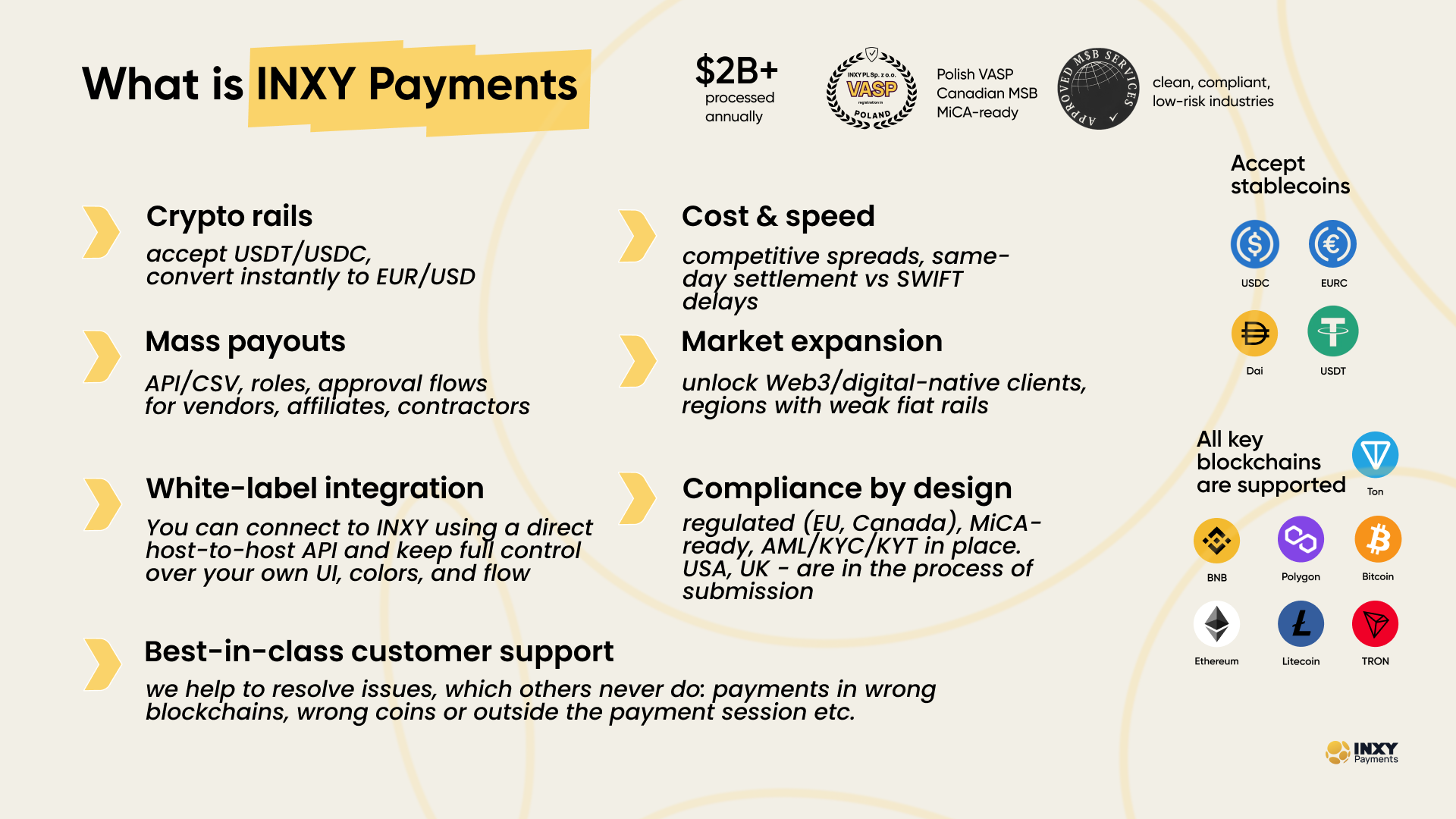
If your business runs on euros, you can settle in euros on-chain — fast, global, and MiCA-compliant. INXY's EURC mass payouts let you fund and pay in euros without the FX round-trip or the crypto overhead. New to the asset? Compare it with the dollar option in EURC vs USDC.
This article is general information, not financial or legal advice.