
A global fintech and crypto strategist with experience across 80+ countries and 25 residencies, beginning in Nigeria. Combines deep cross-continental market insights, regulatory expertise, and hands-on sector engagement to guide international expansion in payments, blockchain, and digital finance.
Specialized in:
- Global crypto and fintech market entry
- Cross-border regulatory navigation
- Emerging market strategy in digital finance
- Blockchain adoption and payment infrastructure
- Focused on scalable, compliant financial innovation across diverse economic landscapes.
More atricles by author

Payoneer Alternatives for Mass Contractor Payouts
Most companies searching for a Payoneer alternative are reacting to their contractors' fees, not their own. Five payout options compared on published fees, batch size and who pays for conversion, plus the cases where Payoneer is still the right answer.

Most companies that look for a Payoneer alternative are not annoyed about their own fee. They are annoyed about their contractors’ fees.
A contractor in Manila invoices 3,000 USD. You pay it in full. She withdraws to her peso account and loses up to 2%, or up to 60 USD, before her bank takes its own cut. Every month. You never see it in your P&L. In month six it comes back to you as a rate-increase request.
This article compares five payout options on published fees, batch size and who pays for conversion. It also names the cases where Payoneer is still the right answer.
All competitor figures below come from each vendor’s own pricing, product or support pages, read between 26 September and 6 October 2026. Prices change often. Re-check every number before it goes into a business case. “Not published” means the vendor does not disclose the figure, not that it is zero.
Diagnose the complaint before you shortlist anything
“Payoneer alternative” is one search for three different problems. Each one has a different answer.
The payee-side deduction. Your payees convert to local currency and lose a percentage you never see. Payoneer’s published fees include up to 2% to withdraw to a local bank account in a different currency, and a fixed 1.50 EUR or 1.50 GBP for a same-currency withdrawal (payoneer.com, read 26 September 2026). The payee carries that cost, and their bank may add its own.
The account, not the price. Ad networks, affiliate platforms and some marketplace models get offboarded, not overcharged. That is a risk decision about the provider’s portfolio. No pricing page will warn you it is coming.
The batch shape. Payoneer’s batch payments product takes up to 1,000 transfers to external accounts, or up to 500 Payoneer-to-Payoneer payments, per file. Recipients do not need a Payoneer account. Coverage is 190+ countries and territories and 70+ currencies. Payoneer-to-Payoneer transfers typically clear within 7 seconds. Batch fees are not published (payoneer.com/batch-payments, read 26 September 2026).
If your complaint is the third one, a cheaper vendor with the same setup will not fix it. Large, regular payout runs need an API, clear approvals and one clean reconciliation file. That is an operations problem dressed up as a pricing problem.
The comparison table
Figures as published by each vendor, read between 26 September and 6 October 2026.
| Option | Architecture | Published headline cost | Batch payouts | Who bears the conversion | Payee needs an account? |
|---|---|---|---|---|---|
| Payoneer | Fiat network + bank rails | Up to 2% cross-currency withdrawal; 1.50 EUR / 1.50 GBP same-currency withdrawal; batch fees not published | File: up to 1,000 external / 500 Payoneer-to-Payoneer per file | Usually the payee | No, for external bank transfers |
| Wise Business | Fiat multi-currency | Conversion from about 0.2%* against the mid-market rate; one-time account fee | Spreadsheet or API, up to 1,000 payments per batch | Sender, at the mid-market rate | No |
| PayPal Payouts | Wallet | 2% per payout, up to a maximum cap; caps vary by country and by domestic vs international; conversion charged on top | Up to 15,000 payments per API call | Sender pays the fee; conversion extra | Yes, the recipient must log in or create one |
| Deel / Remote (contractor admin & EOR) | Employment + admin layer | Deel: 49 USD per contractor / month, 599 USD per EOR employee / month. Remote: 29 USD per contractor / month, 699 USD per EOR employee / month (monthly billing) | Pays contractors in one run; priced per head | Built into the platform, not itemised | Yes, a platform account |
| Stablecoin rails (e.g. INXY Payments) | On-chain settlement, funded in EUR/USD | Fees from 0.1%, depending on volume, currency and corridor; no setup or monthly fees | CSV file or API | Sender funds in EUR/USD; payee bears their own off-ramp | A wallet address or an exchange deposit address |
*Wise prices differ by country page: 0.23–0.24% on the pages we checked. “From” is the best corridor, not the typical one.
Sources: payoneer.com pricing and batch-payments pages; wise.com/pricing/business and Wise batch payments; paypal.com merchant fees and developer.paypal.com Payouts docs; deel.com/pricing; remote.com pricing; inxy.io. Read 26 September – 6 October 2026.
Where Payoneer is still the better answer
Three cases. They are not edge cases.
Your payees are already inside the network. Payoneer-to-Payoneer transfers skip correspondent banking and typically clear within 7 seconds (payoneer.com, 26 September 2026). If most of your contractors already hold Payoneer accounts because a marketplace put them there, moving them elsewhere means re-onboarding thousands of people to save basis points. The migration costs more than the spread.
You need bank-account reach and the payee should not learn anything new. 190+ countries and 70+ currencies, paid to an ordinary local bank account. No wallet, no exchange, no new app. Nothing in the stablecoin category matches that for a payee who does not want to think about how the money moves.
Your payees receive as well as pay. Freelancers who invoice, get paid by several platforms and hold a multi-currency balance use Payoneer as an account, not as your payout rail. Replacing it on your side does not remove it from theirs.
Bottom line: Payoneer’s cost sits in the conversion legs. It is strongest where conversion is rare, and weakest where every payout ends in a conversion to a local currency.
Wise Business: clean FX, careful underwriting
Wise publishes conversion from about 0.2% against the mid-market rate. Its batch payments take up to 1,000 payments by spreadsheet or API. Recipients get paid into their own bank account in their own currency, and they do not need a Wise account (wise.com, read 26 September 2026).
For a company paying contractors in mainstream corridors, this is the clearest cost structure in this comparison. Reconciling against a published mid-market rate is also easier to defend in an audit than reconciling against a blended rate.
One caveat on the number. “From” is the best case. Conversion into many Asian, African and LatAm currencies costs more. Price your own corridors, not the headline.
Where Wise loses: fit, not price. Wise publishes an acceptable use policy that restricts a number of business types. If your vertical sits close to that list, test onboarding before you build an integration. A cheap rail you lose in month seven costs more than a dearer rail you keep. Wise also runs on bank rails. Where correspondent banking is slow or rejects the destination, the software cannot fix the rail underneath.
PayPal Payouts: a small fee, a costly conversion
PayPal charges 2% per payout, up to a maximum cap. Caps vary by sending country and by domestic versus international payouts. On the US fee page, the USD cap is 1.00 USD per payout, or 0.25 USD through the Payouts API. Currency conversion is charged on top. The sender pays the fee, not the recipient (paypal.com and developer.paypal.com, read 6 October 2026).
You can send up to 15,000 payments in one API call. Per-payment limits are 60,000 USD for registered and 20,000 USD for unregistered recipients (55,000 / 17,000 EUR; 50,000 / 15,000 GBP). Payouts support 24 currencies. Recipients are identified by email, phone number or PayPal ID.
The cap changes the math. Where it applies, the fee on a 4,000 USD payout is a fraction of a percent. The real cost sits elsewhere: currency conversion, and what the recipient pays to move money out of PayPal and into a bank.
Where PayPal loses: the recipient must have a PayPal account, or create one, to get the money. An unclaimed payout is a payout that has not happened. Account holds on the recipient side are a real operational risk, and they never show up in a fee table.
Deel and Remote solve a different problem
Deel publishes 49 USD per contractor per month, 325 USD per contractor of record per month and 599 USD per EOR employee per month (deel.com/pricing, read 26 September 2026). Remote publishes 29 USD per contractor per month for contractor management and 699 USD per employee per month for EOR on monthly billing (remote.com, read 6 October 2026).
These are prices for employment and admin work: contracts, onboarding, tax forms, local compliance and, for EOR, being the legal employer. If you need that, buy it.
But look at the unit. You pay per person, per month, no matter how much you pay that person. On a 4,000 USD monthly invoice, 49 USD is about 1.2%. On a 40 USD affiliate payout, it is more than the payout. Run 2,000 small, irregular payees through a per-head platform to fix a payment problem, and you have bought the wrong product.
Changing the rail does not change anyone’s employment status. Classification depends on control, integration, exclusivity and who carries business risk. It does not depend on the currency or the network of the payment. For digital labour platforms, the EU Platform Work Directive, Directive (EU) 2024/2831, introduces a presumption of employment where the facts show direction and control. The platform has to prove otherwise. Member states must transpose it by 2 December 2026. That date belongs on the payments roadmap, not only the legal one.
Stablecoin rails: what changes, and what does not
What changes: settlement stops depending on correspondent banks. Value moves in minutes, on any day, including to destinations your bank may decline. With a hybrid rail you fund in EUR or USD, and your books never leave fiat.
INXY Payments works this way. You fund the payout in EUR or USD. INXY converts and sends USDT, USDC or other supported assets on networks such as Ethereum, Tron, BNB Chain, Polygon and TON. Fees start from 0.1%, depending on volume, currency and corridor, with no setup or monthly fees. Under the hood, each flow is routed to the regulated entity and rails that fit it. You see one account, one balance and one report.
Screening runs before a payout leaves, not after it lands. That covers KYT, sanctions and Travel Rule checks, with Elliptic, Sumsub and Notabene in the stack. The Travel Rule comes from FATF Recommendation 16: originator and beneficiary data travel with crypto transfers. In the EU it is written into Regulation (EU) 2023/1113, with no minimum amount between crypto service providers.
What does not change: the payee still converts. Their local exchange, their spread, their bank’s view of crypto-origin deposits. You have moved the conversion, not removed it. And unlike with Payoneer, you now cannot see it at all. Before you roll anything out, ask a sample of payees per corridor what they net after conversion.
Nor is the rail a default for everyone. BCG and Allium put business-to-individual payouts (contractor pay, creator earnings, refunds and rebates) at about 10% of real-economy stablecoin payment volume. They name strong domestic fiat rails in developed markets, regulation and tax treatment as the brakes (Stablecoin Payments: The Truth Behind the Numbers). Stablecoin rails win where a bank corridor is failing, not because the rail is newer. The mechanics of running one are in our guide to stablecoin payroll, and the wider vendor landscape is in best mass payout platforms in 2026.
What breaks in production
Five failures that show up in month three, not in the demo.
The right address on the wrong chain. Ethereum, BNB Chain and Polygon share the 0x address format, so one address is valid on all three. A payee watching one chain reports a missing payout that is sitting on another. Put the network in the contract and in the batch file. Never guess it from the address format.
The wallet-change email. Shortly before payday, a message that looks like it comes from a contractor asks you to update their payout details. On-chain transfers cannot be recalled. A new address takes effect only after confirmation through a separate, already-verified channel. That rule is the only control you have.
The payday screening hold. KYT flags a recipient address for indirect exposure, and the hold lands on payday. The hold is correct. Screen at onboarding, re-screen before each batch, and decide in advance who resolves a flag and how fast.
Rate drift between preparing and approving. A batch in EUR prepared on Thursday and approved on Monday reprices on a fresh quote. The approver signs a different total from the one the preparer built. Approve on the refreshed quote.
The network fee nobody assigned. Every on-chain payout carries a network fee. Decide in the contract who covers it, you or the payee, and set it the same way in every batch. Otherwise a 500 USDT invoice arrives as slightly less, and someone opens a ticket. See mass crypto payouts for how file and API batches handle fees and statuses.
How to run the evaluation
- Export your last three payout runs. Payee count, ticket sizes, destination countries, currencies. The distribution decides the architecture, and the architecture rules out most of the market.
- Split the file by payout shape. Many small payouts and a few large ones rarely belong on the same rail.
- Ask each payee where the money actually goes: a local bank account, an exchange, a wallet or an existing platform account.
- Price the payee’s leg, not only yours. Sample five payees per corridor and record what they net.
- Ask for the funding-to-execution window. Treat pre-funding as a financing line, not an operational detail.
- Ask how batches run at your volume: file, API or both. Then ask what happens to the other rows when row 14 is rejected.
- Ask what the reconciliation export contains: transaction reference, fiat value at execution, rate used, and fee lines broken out by type.
- Test underwriting early. Name your vertical in the first call, not after integration.
- Run one real batch in parallel with your current provider for a full cycle before you migrate. One month of double fees beats one quarter of clean-up.
Which one, when
| Your situation | The answer |
|---|---|
| Payees already hold Payoneer accounts; moderate volume | Payoneer. Transfers inside the network skip correspondent banking, and re-onboarding costs more than the spread |
| Mainstream corridors; transparent FX is the priority; your vertical onboards easily | Wise Business. From about 0.2% against the mid-market rate, batch payouts by file or API |
| Payees already use PayPal; payouts mostly stay in one currency | PayPal Payouts. The capped fee is low. The costs start when money changes currency |
| You need contracts, tax forms, onboarding or a legal employer | Deel, Remote or another EOR. The rail is not your problem; employment admin is |
| Dozens to thousands of contractors across Asia, LatAm and non-euro Europe; the bank corridor is slow, costly or rejected; accounting must stay in EUR/USD | A hybrid stablecoin rail such as INXY Payments. Corridor reach without handing finance a crypto ledger |
| Payees in the euro area with EUR accounts | SEPA or SEPA Instant. A token adds two conversions and gains nothing |
| Payees in the UK or the US | Usually a domestic bank rail. Both markets have strong local rails, and a stablecoin adds conversions without solving a problem |
| Payees with no reliable local off-ramp | Not a stablecoin rail. You would move cost and risk onto the person you pay, not remove it |
| Mixed base | Two rails, split by corridor. One rail for everyone is a preference, not a requirement |
Start from your own payout export, not from a vendor list. If the rows sit in corridors your bank handles badly, and your finance team needs the ledger to stay in EUR or USD, that is the case INXY Payments is built for. The token mechanics for a USDT-heavy file are in mass payout in USDT. If the rows sit in Frankfurt and Madrid, keep SEPA and spend the time elsewhere.
Either way, bring real data to the conversation. Compare your current payout flow with our team: three months of payout exports are worth more than any pricing page.
This article describes regulatory and market conditions for general information. It is not legal, tax or financial advice. INXY Payments is a payment infrastructure provider, not a law or accountancy firm. Decisions with regulatory consequences should be reviewed by qualified counsel in the relevant jurisdiction.
FAQ
What is the best Payoneer alternative for mass contractor payouts?
There is no single answer, because three different complaints drive the search. If the problem is payee-side conversion cost, compare Wise Business. If it is corridor reach or settlement speed, compare stablecoin rails. If it is contracts and tax admin, you need an EOR or contractor platform, not a payout rail. Diagnose the complaint first.
Does Payoneer charge the sender or the recipient?
Both, in different places. The sending company pays for the payout product; batch fees are not published. The payee pays to withdraw: up to 2% into a different currency, or a fixed 1.50 EUR or 1.50 GBP in the same currency (payoneer.com, 26 September 2026). You will not see the payee’s part.
Can I pay contractors abroad without a local entity?
For genuine independent contractors on a business-to-business contract, yes. No entity is needed to pay them, on any rail. If the people in fact work like employees, you need your own entity or an employer of record, and no payment method changes that. Classification depends on control, integration and exclusivity, not on the rail.
How many payees can I pay in one batch?
It depends on the product and the method. Payoneer publishes up to 1,000 external transfers or 500 Payoneer-to-Payoneer payments per file. PayPal allows up to 15,000 payments per API call. Wise batch payments take up to 1,000. For large, regular runs, an API usually beats file uploads.
Is a stablecoin rail cheaper than Payoneer or Wise?
On the sending side it often is: INXY’s fees start from 0.1%, depending on volume, currency and corridor, with no setup or monthly fees. The comparison is only honest once you add the payee’s own conversion, which no provider quotes. Sample real payees per corridor and compare what they net, not the headline percentages.
Where are stablecoin payouts the wrong choice?
Where payees are in the euro area with EUR accounts, where they are in the UK or the US with strong domestic rails, where they have no reliable local off-ramp, where you pay only a handful of people, or where your real problem is approvals and tax forms rather than the rail. In those cases a bank rail or AP automation is the better buy.
Stablecoin Payroll Fixes the Rail, Not the Employer
Stablecoin payroll moves contractor pay in minutes instead of days, but it does not change who your team legally works for. How to pay a global team in USDC or USDT without a local entity, when you need a payroll platform versus just a payment rail, and a nine-step batch sequence.
A contractor in Manila invoices EUR 3,000. You send it by SWIFT on the 28th. It arrives days later, an intermediary bank has taken its cut, and the amount that lands matches neither the invoice nor your ledger. Stablecoin payroll fixes that part: value moves in minutes, on any day of the week, and arrives at the amount you sent. What it does not fix is who your team legally works for. This article covers both: how to pay a global team in USDC or USDT without a local entity, and where the rail stops being the answer.
What stablecoin payroll is, and what it is not
Stablecoin payroll is paying people, usually contractors, in a fiat-pegged token such as USDC or USDT instead of by bank transfer. The company funds in EUR or USD, the payment settles on-chain in minutes, and the recipient holds the token or converts it to local currency. It changes the payment rail, not the employment relationship or its tax obligations.
The word "payroll" oversells it. Payroll for employees means withholding income tax, paying social contributions, issuing payslips and filing returns in the employee's country. You cannot do any of that without being registered as an employer there, either through your own entity or through an employer of record (EOR). A stablecoin transfer does none of it.
So in practice, "stablecoin payroll without a local entity" means one of two things: paying independent contractors directly, or paying through an EOR that itself funds or disburses in stablecoins. Everything else is marketing.
The honest size of the opportunity is also smaller than the headlines. BCG's analysis of on-chain real-economy payments puts business-to-individual payouts (contractor payments, creator earnings, refunds and rebates) at about 10% of stablecoin payment volume. It names the brakes: strong domestic fiat rails in developed markets, regulatory considerations and tax treatment (BCG and Allium, Stablecoin Payments: The Truth Behind the Numbers). Stablecoin payroll wins where a bank corridor is failing, not because the rail is new.
Three ways to pay a team abroad without an entity
Before choosing a rail, choose the legal structure. The rail follows from it.
| Model | Legal employer | Who handles tax withholding | Role of the stablecoin | Where it breaks |
|---|---|---|---|---|
| Own local entity | You | You, in each country | Optional, for funding the entity | Months of setup per country; overkill for a handful of people |
| Employer of record (EOR) | The EOR | The EOR | Some EORs accept funding or pay out in stablecoins; salary obligations are unchanged | Per-head monthly cost; you still need a cross-border route to fund the EOR |
| Direct contractor payouts on a stablecoin rail | Nobody. It is a B2B contract | The contractor, in their own country | The rail itself | Misclassification, if the contractor in fact works like an employee |
| Freelance platform or marketplace | Nobody, unless local rules say otherwise | The contractor | The platform's payout rail | Platform fees; EU platform-work rules from December 2026 |
For most companies reading this, row three is the relevant one: a contractor base spread across Asia, LatAm and non-euro Europe, paid monthly or per milestone. The mechanics of that row are covered in our practical guide to paying contractors and affiliates in USDC. This article covers the decisions around it.
Do you need a payroll platform, or just a payment rail?
Before choosing how to pay international contractors, ask a blunter question: what are you actually paying the intermediary for?
Contractor and payroll platforms such as 4DEV, Garna, Finboo and EasyStaff can do much more than move the money. Depending on the provider and the arrangement, they may handle contracts, invoices, closing documents and contractor administration. For a company that needs that layer, the service has real value.
Not every company does. Some already manage their contractor relationships themselves: the contracts are signed, the amount due is known, and nobody needs a third party to produce the supporting documents for each payment.
The cost of that layer is easy to miss. A typical contractor payment platform may charge around 3% for the service, with another 1–2% where currency conversion is required. That can bring the total cost of the flow close to 5%. For a company paying $1,000,000 a month to international contractors, the difference is material.
| Contractor platform | INXY payment infrastructure | |
|---|---|---|
| Monthly payouts | $1,000,000 | $1,000,000 |
| Example total cost | ~5% | ~0.5% |
| Monthly cost | ~$50,000 | ~$5,000 |
| Annual cost | ~$600,000 | ~$60,000 |
In this example, the payment flow through INXY costs 10x less, and in many payment flows the gap is 5x or more. The reason is the model, not a discount. A contractor platform sits between the company and the contractor and charges for the administrative layer around the transaction. INXY provides the infrastructure for the payment itself: you pay your contractors directly, and INXY handles conversion, the blockchain infrastructure, AML, KYT, transaction monitoring and reporting behind the scenes.
AI is making the administrative layer cheaper to run in-house. Creating one invoice was always easy. Creating hundreds of correctly structured invoices and payment records every month used to mean hours of repetitive finance work, which is why outsourcing the whole workflow made sense. AI and modern finance tools now automate much of the generating, checking and processing of that documentation. That does not remove legal, tax or employment obligations, but for a company that already manages its contractors internally, it changes the economics of paying a platform to do it.
So the question becomes: are you paying 3–5% because you need contractor administration, or because it was the easiest way to make the payment? If you need an EOR, employment administration, tax handling, contracts or local compliance support, use a provider that offers those services. If your contractors are genuine independent businesses, your contracts are in place and you can manage the documentation yourself, you may not need another company between you and the people you pay. You may only need a better payment rail.
The risk no payment vendor puts on the landing page
Paying someone in USDC does not make them a contractor. Classification depends on how the work is done: who controls the hours, whether the person is integrated into your organisation, whether they work only for you, and who carries the commercial risk. The currency of the invoice plays no part in it.
Someone paid the same amount on the same day every month, working your hours, with a company email address and a line manager, looks like an employee to a tax authority. That holds whether the money arrived over SEPA or TRON. A cheap, fast rail makes it easy to scale a contractor base in a country where you have no entity, and that is exactly when the classification question tends to get skipped.
For platforms, 2026 has a hard date. The EU Platform Work Directive, Directive (EU) 2024/2831, introduces a legal presumption of employment for people working through digital labour platforms where the facts indicate control and direction. The burden of rebutting that presumption sits with the platform. Member states must transpose it by 2 December 2026. For a freelance marketplace or payroll platform paying through stablecoin rails, this matters more this year than any crypto regulation does.
INXY Payments is payment infrastructure. We move, screen and settle the money; we do not determine anyone's employment status, and neither does any other payment provider. That decision belongs to you and your counsel, and it should come before the first batch, not after the first audit letter.
How the money moves: three legs, one of which you do not control
Every stablecoin payroll run has three legs. Most evaluations only look at the middle one.
Leg 1: funding, which runs on banking hours
You fund in EUR or USD from your company bank account. On INXY, conversion is automatic and your accounting stays in EUR or USD; the finance team never has to hold a wallet or pay gas.
The catch is timing. The chain settles 24/7, but your bank does not. To pay on Monday the 1st, the funding has to clear before Friday's banking cut-off. That means holding a pre-funded balance over the weekend: a small treasury float that nobody puts in the business case, and that every payroll calendar has to allow for.
Leg 2: on-chain settlement, which is the easy part
The transfer itself settles in minutes. The decisions are which token and which network.
On network, the market has already chosen for most corridors. BCG and Allium find TRON carries 60–80% of real-economy stablecoin payment flows, though its share fell from about 74% to about 60% across 2025 as Ethereum, Solana, BNB Smart Chain and Polygon gained. USDT on TRC-20 is still what most contractors in Asia and LatAm can receive and cash out locally. For EEA-facing counterparties, USDC is the practical default because it is authorised as an e-money token under MiCA. The trade-offs are covered in USDT vs USDC for business payments and what each USDT network actually costs.
INXY settles across 20 supported cryptocurrencies on ERC-20, TRC-20, BEP-20, Polygon, TON and other networks, so a single batch can pay each contractor on the network they actually use.
Leg 3: the payee's off-ramp, which sets their real pay
The contractor turns USDT into pesos, lira or rupiah through a local exchange, an OTC desk or a payment app. Their spread, their exchange's reliability and their bank's attitude to crypto-origin deposits all apply here, and you see none of it.
This is the leg that decides whether the programme lasts. A payout that is cheap on your side and expensive on theirs comes back six months later as a rate-increase request. Ask a sample of payees what they actually net after conversion, per corridor, before you roll out.
Who carries the exchange-rate move
Decide this in the contract, not on payday. There are three common set-ups:
- Invoice in EUR, pay the USDT equivalent at payout time. The contractor receives the EUR value; you carry the conversion.
- Invoice in USD, pay USDC one to one. Clean for USD-based companies. A company with EUR books carries the EUR/USD move.
- Invoice in the contractor's local currency. This gives you the most exchange-rate exposure and the most reconciliation work. Avoid it unless the contractor insists.
Running a stablecoin payroll batch: the sequence
This is the order that holds up under an audit. Steps 1–4 happen once per payee; steps 5–9 happen every cycle.
- Classify and contract. A written B2B contract that states the invoice currency, the token and network of payment, who pays the network fee, and which exchange rate applies.
- Onboard each payee. Collect identity data, the wallet address, the token and the network. The EU Transfer of Funds Regulation, Regulation (EU) 2023/1113, requires originator and beneficiary information to travel with crypto-asset transfers regardless of amount, with additional checks where a self-hosted wallet is involved. It implements FATF Recommendation 16. Collect this once, at onboarding, not at 17:00 on payday.
- Verify the address with a test transfer, and confirm receipt through a channel other than the one the address came in on.
- Put wallet changes behind a second channel. A new address takes effect only after a call or a confirmation in a separate, already-verified channel.
- Fund the balance before the banking cut-off that precedes payday.
- Build the batch. One row per payee, amounts in fiat or in tokens, uploaded as a file or sent by API.
- Let validation and screening run. On INXY, a batch passes format checks, address and network compatibility checks, KYT screening of recipient addresses, and balance and exchange-rate checks before it can be executed. A flag here is a held payment, not a bug. Decide in advance who resolves it and how quickly.
- Approve and execute, with a second approver for anything above a threshold you set.
- Reconcile each payout and send each payee a statement showing the amount, token, network, transaction hash, and the fiat value and exchange rate used. Contractors need the fiat value at receipt for their own tax records. Sending it proactively costs less than answering forty emails in April.
For the batch mechanics in more depth, see mass crypto payouts.
What breaks in production
These are the failures that show up in month three, not in the demo.
The right address on the wrong chain. Ethereum, BNB Smart Chain and Polygon share the same 0x address format, so an address is valid on all three. A payee who watches only one chain reports a "missing" payout that is in fact sitting on another. With self-custody the funds can usually be reached; with an exchange deposit address that does not support that network, recovery is at the exchange's discretion. Put the network in the contract and in the batch file, and never infer it from the address format.
The wallet-change email. Shortly before payday, an email that appears to come from a contractor asks you to update their wallet. On-chain transfers cannot be recalled. Payroll redirection fraud already happens on bank rails; on a stablecoin rail, the second-channel rule in step 4 is the only control you have.
The payday screening hold. KYT flags a recipient address because an exchange deposit address has had indirect exposure to a risky counterparty. The hold is correct, but it lands at the worst moment. Screen at onboarding, re-screen before each batch, and tell affected payees before they notice.
Rate drift between preparing and approving. A fiat-denominated batch is prepared on Thursday and approved on Monday. By then the quote has expired, the re-quote changes the total, and the approver signs off a different number from the one the preparer built. Approve on the refreshed quote, not the original.
The payee's off-ramp disappears. A local exchange pauses withdrawals, or a payee's bank starts rejecting crypto-origin deposits. You paid on-chain on time, but in practice the contractor has not been paid. Keep a fallback rail on file for every payee.
Network fees broken out by chain. A batch that pays across three networks produces three different fee lines. If your ledger books a single "contractor payroll" line, someone will chase the difference every month. Map the network fee to its own account from the first run.
When stablecoin payroll is the wrong answer
This is the section a vendor would normally leave out, so here it is plainly.
- Your team is in the euro area and has EUR bank accounts. SEPA and SEPA Instant are cheap and fast, and every accountant understands them. Adding a token adds two conversions and gains nothing.
- Your people are employees. Use an EOR or your own entity. The rail is a detail; the employment obligations are not.
- Your payees are in the UK or the US. INXY Payments does not serve those markets. Both also have strong domestic rails, which removes most of the reason to switch.
- Your payees have no clean off-ramp. If the only way to cash out is informal peer-to-peer trading, you have not removed cost and risk; you have moved them onto the person you are paying.
- You pay three people once a month. Onboarding, screening set-up and wallet verification are a fixed cost. At that scale, the bank transfer you already have may simply be cheaper to run.
Stablecoin payroll earns its place where the bank rail is weakest: contractors across Asia and LatAm with long correspondent chains, countries your bank rejects or delays, payees who want dollar-denominated pay in a volatile local currency, and contractor bases of dozens to thousands paid on a fixed cycle.
Decision framework
Pick by payee, not by rail.
| Your situation | Use |
|---|---|
| You need employment, tax or contractor administration | An EOR or a contractor management platform |
| You need invoices and document administration handled for you | A contractor or payroll platform |
| You already manage contracts and documents internally and mainly need to pay contractors globally | Direct stablecoin payouts through payment infrastructure |
| Employees in a country where you have no entity | An EOR or your own entity. Stablecoins are optional, for funding only |
| Contractors in the euro area with EUR accounts | SEPA |
| 10+ contractors in Asia or LatAm, and the bank corridor is slow or rejected | A stablecoin rail: USDT on TRC-20 where payees cash out locally, USDC where counterparties are EEA-regulated |
| A mixed team | Run both rails and let each payee's corridor decide |
| A freelance platform paying thousands of workers in the EU | A stablecoin rail, plus a classification review before 2 December 2026 |
If the third, sixth or last row describes you, that is the problem INXY Payments is built for. You fund in EUR or USD. Payouts settle on-chain across the networks your contractors use. Each payout passes KYT, sanctions and Travel Rule screening before it leaves, with Elliptic and Sumsub in the compliance stack. Your books stay in fiat. Pricing is a transaction fee below 1%, with no setup, monthly or hidden fees. See how it works for crypto payroll and contractor payouts for global teams, or book a demo and bring your payee list. Knowing which corridors your team is actually in is usually enough to tell whether stablecoin payroll will pay for itself.
This article describes regulatory and market conditions for general information. It is not legal, tax, or financial advice — INXY Payments is a payment infrastructure provider, not a law or accountancy firm, and decisions with regulatory consequence should be reviewed by qualified counsel in the relevant jurisdiction.
FAQ
Is it legal to pay contractors in USDC or USDT?
In many jurisdictions, paying an independent contractor in a stablecoin is permitted when both parties agree to it in the contract. How the contractor must report that income, and at what fiat value, varies by country and changes over time. Check the position for each country where you have contractors with qualified counsel, and give every payee the fiat value at receipt.
Can I pay employees in stablecoins?
Employee pay is governed by local wage, tax and social-security rules, and many countries regulate the form in which wages can be paid. Withholding obligations apply whatever the payment method. If you have employees in a country without a local entity, use an employer of record. Some EORs work with stablecoins, but the employer obligations stay with the EOR.
Do I need a local entity to pay contractors in stablecoins?
No, not for genuine independent contractors on a B2B contract. You need an entity or an EOR if the people are in fact employees, and the payment rail does not change which one they are. Classification depends on control, integration and exclusivity, not on whether the invoice is paid over SEPA or on-chain.
Should stablecoin payroll use USDT or USDC?
Use whichever token each payee can actually receive and convert locally. In most of Asia and LatAm that is USDT, commonly on TRC-20. For counterparties in the EEA it is USDC, which is authorised as an e-money token under MiCA. Many contractor programmes run both and record each payee's token and network at onboarding.
How do contractors convert stablecoins to local currency?
Through a local exchange, an OTC desk or a payment app that supports withdrawal to a local bank account. The conversion spread is paid by the contractor and is invisible to you, so ask a sample of payees what they net after conversion in each corridor. An off-ramp that is expensive for them eventually shows up as a higher rate for you.
How fast is stablecoin payroll?
The on-chain transfer typically settles within minutes and runs 24/7. The slower legs are at either end: your fiat funding, which follows banking hours and cut-offs, and the payee's conversion to local currency. Fund before the last banking day ahead of payday so the batch can run on schedule.
How to Accept USDT Payments on Your Website
Accepting USDT is a two-day integration and a six-month operational commitment. This guide covers the full path from sandbox to production: choosing between direct wallet, crypto settlement and fiat settlement, picking networks and confirmation depth, a nine-step integration sequence, five webhook rules that prevent double-crediting, chart-of-accounts mapping through a settlement clearing account, and the failures that show up after go-live.
Accepting USDT is a two-day integration and a six-month operational commitment. The integration is the easy part: a checkout call, a webhook endpoint, a settlement report. What takes longer is everything after go-live — underpayments, wrong-network sends, a webhook that fired three times, and a finance team asking why the settlement total does not match the order total. This guide covers the full path: sandbox to production, webhook handling that survives retries, reconciliation, chart-of-accounts mapping, and the failures that show up in week three.
Decide the model first: direct wallet, gateway, or converted settlement
This decision determines everything downstream, and reversing it later means re-doing the reconciliation.
Direct wallet acceptance. You generate an address, the customer sends USDT, you hold USDT. No provider fee — but you now own address generation, network monitoring, confirmation logic, underpayment handling, refunds, key custody, KYT and sanctions screening. For most businesses that is not a saving; it is an unstaffed payments team.
Gateway with crypto settlement. The provider handles checkout, addresses and confirmation, then settles USDT to your wallet. You keep the token, the price exposure and a cryptoasset on your balance sheet.
Gateway with fiat settlement. Same checkout flow, but the provider auto-converts at confirmation and settles EUR or USD to your bank. Your ledger never holds a cryptoasset and your exposure window is minutes rather than days.
For most merchants the third option is correct, and the reason is not technical: the first two push a treasury and compliance function into a company that did not plan to have one. Crypto payment gateway vs processor sets out how the roles differ. The rest of this guide assumes a gateway integration with fiat settlement — the flow INXY Payments runs across 20 supported cryptocurrencies with next-day bank settlement.
Pick the networks before you write code
USDT is one token on several networks, and they are not interchangeable. A customer who sends TRC-20 USDT to an ERC-20 address has lost the funds, and no amount of support can recover them.
| Network | Block time | Practical finality | Typical merchant use |
|---|---|---|---|
| Tron (TRC-20) | 3 seconds | Solidified once at least 19 of 27 active super representatives have produced a block at that height or above — in practice about 1 minute (TRON developer documentation) | Default for low-value, high-volume checkout and for Asia/LatAm payers |
| Ethereum (ERC-20) | 12-second slots, 32 slots per epoch (6.4 minutes) | Finalised across checkpoint epochs — roughly 13 minutes in practice (ethereum.org) | Higher-value payments, counterparties who require it |
| BNB Smart Chain (BEP-20) | Sub-second to seconds | Provider-defined confirmation depth | Cost-sensitive alternative where payers already hold BEP-20 |
| Polygon | Seconds | Provider-defined confirmation depth | Cost-sensitive, increasingly requested |
The practitioner's rule: support the networks your payers actually use, not every network you can. Each extra network is another address type, confirmation rule, support queue and reconciliation column. Start with two. How USDT network fees compare has the cost detail.
Confirmation depth is a commercial decision, not a technical one. Crediting at one confirmation is fast and carries reorg risk; waiting for finality is safe and costs the customer minutes. For instantly delivered digital goods most merchants credit at the provider's standard depth; for anything irreversible and high-value, wait for finality. Decide it explicitly and check that your provider's default matches.
The integration sequence: sandbox to production in nine steps
- Complete KYB before you write anything. Gateway onboarding requires company documents, UBO identification, a description of your business model and often your website in a reviewable state. It is the longest-lead item in the project and teams routinely start it last. How to verify a merchant account sets out what is collected.
- Get sandbox credentials and read the invoice lifecycle. Every gateway models a payment as an object with states — created, pending, underpaid, confirmed, expired, failed. Map those states to your own order states on paper before you write code. Most integration bugs are state-mapping bugs.
- Create a payment on the server side, never the client. The amount, currency, order reference and callback URL are set by your backend. A client-settable amount is an open invitation, and it is the single most common security defect in crypto checkout integrations.
- Handle the rate lock window explicitly. The gateway quotes a USDT amount against your fiat price and holds it for a fixed window. If the customer pays after expiry, the payment arrives short or long in fiat terms. Display the countdown, and decide in advance whether an expired-but-paid invoice is auto-recredited or manually reviewed.
- Build the webhook endpoint before the checkout page. It is the part that carries the risk, and it needs to exist before you can test anything end to end. Details in the next section.
- Test the failure cases, not the happy path. In sandbox, deliberately produce: an underpayment, an overpayment, a payment after invoice expiry, a duplicate webhook delivery, an out-of-order webhook delivery, and a webhook your endpoint rejects with a 500. If you have not seen all six in sandbox, you will see them in production instead.
- Wire up the settlement report and hand it to finance before go-live. Not after. If the export does not carry, per row, the order reference, the gross fiat amount, the fee, the FX rate applied and the settlement date, your month-end will not close cleanly. This is the step teams skip and regret.
- Go live with one network and a payment cap. Cap the maximum invoice value for the first two weeks. It converts a potential six-figure incident into a three-figure one while your confirmation and reconciliation logic proves itself.
- Reconcile manually for one full cycle. Match every settlement line to an order by hand for the first month. It is how you find the edge case in your state mapping while the volume is still small enough to fix.
Webhook handling: five rules that prevent the expensive bugs
The webhook is where a payment integration succeeds or quietly breaks. Treat it as an untrusted network endpoint that will be called more than once, out of order, and occasionally by someone who is not your provider.
1. Verify the signature before parsing anything. Compute the expected signature over the raw request body — not a re-serialised object, because re-serialisation changes byte order and the signature will not match — and compare in constant time. Reject and log failures.
2. Make the handler idempotent. Key on the provider's payment identifier, not your order ID. Record processed identifiers and return success without re-processing. Webhook delivery is at-least-once by design, so retries are normal, and a non-idempotent handler will credit the same order twice.
3. Never treat the payload amount as your source of truth. Verify server-side against the provider's API before fulfilling. A signature proves the message came from your provider; fetching the object proves the current state.
4. Respond fast, process asynchronously. Return 2xx as soon as the event is persisted, then fulfil on a queue. Inline fulfilment times out under load, the provider retries, and you are back to rule two.
5. Do not assume ordering. A confirmed event can arrive before the pending event preceding it. Drive order state from the event's own state field and a timestamp, never from arrival order.
And make sure the endpoint is reachable. IP allowlists, WAF rules and leftover staging basic-auth are a recurring go-live failure. Confirm delivery from the provider's dashboard on day one, not from your own logs.
Reconciliation and chart-of-accounts mapping
This is the part that determines whether your finance team supports the project in month three.
With fiat settlement, a USDT payment produces three distinct economic events that arrive at different moments: the customer's on-chain payment, the conversion to fiat, and the bank settlement. If your ledger treats them as one event, you will carry an unexplained variance every month.
A mapping pattern that works in practice:
| Event | Debit | Credit |
|---|---|---|
| Invoice issued | Trade receivable | Revenue |
| Payment confirmed on-chain, converted | Settlement clearing account (asset) | Trade receivable |
| Provider fee applied | Payment processing fees (expense) | Settlement clearing account |
| Conversion difference vs invoiced rate | FX gain/loss | Settlement clearing account |
| Bank settlement received | Bank | Settlement clearing account |
The clearing account is the control. It should net to zero once every batch has settled, and a persistent non-zero balance tells you exactly where the break is — unsettled, unmatched, or mis-rated. Without it, differences disappear into revenue and nobody finds them until audit.
Four requirements to put in the provider evaluation, not discover afterwards:
- Row-level settlement export with order reference, gross amount, fee, FX rate and settlement timestamp on every line.
- A stable order reference that survives from invoice creation to bank settlement. If the reference is lost at conversion, matching becomes manual.
- Consistent timezone handling. A settlement timestamp in the provider's timezone against orders in yours produces month-end cut-off differences every single period.
- Fees itemised, not netted. A net figure hides the fee and makes cost analysis impossible.
Accounting treatment for digital assets varies by jurisdiction and by reporting framework, and it changes. The mapping above is an operational pattern, not accounting or tax advice — confirm the treatment with your own auditors before you book it.
What breaks after go-live
Underpayments. The customer sends slightly less than invoiced, usually because their wallet deducted the network fee from the amount rather than adding it. Decide the policy before it happens: auto-accept below a tolerance threshold, hold for review above it, and make the threshold a configuration value rather than a code change.
Wrong-network sends. The dominant support burden in USDT acceptance. Mitigate at the interface: show the network prominently, use network-specific QR codes, never present a bare address without its network label, and put the warning next to the address rather than at the bottom of the page.
Duplicate order creation. A customer refreshes checkout and generates a second invoice for the same order, then pays the first one. Your order is now linked to an unpaid invoice. Key invoice creation on the order ID and return the existing invoice instead of creating a new one.
Refunds are outbound payments, not reversals. There are no chargebacks on this rail — a structural property, since there is no card scheme representment process — which removes a large category of loss. It also means a refund is a new payout to an address the customer supplies, with its own screening, its own network fee and its own operational process. Design the refund flow during integration, not on the first request.
Expired-invoice payments. A customer pays an hour after the rate window closed and the fiat value no longer matches the invoice. Without a written policy this lands on a support agent with no authority to decide it.
Staging credentials that outlive staging. Sandbox keys left in a production environment variable, or a production endpoint still pointing at a dev URL. Verify both directions on go-live day.
The decision framework
Do not start with the API documentation. Start with three questions, in this order:
- Where do your payers sit, and what network do they already use? A payer-data question, not an engineering one, and it settles which networks you support.
- Do you want a cryptoasset on your balance sheet? If no — and for most merchants the answer is no — the model is fiat settlement, which removes most of the treasury and accounting complexity before it exists.
- Who owns reconciliation? If the answer is “we'll work it out after launch,” involve finance now. Every integration that goes badly goes badly at month-end, not at go-live.
Get those three right and the integration is a short piece of work. Get them wrong and no amount of clean code fixes it.
Where this is not the right answer: if you sell primarily to domestic consumers in a well-banked market with working card acceptance and a low decline rate, adding USDT acceptance will produce a small share of volume and a real amount of operational overhead. Stablecoin acceptance earns its keep when cards are failing you — regional declines, chargeback ratios threatening your acquirer relationship, or cross-border settlement measured in days. If none of those describe you, the honest answer is that this is not your priority this quarter.
If they do describe you, the fastest path is a sandbox integration against your real checkout flow rather than a proof of concept. Get started for credentials, or book a demo if the reconciliation model is the part you need to settle first. For the developer-side detail, integrating a crypto payment API goes deeper on the API surface, and checkout design that converts covers the payer-facing half.
This article describes regulatory and market conditions for general information. It is not legal, tax, or financial advice — INXY Payments is a payment infrastructure provider, not a law or accountancy firm, and decisions with regulatory consequence should be reviewed by qualified counsel in the relevant jurisdiction.
FAQ
How do I accept USDT payments on my website?
Integrate a crypto payment gateway: create the payment server-side with the fiat amount and order reference, display the gateway's checkout with the correct network, verify the signed webhook when the payment confirms, and settle either in USDT or converted to fiat. Most merchants choose fiat settlement so no cryptoasset touches the balance sheet.
Which USDT network should I accept?
Support the networks your payers already use rather than all of them. TRC-20 is the common default for low-value, high-volume checkout, with ERC-20 added where counterparties require it. Each extra network adds address handling, confirmation rules, support load and a reconciliation column, so start with two.
How long does a USDT payment take to confirm?
It depends on the network and your chosen confirmation depth. On Tron, a block is solidified in about a minute once at least 19 of 27 active super representatives have built on it. On Ethereum, finality is reached across checkpoint epochs — roughly 13 minutes. Many merchants credit earlier and accept the residual risk.
What happens if a customer underpays?
The gateway marks the payment underpaid rather than confirmed. Set a tolerance threshold in advance: auto-accept small shortfalls, hold larger ones for review. Underpayment is usually caused by a wallet deducting the network fee from the sent amount rather than adding it, so it is common rather than exceptional.
Are there chargebacks on USDT payments?
No. On-chain settlement has no card scheme representment process, so the chargeback category of loss does not exist. Refunds still do — but a refund is a new outbound payment to an address the customer supplies, with its own screening and network fee, so the refund flow needs designing during integration.
How do we reconcile USDT payments in our accounting?
Route everything through a settlement clearing account. The on-chain payment, the conversion and the bank settlement are three separate events arriving at different times; the clearing account should net to zero once a batch has settled, and any residual balance points straight at the break. Require a row-level export with fee and FX rate per line.
TRC-20 vs ERC-20 vs BEP-20: What USDT Really Costs
TRON meters Energy, Ethereum runs a gas auction, BNB Chain does both cheaply — so a fee table comparing them flattens the thing that matters. What a USDT transfer actually costs on each, how fast it is final, and which network to send a payout batch on.
The TRC20 vs ERC20 question is usually answered with a fee table and left there. That answer is incomplete in a way that costs money at volume: the three networks price transactions using three different mechanisms, reach settlement finality on three different timescales, and fail in three different ways when they get busy. If you are sending one transfer, pick the cheapest. If you are sending a payout batch of four hundred, the cheapest network is frequently the wrong one, and this article explains exactly when.
What the three standards are
Snippet target. TRC-20, ERC-20 and BEP-20 are token standards on three separate blockchains — TRON, Ethereum and BNB Smart Chain. The same USDT exists as a different token contract on each, and the balances are not interchangeable without a bridge or an exchange. Choosing a network means choosing that chain's fee model, confirmation speed and liquidity, not a different kind of dollar.
The critical consequence: a USDT balance is chain-specific. Sending BEP-20 USDT to a TRC-20 address is not a slow transfer, it is a transfer to a different network entirely, and whether the funds are recoverable depends on who controls the keys at the destination.
The fee models are not comparable
This is the part fee tables flatten. Each chain charges for a different scarce resource.
Ethereum (ERC-20) — an auction for block space
Ethereum's total fee is "units of gas used * (base fee + priority fee)" (ethereum.org). The base fee is set by the protocol and adjusts with demand: it "will increase or decrease by a maximum of 12.5% per block if the target block size is above or below the target", and once the block is created "this base fee is 'burned', removing it from circulation" (ethereum.org).
A standard ERC-20 transfer consumes roughly 65,000 gas, and around 90,000 from an address that has never held the token (Eco, data pulled 13 May 2026). The same transfer therefore costs approximately $0.30 at 2 gwei, $1.50 at 10 gwei, $4.50 at 30 gwei and $12 at 80 gwei (Eco, 13 May 2026).
The operational point is not the average — it is the variance. A 12.5% per-block move compounds fast. Your treasury model has to survive the 80 gwei day, not the 2 gwei day.
TRON (TRC-20) — a resource you rent, not a price you pay
TRON does not run a gas auction. It meters two resources: Bandwidth, which "covers the byte size of transactions stored on-chain", and Energy, which "covers the computation the TVM performs when executing a smart contract" (TRON developer docs). Every account gets "a free 600 Bandwidth daily quota" and no free Energy at all. A USDT transfer needs roughly 345 Bandwidth, so the free quota covers the Bandwidth leg of about one transfer a day and contributes nothing to the Energy leg, which is where the money is.
A USDT TRC-20 transfer consumes roughly 64,285 Energy to a recipient already holding USDT, and roughly 130,285 Energy to a recipient whose USDT balance is zero.
The doubling is triggered by a zero balance, not by a new address — and this is where most articles get it wrong. The trigger is not history but the balance at the moment of the transfer: if the recipient has never received USDT or its USDT balance is currently zero, the write creates a new storage slot in the token contract rather than updating an existing one, and storage creation on the TVM costs roughly double. A contractor who sweeps their wallet to an exchange after every payment therefore lands on the expensive tier every single time, not once. In a payout batch to freelancers — who by definition empty their wallets — the 130,285-Energy tier is the default case, not the exception. Budget the batch on the high tier and treat the low tier as upside.
Three ways to pay for Energy, and what each actually costs
| Route | What you pay per transfer | What it costs you elsewhere |
|---|---|---|
| Burn TRX | ~6.77 TRX to a funded recipient, ~13.37 TRX to a zero-balance one (≈$1.87 / $3.70 at TRX $0.2766, 10 Feb 2026) | Nothing locked, nothing to manage. Highest per-transfer cost by a wide margin. |
| Stake TRX yourself | No marginal TRX while your Energy allowance lasts | A large locked position and a 14-day exit. A treasury decision, not a fee setting. |
| Rent Energy from a resource provider | ~2.93 TRX per 65,000 Energy for a one-hour rental, published as “around 60% cheaper than burning TRX” (rate card captured 14 September 2026) | An unregulated third party inside your payment execution path. |
Self-staking is a treasury position, not a fee discount. Energy from staking is allocated by "the proportion of your staked TRX relative to the total TRX staked across the entire network for that resource" (TRON developer docs). There is no fixed TRX-per-Energy rate — the amount you must lock to cover a given number of transfers moves with how much everyone else has staked, so any figure you read is a snapshot of a market, not a protocol constant. At the ratios prevailing through 2026, covering a single 65,000-Energy transfer per day has required staking on the order of 13,000 TRX. Exit is slow: "The unstaked TRX enters a 14-day pending period before it can be withdrawn" (TRON developer docs). Staked TRX does carry TRON Power at 1 TP per TRX, but the docs are blunt that "Unused TP earns you nothing — voting is what generates rewards", so any offset against the locked capital requires actively voting for Super Representatives and is not a return on the stake itself. TRONSCAN's Resource Calculator will price a given stake against current network conditions before you commit.
Renting Energy is the part almost nobody writes up. A market exists of operators who stake TRX at scale and resell the resulting Energy, delegated to your address for a fixed window, priced in TRX well below the burn cost. For a business running a few hundred payouts a month this is materially the cheapest route, and unlike staking it locks up no capital.
Here is what a rental vendor will not put on their pricing page. You are inserting an unregulated counterparty into the execution path of a payment. The delegation itself is benign, but your batch now depends on that operator being available at the moment it runs, you are paying them in TRX, and for a regulated payment business that dependency sits inside a process compliance will eventually ask about. Rented Energy is usually the right answer for a merchant optimising their own treasury. It is a much harder answer for a licensed provider executing client payouts at volume — which is one reason INXY abstracts the resource question away entirely rather than handing the merchant a rental dependency to manage.
TRON also caps contract execution with a fee_limit, and the docs are explicit that "a sufficient account balance alone does not guarantee execution". A batch can fail on a fee limit set months earlier while the account is fully funded.
BNB Smart Chain (BEP-20) — cheap, fast, and structurally different
BEP-20 uses an Ethereum-style gas model at much lower prices. A USDT BEP-20 transfer consumes "around 50,000 to 65,000 gas" at "typical gas prices of 1 to 5 gwei in BNB", putting end-to-end fees in "the $0.10 to $0.30 range for a basic transfer at retail demand levels" (Eco, 2026).
The chain itself changed materially in 2025. The Maxwell hardfork went live on mainnet on 30 June 2025, "reducing block times from 1.5 seconds to 0.75 seconds", with "Fast Finality... now achievable in ~1.875 seconds" (BNB Chain, 2025). That is the fastest published finality of the three.
Comparison table
| TRON (TRC-20) | Ethereum (ERC-20) | BNB Smart Chain (BEP-20) | |
|---|---|---|---|
| Fee mechanism | Energy + Bandwidth — burned, self-staked, or rented | Gas auction: base fee (burned) + priority fee | Gas auction at low gas prices |
| Typical USDT transfer cost | Burn: ~6.77 TRX to a funded recipient, ~13.37 TRX to a zero-balance one (≈$1.87 / $3.70 at TRX $0.2766, 10 Feb 2026). Rented Energy: ~2.93 TRX per 65,000 Energy (14 Sep 2026). Self-staked: no marginal cost, large locked position | ~$0.30 at 2 gwei to ~$12 at 80 gwei, 65,000 gas (13 May 2026) | ~$0.10–$0.30, 50,000–65,000 gas at 1–5 gwei (2026) |
| Cost predictability | High if staked or rented; moderate if burned | Low — base fee moves up to 12.5% per block | High |
| Block time | 3 seconds | 12 seconds (one slot) | 0.75 seconds |
| Practical finality | Solidified once ≥19 of 27 Super Representatives have built on it, “about 1 minute” | Checkpoint-based; epochs of 32 slots ≈ 6.4 minutes, so finality lands near 13 minutes | Fast Finality “~1.875 seconds” |
| Reversal cost to an attacker | Requires colluding SRs | “at least one-third of the total supply of staked ETH” | BFT fast-finality guarantees |
| Where volume actually is | Dominant settlement rail: 60–80% of real-economy stablecoin flows, though share fell from ~74% (Jan 2025) to ~60% (end 2025) | Rising share, favoured by regulated institutions | Rising share alongside Solana and Polygon |
| Best for | High-frequency, price-sensitive payouts with deep USDT liquidity | High-value settlement where counterparties demand Ethereum | Fast, cheap transfers where counterparty accepts BNB Chain |
Chain-share figures: BCG / Allium, Stablecoin Payments: The Truth Behind the Numbers. Cost figures carry their own capture dates above; verify against a live explorer before committing a large batch.
Finality time by chain, and what "confirmed" means
"Confirmed" and "final" are different states, and conflating them is how a reconciliation goes wrong.
- TRON produces a block every 3 seconds across 27 Super Representatives. A block is solidified "once at least 19 distinct active SRs have each produced a block at that height or above", which takes "about 1 minute" under normal conditions (TRON developer docs). Before solidification, a reorg is possible — the fork rule is "longest chain wins".
- Ethereum divides time "into slots (12 seconds) and epochs (32 slots)" — roughly 6.4 minutes per epoch — and finalises through checkpoint voting, which in practice means about two epochs, near 13 minutes. Once final, reverting a block requires an attacker "to commit to losing at least one-third of the total supply of staked ETH" (ethereum.org). Most exchanges credit USDT ERC-20 deposits after 12 to 32 confirmations, "putting practical settlement in the 3 to 7 minute range" (Eco, 13 May 2026).
- BNB Smart Chain reaches Fast Finality in "~1.875 seconds" post-Maxwell (BNB Chain, 2025).
The number that matters to you is none of these — it is your counterparty's confirmation policy. If the receiving exchange requires 20 confirmations, TRON's one-minute solidification is irrelevant; you wait for their threshold. Ask for it in writing during integration, because it is the actual determinant of when a payout is "done" from the recipient's point of view.
Network fee pass-through: who eats it
Three models exist, and which one you are on decides whether network fees hit your gross margin or your recipients' trust.
- Absorbed by the sender. You pay the network fee on top of the payout amount. Clean for the recipient, and the line lands in your cost base where finance can see it.
- Deducted from the payout. The recipient receives the amount minus the fee. This is the single largest source of "underpayment" support tickets in crypto acceptance, because the invoice and the received amount no longer match.
- Abstracted by the provider. A gateway sponsors gas and prices it into a blended rate. INXY runs this model — the merchant experience is wallet-free, gas-free and blockchain-free — so network volatility becomes the provider's exposure rather than a line on your month-end.
There is no free option among the three. Abstraction moves the variance rather than eliminating it, and a provider carrying it will price it in somewhere. The question to ask is not "do you charge network fees" but "what happens to my rate when Ethereum gas triples for a week".
Read the full network fee comparison → /blog/usdt-network-fees-compared
Mempool congestion and what actually breaks
Ethereum: the stuck transaction. You broadcast at a max fee that made sense, the base fee climbs 12.5% per block, and your transaction sits unmined. Since "the max fee must exceed the sum of the base fee and the tip", a transaction whose ceiling falls below the prevailing base fee waits indefinitely. Replacing it requires a same-nonce transaction at a higher fee, and if your batch submits sequential nonces, one stuck transaction blocks every transaction behind it. This is the classic Friday-afternoon batch failure.
TRON: the exhausted Energy pool. Staked Energy regenerates over time and a rental covers a fixed window. Either way, a batch that runs past its allowance silently switches to burning TRX for the remainder — so a run budgeted at 2–3 TRX per transfer finishes at 7 or 14, and nothing errors to tell you. If the account also lacks TRX, the remaining transfers simply fail. Size the allowance against the zero-balance Energy figure, not the average.
BNB Smart Chain: the false sense of finality. Sub-second blocks make everything feel instantaneous, which encourages treating first inclusion as settlement. It is not; Fast Finality is a separate state roughly 1.875 seconds later. At three transfers per second in a batch loop, the gap between "submitted" and "final" is where double-counting creeps into reconciliation.
All three: the wrong-network send. The most expensive failure is not a fee, it is a USDT transfer sent on the wrong chain to an address that exists on both. Address formats differ between TRON and the EVM chains, which catches most errors — but ERC-20 and BEP-20 share an address format entirely, and a BEP-20 send to an ERC-20 address is a silent, recoverable-only-if-someone-holds-the-key mistake.
Choosing a network for a payout batch
The operational question the other articles skip. Run it in this order.
- Ask the recipients, before anything else. A batch is only as cheap as the network every recipient can actually receive on. One contractor who can only take ERC-20 does not force the whole batch onto Ethereum — it forces you to split the batch.
- Segment by network, then by recipient balance. On TRON, any recipient sitting at a zero USDT balance costs roughly double the Energy — including regulars who sweep their wallet after every payment. Check balances at batch build time rather than assuming returning payees are on the cheap tier.
- Price the batch on today's numbers, not last month's. Check the live base fee before an Ethereum batch. A 400-transfer batch at 65,000 gas each is 26 million gas; at 2 gwei that is trivial and at 80 gwei it is not.
- Decide burn, stake or rent on TRON — and decide it deliberately. Burning is the default and the most expensive. Renting Energy is usually cheapest and locks no capital, at the price of a third party in the payment path. Self-staking wins only at sustained volume and only if you can lock the position for 14 days on exit. Model all three against your float, not against the per-transfer price.
- Set fee ceilings and nonce strategy before you submit. Use non-sequential or parallelised nonces where the provider supports it, so one stuck transaction does not halt the batch. Set fee_limit on TRON deliberately rather than inheriting a default.
- Run screening before broadcast, not after. KYT and sanctions checks that fire after a transfer is on-chain are a remediation exercise, not a control. On our side, screening, auto-conversion and routing all run before payout execution.
- Reconcile on finality, not inclusion. Mark a payout settled when it reaches the chain's finality state and your counterparty's confirmation threshold — whichever is later.
Send a USDT batch by API or CSV → /cryptocurrencies/mass-payout-in-usdt
Common mistakes
Treating TRON's cost as zero, or paying it the expensive way by default. TRON is cheap, not free: the 600 free daily Bandwidth covers the Bandwidth leg of roughly one transfer and no Energy at all. Burning TRX is what happens when nobody decides anything, and it is the most expensive of the three routes. Deciding once — burn, stake or rent — is worth more than any other network optimisation on this page.
Choosing the network before checking liquidity, and assuming the answer is permanent. A cheap transfer into a market where nobody will off-ramp that token is an expensive transfer. TRON's dominance in real-economy flows exists partly because its USDT liquidity is deepest where payouts actually land — but its share fell from about 74% in January 2025 to about 60% by the end of that year as institutional and platform-integrated flows moved toward Ethereum, BNB Smart Chain, Solana and Polygon (BCG/Allium). Review the network mix; do not set it once.
Optimising the network while ignoring the off-ramp. The network fee is often the smallest line in the total cost of a payout. The conversion spread and the fiat settlement route are usually larger. Fixing the cheap line first is a common and expensive habit.
This article describes technical and market conditions for general information. It is not legal, tax, or financial advice — INXY Payments is a payment infrastructure provider, not a law or accountancy firm, and decisions with regulatory consequence should be reviewed by qualified counsel in the relevant jurisdiction.
Decision framework
- High-frequency payouts to contractors, affiliates or suppliers in emerging markets → TRC-20, and stop burning TRX. Rent Energy if you can accept the counterparty; self-stake if volume is sustained and the capital can sit for 14 days on exit.
- Large, low-frequency settlements to institutional counterparties → ERC-20, and price the gas variance in rather than assuming an average.
- Speed-sensitive transfers where the counterparty already runs BNB Chain → BEP-20, but reconcile on Fast Finality, not first inclusion.
- A mixed recipient list → do not pick one network. Split the batch and treat the split as normal operations rather than an exception.
- You do not want to run any of this → network selection, gas abstraction, screening and conversion belong in infrastructure, not in a finance team's spreadsheet.
The decision worth re-running quarterly is which asset and which chain your recipients actually prefer — it moves. See supported currencies and networks → /cryptocurrencies, or talk to our payments team about a batch → /book-a-demo.
FAQ
Is TRC20 or ERC20 cheaper for sending USDT? TRC-20 is normally cheaper. A USDT TRC-20 transfer costs roughly 6.77 TRX to an address already holding USDT if you burn rather than stake, while an ERC-20 transfer ranges from about $0.30 at 2 gwei to about $12 at 80 gwei. The gap widens sharply whenever Ethereum demand spikes, because TRON's cost is far more stable.
Can I send USDT from a TRC-20 address to an ERC-20 address? No. They are separate blockchains and the address formats differ, so most wallets reject the attempt. Moving between them requires a bridge or an exchange that supports both networks. ERC-20 and BEP-20 share an address format, which makes cross-sends between those two possible and genuinely risky.
Which USDT network is fastest? BNB Smart Chain, on published figures. Blocks are produced every 0.75 seconds and Fast Finality is achievable in around 1.875 seconds. TRON solidifies a block in about a minute, and Ethereum finalises in roughly 13 minutes. In practice your counterparty's required confirmation count usually matters more than the chain's own finality.
Why does a USDT transfer cost twice as much to some addresses? Because the recipient's USDT balance is zero. On TRON that costs roughly 130,285 Energy against 64,285, since the contract must create a storage slot rather than update one. It applies to brand-new addresses and to regulars who empty their wallet after every payment — so for freelancer payouts the expensive tier is the normal case.
How much TRX do I need to stake to cover my transfers? There is no fixed rate. TRON allocates Energy by your share of the total TRX staked network-wide, so the requirement moves as others stake more or less. At 2026 ratios, one 65,000-Energy transfer per day has needed on the order of 13,000 TRX staked, and unstaking carries a 14-day pending period. Price it with a resource calculator before committing.
Should I burn, stake or rent Energy on TRON? Burning is simplest and the most expensive per transfer. Renting Energy from a resource provider is normally the cheapest and locks no capital, but puts a third party in your payment path. Self-staking suits sustained volume if you can tolerate the locked position and the 14-day exit. It is a treasury decision, not an engineering setting.
What is network fee pass-through? It is who bears the blockchain fee on a transfer. Either the sender adds it on top, the recipient absorbs it through a reduced payout, or a payment provider sponsors the gas and prices it into a blended rate. The second model is the most common cause of underpayment and reconciliation disputes.
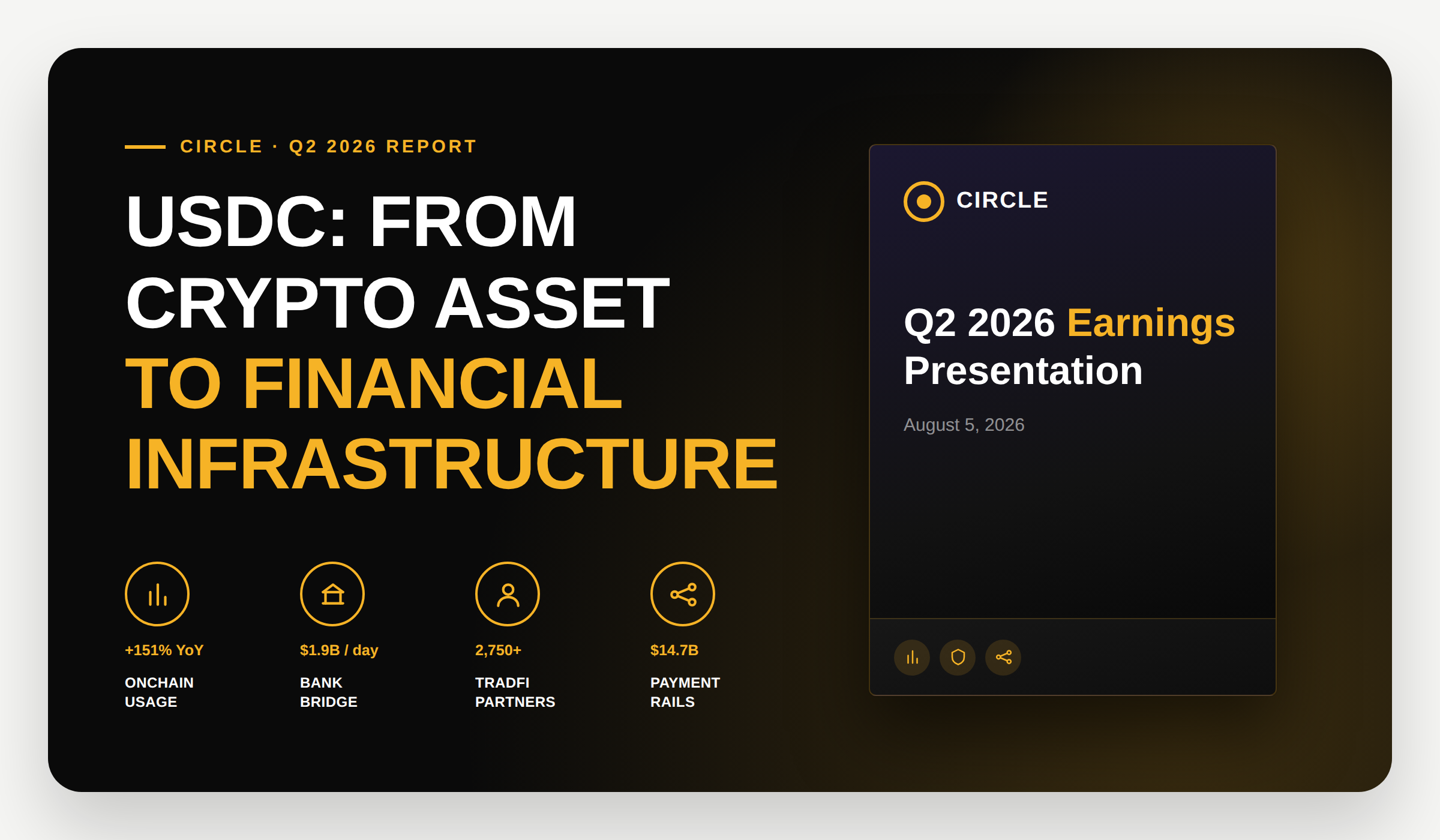
Circle Q2 2026 Report: USDC Is Becoming Financial Infrastructure
Circle’s Q2 2026 report shows how USDC is evolving from a stablecoin into a broader financial rail. Here are the numbers and trends that matter for payments and global businesses.
Circle Q2 2026: Stablecoins Are Becoming Financial Infrastructure
Stablecoins have spent years sitting somewhere between crypto markets and traditional finance.
Circle’s Q2 2026 results suggest that line is becoming much harder to see.
USDC circulation continues to grow. Transaction volume is growing much faster. Banks and financial institutions are moving closer to public blockchain infrastructure. Circle is expanding from stablecoin issuance into payments, tokenized assets, custody, and its own blockchain infrastructure.
The bigger story is not simply that USDC had another strong quarter.
It is that stablecoins are starting to look like a real financial rail.
Here are the developments from Circle’s Q2 2026 Earnings Presentation that we believe matter most.
USDC is growing, but usage is growing much faster
USDC in circulation reached $73.3 billion at the end of Q2 2026, up 19% year over year.
That is significant growth on its own.
But transaction activity tells a more interesting story.
USDC recorded $14.8 trillion in onchain transaction volume during Q2, representing 151% year-over-year growth.
Circle also reported approximately:
- $163 billion in daily onchain transaction volume.
- $1.9 billion in daily minting and redemptions.
- $2.9 billion in daily USDC notional trading volume.
Daily minting and redemption activity increased 105% year over year.
This distinction between supply and activity is important.
A stablecoin can grow because more capital is being stored in it. But when transaction activity grows much faster than circulation, it suggests that the same digital dollars are being used more actively.
Money is not simply entering the system.
It is moving through it.
The wider market shows a similar pattern. Circle’s presentation, using CoinMarketCap and Visa Onchain Analytics data, shows stablecoin circulation growing 22% year over year, while reported transaction volumes grew 84%.
That may be one of the clearest signals that the stablecoin story is moving beyond holding and trading.
The bridge between banking and blockchain is becoming more important
Blockchain transaction speed gets much of the attention around stablecoins.
For businesses, however, a fast blockchain is only useful if money can also move efficiently into and out of it.
Circle reported $170 billion of USDC mint and redeem volume in Q2, compared with $83 billion one year earlier.
Circle’s network now includes more than 15 partner banks, 150 distribution partnerships, and 2,750 direct relationships.
The goal is straightforward.
Make it easier to move between fiat money and USDC across major markets.
This matters because the real business use case rarely ends on a blockchain.
A company may receive stablecoins but need EUR or USD for operating expenses.
A fintech may collect fiat but need stablecoins for international settlement.
A platform may need to move between both depending on the recipient, geography, or payment route.
The blockchain is one part of the journey.
The bridge between traditional money and digital money can be just as important as the rail itself.
Traditional finance is moving closer to stablecoins
One of the strongest themes in Circle’s report is the number of traditional financial institutions appearing throughout it.
The presentation highlights continued adoption involving names including BNY Mellon, Standard Chartered, Kakao, and JCB.
The Arc section goes even further.
Circle lists more than 100 private mainnet partners and shows a validator set that includes financial and infrastructure companies such as BlackRock, DTCC, Global Payments, ICE, Mastercard, MoneyGram, Standard Chartered, Sumitomo Mitsui, and Visa.
This changes the old narrative.
For years, crypto was often presented as an alternative financial system that would replace banks and traditional payment infrastructure.
What is emerging looks different.
Banks, card networks, asset managers, payment companies, and blockchain infrastructure are increasingly connecting to one another.
Stablecoins do not necessarily need to replace traditional finance.
They can become another rail inside it.
Regulation is becoming an infrastructure advantage
The report also makes regulation a central part of Circle’s strategy.
Circle reports USDC across 35 blockchain networks, more than 55 registrations and licenses, and availability across 185 countries.
The company also highlights:
- 1:1 reserve backing.
- Segregated reserve accounts.
- Monthly reserve-asset attestations by a Big Four accounting firm.
- AML and BSA controls.
- Real-time monitoring.
- OFAC screening.
Another major development came in July 2026.
Circle received final OCC approval to establish Circle National Trust under direct US federal oversight.
Circle describes this as a regulated foundation for digital asset custody and a future capability for USDC reserve management.
The strategic message is important.
Regulation is often described as friction for digital assets.
For institutional adoption, the opposite can also be true.
Banks and large businesses need clear rules, reserve transparency, compliance controls, and accountable counterparties before they can move meaningful financial activity onto new rails.
In that context, regulation becomes less of a brake and more of a bridge to adoption.
Stablecoins are becoming payment infrastructure
Perhaps the most relevant development for the payments industry is the growth of Circle Payments Network, or CPN.
CPN connects financial institutions around stablecoin-based payment flows.
Its annualized transaction volume reached $14.7 billion in Q2, growing 76% quarter over quarter. Circle reported 175 financial institutions enrolled by the end of June.
Circle is also working on the less visible parts of payment infrastructure.
The presentation highlights unified onboarding and liquidity, faster corridor activation, automatic rerouting when routes fail, and integrations with Circle Mint, StableFX, and Arc.
These details matter.
Moving a token from one wallet to another is relatively easy.
Building reliable payment infrastructure around it is harder.
Businesses need liquidity.
They need fiat settlement.
They need compliance.
They need reconciliation.
They need reliable payment routes.
They need reporting.
And they need systems that still work when something goes wrong.
That is where stablecoin payments start becoming less about crypto and more about financial operations.
USDC is becoming increasingly cross-chain
Another part of the infrastructure story is interoperability.
USDC is now supported across 35 blockchain networks.
Circle reports 756 CCTP routes across supported networks. Its Cross-Chain Transfer Protocol allows native USDC to move between chains without relying on traditional wrapped-token bridges.
Circle describes the goal as unified liquidity without fragmentation across blockchain ecosystems.
This may sound technical, but the business implication is simple.
Companies generally do not want to think about which blockchain their money is sitting on.
They want liquidity to be available where it is needed.
The more invisible this complexity becomes, the easier stablecoins become to use as ordinary financial infrastructure.
The story is expanding beyond the digital dollar
USDC remains Circle’s core product, but the Q2 presentation points toward a much broader strategy.
EURC circulation reached €382 million, compared with €172 million one year earlier.
That represents approximately 2.2x year-over-year growth.
Circle also reported $3.1 billion in USYC assets, compared with $0.3 billion a year earlier, representing growth of more than 10x. Circle describes USYC as the world’s largest tokenized money market fund.
This is an important expansion of the stablecoin thesis.
The opportunity may not stop with tokenized cash.
Cash can become digital.
Treasury assets can become digital.
Securities can become digital.
Settlement can move onto the same infrastructure.
That brings us to one of the most ambitious parts of Circle’s strategy.
Arc shows where Circle thinks financial infrastructure is heading
Circle plans to launch the Arc mainnet on September 16, according to the Q2 presentation.
Its testnet had already processed 502 million transactions across 2.8 million transacting wallets, with reported uptime of 99.99%.
Arc is not presented as another general-purpose blockchain.
Circle describes it as infrastructure designed specifically for regulated finance.
The network is designed around features such as:
- USDC-denominated gas.
- Sub-second finality.
- Configurable privacy.
- Built-in FX.
- Institutional validators.
Two partnerships show what Circle is aiming for.
DTCC integration is expected to bring tokenized real-world assets onto Arc, including selected equities, ETFs, and Treasuries. Circle also describes potential use cases around securities lending and collateral settlement.
Meanwhile, BlackRock’s BUIDL tokenized treasury fund is expected to deploy on Arc, with BlackRock also participating as a founding validator.
This suggests a much larger ambition.
Circle is not only trying to issue a successful stablecoin.
It is building an environment where money, assets, payments, liquidity, and settlement can increasingly exist on the same infrastructure.
AI agents may become another source of payment demand
One of the more experimental parts of the report is Circle’s work around AI agents.
Circle reports that 99.3% of x402 agent-payment volume settles in USDC, with more than 900 paid services already available in its agent marketplace as of July 31.
The idea is that software agents can hold spending policies, purchase services, settle payments onchain, earn money, and build reputation from completed transactions.
It is still early.
But it highlights something important about digital money.
Traditional payment systems were designed primarily around people and companies.
Software increasingly needs to transact as well.
Always-on, programmable money may therefore find use cases that do not map neatly onto today's card or banking infrastructure.
The financial results show a real business behind the narrative
Circle generated $701 million in total revenue and reserve income in Q2, up 7% year over year.
Adjusted EBITDA reached $143 million, up 8% year over year.
Other revenue grew 41% year over year, although reserve income remains the dominant part of Circle's revenue mix.
Circle continues to guide toward approximately 40% multi-year CAGR in USDC circulation.
The wider market expectations are even broader.
Third-party forecasts cited by Circle put the stablecoin market somewhere between $0.9 trillion and $4 trillion by 2030.
That range is huge.
But perhaps that is the point.
Nobody knows exactly how large the market will become.
The direction is easier to see than the final number.
What we think this means for businesses
Our main takeaway from Circle’s Q2 report is not that every company suddenly needs USDC.
It is that the distinction between “crypto infrastructure” and “financial infrastructure” is starting to disappear.
Stablecoins are becoming useful where they solve an actual financial problem.
That can mean accepting payments from customers who prefer digital assets.
It can mean paying contractors or partners internationally.
It can mean moving liquidity outside banking hours.
It can mean converting between fiat and digital currencies.
It can mean reaching markets where traditional payment rails are expensive or limited.
And increasingly, it can happen behind the scenes without the end user needing to understand blockchain at all.
This is also how we think about the market at INXY Payments.
We started with crypto processing and built products around accepting, converting, and sending digital money.
But businesses do not have a “crypto problem”.
They have a money problem.
They need to receive money, hold it, convert it, pay people, move it internationally, and keep control of the whole process.
Stablecoins are becoming one of the rails that can make those jobs easier.
The technology matters.
But as the infrastructure improves, businesses should need to think about it less.
That may be the clearest sign that stablecoins are growing up.
Explore the full Circle Q2 2026 report
We have highlighted the developments we found most relevant for payments and global businesses.
There is much more in the original 35-page Circle Q2 2026 Earnings Presentation, including detailed data on USDC circulation, liquidity, Arc, CPN, tokenized assets, AI, financial performance, and Circle’s outlook.
The full Circle Q2 2026 report is available below.
Stablecoin Payment Infrastructure in 2026
The most important shift in digital payments this year is not a new chain or a new token. It is the quiet realisation that stablecoins have crossed from speculation into infrastructure. The Paypers’ Global Stablecoins Report 2026 puts total stablecoin market capitalisation at roughly USD 317.9 billion, with projections that it could exceed USD 2 trillion as institutional participation accelerates — and some contributors put the figure closer to USD 4 trillion by 2030. At INXY, we read those numbers differently from most. The headline is not the size of the market. It is that stablecoins have become one of the first blockchain-based instruments to show clear product-market fit in payments.
The most important shift in digital payments this year is not a new chain or a new token. It is the quiet realisation that stablecoins have crossed from speculation into infrastructure. The Paypers’ Global Stablecoins Report 2026 puts total stablecoin market capitalisation at roughly USD 317.9 billion, with projections that it could exceed USD 2 trillion as institutional participation accelerates — and some contributors put the figure closer to USD 4 trillion by 2030. At INXY, we read those numbers differently from most. The headline is not the size of the market. It is that stablecoins have become one of the first blockchain-based instruments to show clear product-market fit in payments.
That single fact reframes the question every finance team, PSP, and merchant should be asking. It is no longer “should we look at stablecoins?” It is “which payment flows should run on them, and what stablecoin payment infrastructure do we need to make that safe, compliant, and economical?” This article is our read of the report’s data — and what it means for businesses that want to accept stablecoin payments, automate payouts, and move value across borders without rebuilding the financial stack from scratch.
Stablecoins have reached product-market fit in payments
For a decade, crypto payments were a promise: faster, cheaper money movement that never quite arrived at scale. What changed is not the blockchain — it is the infrastructure wrapped around it. The report is blunt on this point, describing stablecoins as one of the first blockchain-based instruments to demonstrate clear product-market fit in payments, increasingly used for cross-border settlement, treasury operations, merchant payouts, and everyday commerce.
The adoption base is real, not theoretical. Triple-A’s data cited in the report shows cryptocurrency ownership rising from around 560 million people in 2024 to roughly 700 million in 2026 — about 8.5% of the global population. These are not all traders. A growing share are freelancers, remote workers, and businesses that earn and hold digital dollars and want to spend or settle them without friction. Demand for a usable rail already exists; the constraint has been supply of trustworthy infrastructure.
Our view is simple. The metric that matters is not the market cap of crypto. It is the number of businesses that can use stablecoins to solve a concrete money problem — a supplier that needs paying today, a payout that needs to clear over a weekend, a treasury balance stranded behind a banking cut-off. That is the lens we apply to every number below.
Enterprise adoption is at an inflection point
Awareness of stablecoins among enterprises is now nearly universal, yet active production use remains modest. That gap is exactly what an inflection point looks like. In the EY-Parthenon survey referenced in the report (n=350), a majority of current non-users said they expect to begin using stablecoins within the next six to twelve months. The conversation inside finance teams has moved from “should we look at this?” to “where should we use it first?”
The intent is concentrated, not scattered. Among corporates asked which use cases they are most interested in over the next five years, the top answers were paying suppliers cross-border (77%), accepting cross-border business payments (49%), and accepting domestic business payments (37%). In financial services specifically, 91% of respondents said stablecoins would become a top priority or receive more attention. This is a back-office, treasury-first story — the place where return on investment is clearest and operational risk can be tightly controlled.
One data point matters more than any other for how this market will be served. When corporates were asked how important it is that their existing banking or payments provider supports stablecoins, 81% said it was critical or important, and 68% said they would prefer a bank-grade issuer. In other words, most businesses do not want to become crypto companies. They want to reach stablecoin capability through providers they already trust, embedded into the ERP and treasury systems they already run. Interoperability beats novelty every time.
Cross-border is the killer use case — but only where legacy rails fail
Cross-border payments lead enterprise adoption for a practical reason: this is where the old process is genuinely broken. A traditional international transfer can take days, pass through several correspondent banks, and leave money stranded in transit. Stablecoins offer near real-time settlement, 24/7 availability, and on-chain visibility — and the economics can be decisive. Among organisations already using stablecoins, 41% report cost savings of 10% or more compared with traditional methods, with the largest gains in cross-border B2B, where correspondent fees, FX spreads, and reconciliation costs stack up.
But the honest version of this story is geographic, and we insist on telling it that way. In Europe, where SEPA Instant already moves money in seconds at near-zero cost, the incremental advantage of a stablecoin for a domestic transfer is small. The value appears on corridors where legacy infrastructure fails. The report cites OpenPayd’s point that a USD 200 remittance to Sub-Saharan Africa can cost more than 8%, against a global average above 6% — and that stablecoins can cut that by over 75%, going as low as 0.5% when paired with reliable on- and off-ramps. MetaComp describes a payment from the UAE to Singapore that takes two to five days through correspondent banking settling in roughly 20 minutes at about half the cost.
So the right question is not “will stablecoins replace banks?” It is “which payment flow should run on which rail?” Stablecoins are not a universal upgrade; they are a precise tool for corridors that are slow, expensive, or fragmented. Matching the right rail to the right flow, market by market, is the actual work — and it is the work we build infrastructure to automate.
The cost nobody talks about: on-ramp and off-ramp economics
Here is the trap that sinks naive stablecoin projects, and the report is refreshingly direct about it. The blockchain fee is only a fraction of the true cost. Moving money into a stablecoin (the on-ramp) and back into local fiat (the off-ramp) is not free. Depending on provider, corridor, and volume, conversion fees run from 0.5% to more than 2% per leg — 1% to 4% on a full round trip. For a business with thin margins, that can erase the headline saving entirely.
The lesson we draw is one we design around every day: the cheapest blockchain transaction does not automatically produce the cheapest payment. Any honest assessment of stablecoin economics must include the full on/off-ramp cost, not just the on-chain fee. This is precisely why liquidity, FX, conversion, and settlement infrastructure matter so much — and why the industry is consolidating around orchestration layers such as Circle’s Payments Network (CPN) and cross-chain protocols like CCTP that move USDC between blockchains without costly bridges. The economics only work when at least one party can hold and route stablecoins natively, and when conversion is priced in basis points rather than percentage points.
For most businesses, building that liquidity and conversion layer in-house is neither realistic nor wise. The competitive edge is not owning a wallet; it is reaching deep, well-priced liquidity through infrastructure that already has it.
The hard part is no longer the blockchain — it is everything around it
If there is one theme the report returns to again and again, it is this: the technology is ready and has been for years. What was missing was the infrastructure required to run stablecoin flows safely, at scale, through systems businesses already understand. Companies need compliance, liquidity, fiat connectivity, reconciliation, custody, and orchestration wrapped around the stablecoin rail. That is where the market gets interesting — and where the winners will be decided.
Compliance is becoming part of the product
Regulation has flipped from the biggest barrier to an adoption enabler. Frameworks such as the GENIUS Act in the US and MiCA in the EU now give issuers and providers a clearer operational footing, especially for bank-issued or bank-distributed stablecoins that meet defined reserve, compliance, and governance standards. The question is no longer whether stablecoins are “too risky.” It is whether a company’s infrastructure is good enough to use them safely.
That raises the bar on operations. KYC, AML, Travel Rule obligations, wallet screening, and transaction monitoring all still apply — and adapting them to on-chain flows is a genuine engineering challenge. The report notes that redundant, repeated KYC is a real drag on growth: across the industry, 25–35% of users abandon onboarding when asked to upload an ID and selfie, while modern compliance engines can screen over 99% of transactions within seconds. Compliance is no longer a checkbox bolted on at the end. It is part of the product, and it has to be fast enough not to kill conversion.
Orchestration and the multi-rail future
The report’s central strategic conclusion — and ours — is that stablecoins will not replace every payment rail. The likely future is multi-rail: bank transfers, instant-payment networks, and stablecoins operating side by side, each carrying the flows it serves best. Stablecoins shine where traditional rails are slow, costly, or fragmented; in highly efficient domestic markets, their edge narrows.
That makes orchestration the decisive capability. Orchestration is the end-to-end management of a payment’s journey — deciding, for each transaction, whether to use a stablecoin, which issuer and chain to select, and when to convert between fiat and digital assets, based on value, urgency, liquidity conditions, and counterparty location. As more rails become available, this routing layer is where cost, speed, and compliance are won or lost. The industry examples in the report make the point: the SG-FORGE and Swift live trial settled tokenised bonds using both traditional financial infrastructure and regulated digital currencies, and Nexus Global Payments is interlinking domestic instant-payment systems like India’s UPI and Singapore’s FAST. None of these efforts replace the old system. They make the whole system work together.
What this means for businesses evaluating stablecoin payments
This report describes, almost line for line, the problem we built INXY to solve. INXY provides the infrastructure businesses need to accept stablecoin payments, automate payouts, convert between crypto and fiat, and move money across borders — without building blockchain, liquidity, compliance, and settlement systems from scratch. We operate the layer behind the customer experience, so the complexity stays out of sight.
Concretely, that means:
- The merchant does not need to become a crypto company to accept stablecoin payments — acceptance runs through familiar checkout and settlement flows, with conversion to fiat handled behind the scenes.
- The fintech does not need to build the entire compliance stack — KYC, AML, Travel Rule, and wallet screening are part of the rail, fast enough to protect conversion rather than throttle it.
- The finance team does not need to manage a collection of wallets and chains — payouts, multi-currency treasury, and on/off-ramp conversion are orchestrated through a single integration, priced to keep the full round-trip economics intact.
If you are evaluating stablecoins, we would frame the decision the way the report’s data suggests. Start with the corridors and flows where traditional rails genuinely fail — cross-border supplier payments, international payouts, multi-currency treasury — not with the flows your domestic bank already handles well. Model the full on/off-ramp cost, not just the on-chain fee. And treat compliance and orchestration as core product requirements, not afterthoughts. The businesses that win with stablecoins are not the ones that move tokens; they are the ones that make different payment systems work together.
The winners will be the integrators, not the disruptors
The biggest shift captured in the Global Stablecoins Report 2026 is not from fiat to crypto. It is from crypto product to financial infrastructure — banks, PSPs, and processors integrating stablecoins into systems that already exist. Stablecoins do not need to destroy the old rails to matter. They need to make the whole system move value better.
That is the future we are building for at INXY. Not one payment rail, but many — with an infrastructure layer that decides, routes, converts, and settles across all of them, so businesses get the speed and cost of stablecoins with the trust and control finance teams require. The stablecoin era will not be won by whoever shouts loudest about disruption. It will be won by whoever quietly makes the rails work together.
What Is EURC? Circle's Euro Stablecoin Explained for Business Payments
Most stablecoins track the US dollar. But if your revenue, costs, and recipients are in euros, paying in a dollar-pegged token means an FX round-trip on every transaction. EURC solves that: it's a euro-denominated stablecoin that lets euro-native businesses move money on blockchain rails without leaving the euro.
Most stablecoins track the US dollar. But if your revenue, costs, and recipients are in euros, paying in a dollar-pegged token means an FX round-trip on every transaction. EURC solves that: it's a euro-denominated stablecoin that lets euro-native businesses move money on blockchain rails without leaving the euro.
Here's what EURC is, how it works, and why it has become the default euro stablecoin for regulated business in 2026.
EURC in one sentence
EURC (Euro Coin) is a stablecoin pegged 1:1 to the euro, issued by Circle — the same company behind USDC — and backed fully by euro-denominated reserves. One EURC is designed to always be redeemable for one euro.
Think of it as a digital euro you can send anywhere in minutes, 24/7, without a bank wire.
Who issues EURC, and why that matters
EURC is issued by Circle, a regulated financial technology company. That matters for one reason above all: regulation. Circle holds an EU Electronic Money Institution (EMI) license in France, and that single authorization passports EURC across all 27 EU member states under MiCA, the EU's crypto framework.
In practice, EURC is a MiCA-compliant e-money token. When MiCA's rules took full effect and non-compliant stablecoins were removed from EU-regulated exchanges, EURC was one of the assets that stayed — and it captured much of the resulting demand. By 2026 it had become the dominant euro stablecoin, holding roughly 41% of the euro-stablecoin market, up from about 17% a year earlier.
For a business, that means EURC isn't a fringe experiment — it's the euro stablecoin most likely to be accepted, supported, and compliant across Europe.
What backs EURC?
EURC is 100% backed by euro reserves held in cash and cash-equivalent instruments under Circle's full-reserve model. Circle publishes regular reserve reporting, the same transparency approach it applies to USDC. Each token in circulation is matched by euros held in reserve, which is what keeps the 1:1 peg dependable.
As of 2026, EURC's circulation sits in the range of roughly €400–460 million — smaller than dollar stablecoins, but by far the largest in the euro category.
Which blockchains support EURC?
EURC is a multi-chain asset. It runs natively on:
- Ethereum (where the majority of euro-stablecoin supply sits)
- Base
- Solana
- Stellar
- Avalanche
- World Chain
The network you use determines transfer speed and fees. For payouts, low-fee chains like Solana, Base, or Stellar keep costs to cents; Ethereum is the most liquid but the most expensive to transact on.
Why businesses use a euro stablecoin
If you already operate in euros, why hold a euro on a blockchain instead of in a bank? A few concrete reasons:
- No FX round-trip. Paying euro-based recipients in a dollar stablecoin means converting EUR → USD → EUR, losing spread each way. EURC keeps euros as euros.
- Speed. EURC settles in minutes, any time — including weekends and holidays, when SEPA and bank rails are closed.
- Global reach. A recipient anywhere with a wallet can receive euros, without needing a European bank account.
- Programmability. EURC can be sent via API for automated payouts, something traditional euro rails don't offer natively.
- Regulatory comfort. As a MiCA-compliant token, EURC fits the compliance expectations of European banks, auditors, and partners.
EURC vs a bank euro balance
A euro in your bank and a euro in EURC are both euros — the difference is the rails.

EURC doesn't replace your bank — it complements it for fast, global, programmable euro movement.
Frequently asked questions
What is EURC? EURC (Euro Coin) is a euro-pegged stablecoin issued by Circle, backed 1:1 by euro reserves. It lets businesses hold and send euros on blockchain networks.
Is EURC the same as USDC? They share an issuer (Circle) and a full-reserve, MiCA-compliant model, but EURC is pegged to the euro while USDC is pegged to the US dollar. See our EURC vs USDC comparison.
Is EURC regulated? Yes. EURC is a MiCA-compliant e-money token. Circle's French EMI license passports it across all 27 EU member states.
What backs EURC? Euro-denominated reserves held 1:1 against tokens in circulation, under Circle's full-reserve model with regular reserve reporting.
Which networks support EURC? Ethereum, Base, Solana, Stellar, Avalanche, and World Chain. Choose a low-fee network for cost-efficient payouts.
Can businesses pay in EURC? Yes — EURC is widely used for euro-denominated payouts to contractors, suppliers, and partners, especially within the EU. Learn more in our guide to paying in EURC.
Move euros the modern way
If your business runs on euros, you can settle in euros on-chain — fast, global, and MiCA-compliant. INXY's EURC mass payouts let you fund and pay in euros without the FX round-trip or the crypto overhead. New to the asset? Compare it with the dollar option in EURC vs USDC.
This article is general information, not financial or legal advice.

How to Pay Contractors and Affiliates in USDC: A Practical 2026 Guide
Paying a global team through banks means FX spreads, 3–5 day waits, intermediary fees, and a recipient in another country who receives less than you sent. Paying them in USDC — a fully-reserved, dollar-pegged stablecoin — can turn that into a same-day transfer for cents. But doing it properly, at scale, and in a way your accountant accepts takes more than a wallet.
Paying a global team through banks means FX spreads, 3–5 day waits, intermediary fees, and a recipient in another country who receives less than you sent. Paying them in USDC — a fully-reserved, dollar-pegged stablecoin — can turn that into a same-day transfer for cents. But doing it properly, at scale, and in a way your accountant accepts takes more than a wallet.
This guide walks through how to pay contractors in USDC — the setup, the networks, the compliance basics, and how to keep your books in fiat.
Why businesses pay in USDC
USDC (issued by Circle) is a stablecoin pegged 1:1 to the US dollar and backed by cash and short-dated US Treasuries, with monthly attestations from Deloitte. For paying people, that combination is the point:
- Stable value. Recipients get dollars, not a volatile asset. 1 USDC ≈ $1 at send and at cash-out.
- Speed. Payments settle in minutes, 24/7, including weekends and holidays.
- Global reach. Anyone with a wallet can receive, regardless of local banking.
- Low cost. On low-fee networks, a payout costs cents rather than a wire fee.
- Regulatory standing. USDC is MiCA-compliant in the EU, which makes it a durable choice for European corridors (more on that below).
Before you start: four things to get right
1. Confirm the recipient can receive USDC. They need a wallet address on a network you both support (Ethereum, Solana, Base, Polygon, and others). Confirm the network explicitly — a USDC transfer sent to the wrong network can be lost.
2. Decide who bears the fee. Will you gross up payments so the contractor receives the full agreed amount after network fees, or net it out? Set this in the contract.
3. Handle tax and classification. Paying in stablecoin doesn't change worker classification or your reporting obligations. Contractors are still responsible for their own taxes; you still keep records. Treat USDC payouts like any other payment for compliance purposes.
4. Keep fiat records. Your accounting should capture the fiat value at the time of payout, the fee, the recipient, and the transaction hash — not just on-chain data.
Method 1: Manual USDC payments
For a few contractors, you can pay directly from a self-custody wallet or exchange.
Steps:
- Fund a wallet with USDC and the network's gas token.
- Confirm each contractor's address and network in writing.
- Send each payment; send a small test transfer first for new, large recipients.
- Record each transaction hash against the invoice and its fiat value.
Limits: no automation, no built-in screening, and manual reconciliation. It works for a handful of people and breaks down beyond that.
Method 2: Bulk USDC payouts via CSV or API
For a real team — dozens or thousands of contractors, affiliates, or creators — a payout platform is the practical route. You prepare a recipient list and process it as one batch.
A typical flow:
- Fund in fiat. With a fiat-native provider like INXY, top up in EUR or USD via SEPA or SWIFT — no need to buy crypto yourself.
- Upload a CSV or call the API. Include recipient, amount, and network. The API path lets you trigger payouts straight from your own platform or billing system.
- Automated compliance. The provider runs KYT and sanctions screening and validates addresses before sending.
- Recipients get paid. USDC lands in minutes on supported networks.
- Reconcile in fiat. Export batch-level records with fiat values, fees, payout IDs, and hashes.
This removes the two hardest parts of paying a global team in crypto: compliance and accounting. You never manage keys or gas, and your finance team works in EUR or USD.
Choosing the network for USDC payouts
USDC runs natively on several chains. For payouts:
- Solana / Base / Polygon: cents per transfer, fast — ideal for high-volume contractor and affiliate payments.
- Ethereum (ERC-20): the most liquid and widely integrated, but the most expensive — reserve it for recipients who require it.
Match the network to the recipient's wallet and the payout size; a platform can route this automatically.
Compliance: don't skip screening
Paying contractors across borders means you're exposed to sanctions and AML rules. Two non-negotiables:
- Sanctions screening of recipient wallets before payout.
- Transaction monitoring (KYT) to flag high-risk addresses.
Manual and script-based payouts leave this to you. A regulated payout provider builds it into the flow — which is often the difference between "using crypto rails" and "creating a banking-risk problem."
Frequently asked questions
Can I pay international contractors in USDC? Yes. Anyone with a compatible wallet can receive USDC in minutes, regardless of country, as long as it's legal in their jurisdiction. It's widely used for cross-border contractor, freelancer, and affiliate payments.
Do I need to hold crypto to pay contractors in USDC? No. A fiat-native platform lets you fund in EUR or USD and keep accounting in fiat while recipients receive USDC.
Is paying contractors in USDC legal? Paying in USDC is legal in most jurisdictions, but you remain responsible for worker classification, tax reporting, and AML/sanctions compliance — the same as any payment method. Check local rules for your recipients.
What does it cost to pay someone in USDC? On low-fee networks like Solana, Base, or Polygon, a USDC transfer costs cents. On Ethereum it can be several dollars. Choosing the network controls the cost.
How do I keep accounting clean when paying in USDC? Record the fiat value at payout time, the fee, and the transaction hash for each payment. Payout platforms generate these exports automatically.
Pay your global team without the crypto overhead
If you're paying contractors, affiliates, or creators at scale, you shouldn't be managing wallets, gas, and screening by hand. INXY's mass USDC payouts let you fund in fiat, pay globally in minutes, and reconcile in EUR or USD — with compliance built in. Building a broader payroll flow? See our contractor payroll solution, or weigh the assets in our USDT vs USDC comparison.
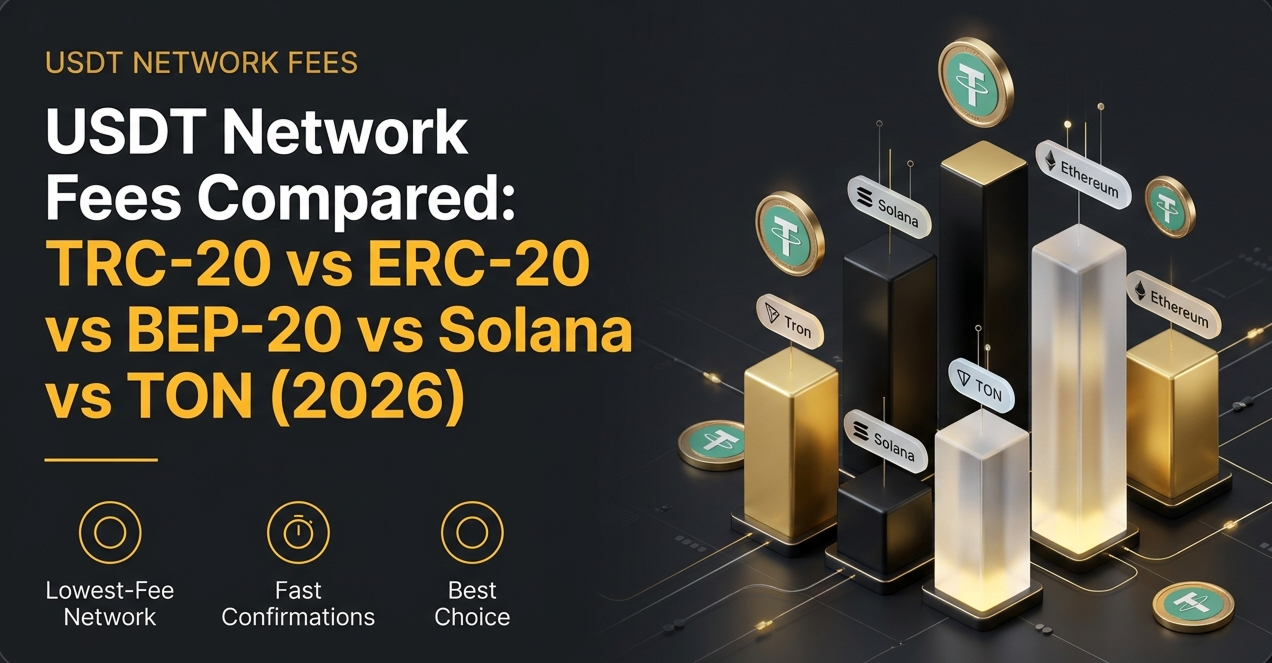
USDT Network Fees Compared: TRC-20 vs ERC-20 vs BEP-20 vs Solana vs TON (2026)
USDT is a single asset, but it lives on more than a dozen blockchains — and the network you choose can change the cost of a transfer by 100x or more. For a one-off payment that's a rounding error. For a business sending thousands of payouts a month, picking the wrong chain quietly burns thousands of dollars.
USDT is a single asset, but it lives on more than a dozen blockchains — and the network you choose can change the cost of a transfer by 100x or more. For a one-off payment that's a rounding error. For a business sending thousands of payouts a month, picking the wrong chain quietly burns thousands of dollars.
This is a practical breakdown of the cheapest network to send USDT in 2026, what drives the fee on each chain, and how to match the network to the payout.
Why USDT fees vary so much
The fee to move USDT has nothing to do with Tether itself. It's the network's gas fee — paid in the chain's native token — that varies:
- On Ethereum (ERC-20) you pay ETH gas, which is priced by network congestion and can spike sharply.
- On Tron (TRC-20) you pay in TRX energy/bandwidth, which is low and stable.
- On Solana, TON, and BNB Chain, base fees are engineered to be very small.
So "how much does it cost to send USDT" is really "which network did you send it on."
USDT fee comparison (2026)
Approximate, indicative costs — real fees move with congestion and the native token price. Use this for relative comparison, not exact quotes.
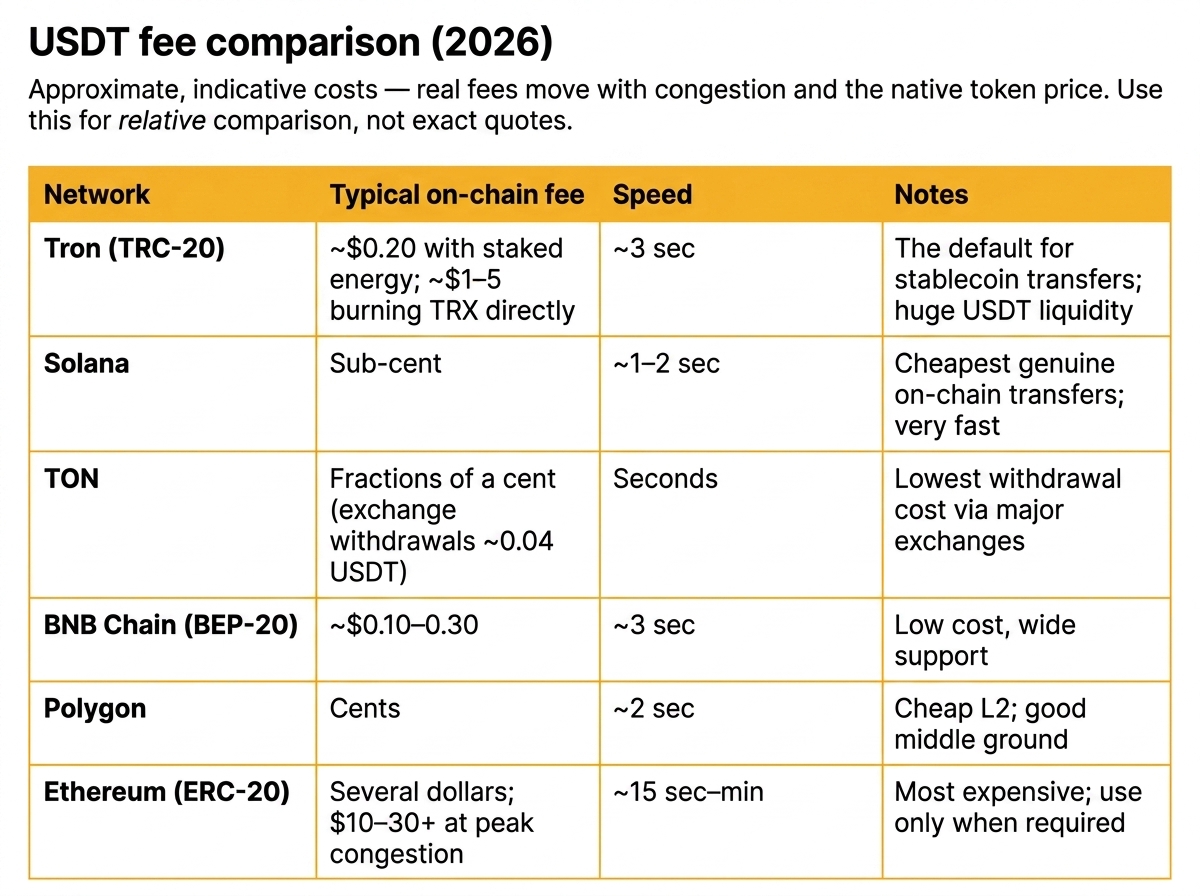
The short version: for pure on-chain cost, Solana and TRC-20 lead, with TON unbeatable for exchange withdrawals. ERC-20 is the most expensive and should be reserved for recipients who specifically need it.
Match the network to the payout amount
Cheapest isn't always "correct." The right network depends on the size of the transfer and where the recipient wants the funds.
- Micro-payouts (under ~$50): TRC-20, Solana, or TON. Fees would otherwise eat a meaningful slice of the payment.
- Standard payouts ($50–$5,000): Solana, Polygon, or TRC-20 keep costs to pennies while settling fast.
- Large transfers (over ~$5,000): Cost matters less relative to the amount. ERC-20 is acceptable if the counterparty requires it — the $10–20 fee is small against the principal, and Ethereum's liquidity and integrations are unmatched.
Beyond the headline fee
Fee-per-transfer is the obvious number. Three others matter just as much at scale:
1. Recipient acceptance. The cheapest network is useless if the recipient's wallet or exchange doesn't support it. Always confirm the network before sending — cross-network mistakes are irreversible.
2. Native-token overhead. Every network needs its gas token in your wallet. Running payouts across five chains means monitoring and topping up five different balances — an operational cost that doesn't show up in the per-transfer fee.
3. Failed and stuck transfers. Underpriced gas on congested networks means stuck transactions and support tickets. Reliability has a cost, too.
How platforms cut costs further
When you run payouts through a fiat-native platform instead of manually, network fees stop being your problem in two ways:
- Automatic routing. The platform sends each payout on a supported low-fee network without you managing gas on every chain.
- No native-token juggling. You fund a balance in EUR or USD; the provider handles conversion and gas. Your reporting stays in fiat.
That removes the hidden operational cost of multi-chain payouts, not just the visible per-transfer fee.
Frequently asked questions
What is the cheapest network to send USDT? For on-chain self-custody transfers, Solana and Tron (TRC-20) are cheapest, and TON offers the lowest withdrawal fees on major exchanges. Ethereum (ERC-20) is the most expensive.
Is TRC-20 always the cheapest for USDT? Not always. TRC-20 is very cheap and has the deepest USDT liquidity, but Solana and TON can be cheaper still per transfer. TRC-20 remains the most widely accepted low-fee option.
Why is sending USDT on Ethereum so expensive? ERC-20 transfers pay ETH gas, priced by network demand. During congestion, a single USDT transfer can exceed $30 in gas.
Does the network affect how much USDT the recipient receives? The network sets the fee you pay to send. Choosing a low-fee chain means more of your budget reaches recipients, especially across many small payouts.
Can I send USDT across networks? An address is tied to one network. To move USDT between chains you need a bridge or an exchange — you can't send TRC-20 USDT directly to an ERC-20 address.
Send on the right network, automatically
If you're running regular USDT payouts, you shouldn't be managing gas tokens across five blockchains. INXY's mass USDT payouts route each transfer over low-fee networks and report everything back in EUR or USD — so you get the cheapest path without the multi-chain overhead. New to bulk sending? Start with our step-by-step USDT payout guide.

How to Send USDT to Multiple Wallets: A Step-by-Step Bulk Payout Guide
Manual works for a handful of payees; scripts work if you want to run infrastructure. If you'd rather send USDT to hundreds or thousands of recipients from a fiat balance — with screening and clean reporting built in — that's exactly what INXY's mass USDT payouts are built for.
Paying twenty affiliates, two hundred contractors, or two thousand players one transaction at a time does not scale. If you need to send USDT to multiple wallets, the method you choose determines your cost, your error rate, and how much of your finance team's week disappears into copy-pasting addresses.
This guide covers the three practical ways to run a bulk USDT transfer in 2026 — manual, scripted, and platform-based — with the trade-offs of each, the mistakes that cost real money, and how to keep clean records for accounting.
What "mass USDT payout" actually means
A mass USDT payout is a single, structured operation that distributes Tether to many recipients at once. Instead of initiating each transfer by hand, you prepare a list of addresses and amounts and process them as a batch.
Three things make this harder than it looks:
- Network choice. USDT exists on Tron (TRC-20), Ethereum (ERC-20), BNB Chain (BEP-20), Solana, TON, Polygon and others. A recipient's address is network-specific — send TRC-20 USDT to an ERC-20 address and the funds are typically lost.
- Fees at volume. A fee that looks trivial for one transfer becomes a line item when multiplied across thousands of recipients.
- Reconciliation. Finance needs a fiat value, a timestamp, and a transaction hash for every payout — not just a wall of blockchain data.
Keep these three in mind; every method below is really a different answer to them.
Method 1: Manual transfers from a wallet or exchange
The simplest approach is to send USDT one recipient at a time from a self-custody wallet (MetaMask, Trust Wallet, Tronlink) or an exchange account.
When it works: fewer than ~10 recipients, infrequent payouts, no automation budget.
Steps:
- Confirm each recipient's network and address in writing. Never assume the network.
- Fund your wallet with enough USDT and the native gas token (TRX for TRC-20, ETH for ERC-20, and so on).
- Send each transfer, double-checking the first and last four characters of every address.
- Save each transaction hash against the recipient's name for your records.
The catch: manual sending does not scale and has no safety net. A single mistyped address is irreversible. There is no batch confirmation, no built-in fiat reporting, and no sanctions screening. Beyond a handful of recipients, error risk climbs fast.
Method 2: Scripts and smart-contract batching
Technical teams can automate payouts with the blockchain's own tooling — a script that loops through a recipient list, or a "multisend" / "disperse" smart contract that pushes many transfers in one on-chain transaction.
When it works: you have engineering resources, a stable set of networks, and you want control over the flow.
What you gain:
- Batching efficiency. Multisend contracts bundle many recipients into a single transaction, which can reduce total gas versus sending individually on some networks.
- Full automation. A script can pull addresses from your database and fire payouts on a schedule.
What you take on:
- Key management. Your script needs access to a funded hot wallet holding private keys — an operational and security liability.
- Gas handling. You must monitor and top up the native token on every network you use.
- No compliance layer. Scripts don't screen recipients against sanctions lists or flag high-risk addresses. That's on you.
- Accounting glue. You still have to convert on-chain data into fiat-denominated records your auditors will accept.
Scripting trades human error for engineering overhead. It's powerful, but you are now running payment infrastructure as a side project.
Method 3: A payout platform (CSV or API)
A dedicated payout platform abstracts the wallet, keys, gas, and networks away. You upload a CSV of recipients or call an API, and the platform handles conversion, routing, screening, and delivery.
When it works: recurring payouts, dozens to thousands of recipients, finance teams that need clean fiat reporting, and businesses that don't want to become a crypto operation.
How a typical batch runs:
- Fund in fiat or stablecoin. Top up a balance — with a provider like INXY you can fund in EUR or USD via SEPA or SWIFT, so you never have to source crypto yourself.
- Upload or connect. Submit a CSV (recipient, amount, network) or send the batch through the API.
- Automated checks. The platform runs KYT and sanctions screening, auto-converts, and routes each payout to the right network.
- Recipients get paid. Delivery happens in minutes on supported low-fee networks.
- Report in fiat. You get batch-level exports with fiat values, fees, payout IDs, and transaction hashes — ready for reconciliation.
The trade-off is that you rely on a provider, but you remove key management, gas operations, compliance gaps, and accounting cleanup in one move.
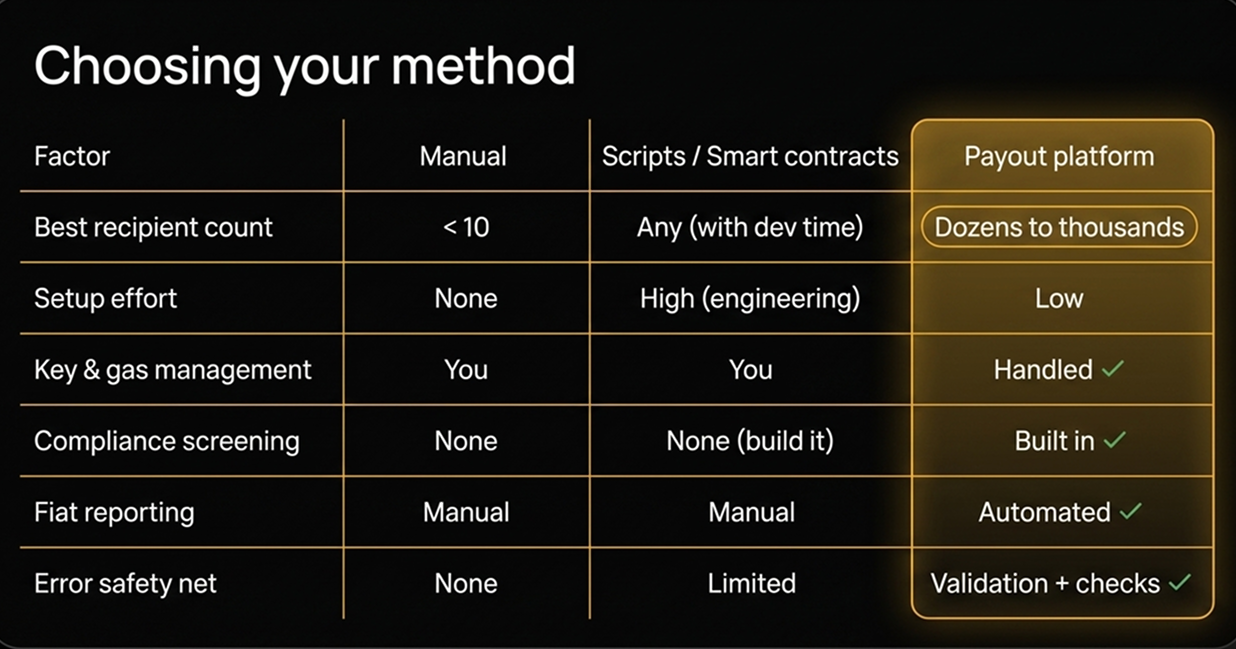
Five mistakes that cost real money
- Wrong network. The most common irreversible loss. Always match the recipient's network to the address.
- Forgetting gas. A wallet full of USDT can't move without the native token for fees.
- No test transfer. For a new large recipient, send a small amount first and confirm receipt.
- Skipping screening. Paying a sanctioned or high-risk address is a legal and banking risk, not just a crypto one.
- Weak records. If you can't tie every hash to a fiat value and a recipient, month-end close becomes painful.
Frequently asked questions
Can I send USDT to many wallets in one transaction? On some networks, yes — a "multisend" smart contract bundles multiple recipients into one on-chain transaction. Otherwise, batching is handled off-chain by a platform that submits the transfers for you.
What's the cheapest way to send USDT in bulk? Low-fee networks such as Tron (TRC-20), Solana, and TON dramatically reduce per-transfer cost versus Ethereum. See our full USDT network fees comparison.
Do I need to hold crypto to run USDT payouts? Not with a fiat-native platform. You can fund in EUR or USD, keep your accounting in fiat, and let the provider handle conversion and delivery.
Is bulk USDT sending safe? The transfer itself is irreversible, so accuracy matters. Reputable platforms add address validation, KYT, and sanctions screening to reduce risk — protections that manual and script-based methods lack.
Scale it without the overhead
Manual works for a handful of payees; scripts work if you want to run infrastructure. If you'd rather send USDT to hundreds or thousands of recipients from a fiat balance — with screening and clean reporting built in — that's exactly what INXY's mass USDT payouts are built for.

MiCA Is Here: How INXY Built a Multi-Jurisdiction Model — and Migrated Every Client Before July 1
1 July 2026. Today marks the beginning of a new chapter for Europe's digital asset industry. The transitional period under the EU's Markets in Crypto-Assets Regulation (MiCA) has ended, and the standard for operating a crypto business in Europe has been raised for good.
1 July 2026. Today marks the beginning of a new chapter for Europe's digital asset industry. The transitional period under the EU's Markets in Crypto-Assets Regulation (MiCA) has ended, and the standard for operating a crypto business in Europe has been raised for good.
For years, much of the industry was built around a single jurisdiction. One license. One operating model. That worked while the rules were still evolving. It works less well now.
We want to be transparent with our clients about where INXY stands and what we did about it. INXY did not obtain a MiCA authorization in Poland. So rather than depend on any single jurisdiction, we moved to a multi-jurisdiction operating model — and before 1 July, we completed the migration of every client off our Polish entity. No payments paused. No settlement stopped.
Here's what MiCA is, what changed on 1 July, and how our model is built to keep your payments running through moments exactly like this one.
What is MiCA?
MiCA (Markets in Crypto-Assets Regulation) is the European Union's comprehensive framework for regulating crypto-assets and the companies that provide crypto services. It replaces a patchwork of national rules with a single, harmonized rulebook across all 27 member states.
In practice, MiCA does three main things:
- Licenses providers. Any company offering crypto-asset services — custody, exchange, transfers, payouts — must be authorized as a Crypto-Asset Service Provider (CASP) by a national regulator. A CASP license can then be "passported" across the EU.
- Regulates stablecoins. Issuers of stablecoins ("e-money tokens") must be authorized and hold strict, fully-backed reserves. This is why compliant stablecoins like USDC and EURC stayed available on EU-regulated venues while non-authorized ones were delisted. (More on this in "Is USDC regulated?")
- Sets conduct and transparency standards for how services are marketed and delivered.
MiCA's rules for service providers began applying on 30 December 2024, with a transitional window for existing firms.
What changed on 1 July 2026
MiCA included a transitional ("grandfathering") period under Article 143. Firms already operating legally under national regimes before 30 December 2024 could continue serving clients — but only until they obtained a CASP license or until 1 July 2026, whichever came first. That date has now passed, and there is no extension mechanism in the regulation.
From today, any provider serving EU clients must hold a MiCA CASP authorization. A legacy national registration no longer provides cover.
The situation in Poland made this especially clear. Poland has not yet enacted the national Crypto-Asset Market Act needed for its regulator (KNF) to issue CASP licenses — the act has been vetoed repeatedly, most recently in June 2026. In practice, that left Polish-registered providers with no domestic path to a CASP license before the deadline.
The limits of a single-jurisdiction model
MiCA is not simply making it harder to launch a crypto business. It is redefining what it means to run one: no longer just "get a license and go," but "operate reliably inside a regulated financial system."
That shift began well before 1 July. Across the market, some companies are spending the coming months restructuring. Some are migrating clients. Some are rethinking how they serve Europe altogether. The common thread is that betting an entire operation on one jurisdiction has become a single point of failure.
INXY's response: a multi-jurisdiction operating model
For payment infrastructure providers, continuity is not optional. Payments cannot pause because the regulatory landscape changes. Businesses still need to settle funds. Cross-border commerce continues every day. Infrastructure should adapt so that businesses don't have to.
That is why INXY expanded beyond a single jurisdiction and built a multi-jurisdiction operating model, spanning:
- Canada — registered Money Services Business (FINTRAC MSB M23375535)
- El Salvador
- Cyprus
- Switzerland
We did not build this because a deadline forced our hand at the last minute. We built it because our B2B clients need reliability that does not depend on the regulatory status of any one country. When the Polish route closed, that model is what let us complete the migration of all clients off our Polish entity before 1 July 2026 — with no interruption to payouts, settlement, or reporting.
What this means for you
- Your service continues. Clients were migrated ahead of the deadline and are served through our appropriately licensed entities. There is no gap in payouts or settlement.
- Your funds and reporting are unaffected. Fiat-denominated reporting, payout records, and reconciliation continue exactly as before.
- Your compliance standards are unchanged. Full KYB, KYC where needed, real-time transaction monitoring (KYT), and sanctions screening remain in force across every jurisdiction we operate in.
Regulation is becoming the foundation, not the obstacle
One conclusion runs through all of this: regulation is no longer just about compliance. It is becoming the foundation that enables institutional adoption of stablecoin infrastructure at scale. The businesses that treat regulatory resilience as core infrastructure — not paperwork — are the ones that will serve the next phase of the market.
That's the central theme of our latest research, Stablecoins 2026: The New Global Financial Settlement Layer, which maps the regulatory landscape and what it means for businesses building on stablecoin rails. (Link / request the report: [add URL].)
Frequently asked questions
Did INXY obtain a MiCA license? No. INXY did not obtain a MiCA authorization in Poland. Instead of relying on a single jurisdiction, we operate a multi-jurisdiction model across Canada, El Salvador, Cyprus, and Switzerland, chosen to give our B2B clients continuity.
What happened to clients on the Polish entity? All clients were migrated off our Polish entity before 1 July 2026. The migration was completed ahead of the MiCA transitional deadline, with no interruption to payments.
What is MiCA, in simple terms? MiCA is the EU's single set of rules for crypto companies and crypto-assets. It requires service providers to be licensed as CASPs and sets strict standards for stablecoins, consumer protection, and transparency across all member states.
What happened on 1 July 2026? MiCA's transitional period ended. From this date, providers serving EU clients must hold a MiCA CASP license; legacy national registrations no longer provide cover.
Will my payments pause? No. Continuity was the entire point of moving to a multi-jurisdiction model. Client migration was completed before the deadline, and settlement continues without interruption.
Talk to us
Regulatory change raises real questions for any business that moves money across borders. If you'd like to understand how our multi-jurisdiction model supports your payouts, contact our team — and we'd be glad to share our perspective as the industry enters this new phase.
This update is provided for information and does not constitute legal advice. Regulatory details are accurate as of 1 July 2026 and may evolve.

Crypto Checkout That Converts: Reducing Drop-off on Stablecoin Payments
You added crypto checkout to win new buyers — but the payment page is quietly leaking them. This guide breaks down exactly where stablecoin payments lose customers: network confusion, price-lock anxiety, wallet friction, unclear confirmations, and surprise fees. Learn the design and infrastructure fixes that turn a leaky pay page into one that converts — including why a well-built crypto checkout can beat cards, clearing ~99.9% of attempts with no chargebacks.
You added a crypto checkout to capture a new segment of buyers, and the demand is real — but the payment page is leaking customers. A shopper picks crypto, lands on the pay screen, hesitates, and disappears. That gap between intent and completed payment is checkout drop-off, and on crypto rails it has its own specific causes that most teams never diagnose.
This guide breaks down where stablecoin payments lose customers, the friction points that drive abandonment, and the concrete design and infrastructure choices that turn a leaky pay page into one that converts. The goal is simple: every shopper who chooses crypto should finish paying.
Why crypto checkouts lose customers
A crypto checkout is not just a card form with different logos. It introduces steps a Web2 buyer has never seen — choosing a network, copying an address, waiting for confirmations — and every unfamiliar step is a place to quit. Unlike a card decline, which the customer understands, a stalled or confusing crypto payment feels risky, and risk kills conversion.

Where drop-off actually happens
Most teams treat the checkout as a single event. It isn't. Crypto payment drop-off clusters at four distinct stages:
- Method selection — the customer considers crypto but doesn't trust it on your site, so they bounce before starting.
- Network and asset choice — faced with "ERC20 / TRC20 / BEP20" they don't recognize, they freeze.
- Wallet action — copying an address or scanning a QR code, switching apps, and fearing a mistake.
- Confirmation wait — the payment is sent but the page gives no clear signal it worked.
You cannot fix abandonment you can't see. Instrument each of these stages separately before changing anything.
Why a one-point conversion gain is worth chasing
Checkout is the highest-leverage surface you own. Traffic, ads, and product pages all exist to deliver a customer to this screen. Recovering even a few percentage points of crypto payment conversion rate here costs nothing in additional traffic — it simply stops you paying for visitors you then lose at the last step. For a business processing meaningful volume, a high-conversion gateway is not a nice-to-have; it is the difference between crypto being a growth channel and a vanity feature.
The main causes of stablecoin payment drop-off
Network and asset confusion
The single biggest source of friction is choice the customer can't evaluate. Asking a non-technical buyer to select between Tron, Ethereum, BNB Chain, and Polygon — each with different fees and speeds — is asking them to make a decision they're unqualified to make. Hesitation becomes abandonment.
Volatility and price-lock anxiety
If the amount due appears to move while the customer reads it, they assume they'll overpay or underpay. Even with stablecoin payments, buyers worry the quote will expire or shift. Without a visibly locked rate, the page feels unsafe.
Wallet friction and manual errors
Copy the address. Switch to the wallet app. Paste. Check the network matches. Confirm the gas. Send. Switch back. Each handoff is a chance to abandon — and the fear of sending funds to the wrong address or wrong chain is enough to make cautious buyers stop entirely.
Slow or unclear confirmation
A customer who has paid but sees a spinning loader with no explanation assumes the worst. On-chain confirmation times vary by network, and a checkout that doesn't explain the wait — or sets no expectation for it — converts the final, already-committed moment into a drop-off. (For the underlying mechanics, see our guide on how long crypto withdrawals and confirmations take.)
Fees, minimums, and surprise costs
A network fee that appears only at the final step, or a minimum the customer trips over, reads as a bait-and-switch. Surprise costs at the moment of payment are one of the most reliable abandonment triggers in any checkout — crypto included.
Missing trust and compliance signals
Crypto still carries a perception of risk for mainstream buyers. A pay page with no licensing, security, or brand reassurance gives a nervous customer every reason to close the tab. Trust is not decoration here; it is a conversion input.
How to design a crypto checkout that converts
Invoice in fiat, settle in stablecoins
Let the customer see the price in the currency they think in — EUR or USD — and pay in crypto behind the scenes, with automatic conversion to stablecoins or fiat on your side. This removes mental math, neutralizes volatility, and lets a Web2 buyer treat the transaction like any other payment. It is the foundation of a converting crypto checkout.
Reduce choices and default to the right network
Don't make the customer a blockchain expert. Pre-select a fast, low-fee network as the default and present asset options in plain language ("Pay with USDT" rather than "TRC20"). Fewer decisions mean fewer exit points. Every option you remove from the critical path is a conversion you keep.
Lock the rate and show a countdown
Display a fixed amount due with a clear, time-boxed quote ("This price is locked for 15:00"). A visible countdown does two things at once: it removes price anxiety and creates gentle urgency that pulls the customer through. Certainty converts.
Make the confirmation state legible
Tell the customer exactly what's happening: "Payment detected — confirming on-chain. This usually takes under a minute." Replace ambiguous spinners with a status that names the step and sets a time expectation. The moment after a customer pays is the worst possible time to leave them guessing.
Add fallback paths
Some customers will start a crypto payment and stall. Offer a clean way to switch methods or retry without losing the cart. A dead-end on a failed or abandoned crypto payment is a guaranteed loss; a graceful fallback recovers a share of it.
Build trust into the page
Show licensing and security signals where the customer makes the decision. INXY operates as licensed and regulated payment infrastructure with AML/KYB controls and partners including Sumsub, Elliptic, and Crystal — the kind of compliance signal that reassures a cautious buyer at exactly the right moment. Surface it; don't bury it in a footer.
Conversion benchmarks: crypto vs cards
When the checkout is built well, crypto doesn't just match card conversion — it can beat it. The structural advantages are real:

Cards fail far more often than most merchants realize — declines, 3-D Secure friction, and cross-border blocks routinely cost 5–30% of attempts. Crypto settlement is final and irreversible, which removes chargebacks entirely and lets a well-designed gateway clear close to every legitimate attempt. For merchants serving Europe, Asia, and LatAm, that reliability is a direct conversion uplift — INXY reports helping customers increase conversion rates by up to 40%. (For a wider comparison of providers and rails, see best payment gateways for SaaS in 2026.)
A pre-launch checklist
Before you ship a crypto checkout, confirm it does all of the following:
- Prices in the customer's fiat currency, with conversion handled automatically.
- Defaults to a fast, low-fee network instead of forcing a choice.
- Locks the rate with a visible countdown.
- Shows total cost up front, including any network fee — no surprises at the last step.
- Names the confirmation step and sets a time expectation.
- Offers a retry or fallback for stalled payments.
- Displays trust and compliance signals on the pay page itself.
- Tracks drop-off by stage, not just overall completion.
How INXY reduces crypto checkout drop-off
INXY's high-conversion API paygate is built around the principles above. Customers are invoiced in fiat and pay in crypto, with automatic conversion to stablecoins or fiat to remove volatility risk. You get settled in your bank account — in EUR or USD — as soon as the next day, with full reporting and an accounting-friendly setup for Web2 companies. The gateway supports 20+ cryptocurrencies across major networks (ERC20, TRC20, BEP20, Polygon, Tron, TON, and more), charges below 1% per transaction with no setup or hidden fees, and is engineered for a ~99.9% success rate.
The result is a checkout your customers finish — built to convert, not just to accept. Add it to your checkout page, webstore, platform, or app via API integration, or book a demo to see the conversion data for your business model.
FAQ
What causes drop-off on crypto checkouts? The most common causes are network and asset confusion, price-lock anxiety, manual wallet friction, unclear confirmation states, surprise fees, and missing trust signals. Each maps to a specific stage of the checkout, so the fix starts with measuring drop-off stage by stage rather than as a single number.
How do stablecoin payments improve checkout conversion? Stablecoins remove volatility from the transaction, so the amount due stays fixed while the customer pays. Pairing that with fiat-denominated pricing and automatic conversion lets a mainstream buyer complete a crypto payment as easily as a card payment — without exposure to price swings.
Is crypto checkout conversion really higher than cards? It can be. Crypto payments have no chargebacks and final settlement, and a well-built gateway can clear close to 99.9% of legitimate attempts versus 70–95% typical card success. The advantage is largest for cross-border and emerging-market customers, where cards are frequently declined or restricted.
Which network should a crypto checkout default to? Default to a fast, low-fee network so customers don't have to choose. Stablecoins on high-throughput networks settle in seconds for a fraction of the cost of slower chains, which both speeds confirmation and reduces the fee shown at checkout.
How do I add a high-conversion crypto checkout to my site? Use a payment gateway with API integration that handles fiat pricing, network selection, rate locking, and conversion for you. INXY integrates with your existing checkout, webstore, or app, and settles to your bank in EUR or USD — see get started.
Losing customers at the crypto pay page? Explore INXY's high-conversion payment gateway and turn stablecoin checkout into a channel that converts.

The Travel Rule for Crypto Payouts: What Screening Actually Runs in 2026
The crypto Travel Rule sits between a business and every crypto payout it sends. This guide covers where the obligation comes from (FATF Recommendation 16 and the EU's no-threshold Regulation (EU) 2023/1113), what originator and beneficiary data must travel, the order screening actually runs in before a transfer is created, and what breaks in production.
If your business sends crypto payouts — to contractors, suppliers, affiliates or partners — the crypto Travel Rule sits between you and every transfer. It is the piece of regulation most likely to delay, hold or return a B2B payout, and most senders meet it for the first time when a payment stops. This guide sets out where the obligation comes from, what data has to travel, the order the checks actually run in, and what breaks in production.
This article describes regulatory and market conditions for general information. It is not legal, tax, or financial advice — INXY Payments is a payment infrastructure provider, not a law or accountancy firm, and decisions with regulatory consequence should be reviewed by qualified counsel in the relevant jurisdiction.
What the Travel Rule is, and where it comes from
The Travel Rule is an anti-money-laundering standard requiring identifying information about the originator (sender) and the beneficiary (recipient) to travel alongside a transfer of value. It began in conventional wire transfers and now applies to crypto.
The instrument: FATF Recommendation 16
The obligation originates in Recommendation 16 of the FATF International Standards on Combating Money Laundering and the Financing of Terrorism and Proliferation, together with its Interpretive Note (INR.16), which sets out the required data fields for wire transfers. Crypto came in through Recommendation 15: FATF amended it in October 2018 to cover virtual assets and virtual asset service providers, and in June 2019 adopted its Interpretive Note (INR.15), which applies R.16's requirements to virtual asset transfers and permits a USD/EUR 1,000 de minimis threshold.
Two developments since then matter operationally:
- In June 2025 FATF adopted revisions to Recommendation 16 on payment transparency, modernising the standard for current payment systems, with a phased implementation timeline for jurisdictions (FATF, Updates to Standards on Recommendation 16 on Payment Transparency, June 2025).
- In July 2026 FATF published its Seventh Targeted Update on Implementation of the FATF Standards on Virtual Assets and VASPs, the annual assessment of how far jurisdictions have actually got, and the current reference for implementation status (FATF, July 2026).
FATF recommendations are not law in themselves. Each jurisdiction legislates its own version, which is why the picture is fragmented and why a payout that is routine in one corridor stalls in another.
Who carries the obligation — and when you are the originator
The duty falls on virtual asset service providers: exchanges, custodial wallet providers and crypto payment gateways. When your business initiates a payout through one, the provider is the originating institution and carries the Travel Rule duty — but it can only discharge that duty using your data.
The burden is shared in a specific and often misunderstood way. The provider operates the machinery. You supply the beneficiary information, and incomplete or mismatched sender-supplied data is the single most common reason a payout stalls. Nothing about using a regulated provider moves that responsibility off your side.
The regulatory picture by region
| FATF baseline | European Union | United States | |
|---|---|---|---|
| Instrument | Recommendation 16, applied to virtual assets by INR.15 | Regulation (EU) 2023/1113, with EBA Guidelines EBA/GL/2024/11 | Bank Secrecy Act, administered by FinCEN |
| Threshold | USD/EUR 1,000, below which a reduced data set may apply | None. Full data on every crypto-asset transfer | USD 3,000 |
| Status | Standard, not law. Jurisdictions implement it. | Directly applicable, since 30 December 2024 | In force; stablecoin issuers being drawn in — see below |
| Companion framework | Recommendation 15 / INR.15 for VAs and VASPs | MiCA, Regulation (EU) 2023/1114, for provider authorisation | — |
| Served by INXY? | — | Yes | No |
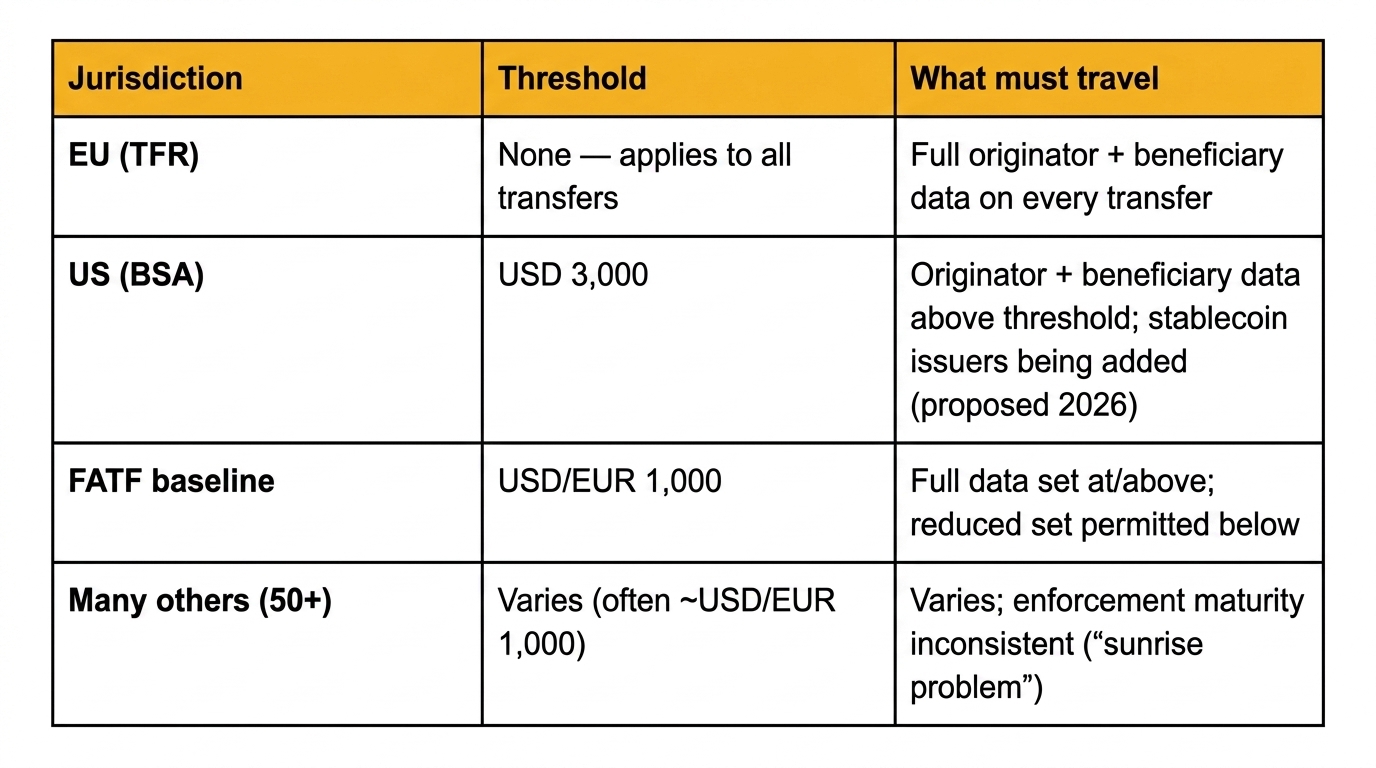
European Union — no de minimis threshold
The EU regime is the strictest of the major ones. Regulation (EU) 2023/1113 — the recast transfer-of-funds rules, extended to cover transfers of crypto-assets — has applied since 30 December 2024, and it carries no minimum threshold. A EUR 5 payout and a EUR 500,000 payout attract the same information obligation. The EBA Guidelines EBA/GL/2024/11 set out how transfers with missing or incomplete information must be handled, including when to execute, reject or suspend.
It operates alongside MiCA, Regulation (EU) 2023/1114, whose Title V governs the authorisation and operating conditions of crypto-asset service providers, with authorisation under Article 59. The two regimes do different jobs: MiCA decides who may provide the service, 2023/1113 decides what information must accompany each transfer.
United States — market context only
In the US the Travel Rule sits under the Bank Secrecy Act with a USD 3,000 threshold, and stablecoin rails are being drawn further into the banking compliance perimeter following the GENIUS Act.
It does not create a path for US readers here. INXY Payments serves Europe, Asia and LatAm, and does not serve the United States, the United Kingdom or sanctioned jurisdictions. The US regime appears in this article as market context and nothing else.
The sunrise problem
Because jurisdictions adopt the rule at different speeds, a compliant provider in a regulated market frequently needs to send Travel Rule data to a counterparty in a market that has not implemented the rule and cannot receive it. This is the sunrise problem, and for a B2B sender it has a blunt consequence: the success of your payout can depend on your beneficiary's jurisdiction rather than your own.
In practice it shows up three ways. The counterparty provider accepts the transfer and ignores the data, which is fine. It rejects the transfer because it cannot process the message, which costs you a cycle. Or it accepts and then queries, which parks the funds without telling anyone. Ask your provider which counterparties in your corridor list fall into the second and third categories before you build a payment calendar around them — or bring the list to a demo and we will mark them.
What data must travel with a B2B crypto payout
The required set is consistent across regimes even where thresholds differ.
Originator (sender) fields
- Name of the originator — your business or the paying entity.
- Wallet address used for the transfer, or a transaction reference.
- Physical or registered address, and in some regimes an official identifier or account number.
Beneficiary (recipient) fields
- Name of the recipient.
- Wallet address receiving the funds.
The transaction amount, execution date and a unique transaction identifier are recorded with every transfer. The operational takeaway: beneficiary name and wallet must be accurate and verifiable before you send. A mismatch is a hold.
Self-hosted wallet payouts — the extra step
Paying a self-hosted, non-custodial wallet — common when paying contractors who hold their own keys — changes the mechanics. There is no counterparty provider to receive the message, so nothing is transmitted onward. Your provider must still collect originator and beneficiary information, and above the relevant threshold may require verification that the beneficiary controls the destination address, based on a risk assessment. Expect to attest to control of the address on larger payouts.
What screening actually runs, in order
This is the part most articles skip, and the order matters more than the list. Using INXY's outbound model, a payout passes through these gates before any transfer is created:
- The payout is created as a request, not a send. Nothing is on-chain yet. This is what makes everything below cheap: a problem caught here produces an error, not a transaction to unwind.
- Pre-send validation. Structural and field-level checks. Failure stops the operation with an error and no transaction is formed.
- Address history lookup. A previously unseen destination address is treated cautiously; a known one carries its last risk result forward.
- Blacklist check on the beneficiary address. A match fails the request outright. No transaction created.
- KYT risk screening. A risk provider scores the destination address. Low or Medium passes. High fails the request, no transaction is created, and an error returns.
- Approved-contact / allow-list check. A recipient marked declined blocks the payout regardless of every check above — the control finance teams use to maintain a vetted payee set for recurring and mass runs.
- Travel Rule message exchange. Only now. The required originator and beneficiary information is packaged and exchanged with the counterparty provider where one exists.
- Settlement.
Screen first, then transmit, then send. Every row in an INXY mass payout batch runs this sequence individually. A provider that exchanges Travel Rule data before screening has told you something about its architecture, and it is worth asking the question during evaluation.
KYB is the gate to the platform, KYT the gate to each transaction, and the Travel Rule the data that rides along with it. A provider handling only the first is one you will outgrow at your first screening event.

What breaks in production
Name mismatch and transliteration. Your beneficiary name does not match the one the counterparty provider holds — legal versus trading name, or a different transliteration from a non-Latin script. This is the most common single cause of a hold, and it is entirely preventable by capturing the name as the beneficiary's own provider holds it rather than as it appears on your invoice.
Screening true positives mid-batch. A row in a mass payout hits a sanctions or KYT match. The correct behaviour is that the row stops and is escalated for review while the rest of the batch proceeds. Some platforms halt the entire batch. Establish which before a payout Friday establishes it for you. To be unambiguous: the right answer is that the payout stops and is reviewed. Any provider positioning reduced screening as a feature is selling a future enforcement problem.
Self-hosted wallet attestations collected too late. If address-control verification is requested at payout time rather than at payee onboarding, you discover it during a cycle. Collect it when you onboard the payee.
Treating a passed screen as permanent. A destination address that scored Low last month can score High this month. Screening is per-transaction for a reason, and a cached pass is not a control.
Compliance risks of getting payouts wrong
- Held or returned transfers — funds sit in review or come back, delaying the people you owe.
- Counterparty refusal — a receiving platform that cannot accept the data, or flags your transfer, bounces it.
- Regulatory exposure — outbound flows without proper screening and recordkeeping invite AML enforcement.
- Operational drag — in-house screening and Travel Rule messaging is never finished, because standards keep moving, as the June 2025 R.16 revisions show.
The decision framework
Three questions settle whether you need to care about any of this in-house.
- Do you send, or only receive? Acceptance screening is the easier half. The outbound leg is where sanctions screening, address risk and transfer-information requirements bite, because on a payout you are the originator. If you will ever send, test the payout leg during evaluation, not after.
- Where are your beneficiaries, and what are their providers? Your corridor list, not your own jurisdiction, determines how much of the sunrise problem you will meet. Get a corridor-by-corridor answer from any provider you shortlist.
- Do you want to own the compliance stack? If not, require a provider that runs validation, blacklist and KYT screening, the Travel Rule exchange and an approved-contact control inside the payout flow, exposed through API and webhooks so a mass run applies the checks per recipient.
What none of this does is reduce your obligations. A regulated provider runs the controls; it does not remove them, and no rail helps anyone bypass KYC, sanctions screening or reporting.
For the asset most B2B runs settle in, see payouts settled in USDT.
FAQ
Does the Travel Rule apply to stablecoin payouts?
Yes. A stablecoin transfer handled by a regulated provider is a transfer of a crypto-asset and carries the same obligations as any other. In the EU, full originator and beneficiary data is required regardless of amount under Regulation (EU) 2023/1113.
What is the Travel Rule threshold?
It depends on the jurisdiction. FATF's standards, as applied to virtual assets by the Interpretive Note to Recommendation 15, permit a USD/EUR 1,000 de minimis threshold below which a reduced data set may apply. The EU applies no threshold — every crypto-asset transfer carries full data. The US applies USD 3,000 under the Bank Secrecy Act.
Do I need to collect data for self-hosted wallet payouts?
Yes. Even with no counterparty provider to receive the message, your provider must still collect originator and beneficiary information, and above the relevant threshold may require verification that the recipient controls the destination address. Collect that attestation at payee onboarding, not at payout time.
Is the Travel Rule the same as KYC?
No. KYC and KYB verify identity once, at onboarding. The Travel Rule governs the transmission of originator and beneficiary data alongside each individual transfer. KYT screens the transaction itself, including the risk of the destination address. Three distinct controls, running at three different moments, and a provider needs all three.
Who is responsible — the sender or the recipient platform?
Both sides carry obligations. The originating provider must collect and transmit the data; the beneficiary provider must receive and retain it. As the business initiating the payout, you are responsible for supplying accurate beneficiary information to your provider, and that is where most failures originate.
What is the sunrise problem?
It is the mismatch created when jurisdictions implement the Travel Rule at different speeds. A provider in a regulated market must send data to a counterparty in a market that cannot receive it. For a payer, it means a payout's success can depend on the beneficiary's jurisdiction rather than your own compliance posture.
Does using a regulated gateway reduce my compliance obligations?
No. It moves the operational work — screening, list maintenance, message exchange, recordkeeping — to a provider built for it. The underlying obligations on your business remain yours, including supplying accurate beneficiary data and keeping it current. No provider can help anyone bypass KYC, sanctions screening or reporting.
Last updated: 14 October 2026.

How Long Do Crypto Withdrawals Take? Processing Times, Fees & Speed Explained
This guide breaks down realistic timeframes by network, the factors that slow withdrawals down, whether "instant" withdrawals are genuine, and how to keep withdrawal fees low.
How long do crypto withdrawals take? In most cases, a crypto withdrawal clears in anywhere from a few seconds to about an hour — but the real answer depends on the blockchain you use, network congestion, and your provider's internal processing. A USDT transfer on a fast network can settle in under a minute, while a Bitcoin withdrawal held for multiple confirmations can take 30–60 minutes. This guide breaks down realistic timeframes by network, the factors that slow withdrawals down, whether "instant" withdrawals are genuine, and how to keep withdrawal fees low.
What Is a Crypto Withdrawal?
A crypto withdrawal is the process of moving digital assets out of an account — typically an exchange, custodial wallet, or payment platform — to an external blockchain address you control. Unlike an internal transfer between two accounts on the same platform, a crypto currency withdrawal is recorded on-chain, which means it must be broadcast to the network, validated by miners or validators, and confirmed in one or more blocks before it is final.
Two distinct stages determine how long the whole thing takes:
- Platform processing — the time your exchange or provider needs to review, batch, and sign the transaction before it ever touches the blockchain.
- Blockchain confirmation — the time the network needs to include your transaction in a block and add enough subsequent blocks to consider it irreversible.
A delay at either stage affects the total. A platform can sit on a request for 30 minutes for security reasons even when the underlying network would settle it in seconds.
How Long Do Crypto Withdrawals Take on Average?
For a healthy network and a provider without manual holds, most crypto withdrawals complete within a few minutes to one hour. The variance comes almost entirely from which chain you pick.
Exchange processing time vs blockchain confirmation time
Platform processing usually adds a few seconds to several minutes. Many providers batch outgoing transactions or run automated risk checks before broadcasting. After broadcast, the clock is controlled by the network: your transaction needs to be picked up by validators and then earn a number of confirmations — additional blocks built on top of it. The more confirmations a provider requires, the safer the transaction and the longer the wait.
Typical withdrawal times by network
The table below shows realistic ranges. Treat these as typical, not guaranteed — congestion and provider policy shift them.
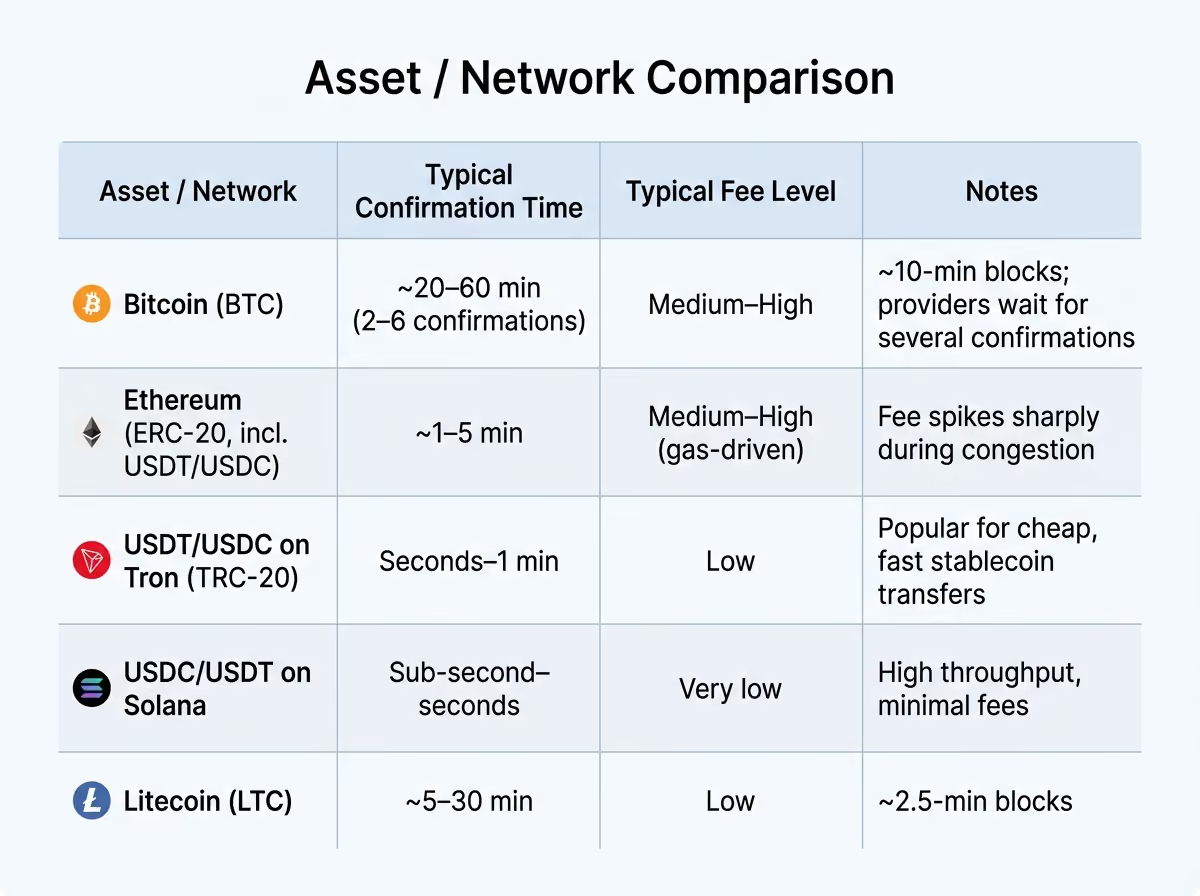
The practical takeaway: the asset and network you choose matter far more than the platform. Sending the same stablecoin over Tron instead of Ethereum can turn a multi-minute, higher-fee withdrawal into a near-instant, low-cost one.
What Affects Crypto Withdrawal Speed?
When a withdrawal takes longer than expected, the cause is almost always one of three things.
Network congestion and gas fees
Every blockchain has limited block space. When demand is high, transactions compete to get included, and those attaching higher fees are prioritized. On networks like Ethereum, a low fee during a busy period can leave your transaction pending for much longer. This is why the same crypto withdrawal can clear in seconds one day and crawl the next.
Exchange security holds and withdrawal limits
Providers routinely apply temporary holds to protect funds. Common triggers include:
- A recent password, 2FA, or device change — many platforms freeze withdrawals for 24–48 hours afterward.
- First-time withdrawals to a new address, which may need additional verification.
- Amounts that exceed your tier's withdrawal limit, forcing a manual review or a split across days.
These holds are deliberate friction, not network delays — and they are the most common reason a withdrawal "stalls" while the blockchain itself is idle.
AML/KYC compliance checks
Regulated platforms screen withdrawals against anti-money-laundering and sanctions rules. Most checks are automated and invisible, but a flagged transaction can be paused for manual review. Larger amounts, transfers to newly seen addresses, or activity that breaks your normal pattern are more likely to be queued for a compliance look before release.
Are Instant Crypto Withdrawals Real?
The term instant crypto withdrawal is mostly marketing shorthand, and it means one of two things:
- Genuinely fast settlement on a fast chain. On high-throughput networks like Solana, or stablecoins on Tron, an instant crypto withdrawal is effectively real — confirmation lands in seconds. There is no magic here; the network is simply fast and cheap.
- Internal "instant" transfers. Some platforms advertise instant withdrawals that are actually off-chain movements between accounts on the same provider. These clear immediately because nothing is broadcast to the blockchain at all — which is fast, but only works inside that provider's ecosystem.
So crypto instant withdrawal is achievable, but read the fine print. A true on-chain "instant" withdrawal depends on the network you select. No provider can make a congested Bitcoin or Ethereum transaction settle instantly without raising the fee.
Crypto Withdrawal Fees Explained
Speed and cost are linked: paying a higher fee can buy faster inclusion, while choosing the wrong network can cost you both time and money. Understanding crypto withdrawal fees helps you optimize for both.
Network fees vs platform fees
A withdrawal fee usually has two components:
- Network (miner/validator) fee — paid to the blockchain to process the transaction. This is dynamic and rises with congestion. It is unavoidable, though it varies enormously by chain.
- Platform fee — an additional charge some providers add on top of the network fee. This is set by the provider and may be flat or percentage-based.
When comparing a crypto withdrawal fee across providers, separate these two. A platform advertising "zero fees" may still pass through a high network fee, and vice versa.
How to reduce crypto withdrawal fees
You have more control over cost than most people assume:
- Choose the right network. Sending stablecoins over Tron or Solana instead of Ethereum is the single biggest lever for low fees.
- Avoid peak congestion. Fees on busy chains drop when network demand falls.
- Batch withdrawals. Consolidating several payouts into fewer transactions reduces total network fees — valuable for businesses running frequent transfers.
- Mind the minimums. Small, frequent withdrawals get eaten by fixed costs; fewer, larger ones are more efficient.
For a crypto cash withdrawal — converting to fiat and sending to a bank — expect an extra layer of timing. The on-chain step may be fast, but the fiat leg typically settles in 1–5 business days depending on the banking rails (SEPA, SWIFT, ACH).
How Businesses Handle High-Volume Crypto Withdrawals
For a business paying suppliers, contractors, or affiliates, withdrawal speed is an operational metric, not a curiosity. Manual, one-by-one withdrawals on a slow or expensive network do not scale.
The businesses that get this right standardize on a few principles:
- Default to fast, low-fee networks for routine payouts, reserving slower chains only when a counterparty specifically requires them.
- Batch and automate outgoing transactions through an API rather than processing them by hand.
- Build compliance into the flow so AML/KYC checks happen up front and don't stall releases later.
This is exactly the problem a dedicated payouts infrastructure solves. INXY's crypto payouts let businesses automate high-volume transfers across networks with predictable timing and fees, while exchange and conversion tools handle the asset and fiat legs. The result is withdrawal speed you can plan around instead of monitoring anxiously.
FAQ
How long do crypto withdrawals take? Most crypto withdrawals complete within a few minutes to an hour. Stablecoins on fast networks like Tron or Solana can settle in seconds, while Bitcoin withdrawals held for several confirmations typically take 30–60 minutes. Platform security holds can add more time independent of the network.
Why is my crypto withdrawal taking so long? The usual causes are network congestion, a provider security hold (often after a recent password or device change), an AML/KYC compliance review, or a low network fee that deprioritizes your transaction. The blockchain itself may be idle while a platform-side hold is the real delay.
What is the fastest crypto to withdraw? Stablecoins on high-throughput networks — such as USDT on Tron or USDC on Solana — are among the fastest and cheapest to withdraw, typically settling in seconds for a low fee.
Can I get instant crypto withdrawals? Yes, in two senses: genuinely fast on-chain settlement on networks like Solana or Tron, or off-chain "instant" transfers between accounts on the same platform. A truly instant crypto withdrawal on a congested network like Bitcoin or Ethereum, however, is not realistic without paying a premium fee.
What is a crypto withdrawal? A crypto withdrawal moves digital assets from an account to an external blockchain address you control. It is recorded on-chain and must be confirmed by the network, which distinguishes it from an instant internal transfer within a single platform.
Ready to move crypto on a timeline you can plan around? Explore INXY's crypto payout and exchange tools for fast, low-fee transfers at scale.

Cross-Border B2B Payments With Stablecoins: The 2026 Guide to Faster, Cheaper Settlement
This guide explains how cross-border stablecoin payments actually work, how they compare to SWIFT, where they make the most sense, and what it takes to start accepting them.
For most businesses, sending money across borders still feels like it did a decade ago: slow, opaque, and expensive. Cross-border crypto payments built on stablecoins are changing that. Instead of routing an international crypto payment through a chain of correspondent banks, a stablecoin transfer settles directly on a blockchain in seconds, for a fraction of the cost. In 2026 this is no longer a fringe experiment — it is one of the fastest-growing segments in business payments, and the data behind it is hard to ignore.
This guide explains how cross-border stablecoin payments actually work, how they compare to SWIFT, where they make the most sense, and what it takes to start accepting them.
Why cross-border crypto payments are replacing the old rails
The traditional system was never designed for the speed of modern commerce. It was designed for banks talking to banks.
The hidden cost of SWIFT and correspondent banking
A typical international wire passes through two to four intermediary banks before it reaches the recipient. Each one takes a cut and adds a delay. The result is well known to any finance team: wire fees of roughly $40–$80 per transaction, settlement times of one to three business days (longer across exotic corridors), and almost no visibility into where the money is at any given moment. Add unfavorable FX spreads and the all-in cost of moving money internationally can quietly erode margins on every cross-border deal.
For a company paying dozens or hundreds of overseas suppliers, contractors, or partners each month, that friction compounds fast.
What changed in 2026
Stablecoins — blockchain tokens pegged 1:1 to a fiat currency such as the US dollar — turned out to be an almost perfect fit for this problem. They hold a stable value, move on open networks 24/7, and settle without a banking intermediary.
Adoption has gone vertical. Business-to-business stablecoin payment volume grew roughly 733% year over year heading into 2026, and total stablecoin transaction volume reached about $33 trillion in 2025. Juniper Research projects that cross-border B2B stablecoin payments will hit $5 trillion by 2035, up from an estimated $13.4 billion today, with the large majority of that future value coming specifically from cross-border business use. In short: the rail is being built right now, and businesses that learn it early gain a cost advantage.
How stablecoin cross-border payments actually work
The mechanics are simpler than the technology sounds. Every cross-border stablecoin payment follows the same three-stage path.
On-ramp, settlement, off-ramp
- On-ramp. The sender converts local fiat (USD, EUR, etc.) into a stablecoin such as USDC or USDT, either from existing treasury or through a payment provider.
- Settlement. The stablecoin moves across a blockchain network directly to the recipient's wallet. This is the step that replaces the entire correspondent-banking chain.
- Off-ramp. The recipient either holds the stablecoin or converts it back to their local currency and withdraws to a bank account.
A provider like INXY handles the on-ramp, settlement, and off-ramp as a single flow, so the business never has to touch a crypto exchange directly.
Stablecoins and networks used
Most B2B volume runs on US-dollar stablecoins — USDC, USDT, and increasingly PYUSD — because they remove currency-volatility risk while keeping the speed of crypto. The network matters too, because it determines how fast and how cheaply a payment finalizes:
- Solana — settlement finality in under half a second, with sub-cent fees.
- Tron — finality in roughly one to two seconds; widely used for USDT.
- Ethereum Layer-2s — low fees with fast confirmation, anchored to Ethereum security.
The practical takeaway: a payment that took three days on SWIFT can finalize in seconds on the right chain.
Stablecoins vs SWIFT: cost, speed, and transparency
The clearest way to understand the shift is a side-by-side comparison of low fee crypto payments against the legacy rails.
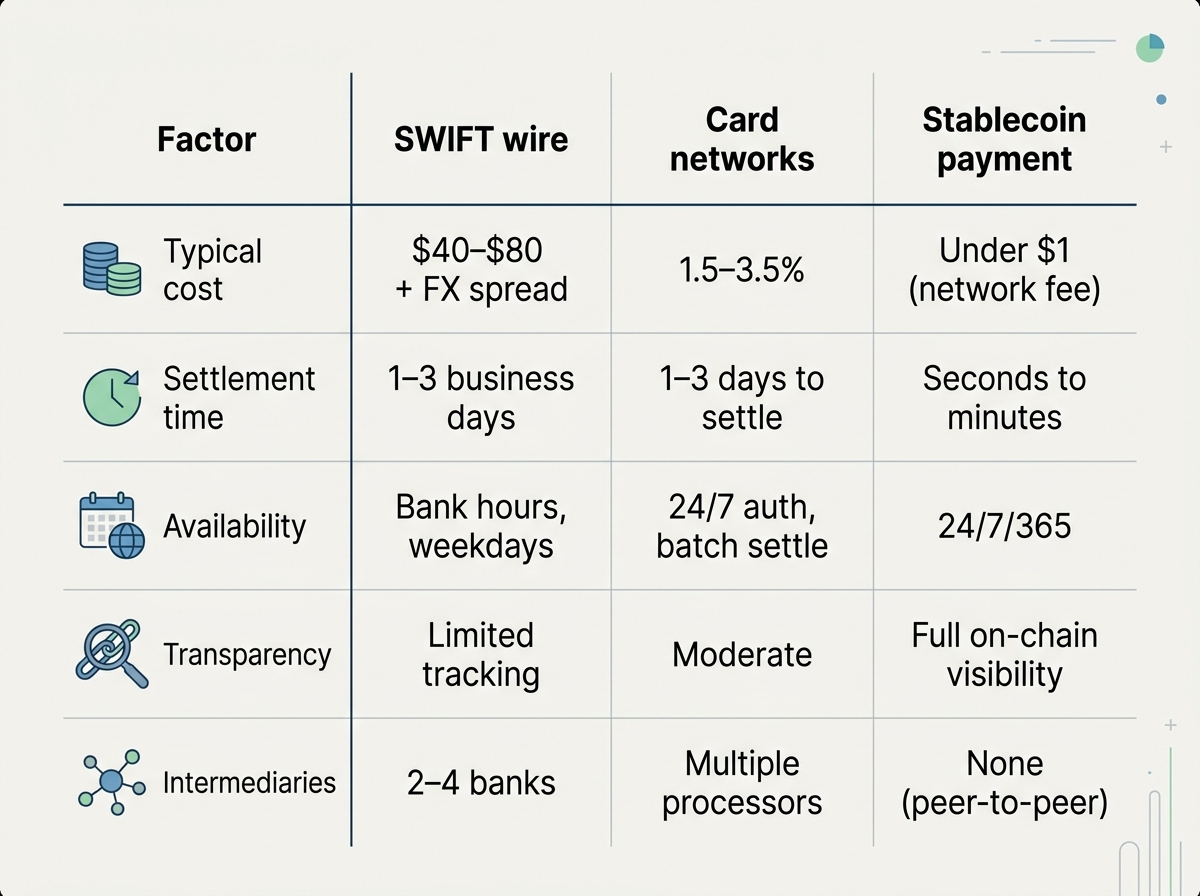
The economics are most dramatic at scale. Dropping from $40+ per wire to under $1 per transfer changes what is financially viable — micro-payments, frequent payouts, and thin-margin corridors that never made sense on SWIFT suddenly do.
Top use cases for global crypto transactions
Stablecoins are not a fit for every payment, but for global crypto transactions between businesses they solve real, recurring pain.
- Supplier and vendor payments. Pay overseas manufacturers and service providers same-day instead of waiting for a wire to clear, improving supplier relationships and unlocking faster terms.
- Contractor and team payouts. Pay international contractors and remote staff in stablecoins without losing 5–10% to fees and FX on every transfer. (INXY also covers dedicated crypto payroll.)
- Marketplace and platform payouts. Distribute earnings to sellers, affiliates, or creators across many countries in a single batch, at predictable cost.
- Treasury and intercompany transfers. Move funds between entities and regions instantly, holding value in a dollar-pegged asset rather than parking it in slow, fee-heavy banking channels.
These are exactly the corridors where the old system performs worst — many small-to-mid payments, many destinations, tight margins.
Are low fee crypto payments compliant? GENIUS Act and MiCA
A fair question from any finance or legal team: is this allowed? In 2026, the answer is increasingly yes — and the regulatory ground is firmer than it has ever been.
In the United States, the GENIUS Act established the first federal framework for payment stablecoins, requiring issuers to be licensed, to hold 1:1 reserves in high-quality liquid assets, and to honor redemption on demand. In the European Union, MiCA (Markets in Crypto-Assets) provides a parallel framework. Together they have moved stablecoins from a regulatory gray zone into supervised, standardized instruments — which is a large part of why institutional adoption accelerated.
What a regulated provider handles for you
Compliance does not have to live on your team. A regulated payment provider performs KYB (Know Your Business) onboarding, screens transactions against AML requirements, and maintains the audit trail you need for reporting. The business gets the speed and cost benefits of stablecoins while the provider absorbs the regulatory heavy lifting.
How to start accepting cross-border crypto payments
Getting started is closer to onboarding a payment processor than to learning crypto.
- Choose a regulated provider that supports on-ramp, settlement, and off-ramp in your corridors — not a raw exchange.
- Complete KYB onboarding and connect your bank account or treasury.
- Pick your stablecoins and networks (USDC/USDT on a fast, low-fee chain) and set how recipients receive funds — held as stablecoin or auto-converted to local fiat.
- Integrate and pay. Use the dashboard for one-off and batch payments, or the API to automate payouts inside your existing systems.
Once live, a cross-border payment that used to mean a wire form and a three-day wait becomes a few clicks and a few seconds.
The bottom line
Cross-border B2B payments are being rebuilt on stablecoin rails, and the trend lines — 733% volume growth, a projected $5 trillion market, and clear regulation under the GENIUS Act and MiCA — point in one direction. For businesses that move money internationally, stablecoins offer dramatically lower fees, near-instant settlement, and full transparency, without the volatility of traditional crypto. The companies adopting it now are the ones that will spend the next decade paying cents where their competitors pay tens of dollars.
Start accepting cross-border crypto payments with INXY →
FAQ
Are stablecoin payments legal for business? Yes. In 2026, US-dollar stablecoins are regulated under the GENIUS Act in the United States and MiCA in the EU. Using a licensed provider keeps your KYB and AML obligations covered.
How fast is settlement? Depending on the network, a stablecoin payment finalizes anywhere from under a second (Solana) to a couple of minutes — versus one to three business days for a SWIFT wire.
What fees apply? The main cost is a small blockchain network fee, often under $1, plus any provider conversion fee on the on-ramp or off-ramp. This compares to $40–$80 per traditional international wire.
USDC or USDT for cross-border payments? Both are widely accepted dollar-pegged stablecoins. USDC is often preferred for its regulatory transparency; USDT has deeper liquidity in some corridors. A good provider supports both so you can match the recipient's preference.

What Are Web3 Payments? Blockchain & Smart Contracts Explained
“Web3 payments” describe a new way to move money in which value travels directly across a blockchain network instead of through banks and card schemes. Unlike traditional online transactions, blockchain payments settle peer-to-peer on a public ledger, are verifiable by anyone, and can run without a central intermediary holding the funds. For businesses, this means faster settlement, lower cross-border costs, and programmable money that can enforce its own rules.
“Web3 payments” describe a new way to move money in which value travels directly across a blockchain network instead of through banks and card schemes. Unlike traditional online transactions, blockchain payments settle peer-to-peer on a public ledger, are verifiable by anyone, and can run without a central intermediary holding the funds. For businesses, this means faster settlement, lower cross-border costs, and programmable money that can enforce its own rules.
This guide explains what web3 payments are, how they work under the hood, where smart contracts fit in, and how they compare to the crypto checkout flows most merchants already know. It is written for founders, finance teams, and product managers evaluating whether on-chain rails belong in their stack.
What Are Web3 Payments?
Web3 payments are transactions executed on decentralized blockchain networks, where ownership of funds is tied to a cryptographic wallet rather than a bank account. The term “web3” refers to the third era of the internet — one built on open, user-owned protocols. In a payment context, web3 crypto payments let a payer send value (typically stablecoins such as USDC or USDT, or assets like ETH and BTC) straight to a recipient’s wallet, with the network itself confirming and recording the transfer.
Three properties separate web3 payments from conventional digital payments:
- Self-custody. The payer controls the funds via private keys until the moment of transfer — there is no card issuer or bank acting as gatekeeper.
- On-chain settlement. The transaction is final once confirmed by the network, usually in seconds to minutes, with no multi-day clearing cycle.
- Programmability. Logic can be attached to the payment itself, so funds release only when predefined conditions are met.
The market context matters. According to recent industry analysis, fiat-backed stablecoins surpassed $300 billion in market capitalization in late 2025, with annualized on-chain settlement volumes in the mid-$20-trillion range — evidence that web3 rails are moving from experiment to real economic activity.
It helps to see where web3 payments sit relative to terms you already use. “Crypto payments” is the umbrella term for paying with digital assets at all. “Web3 payments” is the subset that runs on open, permissionless networks with user-held funds — as opposed to a closed processor that simply accepts coins and settles them to your bank. That difference in architecture is what unlocks the speed, reach, and automation covered below.
How Web3 Payments Work: Blockchain & Wallets
Blockchain payments rely on three components working together: a wallet that holds the keys, a blockchain network that validates transactions, and (for business use) a gateway that translates the on-chain event into something an accounting system can read. Here is the flow in plain terms.
The role of self-custody wallets
A crypto wallet does not “store” coins; it stores the private keys that prove ownership of a balance recorded on-chain. When a customer pays, their wallet signs the transaction with that key, authorizing the network to move the balance to the merchant’s address. Because the key never leaves the user, there is no card number to steal and no chargeback to reverse — a structural difference from card payments.
On-chain settlement vs. traditional rails
In a card transaction, authorization, clearing, and settlement happen across several institutions over one to three business days. With blockchain payments, validators confirm the transfer and write it to an immutable ledger in a single step. The table below summarizes the practical differences.
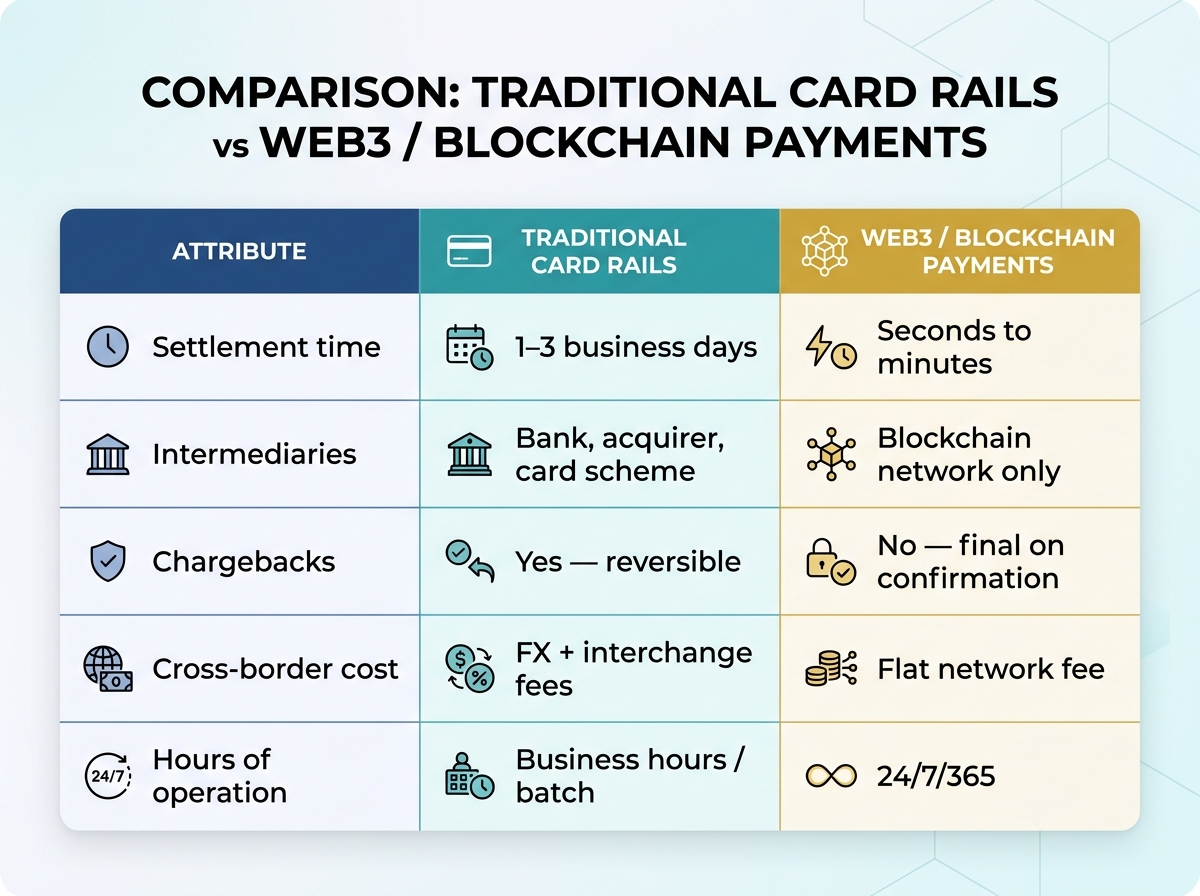
Smart Contract Payments Explained
Smart contract payments are blockchain transactions governed by self-executing code. A smart contract is a program deployed on-chain that automatically performs an action — release funds, split a payment, issue a refund — when its conditions are satisfied. No human has to intervene, and no party can alter the outcome once the contract is live.
Automated & programmable payments
This is where web3 moves beyond simple transfers. A smart contract can hold funds in escrow and release them only when a delivery is confirmed, automatically distribute revenue among several wallets, or stream a salary continuously over time. For businesses, programmable money reduces manual reconciliation and removes the trust gap in multi-party deals.
Consider a marketplace that owes three parties on every sale: the seller, an affiliate, and the platform itself. With cards, that single payment is captured, then split later through separate payout runs and reconciliation. A smart contract executes the split atomically — the moment funds arrive, each wallet receives its share in the same transaction. The same logic powers milestone-based contractor payments, automated refunds, and subscription renewals, all without a card on file or a manual approval step.
- Escrow: funds lock until both sides meet their obligations.
- Revenue splits: a single incoming payment is divided across partners in one transaction.
- Recurring & usage-based billing: subscriptions and metered charges execute on-chain without a card on file.
Tokenized payment solutions
Tokenized payment solutions represent real-world value — a dollar, an invoice, a loyalty credit — as a transferable token on a blockchain. Stablecoins are the most widely used example: a token pegged 1:1 to fiat that combines the stability of a currency with the speed of crypto. Industry research estimates that B2B flows already account for roughly 40% of real-economy stablecoin payments and are growing about 65% per year, which is why tokenized settlement is becoming the default rail for cross-border business payments.
Web3 Payments vs. Traditional Crypto Checkout
Many merchants already “accept crypto” through a hosted checkout that converts coins to fiat. That is a useful on-ramp, but it is not the same as a full web3 payment model. The distinction is about who controls the funds and whether the payment carries logic.
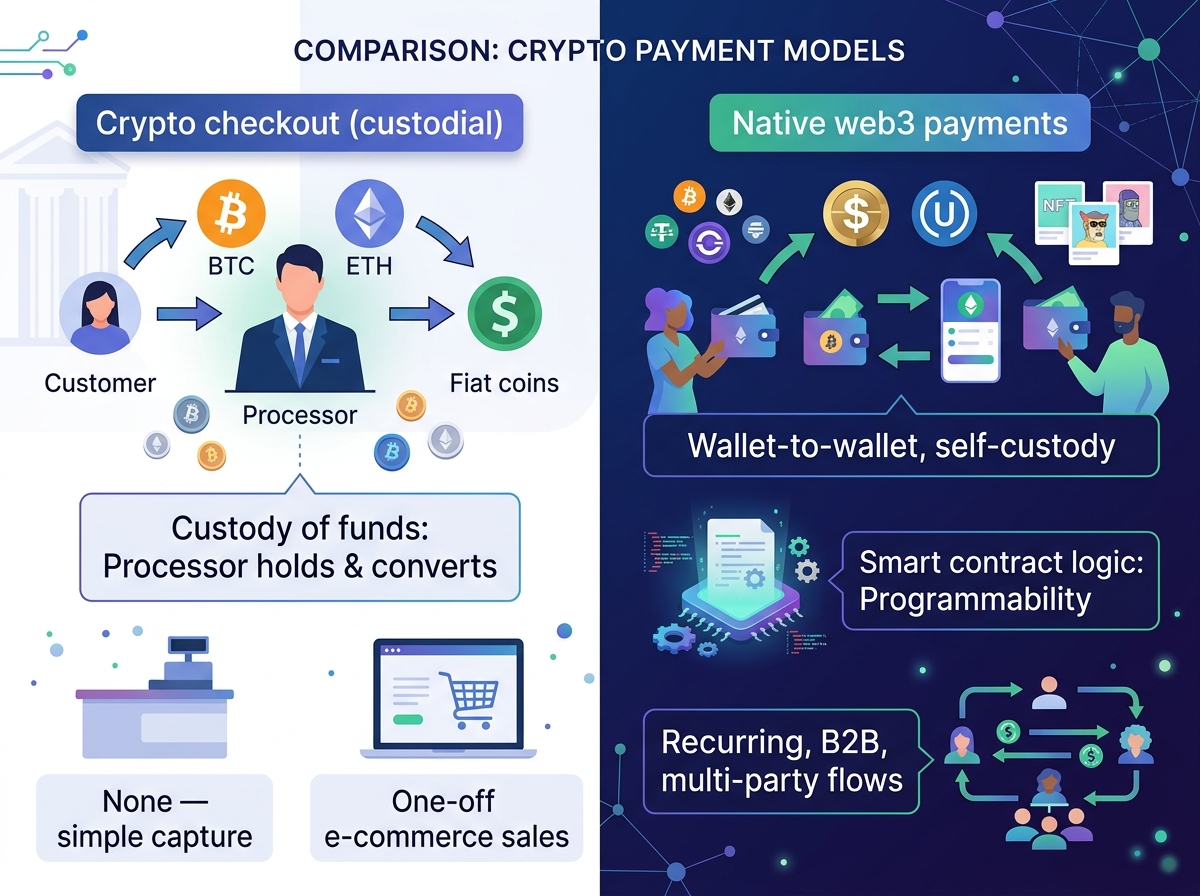
In practice the two coexist. A business might use a custodial checkout for retail customers while using native, programmable rails for supplier payouts and partner settlements. For a deeper breakdown of provider roles, see our guide on the difference between a crypto payment gateway and a processor.
Benefits & Risks for Businesses
Web3 payments — and the broader category of blockchain smart contracts for business — offer clear operational upside, but they come with trade-offs that finance and compliance teams should weigh.
Key benefits:
- Near-instant, 24/7 settlement that frees up working capital.
- Lower cross-border fees by removing correspondent-banking layers.
- No chargebacks, reducing fraud exposure for digital goods.
- Automation of escrow, splits, and recurring billing through smart contracts.
Risks to manage:
- Price volatility on non-stablecoin assets — most businesses settle in stablecoins to neutralize this.
- Irreversibility means errors and misdirected payments are hard to recover.
- Regulatory obligations: under frameworks like the EU’s MiCA, you must work with a licensed VASP/CASP and apply KYC/AML and Travel Rule checks.
- Smart-contract risk: poorly audited code can be exploited, so use vetted, audited contracts.
For most companies the practical answer is not to choose between safety and innovation, but to adopt web3 payments through a partner that has already solved custody, compliance, and key management. That keeps the operational benefits — speed, automation, global reach — while shifting the hardest security and regulatory work to infrastructure built for it.
How to Start Accepting Web3 Payments
You do not need to build blockchain infrastructure in-house. A compliant gateway abstracts the wallet, network, and conversion layers so you can accept on-chain payments with a standard integration. A practical path:
- Choose your settlement asset. Stablecoins (USDC, USDT, DAI) are the standard for business to avoid volatility.
- Select a regulated provider. Confirm licensing, multi-chain support, and KYC/AML coverage for your regions.
- Integrate via API or plugin. Add the checkout or payout flow and connect webhooks to your back office.
- Decide what to automate. Map which payments — escrow, splits, recurring — benefit from smart-contract logic.
INXY provides a regulated, EU-compliant gateway for exactly this. Explore the web3 payments solution and our smart-contract payment infrastructure, or read how to accept crypto payments in 2026 for the full setup walkthrough.
FAQ
What are web3 payments in simple terms? They are payments sent directly between crypto wallets over a blockchain, without a bank or card network in the middle. The network verifies and records the transfer.
Are web3 payments safe? The underlying blockchain settlement is highly secure and tamper-resistant. The main risks are user error, asset volatility, and smart-contract bugs — all manageable by using stablecoins, audited contracts, and a regulated gateway.
What is a smart contract payment? A payment controlled by on-chain code that executes automatically when set conditions are met — for example, releasing escrowed funds once delivery is confirmed.
How are web3 payments different from accepting Bitcoin at checkout? A standard crypto checkout is custodial and converts coins to fiat. Native web3 payments keep funds in self-custody and can carry programmable logic, making them better suited to recurring, B2B, and multi-party flows.

Pay Employees and Contractors in Bitcoin
Automate BTC payouts for global teams with INXY Payments — no crypto infrastructure required. Fast, compliant, and built for business.
Why Businesses Are Choosing Bitcoin for Payroll and Contractor Payments
As remote work becomes the global standard, companies face a common challenge: paying international teams through traditional banking is slow, expensive, and geographically limited. Bitcoin payouts eliminate SWIFT delays, excessive conversion fees, and banking restrictions — letting businesses pay employees and contractors in Bitcoin within minutes, regardless of their location.
From affiliate networks and iGaming platforms to SaaS companies and freelancer marketplaces, paying in Bitcoin is no longer a niche practice. Paying employees in Bitcoin and contractors in BTC is no longer reserved for crypto-native startups — it is a competitive edge in global talent acquisition that reduces operational costs across the board. INXY Payments makes this straightforward: no need to buy Bitcoin in advance, no separate exchange accounts, no manual compliance work — everything runs through a single B2B platform built for exactly this use case.
How to Pay Employees in Bitcoin with INXY: 3 Simple Steps
- Create an INXY Account & Complete KYB — Sign up as a business, submit your company documents, and pass KYB verification through the INXY dashboard. Your organisation is reviewed and activated within 1–3 business days — no crypto expertise required.
- Add Recipients or Connect the Payouts API — Upload a CSV file with recipient BTC addresses via the INXY dashboard, or integrate the Payouts API directly into your platform for fully automated workflows. The API is built to handle payouts at scale — no hard limit on the number of recipients per cycle. Real-time webhook notifications keep your system updated on each payout status.
- Send BTC Payouts — from Crypto or Fiat — Trigger single or mass BTC payouts from your balance. If you hold EUR or USD, INXY's buy_crypto flag auto-converts your fiat to Bitcoin at the moment of each payout — no pre-purchased BTC required, no exchange accounts to manage.
Benefits of Bitcoin Payouts for Business
Global Reach Without Banking Limits
Bitcoin payouts via INXY work for recipients in any country, with or without a bank account. No correspondent bank fees, no SWIFT delays, no rejected transfers due to local banking restrictions. Your payroll operates globally, on your schedule.
No Chargebacks
Crypto transactions are final and immutable. Once a BTC payout is broadcast to the network, it cannot be reversed or disputed — a critical advantage for high-volume affiliate and iGaming payouts where chargeback fraud is a constant risk.
Instant Settlement
BTC payouts initiated through INXY are broadcast on-chain within minutes. Compared to international wire transfers that take 2–5 business days, Bitcoin delivers settlement speed that matches the pace of modern business operations.
Pay from Fiat, Send in Bitcoin
If your treasury operates in EUR or USD, there is no need to pre-purchase Bitcoin on an exchange. INXY's buy_crypto feature handles the fiat-to-BTC conversion automatically at the moment each payout is triggered — the exchange rate is locked at execution time, and the full flow is recorded in your transaction history.
Built-In Compliance — KYT, AML, Travel Rule
Every BTC payout processed through INXY goes through KYT (Know Your Transaction) screening before broadcast. High-risk addresses are blocked automatically. For recipients in your Contact List, Travel Rule data exchange via Notabene is handled by the platform — no manual compliance burden on your team.
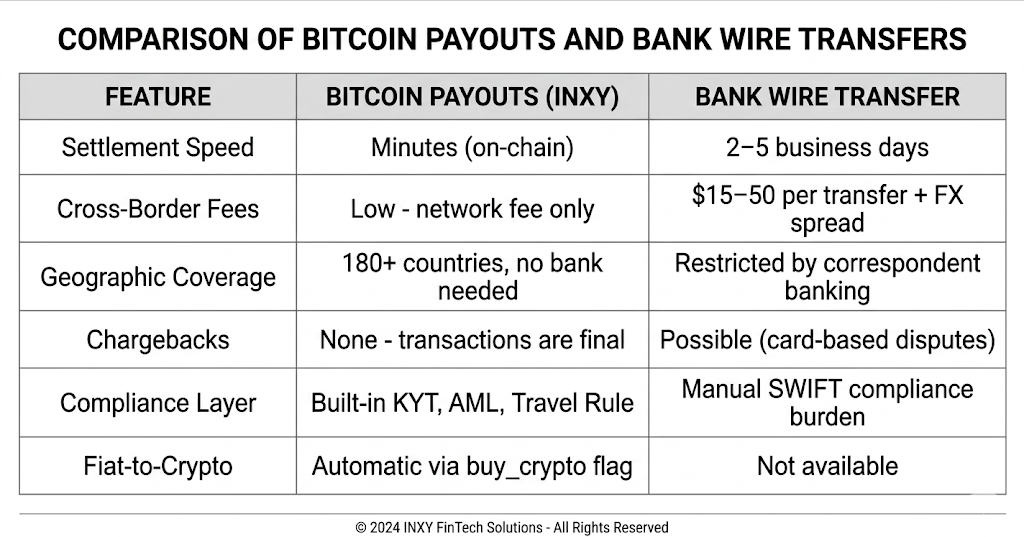
Who Uses Bitcoin Payouts?
Affiliate Networks & CPA Platforms
Affiliate networks need to pay hundreds or thousands of publishers worldwide, often weekly or bi-weekly. INXY supports batch processing of up to hundreds of recipients per API call, with full webhook notifications on payout status. Mass payouts that previously took 5 banking days now complete in minutes — and companies that pay employees and contractors in Bitcoin report significantly lower operational overhead.
iGaming & Online Gaming Platforms
Gaming and gambling platforms regularly pay out winnings and contractor fees in crypto. Bitcoin is the preferred payout currency for many players and partners due to its universal recognition and broad wallet support. INXY's compliance layer — KYT screening, AML review, Travel Rule — ensures platforms stay clean without building their own infrastructure.
Remote-First Companies & Tech Teams
Companies with globally distributed engineering, design, or operations teams use INXY to offer Bitcoin as an alternative compensation option. Contractors who prefer crypto over bank transfers get paid faster, while the company avoids currency conversion overhead and cross-border banking fees.
Freelancer Marketplaces & Gig Economy Platforms
For platforms managing large pools of independent contractors, mass Bitcoin payouts through INXY reduce the operational cost of international payroll significantly. One file upload or one API call pays thousands of contractors in a single batch — with per-recipient status tracking and exportable CSV reports.
Frequently Asked Questions
Is it legal to pay employees in Bitcoin?
In most jurisdictions, paying contractors in Bitcoin is fully legal. For full-time employees, regulations vary: many countries — including the US, UK, and EU member states — allow crypto salary supplements or contractor payments in crypto, but typically require that the minimum statutory wage be paid in local fiat currency. Consult local labour law before switching your primary payroll to Bitcoin.
Can you pay employees in Bitcoin in the US?
Yes. The Fair Labor Standards Act (FLSA) requires that the federal minimum wage be paid in US dollars, but additional compensation — including contractor payments and performance bonuses — can be made in Bitcoin. Many US-based companies and DAOs already pay freelancers and contractors in BTC without legal issues.
Which companies pay employees in Bitcoin?
A growing number of global businesses pay employees and contractors in Bitcoin, particularly in tech, gaming, and affiliate marketing industries. Remote-first companies, crypto-native startups, and platforms with large contractor networks were early adopters. With infrastructure like INXY, any B2B business can now add BTC payouts without building crypto capabilities in-house.
How does INXY's buy_crypto flag work for BTC payouts?
If your INXY balance is in EUR or USD, the buy_crypto: true flag triggers an automatic fiat-to-BTC exchange at the moment each payout is initiated. The exchange rate is locked at execution time, and the network fee is deducted from the payout amount. You do not need to hold Bitcoin in advance — INXY handles the conversion in the same transaction flow.
What happens if a BTC address is flagged as high-risk?
Before any payout is created, INXY screens the recipient's BTC address through KYT. If the address is flagged as high-risk, the payout is blocked automatically and you receive an error notification via webhook and dashboard. You can review the case and contact the INXY compliance team if needed.
What is the maximum number of Bitcoin payouts per batch?
INXY's infrastructure handles payout cycles of any size — from small partner networks to programs with hundreds of recipients — all processed in minutes, with full webhook notifications on each transaction.
Start Sending Bitcoin Payouts with INXY
Ready to pay your global team in Bitcoin? Join hundreds of businesses that use INXY Payments to run fast, compliant BTC payouts — from a single contractor to thousands of recipients. No crypto expertise required, no pre-purchased Bitcoin needed, no separate exchange accounts.
Get Started with INXY — Free Setup
Already have an account? Go to Send Crypto → Payouts in your INXY dashboard.

Institutional fiat on-ramps: How to procure and manage stablecoin liquidity at scale
Interchange fees, multi-day settlement windows, and chargeback exposure are not just operational annoyances - they are compounding structural costs on every transaction. Stablecoin payments eliminate that friction: near-instant finality, zero reversal risk, and a single cross-border settlement layer operating 24/7. This piece lays out the business and technical case for executives evaluating a shift from legacy fiat rails to purpose-built blockchain infrastructure.
The end of fiat friction: Why strategic merchants are switching to stablecoin payments
The legacy financial system imposes a structural tax on growth. For decades, merchants have absorbed correspondent banking fees, 3% interchange costs, and chargeback losses that erode margin on every transaction. In a global economy, waiting T+3 or T+5 for settlement is not an inconvenience — it is a liquidity problem.
To accept crypto once meant exposure to price volatility. That is no longer the case. Stablecoins — pegged to the US Dollar or Euro — deliver the settlement efficiency of blockchain without the speculation. For C-level executives, the question is no longer whether to integrate digital assets, but how quickly legacy bottlenecks can be replaced with purpose-built infrastructure.

1. Settlement velocity: From days to seconds
Traditional cross-border settlements move through a chain of intermediate banks, accumulating fees and losing transparency at every hop. SWIFT provides no real-time visibility into where funds are or when they will arrive.
Stablecoins operate on a 24/7/365 ledger with near-instant finality. Settling on Ethereum, Polygon, or TRON, merchants are no longer bound by banking hours or cut-off windows. Capital lands, clears, and is available for redeployment immediately — not in a pending queue.
inxy.io integrates directly into this settlement layer, giving merchants the operational continuity that traditional finance structurally cannot offer.
2. Eliminating the chargeback tax
Chargeback fraud costs merchants billions annually. Credit card networks are centralised by design, which means any transaction can be reversed — often at the merchant's expense, with little recourse.
Blockchain transactions are push-based and immutable. When a business chooses to accept crypto in the form of stablecoins, payment finality is guaranteed by the protocol, not by a bank's dispute resolution team.
- No chargebacks: Once confirmed on-chain, a transaction cannot be reversed by a third party.
- Reduced fraud overhead: No need for aggressive fraud filters that block legitimate customers.
- Revenue sovereignty: You control your income stream without intermediary intervention.
3. Technical infrastructure: Beyond the hype
A payment gateway needs to be a piece of production-grade fintech infrastructure, not just a wallet interface. High-volume merchants require an API that abstracts blockchain complexity without sacrificing control.
What inxy.io provides:
- 1. No crypto management overhead: Merchants do not handle tokens or gas fees. That layer is abstracted entirely.
- 2. Volatility protection: Pay-ins convert to stablecoins or fiat instantly, locking in value at the moment of transaction.
- 3. Multi-chain support: USDT, USDC, DAI, EURC, TON, BTC, ETH, LTC, TRX, BNB, DOGE across ERC-20, TRC-20, Polygon, and BSC — customers transact on the network that works best for them.
- 4. Real-time webhooks: Instant payment status notifications to your backend, enabling automated fulfilment or shipping triggers without polling.
- 5. Compliance stack: EU VASP (Poland), Canadian MSB, MiCA-ready, AML/KYT/KYC, sanctions screening via Elliptic and Sumsub, Big-4-friendly fiat reporting.

4. Drastic reduction in operational costs
Managing global payments typically means maintaining multiple local currency accounts and navigating FX spreads on every cross-border transfer. Stablecoins provide a single settlement layer that works across jurisdictions without currency conversion overhead.
Consolidating payment rails through inxy.io can reduce payment processing Opex by up to 80%. Instead of paying a chain of intermediaries for the movement of value, you pay for efficient infrastructure. That margin stays in the business.
FAQ: Navigating the stablecoin shift
Is it difficult to integrate a stablecoin gateway into an existing platform?
No. inxy.io integrates via a REST API or pre-built plugins for major e-commerce engines. Documentation and technical support are included, and most teams go live faster than a standard merchant bank account setup.
How do we handle gas fee volatility?
inxy.io routes transactions through high-throughput networks to keep fees minimal. Customers can select the most cost-effective network for their transaction — the infrastructure handles the routing logic.
How does accepting stablecoins affect our accounting?
USDT and USDC are pegged 1:1 to the dollar, which makes them materially simpler to account for than traditional cryptocurrencies. inxy.io provides detailed reporting and CSV exports compatible with standard accounting software and ERP systems.

What about regulatory compliance?
inxy.io is built with compliance as a core component, not an afterthought — EU VASP registration, MiCA readiness, AML/KYT screening, and Big-4-auditable reporting. Your business stays within the regulatory framework while operating at full velocity.
Scalability Without Compromise
The merchant of 2026 cannot run on 1970s banking rails. The competitive advantage belongs to businesses that eliminate payment friction and capture the full value of their transactions across borders.
inxy.io is the infrastructure layer for that transition — robust APIs, multi-chain settlement, and a compliance stack built for global scale.
Partner with INXY — secure your payment infrastructure and lead the market.

How to Automate Mass Crypto Payouts for International Freelancers
Wire transfers are draining freelance platform margins with high fees, opaque FX spreads, and week-long settlement delays. Automated mass crypto payouts via stablecoins like USDT and USDC eliminate these bottlenecks — processing thousands of global transactions in seconds through a single API call. This guide walks through the full transition: choosing the right digital assets, integrating a payout API, and automating reconciliation at scale.
It is payday, and your finance department is drowning in a massive spreadsheet filled with SWIFT codes, routing numbers, and fluctuating exchange rates. A few days later, your support channels are flooded with frustrated messages from international developers who still have not received their money because a correspondent bank mysteriously held the funds. If you operate a global freelance platform, a talent marketplace, or a remote agency, this logistical nightmare is likely your recurring reality. While hiring elite talent across borders is frictionless, compensating them remains stuck in the 1990s.
Legacy banking rails actively erode your profit margins with exorbitant fees and damage your reputation among top professionals. It is time to stop burning cash and developer hours on slow wire transfers. By transitioning to automated mass cryptocurrency payouts – specifically leveraging stablecoins you can execute thousands of global transactions simultaneously, settling payments in seconds rather than unpredictable weeks.
The Bottleneck of Traditional Global Payroll
Processing international payroll through fiat channels involves a convoluted chain of intermediary banks, each extracting a cut and adding days to the settlement timeline. The traditional system is plagued by critical operational pain points for freelance platforms:
- Exorbitant Transaction Fees: Standard wire transfers cost $15 to $50 per transaction. This makes frequent micro-payouts to temporary contractors or gig workers entirely unfeasible.
- Unpredictable Settlement Delays: Cross-border payments routinely take three to seven business days to clear, causing immense anxiety for freelancers relying on timely income.
- Hidden FX Markups: Banks apply highly unfavorable foreign exchange spreads, directly reducing the contractor's purchasing power and causing disputes over missing funds.
- Severe Financial Exclusion: Talented professionals in emerging markets are often completely locked out of standard, legacy payment methods like PayPal or Stripe.
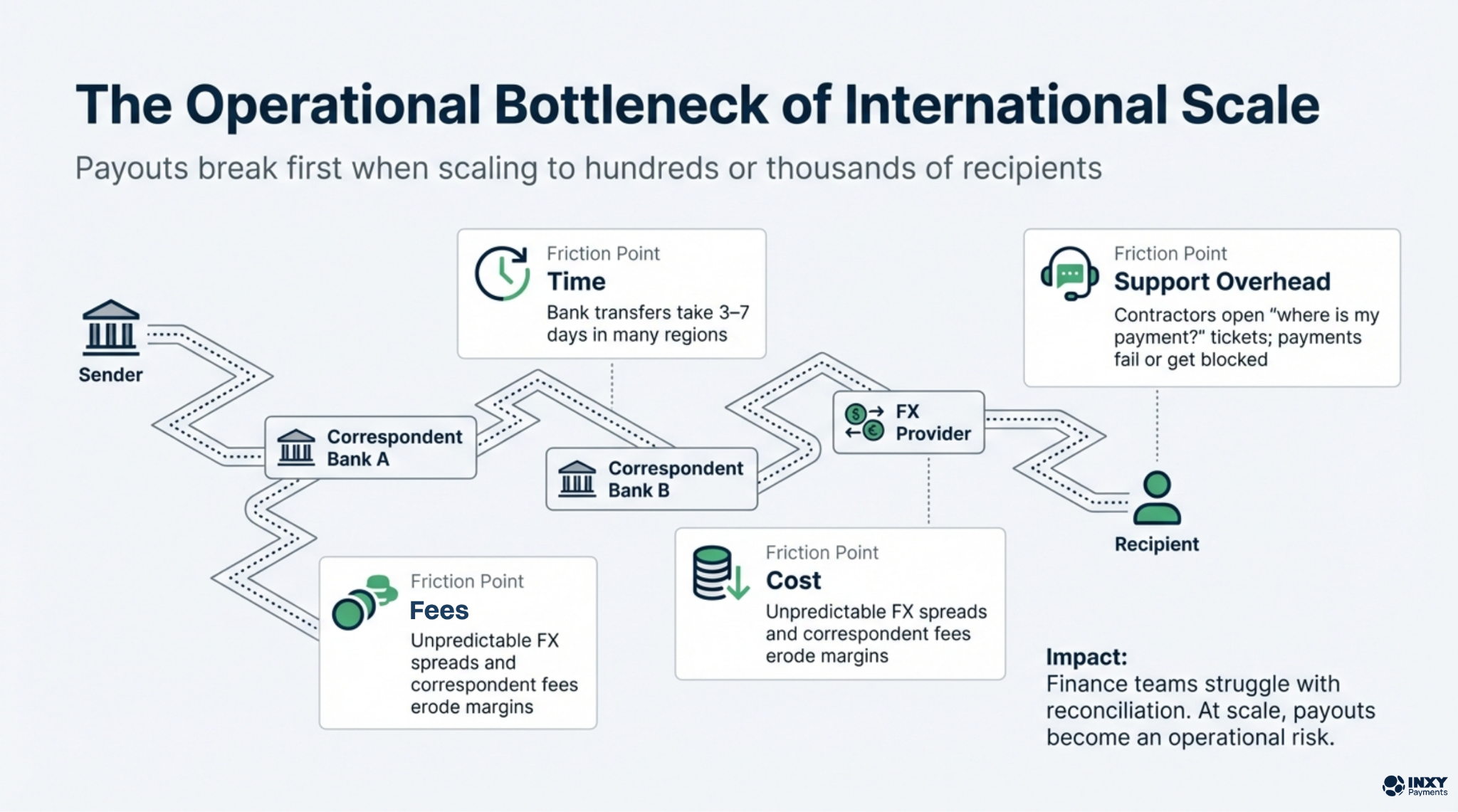
The Mechanics of Crypto Payout Automation
Shifting platform operations to cryptocurrency, particularly utilizing stablecoins like USDT or USDC, neutralizes these flaws. Because they are securely pegged to the US Dollar, they eliminate the price volatility of digital assets like Bitcoin.
The true transformative power for your platform lies in API automation. Instead of a finance manager manually processing invoices one by one, a mass payout system allows your backend infrastructure to trigger hundreds of transactions simultaneously through a single API call. Executed via automated batch processing on high-speed blockchains like Tron or Polygon, network fees drop to mere pennies.
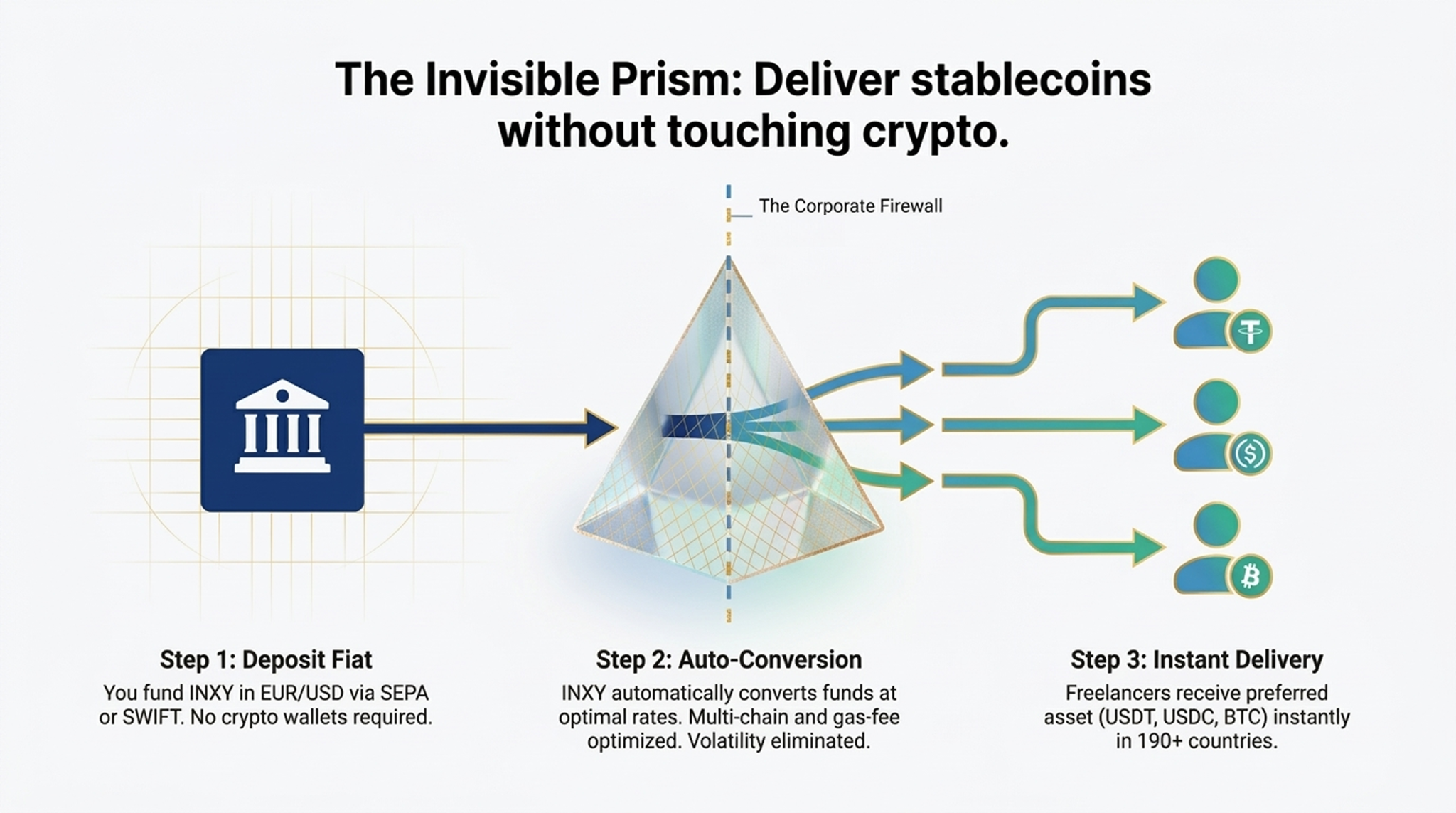
Step-by-Step Guide to Automating Global Payouts
Transitioning to a crypto-first compensation model requires a strategic technical approach to ensure smooth onboarding for your contractors:
- Select the Right Digital Assets: Default to stablecoins (USDT/USDC) on fast networks to ensure negligible gas fees and zero price volatility for the receiving party.
- Integrate a Payout API: Connect your backend directly to a dedicated crypto gateway supporting mass payout endpoints instead of trying to build and maintain complex nodes from scratch.
- Map Contractor Wallets: Update your platform onboarding flow to allow freelancers to securely save and verify their digital wallet addresses alongside their traditional profile data.
- Automate Trigger Events: Configure your platform's internal logic so that approved timesheets, completed milestones, or specific calendar dates automatically trigger the API payout calls.
- Streamline Reconciliation: Utilize a gateway that provides detailed transaction hashes and automated ledger updates so your accounting team can track successful disbursements in real-time.
INXY: The Premier Payout Gateway for Freelance Platforms
Implementing automated financial infrastructure requires an enterprise-grade technological backbone. For global talent marketplaces, remote agencies, and HR platforms modernizing their compensation systems, INXY stands out as the ultimate strategic partner.
INXY provides a powerful cryptocurrency payment gateway designed specifically for the high-volume, automated disbursement needs of the gig economy. By integrating the INXY API, your platform can automate mass crypto payroll effortlessly, completely removing the heavy lifting of blockchain node management. We act as the secure bridge between your administrative dashboard and the blockchain, ensuring rapid global settlement, automated transaction reconciliation, and flawless execution for every single contractor payout. Our infrastructure scales perfectly alongside your growing international workforce.
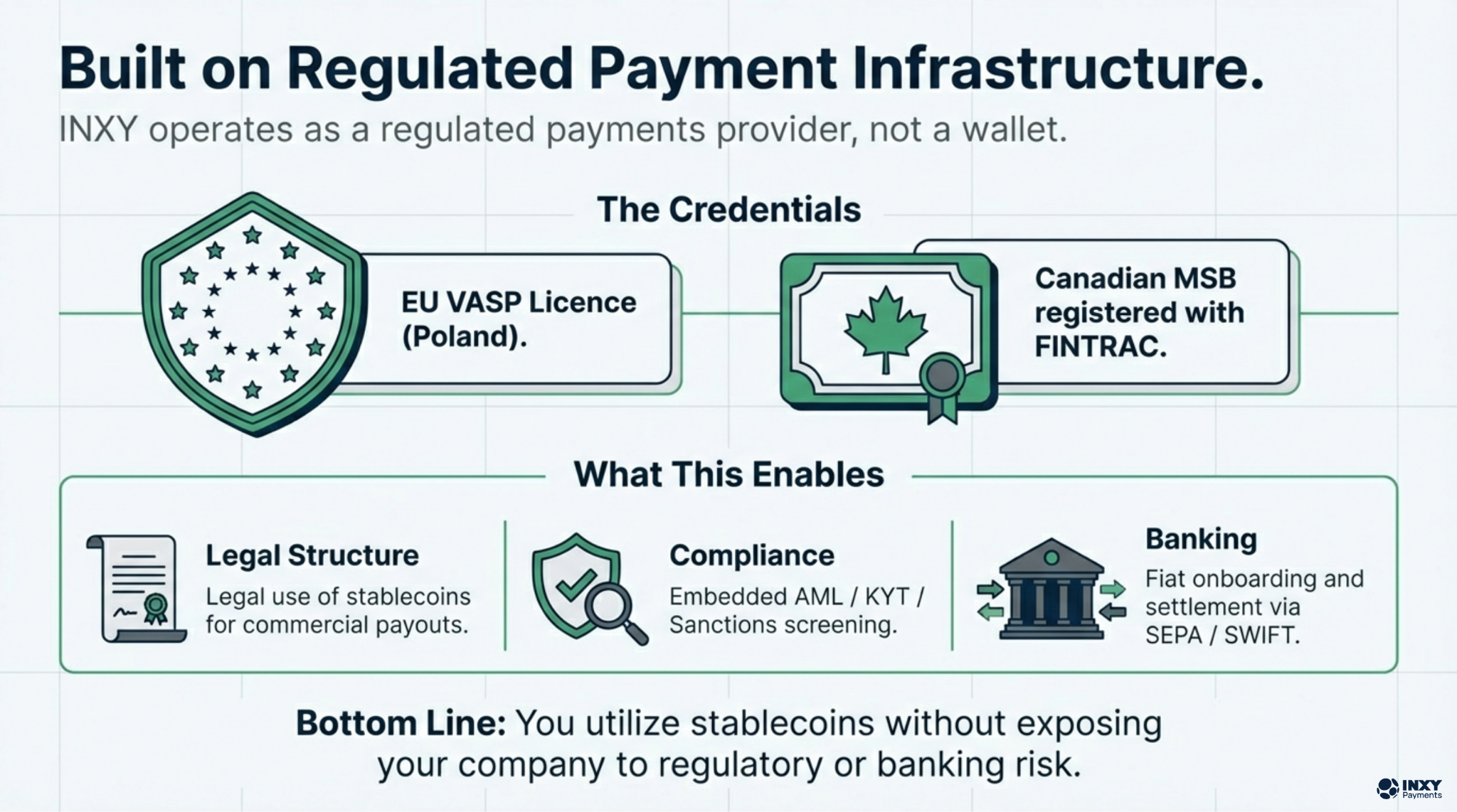
Conclusion
The future of global work is undeniably decentralized, and platform compensation methods must evolve to keep pace. Automating mass crypto payouts is not just an operational upgrade; it is a profound competitive advantage that attracts and retains top global talent who demand fast, transparent payments. Do not let outdated banking rails hold your platform's growth hostage.
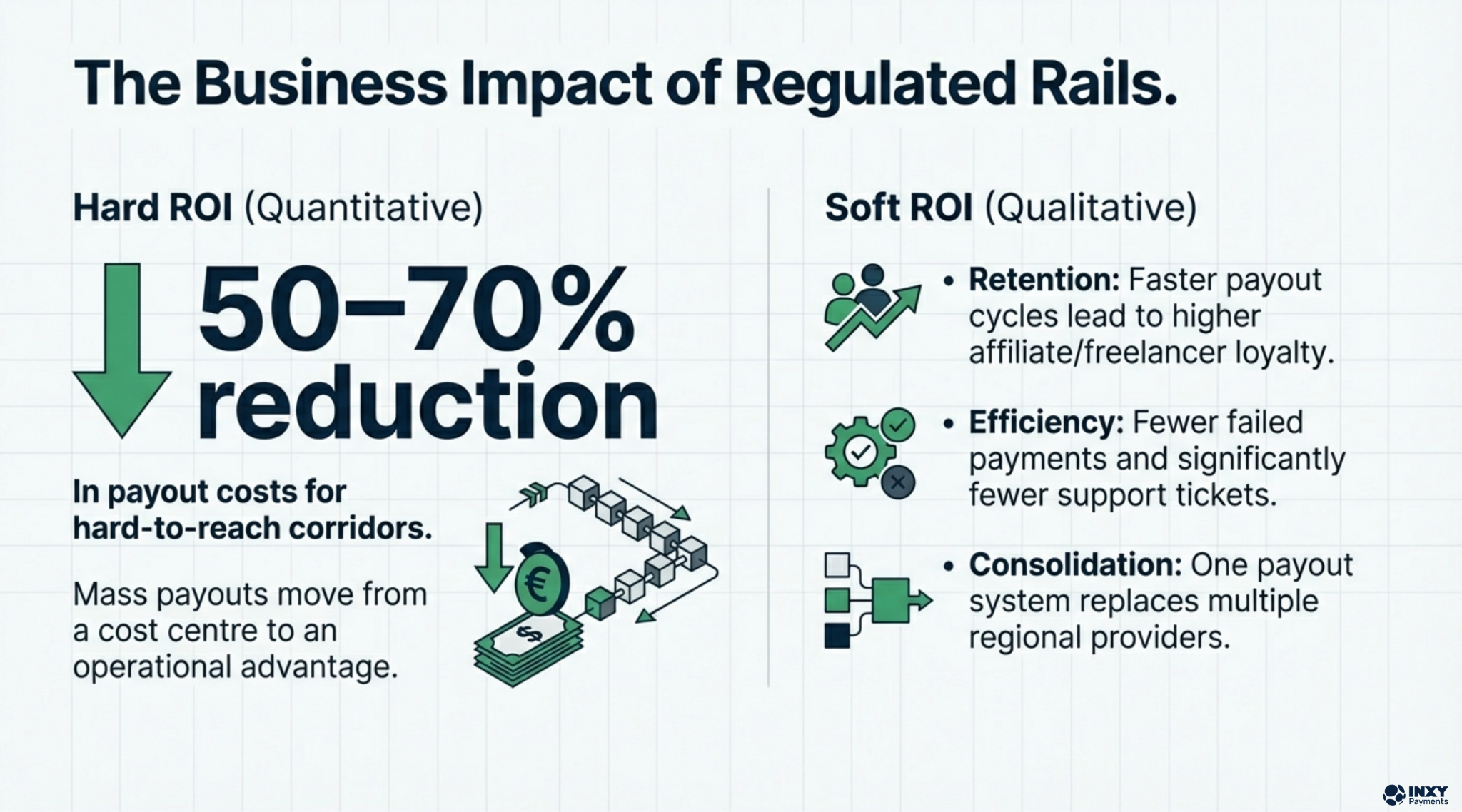
Ready to revolutionize your payroll system and automate your global disbursements? Discover how our robust API solutions can scale your platform securely by visiting https://www.inxy.io/ today.
Cheapest Crypto Exchanges
Industry insiders call it "death by a thousand cuts." Whether it's inflated spreads or high withdrawal fees, processing digital assets can be surprisingly expensive if you're using the wrong tools. In our latest guide, we break down: The Anatomy of Fees: Maker vs. Taker and the "Silent Cost" of spreads. Top Retail Exchanges: Where to find the lowest rates for day trading. The Business Trap: Why using a retail exchange for merchant payments is a costly mistake. For enterprises, the secret to cost-efficiency isn't a cheaper exchange—it's specialized infrastructure. Learn how INXY eliminates volatility risks and provides transparent, flat-rate processing.
Imagine closing a $100,000 international deal or executing a perfectly timed crypto trade, only to discover that thousands of dollars vanished into thin air before the funds even settled. The money wasn't stolen by hackers, nor was it lost to a sudden market crash. It was silently siphoned off by the very platform you trusted to process it.
This is the reality of hidden cryptocurrency fees—a silent killer often described by industry insiders as "death by a thousand cuts." Whether you are an active trader watching your portfolio bleed or a business owner seeing profit margins shrink, ignoring the complex fee structures of digital asset platforms is an expensive mistake. Finding the cheapest crypto exchange is not just about clicking the marketing banner that screams "0% trading fees"—it requires a deep understanding of how these platforms actually generate their revenue behind the scenes. In this guide, we will uncover the true costs of digital transactions, highlight the platforms offering the best rates, and reveal why modern businesses must use an entirely different infrastructure to protect their bottom line.

The Anatomy of Cryptocurrency Fees
To navigate the market effectively and keep more of your own money, you first need to understand the different tolls you pay along the way. Most users only look at the baseline trading fee, but the reality is much more complex:
- Maker and Taker Fees: This is the most common and transparent pricing model. A "Maker" provides liquidity to the market by placing a limit order that isn't immediately filled. A "Taker" removes liquidity by executing a market order against the existing order book. Because exchanges desperately want deep, active order books, Maker fees are almost always significantly cheaper than Taker fees.
- The Spread (The Silent Cost): This is the hidden difference between the highest price a buyer is willing to pay and the lowest price a seller is willing to accept. Platforms that aggressively advertise "zero fee trading" almost always make their money by inflating this spread. This means you are essentially getting a much worse exchange rate than the actual global market price.
- Deposit and Withdrawal Fees: Getting your money onto an exchange might be free, but taking it off rarely is. Depending on network congestion and the exchange's internal corporate policies, moving your Bitcoin or USDT to a private wallet or a bank account can carry shockingly high flat fees, completely negating any money you saved on trades.
Top Contenders: Where Retail Traders Pay Less
If you are an individual investor or a day trader, choosing the right platform can save you thousands of dollars over a year of active trading. While fee structures frequently evolve, a few industry giants consistently offer the most competitive rates:
- Binance: Globally recognized as the heavyweight champion of low fees. With baseline spot trading fees often starting around 0.1% (and dropping even lower if you hold their native BNB token), it remains the premier destination for high-volume traders seeking maximum cost-efficiency.
- Kraken (Pro): While Kraken's standard application is highly user-friendly, switching to the Kraken Pro interface unlocks heavily discounted maker and taker fees. It is widely praised for its strict transparency, meaning traders won't be blindsided by unexpected spread inflations during highly volatile market swings.
- KuCoin: Often hailed as the "people's exchange," KuCoin maintains a highly competitive baseline fee structure. It is particularly popular for investors dealing in micro-cap altcoins who want to maximize their purchasing power without being drained by high transactional costs.
The Business Trap: Why Cheap Exchanges Are Expensive for Merchants
Here is where the narrative sharply pivots. If you are an individual trading for personal profit, the exchanges listed above are perfect. But what if you are a business owner? What if you run an e-commerce store, a digital agency, or an international SaaS company, and you want to accept crypto payments from your clients?
Many businesses make the fatal mistake of directing customer payments directly into a standard retail exchange account. They assume that because the trading fees are low, it must be a cost-effective collection solution. In reality, it is a logistical and financial nightmare. When a business uses a retail exchange to process payments, they face a costly "Triple Threat":
- Customers are forced to pay unpredictable network gas fees just to send funds to your specific exchange wallet.
- The business faces severe volatility risks between the time the customer pays and the time the company manually logs in to convert the crypto to stable fiat.
- The company is eventually crushed by high, flat-rate withdrawal fees when attempting to move that accumulated revenue into a corporate bank account.

The Cost-Effective Enterprise Solution
To truly minimize fees and maximize corporate revenue, modern businesses do not use speculative trading exchanges to accept payments. Instead, they rely on specialized, enterprise-grade infrastructure: a dedicated crypto payment gateway like INXY PAYMENTS.
Engineered explicitly for B2B and merchant needs, INXY completely bypasses the predatory spread structures and withdrawal traps of retail exchanges. By integrating INXY into your business framework, you unlock a fundamentally superior economic model:
- Transparent Processing Rates: Unlike exchanges that hide exorbitant costs in the spread, a premium gateway like inxy.io offers flat, highly transparent processing fees. You know exactly what it costs to process a payment, allowing for accurate, predictable financial forecasting.
- Instant Conversion, Zero Volatility: To avoid the hidden, devastating cost of a sudden market crash, the gateway can instantly convert incoming crypto payments into stablecoins or fiat currency at the exact point of sale.
- Automated Accounting: Time is money. Instead of paying accountants to manually track individual wallet deposits across a retail exchange, INXY provides automated invoicing, robust reporting, and mass payout features, drastically reducing expensive administrative overhead.
Conclusion
Navigating the complex world of cryptocurrency fees requires looking past bold marketing slogans and understanding the actual mechanics of the platform. For individual investors, optimizing maker and taker fees on retail platforms is the key to maximizing portfolio returns. However, the corporate world requires a drastically different toolset. By shifting away from retail exchanges and leveraging a powerful crypto payment gateway like INXY, forward-thinking businesses can process global payments with minimal friction, absolute transparency, and unparalleled cost-efficiency.
How does Crypto Exchange work?
Explore the mechanics behind cryptocurrency exchanges, from matching engines and liquidity pools to the differences between CEXs and DEXs. While exchanges power the digital economy for traders, discover why forward-thinking businesses are turning to specialized crypto payment gateways to safely accept digital assets and drive revenue.
In May 2010, a hungry programmer made financial history by trading 10,000 Bitcoins for two Papa John’s pizzas. At the time, there were no global marketplaces, no flashing price tickers, and absolutely no liquidity—just a simple forum post and a massive leap of faith. Today, the landscape has transformed beyond recognition. Those same pizzas would now be worth hundreds of millions of dollars, and the digital asset market has evolved into a trillion-dollar ecosystem.
At the beating heart of this financial revolution is the cryptocurrency exchange. Whether you are a retail investor looking to buy your first fraction of a Bitcoin, a professional trader executing high-frequency strategies, or a modern business owner trying to tap into a global, borderless customer base, understanding what a crypto exchange is and how it functions is the crucial first step to entering the digital economy.

The Engine of the Digital Economy
On any given day, top cryptocurrency exchanges process combined trading volumes exceeding $100 billion. They are the bustling, hyper-active metropolises of the digital age.
At its core, a cryptocurrency exchange is a highly secure digital marketplace that allows users to buy, sell, or trade cryptocurrencies for other assets. These assets can include conventional fiat money (like US Dollars or Euros) or other digital tokens. Exchanges act as the vital intermediary, providing the infrastructure, security, and liquidity necessary for the global crypto market to operate 24/7 without interruption.
Under the Hood: How an Exchange Functions
How does a platform handle millions of transactions per second without collapsing? Buying crypto might look like a simple tap on a smartphone screen, but the magic happens under the hood through several interconnected, highly advanced systems:
- The Matching Engine: This is the absolute brain of the operation. The matching engine is an advanced software algorithm that continuously monitors and pairs buy and sell orders. When a buyer's bid meets a seller's asking price, the engine executes the trade in milliseconds.
- Order Books and Market Depth: An order book is an electronic, real-time ledger of all the outstanding buy and sell orders for a specific trading pair (e.g., BTC/USD). It visualizes the current market depth, allowing traders to gauge ongoing supply, demand, and potential price movements.
- Liquidity Pools: Liquidity dictates how easily an asset can be converted into cash without drastically affecting its market price. High liquidity means there are plenty of active buyers and sellers, resulting in lightning-fast transaction times and highly stable pricing.
- Integrated Wallets: To facilitate instant trading, exchanges provide users with proprietary digital wallets. This allows traders to temporarily store their funds directly within the platform’s ecosystem for rapid deployment.
Centralized vs. Decentralized Exchanges (CEX vs. DEX)
As the industry has matured, two distinct philosophies have emerged regarding how these marketplaces should operate:
- Centralized Exchanges (CEX): Platforms like Binance or Coinbase are owned and operated by a central corporate entity. They act as a trusted third party, offering deep institutional liquidity, fiat-to-crypto on-ramps, and user-friendly interfaces. The trade-off is that you must trust the corporation with the custody of your funds.
- Decentralized Exchanges (DEX): Platforms like Uniswap operate entirely on blockchain technology using automated smart contracts. There is no central authority. Users retain 100% control of their funds by connecting their own private wallets. While they offer superior privacy and eliminate centralized points of failure, they can be intimidating for beginners.

The Commercial Shift: Why Businesses Need More Than an Exchange
This is where the story shifts from pure speculation to real-world commercial utility. With over 420 million active cryptocurrency users worldwide, digital assets are no longer just a niche internet hobby. They represent a massive, highly lucrative, and untapped consumer base. Recent industry surveys reveal a staggering metric: merchants who begin accepting crypto payments see an average ROI of up to 327%, with nearly 40% of their crypto-paying customers being entirely new to the brand.
However, here is the critical catch for corporate adoption. While exchanges are engineering marvels for individual traders, they are fundamentally not optimized for commercial B2B operations. If an online retailer or a global enterprise wants to accept crypto, directing clients to a standard exchange order book is a logistical nightmare. It leads to severe accounting errors, subjects the company to unpredictable withdrawal fees, and exposes business revenue to extreme, day-to-day price volatility.
To truly capitalize on the crypto economy, modern businesses require specialized, enterprise-grade infrastructure. The optimal solution is an advanced crypto payment gateway like inxy.io.
Instead of forcing merchants to navigate the speculative chaos of a trading platform, inxy.io is built specifically for seamless corporate integration. As a premier crypto payment gateway, it bridges the gap between digital assets and traditional commerce by offering:
- An Automated Checkout Experience: It seamlessly integrates into a company's existing website or application, allowing global customers to pay in their preferred cryptocurrency in just a few clicks.
- Instant Volatility Shielding: A premium gateway like inxy.io can instantly convert volatile crypto payments into stablecoins or fiat currency at the exact moment of the transaction, protecting the merchant's bottom line from sudden market crashes.
- Cost-Efficiency and Compliance: By completely avoiding the heavy withdrawal constraints and hidden spread fees of retail exchanges, inxy.io provides transparent pricing, clear accounting, and professional invoicing tailored for corporate legal compliance.

Conclusion
Understanding the mechanics of a crypto exchange is essential for anyone navigating the modern financial landscape. They provide the necessary liquidity and global accessibility that keep the blockchain economy thriving. However, as digital assets move from the trading floor to the retail checkout, the tools we use must also evolve. While speculators will always rely on CEXs and DEXs, forward-thinking businesses must look toward specialized solutions. By leveraging a dedicated crypto payment gateway like inxy.io, companies can safely, efficiently, and profitably open their doors to the future of global commerce.

The Future of Global Commerce: Cross-Border Crypto Payments vs. Bank Transfers
The Future of Global Commerce: Crypto Payments vs. Traditional Banking The $190 trillion cross-border payment market is undergoing a systemic shift. While traditional SWIFT transfers remain the bedrock of trade, blockchain-based solutions are no longer just an alternative—they are a strategic imperative. Key Takeaways: Settlement Velocity: Moving from 3-5 business days to near-instant, 24/7/365 availability. Cost Optimization: Reducing transaction fees by 60% to 80% by removing intermediary "hops." Risk Mitigation: Eliminating chargeback fraud through blockchain immutability and transparent tracking. As we move toward a hybrid financial ecosystem, understanding these digital rails is essential for any global enterprise. Read our full analysis on how to future-proof your payment stack.
The global cross-border payment market is a staggering financial behemoth, moving approximately $190 trillion annually across the world's economies. For decades, this massive flow of capital has been heavily dominated by traditional financial institutions, operating on infrastructure originally designed in the pre-digital era. However, the legacy correspondent banking system is currently facing unprecedented, systemic disruption from blockchain technology and digital assets. As global commerce accelerates and borders become increasingly blurred in the digital age, the debate between Cross-Border Crypto Payments vs. Bank Transfers has become one of the most critical conversations in the fintech and crypto processing industry.
While traditional bank transfers remain the undisputed bedrock of global trade—largely due to their established regulatory frameworks, institutional trust, and systemic stability—crypto payments are rapidly gaining ground. Driven primarily by the rise of stablecoins and decentralized finance (DeFi) networks, these digital alternatives are emerging as a significantly faster, cheaper, and more inclusive alternative for businesses operating on an international scale.
For Chief Financial Officers, treasury managers, and e-commerce leaders, understanding the nuances of these two fundamentally different financial rails is no longer optional; it is a strategic business imperative. In this comprehensive, deep-dive guide, we will break down exactly how these two systems compare across key operational metrics, the roadblocks that remain, and how you can position your enterprise to leverage automated crypto processing for future growth.
Exploring the Great Divide: Cross-Border Crypto Payments vs. Bank Transfers
To truly understand the shifting paradigm in global finance, business leaders must look under the hood of how money actually moves across borders. The differences between legacy fiat rails and decentralized blockchain ledgers fundamentally alter how businesses manage cash flow, mitigate risk, and scale their operations globally. Let us examine the core operational differences.
1. The Mechanics of Speed and Settlement
Time is money, and in international trade, settlement delays can create cascading cash-flow bottlenecks that stifle growth, frustrate suppliers, and complicate supply chain management.
Traditional Bank Transfers: Traditional cross-border payments rely heavily on the SWIFT (Society for Worldwide Interbank Financial Telecommunication) messaging network and a highly complex "correspondent banking" model. Because it is logistically impossible for every bank in the world to hold direct, bilateral relationships with every other bank globally, a single international payment cannot simply travel from Point A to Point B. Instead, it often "hops" through multiple intermediary banks before reaching its final destination.
- Timeframe: Because of these necessary intermediary hops, and the manual reconciliation required at each step, settlements typically take anywhere from 2 to 5 business days to clear.
- Limitations: Traditional transactions are strictly bound by localized banking cut-off times, weekends, and regional bank holidays. If a company in London sends a payment to a supplier in Tokyo on a Friday afternoon, that payment will sit in limbo until the following Monday—or longer, if there is a local holiday. This creates highly unpredictable cash-flow gaps.
Crypto & Blockchain Payments: Blockchain networks operate on a fundamentally different, modern architecture: a decentralized, single-ledger system. This technology allows for direct, peer-to-peer (P2P) transfers that bypass traditional intermediary banks entirely.
- Timeframe: Settlements on blockchain networks occur in a matter of seconds or minutes, regardless of the geographic distance between the sender and the receiver. For example, enterprise-grade networks like Ripple (XRP) or major fiat-backed stablecoins settle almost instantly.
- Limitations (or lack thereof): Cryptocurrencies and blockchain networks operate 24/7/365. They do not sleep, they do not observe weekends, and they do not pause for national holidays. This effectively eliminates the delays caused by traditional operating hours, allowing businesses to execute just-in-time cross-border settlements.
Professional Takeaway: If your business relies on rapid inventory turnover or immediate supplier payments, integrating a crypto payment gateway to facilitate stablecoin settlements can drastically improve your working capital cycles.

2. Cost Efficiency and the Death of Intermediaries
Profit margins on international sales and B2B vendor payments are frequently eroded by the opaque and compounding costs associated with moving money across borders.
Traditional Bank Transfers: The multi-hop nature of correspondent banking means that each intermediary institution involved in the transfer process extracts its own toll. This can come in the form of a flat processing fee, an unfavorable foreign exchange (FX) spread, or a network messaging fee.
- Impact: Transaction costs can be prohibitively high, especially for smaller retail payments, B2B micro-transactions, and remittances. According to recent data from the World Bank and the International Monetary Fund (IMF) [source: worldbank.org], high legacy banking fees remain one of the most significant barriers to global financial inclusion and frictionless international trade.
Crypto & Blockchain Payments: By systematically removing the middlemen from the transaction lifecycle, blockchain payments drastically reduce the costs associated with moving capital. The network validates the transaction programmatically, requiring only a small fraction of the fee traditionally charged by banks.
- Impact: Comprehensive market research indicates that utilizing crypto or stablecoin rails can reduce cross-border transaction fees by a staggering 60% to 80%. This reduction is particularly transformative for the global remittance market and for small-to-medium enterprises (SMEs) that were previously priced out of efficient global trade due to prohibitive SWIFT fees. For businesses processing thousands of international transactions monthly, these savings directly, and heavily, impact the bottom line.
Professional Takeaway: Audit your current cross-border payment flows. Calculate the total annual cost of FX spreads and wire fees. For many e-commerce and SaaS platforms, migrating even 20% of cross-border volume to a crypto processing solution yields immediate, measurable ROI.

3. Security, Transparency, and Finality
How businesses track their funds in transit, and how they protect themselves from fraud, differs wildly between traditional banking and blockchain processing.
Traditional Bank Transfers: While the legacy banking system is highly secure, stringently regulated, and heavily insured, traditional transfers can be notoriously opaque for the end-user. Businesses often experience high levels of uncertainty regarding the exact status of a payment mid-transit. Furthermore, they frequently lack visibility into the final fees that will be deducted by intermediary banks before the funds arrive.
Additionally, traditional systems allow for chargebacks and settlement reversals. While designed to protect consumers, chargebacks pose significant administrative burdens and financial risks for online merchants who fall victim to "friendly fraud."
Crypto & Blockchain Payments: Blockchain ledgers are mathematically immutable. Once a transaction is algorithmically verified and recorded on the chain, it is permanent and cannot be altered, spoofed, or deleted.
- Pros: This immutability provides total, unprecedented transparency. Anyone with the transaction hash can track the payment on the public ledger in real-time, eliminating the "where is my money?" anxiety. Furthermore, the irreversible nature of blockchain transactions entirely eliminates chargeback fraud—a massive relief for merchants, protecting businesses from unexpected revenue losses and malicious consumer behavior.
- Cons: The absolute finality of the blockchain is a double-edged sword. If funds are mistakenly sent to the wrong wallet address due to human error, they are generally unrecoverable. Unlike a bank, there is no centralized customer service hotline to reverse an erroneous blockchain transaction.
Professional Takeaway: To mitigate the risk of lost funds via human error, utilize automated crypto payment gateways that generate dynamic, single-use QR codes and exact-amount payment links, removing the need for manual address entry by your clients.
Key Risks and Roadblocks to Mainstream Adoption
While crypto payments offer operational superiority in speed and cost, they face significant hurdles that prevent total mainstream displacement of traditional banking. A balanced fintech strategy must acknowledge and navigate these challenges.
1. The Volatility Dilemma Legacy cryptocurrencies like Bitcoin (BTC) or Ethereum (ETH) are highly speculative assets. A 10% price swing during a brief transaction window makes them highly impractical for standard corporate functions, such as payroll distribution or invoice settlements. This is exactly why the market is pivoting heavily toward stablecoins—digital assets pegged 1:1 to fiat currencies like the US Dollar, combining the technological speed of crypto with the economic stability of traditional money.
2. Regulatory Uncertainty & Compliance Protocols Traditional banks have spent decades building robust, globally recognized Anti-Money Laundering (AML) and Know Your Customer (KYC) compliance frameworks. The pseudonymous nature of foundational cryptocurrencies complicates these essential compliance measures. Inconsistent, fragmented regulatory frameworks across different global jurisdictions make enterprise-level adoption risky for heavily audited corporations. Processing platforms must provide built-in compliance tools to bridge this gap safely.
3. Wholesale Dominance and Institutional Inertia Traditional financial systems are purpose-built to safely handle massive, multi-billion-dollar wholesale transactions between sovereign nations and multinational conglomerates. Currently, crypto payments represent only a small fraction of total global volume, primarily capturing retail, SME, and remittance flows. Unseating a $190 trillion entrenched system takes time.
The Future: Convergence Over Replacement
The consensus among top economic researchers and fintech analysts is that blockchain will not immediately replace traditional bank transfers; rather, the two systems are destined to integrate. We are moving toward a hybrid financial ecosystem.
Major financial institutions are already adopting blockchain infrastructure to modernize their own rails. For instance, J.P. Morgan has developed its own blockchain networks to facilitate 24/7 cross-border settlements for institutional clients. Additionally, global authorities and central banks are heavily researching and piloting Central Bank Digital Currencies (CBDCs). These sovereign digital assets aim to combine the speed, transparency, and efficiency of blockchain technology with the absolute trust, stability, and regulatory backing of traditional fiat money.
The future of the fintech processing industry lies in interoperability—systems that allow a business to accept a payment in a stablecoin from a client in Brazil, and have it instantly settled as fiat in a corporate bank account in Europe, entirely seamlessly.

Automating Business Processes with INXY
Navigating the transition from legacy finance to digital assets doesn't have to be a logistical nightmare. To stay competitive, modern businesses need payment infrastructure that is as dynamic and global as their customer base.
At INXY, we understand that navigating the complexities of Cross-Border Crypto Payments vs. Bank Transfers requires robust, reliable, and secure technology. Our cutting-edge payment gateway solutions are designed specifically to help forward-thinking enterprises automate their business processes, effortlessly bridging the gap between traditional fiat banking and the emerging crypto economy.
Whether you are looking to eliminate exorbitant SWIFT fees, accept cross-border stablecoin payments with zero volatility risk, or implement comprehensive cross-domain tracking for your payment flows, INXY provides the enterprise-grade infrastructure to make it happen seamlessly.
Ready to modernize your financial stack and expand your global reach without the friction of traditional banking? Explore our comprehensive suite of payment gateway solutions at INXY.io and discover how we can tailor an automated crypto processing strategy for your specific business needs. Contact our integration team today to future-proof your payment operations.

How to Verify a Merchant Account? Step-by-Step Guide
Navigating the regulatory landscape of 2026 is crucial for any business accepting digital assets. This guide provides a comprehensive, step-by-step walkthrough of the merchant verification process for crypto payment gateways in the European Union. From understanding the Markets in Crypto-Assets (MiCA) regulation to mastering the Know Your Business (KYB) documentation requirements, we detail exactly how to secure a verified, bank-grade account. Whether you are in e-commerce, hosting, or high-risk industries, this unified framework ensures your business is compliant, secure, and ready for the global economy.
The institutionalization of the digital asset economy within the European Union has reached a definitive stage. As the financial sector navigates the complexities of the mid-2020s, regulatory compliance and operational excellence are no longer optional for businesses seeking to leverage blockchain-based financial rails.
For crypto payment gateways based in the EU, such as INXY Payments, the verification workflow represents the first and most critical touchpoint in establishing a secure, bank-grade relationship with professional partners. This report provides an exhaustive analysis of the merchant verification process, grounded in the primary directives of the Markets in Crypto-Assets (MiCA) Regulation and the practical requirements of the Know Your Business (KYB) standards.
The Regulatory Landscape: MiCA, TFR, and DAC8
The "Regulatory Rubicon" has been crossed, shifting the focus of European authorities from drafting policy to aggressive enforcement. Central to this environment is the Markets in Crypto-Assets Regulation (MiCA), which has successfully harmonized the rules for digital assets across all 27 EU member states.
The verification process is now governed by three key frameworks:
- MiCA Authorization: Eliminates the "Wild West" era, ensuring only fully authorized providers operate within the EEA.
- Transfer of Funds Regulation (TFR): Enforces a "Zero Threshold" policy for the "Travel Rule," requiring detailed data on the originator and beneficiary for every transaction.
- DAC8: Mandates strict tax reporting and the collection of Tax Identification Numbers (TINs) to ensure fiscal transparency.
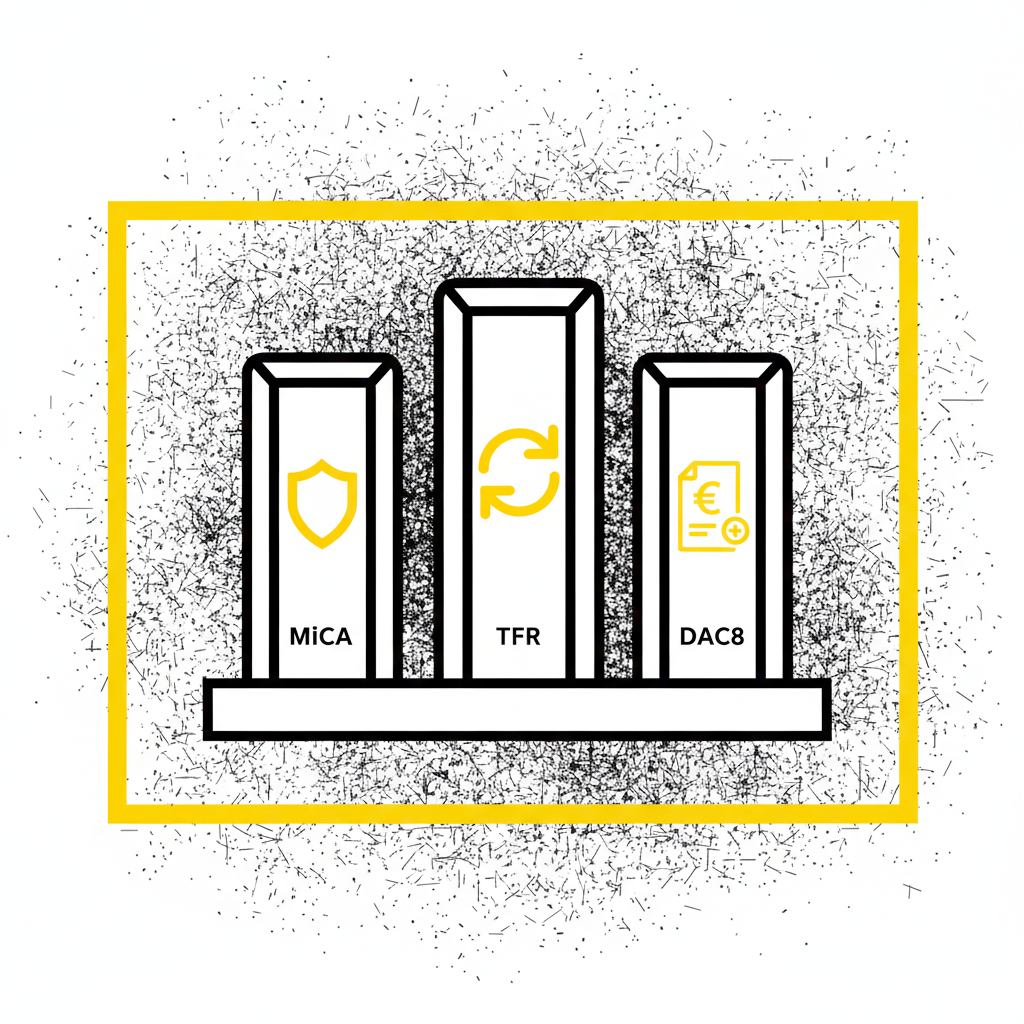
Architecture of the Know Your Business (KYB) Process
Know Your Business (KYB) is the primary defensive mechanism used by fintech gateways. Unlike Know Your Customer (KYC), which focuses on individuals, KYB requires a deeper exploration of corporate hierarchies.
The Verification Objectives:
- Legal Existence: Proving the business is a real, registered entity.
- Control Disclosure: Identifying the Ultimate Beneficial Owners (UBOs) to prevent the use of shell companies for illicit activities.
- Risk Scoring: Evaluating the industry, geography, and transaction profile of the merchant.
The INXY Payments Verification Workflow: A Step-by-Step Guide
The verification process is designed to be rigorous yet streamlined, ensuring all participants meet EU compliance standards. This is a unified process applicable to all merchants, regardless of their industry or integration method.
Step 1: Initial Company Data Intake
The process commences with the "Company data form." The merchant must enter fundamental identifying information, including the legal Company Name, official Registration Number, and Country of Registration.
Note: Providing a direct company email is recommended to ensure a clear line of communication with compliance officers.

Step 2: Comprehensive Documentation Upload
Merchants must validate their legal status by uploading a robust evidentiary file. Mandatory documents typically include:
- Certificate of Incorporation / Business Registration: Proof that the entity exists in a government registry.
- Articles of Association (AOA): Defines the entity's operations and leadership structure.
- Operating License: Required only if the merchant operates in a specifically regulated sector (e.g., gambling, forex).
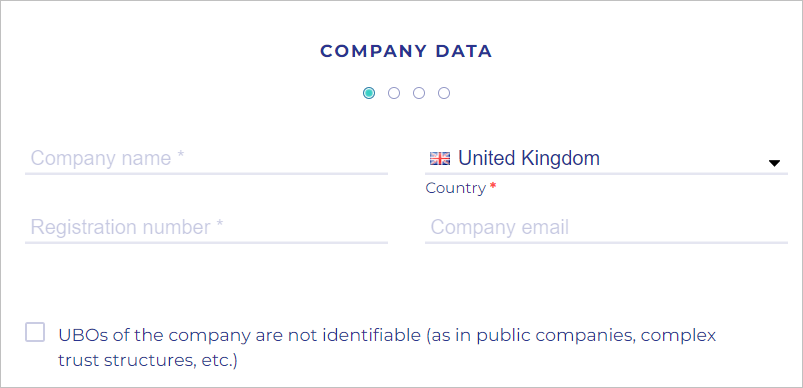
Step 3: Ultimate Beneficial Owner (UBO) Identification
Identifying the natural persons who ultimately control the entity is the cornerstone of EU AML regulations.
- The 25% Rule: Merchants must identify any natural person holding more than 25% of ownership shares or voting rights.
- Verification: For each UBO, the system requires their full name, date of birth, and contact details. Identity verification can be performed live or via a secure link sent to the stakeholder.
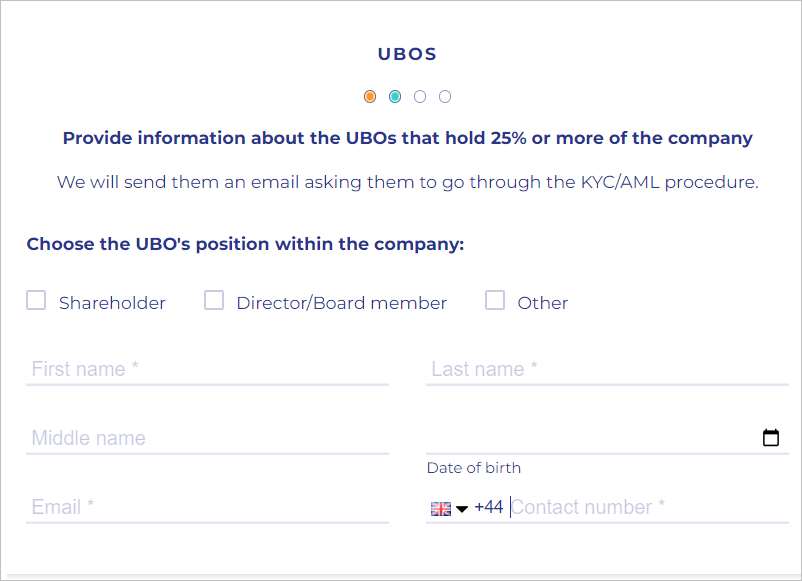
Step 4: Shareholder and Representative Verification
- Corporate Shareholders: If a shareholder is another company, the merchant must provide that entity's Articles of Association and trace the ownership chain back to a natural person.
- Legal Representative: Data must be provided for the person acting on behalf of the company, ensuring they have the legal authority (e.g., Director status or Power of Attorney) to open financial accounts.
Step 5: Final Validation and Submission
The penultimate step is a thorough review of all provided data. Once confirmed, the application enters the compliance review queue. Thanks to automated systems, merchants can track their status in real-time via their dashboard.
Document Requirements and Authentication Standards
The integrity of the verification process relies entirely on the quality of the documentation. The European fintech environment maintains a high bar for validity.
Mandatory Conditions for Approval:
- Language: All documents must be in English. If the original is in another language, a notarized translation is required.
- Authentication: Documents must be "official," bearing the necessary stamps, signatures, or qualified electronic seals as per local laws.
- Recency: Extracts from commercial registries generally should not be older than 3 months to ensure the data is current.
Common Reasons for Rejection:
- Typos: Mismatches between the input form and the uploaded PDF.
- Missing Pages: Uploading incomplete Articles of Association.
- Low Quality: Blurry scans or photos where text is illegible.
Security and Data Protection (GDPR & DORA)
The sensitive nature of KYB data requires the highest levels of protection.
- GDPR Compliance: Data is used solely for client identification and activity justification, adhering to the principle of "Purpose Limitation."
- DORA (Digital Operational Resilience Act): Mandates that payment gateways demonstrate resilience against cyber threats. Data is encrypted at rest and in transit, with role-based access ensuring only authorized compliance personnel can view identity files.
Conclusion: Compliance as a Competitive Advantage
Completing the merchant verification process is more than a regulatory hurdle; it is a strategic move that positions a business as a credible player in the global economy. By adhering to this standardized verification workflow, merchants—whether they are hosting providers, e-commerce stores, or digital service agencies—secure a stable, bank-grade foundation for their financial operations.
In the mature crypto economy of 2026, a verified account is the key to unlocking global markets, ensuring seamless settlements, and protecting business capital from regulatory friction.

Accept Crypto Payments on WHMCS
Gemini said Here is a concise blog summary optimized for readability and engagement, designed to pull readers into the full guide. Blog Summary: Integrating Crypto via INXY for WHMCS In 2026, cryptocurrency has moved beyond speculation to become a primary "production" currency for global digital services. For hosting providers and agencies using WHMCS, the shift toward stablecoins—the "Internet’s dollar"—is a critical competitive advantage. This guide explores how to integrate the INXY Payment Gateway, a robust solution designed to bridge the gap between traditional billing and the modern crypto economy.
In 2026, the fintech landscape is shifting from speculation to production. For hosting providers, VPN services, and digital agencies using WHMCS, the question is no longer if you should accept cryptocurrency, but how efficiently you can do it. With stablecoins becoming the "Internet’s dollar" for cross-border flows, integrating a robust payment gateway is essential for maintaining a competitive edge in the EU and global markets.
One of the most seamless ways to bridge the gap between traditional billing and the crypto economy is through the INXY Payment Gateway. This guide provides a detailed walkthrough for setting up the INXY module on your WHMCS platform.
1. Why Crypto for WHMCS in 2026?
Integrating crypto payments into your billing system offers several strategic advantages:
- Lower Fees: Traditional processors often charge 2–4% for international payments, while gateways like INXY provide more cost-effective alternatives.
- Chargeback Protection: Blockchain transactions are immutable; once confirmed, they cannot be reversed by the sender, eliminating the administrative burden of fraudulent chargebacks.
- Global Reach: Crypto allows you to accept payments from customers in regions with restrictive banking or unstable local currencies without multi-day delays.

2. System Requirements
Before installation, ensure your environment meets the following criteria for the INXY module (Version 1.0.3):
- WHMCS Version: 8.0 up to 8.13.1.
- PHP Version: 7.4 or higher with ionCube Loader.
- Merchant Account: A valid account on the INXY platform.
- Security: An SSL certificate is recommended to ensure secure webhook notifications.
3. Step-by-Step Installation
Step 1: Download the Module
Download the official module archive from the INXY distribution folder.
Step 2: Upload Files
Using FTP or your hosting file manager, upload the files to your WHMCS directory following this structure:
- /modules/gateways/inxy.php
- /modules/gateways/inxy/ (including assets, pages, and config files)
- /modules/gateways/callback/inxy.php
Step 3: Activation
- Log in to your WHMCS Admin Panel.
- Go to Apps & Integrations and find the INXY Payment Gateway.
- Click Activate.
4. Configuration and API Setup
Navigate to System Settings → Payment Gateways → INXY Payment Gateway to finalize your settings:
Field
Description
Display Name
What customers see at checkout (e.g., "Pay with Crypto").
API & Secret Key
Found in your INXY Dashboard.
Convert To
Select USD or EUR for processing fiat invoices.
Test Mode
Enable this to use the Sandbox environment for testing.
Setting Up Webhooks
To ensure your invoices are marked as paid automatically, you must configure the Postback URL in your INXY Merchant Dashboard:
- URL Format: https://yourdomain.com/modules/gateways/callback/inxy.php
- Location: Go to Merchant settings → API in the INXY dashboard and paste the URL.

5. Advanced Matching and Underpayment Rules
Crypto transactions can sometimes result in minor amount differences due to network fees. INXY handles this through the config.php file:
- Amount Deviation: By default, the module accepts payments within 1% of the requested amount. For WHMCS, it is recommended to set 'amount_deviation_percentage' = 49 to reduce unnecessary top-up attempts and align with WHMCS's partial payment flow.
- Time Window: Payments must arrive within 2 hours in production (30 minutes in Sandbox) to be automatically matched.

6. Summary of Payment Outcomes
Status
Customer Experience
WHMCS Admin Status
Paid in Full
Invoice shows "Paid".
Order marked as paid.
Overpaid
Extra amount added as credit.
Visible credit in account.
Partially Paid
"Awaiting payment" status.
Balance reduced by amount received.
Expired
"Expired" status on page.
Order remains unpaid.
By implementing INXY, you provide your users with a modern, 24/7 payment rail that settles in seconds, ensuring your hosting or digital business stays ahead of the curve in 2026.
Would you like me to draft a series of social media posts to announce your new crypto payment options to your customers?

Crypto Payment Gateway vs. Processor: What’s the Difference?
While the terms are often used interchangeably, choosing between a Crypto Payment Gateway and a Crypto Processor can fundamentally change how your business handles digital assets. One acts as the technical bridge, while the other serves as a comprehensive financial engine.
If you’ve spent any time navigating the fintech landscape in 2026, you’ve likely noticed that "crypto payment gateway" and "crypto payment processor" are thrown around like synonyms. In casual conversation, that’s fine. But if you’re a business owner in the EU trying to optimize your checkout or manage a complex treasury, the distinction matters. It’s the difference between a sleek front-end interface and the heavy-duty engine room that actually moves the money.
Let’s break down the technicalities of these two components and see how they work together to modernize your business.
The Crypto Payment Gateway: Your Digital Storefront

Think of the Crypto Payment Gateway as the "front-end" layer. It is the bridge between your website and the blockchain. Its primary job is to handle the customer-facing part of the transaction.
When a customer clicks "Pay with Crypto," the gateway jumps into action:
- Checkout UI: It displays the QR code or wallet address.
- Real-time Rate Locking: It calculates the exact exchange rate between, say, Bitcoin and the Euro, and freezes it for a few minutes so the customer knows exactly what they’re paying.
- Data Transmission: It securely passes the transaction details to the processor.
Essentially, the gateway is the digital equivalent of a Point-of-Sale (POS) terminal. It’s all about user experience and making sure the "handshake" between the customer and the merchant is secure and seamless.
The Crypto Payment Processor: The Engine Room

While the gateway handles the "hello," the Crypto Payment Processor handles the "settlement." This is the back-end infrastructure that manages the lifecycle of the funds after the customer hits send.
The processor’s responsibilities are significantly broader:
- Blockchain Validation: It monitors the network to confirm the transaction has reached the required number of blocks.
- Settlement & Conversion: This is the big one. If you invoiced for €1,000 but the customer paid in Bitcoin, the processor handles the conversion and ensures those funds are ready for your bank account.
- Compliance (KYC/AML): It runs the necessary checks to ensure the transaction isn't linked to illicit activity—a non-negotiable for EU-based businesses under current regulations.
- Payouts: It manages the transfer of funds from the crypto ecosystem into your corporate SEPA or SWIFT account.
Comparison at a Glance
Feature
Crypto Payment Gateway
Crypto Payment Processor
Primary Role
Front-end UI / Communication
Back-end settlement / Logistics
Focus
User Experience (UX)
Compliance & Fund Movement
Key Output
QR Codes, API Callbacks
Fiat Payouts, Tax Reporting
Analogy
The Card Reader on the counter
The Bank/Clearing House
Why the Distinction Matters for EU Businesses
In the European fintech market, precision is everything. If you only use a "gateway" without a robust processing layer, you might find yourself with a wallet full of crypto but no easy way to pay your local taxes or suppliers in fiat.
Conversely, a processor without a good gateway might provide great liquidity, but your customers will struggle with a clunky, manual checkout process that kills your conversion rate.
This is where integrated solutions come in. Platforms like INXY bridge this gap by functioning as a unified ecosystem. By combining an EU-licensed gateway (the part your customers see) with a powerful processing engine (the part your accountant loves), it removes the friction of managing two separate services.
Why "All-in-One" is the 2026 Standard
Modern fintech has moved past fragmented tools. For instance, INXY Payments focuses heavily on high-conversion gateways specifically for e-commerce, infrastructure and hosting providers. Because they operate as an EU-authorized VASP (Virtual Asset Service Provider), the processing side is built-in.
For a merchant, this means:
- Zero Volatility: The rate is locked at the gateway level and settled instantly at the processor level.
- Mass Payouts: You can collect payments via the gateway and immediately use those funds to pay global affiliates or remote teams via the processor’s API.
- Legal Clarity: Since the processor handles the KYB (Know Your Business) and AML checks, the funds landing in your bank account are "clean" and fully documented for tax purposes.
Summary
A gateway gets you paid; a processor keeps you in business. While they serve different technical functions, the most successful companies in 2026 are those that don’t make their customers (or their dev teams) choose between the two.
By using an integrated platform like INXY, you get the best of both worlds: a checkout experience that converts and a back-end that settles without the headaches of traditional banking delays.
Crypto Mass Payouts 2026: Pay 10,000 Freelancers
Crypto mass payouts in 2026 enable businesses to pay thousands of freelancers quickly and globally using stablecoins and automated blockchain infrastructure. This article explains how modern payout platforms abstract network complexity, handle compliance and accounting, and turn large-scale crypto payouts into a reliable, repeatable payment process.
Understanding Crypto Mass Payouts
Crypto mass payouts sound like a big, fancy term, but the basic idea is simple. Imagine you have a large list of freelancers, say 10,000, and you need to pay them. Doing this one by one would take a huge amount of time. That’s where crypto mass payouts come in. They allow businesses to send payments to a large group at once, instead of processing thousands of individual transfers.
At a high level, the process relies on blockchain technology. Blockchains like Bitcoin, Ethereum, TRON, and others act as shared public ledgers. Every transaction is recorded and can be verified, which makes the system transparent and hard to manipulate. This is one of the reasons crypto payments are trusted for global payouts.
However, while the concept of mass payouts is straightforward, execution becomes much more complex as volume grows. Paying 10 freelancers is one thing. Paying 10,000 introduces operational challenges that are easy to underestimate at first.
For businesses, crypto mass payouts can save time and reduce fees compared to traditional bank transfers, especially for international payments. A freelancer in another country might receive funds in minutes instead of waiting days for a wire transfer. Stablecoins like USDT and USDC are commonly used because they are tied to the US dollar, which helps avoid sharp price swings.
At the same time, real-world payout operations involve much more than just “sending crypto.” Network fees, compliance checks, reconciliation, and reporting all become part of the picture.

The Rise of Freelancing in 2026
Freelancing has taken the world by storm in 2026. What used to be a niche career path is now a mainstream way of working. More professionals are choosing flexible, remote work, and companies are increasingly comfortable hiring freelancers across borders.
Technology has played a major role in this shift. Platforms that connect freelancers with clients have matured, and global collaboration tools are now standard. Payment systems have also evolved, making it easier to send money across countries.
As freelancer volumes increase, payments turn into a scaling challenge. A system that works well for a few dozen payouts often breaks down when a company needs to pay hundreds or thousands of people on a regular basis. Delays, errors, or failed payments quickly impact trust and retention.
This is one reason why crypto and stablecoin payouts have gained traction. They offer speed and global reach, but only when supported by the right infrastructure.
Choosing the Right Crypto for Payouts
When deciding which cryptocurrency to use for mass payouts, several factors matter. Speed and transaction fees are important, which is why stablecoins such as USDT and USDC are popular choices. Their value remains relatively stable, making them suitable for salary-like payments.
Security and reliability are also critical. Businesses typically prefer assets and networks with a strong track record and wide adoption.
An often-overlooked factor is the blockchain network itself. USDT on TRON, USDT on Ethereum, and USDT on other networks may share the same name, but operationally they behave very differently. Each network has its own fee structure, speed, and technical requirements. Choosing the wrong network or mixing them up can lead to failed or lost payments.
As payout volumes grow, these differences become more important, not less.
Tech Solutions for Fast Payouts
In the fast-paced world of freelancing, getting paid quickly is a top priority. Blockchain technology makes this possible by allowing transactions to be processed directly between parties, without traditional banking intermediaries. This often results in faster settlement and lower fees.
Smart contracts can add another layer of automation by executing payments when predefined conditions are met. Crypto wallets store assets like USDT and USDC and allow recipients to receive funds from anywhere in the world.
That said, these tools alone are not enough for large-scale payouts. Wallets and smart contracts do not automatically handle gas fees, currency conversion, compliance checks, or accounting. Without additional systems, finance teams still end up doing a lot of manual work.
This is why modern payout platforms focus on orchestration rather than just transactions.

Step-by-Step Process for Mass Payouts
When companies first explore crypto mass payouts, they often follow a simple process. They collect wallet addresses from freelancers, prepare a payout list, and upload it as a CSV file to a payout tool. After reviewing the data, they initiate the transfer and notify recipients.
While this approach may work for small batches, it becomes risky and inefficient at scale. Each payout requires the correct wallet address, the correct blockchain network, and sufficient funds to cover transaction fees. With hundreds or thousands of rows, manual verification takes significant time and mistakes are hard to avoid.
Another major challenge is gas fees. Every blockchain requires transaction fees to be paid in its native token. For example, sending USDT on the TRON network requires TRX, while sending USDT on Ethereum requires ETH. This means businesses must constantly monitor and replenish balances of multiple native tokens just to keep payouts running.
Modern payout infrastructure solves this by abstracting gas management entirely. The platform ensures that all required native tokens are available behind the scenes, so businesses can execute payouts without worrying about blockchain-specific fee mechanics. From the user’s perspective, the process feels much closer to sending fiat payments.
At scale, this level of automation dramatically reduces both time spent and the risk of human error.
Automatic Conversion and Simplified Operations
Another important improvement in modern payout systems is automatic currency conversion. Freelancers and partners often prefer different payout assets. Some want USDT, others USDC, and some may request different networks.
Manually handling these preferences requires holding multiple crypto balances, performing frequent swaps, and tracking exchange rates. This adds complexity and exposes businesses to accounting challenges.
With modern platforms, companies can fund payouts in EUR or USD. Conversions happen automatically at the time of payout, using optimized rates, and recipients receive their preferred asset. The business does not need external exchange accounts or manual balance management.
As a result, crypto becomes almost invisible to internal teams.
Ensuring Security and Compliance
Handling large volumes of payouts requires strong security and compliance practices. Regulations vary by country, but AML and KYT requirements are now standard expectations, not optional extras.
Without automated screening, businesses risk sending funds to sanctioned or high-risk wallets. In real-world cases, this has led to frozen balances, blocked withdrawals, and strained banking relationships.
Modern payout platforms integrate compliance checks directly into the payout flow, ensuring that every transaction is screened before it is executed. This protects both the business and its partners.
Accounting and Reporting Without Disruption
One of the biggest concerns for finance teams is accounting. Tracking crypto movements manually can create reporting and tax complications, especially when exchange rates fluctuate.
Modern systems address this by providing fiat-denominated reporting, even when payouts are made in crypto. Finance teams can continue to work in EUR or USD, with clean, audit-ready reports that fit into existing accounting processes.
This allows companies to introduce crypto payouts without redesigning their entire financial workflow.
Support and Operational Reality
Crypto payouts often run outside standard business hours. Many providers offer support only during weekdays, which can be problematic when large payout batches are scheduled over weekends or holidays.
Live, responsive support during payout windows becomes a critical operational factor. When something goes wrong, delays of several hours can have a significant impact on trust and operations.
Future Trends in Crypto Payouts
Looking ahead, crypto mass payouts are becoming faster, more stable, and more automated. Stablecoins continue to gain popularity, and clearer regulations are helping businesses feel more confident adopting crypto-based payment rails.
One of the most important trends is abstraction. Businesses increasingly expect crypto payouts to behave like traditional payments: funded in fiat, delivered in the recipient’s chosen asset, and reported in fiat terms.
Platforms focused on infrastructure, such as INXY, reflect this shift by hiding blockchain complexity and allowing companies to scale payouts without increasing operational overhead.
Final Thoughts
Crypto mass payouts in 2026 are no longer about experimenting with blockchain. They are about running reliable, global payment operations.
When supported by proper automation, compliance, and reporting, paying 10,000 freelancers becomes a routine process rather than a source of stress. For businesses operating at scale, this is the real value of modern crypto payout infrastructure.
FAQ
What are crypto mass payouts and why are they important for businesses with large freelance workforces?
Crypto mass payouts are a method of disbursing payments to a large number of recipients simultaneously using cryptocurrencies. They are crucial for businesses with extensive freelance workforces because they offer speed, cost-efficiency, and global reach, which traditional banking systems may lack.
How has the rise of freelancing in 2026 affected payment systems?
The growth of the freelancing economy in 2026 has led to increased demand for flexible and efficient payment systems. This shift necessitates faster, more reliable ways to pay freelancers worldwide, driving the adoption of crypto mass payouts as a viable solution.
What cryptocurrencies are popular for mass payouts and what are their benefits?
Popular cryptocurrencies for mass payouts include USDT and USDC. These stablecoins are favored due to their price stability, which minimizes the risk of value fluctuations during transactions, making them an ideal choice for businesses and freelancers alike.
What technologies facilitate rapid crypto payouts to freelancers?
Innovative platforms and technologies, such as blockchain-based payment systems and smart contract automation, enable businesses to conduct rapid crypto payouts. These solutions streamline the payment process, reduce transaction times, and ensure transparency and accuracy in disbursements.
How can businesses execute mass payouts effectively within a tight timeframe?
To execute mass payouts efficiently, businesses should follow a step-by-step process: select a reliable crypto payment platform, integrate necessary APIs, prepare and verify recipient wallet addresses, choose the appropriate cryptocurrency, and initiate the payout using automated systems for accuracy and speed.
Why are security measures and compliance important in crypto payrolls?
Security measures and compliance are vital in crypto payrolls to protect sensitive financial data, prevent fraud, and adhere to legal regulations. Ensuring robust encryption, multi-factor authentication, and compliance with international financial laws helps maintain trust and reliability in crypto transactions.
What future trends in crypto payouts should businesses be aware of beyond 2026?
Beyond 2026, businesses should be prepared for trends such as the integration of AI in payment processes, increased regulatory scrutiny, and the rise of decentralized finance (DeFi) solutions. Staying informed and adaptable will allow businesses to leverage these trends for more efficient and secure payment systems.

How to Send Crypto in 2026: Step-by-Step
Sending crypto in 2026 is faster and more accessible thanks to improved wallets, lower network fees, and advanced blockchain technologies. This step-by-step guide explains how to send BTC, USDT, USDC, and ETH securely, compare transaction fees, track transfers, and stay ahead of future crypto transaction trends.

Understanding Cryptocurrency Basics
Cryptocurrency might sound complicated, but it's quite straightforward once you get the hang of it. At its core, cryptocurrency is a type of digital money. Unlike traditional currencies like the dollar or euro, crypto doesn't rely on banks. Instead, it uses technology called blockchain to keep track of transactions. This technology is like a digital ledger that records every transaction made.
Bitcoin is the most famous cryptocurrency, but there are many others like Ethereum, USDT, and USDC. Each has its own features and uses. For instance, Bitcoin is often used as a store of value, like gold. Ethereum, on the other hand, is known for its smart contracts. These are like self-executing contracts with the terms directly written into code.
Sending crypto involves creating a digital wallet. This wallet is a bit like a bank account but only for digital currencies. To send crypto, you need the recipient's wallet address. It's important to double-check this address because once you send crypto, you can't get it back if the address is wrong. Crypto transactions are generally fast and can be cheaper than traditional money transfers.

Choosing the Right Crypto Payment Platform
When it comes to sending crypto, picking the right payment platform is crucial. The options have expanded greatly by 2026, offering more choices than ever. But with choice comes the challenge of finding the best fit for your needs. Let's break down what to look for in a crypto payment platform.
First, consider the transaction fees. Different platforms charge varying fees for sending crypto. Some offer lower fees for particular cryptocurrencies like BTC, USDT, USDC, or ETH. It's smart to compare these fees as they can affect the overall cost of your transactions. A platform with lower fees can save you money in the long run.
Next, think about ease of use. Not all platforms are user-friendly. If you're new to crypto, look for a platform that offers a straightforward interface. Tutorials and customer support can also be a big help. A good platform should make the process of sending crypto as simple as possible.
Security is another key factor. You need a platform that keeps your funds safe. Look for platforms with strong security measures, such as two-factor authentication and encryption. You want assurance that your crypto won't fall into the wrong hands.
Consider the platform's reputation and reviews. A platform with positive reviews from other users can be a good sign. Check forums and social media for feedback. Sometimes, the experiences of others can guide you toward the right choice.
Finally, look at the supported cryptocurrencies. If you plan to send BTC, USDT, USDC, or ETH, make sure the platform supports these. Some platforms offer a wider range of cryptocurrencies, which can be useful if you plan to diversify your holdings.
In essence, selecting the right crypto payment platform involves balancing fees, usability, security, reputation, and currency support. By focusing on these aspects, you'll be well on your way to finding a platform that suits your needs.

Setting Up Your Crypto Wallet (ссылка на блог)
Setting up a crypto wallet is a crucial step in sending crypto. It's like having a digital bank account where you store your cryptocurrencies. Let's break down the process into simple steps.
First, you'll need to choose the type of wallet. There are several options like hardware wallets, mobile wallets, and desktop wallets. Each has its own benefits. For instance, hardware wallets are secure because they store your crypto offline. Mobile wallets are convenient for everyday use.
Once you've picked a wallet type, it's time to download or purchase it. If you're going for a software wallet, visit the official website or app store to download it. Be cautious of fake sites and apps. For hardware wallets, buy from a trusted source to avoid counterfeit products.
After installing your wallet, you'll need to create an account. During this step, you'll set up a strong password. This is vital for your wallet's security. You might also be required to set up two-factor authentication for an extra layer of protection.
You'll then receive a recovery phrase. This is a set of words you'll need if you ever lose access to your wallet. Write it down and store it somewhere safe. Never share this phrase with anyone.
Finally, add some crypto to your wallet. You can do this by purchasing crypto from an exchange or receiving it from someone else. Make sure to double-check wallet addresses when sending or receiving crypto to avoid mistakes. With these steps, you're ready to manage your crypto securely.

How to Send BTC, USDT, USDC, and ETH
Sending crypto can seem tricky, but it's quite simple once you get the hang of it. Let's break it down. First, you need a wallet. There are many options, like hardware wallets, mobile apps, or online platforms. Choose one that fits your needs and create an account.
When you're ready to send crypto, you'll need the recipient's wallet address. It's a long string of letters and numbers, so double-check it to avoid mistakes. For example, if you're sending Bitcoin (BTC), make sure the address is a BTC address. Sending crypto to the wrong type of address can result in a loss.
Next, enter the amount you want to send. Most platforms let you choose how much you want to pay in fees. Lower fees mean slower transactions, while paying more can speed things up. It's a balance between cost and time.
Once everything looks good, confirm the transaction. Some platforms may ask for additional verification, like a code sent to your phone or email. This step helps keep your crypto safe. After confirmation, the transaction is processed. Depending on the network, it can take a few minutes to complete.
Keeping track of the transaction is easy. You can use a blockchain explorer to see its status. Just enter your transaction ID or wallet address to follow its progress.
Comparing Transaction Fees
When sending crypto, transaction fees can vary greatly depending on the network you choose. Let’s break this down with a few clear examples.
Imagine you’re sending Bitcoin (BTC). The Bitcoin network can have relatively high fees, especially during periods of high demand. This often makes small transactions less cost-effective.
Now consider Ethereum (ETH). Ethereum transaction fees, known as gas fees, fluctuate depending on network congestion. During peak activity—such as popular NFT launches or intense DeFi usage—these fees can increase significantly.
The same principle applies to stablecoins like USDT and USDC. While their value remains stable, transaction fees depend entirely on the blockchain network used. An important detail to keep in mind is that gas fees are always paid in the native token of the blockchain, not in the stablecoin itself.
For example, if you send USDT on the Ethereum network (ERC-20), you must have enough ETH in your wallet to cover the gas fee. Similarly, when sending USDT on the Tron network (TRC-20), you need to hold TRX in addition to USDT. Without the native token on your balance, the transaction cannot be processed.
This is why networks like Tron are often chosen for USDT transfers—fees there are usually much lower. However, it’s essential to monitor your balance of native coins (ETH, TRX, etc.) to avoid failed transactions.
When choosing how to send crypto, always compare current network fees and make sure you have enough of the required native token. This approach helps keep your transactions smooth, predictable, and cost-effective.
Tracking Your Crypto Transactions
Keeping tabs on your crypto transactions can seem like a puzzle at first. Yet, with a few simple steps, it can become second nature. When you send crypto, each transaction gets recorded on a public ledger called a blockchain. This ledger is like a big book that everyone can see but no one can change. It helps ensure transparency and security.
To start tracking, you'll need a wallet. This is like your digital pocket for holding cryptocurrencies. Each wallet has a unique address, much like your house address, but for crypto. When you send crypto, it gets recorded with this address. Many wallets offer features allowing you to see your full transaction history. This is handy for checking past transfers or seeing who you've sent crypto to.
For those who like visuals, some platforms provide charts and graphs that show your transaction activity over time. These can help you spot patterns or unusual activity. If you're using a crypto payment platform, they might offer additional tools for managing and viewing your transactions. Some even offer alerts to notify you of any new activity, ensuring you're always in the loop.
If you're dealing with several types of crypto like BTC, USDT, USDC, or ETH, separate wallets might be needed. This keeps things organized and prevents confusion. For those wanting to dive deeper, blockchain explorers are available. These are online tools that let you search a transaction by entering your wallet address. They offer detailed info, such as transaction status and fees paid.
Tracking your crypto transactions isn't just about staying organized. It's a way to protect your crypto and understand your spending habits. With these tools, you can manage your crypto finances in a smart and secure way.
Future Trends in Crypto Transactions
The world of cryptocurrency is always on the move. As we look to 2026, several exciting trends are shaping how people send crypto. These changes are not just about technology but also about how we use crypto in everyday life.
One major trend is the rise of decentralized finance, or DeFi. DeFi platforms allow users to conduct financial transactions without a central authority, like a bank. This means lower fees and more control over your money when you send crypto. DeFi is growing fast, and more people are using it for everything from loans to savings accounts.
Another trend to watch is the integration of crypto into traditional financial systems. More banks and financial institutions are starting to accept and use cryptocurrencies. This means you might soon be able to send crypto directly from your bank account. It's a big step towards making crypto a part of everyday financial activities.
In addition to these changes, there is also a focus on improving the speed and efficiency of crypto transactions. Technologies like the Lightning Network for Bitcoin and Ethereum 2.0 are being developed to make transactions faster and cheaper. This could make sending crypto as quick and easy as sending a text message.
Security is another important area of development. As more people use crypto, the need for secure transactions becomes even more critical. New security measures, such as multi-signature wallets and advanced encryption techniques, are being introduced. These tools help protect users' funds and personal information.
Moreover, the use of stablecoins like USDT and USDC is growing. These are cryptocurrencies pegged to stable assets like the US dollar. They offer the benefits of digital currencies without the volatility. This makes them an attractive option for people looking to send crypto with minimal risk.
Lastly, there is an increasing focus on regulation. Governments around the world are working on new laws to govern cryptocurrency use. While some fear that regulation could stifle innovation, it could also make crypto more reliable and accessible to everyone.
As we move forward, these trends will shape the future of crypto transactions. Whether you're a seasoned investor or a newcomer, keeping an eye on these developments can help you make informed decisions about how to send crypto. The landscape is evolving, and with it, new opportunities are emerging for everyone.
FAQ
What is cryptocurrency and why are BTC, USDT, USDC, and ETH commonly used for sending?
Cryptocurrency is a digital or virtual form of currency that uses cryptography for security. BTC (Bitcoin), USDT (Tether), USDC (USD Coin), and ETH (Ethereum) are commonly used due to their widespread acceptance, liquidity, and relatively stable values, making them ideal for transactions.
How do I choose the right crypto payment platform for sending crypto with low fees?
When selecting a crypto payment platform, consider factors such as transaction fees, user interface, security features, and supported cryptocurrencies. Platforms like Binance, Coinbase, and Kraken are popular due to their competitive fees and reliability.
What steps are involved in setting up a secure crypto wallet?
To set up a secure crypto wallet, first choose between a hardware wallet (for maximum security) or a software wallet (for convenience). Download the wallet app or set up the hardware device, create a strong password, and ensure you have a backup of your recovery phrase.
Can you provide a step-by-step guide on sending BTC, USDT, USDC, and ETH?
- Open your crypto wallet and select the cryptocurrency you wish to send.
- Enter the recipient's wallet address.
- Specify the amount to send.
- Review the transaction details, including network fees.
- Confirm and authorize the transaction.
- Wait for transaction confirmation on the blockchain.
How can I compare transaction fees across different networks and platforms?
To compare transaction fees, research and compare the fee structures of each platform, focusing on network fees, withdrawal fees, and any additional service charges. Tools like CoinGecko and CoinMarketCap provide up-to-date fee comparisons.
What methods are available for tracking my crypto transactions?
You can track your crypto transactions using blockchain explorers such as Etherscan for ETH and its tokens or Blockchain.com for BTC. These tools allow you to enter the transaction ID to view the status and confirmations.
What future trends can we expect in crypto transactions by 2026?
By 2026, expect increased adoption of Layer 2 solutions for faster and cheaper transactions, greater integration of AI for improved fraud detection, and wider acceptance of crypto payments in mainstream finance, enhancing user experience and security.

7 Real Cases: Companies Accepting Crypto
Seven business cases showing how crypto payments are implemented in practice.
The Rise of Crypto Payments
The world of payments is changing quickly, and crypto is leading the charge. As more people understand digital currencies, companies are eager to accept crypto payments. This shift is not just for tech giants; even small businesses are jumping on board. They see the benefits, like lower fees and faster transactions.
Consider a coffee shop that starts to accept crypto. They can attract tech-savvy customers who prefer using digital wallets over traditional money. There's also the appeal of stablecoins, which offer the stability of traditional currencies with the speed of crypto. These coins are less volatile, making them a safer choice for businesses.
In 2025 and 2026, more companies will likely join this trend. The rise of crypto payments is creating a new business landscape, where flexibility and innovation are key. As we move forward, this trend will reshape how we think about money and transactions.

Case Study 1: Tech Giant X
In 2025, Tech Giant X made a bold move by choosing to accept crypto payments. This decision came after noticing a rising trend in digital currencies. The company saw a chance to reach a broader audience, especially tech-savvy individuals keen on using cryptocurrencies.
At first, they focused on using Bitcoin and Ethereum, which were popular at the time. To manage the volatility of these currencies, they decided to use a stablecoin backed by real assets. This step ensured they kept financial stability while still embracing innovation.
The shift required some changes in their payment system. They partnered with a leading crypto payment processor to handle transactions smoothly. This partnership allowed them to offer a seamless shopping experience to users paying with crypto.
Tech Giant X's strategy paid off. They noticed an increase in sales among younger customers. The move also positioned them as a leader in the industry, inspiring other companies to explore cryptocurrencies.
Case Study 2: Retail Chain Y
Retail Chain Y, a well-known department store, made headlines in 2026 by deciding to accept crypto payments. This decision came after noticing a shift in customer preferences. More shoppers wanted to use digital currencies like Bitcoin and stablecoin. The management saw this as a chance to attract tech-savvy customers.
To make this happen, Retail Chain Y partnered with a blockchain payment provider. This allowed them to integrate crypto transactions easily. They set up user-friendly terminals at checkout points. Customers could now scan a QR code on their phones to pay with crypto.
The process was smooth and fast, making it popular among customers. This move not only boosted sales but also positioned the chain as a modern and innovative company. By accepting crypto, Retail Chain Y tapped into a growing market and won the loyalty of new customers.
Case Study 3: Food Delivery Service Z
In 2025, Food Delivery Service Z decided to accept crypto payments. This change was driven by the need to reach tech-savvy customers who value convenience and digital innovation. By accepting crypto, the company tapped into a growing customer segment that prefers using cryptocurrencies for everyday transactions.
To make the transition smooth, Service Z partnered with a crypto payment processor. This ensured transactions were quick and secure. Customers could pay using popular cryptocurrencies like Bitcoin and Ethereum, as well as stablecoins, which offer price stability.
Service Z’s decision to accept crypto also helped them stand out in the crowded food delivery market. They marketed this feature prominently, attracting more users who appreciated the flexibility and novelty of paying with digital currencies. This move not only boosted their customer base but also increased their brand visibility.

Case Study 4: Hosting Provider С
Instead of redesigning their whole billing system, the company added a stablecoin option through an external payment API. The goal wasn’t to replace their existing methods. They only wanted to give customers another way to pay without changing the rest of their workflow.
The technical setup was straightforward. Their team added a new payment route, tested a few transactions, and then made it available to users. Customers could now pay invoices in USDT or USDC. The hosting provider kept accounting in euros, which made reporting easier for their finance team.
A few patterns appeared after the first months:
- A noticeable share of crypto users paid for 12 to 24 months upfront, far more than the typical card-paying customers.
- Several new customers arrived who had never used the provider before, matching the trend that around 40% of crypto-paying users tend to be new to the merchant.
- Some customers increased their spending slightly when crypto were available, which aligned with general industry data showing that crypto users often spend more when given the option.
- The company also saw traffic from regions where card payments didn't always work well, and stablecoins offered a more reliable way to complete orders.
The change also highlighted an internal benefit: staff no longer had to manually track crypto receipts or confirm transaction hashes. The API returned all details in one place, which reduced back-and-forth during billing checks.
Hosting Provider Z did not run marketing campaigns around the new feature. They simply added it to their billing page. Still, it became a regular payment method for a specific segment of their clients — mostly developers who were already familiar with digital assets.
By the end of the year, the company concluded that stablecoin support didn’t transform their business, but it made payments smoother for a meaningful group of users. It also helped them understand how digital dollars fit into hosting, which gave them clearer ideas for future improvements

Case Study 5: E-commerce Platform B
In 2025, E-commerce Platform B made a bold move. They decided to accept crypto payments. This decision was not only innovative but also strategic. The world was moving towards digital currencies, and they wanted to be at the forefront.
The first step was to choose which cryptocurrencies to accept. They went with popular ones like Bitcoin and Ethereum. But they didn't stop there. They added stablecoins too. Stablecoins are digital currencies with a stable value, often linked to a currency like the US dollar. This way, they could offer their customers more options.
Next, they had to make sure their system could handle crypto payments. This wasn't simple. They needed to integrate a secure payment gateway. They partnered with a company specializing in crypto transactions. This ensured that all payments were safe and fast.
Training their staff was another important step. Many employees were new to cryptocurrencies. They needed to understand how to process these transactions. E-commerce Platform B held training sessions to teach them about different cryptocurrencies. They also learned how to deal with any issues that might arise during transactions.
Marketing played a vital role in this transition. They launched a campaign to inform customers about their new payment options. They used social media to reach a wider audience. The message was clear: customers could now pay with crypto.
The decision to accept crypto brought in new customers. Many people prefer using digital currencies for online shopping. E-commerce Platform B saw an increase in sales. Customers appreciated the variety of payment methods.
Accepting crypto payments also positioned them as a forward-thinking company. It showed they were ready to embrace new technology. This decision set them apart from competitors who were still wary of digital currencies.
E-commerce Platform B's journey was not without challenges. They faced technical issues and had to ensure compliance with regulations. But their determination paid off. By 2026, they were a leader in the e-commerce industry, thanks to their innovative approach to payments.

Case Study 6: Online Marketplace A
In 2025, Online Marketplace A, a well-known player in the e-commerce sector, decided to embrace cryptocurrency payments. This bold move aimed to attract tech-savvy consumers and stay ahead of the competition. With the growing interest in digital currencies, the marketplace saw an opportunity to expand its customer base.
To start, the company needed to choose which cryptocurrencies to accept. After thoughtful consideration, they opted for popular ones like Bitcoin and Ethereum, as well as stablecoins. Stablecoins, being less volatile, offered a more predictable value, making them appealing for both the company and its customers.
Integrating crypto payments required some technical upgrades. The company partnered with a payment processor specializing in digital currencies. This partnership ensured smooth transactions and reduced the risk of potential security issues. It was essential to make the payment system user-friendly, so customers could easily complete their purchases with crypto.
Online Marketplace A didn't stop at just accepting crypto payments. They launched a marketing campaign to promote this new feature. The campaign targeted tech enthusiasts and highlighted the benefits of using cryptocurrencies, such as lower transaction fees and increased privacy.
The results were impressive. Within months, the marketplace saw a surge in new customers, many of whom preferred crypto over traditional payment methods. Existing customers also expressed satisfaction with the added payment options, which improved their shopping experience.
This case shows how strategic planning and innovation can help companies adapt to changing market trends. By accepting crypto, Online Marketplace A not only attracted more customers but also positioned itself as a forward-thinking leader in the e-commerce industry.
Case Study 7: Nonprofit Organization D
In 2025, Nonprofit Organization D decided to accept crypto payments. Their goal was to reach a global audience and increase donations. Digital currencies provided a way to lower transaction fees and offer donors more options. By accepting crypto, they made it easier for people worldwide to contribute to their cause.
The organization started by exploring different cryptocurrencies. They chose to accept Bitcoin, Ethereum, and a stablecoin. Bitcoin and Ethereum were popular, while the stablecoin provided price stability. This combination allowed them to manage risk while offering flexibility to donors.
To integrate crypto payments, they partnered with a payment processor. This processor allowed them to convert crypto to local currency quickly. It was important to avoid the volatility of cryptocurrency markets. The conversion process ensured that funds remained stable and useful for their projects.
Nonprofit Organization D faced challenges in educating their team and donors. The team needed to understand how cryptocurrency works. They held training sessions to explain key concepts like wallets and blockchain. For donors, they created simple guides on how to donate using crypto. This helped remove confusion and encouraged more people to give.
The organization also highlighted the benefits of crypto donations. They promoted the transparency and security of blockchain technology. Donors appreciated the ability to track their contributions. This transparency built trust and strengthened relationships with supporters.
By accepting crypto, Nonprofit Organization D expanded their reach. They tapped into a new donor base interested in digital currencies. They also reduced overhead costs, allowing more funds to go directly to their programs. This case shows how nonprofits can benefit from embracing modern payment methods.
FAQ
Why are more companies starting to accept cryptocurrency payments?
Companies are increasingly accepting cryptocurrency due to its potential to attract tech-savvy customers, reduce transaction fees, and offer faster, borderless transactions. The growing popularity and acceptance of digital currencies among consumers also drive this trend.
What challenges did Tech Giant X face when integrating crypto payments?
Tech Giant X faced several challenges, including setting up secure and reliable crypto payment gateways, complying with regulatory requirements, and educating customers and staff about using cryptocurrencies.
How did Retail Chain Y's customers respond to the introduction of crypto payments?
Retail Chain Y saw a positive response from customers, with increased engagement and a boost in sales from crypto-enthusiastic consumers. However, they also encountered initial confusion, necessitating a targeted educational campaign.
What benefits did Food Delivery Service Z experience after adopting crypto payments?
Food Delivery Service Z benefited from faster transaction times and reduced payment processing costs. Additionally, the option to pay with crypto helped them attract a niche segment of tech-savvy customers, enhancing overall satisfaction.
How did accepting cryptocurrency impact Online Marketplace A's business operations?
Online Marketplace A experienced smoother international transactions and a reduction in fraud-related issues. The move also broadened their customer base by attracting users who prefer cryptocurrency for online shopping.
What was the effect of integrating stablecoins on E-commerce Platform B's sales?
E-commerce Platform B saw an increase in sales due to the stability and reliability of stablecoins, which appealed to customers wary of the volatility associated with other cryptocurrencies. This integration also simplified cross-border transactions.
How did Subscription Service C use crypto payments to increase customer retention?
Subscription Service C attracted a new demographic interested in paying with cryptocurrency, offering them exclusive benefits and promotions. This strategy not only improved retention rates but also expanded their subscriber base.

How to Accept Crypto Payments in 2026
A simple guide to accepting crypto payments safely and legally in 2026.
Understanding Cryptocurrency Basics
Cryptocurrency is a type of digital or virtual currency. It uses cryptography to secure transactions. This makes it hard to counterfeit. Unlike traditional money, cryptocurrencies operate on a technology called blockchain. This is a decentralized system spread across many computers.
Bitcoin was the first and is the most well-known cryptocurrency. But now, there are thousands of different cryptocurrencies. Each has its own unique features. For example, some are used for fast, low-cost transactions. Others focus on privacy.
A popular feature of cryptocurrencies is their ability to be traded or exchanged easily. People can buy, sell, or trade them on different online platforms. These platforms are called exchanges. Some well-known exchanges are Binance and Coinbase.
Stablecoins are another type of cryptocurrency. They are designed to minimize price fluctuations. They achieve this by being pegged to stable assets like the US dollar. USDT and USDC are examples of stablecoins. They provide stability in the volatile crypto market.
Cryptocurrencies are stored in digital wallets. These can be online, offline, or even hardware devices. Each wallet has a unique address. This address is used to send and receive cryptocurrencies.
While cryptocurrencies offer many benefits, they also come with risks. Their prices can be very volatile. This means they can change quickly and unpredictably. Security is another concern. If a wallet is hacked, it can lead to loss of funds.
Understanding how cryptocurrencies work is important. It helps in making informed decisions. Whether you want to invest or accept crypto payments, knowing the basics is the first step.
Setting Up Your Digital Wallet
Setting up a digital wallet for accepting crypto is like opening a new bank account, but much simpler. First, choose a wallet that suits your needs—whether it's a software wallet for easy access on your phone or a hardware wallet for extra security. Software wallets are apps you can download, making them convenient for daily transactions. Hardware wallets, on the other hand, are devices you connect to your computer, keeping your crypto offline and safe from hackers.
Next, install your chosen wallet and follow the instructions to create an account. You'll be given a unique address, like your wallet's phone number, where people can send you cryptocurrency. It’s crucial to secure your wallet with a strong password and, if possible, enable two-factor authentication for added security. Keep your recovery phrase safe; it’s your lifeline if you forget your password.
Finally, explore the wallet's features. Some wallets let you exchange one cryptocurrency for another directly within the app, while others offer detailed transaction history. Getting familiar with these options ensures smooth management of your crypto payments.

Choosing the Right Payment Processor
Picking the best payment processor for accepting crypto can feel like choosing the right car. You want something reliable, fast, and easy to handle.
In 2026, the most important thing to check is stablecoin support, not just Bitcoin.
Most companies now prefer USDT, USDC, or DAI, because they offer price stability and dominate real business payments. Stablecoins now power most B2B payment growth worldwide.
Next, look at fees. Some processors charge a flat rate, others a percentage, and some add hidden spreads when converting crypto to fiat. It’s like buying a concert ticket—sometimes the “service fee” costs more than the seat.
A modern processor should integrate smoothly into your existing systems—your checkout page, invoicing software, or backend platform. Ideally, it should support both plugins (Shopify, WooCommerce) and API integration so your business can scale later.
Security matters too. Look for processors that:
- screen every transaction (KYT)
- support strong encryptio
- offer clear, audit-friendly reporting
This is especially important as more countries enforce stricter crypto regulations, especially in the EU under MiCA.

Integrating Crypto Payments into Your Business
Integrating crypto payments into your business is easier today than ever before. Most companies start by choosing a crypto payment gateway that works alongside their existing checkout or invoicing system. These gateways support major cryptocurrencies like Bitcoin, Ethereum, and stablecoins such as USDT and USDC.
Once you choose a provider, you connect it to your website or platform. Many services offer simple plugins for Shopify, WooCommerce, and other tools. If you prefer something custom, you can use their API to build your own flow.
One helpful feature offered by most payment gateways is automatic conversion. This means that when a customer pays in crypto, the gateway can instantly convert it into stablecoins or fiat currency. Your balance stays steady, which makes bookkeeping easier and avoids the need to monitor crypto price changes. You simply receive the amount in the currency you prefer.
It also helps to clearly show on your website that you accept crypto. Customers who use digital assets often look for businesses that support their preferred payment methods.
As with any payment method, security matters. Keep your accounts protected with two-factor authentication and make sure your systems are up to date. A good gateway will also include its own safeguards, such as blockchain monitoring and fraud checks.
Offering crypto payments is a simple way to expand your payment options, make checkout more flexible, and reach customers in more parts of the world.
Tax Implications and Legal Considerations
When you begin accepting crypto payments, it’s important to understand how taxes and regulations apply in your region. Rules vary from country to country, but most treat cryptocurrency as an asset or a form of taxable income. If your business receives crypto as payment, it may need to be reported to your local tax authority. Keeping clean records of all transactions makes this process easier.
Regulation is also evolving around the world.
European Union
- MiCA is now active.
- Strict AML and Travel Rule checks.
- You must work with a licensed VASP/CASP.
United States
- Rules differ by state.
- A federal stablecoin law is expected soon.
- Choose a partner who follows both federal and state-level compliance.
United Kingdom
- New crypto rules expected in 2026.
- FCA requires AML, Travel Rule, and Financial Promotions compliance from providers.
Singapore
- Very clear regulation under the Payment Services Act.
- You must work only with licensed Digital Payment Token providers.
Hong Kong
- Strong VASP licensing since 2023.
- New stablecoin rules start in 2025.
Middle East (UAE, Bahrain)
- UAE’s VARA sets strict rules for crypto companies.
- Follow AML/CFT and Travel Rule requirements.
Latin America
- Rules vary by country.
- Brazil and Mexico are building national frameworks.
- Work with partners who apply strong AML controls.
Because the landscape changes quickly, many businesses choose crypto payment processors that are already licensed or registered in their operating regions. Working with a regulated partner often simplifies compliance, especially around AML, KYC, and reporting obligations.
It’s also helpful to consult a tax or legal advisor familiar with cryptocurrency. They can guide you on reporting requirements, record-keeping, and any local rules you may need to follow.
Finally, many companies prefer accepting stablecoins like USDT or USDC. These assets are tied to national currencies and are less volatile than traditional cryptocurrencies, which can make accounting and financial planning easier.

Marketing Your Crypto Payment Options
When it comes to accepting crypto, getting the word out is key. Let people know you accept crypto payments. It can attract a new group of customers who prefer using digital currencies. To make this happen, you need a solid marketing plan tailored to this unique payment method.
One way to start is by updating your website and social media profiles. Highlight your new payment option. Create eye-catching banners or badges that say you accept cryptocurrencies like Bitcoin, Ethereum, or stablecoins such as USDT and USDC. This visual cue can grab attention and encourage visitors to explore more.
Consider writing blog posts or articles about the benefits of accepting crypto. These can educate your audience and position you as a forward-thinking business. Explain why crypto payments are secure, fast, and cost-effective. Use simple language to break down complex concepts. This helps even those new to crypto understand its advantages.
Social media is a powerful tool. Use it to announce your new payment methods. Platforms like Twitter, Instagram, and Facebook allow you to reach a wide audience. Create engaging posts with hashtags related to cryptocurrency. These can help your posts appear in searches made by crypto enthusiasts.
Collaborations with crypto influencers can extend your reach. Find influencers who align with your brand. They can showcase your business to their followers, who might be interested in using crypto. A positive mention from a trusted voice can enhance your credibility.
Email marketing can also play a role. Send newsletters to your subscribers informing them about your new payment option. Offer exclusive promotions or discounts for those who choose to pay with crypto. This can motivate them to try out the new payment method.
Hosting events or webinars about cryptocurrency can engage your audience. These can be opportunities to answer questions and demonstrate how paying with crypto works. Educating potential customers can remove doubts and make them more comfortable using digital currencies.
By using these marketing strategies, you can effectively promote your crypto payment options. This can lead to increased customer engagement and potentially boost your sales.
Future Trends in Cryptocurrency Payments
Let's talk about the exciting trends in cryptocurrency payments as we look ahead to 2026. Cryptocurrencies are changing the way we think about money, and it's only going to get more interesting. Businesses and freelancers should keep an eye on these trends to stay ahead of the curve.
One major trend is the rise of stablecoins. These are digital currencies that are tied to real-world assets like the US dollar. Examples include USDT and USDC. They provide the benefits of cryptocurrencies without the wild price swings. This makes them attractive for businesses that want to accept crypto without worrying about losing value overnight. Stablecoins are becoming a popular choice for payments because they offer stability and trust.
Another trend is the growing acceptance of crypto by big companies. More and more large businesses are starting to accept crypto payments. This is because they see the potential of reaching new customers worldwide. When big players jump on board, smaller businesses often follow. This could lead to more widespread use of crypto in everyday transactions.
There's also a push for better technology to support crypto payments. Developers are working on making transactions faster and cheaper. Right now, some cryptocurrencies take too long to process or have high fees. But new technologies, like the Lightning Network, aim to solve these problems. They allow instant transactions with very low fees. This makes crypto more practical for everyday use.
Security is always a concern with cryptocurrencies. As we move forward, we can expect improvements in this area too. Developers are creating more secure wallets and platforms to protect users from scams and hacks. This is crucial for building trust in the system.
Regulations are another important factor. Governments around the world are trying to figure out how to handle cryptocurrencies. In 2026, we might see more clear rules and regulations. This could make it easier for businesses to accept crypto without worrying about legal issues.
Lastly, as more people become familiar with cryptocurrency, we'll likely see an increase in its use. Education is key here. The more people know about how crypto works, the more comfortable they'll feel using it. This could lead to a significant increase in crypto payments.
In summary, the future of cryptocurrency payments looks promising. With stablecoins, big company adoption, better technology, increased security, clear regulations, and greater awareness, businesses and freelancers have much to look forward to in 2026. Keep an eye on these trends to stay ahead in the evolving world of crypto.
FAQ
What is cryptocurrency, and why should I consider accepting it as a payment method?
Cryptocurrency is a digital or virtual form of currency that uses cryptography for security and operates on decentralized networks like blockchain technology. Accepting crypto payments can broaden your customer base, lower transaction fees, and enhance your business's image as forward-thinking and tech-savvy.
How do I choose the right digital wallet for my business?
When selecting a digital wallet, consider factors like security features, compatibility with multiple cryptocurrencies, user interface, and customer support. Look for wallets with strong encryption and backup options to ensure your funds remain secure.
What should I look for in a cryptocurrency payment processor?
Key considerations for choosing a crypto payment processor include transaction fees, supported cryptocurrencies, ease of integration with existing systems, and customer support. Compare different options to find a processor that aligns with your business needs and budget.
How can I integrate cryptocurrency payments into my existing payment systems?
To integrate cryptocurrency payments, you can use plugins or APIs provided by your chosen payment processor. These tools allow you to seamlessly add crypto payment options to your website or point-of-sale systems, offering customers a smooth checkout experience.
What are the tax implications of accepting cryptocurrency payments?
The tax implications can vary based on your location, but generally, cryptocurrencies are treated as property for tax purposes. This means you need to track transactions and report any capital gains or losses. Consult with a tax professional to ensure compliance with local regulations.
How can I effectively market my acceptance of crypto payments?
Promote your crypto payment options through your website, social media, and email marketing. Highlight the benefits, such as lower fees and enhanced security, to attract tech-savvy customers. Collaborating with crypto influencers and participating in blockchain events can also boost visibility.
What future trends should I be aware of in the cryptocurrency payment space?
Stay informed about trends like the rise of decentralized finance (DeFi), the increasing use of stablecoins, and advancements in blockchain technology. These developments could offer new opportunities for reducing costs and enhancing transaction security in the coming years.
Let’s work together
See how easy it is to start with crypto payments without interrupting your current business flow