If you’ve spent any time navigating the fintech landscape in 2026, you’ve likely noticed that "crypto payment gateway" and "crypto payment processor" are thrown around like synonyms. In casual conversation, that’s fine. But if you’re a business owner in the EU trying to optimize your checkout or manage a complex treasury, the distinction matters. It’s the difference between a sleek front-end interface and the heavy-duty engine room that actually moves the money.
Let’s break down the technicalities of these two components and see how they work together to modernize your business.
The Crypto Payment Gateway: Your Digital Storefront
Think of the Crypto Payment Gateway as the "front-end" layer. It is the bridge between your website and the blockchain. Its primary job is to handle the customer-facing part of the transaction.
When a customer clicks "Pay with Crypto," the gateway jumps into action:
Checkout UI: It displays the QR code or wallet address.
Real-time Rate Locking: It calculates the exact exchange rate between, say, Bitcoin and the Euro, and freezes it for a few minutes so the customer knows exactly what they’re paying.
Data Transmission: It securely passes the transaction details to the processor.
Essentially, the gateway is the digital equivalent of a Point-of-Sale (POS) terminal. It’s all about user experience and making sure the "handshake" between the customer and the merchant is secure and seamless.
The Crypto Payment Processor: The Engine Room
While the gateway handles the "hello," the Crypto Payment Processor handles the "settlement." This is the back-end infrastructure that manages the lifecycle of the funds after the customer hits send.
The processor’s responsibilities are significantly broader:
Blockchain Validation: It monitors the network to confirm the transaction has reached the required number of blocks.
Settlement & Conversion: This is the big one. If you invoiced for €1,000 but the customer paid in Bitcoin, the processor handles the conversion and ensures those funds are ready for your bank account.
Compliance (KYC/AML): It runs the necessary checks to ensure the transaction isn't linked to illicit activity—a non-negotiable for EU-based businesses under current regulations.
Payouts: It manages the transfer of funds from the crypto ecosystem into your corporate SEPA or SWIFT account.
Comparison at a Glance
Feature
Crypto Payment Gateway
Crypto Payment Processor
Primary Role
Front-end UI / Communication
Back-end settlement / Logistics
Focus
User Experience (UX)
Compliance & Fund Movement
Key Output
QR Codes, API Callbacks
Fiat Payouts, Tax Reporting
Analogy
The Card Reader on the counter
The Bank/Clearing House
Why the Distinction Matters for EU Businesses
In the European fintech market, precision is everything. If you only use a "gateway" without a robust processing layer, you might find yourself with a wallet full of crypto but no easy way to pay your local taxes or suppliers in fiat.
Conversely, a processor without a good gateway might provide great liquidity, but your customers will struggle with a clunky, manual checkout process that kills your conversion rate.
This is where integrated solutions come in. Platforms like INXY bridge this gap by functioning as a unified ecosystem. By combining an EU-licensed gateway (the part your customers see) with a powerful processing engine (the part your accountant loves), it removes the friction of managing two separate services.
Why "All-in-One" is the 2026 Standard
Modern fintech has moved past fragmented tools. For instance, INXY Payments focuses heavily on high-conversion gateways specifically for e-commerce, infrastructure and hosting providers. Because they operate as an EU-authorized VASP (Virtual Asset Service Provider), the processing side is built-in.
For a merchant, this means:
Zero Volatility: The rate is locked at the gateway level and settled instantly at the processor level.
Mass Payouts: You can collect payments via the gateway and immediately use those funds to pay global affiliates or remote teams via the processor’s API.
Legal Clarity: Since the processor handles the KYB (Know Your Business) and AML checks, the funds landing in your bank account are "clean" and fully documented for tax purposes.
Summary
A gateway gets you paid; a processor keeps you in business. While they serve different technical functions, the most successful companies in 2026 are those that don’t make their customers (or their dev teams) choose between the two.
By using an integrated platform like INXY, you get the best of both worlds: a checkout experience that converts and a back-end that settles without the headaches of traditional banking delays.
An INXY expert read on Finery Markets' "Stablecoin 2035: Back to the Future" report (H1 2026)
Finery Markets just published its "Stablecoin 2035" report, and the headline number is hard to ignore: stablecoins reached 81% of all institutional OTC trades in H1 2026, up from 26% in 2023. The debate about whether stablecoins have product-market fit is over. The interesting questions now are operational — and they land squarely on the businesses that move money for a living.
Here is how our team reads the data, and what it changes for anyone building on stablecoin rails.
The numbers that matter
OTC is the only growing segment. In H1 2026, OTC trading volumes grew +76% YoY, while the top-20 DEXs fell -38% and the top-20 CEXs -13%. Institutional flow is consolidating into OTC, and it is settling in stablecoins — stablecoin OTC volume nearly doubled (+94% YoY).
The dollar owns the rail. USD-pegged tokens accounted for 99.87% of OTC stablecoin volume. EUR stablecoins grew 32x year over year, but off a base so small it changes nothing structurally — yet.
The market is deep and diversifying. Total supply is now north of $300B (~$319B). Tether sits around $190B and USDC around $76B, but their combined share slipped from ~89% to ~83% as issuers multiplied from 30 in 2020 to 215+ in 2025.
Real assets are following. Tokenized U.S. Treasuries crossed $15B (+150% YoY); tokenized equities are near $1.5B (+400%). Roughly two-thirds of stablecoin supply is held in emerging markets — savings demand, not speculation.
Three signals for payment businesses
1. Payments and treasury — not trading — are the real entry point. The report's contributors converge on one idea: stablecoins become "ordinary" inside a company through the treasury and payments desk, not the trading floor. Cross-border corridors that took 2–5 business days now settle in minutes, with all-in costs compressing from 3–5% (correspondent banking) toward ~1%. For a payments provider, that is the pitch: released working capital and removed friction on flows that recur every single day.
2. The winning infrastructure is invisible. Multiple authors describe the same 2035 endpoint — the word "stablecoin" disappears from the enterprise vocabulary because the rails sit beneath familiar fintech interfaces. Users initiate value in stablecoins; merchants and counterparties receive local fiat without ever touching a wallet, chain, or bridge. The value isn't the token. It's the compliance-first connective layer that hides complexity while preserving speed and 24/7 availability.
3. "Regulated" is the moat. Across every contribution, the common thread is regulation. By 2035, regulated coins — dollar and local alike — are expected to hold the dominant share of supply and activity. Licensing, compliance translation across jurisdictions (MiCA, VARA, Singapore's PSA), and a single clean interface across a fragmented patchwork of currency regimes become the real competitive edge — not raw settlement speed.
The INXY takeaway
The report describes a world where money movement runs on stablecoin rails without the end user ever needing to know it. That is exactly the layer payment infrastructure providers should be building toward: regulated on/off-ramps, stablecoin-to-fiat settlement in the currencies clients actually need, and an interface that treats "any currency, any chain" as a non-issue.
The strategic mistake would be to read this as a race to launch yet another stablecoin. The report is explicit that by 2035, "the truly savvy stablecoin strategy may be not launching one at all." The durable advantage is not issuance — issuance is easy. It is liquidity, compliance, and distribution wired into the systems businesses already use.
For merchants, PSPs, and treasuries evaluating stablecoin payments today, the question the report leaves us with is the right one to steal: not how do we add stablecoins to our stack — but what does our business look like when settlement is instant, always-on, and fiat never needs to leave the chain in the first place?
This commentary is informational and not investment advice.
In recent years, cryptocurrency has taken center stage in the world of finance. Back in the day, only tech enthusiasts and a few daring investors dabbled in it. Fast forward to 2026, and getting paid in crypto has become a norm for many. With the rise of Bitcoin (BTC), Tether (USDT), and USD Coin (USDC), businesses and freelancers have more options than ever.
Why this shift? Traditional banks can be slow and expensive for international transactions. Crypto payments solve this by being faster and often cheaper. Imagine a freelancer in India working for a company in the US. With crypto, they can receive their payment in minutes rather than days.
Platforms that support crypto payments have also grown. These platforms help businesses pay employees in digital currencies, making the process smooth. More companies see the potential in crypto payroll, offering it as a payment option. As this trend continues, getting paid in crypto could become as common as using a credit card.
Understanding USDT, USDC, and BTC
Let's dive into the world of crypto, especially USDT, USDC, and BTC. These three are top players in the cryptocurrency arena. USDT and USDC are what's known as stablecoins. This means their value is tied to the dollar. So, if you're dealing with USDT or USDC, you're looking at a stable value, usually one dollar. This makes them great for transactions, as you avoid big price swings.
BTC, or Bitcoin, is a bit different. It’s the first and most famous cryptocurrency. Unlike stablecoins, Bitcoin's value can change a lot. It’s often seen as digital gold. Why? Because people use it to store value over time.
Imagine you’re sending money to a friend abroad. Using USDT or USDC might be your choice for a stable transaction. But if you're investing for the future, Bitcoin could be more appealing. Each has its own use, and knowing these differences helps you choose the right one.
Choosing the Right Crypto Payment Platform
Picking a crypto payment platform is a bit like choosing a new phone. You want something reliable, easy to use, and packed with features. Let's look at some key things to consider.
First, security is crucial. Look for platforms with strong protection like two-factor authentication. This keeps your funds safe from hackers. Platforms like Coinbase and Binance have solid security measures, making them popular choices.
Next, think about the currencies you need. Some platforms support only a few, while others have a broader range. If you want to get paid in USDT, USDC, or BTC, ensure the platform you choose supports these.
Transaction fees are another point to consider. Some platforms charge more than others. Compare fees to avoid surprises later. Lower fees can mean more money in your pocket.
User experience is important too. A simple and clean interface makes transactions easier. Platforms with good customer support can also be a lifesaver if you encounter problems.
Lastly, check for any extra features. Some platforms offer benefits like staking or lending options. These can give you more ways to earn from your crypto.
Choosing the right platform takes a bit of research, but it's worth it for a smooth experience.
Setting Up Your Crypto Wallet
Getting paid in crypto means you'll need a wallet to store your digital coins. Think of a crypto wallet as your virtual bank account. It's where you keep your crypto earnings safe and sound. Let's break down the process of setting up your own crypto wallet.
First, you'll need to choose the type of wallet that suits your needs. There are two main types: hot wallets and cold wallets. Hot wallets are connected to the internet. They're like the apps on your phone or computer. They're easy to use and perfect for quick transactions. Examples include Trust Wallet or MetaMask. Cold wallets, on the other hand, are offline. They're secure and ideal for storing large amounts of crypto. Picture them as USB sticks that hold your digital currency. Popular cold wallets include Ledger Nano and Trezor.
When choosing a cold wallet, it's exciting to see the latest tech. For example, the new Trezor Safe 7 features a state-of-the-art 7th generation secure chip and even includes protection against future quantum computer threats. Other brands are rethinking the design entirely. Take Tangem—it uses a set of sleek cards with a high-security 6th generation chip. A major plus is that it removes the stressful "seed phrase" you have to write down and keep safe. Instead, you can restore access using your backup cards. (Note: it works with your phone via NFC to make transactions).
Once you've decided on the type, it's time to set it up. If you go with a hot wallet, download the app or software from a trusted source. Be careful of fake sites or apps. They can trick you into giving away your crypto. After downloading, follow the setup instructions. You'll likely be asked to create a username and password. Keep this information safe and private.
In the case of a cold wallet, you'll purchase the device from a reputable store. When it arrives, connect it to your computer and follow the instructions. You'll be guided to set up a PIN and, for most models, a recovery phrase. This recovery phrase is crucial. It's a set of random words that help you recover your wallet if it's lost or stolen. Write them down on paper and store them in a secure place. (Remember, wallets like Tangem offer a different, card-based recovery method).
Next, you need to fund your wallet. To get paid in crypto, share your wallet address with your employer or client. This address is like your bank account number. It's a long string of letters and numbers. Ensure you share the correct address for the specific crypto you're using, like USDT, USDC, or BTC.
Finally, always keep your wallet updated. Developers often release updates to improve security and add features. Regularly backing up your wallet (whether it's your seed phrase or backup cards) is a good habit too. It protects your funds against potential losses.
Setting up a crypto wallet might seem tricky. But with careful steps and modern options that boost both security and convenience, you can have a secure place for your crypto payments.
Integrating Crypto Payroll for Businesses
In 2026, more businesses are looking at crypto payroll as a smart move. Paying employees with digital currencies like BTC, USDT, and USDC is no longer a novelty. It's becoming common. But how does one actually integrate crypto payroll into a business? Let's break it down.
First, you need a solid crypto payment platform. These platforms act as the backbone for crypto payroll. They manage transactions and convert fiat to crypto or vice versa. Popular platforms offer easy setup and user-friendly interfaces. They let you automate payments, ensuring timely salaries in digital currency. Crucially, the right platform handles the complex "blockchain plumbing" for you:
Gas Management: Gas fees vary by network and can cause payments to fail. Your platform should automatically calculate optimal fees and adjust during network congestion so transactions go through without manual intervention.
Error Handling: Don't rely on systems that fail silently. Choose a provider that actively monitors transactions and automatically retries failed payments, offering features like gas refunds for failures to reduce payout issues.
Auto-Conversion: Accepting crypto is only half the solution. Look for infrastructure that supports automatic conversion of received crypto into your preferred settlement currency (like fiat or a stablecoin) at the point of receipt. This ensures operational efficiency and minimizes FX risk for your business.
Legal compliance is crucial. It's important to check local laws regarding crypto payroll. Some regions have specific regulations. For instance, tax implications might differ from traditional payroll systems. Consulting a financial advisor who understands crypto can be a wise step.
Choosing the right digital wallet is vital. A secure wallet ensures your funds are safe. There are software wallets for ease of access and hardware wallets for added security. Businesses often use multiple wallets for different purposes, like one for daily transactions and another for savings.
Employee education is the next step. Not all employees may be familiar with crypto. Offering training sessions can help them understand how to use digital wallets and the benefits of receiving crypto payments. This can increase their confidence and acceptance of this new payment method.
Lastly, consider transaction fees. Crypto transactions can incur fees, which vary between currencies and platforms. It's smart to compare rates and choose the most cost-effective option for your business. This helps in maintaining a budget-friendly payroll system while embracing the future of finance. A robust platform simplifies this by providing clear fee structures and handling the variable costs of gas and conversions automatically.
Tax Implications of Getting Paid in Crypto
Getting paid in crypto might sound exciting, but it's important to think about taxes. Just like regular money, crypto is subject to tax rules. These rules can change based on where you live, so it's good to check with local tax authorities.
When you receive crypto as payment, it's often seen as income. This means you'll pay tax on the value of the crypto at the time you get it. If your employer pays you in crypto, they might report this to tax authorities just like they would with regular salaries.
If you sell your crypto later, you might have to pay more taxes. This is called capital gains tax. The gain is the difference between what you sold it for and what it was worth when you got it. For example, if you receive Bitcoin worth $500 today and sell it later for $700, you might pay tax on the $200 gain.
Countries have different rules for crypto taxes. In the U.S., for example, the IRS treats crypto as property. This means you might need to keep records of transactions to report during tax season. Some countries might have more relaxed rules, while others could be stricter.
Modern payment platforms help solve these complexities by offering the ability to legally accept, send, and exchange cryptocurrencies just like regular money, while minimizing your tax and accounting burden. For example, you can use a system where you receive fiat directly—with no need to personally hold crypto assets. This approach significantly reduces volatility risk, compliance complexity, and operational friction.
There are tools to help you manage crypto taxes. Some platforms track transactions and provide reports. This can make it easier to understand what you owe. It's also useful to consult with a tax professional who knows about crypto to avoid mistakes.
Crypto taxes can seem tricky, but understanding the basics can help you stay on track. Keep records of your transactions and check local laws to ensure you're complying with tax requirements.
The Future of Crypto Payments
The world of crypto payments is evolving rapidly. By 2026, we can expect to see more businesses and individuals using cryptocurrencies like USDT, USDC, and BTC for everyday transactions. One reason for this growth is the increasing trust in blockchain technology. As more people understand how it works, they feel more comfortable using it. This trust is a big factor in making crypto payments more popular.
Many companies are already exploring how to make crypto payments easier. Some are developing platforms that allow users to pay with crypto just as easily as with cash or credit cards. These platforms are designed to be user-friendly, so even those new to crypto can use them without any trouble. For instance, some platforms are focusing on seamless integration with existing payment systems. This means you can use your favorite crypto wallet to make payments at stores that accept crypto.
Another trend we're seeing is the rise of stablecoins like USDT and USDC. These coins are tied to traditional currencies, so their value remains stable. This stability makes them attractive for everyday use, as people don't have to worry about sudden price changes. As a result, more businesses and consumers are choosing stablecoins for transactions.
Regulations are also playing a crucial role in shaping the future of crypto payments. Governments around the world are working to create laws that protect users and encourage innovation. These regulations help create a safe environment for people to use crypto without fear of scams or fraud.
Finally, the future of crypto payments will likely involve new technologies. Innovations like smart contracts and decentralized finance are already changing the way payments are processed. These technologies make transactions faster, cheaper, and more secure. As they become more widespread, they will make crypto payments even more appealing.
The future of crypto payments looks bright. With trust in blockchain growing, user-friendly platforms emerging, stablecoins gaining popularity, supportive regulations, and new technologies on the horizon, it's clear that cryptocurrencies will play an important role in the global economy.
FAQ
What are the benefits of getting paid in cryptocurrencies like USDT, USDC, and BTC?
Cryptocurrencies like USDT, USDC, and BTC offer benefits such as faster transaction times, lower fees, and increased global access. They also provide a hedge against local currency inflation and can be easily converted into other assets.
How do USDT, USDC, and BTC differ in terms of payment?
USDT and USDC are stablecoins, meaning they are pegged to the US dollar, making them less volatile and ideal for stable transactions. BTC is more volatile, which can be a benefit for potential gains but also carries more risk.
What should I consider when choosing a crypto payment platform?
When choosing a crypto payment platform, consider factors like security features, transaction fees, supported cryptocurrencies, user interface, and customer support. Research and compare reviews to find a platform that aligns with your needs.
How do I set up a crypto wallet to receive payments?
To set up a crypto wallet, choose a wallet type (hardware, software, or web-based), download the app or software, create an account, and securely store your private keys and recovery phrase. Follow the wallet’s specific setup instructions to ensure security.
Can businesses easily integrate crypto payroll systems?
Yes, businesses can integrate crypto payroll systems by partnering with specialized service providers that offer seamless integration with existing payroll systems. These services handle the conversion and distribution of fiat to cryptocurrency.
Are there tax implications for receiving income in crypto?
Yes, receiving income in crypto is subject to tax regulations in most jurisdictions. You must report crypto earnings as income, and it may be treated as capital gains when converted to fiat currency. Consult a tax professional for specific guidance.
What does the future hold for crypto payments by 2026?
By 2026, crypto payments are expected to become more mainstream, with increased adoption by businesses and individuals. Advances in blockchain technology and regulatory clarity may lead to more secure and efficient payment systems, further integrating cryptocurrencies into the global economy.
Why Businesses Are Choosing Bitcoin for Payroll and Contractor Payments
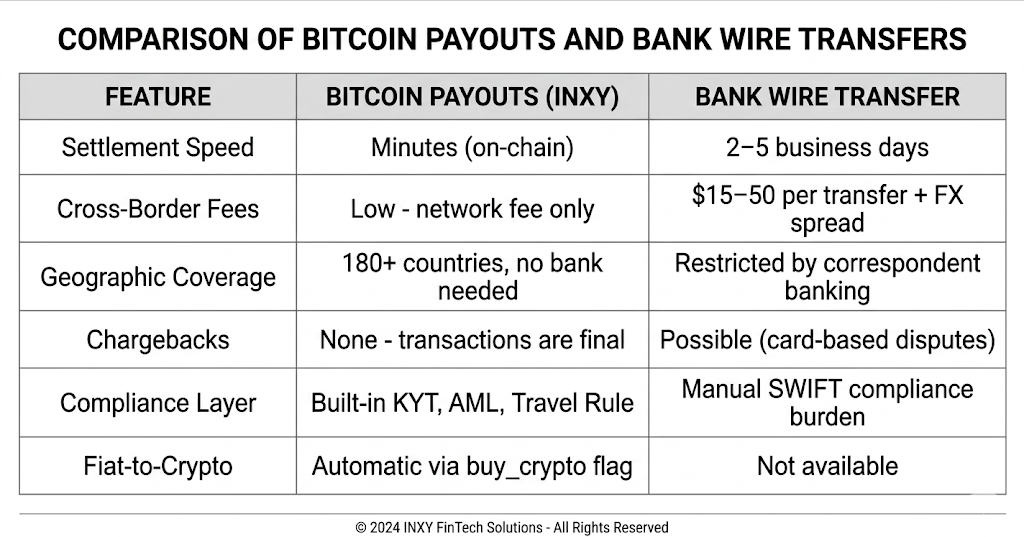
As remote work becomes the global standard, companies face a common challenge: paying international teams through traditional banking is slow, expensive, and geographically limited. Bitcoin payouts eliminate SWIFT delays, excessive conversion fees, and banking restrictions — letting businesses pay employees and contractors in Bitcoin within minutes, regardless of their location.
From affiliate networks and iGaming platforms to SaaS companies and freelancer marketplaces, paying in Bitcoin is no longer a niche practice. Paying employees in Bitcoin and contractors in BTC is no longer reserved for crypto-native startups — it is a competitive edge in global talent acquisition that reduces operational costs across the board. INXY Payments makes this straightforward: no need to buy Bitcoin in advance, no separate exchange accounts, no manual compliance work — everything runs through a single B2B platform built for exactly this use case.
How to Pay Employees in Bitcoin with INXY: 3 Simple Steps
Create an INXY Account & Complete KYB — Sign up as a business, submit your company documents, and pass KYB verification through the INXY dashboard. Your organisation is reviewed and activated within 1–3 business days — no crypto expertise required.
Add Recipients or Connect the Payouts API — Upload a CSV file with recipient BTC addresses via the INXY dashboard, or integrate the Payouts API directly into your platform for fully automated workflows. The API is built to handle payouts at scale — no hard limit on the number of recipients per cycle. Real-time webhook notifications keep your system updated on each payout status.
Send BTC Payouts — from Crypto or Fiat — Trigger single or mass BTC payouts from your balance. If you hold EUR or USD, INXY's buy_crypto flag auto-converts your fiat to Bitcoin at the moment of each payout — no pre-purchased BTC required, no exchange accounts to manage.
Benefits of Bitcoin Payouts for Business
Global Reach Without Banking Limits
Bitcoin payouts via INXY work for recipients in any country, with or without a bank account. No correspondent bank fees, no SWIFT delays, no rejected transfers due to local banking restrictions. Your payroll operates globally, on your schedule.
No Chargebacks
Crypto transactions are final and immutable. Once a BTC payout is broadcast to the network, it cannot be reversed or disputed — a critical advantage for high-volume affiliate and iGaming payouts where chargeback fraud is a constant risk.
Instant Settlement
BTC payouts initiated through INXY are broadcast on-chain within minutes. Compared to international wire transfers that take 2–5 business days, Bitcoin delivers settlement speed that matches the pace of modern business operations.
Pay from Fiat, Send in Bitcoin
If your treasury operates in EUR or USD, there is no need to pre-purchase Bitcoin on an exchange. INXY's buy_crypto feature handles the fiat-to-BTC conversion automatically at the moment each payout is triggered — the exchange rate is locked at execution time, and the full flow is recorded in your transaction history.
Built-In Compliance — KYT, AML, Travel Rule
Every BTC payout processed through INXY goes through KYT (Know Your Transaction) screening before broadcast. High-risk addresses are blocked automatically. For recipients in your Contact List, Travel Rule data exchange via Notabene is handled by the platform — no manual compliance burden on your team.
Who Uses Bitcoin Payouts?
Affiliate Networks & CPA Platforms
Affiliate networks need to pay hundreds or thousands of publishers worldwide, often weekly or bi-weekly. INXY supports batch processing of up to hundreds of recipients per API call, with full webhook notifications on payout status. Mass payouts that previously took 5 banking days now complete in minutes — and companies that pay employees and contractors in Bitcoin report significantly lower operational overhead.
iGaming & Online Gaming Platforms
Gaming and gambling platforms regularly pay out winnings and contractor fees in crypto. Bitcoin is the preferred payout currency for many players and partners due to its universal recognition and broad wallet support. INXY's compliance layer — KYT screening, AML review, Travel Rule — ensures platforms stay clean without building their own infrastructure.
Remote-First Companies & Tech Teams
Companies with globally distributed engineering, design, or operations teams use INXY to offer Bitcoin as an alternative compensation option. Contractors who prefer crypto over bank transfers get paid faster, while the company avoids currency conversion overhead and cross-border banking fees.
Freelancer Marketplaces & Gig Economy Platforms
For platforms managing large pools of independent contractors, mass Bitcoin payouts through INXY reduce the operational cost of international payroll significantly. One file upload or one API call pays thousands of contractors in a single batch — with per-recipient status tracking and exportable CSV reports.
Frequently Asked Questions
Is it legal to pay employees in Bitcoin?
In most jurisdictions, paying contractors in Bitcoin is fully legal. For full-time employees, regulations vary: many countries — including the US, UK, and EU member states — allow crypto salary supplements or contractor payments in crypto, but typically require that the minimum statutory wage be paid in local fiat currency. Consult local labour law before switching your primary payroll to Bitcoin.
Can you pay employees in Bitcoin in the US?
Yes. The Fair Labor Standards Act (FLSA) requires that the federal minimum wage be paid in US dollars, but additional compensation — including contractor payments and performance bonuses — can be made in Bitcoin. Many US-based companies and DAOs already pay freelancers and contractors in BTC without legal issues.
Which companies pay employees in Bitcoin?
A growing number of global businesses pay employees and contractors in Bitcoin, particularly in tech, gaming, and affiliate marketing industries. Remote-first companies, crypto-native startups, and platforms with large contractor networks were early adopters. With infrastructure like INXY, any B2B business can now add BTC payouts without building crypto capabilities in-house.
How does INXY's buy_crypto flag work for BTC payouts?
If your INXY balance is in EUR or USD, the buy_crypto: true flag triggers an automatic fiat-to-BTC exchange at the moment each payout is initiated. The exchange rate is locked at execution time, and the network fee is deducted from the payout amount. You do not need to hold Bitcoin in advance — INXY handles the conversion in the same transaction flow.
What happens if a BTC address is flagged as high-risk?
Before any payout is created, INXY screens the recipient's BTC address through KYT. If the address is flagged as high-risk, the payout is blocked automatically and you receive an error notification via webhook and dashboard. You can review the case and contact the INXY compliance team if needed.
What is the maximum number of Bitcoin payouts per batch?
INXY's infrastructure handles payout cycles of any size — from small partner networks to programs with hundreds of recipients — all processed in minutes, with full webhook notifications on each transaction.
Start Sending Bitcoin Payouts with INXY
Ready to pay your global team in Bitcoin? Join hundreds of businesses that use INXY Payments to run fast, compliant BTC payouts — from a single contractor to thousands of recipients. No crypto expertise required, no pre-purchased Bitcoin needed, no separate exchange accounts.
Get Started with INXY — Free Setup
Already have an account? Go to Send Crypto → Payouts in your INXY dashboard.