Most stablecoins track the US dollar. But if your revenue, costs, and recipients are in euros, paying in a dollar-pegged token means an FX round-trip on every transaction. EURC solves that: it's a euro-denominated stablecoin that lets euro-native businesses move money on blockchain rails without leaving the euro.
Here's what EURC is, how it works, and why it has become the default euro stablecoin for regulated business in 2026.
EURC in one sentence
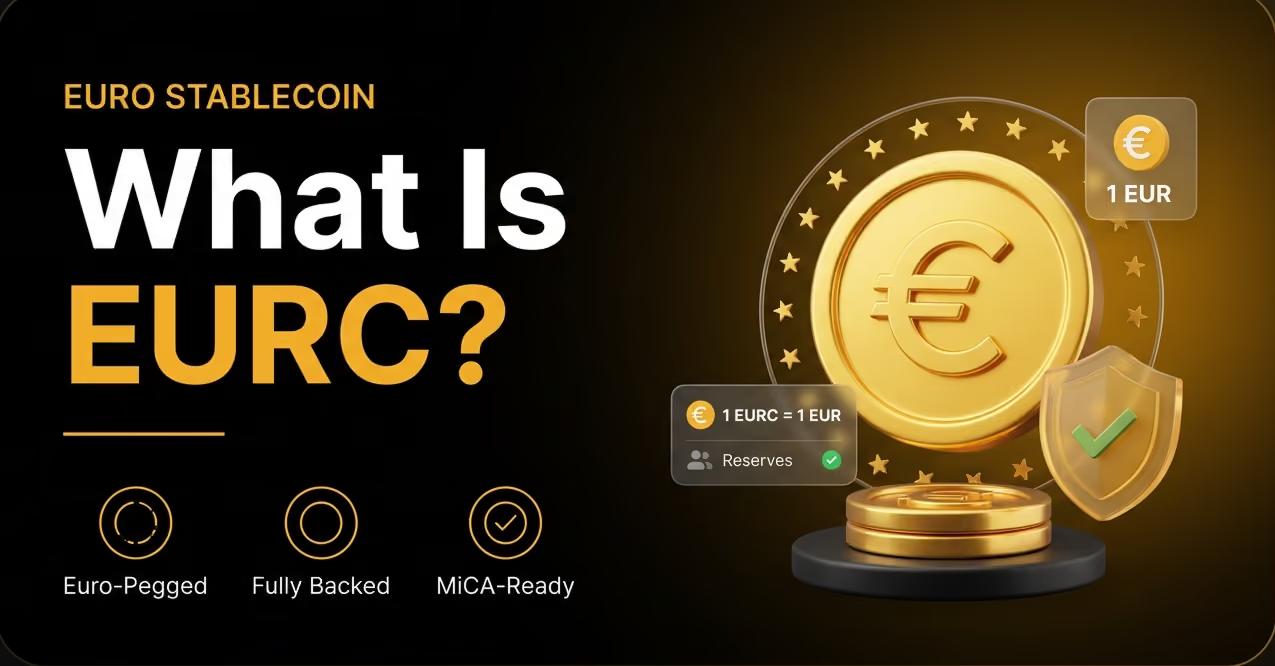
EURC (Euro Coin) is a stablecoin pegged 1:1 to the euro, issued by Circle — the same company behind USDC — and backed fully by euro-denominated reserves. One EURC is designed to always be redeemable for one euro.
Think of it as a digital euro you can send anywhere in minutes, 24/7, without a bank wire.
Who issues EURC, and why that matters
EURC is issued by Circle, a regulated financial technology company. That matters for one reason above all: regulation. Circle holds an EU Electronic Money Institution (EMI) license in France, and that single authorization passports EURC across all 27 EU member states under MiCA, the EU's crypto framework.
In practice, EURC is a MiCA-compliant e-money token. When MiCA's rules took full effect and non-compliant stablecoins were removed from EU-regulated exchanges, EURC was one of the assets that stayed — and it captured much of the resulting demand. By 2026 it had become the dominant euro stablecoin, holding roughly 41% of the euro-stablecoin market, up from about 17% a year earlier.
For a business, that means EURC isn't a fringe experiment — it's the euro stablecoin most likely to be accepted, supported, and compliant across Europe.
What backs EURC?
EURC is 100% backed by euro reserves held in cash and cash-equivalent instruments under Circle's full-reserve model. Circle publishes regular reserve reporting, the same transparency approach it applies to USDC. Each token in circulation is matched by euros held in reserve, which is what keeps the 1:1 peg dependable.
As of 2026, EURC's circulation sits in the range of roughly €400–460 million — smaller than dollar stablecoins, but by far the largest in the euro category.
Which blockchains support EURC?
EURC is a multi-chain asset. It runs natively on:
Ethereum (where the majority of euro-stablecoin supply sits)
Base
Solana
Stellar
Avalanche
World Chain
The network you use determines transfer speed and fees. For payouts, low-fee chains like Solana, Base, or Stellar keep costs to cents; Ethereum is the most liquid but the most expensive to transact on.
Why businesses use a euro stablecoin
If you already operate in euros, why hold a euro on a blockchain instead of in a bank? A few concrete reasons:
No FX round-trip. Paying euro-based recipients in a dollar stablecoin means converting EUR → USD → EUR, losing spread each way. EURC keeps euros as euros.
Speed. EURC settles in minutes, any time — including weekends and holidays, when SEPA and bank rails are closed.
Global reach. A recipient anywhere with a wallet can receive euros, without needing a European bank account.
Programmability. EURC can be sent via API for automated payouts, something traditional euro rails don't offer natively.
Regulatory comfort. As a MiCA-compliant token, EURC fits the compliance expectations of European banks, auditors, and partners.
EURC vs a bank euro balance
A euro in your bank and a euro in EURC are both euros — the difference is the rails.
EURC doesn't replace your bank — it complements it for fast, global, programmable euro movement.
Frequently asked questions
What is EURC? EURC (Euro Coin) is a euro-pegged stablecoin issued by Circle, backed 1:1 by euro reserves. It lets businesses hold and send euros on blockchain networks.
Is EURC the same as USDC? They share an issuer (Circle) and a full-reserve, MiCA-compliant model, but EURC is pegged to the euro while USDC is pegged to the US dollar. See our EURC vs USDC comparison.
Is EURC regulated? Yes. EURC is a MiCA-compliant e-money token. Circle's French EMI license passports it across all 27 EU member states.
What backs EURC? Euro-denominated reserves held 1:1 against tokens in circulation, under Circle's full-reserve model with regular reserve reporting.
Which networks support EURC? Ethereum, Base, Solana, Stellar, Avalanche, and World Chain. Choose a low-fee network for cost-efficient payouts.
Can businesses pay in EURC? Yes — EURC is widely used for euro-denominated payouts to contractors, suppliers, and partners, especially within the EU. Learn more in our guide to paying in EURC.
Move euros the modern way
If your business runs on euros, you can settle in euros on-chain — fast, global, and MiCA-compliant. INXY's EURC mass payouts let you fund and pay in euros without the FX round-trip or the crypto overhead. New to the asset? Compare it with the dollar option in EURC vs USDC.
This article is general information, not financial or legal advice.
Why Businesses Are Choosing Bitcoin for Payroll and Contractor Payments
As remote work becomes the global standard, companies face a common challenge: paying international teams through traditional banking is slow, expensive, and geographically limited. Bitcoin payouts eliminate SWIFT delays, excessive conversion fees, and banking restrictions — letting businesses pay employees and contractors in Bitcoin within minutes, regardless of their location.
From affiliate networks and iGaming platforms to SaaS companies and freelancer marketplaces, paying in Bitcoin is no longer a niche practice. Paying employees in Bitcoin and contractors in BTC is no longer reserved for crypto-native startups — it is a competitive edge in global talent acquisition that reduces operational costs across the board. INXY Payments makes this straightforward: no need to buy Bitcoin in advance, no separate exchange accounts, no manual compliance work — everything runs through a single B2B platform built for exactly this use case.
How to Pay Employees in Bitcoin with INXY: 3 Simple Steps
Create an INXY Account & Complete KYB — Sign up as a business, submit your company documents, and pass KYB verification through the INXY dashboard. Your organisation is reviewed and activated within 1–3 business days — no crypto expertise required.
Add Recipients or Connect the Payouts API — Upload a CSV file with recipient BTC addresses via the INXY dashboard, or integrate the Payouts API directly into your platform for fully automated workflows. The API is built to handle payouts at scale — no hard limit on the number of recipients per cycle. Real-time webhook notifications keep your system updated on each payout status.
Send BTC Payouts — from Crypto or Fiat — Trigger single or mass BTC payouts from your balance. If you hold EUR or USD, INXY's buy_crypto flag auto-converts your fiat to Bitcoin at the moment of each payout — no pre-purchased BTC required, no exchange accounts to manage.
Benefits of Bitcoin Payouts for Business
Global Reach Without Banking Limits
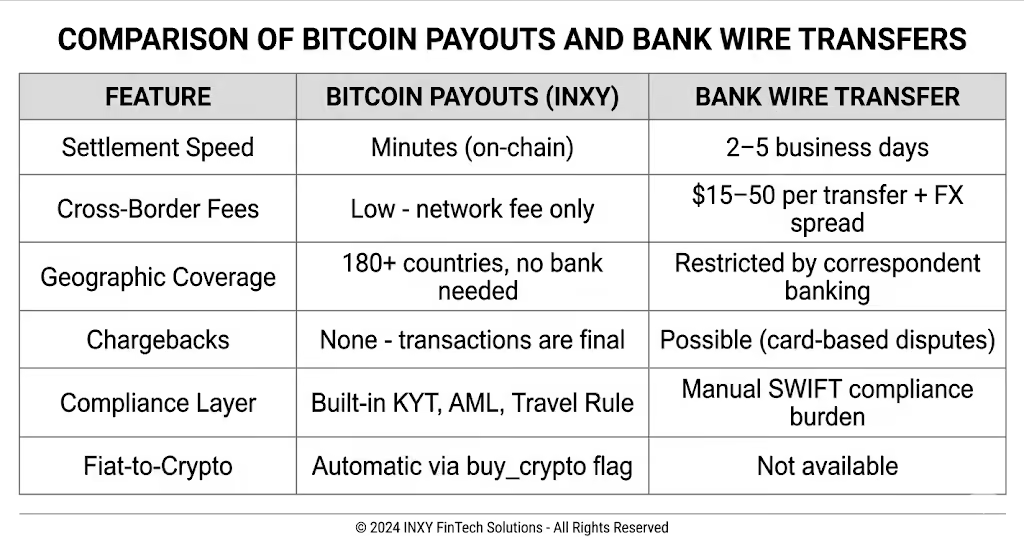
Bitcoin payouts via INXY work for recipients in any country, with or without a bank account. No correspondent bank fees, no SWIFT delays, no rejected transfers due to local banking restrictions. Your payroll operates globally, on your schedule.
No Chargebacks
Crypto transactions are final and immutable. Once a BTC payout is broadcast to the network, it cannot be reversed or disputed — a critical advantage for high-volume affiliate and iGaming payouts where chargeback fraud is a constant risk.
Instant Settlement
BTC payouts initiated through INXY are broadcast on-chain within minutes. Compared to international wire transfers that take 2–5 business days, Bitcoin delivers settlement speed that matches the pace of modern business operations.
Pay from Fiat, Send in Bitcoin
If your treasury operates in EUR or USD, there is no need to pre-purchase Bitcoin on an exchange. INXY's buy_crypto feature handles the fiat-to-BTC conversion automatically at the moment each payout is triggered — the exchange rate is locked at execution time, and the full flow is recorded in your transaction history.
Built-In Compliance — KYT, AML, Travel Rule
Every BTC payout processed through INXY goes through KYT (Know Your Transaction) screening before broadcast. High-risk addresses are blocked automatically. For recipients in your Contact List, Travel Rule data exchange via Notabene is handled by the platform — no manual compliance burden on your team.
Who Uses Bitcoin Payouts?
Affiliate Networks & CPA Platforms
Affiliate networks need to pay hundreds or thousands of publishers worldwide, often weekly or bi-weekly. INXY supports batch processing of up to hundreds of recipients per API call, with full webhook notifications on payout status. Mass payouts that previously took 5 banking days now complete in minutes — and companies that pay employees and contractors in Bitcoin report significantly lower operational overhead.
iGaming & Online Gaming Platforms
Gaming and gambling platforms regularly pay out winnings and contractor fees in crypto. Bitcoin is the preferred payout currency for many players and partners due to its universal recognition and broad wallet support. INXY's compliance layer — KYT screening, AML review, Travel Rule — ensures platforms stay clean without building their own infrastructure.
Remote-First Companies & Tech Teams
Companies with globally distributed engineering, design, or operations teams use INXY to offer Bitcoin as an alternative compensation option. Contractors who prefer crypto over bank transfers get paid faster, while the company avoids currency conversion overhead and cross-border banking fees.
Freelancer Marketplaces & Gig Economy Platforms
For platforms managing large pools of independent contractors, mass Bitcoin payouts through INXY reduce the operational cost of international payroll significantly. One file upload or one API call pays thousands of contractors in a single batch — with per-recipient status tracking and exportable CSV reports.
Frequently Asked Questions
Is it legal to pay employees in Bitcoin?
In most jurisdictions, paying contractors in Bitcoin is fully legal. For full-time employees, regulations vary: many countries — including the US, UK, and EU member states — allow crypto salary supplements or contractor payments in crypto, but typically require that the minimum statutory wage be paid in local fiat currency. Consult local labour law before switching your primary payroll to Bitcoin.
Can you pay employees in Bitcoin in the US?
Yes. The Fair Labor Standards Act (FLSA) requires that the federal minimum wage be paid in US dollars, but additional compensation — including contractor payments and performance bonuses — can be made in Bitcoin. Many US-based companies and DAOs already pay freelancers and contractors in BTC without legal issues.
Which companies pay employees in Bitcoin?
A growing number of global businesses pay employees and contractors in Bitcoin, particularly in tech, gaming, and affiliate marketing industries. Remote-first companies, crypto-native startups, and platforms with large contractor networks were early adopters. With infrastructure like INXY, any B2B business can now add BTC payouts without building crypto capabilities in-house.
How does INXY's buy_crypto flag work for BTC payouts?
If your INXY balance is in EUR or USD, the buy_crypto: true flag triggers an automatic fiat-to-BTC exchange at the moment each payout is initiated. The exchange rate is locked at execution time, and the network fee is deducted from the payout amount. You do not need to hold Bitcoin in advance — INXY handles the conversion in the same transaction flow.
What happens if a BTC address is flagged as high-risk?
Before any payout is created, INXY screens the recipient's BTC address through KYT. If the address is flagged as high-risk, the payout is blocked automatically and you receive an error notification via webhook and dashboard. You can review the case and contact the INXY compliance team if needed.
What is the maximum number of Bitcoin payouts per batch?
INXY's infrastructure handles payout cycles of any size — from small partner networks to programs with hundreds of recipients — all processed in minutes, with full webhook notifications on each transaction.
Start Sending Bitcoin Payouts with INXY
Ready to pay your global team in Bitcoin? Join hundreds of businesses that use INXY Payments to run fast, compliant BTC payouts — from a single contractor to thousands of recipients. No crypto expertise required, no pre-purchased Bitcoin needed, no separate exchange accounts.
Get Started with INXY — Free Setup
Already have an account? Go to Send Crypto → Payouts in your INXY dashboard.
The Travel Rule for Crypto Payouts: What B2B Senders Must Know in 2026
The Travel Rule requires sender and recipient identity data to accompany crypto transfers, and in 2026 it directly affects any business paying contractors, suppliers, or partners in crypto. This guide breaks down the regulatory picture by region — the EU's no-threshold TFR, the US $3,000 BSA rule plus new GENIUS Act stablecoin obligations, and FATF's $1,000 baseline — and the exact originator/beneficiary data each payout must carry, including the extra step for self-hosted wallets. It then shows how a regulated crypto gateway runs pre-send screening, KYT/AML checks, and the Travel Rule inside the payout flow, so B2B senders stay compliant without building their own compliance stack.
If your business sends crypto payouts — to contractors, suppliers, affiliates, or partners — the crypto Travel Rule now sits between you and every transfer. It is the single piece of kyc aml crypto payments regulation most likely to delay, freeze, or return a B2B payout in 2026, and most senders only learn about it after a payment is held. This guide explains what the Travel Rule is, how the 2026 rules differ by region, what data must accompany each payout, and how a regulated crypto gateway runs the checks so you don't have to build a compliance stack yourself.
What the crypto Travel Rule is (and why it now applies to your payouts)
The Travel Rule is an anti-money-laundering standard that requires identifying information about the sender (originator) and recipient (beneficiary) to "travel" alongside a transfer of value. It originated in traditional banking and now applies to crypto.
FATF Recommendation 16, extended to crypto
The rule comes from the Financial Action Task Force (FATF), whose Recommendation 16 was extended in 2019 to cover virtual assets. The principle is simple: when a regulated provider moves crypto on a customer's behalf, it must collect, transmit, and retain originator and beneficiary details so that law enforcement can trace funds. FATF recommendations are influential but not law in themselves — each jurisdiction decides how to implement them, which is why the picture is fragmented (more on that below).
Who counts as a VASP — and when you are the originator
The obligation falls on Virtual Asset Service Providers (VASPs): exchanges, custodial wallet providers, and crypto payment gateways. When your business initiates a payout through such a provider, the provider is the "originating institution" and carries the Travel Rule duty — but it can only meet that duty with your data. In practice this means the gateway must know who you are paying and why, and you must be able to supply recipient details on demand. The compliance burden is shared: the provider operates the machinery, but incomplete sender data is the most common reason a payout stalls.
The 2026 regulatory picture: crypto compliance and regulations by region
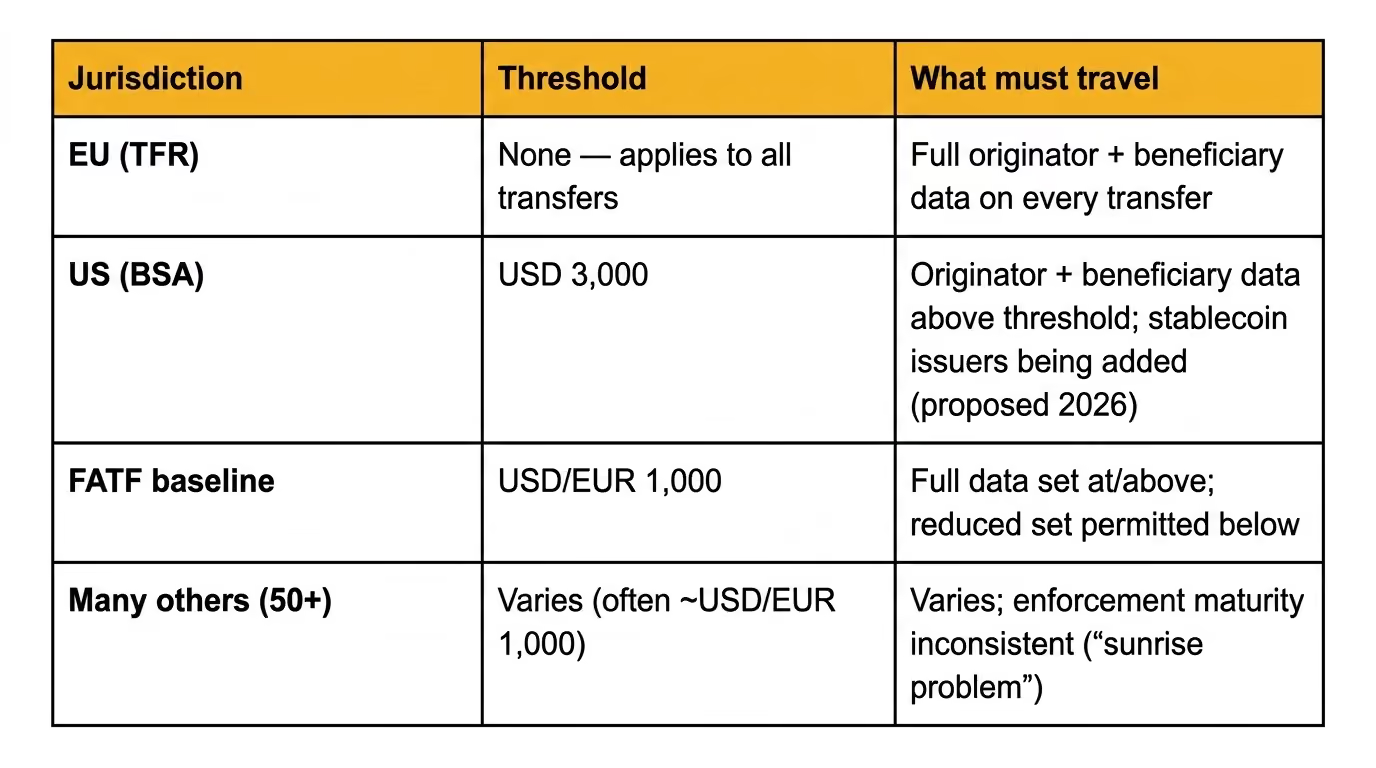
By 2026, over 50 jurisdictions have enacted Travel Rule legislation — roughly 73% of FATF-assessed jurisdictions, up from a far smaller base two years earlier. Enforcement maturity, thresholds, and required data still vary widely, so a payout that is routine in one corridor can be blocked in another.
EU — Transfer of Funds Regulation (TFR), no de-minimis threshold
The EU's recast Transfer of Funds Regulation (TFR) took effect on 30 December 2024. It is the strictest major regime: full originator and beneficiary data must accompany every crypto-asset transfer handled by a regulated provider, with no minimum threshold. A €5 payout and a €500,000 payout carry the same data obligation. The TFR operates alongside MiCA, the EU's broader crypto-asset framework, which governs licensing of providers.
US — Bank Secrecy Act Travel Rule, USD 3,000 threshold
In the United States the Travel Rule lives under the Bank Secrecy Act (BSA), administered by FinCEN, with a threshold of USD 3,000 — notably higher than FATF's recommendation. A 2026 development matters for stablecoin senders: following the GENIUS Act (signed July 2025), the U.S. Treasury proposed a rule on 8 April 2026 treating permitted stablecoin issuers as BSA financial institutions, subject to AML programs, recordkeeping, and the Travel Rule, with compliance expected around April 2027. The direction of travel is clear — stablecoin rails are being pulled fully into the same compliance perimeter as the banking system.
FATF global threshold and the "sunrise problem"
FATF recommends a standard threshold of USD/EUR 1,000, below which a reduced data set may apply. Because jurisdictions adopt the rule at different speeds, the industry faces the "sunrise problem": a compliant provider in a regulated market may need to send Travel Rule data to a counterparty in a market that has not yet implemented the rule and cannot receive it. For B2B senders this means a payout's success can depend on the recipient platform's jurisdiction, not just your own.
What data must "travel" with a B2B crypto payout
The required data set is consistent across regimes, even where thresholds differ.
Required originator (sender) fields
Name of the originator (your business or the paying entity).
Wallet address used for the transfer (or a transaction reference).
Physical/registered address, and in some regimes an official identifier or account number.
Required beneficiary (recipient) fields
Name of the recipient.
Wallet address receiving the funds.
In addition, the transaction amount, execution date, and a unique transaction identifier are recorded with every transfer. For your operations, the practical takeaway is that recipient name + wallet must be accurate and verifiable before you send — a mismatch is a hold.
Self-hosted (unhosted) wallet payouts — the extra step
Paying out to a self-hosted (non-custodial) wallet — common when paying contractors or partners who hold their own keys — changes the mechanics. There is no counterparty VASP to receive the Travel Rule message, so the data isn't transmitted onward; instead, your provider must still collect originator and beneficiary information from you, and above the relevant threshold may require verification of wallet ownership based on a risk assessment. Expect to attest that the recipient controls the destination address for larger payouts.
How a regulated crypto gateway runs the Travel Rule on outbound payouts
This is where a regulated crypto gateway earns its keep. Rather than connecting to Travel Rule messaging protocols, screening providers, and sanctions lists yourself, the gateway runs the controls inside the payout flow. Using INXY's outbound model as a concrete example, an outgoing payout passes through several gates before any transfer is created.
Pre-send checks — address risk and blacklist screening
A payout starts as a withdrawal request, not an immediate send. A pre-send validation stage runs first and can stop the operation with an error so that no transaction is ever formed. As part of this, the recipient address is looked up against historical risk data: a previously unseen address is treated cautiously, while a known address carries its last risk result. This means a problematic payout is caught at draft stage, not after funds have left.
KYT/AML screening of the recipient
Next is the outbound KYT (Know Your Transaction) sequence. The recipient address is checked against a blacklist; a match fails the request outright with no transaction created. If it clears, a risk provider screens the address and returns an outcome:
Low or Medium → the payout draft passes and proceeds.
High → the request fails, no transaction is created, and an error is returned.
This is the kyc aml crypto payments layer working in real time on the money leaving your account.
The Travel Rule message exchange
Only after screening passes does the Travel Rule step run, packaging and exchanging the required originator/beneficiary information with the counterparty provider where one exists. The payout then proceeds to settlement. The sequence matters: screen first, transmit data, then send.
Approved contacts and recipient allow-lists
Gateways typically maintain a contact list of approved recipients. A recipient flagged as declined blocks the payout regardless of other checks — a useful control for finance teams that want a vetted, reusable set of payees for recurring or mass payouts.
KYB is the gate to the platform; KYT is the gate to each transaction; the Travel Rule is the data that rides along with it. A gateway that handles all three is what "secure crypto payments" actually means in operational terms.
Compliance risks of getting payouts wrong
For a B2B sender, Travel Rule failures are not abstract — they hit cash flow and counterparties directly:
Held or returned transfers. Missing or mismatched recipient data is the most common cause of a stalled payout. Funds can sit in review or be returned, delaying contractor and supplier payments.
Counterparty refusal. If the receiving platform can't accept Travel Rule data (the sunrise problem) or flags your transfer, it may bounce the payment.
Regulatory exposure. Operating outbound flows without proper screening and recordkeeping exposes the business to AML penalties — increasingly so as stablecoin issuers are folded into BSA-style obligations.
Operational drag. Building and maintaining screening, sanctions, and Travel Rule messaging in-house is expensive and never "done," because rules and thresholds keep shifting.
How to automate crypto payouts without owning the compliance stack
The practical answer for most B2B senders is to run payouts through a regulated crypto gateway that treats the Travel Rule, KYT, and sanctions screening as part of the payout itself — not as something you bolt on.
With INXY, every outbound payout passes through pre-send validation, blacklist and KYT risk screening, and the Travel Rule step before settlement, and recurring payees can be managed through an approved contact list. Because the same flow is exposed via API and webhooks, you can run mass payouts — paying hundreds of contractors or partners at once — with compliance checks applied per recipient automatically, and receive status events back into your own systems. That is what "how to automate crypto payouts" looks like when compliance is built in rather than improvised.
If compliance posture is your priority, start with INXY's security & compliance capabilities; if payout mechanics are the focus, see crypto payouts and the cross-border and payroll options that build on the same rails.
FAQ
Does the Travel Rule apply to stablecoin payouts? Yes. Stablecoin transfers handled by a regulated provider are subject to the Travel Rule like any other virtual asset. In the EU, full data is required regardless of amount; in the US, stablecoin issuers are being brought explicitly into BSA Travel Rule obligations under a rule proposed in April 2026.
What is the Travel Rule threshold in 2026? It depends on the jurisdiction. FATF recommends USD/EUR 1,000; the US applies USD 3,000 under the BSA; the EU applies no threshold — every transfer carries full data.
Do I need to collect data for self-hosted (unhosted) wallet payouts? Yes. Even though there's no counterparty provider to receive the message, your gateway must still collect originator and beneficiary information, and above the relevant threshold may require proof that the recipient controls the destination wallet.
Is the Travel Rule the same as KYC? No. KYC/KYB verifies identity at onboarding. The Travel Rule governs the transmission of identity data alongside each transfer. They work together but are distinct obligations.
Who is responsible — the sender or the recipient platform? Both sides carry obligations. The originating provider must collect and transmit sender/recipient data; the beneficiary provider must receive and retain it. As the business initiating the payout, you're responsible for supplying accurate recipient information to your provider.
How to Send USDT to Multiple Wallets: A Step-by-Step Bulk Payout Guide
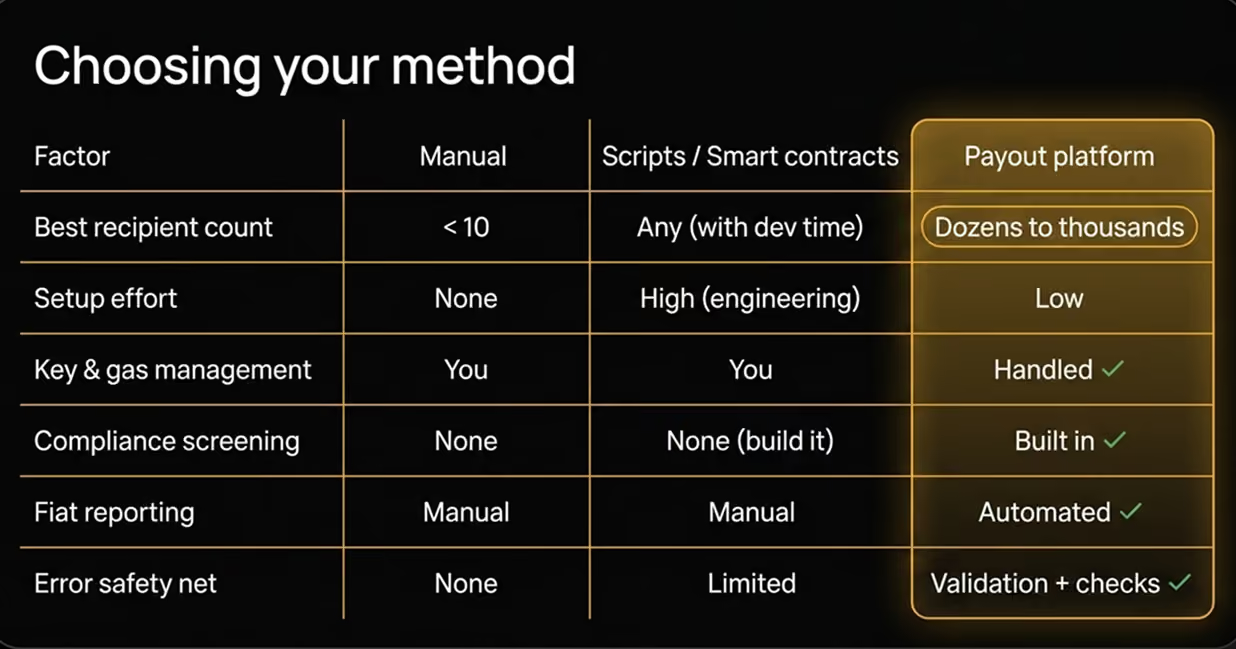
Manual works for a handful of payees; scripts work if you want to run infrastructure. If you'd rather send USDT to hundreds or thousands of recipients from a fiat balance — with screening and clean reporting built in — that's exactly what INXY's mass USDT payouts are built for.
Paying twenty affiliates, two hundred contractors, or two thousand players one transaction at a time does not scale. If you need to send USDT to multiple wallets, the method you choose determines your cost, your error rate, and how much of your finance team's week disappears into copy-pasting addresses.
This guide covers the three practical ways to run a bulk USDT transfer in 2026 — manual, scripted, and platform-based — with the trade-offs of each, the mistakes that cost real money, and how to keep clean records for accounting.
What "mass USDT payout" actually means
A mass USDT payout is a single, structured operation that distributes Tether to many recipients at once. Instead of initiating each transfer by hand, you prepare a list of addresses and amounts and process them as a batch.
Three things make this harder than it looks:
Network choice. USDT exists on Tron (TRC-20), Ethereum (ERC-20), BNB Chain (BEP-20), Solana, TON, Polygon and others. A recipient's address is network-specific — send TRC-20 USDT to an ERC-20 address and the funds are typically lost.
Fees at volume. A fee that looks trivial for one transfer becomes a line item when multiplied across thousands of recipients.
Reconciliation. Finance needs a fiat value, a timestamp, and a transaction hash for every payout — not just a wall of blockchain data.
Keep these three in mind; every method below is really a different answer to them.
Method 1: Manual transfers from a wallet or exchange
The simplest approach is to send USDT one recipient at a time from a self-custody wallet (MetaMask, Trust Wallet, Tronlink) or an exchange account.
When it works: fewer than ~10 recipients, infrequent payouts, no automation budget.
Steps:
Confirm each recipient's network and address in writing. Never assume the network.
Fund your wallet with enough USDT and the native gas token (TRX for TRC-20, ETH for ERC-20, and so on).
Send each transfer, double-checking the first and last four characters of every address.
Save each transaction hash against the recipient's name for your records.
The catch: manual sending does not scale and has no safety net. A single mistyped address is irreversible. There is no batch confirmation, no built-in fiat reporting, and no sanctions screening. Beyond a handful of recipients, error risk climbs fast.
Method 2: Scripts and smart-contract batching
Technical teams can automate payouts with the blockchain's own tooling — a script that loops through a recipient list, or a "multisend" / "disperse" smart contract that pushes many transfers in one on-chain transaction.
When it works: you have engineering resources, a stable set of networks, and you want control over the flow.
What you gain:
Batching efficiency. Multisend contracts bundle many recipients into a single transaction, which can reduce total gas versus sending individually on some networks.
Full automation. A script can pull addresses from your database and fire payouts on a schedule.
What you take on:
Key management. Your script needs access to a funded hot wallet holding private keys — an operational and security liability.
Gas handling. You must monitor and top up the native token on every network you use.
No compliance layer. Scripts don't screen recipients against sanctions lists or flag high-risk addresses. That's on you.
Accounting glue. You still have to convert on-chain data into fiat-denominated records your auditors will accept.
Scripting trades human error for engineering overhead. It's powerful, but you are now running payment infrastructure as a side project.
Method 3: A payout platform (CSV or API)
A dedicated payout platform abstracts the wallet, keys, gas, and networks away. You upload a CSV of recipients or call an API, and the platform handles conversion, routing, screening, and delivery.
When it works: recurring payouts, dozens to thousands of recipients, finance teams that need clean fiat reporting, and businesses that don't want to become a crypto operation.
How a typical batch runs:
Fund in fiat or stablecoin. Top up a balance — with a provider like INXY you can fund in EUR or USD via SEPA or SWIFT, so you never have to source crypto yourself.
Upload or connect. Submit a CSV (recipient, amount, network) or send the batch through the API.
Automated checks. The platform runs KYT and sanctions screening, auto-converts, and routes each payout to the right network.
Recipients get paid. Delivery happens in minutes on supported low-fee networks.
Report in fiat. You get batch-level exports with fiat values, fees, payout IDs, and transaction hashes — ready for reconciliation.
The trade-off is that you rely on a provider, but you remove key management, gas operations, compliance gaps, and accounting cleanup in one move.
Five mistakes that cost real money
Wrong network. The most common irreversible loss. Always match the recipient's network to the address.
Forgetting gas. A wallet full of USDT can't move without the native token for fees.
No test transfer. For a new large recipient, send a small amount first and confirm receipt.
Skipping screening. Paying a sanctioned or high-risk address is a legal and banking risk, not just a crypto one.
Weak records. If you can't tie every hash to a fiat value and a recipient, month-end close becomes painful.
Frequently asked questions
Can I send USDT to many wallets in one transaction? On some networks, yes — a "multisend" smart contract bundles multiple recipients into one on-chain transaction. Otherwise, batching is handled off-chain by a platform that submits the transfers for you.
What's the cheapest way to send USDT in bulk? Low-fee networks such as Tron (TRC-20), Solana, and TON dramatically reduce per-transfer cost versus Ethereum. See our full USDT network fees comparison.
Do I need to hold crypto to run USDT payouts? Not with a fiat-native platform. You can fund in EUR or USD, keep your accounting in fiat, and let the provider handle conversion and delivery.
Is bulk USDT sending safe? The transfer itself is irreversible, so accuracy matters. Reputable platforms add address validation, KYT, and sanctions screening to reduce risk — protections that manual and script-based methods lack.
Scale it without the overhead
Manual works for a handful of payees; scripts work if you want to run infrastructure. If you'd rather send USDT to hundreds or thousands of recipients from a fiat balance — with screening and clean reporting built in — that's exactly what INXY's mass USDT payouts are built for.