The legacy financial system imposes a structural tax on growth. For decades, merchants have absorbed correspondent banking fees, 3% interchange costs, and chargeback losses that erode margin on every transaction. In a global economy, waiting T+3 or T+5 for settlement is not an inconvenience — it is a liquidity problem.
To accept crypto once meant exposure to price volatility. That is no longer the case. Stablecoins — pegged to the US Dollar or Euro — deliver the settlement efficiency of blockchain without the speculation. For C-level executives, the question is no longer whether to integrate digital assets, but how quickly legacy bottlenecks can be replaced with purpose-built infrastructure.
1. Settlement velocity: From days to seconds
Traditional cross-border settlements move through a chain of intermediate banks, accumulating fees and losing transparency at every hop. SWIFT provides no real-time visibility into where funds are or when they will arrive.
Stablecoins operate on a 24/7/365 ledger with near-instant finality. Settling on Ethereum, Polygon, or TRON, merchants are no longer bound by banking hours or cut-off windows. Capital lands, clears, and is available for redeployment immediately — not in a pending queue.
inxy.io integrates directly into this settlement layer, giving merchants the operational continuity that traditional finance structurally cannot offer.
2. Eliminating the chargeback tax
Chargeback fraud costs merchants billions annually. Credit card networks are centralised by design, which means any transaction can be reversed — often at the merchant's expense, with little recourse.
Blockchain transactions are push-based and immutable. When a business chooses to accept crypto in the form of stablecoins, payment finality is guaranteed by the protocol, not by a bank's dispute resolution team.
No chargebacks: Once confirmed on-chain, a transaction cannot be reversed by a third party.
Reduced fraud overhead: No need for aggressive fraud filters that block legitimate customers.
Revenue sovereignty: You control your income stream without intermediary intervention.
3. Technical infrastructure: Beyond the hype
A payment gateway needs to be a piece of production-grade fintech infrastructure, not just a wallet interface. High-volume merchants require an API that abstracts blockchain complexity without sacrificing control.
What inxy.io provides:
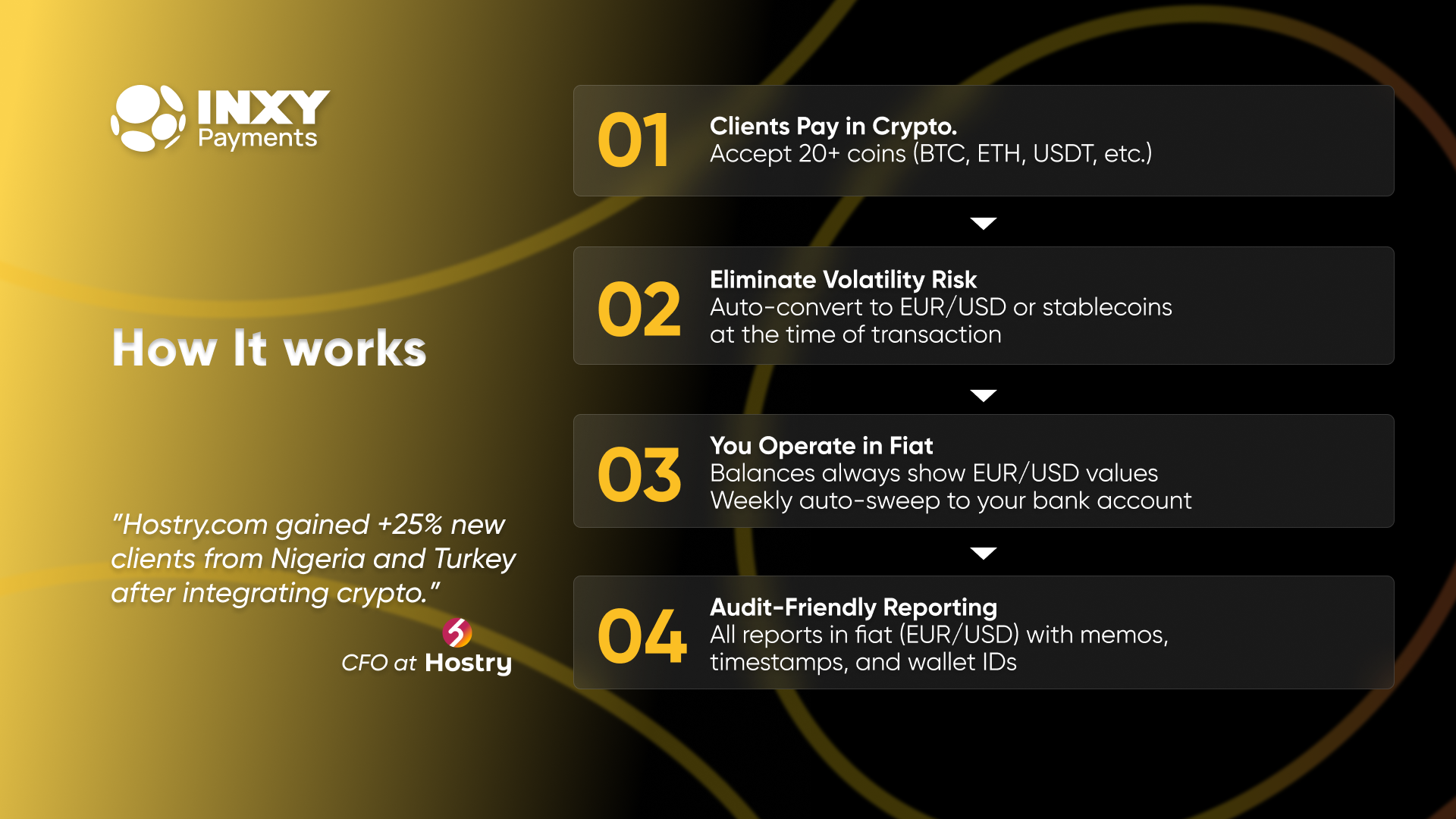
No crypto management overhead: Merchants do not handle tokens or gas fees. That layer is abstracted entirely.
Volatility protection: Pay-ins convert to stablecoins or fiat instantly, locking in value at the moment of transaction.
Multi-chain support: USDT, USDC, DAI, EURC, TON, BTC, ETH, LTC, TRX, BNB, DOGE across ERC-20, TRC-20, Polygon, and BSC — customers transact on the network that works best for them.
Real-time webhooks: Instant payment status notifications to your backend, enabling automated fulfilment or shipping triggers without polling.
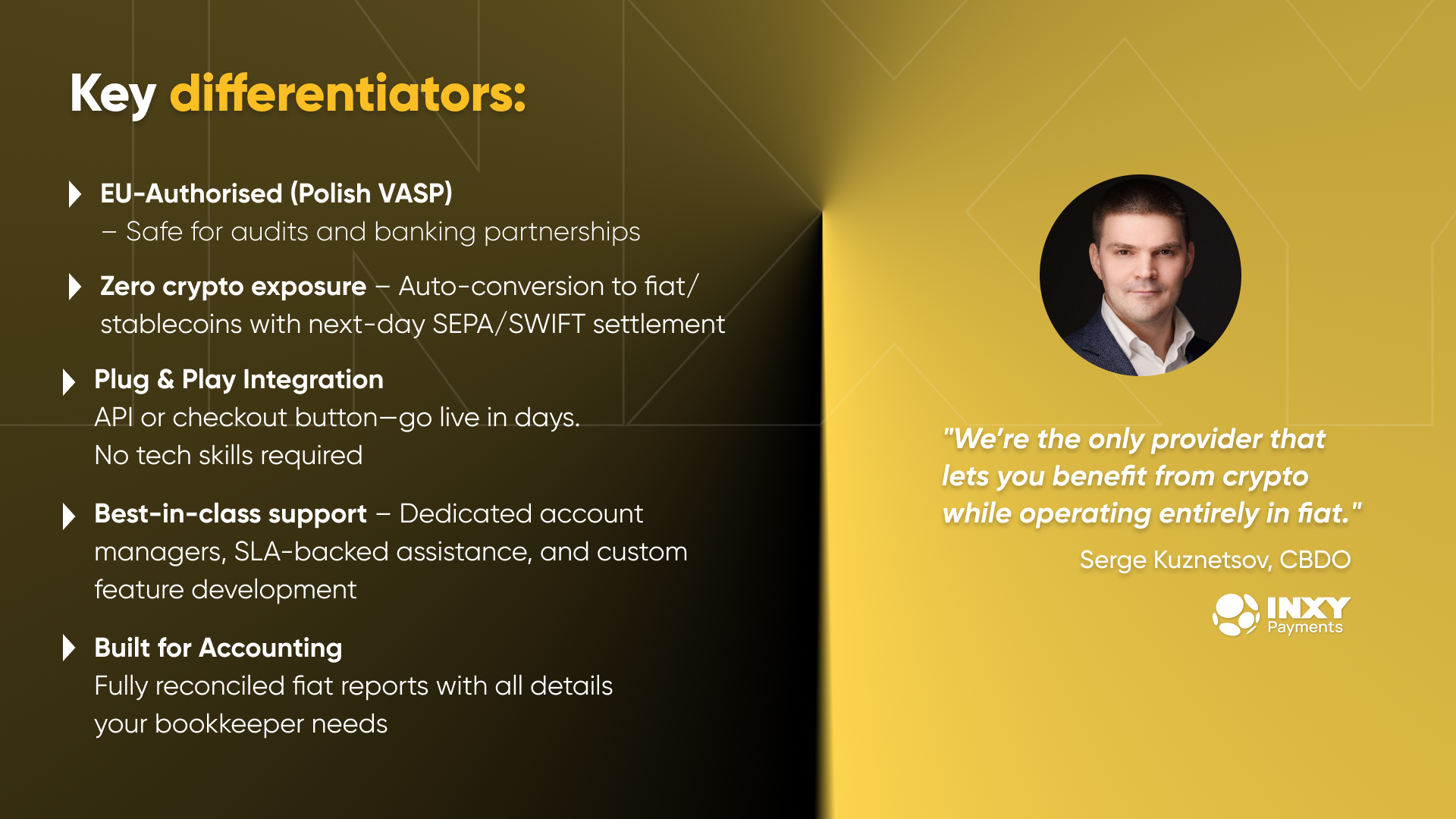
Compliance stack: EU VASP (Poland), Canadian MSB, MiCA-ready, AML/KYT/KYC, sanctions screening via Elliptic and Sumsub, Big-4-friendly fiat reporting.
4. Drastic reduction in operational costs
Managing global payments typically means maintaining multiple local currency accounts and navigating FX spreads on every cross-border transfer. Stablecoins provide a single settlement layer that works across jurisdictions without currency conversion overhead.
Consolidating payment rails through inxy.io can reduce payment processing Opex by up to 80%. Instead of paying a chain of intermediaries for the movement of value, you pay for efficient infrastructure. That margin stays in the business.
FAQ: Navigating the stablecoin shift
Is it difficult to integrate a stablecoin gateway into an existing platform?
No. inxy.io integrates via a REST API or pre-built plugins for major e-commerce engines. Documentation and technical support are included, and most teams go live faster than a standard merchant bank account setup.
How do we handle gas fee volatility?
inxy.io routes transactions through high-throughput networks to keep fees minimal. Customers can select the most cost-effective network for their transaction — the infrastructure handles the routing logic.
How does accepting stablecoins affect our accounting?
USDT and USDC are pegged 1:1 to the dollar, which makes them materially simpler to account for than traditional cryptocurrencies. inxy.io provides detailed reporting and CSV exports compatible with standard accounting software and ERP systems.
What about regulatory compliance?
inxy.io is built with compliance as a core component, not an afterthought — EU VASP registration, MiCA readiness, AML/KYT screening, and Big-4-auditable reporting. Your business stays within the regulatory framework while operating at full velocity.
Scalability Without Compromise
The merchant of 2026 cannot run on 1970s banking rails. The competitive advantage belongs to businesses that eliminate payment friction and capture the full value of their transactions across borders.
inxy.io is the infrastructure layer for that transition — robust APIs, multi-chain settlement, and a compliance stack built for global scale.
Partner with INXY — secure your payment infrastructure and lead the market.
An INXY expert read on Finery Markets' "Stablecoin 2035: Back to the Future" report (H1 2026)
Finery Markets just published its "Stablecoin 2035" report, and the headline number is hard to ignore: stablecoins reached 81% of all institutional OTC trades in H1 2026, up from 26% in 2023. The debate about whether stablecoins have product-market fit is over. The interesting questions now are operational — and they land squarely on the businesses that move money for a living.
Here is how our team reads the data, and what it changes for anyone building on stablecoin rails.
The numbers that matter
OTC is the only growing segment. In H1 2026, OTC trading volumes grew +76% YoY, while the top-20 DEXs fell -38% and the top-20 CEXs -13%. Institutional flow is consolidating into OTC, and it is settling in stablecoins — stablecoin OTC volume nearly doubled (+94% YoY).
The dollar owns the rail. USD-pegged tokens accounted for 99.87% of OTC stablecoin volume. EUR stablecoins grew 32x year over year, but off a base so small it changes nothing structurally — yet.
The market is deep and diversifying. Total supply is now north of $300B (~$319B). Tether sits around $190B and USDC around $76B, but their combined share slipped from ~89% to ~83% as issuers multiplied from 30 in 2020 to 215+ in 2025.
Real assets are following. Tokenized U.S. Treasuries crossed $15B (+150% YoY); tokenized equities are near $1.5B (+400%). Roughly two-thirds of stablecoin supply is held in emerging markets — savings demand, not speculation.
Three signals for payment businesses
1. Payments and treasury — not trading — are the real entry point. The report's contributors converge on one idea: stablecoins become "ordinary" inside a company through the treasury and payments desk, not the trading floor. Cross-border corridors that took 2–5 business days now settle in minutes, with all-in costs compressing from 3–5% (correspondent banking) toward ~1%. For a payments provider, that is the pitch: released working capital and removed friction on flows that recur every single day.
2. The winning infrastructure is invisible. Multiple authors describe the same 2035 endpoint — the word "stablecoin" disappears from the enterprise vocabulary because the rails sit beneath familiar fintech interfaces. Users initiate value in stablecoins; merchants and counterparties receive local fiat without ever touching a wallet, chain, or bridge. The value isn't the token. It's the compliance-first connective layer that hides complexity while preserving speed and 24/7 availability.
3. "Regulated" is the moat. Across every contribution, the common thread is regulation. By 2035, regulated coins — dollar and local alike — are expected to hold the dominant share of supply and activity. Licensing, compliance translation across jurisdictions (MiCA, VARA, Singapore's PSA), and a single clean interface across a fragmented patchwork of currency regimes become the real competitive edge — not raw settlement speed.
The INXY takeaway
The report describes a world where money movement runs on stablecoin rails without the end user ever needing to know it. That is exactly the layer payment infrastructure providers should be building toward: regulated on/off-ramps, stablecoin-to-fiat settlement in the currencies clients actually need, and an interface that treats "any currency, any chain" as a non-issue.
The strategic mistake would be to read this as a race to launch yet another stablecoin. The report is explicit that by 2035, "the truly savvy stablecoin strategy may be not launching one at all." The durable advantage is not issuance — issuance is easy. It is liquidity, compliance, and distribution wired into the systems businesses already use.
For merchants, PSPs, and treasuries evaluating stablecoin payments today, the question the report leaves us with is the right one to steal: not how do we add stablecoins to our stack — but what does our business look like when settlement is instant, always-on, and fiat never needs to leave the chain in the first place?
This commentary is informational and not investment advice.
The world of payments is changing quickly, and crypto is leading the charge. As more people understand digital currencies, companies are eager to accept crypto payments. This shift is not just for tech giants; even small businesses are jumping on board. They see the benefits, like lower fees and faster transactions.
Consider a coffee shop that starts to accept crypto. They can attract tech-savvy customers who prefer using digital wallets over traditional money. There's also the appeal of stablecoins, which offer the stability of traditional currencies with the speed of crypto. These coins are less volatile, making them a safer choice for businesses.
In 2025 and 2026, more companies will likely join this trend. The rise of crypto payments is creating a new business landscape, where flexibility and innovation are key. As we move forward, this trend will reshape how we think about money and transactions.
Case Study 1: Tech Giant X
In 2025, Tech Giant X made a bold move by choosing to accept crypto payments. This decision came after noticing a rising trend in digital currencies. The company saw a chance to reach a broader audience, especially tech-savvy individuals keen on using cryptocurrencies.
At first, they focused on using Bitcoin and Ethereum, which were popular at the time. To manage the volatility of these currencies, they decided to use a stablecoin backed by real assets. This step ensured they kept financial stability while still embracing innovation.
The shift required some changes in their payment system. They partnered with a leading crypto payment processor to handle transactions smoothly. This partnership allowed them to offer a seamless shopping experience to users paying with crypto.
Tech Giant X's strategy paid off. They noticed an increase in sales among younger customers. The move also positioned them as a leader in the industry, inspiring other companies to explore cryptocurrencies.
Case Study 2: Retail Chain Y
Retail Chain Y, a well-known department store, made headlines in 2026 by deciding to accept crypto payments. This decision came after noticing a shift in customer preferences. More shoppers wanted to use digital currencies like Bitcoin and stablecoin. The management saw this as a chance to attract tech-savvy customers.
To make this happen, Retail Chain Y partnered with a blockchain payment provider. This allowed them to integrate crypto transactions easily. They set up user-friendly terminals at checkout points. Customers could now scan a QR code on their phones to pay with crypto.
The process was smooth and fast, making it popular among customers. This move not only boosted sales but also positioned the chain as a modern and innovative company. By accepting crypto, Retail Chain Y tapped into a growing market and won the loyalty of new customers.
Case Study 3: Food Delivery Service Z
In 2025, Food Delivery Service Z decided to accept crypto payments. This change was driven by the need to reach tech-savvy customers who value convenience and digital innovation. By accepting crypto, the company tapped into a growing customer segment that prefers using cryptocurrencies for everyday transactions.
To make the transition smooth, Service Z partnered with a crypto payment processor. This ensured transactions were quick and secure. Customers could pay using popular cryptocurrencies like Bitcoin and Ethereum, as well as stablecoins, which offer price stability.
Service Z’s decision to accept crypto also helped them stand out in the crowded food delivery market. They marketed this feature prominently, attracting more users who appreciated the flexibility and novelty of paying with digital currencies. This move not only boosted their customer base but also increased their brand visibility.
Case Study 4: Hosting Provider С
Instead of redesigning their whole billing system, the company added a stablecoin option through an external payment API. The goal wasn’t to replace their existing methods. They only wanted to give customers another way to pay without changing the rest of their workflow.
The technical setup was straightforward. Their team added a new payment route, tested a few transactions, and then made it available to users. Customers could now pay invoices in USDT or USDC. The hosting provider kept accounting in euros, which made reporting easier for their finance team.
A few patterns appeared after the first months:
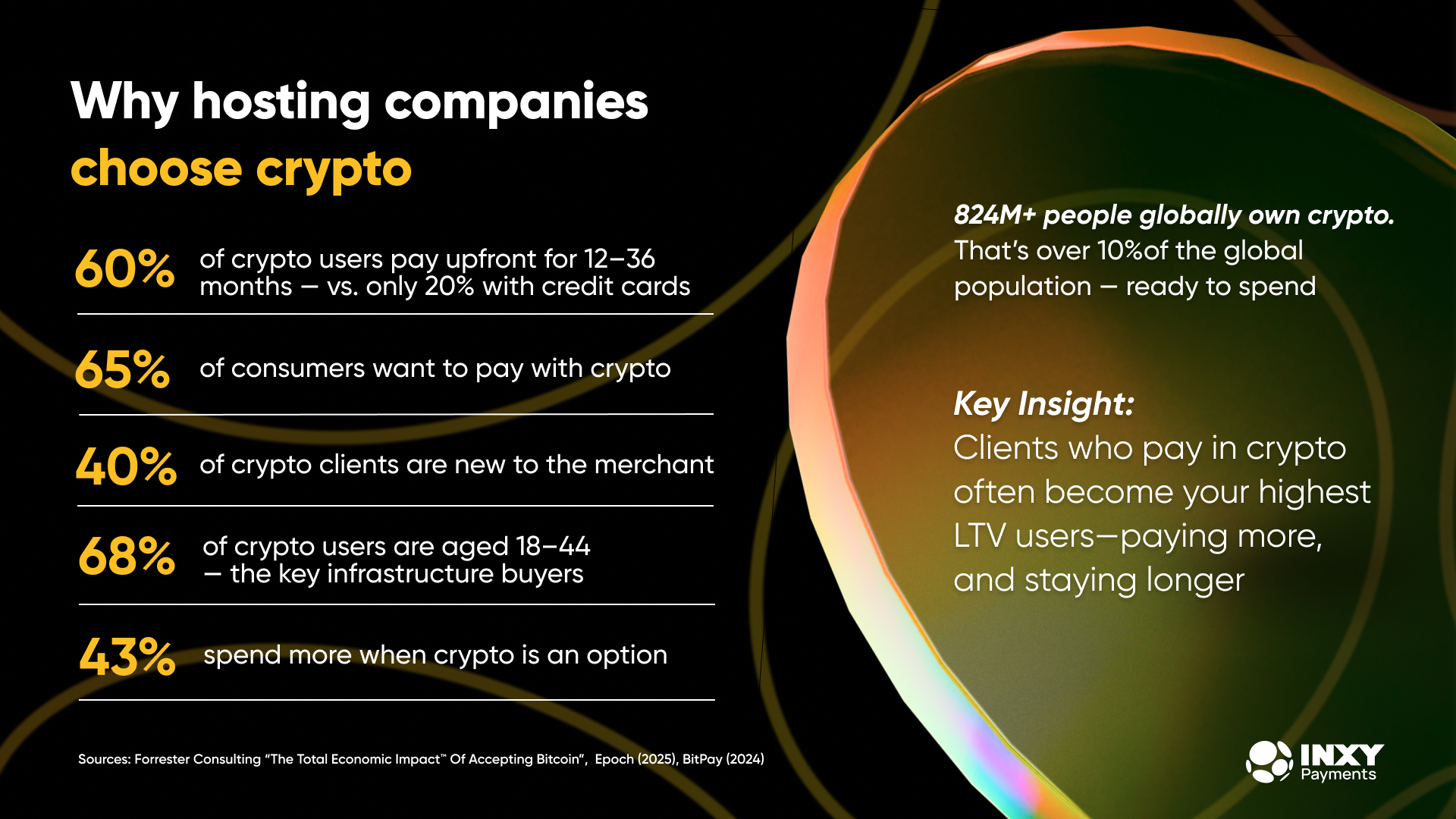
A noticeable share of crypto users paid for 12 to 24 months upfront, far more than the typical card-paying customers.
Several new customers arrived who had never used the provider before, matching the trend that around 40% of crypto-paying users tend to be new to the merchant.
Some customers increased their spending slightly when crypto were available, which aligned with general industry data showing that crypto users often spend more when given the option.
The company also saw traffic from regions where card payments didn't always work well, and stablecoins offered a more reliable way to complete orders.
The change also highlighted an internal benefit: staff no longer had to manually track crypto receipts or confirm transaction hashes. The API returned all details in one place, which reduced back-and-forth during billing checks.
Hosting Provider Z did not run marketing campaigns around the new feature. They simply added it to their billing page. Still, it became a regular payment method for a specific segment of their clients — mostly developers who were already familiar with digital assets.
By the end of the year, the company concluded that stablecoin support didn’t transform their business, but it made payments smoother for a meaningful group of users. It also helped them understand how digital dollars fit into hosting, which gave them clearer ideas for future improvements
Case Study 5: E-commerce Platform B
In 2025, E-commerce Platform B made a bold move. They decided to accept crypto payments. This decision was not only innovative but also strategic. The world was moving towards digital currencies, and they wanted to be at the forefront.
The first step was to choose which cryptocurrencies to accept. They went with popular ones like Bitcoin and Ethereum. But they didn't stop there. They added stablecoins too. Stablecoins are digital currencies with a stable value, often linked to a currency like the US dollar. This way, they could offer their customers more options.
Next, they had to make sure their system could handle crypto payments. This wasn't simple. They needed to integrate a secure payment gateway. They partnered with a company specializing in crypto transactions. This ensured that all payments were safe and fast.
Training their staff was another important step. Many employees were new to cryptocurrencies. They needed to understand how to process these transactions. E-commerce Platform B held training sessions to teach them about different cryptocurrencies. They also learned how to deal with any issues that might arise during transactions.
Marketing played a vital role in this transition. They launched a campaign to inform customers about their new payment options. They used social media to reach a wider audience. The message was clear: customers could now pay with crypto.
The decision to accept crypto brought in new customers. Many people prefer using digital currencies for online shopping. E-commerce Platform B saw an increase in sales. Customers appreciated the variety of payment methods.
Accepting crypto payments also positioned them as a forward-thinking company. It showed they were ready to embrace new technology. This decision set them apart from competitors who were still wary of digital currencies.
E-commerce Platform B's journey was not without challenges. They faced technical issues and had to ensure compliance with regulations. But their determination paid off. By 2026, they were a leader in the e-commerce industry, thanks to their innovative approach to payments.
Case Study 6: Online Marketplace A
In 2025, Online Marketplace A, a well-known player in the e-commerce sector, decided to embrace cryptocurrency payments. This bold move aimed to attract tech-savvy consumers and stay ahead of the competition. With the growing interest in digital currencies, the marketplace saw an opportunity to expand its customer base.
To start, the company needed to choose which cryptocurrencies to accept. After thoughtful consideration, they opted for popular ones like Bitcoin and Ethereum, as well as stablecoins. Stablecoins, being less volatile, offered a more predictable value, making them appealing for both the company and its customers.
Integrating crypto payments required some technical upgrades. The company partnered with a payment processor specializing in digital currencies. This partnership ensured smooth transactions and reduced the risk of potential security issues. It was essential to make the payment system user-friendly, so customers could easily complete their purchases with crypto.
Online Marketplace A didn't stop at just accepting crypto payments. They launched a marketing campaign to promote this new feature. The campaign targeted tech enthusiasts and highlighted the benefits of using cryptocurrencies, such as lower transaction fees and increased privacy.
The results were impressive. Within months, the marketplace saw a surge in new customers, many of whom preferred crypto over traditional payment methods. Existing customers also expressed satisfaction with the added payment options, which improved their shopping experience.
This case shows how strategic planning and innovation can help companies adapt to changing market trends. By accepting crypto, Online Marketplace A not only attracted more customers but also positioned itself as a forward-thinking leader in the e-commerce industry.
Case Study 7: Nonprofit Organization D
In 2025, Nonprofit Organization D decided to accept crypto payments. Their goal was to reach a global audience and increase donations. Digital currencies provided a way to lower transaction fees and offer donors more options. By accepting crypto, they made it easier for people worldwide to contribute to their cause.
The organization started by exploring different cryptocurrencies. They chose to accept Bitcoin, Ethereum, and a stablecoin. Bitcoin and Ethereum were popular, while the stablecoin provided price stability. This combination allowed them to manage risk while offering flexibility to donors.
To integrate crypto payments, they partnered with a payment processor. This processor allowed them to convert crypto to local currency quickly. It was important to avoid the volatility of cryptocurrency markets. The conversion process ensured that funds remained stable and useful for their projects.
Nonprofit Organization D faced challenges in educating their team and donors. The team needed to understand how cryptocurrency works. They held training sessions to explain key concepts like wallets and blockchain. For donors, they created simple guides on how to donate using crypto. This helped remove confusion and encouraged more people to give.
The organization also highlighted the benefits of crypto donations. They promoted the transparency and security of blockchain technology. Donors appreciated the ability to track their contributions. This transparency built trust and strengthened relationships with supporters.
By accepting crypto, Nonprofit Organization D expanded their reach. They tapped into a new donor base interested in digital currencies. They also reduced overhead costs, allowing more funds to go directly to their programs. This case shows how nonprofits can benefit from embracing modern payment methods.
FAQ
Why are more companies starting to accept cryptocurrency payments?
Companies are increasingly accepting cryptocurrency due to its potential to attract tech-savvy customers, reduce transaction fees, and offer faster, borderless transactions. The growing popularity and acceptance of digital currencies among consumers also drive this trend.
What challenges did Tech Giant X face when integrating crypto payments?
Tech Giant X faced several challenges, including setting up secure and reliable crypto payment gateways, complying with regulatory requirements, and educating customers and staff about using cryptocurrencies.
How did Retail Chain Y's customers respond to the introduction of crypto payments?
Retail Chain Y saw a positive response from customers, with increased engagement and a boost in sales from crypto-enthusiastic consumers. However, they also encountered initial confusion, necessitating a targeted educational campaign.
What benefits did Food Delivery Service Z experience after adopting crypto payments?
Food Delivery Service Z benefited from faster transaction times and reduced payment processing costs. Additionally, the option to pay with crypto helped them attract a niche segment of tech-savvy customers, enhancing overall satisfaction.
How did accepting cryptocurrency impact Online Marketplace A's business operations?
Online Marketplace A experienced smoother international transactions and a reduction in fraud-related issues. The move also broadened their customer base by attracting users who prefer cryptocurrency for online shopping.
What was the effect of integrating stablecoins on E-commerce Platform B's sales?
E-commerce Platform B saw an increase in sales due to the stability and reliability of stablecoins, which appealed to customers wary of the volatility associated with other cryptocurrencies. This integration also simplified cross-border transactions.
How did Subscription Service C use crypto payments to increase customer retention?
Subscription Service C attracted a new demographic interested in paying with cryptocurrency, offering them exclusive benefits and promotions. This strategy not only improved retention rates but also expanded their subscriber base.
How to profitably accept crypto for low-cost VPS and micro-cloud services
For budget VPS and micro-cloud providers, a $0.30 flat processing fee can wipe out nearly 10% of a $5 invoice before the server even boots. This guide breaks down how to accept crypto payments profitably — using stablecoins on low-fee networks like TRC-20 and Polygon, combined with a pre-paid balance model that eliminates micro-transaction overhead. Learn the operational blueprint for crypto-native billing that protects your margins and scales with your infrastructure.
How to profitably accept crypto for low-cost VPS and micro-cloud services
You provision a virtual machine, allocate the IP address, and send the customer an automated invoice for $4.99. Then, the traditional payment processor takes its cut: a standard $0.30 flat rate plus 2.9% of the total transaction. Just like that, nearly 10% of your gross revenue vanishes before the server even boots up. If you are operating in the micro-cloud and budget VPS market, your biggest competitor is not another hosting company; it is the legacy banking system actively eating your razor-thin profit margins.
Premium dedicated servers priced at $200 a month can easily absorb standard credit card fees. Low-cost infrastructure simply cannot. The survival and scalability of a budget IaaS (Infrastructure as a Service) provider depend entirely on extreme transaction efficiency. By strategically deploying cryptocurrency payments on low-fee blockchain networks, you can bypass fiat gateways, preserve your margins, and attract a global audience of developers who prefer decentralized payments.
Fiat gateways vs. Digital assets
To understand why traditional billing is fundamentally broken for micro-cloud services, we must examine the harsh mathematics of a $5 monthly transaction.
Scenario A: The Fiat Processing Trap When a client pays a $5 invoice via Stripe or PayPal, the fixed $0.30 fee disproportionately damages the transaction. The total fee amounts to roughly $0.45. If your baseline infrastructure cost (electricity, bandwidth, hardware depreciation) for that specific virtual machine is $3.50, your actual profit is immediately slashed. Furthermore, if that user initiates a chargeback, you lose the server resources, the original $5, and are penalized with a $15 dispute fee. You have effectively paid money to host a server for a stranger.
Scenario B: High-Speed Blockchain Routing Now, consider processing that same $5 transaction using a stablecoin like USDT routed through a Layer-2 blockchain network (such as Polygon) or a high-throughput chain (like Tron/TRC-20). The transaction fee drops from $0.45 to a fraction of a penny. There are zero chargeback risks, no rolling reserves held by acquiring banks, and the funds settle into your company’s digital wallet in a matter of seconds. You keep 100% of the revenue you earned.
The operational blueprint for micro-transactions
You cannot simply paste a Bitcoin wallet address on your checkout page and expect profitability. Bitcoin network fees can sometimes exceed the cost of the VPS itself. To succeed in the micro-cloud space, providers must adopt a specialized operational architecture:
Implement the Account "Top-Up" Model: Instead of forcing users to process a $4 crypto transaction every single month, shift your billing panel to a credit system. Require a minimum deposit of $20 in cryptocurrency, which is added to their account balance. Your system then automatically deducts the $4 daily or monthly from that pre-paid internal ledger.
Enforce Stablecoin Dominance: Volatile assets are dangerous for low-margin services. Restrict micro-payments strictly to stablecoins like USDT and USDC. This guarantees that a $5 payment today remains worth exactly $5 when you need to pay your own upstream datacenter bills next week.
Mandate Low-Cost Networks: Disable legacy networks like Ethereum (ERC-20) for small checkouts, as the gas fees will frustrate your users. Only present checkout options for TRC-20, BEP-20, or Polygon networks, ensuring the customer pays almost nothing to send you the funds.
Overcoming the implementation hurdle with INXY
Many hosting providers hesitate to adopt digital payments because tracking microscopic network fees, managing multiple blockchain nodes, and building custom billing integrations sounds like an administrative nightmare. This is exactly where INXY transforms your entire billing architecture.
Unlike generic merchant processors, INXY is an enterprise-grade cryptocurrency payment gateway specifically designed to handle the high-frequency, low-cost routing required by modern cloud providers. We seamlessly integrate directly into your existing billing panels – whether you use WHMCS, HostBill, or a custom internal dashboard.
When you partner with INXY, you do not need to worry about manually verifying network confirmations or updating user balances. Our API automatically generates unique payment addresses, monitors the lowest-fee networks like Tron and Polygon, confirms the exact stablecoin deposit, and instantly updates the client's pre-paid balance on your server. INXY acts as your automated, invisible cashier, securing your revenue without the bloat of traditional banking.
Conclusion
The micro-cloud sector thrives on volume and automation. Continuing to rely on payment processors that penalize small transactions is an unsustainable business model. By shifting to a crypto-native, pre-paid balance structure, you eliminate crippling flat fees, protect yourself from chargeback fraud, and capture a rapidly growing demographic of privacy-conscious developers.
Ready to stop giving away your profit margins to payment processors? Discover how our automated payment gateway can drastically improve your server profitability by visiting https://www.inxy.io/ today.












.png)