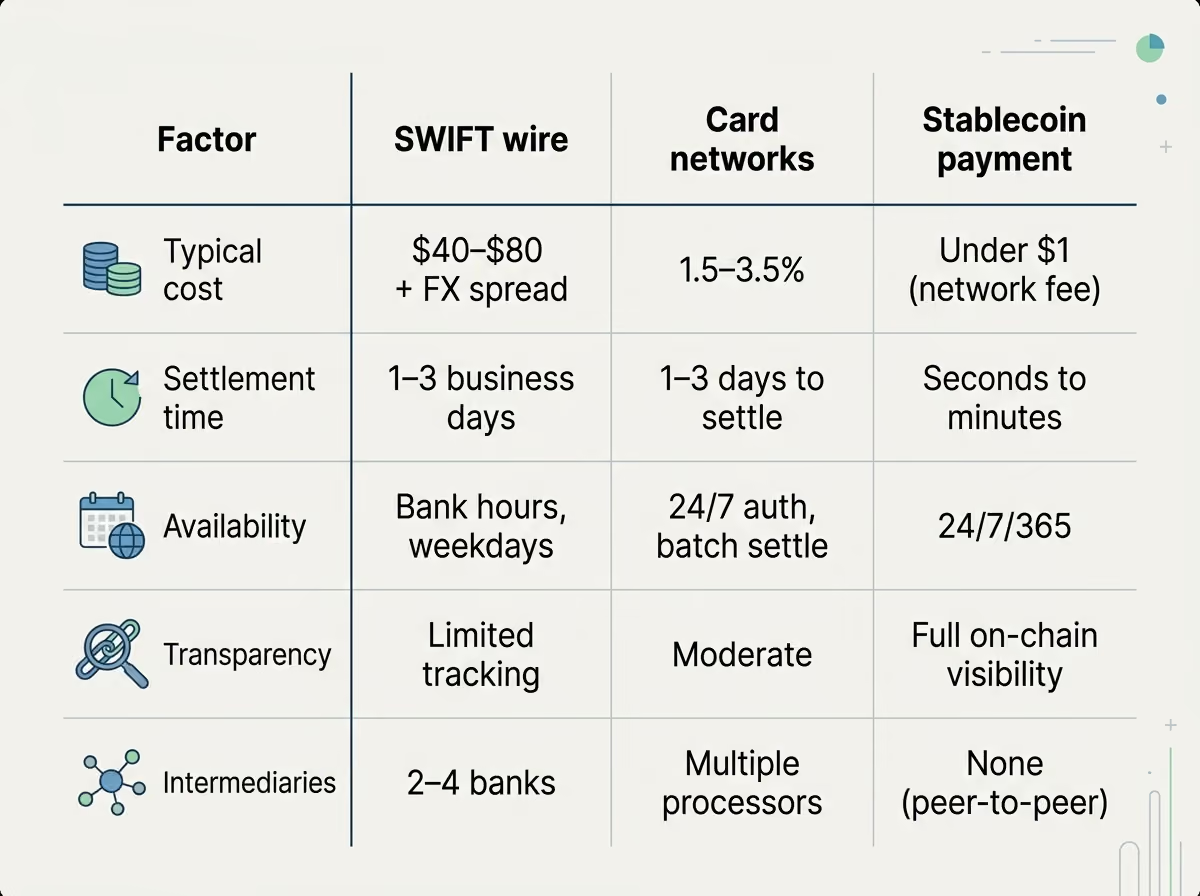

A payout batch does not fail loudly. It fails as fourteen rejected rows out of 3,000, a Friday afternoon, and a finance lead reconciling by hand on Saturday. Choosing a mass payout platform is a choice about which failure mode you are willing to own. This article compares the three architectures on the market — fiat mass-payout software, crypto-native payout providers, and hybrid stablecoin rails — on published pricing, corridor reach, settlement timing and what each one costs you when it goes wrong.
Competitor pricing and product capability in this article were read from each vendor's own published pricing, product and support documentation on 15 and 17 September 2026. Every platform named was checked for a published bulk-payout product, not just a payment gateway. Payment pricing changes constantly — re-check every figure before you quote it in a business case.
What a mass payout platform actually is — three architectures, not one market
The phrase "best mass payout platform" returns three different product categories that solve overlapping problems in incompatible ways. Confusing them is the most common reason a procurement process ends with the wrong tool.
Fiat mass-payout software (Tipalti, Trolley, Payoneer, Wise Business, PayPal Payouts) sits on top of correspondent banking and card networks. It automates payee onboarding, tax-form collection, approval workflow and AP reconciliation, then hands the actual value transfer to banks. Its strength is the workflow and the accounting integration. Its constraint is the rail underneath: where the bank cannot go, the software cannot go either.
Crypto-native payout providers (CoinGate, NOWPayments, Cryptomus and similar) move value on-chain. The rail is fast and geographically indifferent. The surrounding product, however, is usually built first for merchants accepting payments, with payouts added alongside — sometimes as a well-documented module, sometimes as a page you have to go looking for. Payee experience frequently assumes the recipient already holds a wallet, or is willing to open an account somewhere to receive one.
Hybrid stablecoin rails (INXY Payments, BVNK and others in this category) settle on-chain but present a fiat-denominated product: you fund in EUR or USD, the recipient receives value, and your chart of accounts never leaves fiat. INXY's own framing is wallet-free, gas-free, blockchain-free — the buyer is not being sold exposure to a cryptoasset, they are being sold a settlement rail.
The architectural question is simple and it comes before the vendor question: is your payout problem a workflow problem, a corridor problem, or both? Workflow problems — approvals, tax forms, ERP sync, multi-entity AP — are solved well by fiat software. Corridor problems — payees in markets your bank declines, five-day settlement, payouts that arrive net of three intermediary deductions — are not solved by better software on the same rail.
The eight criteria that actually decide it
Most comparison articles rank on headline fee. Headline fee is rarely the variable that decides whether a payout stack works.
| Criterion | Why it decides the outcome | What to ask the vendor |
|---|---|---|
| Corridor coverage | A rail that cannot reach 6% of your payees creates a permanent manual process for that 6% | Give me your decline list by country and payout method, not your marketing map |
| Batch capacity | A published per-batch cap turns one payout run into many, each with its own approval and reconciliation artefact | How many rows in a single batch, and what happens at the limit — reject, split, or queue? |
| Settlement timing | T+0 vs T+3 is a working-capital cost, not a convenience feature | What is the time from batch approval to payee availability, per method, at the 95th percentile? |
| True cost per payout | Headline fee, FX spread, network fee, intermediary deductions and pre-funding float are five separate line items | Quote me the all-in cost of a 1,200-payout batch averaging 340 EUR, landing in six countries |
| Failure semantics | What happens to rows 400–420 when row 399 fails | Is a batch atomic or per-row? What is the retry model? Are payout requests idempotent? |
| Reconciliation output | If the export does not map to your chart of accounts, you have bought a data-entry job | Show me the settlement report, at row level, with FX rate and fee broken out per payout |
| Compliance posture | KYB depth, KYT screening, sanctions and PEP screening, Travel Rule handling | Which screening runs pre-send, and what happens to a payout that hits a true positive? |
| Payee experience | Payee-side friction is the single largest driver of support cost in payouts | What does the payee do on first receipt, and what percentage complete it without support? |
The two questions in that table that vendors answer worst are reconciliation output and failure semantics. Ask them first.
Fiat mass-payout platforms: strong workflow, inherited rail
Tipalti
Tipalti is AP automation with a mass-payments module attached, and it is genuinely good at the part most crypto providers ignore entirely: supplier onboarding, tax-form collection, approval hierarchies and ERP synchronisation. Published pricing starts at $99/month for Accounts Payable and $249/month for Mass Payments (tipalti.com/pricing, read 15 September 2026). Per-invoice and per-payment transaction fees exist but are not itemised publicly; FX is described as built into the payment workflow rather than quoted as a separate spread.
Where Tipalti loses: a company paying 2,000 small-value affiliates monthly in markets its bank underwrites poorly. The subscription plus per-transaction economics are built for a supplier ledger of hundreds, not a payee ledger of thousands, and the underlying rail still has to reach the payee.
Payoneer
Payoneer's advantage is the network: where both sides hold accounts, value moves inside the network rather than across correspondent banking. Published fees include fixed bank withdrawal fees of 1.50 USD, 1.50 EUR or 1.50 GBP for local-currency withdrawals, 0.5% of the withdrawal amount above a $50,000 monthly threshold, up to 3% for non-local currency transactions, and a 29.95 USD annual fee on dormant accounts (payoneer.com/about/pricing, read 15 September 2026).
Where Payoneer loses: the "up to 3%" non-local-currency line is where the money goes, and it is borne by the payee. If your payees are price-sensitive contractors converting to local currency, the deduction they see is the number that generates support tickets — not your platform fee.
Wise Business
Wise publishes the most transparent FX pricing in the category: conversion from 0.24%, with a mid-market reference rate, free domestic payments in nine listed currencies, and named receive fees for SWIFT inbound (6.11 USD, 2.16 GBP, 2.39 EUR) plus a 50 GBP one-off charge for receiving-account details (wise.com/gb/pricing/business, read 15 September 2026).
Where Wise loses: high-risk verticals. Wise underwrites its customer book conservatively, and ad networks, iGaming affiliates and some marketplace models find the account itself is the constraint — not the pricing. A cheap rail you get offboarded from in month seven is more expensive than a slightly dearer rail you keep.
PayPal Payouts
PayPal Payouts applies a variable fee of 2%, with caps that vary by sending country and by domestic versus international payout type; currency conversion is charged additionally (developer.paypal.com/payouts/fees, read 15 September 2026). Per-payout transaction limits are published by currency — for example $60,000 for registered USD recipients and $20,000 for unregistered ones.
Where PayPal loses: anything with a real corridor problem. The capped 2% is competitive for small payouts into well-served markets and uncompetitive for large ones; recipient-side availability and account holds are the operational risk, and they are not visible in the fee table.
Crypto-native payout providers: right rail, merchant-shaped product
CoinGate
CoinGate publishes the clearest crypto payout pricing in the comparison set: 1% per transaction on the Standard plan, crypto payouts at 0.50 EUR + 0.5%, or 0.50 EUR + 1.5% where conversion is involved, free SEPA and crypto withdrawals above a 50 EUR minimum, 0.50% on SWIFT withdrawals, and a 1% exchange fee on manual conversions (coingate.com/pricing, read 15 September 2026).
Its bulk capability is Batch Payouts: a CSV upload capped at up to 300 payouts per file, available to verified business accounts only, charged as a fixed 0.50 EUR plus a percentage that depends on whether a conversion was applied, with no minimum per individual payout and an optional four-eye approval step before a batch executes (CoinGate support documentation, read 17 September 2026).
Where CoinGate loses: the 300-row cap. A 3,000-payee affiliate run becomes ten CSV files, ten approvals and ten reconciliation artefacts — which is not a pricing problem, it is an operational one, and it is invisible on the pricing page. CoinGate also ships the strongest control in the crypto-native set, the four-eye approval, so the honest reading is that it is built for controlled, moderate-volume batches rather than for scale.
NOWPayments
On acquiring, NOWPayments publishes 1% for payments without exchange and 1.5% for multi-currency, fixed-rate or "fee paid by user" payments, with network fees passed through as variable blockchain cost (nowpayments.io help centre, read 15 September 2026).
Its mass payout product is headlined "Zero-fee crypto mass payouts", scaling from 1 to 100,000 recipients by CSV upload or API, and is powered by ChangeNOW. The mechanism behind the zero is the part that matters: each recipient is given a ChangeNOW account, into which the payout lands (nowpayments.io/mass-payments, read 17 September 2026).
Where NOWPayments loses: that recipient account is a real constraint, not a detail. You are asking every payee to onboard to a third-party exchange to receive their money, which moves your payee-support burden onto someone else's KYC queue and someone else's supported-country list. For an affiliate base that already uses it, that is free scale. For a contractor base that does not, it is the highest-friction option in this comparison.
Cryptomus
Cryptomus does not surface mass payouts among the headline products on its homepage — the navigation leads with the payment gateway, cards and trading — but it publishes a dedicated Mass Payouts product page and a payout API. The page advertises batches by file upload or API, states no restriction on the number of addresses, claims "100,000+ transactions in 3 clicks", and publishes "Commissions — 0%" (cryptomus.com/mass-payout, read 17 September 2026).
Where Cryptomus loses: the same place its headline wins. A published 0% commission on a payout product means the cost lives somewhere else — network fee treatment, conversion spread, or the balance you have to hold on-platform to fund the batch. None of those are quantified on the page. A rate you cannot model is not cheaper than a rate you can; it is just unpriced until the first invoice.
Two zeros, one lesson. Both Cryptomus and NOWPayments headline their payout products at zero fee, and neither publishes what replaces it. That is not an accusation — it is the reason the "line items nobody quotes" section below exists, and the reason your evaluation should price a real batch rather than compare headline rates.
Hybrid stablecoin rails: fiat in, fiat out, on-chain in the middle
This is the category INXY Payments operates in, so read the following knowing where it comes from.
The hybrid model exists because the two categories above each solve half the problem. Fiat software gives you workflow and accounting on a rail with corridor limits. Crypto-native gives you the rail without the finance-team product. Hybrid rails fund in fiat, settle on-chain, and deliver in a form the payee can use, with the accounting staying denominated in EUR or USD.
INXY's published position is a transaction fee from 0.1% with no setup, monthly or hidden fees, and reduced rates available for large volumes, same-day global settlement with next-day fiat to bank, and no chargebacks — a structural property of the rail rather than a policy, because there is no card scheme representment process to lose. Compliance screening runs through partners including Elliptic and Sumsub, with Travel Rule and AML handling built into the flow rather than bolted on. INXY supports 20 cryptocurrencies across ERC-20, TRC-20, BEP-20, Polygon, Tron, TON, Bitcoin, Litecoin and DOGE.
Where INXY loses — and this matters more than anything above it. If your payout problem is a domestic one — 400 suppliers in a single SEPA country, paid monthly, with invoice matching and approval chains as the real work — a stablecoin rail solves a problem you do not have. SEPA Instant already settles in seconds at near-zero cost, and what you actually need is AP automation. Buy Tipalti. Similarly, if your payees are consumer-grade recipients with no appetite for anything unfamiliar and your corridors are all well-served, the migration cost outweighs the settlement gain. INXY is the right answer when the corridor is the constraint, the volume is real, and the settlement delay is costing you working capital — not when the workflow is the constraint.
The geographic constraint is not a footnote. INXY serves Europe, Asia and LatAm and does not serve the UK, the US, or sanctioned jurisdictions. If a material share of your payee base sits in those markets, this rail does not solve your problem regardless of how well it prices, and no vendor including us should sell you around that.
The comparison table
Figures as published by each vendor on 15 September 2026, with the crypto-native payout rows re-checked and expanded on 17 September 2026. "Not published" means the vendor does not disclose the figure — not that the cost or the limit is zero.
| Platform | Architecture | Published headline fee | Published batch capacity | Settlement | Published FX handling | Public pricing? |
|---|---|---|---|---|---|---|
| Tipalti | Fiat / AP automation | From $99/mo (AP), from $249/mo (Mass Payments) + per-transaction fees not itemised | Not published | Bank rails | Built into workflow, not itemised | Partial |
| Payoneer | Fiat / network | 1.50 USD/EUR/GBP local withdrawal; 0.5% above $50k/mo; up to 3% non-local | Not published | Network-internal instant; bank withdrawal varies | Up to 3% | Yes |
| Wise Business | Fiat / multi-currency | Conversion from 0.24%; 50 GBP account details; SWIFT receive 6.11 USD / 2.39 EUR | Batch payments supported; cap not published | Varies by corridor | From 0.24%, mid-market reference | Yes |
| PayPal Payouts | Fiat / wallet | Variable 2%, capped by country and payout type | Per-payout currency limits published; batch cap not | Wallet-instant, withdrawal varies | Charged additionally | Partial |
| CoinGate | Crypto-native | Batch Payouts: 0.50 EUR fixed + % depending on conversion; acquiring 1% | Up to 300 per CSV batch | On-chain; weekly settlement on Standard | 1% on manual conversion | Yes |
| NOWPayments | Crypto-native | Mass payouts headlined at zero fee; acquiring 1% / 1.5% | 1 to 100,000 recipients | On-chain, via ChangeNOW recipient accounts | Not itemised for payouts | Partial |
| Cryptomus | Crypto-native | Mass payouts published as "Commissions — 0%"; cost basis not stated | No published limit on addresses | On-chain | Not published | Partial |
| BVNK | Hybrid stablecoin | No public pricing page; quote-based | Not published | On-chain + fiat rails | Not published | No |
| INXY Payments | Hybrid stablecoin | From 0.1% transaction fee; no setup, monthly or hidden fees; reduced rates at large volume | File or API batch; no published row cap | Same-day global settlement; next-day fiat to bank | Auto-conversion to fiat | Partial |
The line items nobody quotes
Five costs sit outside every pricing page in the table above, and together they usually exceed the headline fee.
Pre-funding float. If the rail requires you to pre-fund a balance before a batch executes, you are lending the provider working capital. On a monthly payout run of 1.2M EUR with a three-day funding lead, that is three days of capital cost every month, permanently. Ask what the funding-to-execution window is and treat it as a financing line, not an operational detail.
FX spread versus mid-market. A "0.5% fee" applied to a rate already marked 0.8% off mid-market is a 1.3% cost. Wise publishes against the mid-market rate explicitly; most of the others do not. Always benchmark the rate you are quoted against the mid-market rate at the same timestamp, not against the previous vendor's rate.
Network fee pass-through. On-chain payouts carry a network fee that varies with congestion. Whether the provider absorbs it, passes it through at cost, or marks it up is a real commercial term and it is rarely on the pricing page. On a 3,000-row batch, a few cents of markup per row is not a rounding error. This is usually where a "0% commission" payout product recovers its margin — both Cryptomus and NOWPayments headline their payout products at zero fee, and neither publishes the network-fee or spread treatment that sits behind it.
Failed-payout rework. The genuine cost of a failed row is not the fee — it is the finance analyst who investigates it, contacts the payee, corrects the record and re-submits. At a 2% failure rate on a 3,000-payout batch, that is 60 manual investigations per run. Ask every vendor for their observed first-attempt success rate on your corridor mix, in writing.
Payee-side deduction. The number that determines whether your affiliates complain is what lands in their account, not what leaves yours. Intermediary bank deductions on SWIFT and non-local-currency conversion charges are invisible in your reporting and highly visible in theirs.
What breaks in production
Partial batch failure with unclear semantics. The batch reports "completed," 2,946 of 3,000 rows settled, and the report does not distinguish rows that failed validation from rows that were submitted and rejected downstream. Rerunning the file double-pays the 2,946. This is why idempotency keys on payout requests are a procurement requirement, not a developer preference.
Wrong-network sends. A payee supplies an address and selects the wrong network. On stablecoin rails this is the single most common payee-side error. The mitigation is product-level — network selection derived from the payee's own confirmed profile rather than free-text entry — and it is worth more than a 0.1% fee difference.
Screening true positives mid-batch. A payout hits a sanctions or KYT match. The correct behaviour is that the payout stops, is escalated for review, and the rest of the batch proceeds. Some platforms halt the entire batch. Ask which, before you find out on a payout Friday. And to be unambiguous: the right answer is that the payout stops and is reviewed. Any provider positioning reduced screening as a feature is selling you a future enforcement problem, not a payment rail.
Month-end reconciliation drift. Settlement timestamps in the provider's timezone, FX applied at execution rather than at approval, and fees netted rather than itemised — three small mismatches that produce an unexplained variance line every single month. Demand the row-level export during evaluation and hand it to whoever closes your books before you sign.
Payee onboarding decay. Payee details go stale. Bank accounts close, addresses rotate. A platform with no re-verification prompt accumulates a growing tail of failing rows that nobody owns.
An eleven-step evaluation sequence
- Export your last three payout runs and build the real distribution: payee count, value distribution, country mix, currency mix, and observed failure rate. Most teams discover their average payout is far smaller and their corridor list far longer than they assumed.
- Classify the problem: workflow-constrained, corridor-constrained, or both. This eliminates two of the three architectures immediately.
- Request a corridor decline list from each shortlisted vendor, by country and method. Not a coverage map — a decline list.
- Price the real batch, not a sample: all-in cost including FX spread benchmarked to mid-market at the same timestamp, network fees, and any pre-funding requirement expressed as days of float.
- Ask for the per-batch row limit and what happens at it. A cap of 300 against a 3,000-row run means ten files, ten approvals and ten reconciliation artefacts every cycle. Get the number in writing; it is rarely on the pricing page.
- Ask for failure semantics in writing: atomic or per-row, idempotency support, retry model, and what happens to a batch when one row hits a screening match.
- Run a sandbox batch of at least 50 rows covering your three hardest corridors, including deliberately malformed rows.
- Hand the settlement export to your controller before the commercial conversation goes further. If it does not map to the chart of accounts, the integration cost is a hidden line item.
- Test the payee path yourself, end to end, as a payee in your largest corridor. Time it. Count the steps. Include any account the payee is required to open — if receiving your payout means onboarding to a third-party exchange, that is part of your payout product whether you chose it or not.
- Verify the compliance posture: KYB depth, which screening runs pre-send, Travel Rule handling, and how a true positive is escalated. Our guide to Travel Rule and crypto payouts covers what actually runs.
- Run one real batch in parallel with your incumbent for a full cycle before migrating. Parallel running costs one month of double fees and saves one quarter of remediation.
Which one, when
| Your situation | The answer | Why |
|---|---|---|
| Hundreds of suppliers, one or two well-served currencies, approvals and tax forms are the real work | Tipalti or similar AP automation | Your problem is workflow, not rail. A stablecoin rail adds nothing. |
| Payees already inside one network, moderate volume, price-sensitive recipients | Payoneer | Network-internal transfer avoids correspondent banking entirely |
| Transparent FX is the priority, corridors are mainstream, underwriting is straightforward | Wise Business | Best published FX transparency in the set |
| Small-value payouts into well-served markets, payees already hold wallets | PayPal Payouts | The 2% cap works in your favour at low ticket sizes |
| Controlled batches under 300 rows, crypto-first business, approval discipline matters | CoinGate Batch Payouts | Clearest published pricing in the set and four-eye approval — but the 300-row cap is hard |
| Large affiliate base that already lives on exchange accounts | NOWPayments mass payouts | Scales to 100,000 recipients at a headline zero fee, if your payees accept a ChangeNOW account |
| Thousands of payees across Europe, Asia and LatAm; settlement delay is a working-capital cost; accounting must stay in EUR/USD | A hybrid stablecoin rail such as INXY mass crypto payouts | Corridor reach without handing your finance team a crypto ledger |
| Material payee base in the UK or US | None of the stablecoin options here | INXY does not serve those markets; solve it on a rail that does |
If your batch is mostly USDT and the corridor is the constraint, the mechanics are set out in mass payout in USDT, and the same flow for dollar-denominated payees who require a MiCA-authorised token is in mass payout in USDC. For contractor and payroll-shaped batches specifically, crypto payroll and contractor payouts is the relevant page, and how to automate mass crypto payouts covers the automation layer.
The decision, stated plainly
Do not start from the vendor list. Start from your own last three payout runs, because the distribution in that export determines the architecture, and the architecture eliminates most of the market before you speak to anyone. If the constraint is workflow, buy AP automation and stop reading comparison articles about stablecoins. If the constraint is the corridor — payees your bank will not reach, settlement measured in days, deductions you cannot see — then the rail has to change, and the only question left is whether you want the on-chain complexity on your side of the wall or the provider's.
If it is the second, the shortest useful next step is a scoped batch against your real corridor mix rather than a demo against theirs. Book a demo with your last payout export in hand, and ask for the row-level settlement report before anything else.
This article describes regulatory and market conditions for general information. It is not legal, tax, or financial advice — INXY Payments is a payment infrastructure provider, not a law or accountancy firm, and decisions with regulatory consequence should be reviewed by qualified counsel in the relevant jurisdiction.
FAQ
What is a mass payout platform?
A mass payout platform executes many outbound payments from a single instruction — a file upload or an API call — instead of one payment at a time. The category covers three architectures: fiat AP automation software, crypto-native payout providers, and hybrid stablecoin rails that fund in fiat and settle on-chain. They solve different problems and are not interchangeable.
How much does a mass payout cost?
Published headline fees across the platforms compared here range from zero-fee headlines on some crypto payout products to a capped 2% per payout, as published by each vendor in September 2026. The headline fee is rarely the largest cost. FX spread against mid-market, network fee pass-through, pre-funding float and failed-payout rework typically add more than the quoted rate.
Are crypto mass payouts faster than bank transfers?
On-chain settlement completes in minutes rather than the multi-day window typical of correspondent banking, and it does not observe banking hours or cut-off times. The constraint moves from the rail to compliance screening and payee-side availability, which is why pre-send screening design matters more than raw block time.
What happens if one payment in a batch fails?
It depends entirely on the platform's failure semantics, and this is the question most buyers skip. Some platforms process per-row and continue; others halt the batch. Ask for the behaviour in writing, confirm that payout requests support idempotency keys, and test it with deliberately malformed rows in a sandbox before go-live.
Which stablecoin should we use for payouts?
It depends on where your payees are and what their counterparties accept. USDT has the deepest liquidity and the widest informal acceptance in Asia and LatAm; USDC is authorised as an e-money token under MiCA and is the practical choice for EEA-facing counterparties. Many payout programmes run both rather than choosing.
Can we keep our accounting in EUR if we pay out in stablecoins?
Yes, on a hybrid rail. You fund in fiat, the provider handles conversion and on-chain settlement, and the settlement report returns in your base currency. Insist on a row-level export with FX rate and fee broken out per payout — if the export does not map to your chart of accounts, you have bought a data-entry job.