
For most businesses, sending money across borders still feels like it did a decade ago: slow, opaque, and expensive. Cross-border crypto payments built on stablecoins are changing that. Instead of routing an international crypto payment through a chain of correspondent banks, a stablecoin transfer settles directly on a blockchain in seconds, for a fraction of the cost. In 2026 this is no longer a fringe experiment — it is one of the fastest-growing segments in business payments, and the data behind it is hard to ignore.
This guide explains how cross-border stablecoin payments actually work, how they compare to SWIFT, where they make the most sense, and what it takes to start accepting them.
Why cross-border crypto payments are replacing the old rails
The traditional system was never designed for the speed of modern commerce. It was designed for banks talking to banks.
The hidden cost of SWIFT and correspondent banking
A typical international wire passes through two to four intermediary banks before it reaches the recipient. Each one takes a cut and adds a delay. The result is well known to any finance team: wire fees of roughly $40–$80 per transaction, settlement times of one to three business days (longer across exotic corridors), and almost no visibility into where the money is at any given moment. Add unfavorable FX spreads and the all-in cost of moving money internationally can quietly erode margins on every cross-border deal.
For a company paying dozens or hundreds of overseas suppliers, contractors, or partners each month, that friction compounds fast.
What changed in 2026
Stablecoins — blockchain tokens pegged 1:1 to a fiat currency such as the US dollar — turned out to be an almost perfect fit for this problem. They hold a stable value, move on open networks 24/7, and settle without a banking intermediary.
Adoption has gone vertical. Business-to-business stablecoin payment volume grew roughly 733% year over year heading into 2026, and total stablecoin transaction volume reached about $33 trillion in 2025. Juniper Research projects that cross-border B2B stablecoin payments will hit $5 trillion by 2035, up from an estimated $13.4 billion today, with the large majority of that future value coming specifically from cross-border business use. In short: the rail is being built right now, and businesses that learn it early gain a cost advantage.
How stablecoin cross-border payments actually work
The mechanics are simpler than the technology sounds. Every cross-border stablecoin payment follows the same three-stage path.
On-ramp, settlement, off-ramp
- On-ramp. The sender converts local fiat (USD, EUR, etc.) into a stablecoin such as USDC or USDT, either from existing treasury or through a payment provider.
- Settlement. The stablecoin moves across a blockchain network directly to the recipient's wallet. This is the step that replaces the entire correspondent-banking chain.
- Off-ramp. The recipient either holds the stablecoin or converts it back to their local currency and withdraws to a bank account.
A provider like INXY handles the on-ramp, settlement, and off-ramp as a single flow, so the business never has to touch a crypto exchange directly.
Stablecoins and networks used
Most B2B volume runs on US-dollar stablecoins — USDC, USDT, and increasingly PYUSD — because they remove currency-volatility risk while keeping the speed of crypto. The network matters too, because it determines how fast and how cheaply a payment finalizes:
- Solana — settlement finality in under half a second, with sub-cent fees.
- Tron — finality in roughly one to two seconds; widely used for USDT.
- Ethereum Layer-2s — low fees with fast confirmation, anchored to Ethereum security.
The practical takeaway: a payment that took three days on SWIFT can finalize in seconds on the right chain.
Stablecoins vs SWIFT: cost, speed, and transparency
The clearest way to understand the shift is a side-by-side comparison of low fee crypto payments against the legacy rails.
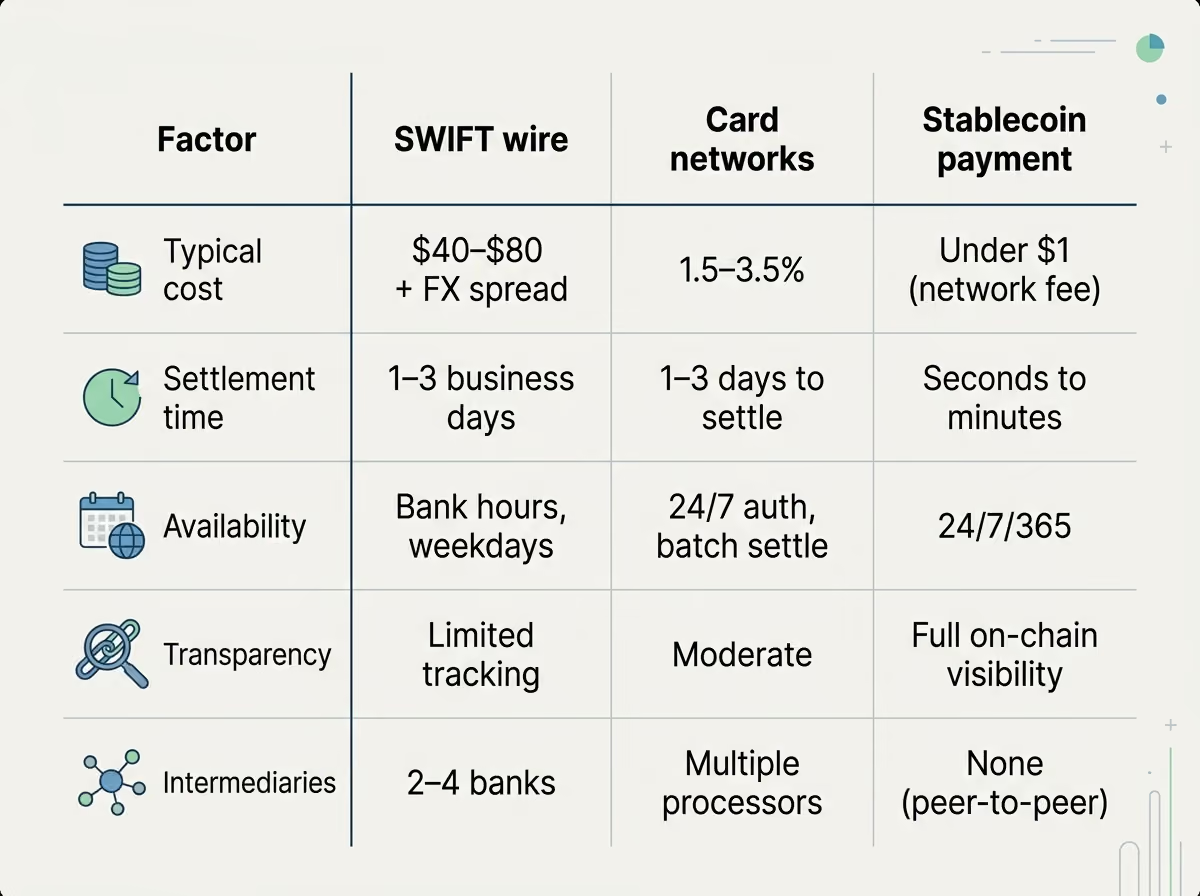
The economics are most dramatic at scale. Dropping from $40+ per wire to under $1 per transfer changes what is financially viable — micro-payments, frequent payouts, and thin-margin corridors that never made sense on SWIFT suddenly do.
Top use cases for global crypto transactions
Stablecoins are not a fit for every payment, but for global crypto transactions between businesses they solve real, recurring pain.
- Supplier and vendor payments. Pay overseas manufacturers and service providers same-day instead of waiting for a wire to clear, improving supplier relationships and unlocking faster terms.
- Contractor and team payouts. Pay international contractors and remote staff in stablecoins without losing 5–10% to fees and FX on every transfer. (INXY also covers dedicated crypto payroll.)
- Marketplace and platform payouts. Distribute earnings to sellers, affiliates, or creators across many countries in a single batch, at predictable cost.
- Treasury and intercompany transfers. Move funds between entities and regions instantly, holding value in a dollar-pegged asset rather than parking it in slow, fee-heavy banking channels.
These are exactly the corridors where the old system performs worst — many small-to-mid payments, many destinations, tight margins.
Are low fee crypto payments compliant? GENIUS Act and MiCA
A fair question from any finance or legal team: is this allowed? In 2026, the answer is increasingly yes — and the regulatory ground is firmer than it has ever been.
In the United States, the GENIUS Act established the first federal framework for payment stablecoins, requiring issuers to be licensed, to hold 1:1 reserves in high-quality liquid assets, and to honor redemption on demand. In the European Union, MiCA (Markets in Crypto-Assets) provides a parallel framework. Together they have moved stablecoins from a regulatory gray zone into supervised, standardized instruments — which is a large part of why institutional adoption accelerated.
What a regulated provider handles for you
Compliance does not have to live on your team. A regulated payment provider performs KYB (Know Your Business) onboarding, screens transactions against AML requirements, and maintains the audit trail you need for reporting. The business gets the speed and cost benefits of stablecoins while the provider absorbs the regulatory heavy lifting.
How to start accepting cross-border crypto payments
Getting started is closer to onboarding a payment processor than to learning crypto.
- Choose a regulated provider that supports on-ramp, settlement, and off-ramp in your corridors — not a raw exchange.
- Complete KYB onboarding and connect your bank account or treasury.
- Pick your stablecoins and networks (USDC/USDT on a fast, low-fee chain) and set how recipients receive funds — held as stablecoin or auto-converted to local fiat.
- Integrate and pay. Use the dashboard for one-off and batch payments, or the API to automate payouts inside your existing systems.
Once live, a cross-border payment that used to mean a wire form and a three-day wait becomes a few clicks and a few seconds.
The bottom line
Cross-border B2B payments are being rebuilt on stablecoin rails, and the trend lines — 733% volume growth, a projected $5 trillion market, and clear regulation under the GENIUS Act and MiCA — point in one direction. For businesses that move money internationally, stablecoins offer dramatically lower fees, near-instant settlement, and full transparency, without the volatility of traditional crypto. The companies adopting it now are the ones that will spend the next decade paying cents where their competitors pay tens of dollars.
Start accepting cross-border crypto payments with INXY →
FAQ
Are stablecoin payments legal for business? Yes. In 2026, US-dollar stablecoins are regulated under the GENIUS Act in the United States and MiCA in the EU. Using a licensed provider keeps your KYB and AML obligations covered.
How fast is settlement? Depending on the network, a stablecoin payment finalizes anywhere from under a second (Solana) to a couple of minutes — versus one to three business days for a SWIFT wire.
What fees apply? The main cost is a small blockchain network fee, often under $1, plus any provider conversion fee on the on-ramp or off-ramp. This compares to $40–$80 per traditional international wire.
USDC or USDT for cross-border payments? Both are widely accepted dollar-pegged stablecoins. USDC is often preferred for its regulatory transparency; USDT has deeper liquidity in some corridors. A good provider supports both so you can match the recipient's preference.