Navigating Crypto Compliance for Fintechs: How to Offer Stablecoins Safely
As global regulators tighten their grip on digital assets, offering stablecoins safely has become a critical challenge for fintechs. This guide explores how to navigate recent EU restrictions on USDT, why fully collateralized USDC is the gold standard for institutional compliance, and how integrating a multi-asset gateway like INXY protects your platform while providing seamless global transfers.
Navigating Crypto Compliance for Fintechs: How to Offer Stablecoins Safely
Imagine launching a killer feature that multiplies your transaction volume overnight, only to have regulators freeze your operations a week later. Welcome to the high-stakes reality of integrating stablecoins into your platform. Right now, digital dollars are powering the global economy, moving billions across borders daily. Your users are demanding it, and the business case for instant settlements is undeniable.
But there is a catch. Financial watchdogs globally are circling. Offering stablecoins is a massive growth lever for ambitious fintechs, but stepping into the crypto arena without an airtight compliance strategy is like walking a tightrope without a net. The ultimate challenge is navigating this regulatory minefield without sacrificing the seamless user experience your customers expect.
The Top Three: USDT, USDC, and DAI
Before diving into regulatory complexities, it is crucial to understand the stablecoin hierarchy and why diversifying your asset offerings is mandatory for compliance.
Tether (USDT): While it currently holds the number one spot for global trading volume, USDT faces severe regulatory headwinds. Notably, the European Union has implemented strict restrictions and effective bans on USDT exchanges under new frameworks, forcing fintechs to rethink relying on a single asset.
USD Coin (USDC): Sitting comfortably as the second most popular stablecoin, USDC is the gold standard for institutional compliance. It is a fully collateralized asset, genuinely backed 1:1 by actual US dollars and short-term assets, providing unparalleled transparency for strict regulators.
DAI: Holding the third position globally, DAI offers a robust, decentralized alternative that maintains its peg through smart contracts and over-collateralization, rounding out the essential stablecoins for any modern financial platform.
Key Regulatory Challenges in the Crypto Landscape
Offering stablecoins is not as simple as plugging into an API. Financial authorities are rapidly tightening their grip to prevent money laundering and systemic economic risks. First, stringent Know Your Customer (KYC) and Anti-Money Laundering (AML) directives require dynamic, ongoing monitoring. Second, the FATF Travel Rule mandates that institutions must securely share originator and beneficiary data for crypto transfers exceeding specific thresholds.
Finally, jurisdictional fragmentation creates a massive headache. The EU’s Markets in Crypto-Assets (MiCA) regulation perfectly exemplifies this, creating strict new rulebooks that directly restrict non-compliant stablecoins like USDT. This makes offering fully backed, transparent assets like USDC an absolute necessity for European operations.
Proven Strategies to Offer Stablecoins Compliantly
To protect your business from crippling fines while maximizing the incredible benefits of digital assets, you must follow these proven operational strategies:
Diversify Your Assets: Do not rely solely on USDT. Offer USDC to satisfy strict regulatory requirements in the EU, and provide DAI for users seeking decentralized options.
Implement Bank-Grade KYC/AML: Utilize automated identity verification systems that check users against global sanctions watchlists in real-time.
Integrate Transaction Monitoring: Deploy sophisticated blockchain analytics tools to trace wallets, ensuring incoming funds are not linked to illicit activities.
Geofence Restricted Jurisdictions: Utilize precise IP tracking to block specific stablecoin features in regions where they are explicitly banned or heavily restricted.
INXY as the Premier Crypto Payment Gateway Partner
Navigating this tangled web of regulations demands the right underlying technological infrastructure. This is where INXY steps in as the premier partner for fintech companies looking to integrate digital assets securely.
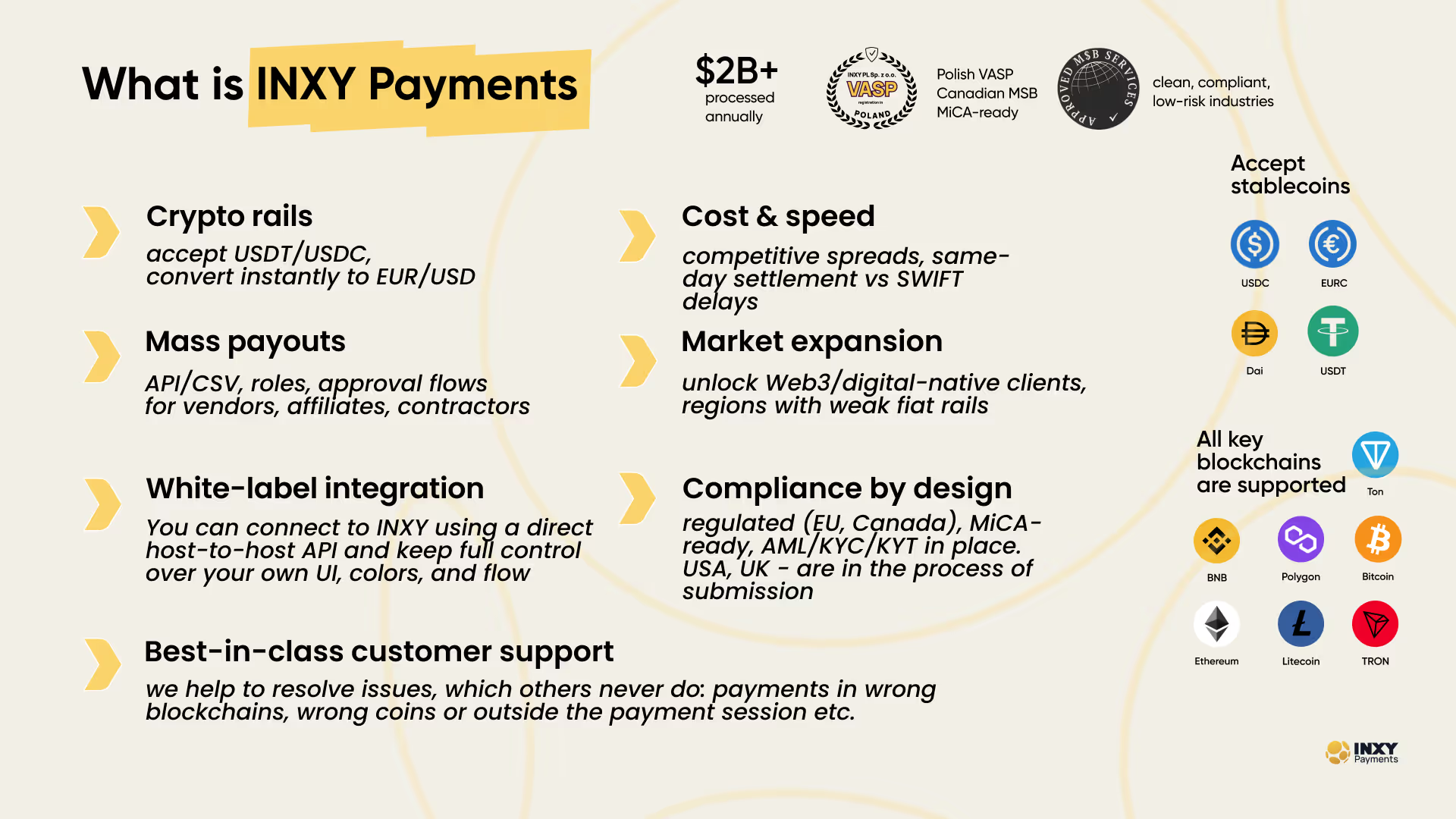
As a dedicated cryptocurrency payment gateway, INXY understands the exact pain points fintechs face. Most importantly, INXY natively supports all three of the top stablecoins: USDT, USDC, and DAI. Whether you need a reliable gateway to process fully backed USDC deposits in the heavily regulated EU market or high-speed APIs for global USDT and DAI transfers, INXY provides the robust backbone your application needs to scale while maintaining strict operational compliance.
Conclusion
The future of global payments is strictly digital, and stablecoins are leading the charge. While the fragmented regulatory environment is complex, it should not deter your business from innovating. By prioritizing proactive compliance, diversifying your asset offerings, and choosing the right technological allies, you can confidently offer secure stablecoin services to your users.
Ready to future-proof your financial platform? Discover how we can help you scale your operations compliantly by visiting https://www.inxy.io/fintech today.
Explore the mechanics behind cryptocurrency exchanges, from matching engines and liquidity pools to the differences between CEXs and DEXs. While exchanges power the digital economy for traders, discover why forward-thinking businesses are turning to specialized crypto payment gateways to safely accept digital assets and drive revenue.
In May 2010, a hungry programmer made financial history by trading 10,000 Bitcoins for two Papa John’s pizzas. At the time, there were no global marketplaces, no flashing price tickers, and absolutely no liquidity—just a simple forum post and a massive leap of faith. Today, the landscape has transformed beyond recognition. Those same pizzas would now be worth hundreds of millions of dollars, and the digital asset market has evolved into a trillion-dollar ecosystem.
At the beating heart of this financial revolution is the cryptocurrency exchange. Whether you are a retail investor looking to buy your first fraction of a Bitcoin, a professional trader executing high-frequency strategies, or a modern business owner trying to tap into a global, borderless customer base, understanding what a crypto exchange is and how it functions is the crucial first step to entering the digital economy.
The Engine of the Digital Economy
On any given day, top cryptocurrency exchanges process combined trading volumes exceeding $100 billion. They are the bustling, hyper-active metropolises of the digital age.
At its core, a cryptocurrency exchange is a highly secure digital marketplace that allows users to buy, sell, or trade cryptocurrencies for other assets. These assets can include conventional fiat money (like US Dollars or Euros) or other digital tokens. Exchanges act as the vital intermediary, providing the infrastructure, security, and liquidity necessary for the global crypto market to operate 24/7 without interruption.
Under the Hood: How an Exchange Functions
How does a platform handle millions of transactions per second without collapsing? Buying crypto might look like a simple tap on a smartphone screen, but the magic happens under the hood through several interconnected, highly advanced systems:
The Matching Engine: This is the absolute brain of the operation. The matching engine is an advanced software algorithm that continuously monitors and pairs buy and sell orders. When a buyer's bid meets a seller's asking price, the engine executes the trade in milliseconds.
Order Books and Market Depth: An order book is an electronic, real-time ledger of all the outstanding buy and sell orders for a specific trading pair (e.g., BTC/USD). It visualizes the current market depth, allowing traders to gauge ongoing supply, demand, and potential price movements.
Liquidity Pools: Liquidity dictates how easily an asset can be converted into cash without drastically affecting its market price. High liquidity means there are plenty of active buyers and sellers, resulting in lightning-fast transaction times and highly stable pricing.
Integrated Wallets: To facilitate instant trading, exchanges provide users with proprietary digital wallets. This allows traders to temporarily store their funds directly within the platform’s ecosystem for rapid deployment.
Centralized vs. Decentralized Exchanges (CEX vs. DEX)
As the industry has matured, two distinct philosophies have emerged regarding how these marketplaces should operate:
Centralized Exchanges (CEX): Platforms like Binance or Coinbase are owned and operated by a central corporate entity. They act as a trusted third party, offering deep institutional liquidity, fiat-to-crypto on-ramps, and user-friendly interfaces. The trade-off is that you must trust the corporation with the custody of your funds.
Decentralized Exchanges (DEX): Platforms like Uniswap operate entirely on blockchain technology using automated smart contracts. There is no central authority. Users retain 100% control of their funds by connecting their own private wallets. While they offer superior privacy and eliminate centralized points of failure, they can be intimidating for beginners.
The Commercial Shift: Why Businesses Need More Than an Exchange
This is where the story shifts from pure speculation to real-world commercial utility. With over 420 million active cryptocurrency users worldwide, digital assets are no longer just a niche internet hobby. They represent a massive, highly lucrative, and untapped consumer base. Recent industry surveys reveal a staggering metric: merchants who begin accepting crypto payments see an average ROI of up to 327%, with nearly 40% of their crypto-paying customers being entirely new to the brand.
However, here is the critical catch for corporate adoption. While exchanges are engineering marvels for individual traders, they are fundamentally not optimized for commercial B2B operations. If an online retailer or a global enterprise wants to accept crypto, directing clients to a standard exchange order book is a logistical nightmare. It leads to severe accounting errors, subjects the company to unpredictable withdrawal fees, and exposes business revenue to extreme, day-to-day price volatility.
To truly capitalize on the crypto economy, modern businesses require specialized, enterprise-grade infrastructure. The optimal solution is an advanced crypto payment gateway like inxy.io.
Instead of forcing merchants to navigate the speculative chaos of a trading platform, inxy.io is built specifically for seamless corporate integration. As a premier crypto payment gateway, it bridges the gap between digital assets and traditional commerce by offering:
An Automated Checkout Experience: It seamlessly integrates into a company's existing website or application, allowing global customers to pay in their preferred cryptocurrency in just a few clicks.
Instant Volatility Shielding: A premium gateway like inxy.io can instantly convert volatile crypto payments into stablecoins or fiat currency at the exact moment of the transaction, protecting the merchant's bottom line from sudden market crashes.
Cost-Efficiency and Compliance: By completely avoiding the heavy withdrawal constraints and hidden spread fees of retail exchanges, inxy.io provides transparent pricing, clear accounting, and professional invoicing tailored for corporate legal compliance.
Conclusion
Understanding the mechanics of a crypto exchange is essential for anyone navigating the modern financial landscape. They provide the necessary liquidity and global accessibility that keep the blockchain economy thriving. However, as digital assets move from the trading floor to the retail checkout, the tools we use must also evolve. While speculators will always rely on CEXs and DEXs, forward-thinking businesses must look toward specialized solutions. By leveraging a dedicated crypto payment gateway like inxy.io, companies can safely, efficiently, and profitably open their doors to the future of global commerce.
Choosing the best crypto exchange in 2026 depends on fees, transaction speed, security, and overall user experience. This guide compares leading crypto exchanges, highlights platforms with low fees and fast performance, and explains what to look for to trade safely and efficiently in a rapidly evolving market.
Crypto exchanges are platforms where you can buy, sell, or trade cryptocurrencies. Imagine them like a stock market but for digital coins. They let you swap your Bitcoin for Ethereum or convert your dollars into a stablecoin.
These exchanges come in two main types: centralized and decentralized. Centralized ones, like Binance, have a company behind them that manages everything. They often offer better security and customer service. Decentralized exchanges, or DEXs, let you trade directly with others, giving you more control over your assets.
When choosing an exchange, look for low commission fees and fast transaction speed. Some platforms set withdrawal limits, so check those if you plan on moving large amounts. Mass payouts are a feature to seek if you need to distribute funds to many users. Each exchange has its pros and cons, so consider what's important to you before diving in.
Criteria for Selection
Choosing the best crypto exchange in 2026 isn't a walk in the park. It's all about weighing different aspects. First, let's talk about fees. Lower fees mean you keep more of your money. Some exchanges offer low commission rates, making them attractive to traders who buy and sell often.
Next up is transaction speed. Fast transaction times allow you to buy or sell quickly, which is crucial in the fast-moving world of crypto. Nobody wants to wait around while prices are changing.
Security is a big deal too. With the rise in cyber threats, knowing your money is safe is essential. Exchanges that invest in top-notch security measures, like two-factor authentication and cold storage, stand out.
Consider withdrawal limits as well. High limits mean you can access your funds whenever you want. It's important for those who deal with large amounts of cryptocurrency.
Mass payouts are another factor. If you're involved in crypto mining or other activities that require frequent payouts, you'll want an exchange that handles mass payouts efficiently.
Stablecoin availability is something to think about. Exchanges that support various stablecoins can provide more options for trading or holding value.
Each of these criteria plays a role in finding the best exchange. Balancing them based on your needs will help you make the right choice.
Top Crypto Exchanges for Low Fees
When it comes to buying and selling crypto, fees can really add up. That's why it's key to choose a cryptocurrency exchange that offers low fees. Some exchanges charge a flat fee for every trade, while others use a percentage of the trade amount. For instance, if you trade a large amount, a percentage fee might cost you more.
Binance and Kraken are often praised for their low fees. Binance, for example, charges a very small percentage for each trade. This can save you a lot over time, especially if you're trading frequently. Kraken also offers competitive fees, making it a favorite for many traders.
Another option to consider is using a stablecoin. Some exchanges offer discounts or lower fees when you trade with stablecoins. This can be a smart way to keep costs down. It's important to check each exchange's fee schedule before you start trading. This way, you won't get any nasty surprises down the road. Choosing the right exchange can help you maximize your investment without losing too much to fees.
Fastest Crypto Exchanges
When you're dealing with cryptocurrency, every second counts. Transaction speed is a big deal in the crypto world. It's all about how fast you can buy, sell, or transfer your digital coins. Some exchanges stand out because they let you do this super quickly. Let's dive into what makes these exchanges tick.
First off, why does speed matter? Imagine you're at a store, and you want to buy something. You hand over your money, but the cashier takes forever to process it. Frustrating, right? The same goes for crypto exchanges. A fast exchange means you can make trades when the market is right for you. It's like being the first in line for a new gadget release.
So, what makes an exchange fast? It's a mix of technology and strategy. These exchanges use cutting-edge servers and networks. They're always upgrading to handle more transactions at once. Think of it like a highway. More lanes and fewer traffic lights mean you get to your destination faster.
One example of a speedy exchange is Binance. Known for its lightning-fast transactions, Binance uses technology that can process over a million orders per second. This means you rarely have to wait to complete a trade. KuCoin is another name that pops up when we talk speed. They have a reputation for quick order processing, ensuring users can jump on market opportunities without delay.
But speed isn't just about the tech. It's also about the user experience. Fast exchanges have simple and intuitive interfaces. This means you spend less time figuring out how to make a trade and more time actually trading. It's like shopping online with a website that's easy to navigate.
However, don't forget about security. A fast exchange is great, but it must also be safe. The best exchanges balance speed with security measures to protect your money and information. After all, no one wants a fast transaction if it puts their assets at risk.
In 2026, the fastest exchanges will likely combine advanced technology with user-friendly designs. They'll cater to both beginners and experts, ensuring everyone can trade quickly and securely. As the crypto world evolves, speed will remain a key factor in choosing the right exchange for you.
Security Features of Leading Exchanges
When we talk about crypto exchanges, security is a big deal. In 2026, exchanges are stepping up their game to keep your digital assets safe. They use several strong security features, and here’s a look at some of them.
One of the main features is two-factor authentication (2FA). This adds an extra layer of protection by requiring not just a password but also a code sent to your phone. So, even if someone gets your password, they can't access your account without your phone.
Another key feature is cold storage. This means keeping most of the cryptocurrency offline, away from potential hackers. Cold storage is like a vault for your digital coins, making it much harder for online thieves to get to them.
Exchanges also use encryption to protect data. This scrambles information so that it can only be read by someone with the right key. It keeps your personal and financial details secure from prying eyes.
Some exchanges go even further by offering insurance to cover potential losses. This means if there’s a security breach, you might get compensated. It’s like having a safety net for your investments.
Regular audits are also part of the security measures. These audits check the exchange's systems for vulnerabilities. It's a way to catch and fix problems before they can be exploited by hackers.
Look out for exchanges that have a strong track record of keeping user funds secure. They often have security teams working around the clock to monitor for suspicious activity. These teams are crucial in preventing attacks and responding quickly if something goes wrong.
In 2026, exchanges are more prepared than ever to protect your assets. By using advanced security features, they aim to provide a safe environment for trading and investing in cryptocurrencies.
User Experience and Support
When choosing a crypto exchange, user experience is key. A well-designed platform helps users find what they need quickly. Imagine trying to trade in a cluttered market; it's confusing and stressful. Similarly, a clean and intuitive interface makes trading smoother. Many top exchanges offer easy navigation with clear labels. Even beginners can understand where to click and what to do next.
Support is another crucial factor. In the crypto world, issues can arise anytime, and quick help is often needed. Good exchanges offer 24/7 customer support, ready to assist whether it's a technical glitch or a simple question. Some exchanges even provide live chat, where you can get instant answers instead of waiting for an email reply.
Let's talk about mobile apps. Many users trade on the go, using phones or tablets. A good mobile app mirrors the desktop experience. It should be fast, not freeze, and support all functions, like buying, selling, or checking balances. Imagine being able to trade while waiting for a bus or during a lunch break.
Feedback from other users is valuable. Reviews and ratings give insights into what an exchange does well and where it might lack. If many users mention slow response times from support, it might be a red flag. On the other hand, praise for quick help boosts confidence in the platform.
Language support is also important. Crypto is global, and exchanges should support multiple languages. This makes it easier for non-English speakers to navigate and understand the platform. A user-friendly exchange speaks the user's language, not just literally but also figuratively, by making every step clear and simple.
Conclusion: Choosing the Right Exchange
Picking the right crypto exchange can feel like choosing the right tool for a job. Different exchanges offer different features, so it's crucial to know what you need. Let's break down the key factors to help you make an informed choice.
First, think about fees. Some exchanges charge high fees for transactions, which can eat into your profits. Look for exchanges with low commission rates. This is especially important if you plan to trade frequently. Compare the fee structures of various exchanges to find the most cost-effective option.
Next, consider transaction speed. If you're looking to make quick trades, an exchange with fast transaction processing is essential. Slow transaction speeds can lead to missed opportunities, especially in the fast-paced crypto market. Check user reviews or test the platform yourself to see how quickly it processes transactions.
Security is another critical factor. An exchange must have robust security measures to protect your funds. Look for exchanges that offer two-factor authentication and cold storage options. These features help safeguard your assets against hacks and breaches.
Withdrawal limits are also important. Some exchanges have strict limits on how much you can withdraw at one time. If you plan to move large amounts of crypto, ensure the exchange allows for mass payouts. Check the withdrawal policies of each exchange to avoid unexpected restrictions later.
Stablecoins can offer stability in a volatile market. If you want to minimize risk, consider an exchange that supports a wide range of stablecoins. Stablecoins retain their value better than other cryptocurrencies, making them a safer choice during market fluctuations.
Finally, think about user experience. A user-friendly interface can make trading smoother and less stressful. Look for exchanges with intuitive designs and helpful customer support. This can make a big difference, especially if you're new to cryptocurrency trading.
By focusing on these factors—fees, speed, security, withdrawal limits, stablecoins, and user experience—you can find a crypto exchange that meets your needs. Make sure to research thoroughly before making your choice. Each factor plays a part in ensuring a positive trading experience.
FAQ
What are crypto exchanges, and why are they important?
Crypto exchanges are platforms that facilitate the buying, selling, and trading of cryptocurrencies. They are crucial for the cryptocurrency ecosystem as they provide the necessary infrastructure for market liquidity and price discovery.
What factors should I consider when choosing a crypto exchange in 2026?
Key factors to consider include the exchange's fee structure, transaction speed, security measures, user experience, and customer support. These elements determine the overall efficiency and safety of your trading experience.
Which crypto exchanges are known for having the lowest fees?
Exchanges that offer low commission rates and competitive pricing are highlighted in the 'Top Crypto Exchanges for Low Fees' section. These platforms provide cost-effective trading solutions and are ideal for frequent traders.
What makes an exchange fast, and why is speed important?
An exchange's speed is determined by the efficiency of its transaction processing system. Fast exchanges enable quick buying and selling of cryptocurrencies, which is essential for taking advantage of market opportunities and minimizing slippage.
How do top exchanges ensure the security of user funds and data?
Leading exchanges implement advanced security measures such as two-factor authentication, encryption protocols, cold storage for assets, and regular security audits to safeguard user funds and sensitive information.
How can I evaluate the user experience and support of a crypto exchange?
Assess the platform's user interface for ease of navigation and accessibility. In addition, consider the quality and availability of customer support services, including responsiveness and the range of support channels offered.
What are some tips for choosing the right crypto exchange for my needs?
Consider your trading priorities, such as cost, speed, and security. Evaluate the exchange's reputation and reviews, and ensure it supports the cryptocurrencies you wish to trade. Tailor your choice based on your individual needs and trading strategy.
The Future of Global Commerce: Cross-Border Crypto Payments vs. Bank Transfers
The Future of Global Commerce: Crypto Payments vs. Traditional Banking The $190 trillion cross-border payment market is undergoing a systemic shift. While traditional SWIFT transfers remain the bedrock of trade, blockchain-based solutions are no longer just an alternative—they are a strategic imperative. Key Takeaways: Settlement Velocity: Moving from 3-5 business days to near-instant, 24/7/365 availability. Cost Optimization: Reducing transaction fees by 60% to 80% by removing intermediary "hops." Risk Mitigation: Eliminating chargeback fraud through blockchain immutability and transparent tracking. As we move toward a hybrid financial ecosystem, understanding these digital rails is essential for any global enterprise. Read our full analysis on how to future-proof your payment stack.
The global cross-border payment market is a staggering financial behemoth, moving approximately $190 trillion annually across the world's economies. For decades, this massive flow of capital has been heavily dominated by traditional financial institutions, operating on infrastructure originally designed in the pre-digital era. However, the legacy correspondent banking system is currently facing unprecedented, systemic disruption from blockchain technology and digital assets. As global commerce accelerates and borders become increasingly blurred in the digital age, the debate between Cross-Border Crypto Payments vs. Bank Transfers has become one of the most critical conversations in the fintech and crypto processing industry.
While traditional bank transfers remain the undisputed bedrock of global trade—largely due to their established regulatory frameworks, institutional trust, and systemic stability—crypto payments are rapidly gaining ground. Driven primarily by the rise of stablecoins and decentralized finance (DeFi) networks, these digital alternatives are emerging as a significantly faster, cheaper, and more inclusive alternative for businesses operating on an international scale.
For Chief Financial Officers, treasury managers, and e-commerce leaders, understanding the nuances of these two fundamentally different financial rails is no longer optional; it is a strategic business imperative. In this comprehensive, deep-dive guide, we will break down exactly how these two systems compare across key operational metrics, the roadblocks that remain, and how you can position your enterprise to leverage automated crypto processing for future growth.
Exploring the Great Divide: Cross-Border Crypto Payments vs. Bank Transfers
To truly understand the shifting paradigm in global finance, business leaders must look under the hood of how money actually moves across borders. The differences between legacy fiat rails and decentralized blockchain ledgers fundamentally alter how businesses manage cash flow, mitigate risk, and scale their operations globally. Let us examine the core operational differences.
1. The Mechanics of Speed and Settlement
Time is money, and in international trade, settlement delays can create cascading cash-flow bottlenecks that stifle growth, frustrate suppliers, and complicate supply chain management.
Traditional Bank Transfers: Traditional cross-border payments rely heavily on the SWIFT (Society for Worldwide Interbank Financial Telecommunication) messaging network and a highly complex "correspondent banking" model. Because it is logistically impossible for every bank in the world to hold direct, bilateral relationships with every other bank globally, a single international payment cannot simply travel from Point A to Point B. Instead, it often "hops" through multiple intermediary banks before reaching its final destination.
Timeframe: Because of these necessary intermediary hops, and the manual reconciliation required at each step, settlements typically take anywhere from 2 to 5 business days to clear.
Limitations: Traditional transactions are strictly bound by localized banking cut-off times, weekends, and regional bank holidays. If a company in London sends a payment to a supplier in Tokyo on a Friday afternoon, that payment will sit in limbo until the following Monday—or longer, if there is a local holiday. This creates highly unpredictable cash-flow gaps.
Crypto & Blockchain Payments: Blockchain networks operate on a fundamentally different, modern architecture: a decentralized, single-ledger system. This technology allows for direct, peer-to-peer (P2P) transfers that bypass traditional intermediary banks entirely.
Timeframe: Settlements on blockchain networks occur in a matter of seconds or minutes, regardless of the geographic distance between the sender and the receiver. For example, enterprise-grade networks like Ripple (XRP) or major fiat-backed stablecoins settle almost instantly.
Limitations (or lack thereof): Cryptocurrencies and blockchain networks operate 24/7/365. They do not sleep, they do not observe weekends, and they do not pause for national holidays. This effectively eliminates the delays caused by traditional operating hours, allowing businesses to execute just-in-time cross-border settlements.
Professional Takeaway: If your business relies on rapid inventory turnover or immediate supplier payments, integrating a crypto payment gateway to facilitate stablecoin settlements can drastically improve your working capital cycles.
2. Cost Efficiency and the Death of Intermediaries
Profit margins on international sales and B2B vendor payments are frequently eroded by the opaque and compounding costs associated with moving money across borders.
Traditional Bank Transfers: The multi-hop nature of correspondent banking means that each intermediary institution involved in the transfer process extracts its own toll. This can come in the form of a flat processing fee, an unfavorable foreign exchange (FX) spread, or a network messaging fee.
Impact: Transaction costs can be prohibitively high, especially for smaller retail payments, B2B micro-transactions, and remittances. According to recent data from the World Bank and the International Monetary Fund (IMF) [source: worldbank.org], high legacy banking fees remain one of the most significant barriers to global financial inclusion and frictionless international trade.
Crypto & Blockchain Payments: By systematically removing the middlemen from the transaction lifecycle, blockchain payments drastically reduce the costs associated with moving capital. The network validates the transaction programmatically, requiring only a small fraction of the fee traditionally charged by banks.
Impact: Comprehensive market research indicates that utilizing crypto or stablecoin rails can reduce cross-border transaction fees by a staggering 60% to 80%. This reduction is particularly transformative for the global remittance market and for small-to-medium enterprises (SMEs) that were previously priced out of efficient global trade due to prohibitive SWIFT fees. For businesses processing thousands of international transactions monthly, these savings directly, and heavily, impact the bottom line.
Professional Takeaway: Audit your current cross-border payment flows. Calculate the total annual cost of FX spreads and wire fees. For many e-commerce and SaaS platforms, migrating even 20% of cross-border volume to a crypto processing solution yields immediate, measurable ROI.
3. Security, Transparency, and Finality
How businesses track their funds in transit, and how they protect themselves from fraud, differs wildly between traditional banking and blockchain processing.
Traditional Bank Transfers: While the legacy banking system is highly secure, stringently regulated, and heavily insured, traditional transfers can be notoriously opaque for the end-user. Businesses often experience high levels of uncertainty regarding the exact status of a payment mid-transit. Furthermore, they frequently lack visibility into the final fees that will be deducted by intermediary banks before the funds arrive.
Additionally, traditional systems allow for chargebacks and settlement reversals. While designed to protect consumers, chargebacks pose significant administrative burdens and financial risks for online merchants who fall victim to "friendly fraud."
Crypto & Blockchain Payments: Blockchain ledgers are mathematically immutable. Once a transaction is algorithmically verified and recorded on the chain, it is permanent and cannot be altered, spoofed, or deleted.
Pros: This immutability provides total, unprecedented transparency. Anyone with the transaction hash can track the payment on the public ledger in real-time, eliminating the "where is my money?" anxiety. Furthermore, the irreversible nature of blockchain transactions entirely eliminates chargeback fraud—a massive relief for merchants, protecting businesses from unexpected revenue losses and malicious consumer behavior.
Cons: The absolute finality of the blockchain is a double-edged sword. If funds are mistakenly sent to the wrong wallet address due to human error, they are generally unrecoverable. Unlike a bank, there is no centralized customer service hotline to reverse an erroneous blockchain transaction.
Professional Takeaway: To mitigate the risk of lost funds via human error, utilize automated crypto payment gateways that generate dynamic, single-use QR codes and exact-amount payment links, removing the need for manual address entry by your clients.
Key Risks and Roadblocks to Mainstream Adoption
While crypto payments offer operational superiority in speed and cost, they face significant hurdles that prevent total mainstream displacement of traditional banking. A balanced fintech strategy must acknowledge and navigate these challenges.
1. The Volatility Dilemma Legacy cryptocurrencies like Bitcoin (BTC) or Ethereum (ETH) are highly speculative assets. A 10% price swing during a brief transaction window makes them highly impractical for standard corporate functions, such as payroll distribution or invoice settlements. This is exactly why the market is pivoting heavily toward stablecoins—digital assets pegged 1:1 to fiat currencies like the US Dollar, combining the technological speed of crypto with the economic stability of traditional money.
2. Regulatory Uncertainty & Compliance Protocols Traditional banks have spent decades building robust, globally recognized Anti-Money Laundering (AML) and Know Your Customer (KYC) compliance frameworks. The pseudonymous nature of foundational cryptocurrencies complicates these essential compliance measures. Inconsistent, fragmented regulatory frameworks across different global jurisdictions make enterprise-level adoption risky for heavily audited corporations. Processing platforms must provide built-in compliance tools to bridge this gap safely.
3. Wholesale Dominance and Institutional Inertia Traditional financial systems are purpose-built to safely handle massive, multi-billion-dollar wholesale transactions between sovereign nations and multinational conglomerates. Currently, crypto payments represent only a small fraction of total global volume, primarily capturing retail, SME, and remittance flows. Unseating a $190 trillion entrenched system takes time.
The Future: Convergence Over Replacement
The consensus among top economic researchers and fintech analysts is that blockchain will not immediately replace traditional bank transfers; rather, the two systems are destined to integrate. We are moving toward a hybrid financial ecosystem.
Major financial institutions are already adopting blockchain infrastructure to modernize their own rails. For instance, J.P. Morgan has developed its own blockchain networks to facilitate 24/7 cross-border settlements for institutional clients. Additionally, global authorities and central banks are heavily researching and piloting Central Bank Digital Currencies (CBDCs). These sovereign digital assets aim to combine the speed, transparency, and efficiency of blockchain technology with the absolute trust, stability, and regulatory backing of traditional fiat money.
The future of the fintech processing industry lies in interoperability—systems that allow a business to accept a payment in a stablecoin from a client in Brazil, and have it instantly settled as fiat in a corporate bank account in Europe, entirely seamlessly.
Automating Business Processes with INXY
Navigating the transition from legacy finance to digital assets doesn't have to be a logistical nightmare. To stay competitive, modern businesses need payment infrastructure that is as dynamic and global as their customer base.
At INXY, we understand that navigating the complexities of Cross-Border Crypto Payments vs. Bank Transfers requires robust, reliable, and secure technology. Our cutting-edge payment gateway solutions are designed specifically to help forward-thinking enterprises automate their business processes, effortlessly bridging the gap between traditional fiat banking and the emerging crypto economy.
Whether you are looking to eliminate exorbitant SWIFT fees, accept cross-border stablecoin payments with zero volatility risk, or implement comprehensive cross-domain tracking for your payment flows, INXY provides the enterprise-grade infrastructure to make it happen seamlessly.
Ready to modernize your financial stack and expand your global reach without the friction of traditional banking? Explore our comprehensive suite of payment gateway solutions atINXY.io and discover how we can tailor an automated crypto processing strategy for your specific business needs. Contact our integration team today to future-proof your payment operations.