
Blog
In this dedicated blog page, we invite you to explore a wealth of knowledge, expertise, and inspiration that transcends traditional boundaries.

INXY Raises $7M to Expand Cross-Border Payment Infrastructure
INXY has secured new funding to continue building its global payments platform. The total round reached $7M. The company focuses on stablecoin infrastructure for businesses. Its tools help companies accept crypto and send payouts while keeping accounting in fiat.
INXY has secured new funding to continue building its global payments platform. The total round reached $7M.
The company focuses on stablecoin infrastructure for businesses. Its tools help companies accept crypto and send payouts while keeping accounting in fiat.
This funding comes at a time when global payments are changing. Traditional rails are slow and expensive. Cross-border transfers often take days and include multiple intermediaries.
Stablecoins offer a different path. They move value quickly and directly. They reduce friction in international transactions. Many businesses are starting to explore this model.
INXY builds infrastructure for this shift. The goal is simple. Let companies use crypto without becoming crypto companies.
The platform supports mass payouts, payment acceptance, and automated conversion. Funds can be sent globally and settled in EUR or USD.
The company has already processed over $2B in annual stablecoin volume. This shows growing demand for alternative payment rails.
The new capital will be used to:
– Expand the payments infrastructure.
– Strengthen compliance and regulatory alignment.
– Grow the team and product capabilities.
Regulation is also shaping the market. In Europe, frameworks like MiCA are creating clearer rules for crypto services. This makes it easier for businesses to adopt compliant solutions.
INXY positions itself in this new environment as a regulated infrastructure provider. It operates under EU and Canadian frameworks and focuses on low-risk business use cases.
The company believes the future of payments will be stablecoin-based, compliant, and invisible to the end user.
The work ahead is not about hype. It is about making payments simple, reliable, and global.
Articles
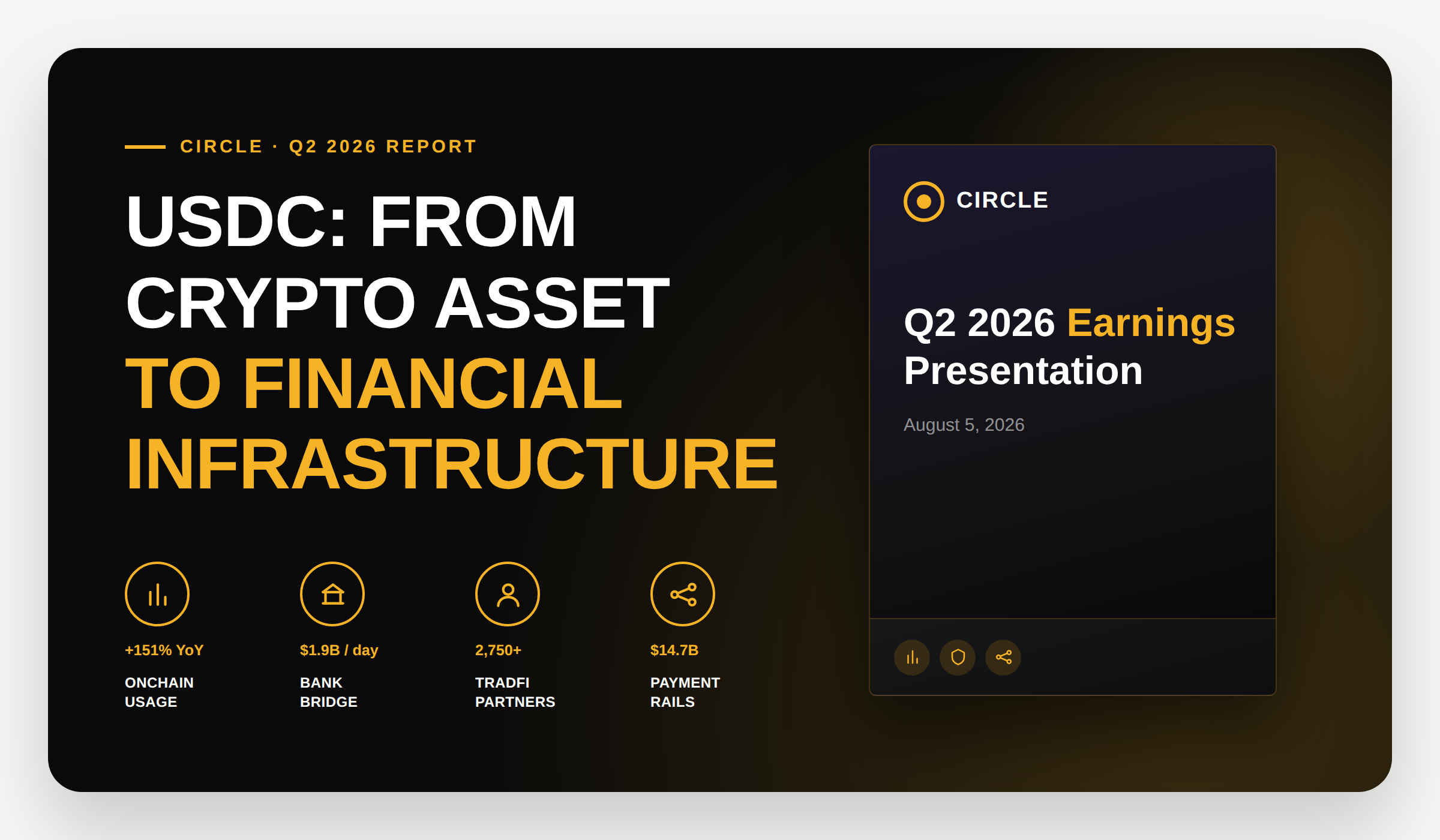
Circle Q2 2026 Report: USDC Is Becoming Financial Infrastructure
Circle’s Q2 2026 report shows how USDC is evolving from a stablecoin into a broader financial rail. Here are the numbers and trends that matter for payments and global businesses.
Circle Q2 2026: Stablecoins Are Becoming Financial Infrastructure
Stablecoins have spent years sitting somewhere between crypto markets and traditional finance.
Circle’s Q2 2026 results suggest that line is becoming much harder to see.
USDC circulation continues to grow. Transaction volume is growing much faster. Banks and financial institutions are moving closer to public blockchain infrastructure. Circle is expanding from stablecoin issuance into payments, tokenized assets, c
ustody, and its own blockchain infrastructure.
The bigger story is not simply that USDC had another strong quarter.
It is that stablecoins are starting to look like a real financial rail.
Here are the developments from Circle’s Q2 2026 Earnings Presentation that we believe matter most.
USDC is growing, but usage is growing much faster
USDC in circulation reached $73.3 billion at the end of Q2 2026, up 19% year over year.
That is significant growth on its own.
But transaction activity tells a more interesting story.
USDC recorded $14.8 trillion in onchain transaction volume during Q2, representing 151% year-over-year growth.
Circle also reported approximately:
- $163 billion in daily onchain transaction volume.
- $1.9 billion in daily minting and redemptions.
- $2.9 billion in daily USDC notional trading volume.
Daily minting and redemption activity increased 105% year over year.
This distinction between supply and activity is important.
A stablecoin can grow because more capital is being stored in it. But when transaction activity grows much faster than circulation, it suggests that the same digital dollars are being used more actively.
Money is not simply entering the system.
It is moving through it.
The wider market shows a similar pattern. Circle’s presentation, using CoinMarketCap and Visa Onchain Analytics data, shows stablecoin circulation growing 22% year over year, while reported transaction volumes grew 84%.
That may be one of the clearest signals that the stablecoin story is moving beyond holding and trading.
The bridge between banking and blockchain is becoming more important
Blockchain transaction speed gets much of the attention around stablecoins.
For businesses, however, a fast blockchain is only useful if money can also move efficiently into and out of it.
Circle reported $170 billion of USDC mint and redeem volume in Q2, compared with $83 billion one year earlier.
Circle’s network now includes more than 15 partner banks, 150 distribution partnerships, and 2,750 direct relationships.
The goal is straightforward.
Make it easier to move between fiat money and USDC across major markets.
This matters because the real business use case rarely ends on a blockchain.
A company may receive stablecoins but need EUR or USD for operating expenses.
A fintech may collect fiat but need stablecoins for international settlement.
A platform may need to move between both depending on the recipient, geography, or payment route.
The blockchain is one part of the journey.
The bridge between traditional money and digital money can be just as important as the rail itself.
Traditional finance is moving closer to stablecoins
One of the strongest themes in Circle’s report is the number of traditional financial institutions appearing throughout it.
The presentation highlights continued adoption involving names including BNY Mellon, Standard Chartered, Kakao, and JCB.
The Arc section goes even further.
Circle lists more than 100 private mainnet partners and shows a validator set that includes financial and infrastructure companies such as BlackRock, DTCC, Global Payments, ICE, Mastercard, MoneyGram, Standard Chartered, Sumitomo Mitsui, and Visa.
This changes the old narrative.
For years, crypto was often presented as an alternative financial system that would replace banks and traditional payment infrastructure.
What is emerging looks different.
Banks, card networks, asset managers, payment companies, and blockchain infrastructure are increasingly connecting to one another.
Stablecoins do not necessarily need to replace traditional finance.
They can become another rail inside it.
Regulation is becoming an infrastructure advantage
The report also makes regulation a central part of Circle’s strategy.
Circle reports USDC across 35 blockchain networks, more than 55 registrations and licenses, and availability across 185 countries.
The company also highlights:
- 1:1 reserve backing.
- Segregated reserve accounts.
- Monthly reserve-asset attestations by a Big Four accounting firm.
- AML and BSA controls.
- Real-time monitoring.
- OFAC screening.
Another major development came in July 2026.
Circle received final OCC approval to establish Circle National Trust under direct US federal oversight.
Circle describes this as a regulated foundation for digital asset custody and a future capability for USDC reserve management.
The strategic message is important.
Regulation is often described as friction for digital assets.
For institutional adoption, the opposite can also be true.
Banks and large businesses need clear rules, reserve transparency, compliance controls, and accountable counterparties before they can move meaningful financial activity onto new rails.
In that context, regulation becomes less of a brake and more of a bridge to adoption.
Stablecoins are becoming payment infrastructure
Perhaps the most relevant development for the payments industry is the growth of Circle Payments Network, or CPN.
CPN connects financial institutions around stablecoin-based payment flows.
Its annualized transaction volume reached $14.7 billion in Q2, growing 76% quarter over quarter. Circle reported 175 financial institutions enrolled by the end of June.
Circle is also working on the less visible parts of payment infrastructure.
The presentation highlights unified onboarding and liquidity, faster corridor activation, automatic rerouting when routes fail, and integrations with Circle Mint, StableFX, and Arc.
These details matter.
Moving a token from one wallet to another is relatively easy.
Building reliable payment infrastructure around it is harder.
Businesses need liquidity.
They need fiat settlement.
They need compliance.
They need reconciliation.
They need reliable payment routes.
They need reporting.
And they need systems that still work when something goes wrong.
That is where stablecoin payments start becoming less about crypto and more about financial operations.
USDC is becoming increasingly cross-chain
Another part of the infrastructure story is interoperability.
USDC is now supported across 35 blockchain networks.
Circle reports 756 CCTP routes across supported networks. Its Cross-Chain Transfer Protocol allows native USDC to move between chains without relying on traditional wrapped-token bridges.
Circle describes the goal as unified liquidity without fragmentation across blockchain ecosystems.
This may sound technical, but the business implication is simple.
Companies generally do not want to think about which blockchain their money is sitting on.
They want liquidity to be available where it is needed.
The more invisible this complexity becomes, the easier stablecoins become to use as ordinary financial infrastructure.
The story is expanding beyond the digital dollar
USDC remains Circle’s core product, but the Q2 presentation points toward a much broader strategy.
EURC circulation reached €382 million, compared with €172 million one year earlier.
That represents approximately 2.2x year-over-year growth.
Circle also reported $3.1 billion in USYC assets, compared with $0.3 billion a year earlier, representing growth of more than 10x. Circle describes USYC as the world’s largest tokenized money market fund.
This is an important expansion of the stablecoin thesis.
The opportunity may not stop with tokenized cash.
Cash can become digital.
Treasury assets can become digital.
Securities can become digital.
Settlement can move onto the same infrastructure.
That brings us to one of the most ambitious parts of Circle’s strategy.
Arc shows where Circle thinks financial infrastructure is heading
Circle plans to launch the Arc mainnet on September 16, according to the Q2 presentation.
Its testnet had already processed 502 million transactions across 2.8 million transacting wallets, with reported uptime of 99.99%.
Arc is not presented as another general-purpose blockchain.
Circle describes it as infrastructure designed specifically for regulated finance.
The network is designed around features such as:
- USDC-denominated gas.
- Sub-second finality.
- Configurable privacy.
- Built-in FX.
- Institutional validators.
Two partnerships show what Circle is aiming for.
DTCC integration is expected to bring tokenized real-world assets onto Arc, including selected equities, ETFs, and Treasuries. Circle also describes potential use cases around securities lending and collateral settlement.
Meanwhile, BlackRock’s BUIDL tokenized treasury fund is expected to deploy on Arc, with BlackRock also participating as a founding validator.
This suggests a much larger ambition.
Circle is not only trying to issue a successful stablecoin.
It is building an environment where money, assets, payments, liquidity, and settlement can increasingly exist on the same infrastructure.
AI agents may become another source of payment demand
One of the more experimental parts of the report is Circle’s work around AI agents.
Circle reports that 99.3% of x402 agent-payment volume settles in USDC, with more than 900 paid services already available in its agent marketplace as of July 31.
The idea is that software agents can hold spending policies, purchase services, settle payments onchain, earn money, and build reputation from completed transactions.
It is still early.
But it highlights something important about digital money.
Traditional payment systems were designed primarily around people and companies.
Software increasingly needs to transact as well.
Always-on, programmable money may therefore find use cases that do not map neatly onto today's card or banking infrastructure.
The financial results show a real business behind the narrative
Circle generated $701 million in total revenue and reserve income in Q2, up 7% year over year.
Adjusted EBITDA reached $143 million, up 8% year over year.
Other revenue grew 41% year over year, although reserve income remains the dominant part of Circle's revenue mix.
Circle continues to guide toward approximately 40% multi-year CAGR in USDC circulation.
The wider market expectations are even broader.
Third-party forecasts cited by Circle put the stablecoin market somewhere between $0.9 trillion and $4 trillion by 2030.
That range is huge.
But perhaps that is the point.
Nobody knows exactly how large the market will become.
The direction is easier to see than the final number.
What we think this means for businesses
Our main takeaway from Circle’s Q2 report is not that every company suddenly needs USDC.
It is that the distinction between “crypto infrastructure” and “financial infrastructure” is starting to disappear.
Stablecoins are becoming useful where they solve an actual financial problem.
That can mean accepting payments from customers who prefer digital assets.
It can mean paying contractors or partners internationally.
It can mean moving liquidity outside banking hours.
It can mean converting between fiat and digital currencies.
It can mean reaching markets where traditional payment rails are expensive or limited.
And increasingly, it can happen behind the scenes without the end user needing to understand blockchain at all.
This is also how we think about the market at INXY Payments.
We started with crypto processing and built products around accepting, converting, and sending digital money.
But businesses do not have a “crypto problem”.
They have a money problem.
They need to receive money, hold it, convert it, pay people, move it internationally, and keep control of the whole process.
Stablecoins are becoming one of the rails that can make those jobs easier.
The technology matters.
But as the infrastructure improves, businesses should need to think about it less.
That may be the clearest sign that stablecoins are growing up.
Explore the full Circle Q2 2026 report
We have highlighted the developments we found most relevant for payments and global businesses.
There is much more in the original 35-page Circle Q2 2026 Earnings Presentation, including detailed data on USDC circulation, liquidity, Arc, CPN, tokenized assets, AI, financial performance, and Circle’s outlook.
The full Circle Q2 2026 report is available below.
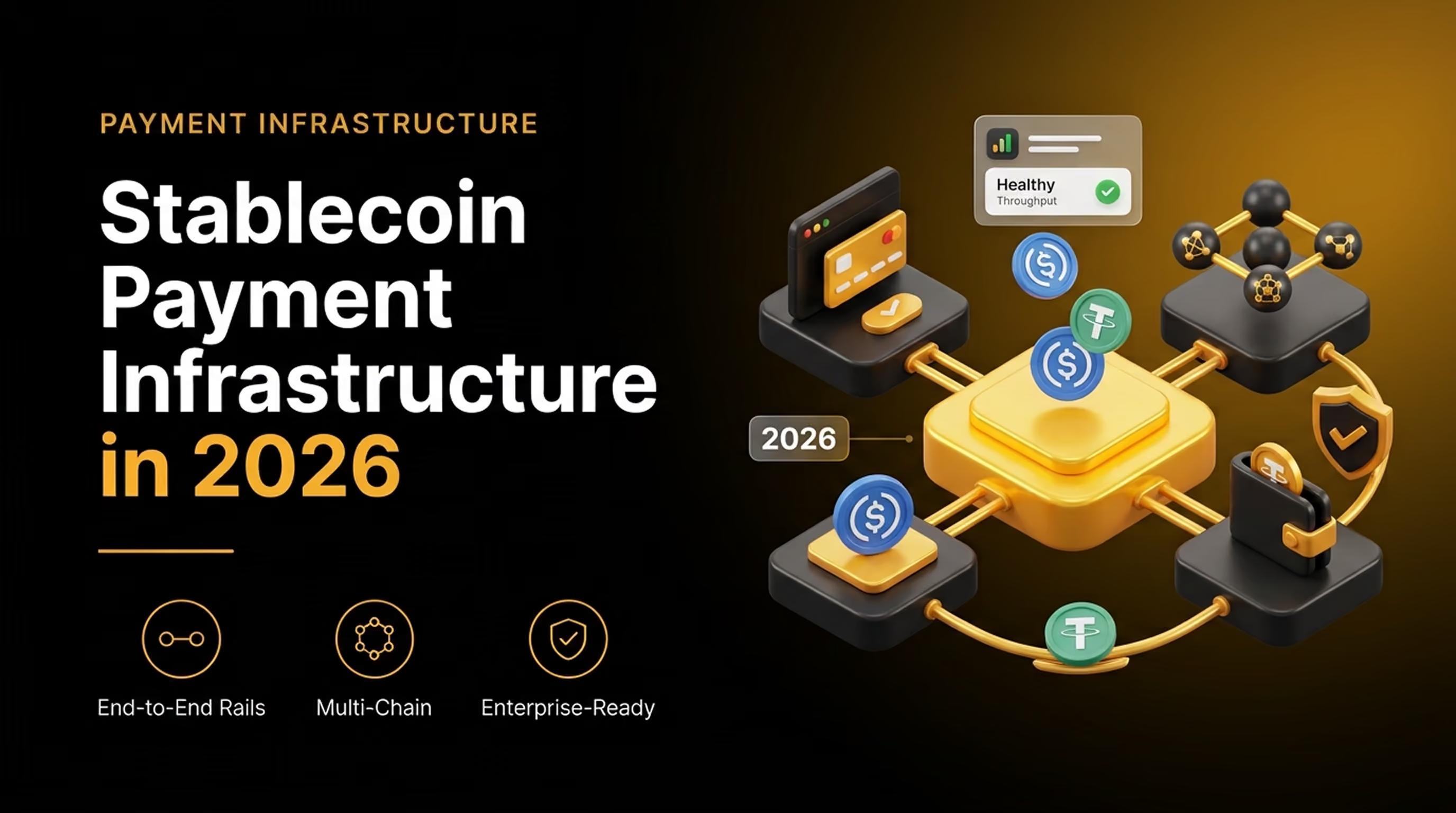
Stablecoin Payment Infrastructure in 2026
The most important shift in digital payments this year is not a new chain or a new token. It is the quiet realisation that stablecoins have crossed from speculation into infrastructure. The Paypers’ Global Stablecoins Report 2026 puts total stablecoin market capitalisation at roughly USD 317.9 billion, with projections that it could exceed USD 2 trillion as institutional participation accelerates — and some contributors put the figure closer to USD 4 trillion by 2030. At INXY, we read those numbers differently from most. The headline is not the size of the market. It is that stablecoins have become one of the first blockchain-based instruments to show clear product-market fit in payments.
The most important shift in digital payments this year is not a new chain or a new token. It is the quiet realisation that stablecoins have crossed from speculation into infrastructure. The Paypers’ Global Stablecoins Report 2026 puts total stablecoin market capitalisation at roughly USD 317.9 billion, with projections that it could exceed USD 2 trillion as institutional participation accelerates — and some contributors put the figure closer to USD 4 trillion by 2030. At INXY, we read those numbers differently from most. The headline is not the size of the market. It is that stablecoins have become one of the first blockchain-based instruments to show clear product-market fit in payments.
That single fact reframes the question every finance team, PSP, and merchant should be asking. It is no longer “should we look at stablecoins?” It is “which payment flows should run on them, and what stablecoin payment infrastructure do we need to make that safe, compliant, and economical?” This article is our read of the report’s data — and what it means for businesses that want to accept stablecoin payments, automate payouts, and move value across borders without rebuilding the financial stack from scratch.
Stablecoins have reached product-market fit in payments
For a decade, crypto payments were a promise: faster, cheaper money movement that never quite arrived at scale. What changed is not the blockchain — it is the infrastructure wrapped around it. The report is blunt on this point, describing stablecoins as one of the first blockchain-based instruments to demonstrate clear product-market fit in payments, increasingly used for cross-border settlement, treasury operations, merchant payouts, and everyday commerce.
The adoption base is real, not theoretical. Triple-A’s data cited in the report shows cryptocurrency ownership rising from around 560 million people in 2024 to roughly 700 million in 2026 — about 8.5% of the global population. These are not all traders. A growing share are freelancers, remote workers, and businesses that earn and hold digital dollars and want to spend or settle them without friction. Demand for a usable rail already exists; the constraint has been supply of trustworthy infrastructure.
Our view is simple. The metric that matters is not the market cap of crypto. It is the number of businesses that can use stablecoins to solve a concrete money problem — a supplier that needs paying today, a payout that needs to clear over a weekend, a treasury balance stranded behind a banking cut-off. That is the lens we apply to every number below.
Enterprise adoption is at an inflection point
Awareness of stablecoins among enterprises is now nearly universal, yet active production use remains modest. That gap is exactly what an inflection point looks like. In the EY-Parthenon survey referenced in the report (n=350), a majority of current non-users said they expect to begin using stablecoins within the next six to twelve months. The conversation inside finance teams has moved from “should we look at this?” to “where should we use it first?”
The intent is concentrated, not scattered. Among corporates asked which use cases they are most interested in over the next five years, the top answers were paying suppliers cross-border (77%), accepting cross-border business payments (49%), and accepting domestic business payments (37%). In financial services specifically, 91% of respondents said stablecoins would become a top priority or receive more attention. This is a back-office, treasury-first story — the place where return on investment is clearest and operational risk can be tightly controlled.
One data point matters more than any other for how this market will be served. When corporates were asked how important it is that their existing banking or payments provider supports stablecoins, 81% said it was critical or important, and 68% said they would prefer a bank-grade issuer. In other words, most businesses do not want to become crypto companies. They want to reach stablecoin capability through providers they already trust, embedded into the ERP and treasury systems they already run. Interoperability beats novelty every time.
Cross-border is the killer use case — but only where legacy rails fail
Cross-border payments lead enterprise adoption for a practical reason: this is where the old process is genuinely broken. A traditional international transfer can take days, pass through several correspondent banks, and leave money stranded in transit. Stablecoins offer near real-time settlement, 24/7 availability, and on-chain visibility — and the economics can be decisive. Among organisations already using stablecoins, 41% report cost savings of 10% or more compared with traditional methods, with the largest gains in cross-border B2B, where correspondent fees, FX spreads, and reconciliation costs stack up.
But the honest version of this story is geographic, and we insist on telling it that way. In Europe, where SEPA Instant already moves money in seconds at near-zero cost, the incremental advantage of a stablecoin for a domestic transfer is small. The value appears on corridors where legacy infrastructure fails. The report cites OpenPayd’s point that a USD 200 remittance to Sub-Saharan Africa can cost more than 8%, against a global average above 6% — and that stablecoins can cut that by over 75%, going as low as 0.5% when paired with reliable on- and off-ramps. MetaComp describes a payment from the UAE to Singapore that takes two to five days through correspondent banking settling in roughly 20 minutes at about half the cost.
So the right question is not “will stablecoins replace banks?” It is “which payment flow should run on which rail?” Stablecoins are not a universal upgrade; they are a precise tool for corridors that are slow, expensive, or fragmented. Matching the right rail to the right flow, market by market, is the actual work — and it is the work we build infrastructure to automate.
The cost nobody talks about: on-ramp and off-ramp economics
Here is the trap that sinks naive stablecoin projects, and the report is refreshingly direct about it. The blockchain fee is only a fraction of the true cost. Moving money into a stablecoin (the on-ramp) and back into local fiat (the off-ramp) is not free. Depending on provider, corridor, and volume, conversion fees run from 0.5% to more than 2% per leg — 1% to 4% on a full round trip. For a business with thin margins, that can erase the headline saving entirely.
The lesson we draw is one we design around every day: the cheapest blockchain transaction does not automatically produce the cheapest payment. Any honest assessment of stablecoin economics must include the full on/off-ramp cost, not just the on-chain fee. This is precisely why liquidity, FX, conversion, and settlement infrastructure matter so much — and why the industry is consolidating around orchestration layers such as Circle’s Payments Network (CPN) and cross-chain protocols like CCTP that move USDC between blockchains without costly bridges. The economics only work when at least one party can hold and route stablecoins natively, and when conversion is priced in basis points rather than percentage points.
For most businesses, building that liquidity and conversion layer in-house is neither realistic nor wise. The competitive edge is not owning a wallet; it is reaching deep, well-priced liquidity through infrastructure that already has it.
The hard part is no longer the blockchain — it is everything around it
If there is one theme the report returns to again and again, it is this: the technology is ready and has been for years. What was missing was the infrastructure required to run stablecoin flows safely, at scale, through systems businesses already understand. Companies need compliance, liquidity, fiat connectivity, reconciliation, custody, and orchestration wrapped around the stablecoin rail. That is where the market gets interesting — and where the winners will be decided.
Compliance is becoming part of the product
Regulation has flipped from the biggest barrier to an adoption enabler. Frameworks such as the GENIUS Act in the US and MiCA in the EU now give issuers and providers a clearer operational footing, especially for bank-issued or bank-distributed stablecoins that meet defined reserve, compliance, and governance standards. The question is no longer whether stablecoins are “too risky.” It is whether a company’s infrastructure is good enough to use them safely.
That raises the bar on operations. KYC, AML, Travel Rule obligations, wallet screening, and transaction monitoring all still apply — and adapting them to on-chain flows is a genuine engineering challenge. The report notes that redundant, repeated KYC is a real drag on growth: across the industry, 25–35% of users abandon onboarding when asked to upload an ID and selfie, while modern compliance engines can screen over 99% of transactions within seconds. Compliance is no longer a checkbox bolted on at the end. It is part of the product, and it has to be fast enough not to kill conversion.
Orchestration and the multi-rail future
The report’s central strategic conclusion — and ours — is that stablecoins will not replace every payment rail. The likely future is multi-rail: bank transfers, instant-payment networks, and stablecoins operating side by side, each carrying the flows it serves best. Stablecoins shine where traditional rails are slow, costly, or fragmented; in highly efficient domestic markets, their edge narrows.
That makes orchestration the decisive capability. Orchestration is the end-to-end management of a payment’s journey — deciding, for each transaction, whether to use a stablecoin, which issuer and chain to select, and when to convert between fiat and digital assets, based on value, urgency, liquidity conditions, and counterparty location. As more rails become available, this routing layer is where cost, speed, and compliance are won or lost. The industry examples in the report make the point: the SG-FORGE and Swift live trial settled tokenised bonds using both traditional financial infrastructure and regulated digital currencies, and Nexus Global Payments is interlinking domestic instant-payment systems like India’s UPI and Singapore’s FAST. None of these efforts replace the old system. They make the whole system work together.
What this means for businesses evaluating stablecoin payments
This report describes, almost line for line, the problem we built INXY to solve. INXY provides the infrastructure businesses need to accept stablecoin payments, automate payouts, convert between crypto and fiat, and move money across borders — without building blockchain, liquidity, compliance, and settlement systems from scratch. We operate the layer behind the customer experience, so the complexity stays out of sight.
Concretely, that means:
- The merchant does not need to become a crypto company to accept stablecoin payments — acceptance runs through familiar checkout and settlement flows, with conversion to fiat handled behind the scenes.
- The fintech does not need to build the entire compliance stack — KYC, AML, Travel Rule, and wallet screening are part of the rail, fast enough to protect conversion rather than throttle it.
- The finance team does not need to manage a collection of wallets and chains — payouts, multi-currency treasury, and on/off-ramp conversion are orchestrated through a single integration, priced to keep the full round-trip economics intact.
If you are evaluating stablecoins, we would frame the decision the way the report’s data suggests. Start with the corridors and flows where traditional rails genuinely fail — cross-border supplier payments, international payouts, multi-currency treasury — not with the flows your domestic bank already handles well. Model the full on/off-ramp cost, not just the on-chain fee. And treat compliance and orchestration as core product requirements, not afterthoughts. The businesses that win with stablecoins are not the ones that move tokens; they are the ones that make different payment systems work together.
The winners will be the integrators, not the disruptors
The biggest shift captured in the Global Stablecoins Report 2026 is not from fiat to crypto. It is from crypto product to financial infrastructure — banks, PSPs, and processors integrating stablecoins into systems that already exist. Stablecoins do not need to destroy the old rails to matter. They need to make the whole system move value better.
That is the future we are building for at INXY. Not one payment rail, but many — with an infrastructure layer that decides, routes, converts, and settles across all of them, so businesses get the speed and cost of stablecoins with the trust and control finance teams require. The stablecoin era will not be won by whoever shouts loudest about disruption. It will be won by whoever quietly makes the rails work together.
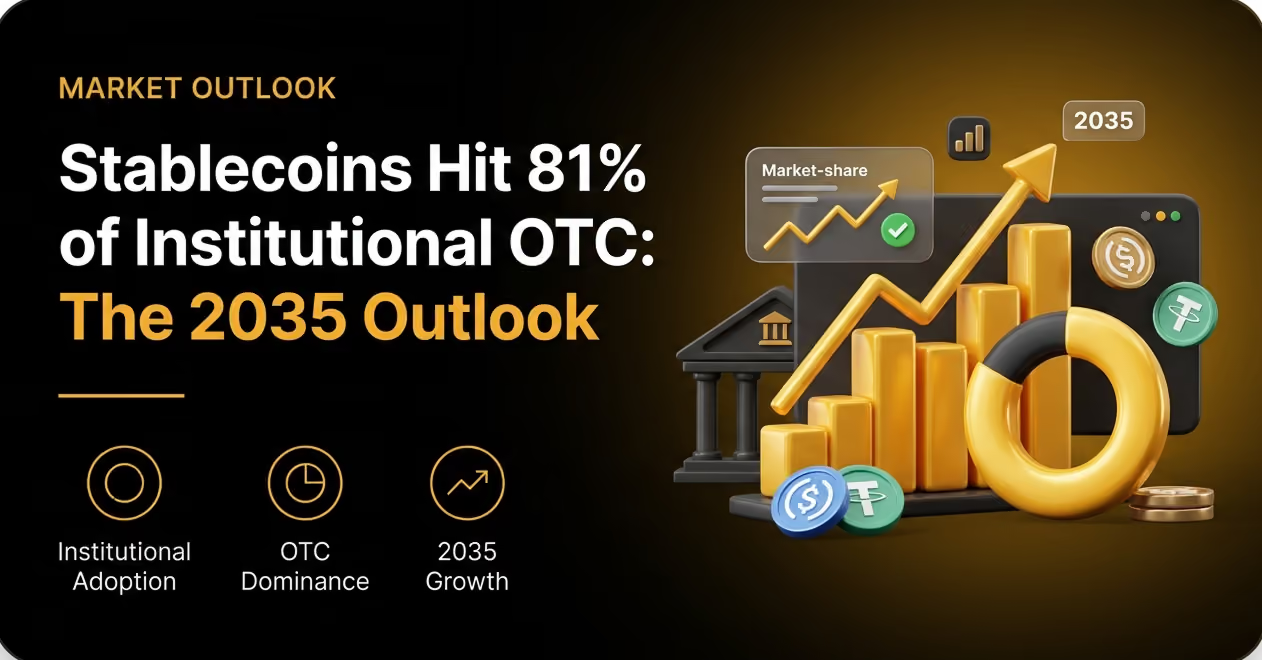
Stablecoins Just Took Over Institutional OTC
Stablecoins hit 81% of institutional OTC in H1 2026. INXY unpacks Finery Markets' Stablecoin 2035 report — key data and what it means for payments.
An INXY expert read on Finery Markets' "Stablecoin 2035: Back to the Future" report (H1 2026)
Finery Markets just published its "Stablecoin 2035" report, and the headline number is hard to ignore: stablecoins reached 81% of all institutional OTC trades in H1 2026, up from 26% in 2023. The debate about whether stablecoins have product-market fit is over. The interesting questions now are operational — and they land squarely on the businesses that move money for a living.
Here is how our team reads the data, and what it changes for anyone building on stablecoin rails.
The numbers that matter
- OTC is the only growing segment. In H1 2026, OTC trading volumes grew +76% YoY, while the top-20 DEXs fell -38% and the top-20 CEXs -13%. Institutional flow is consolidating into OTC, and it is settling in stablecoins — stablecoin OTC volume nearly doubled (+94% YoY).
- The dollar owns the rail. USD-pegged tokens accounted for 99.87% of OTC stablecoin volume. EUR stablecoins grew 32x year over year, but off a base so small it changes nothing structurally — yet.
- The market is deep and diversifying. Total supply is now north of $300B (~$319B). Tether sits around $190B and USDC around $76B, but their combined share slipped from ~89% to ~83% as issuers multiplied from 30 in 2020 to 215+ in 2025.
- Real assets are following. Tokenized U.S. Treasuries crossed $15B (+150% YoY); tokenized equities are near $1.5B (+400%). Roughly two-thirds of stablecoin supply is held in emerging markets — savings demand, not speculation.
Three signals for payment businesses
1. Payments and treasury — not trading — are the real entry point. The report's contributors converge on one idea: stablecoins become "ordinary" inside a company through the treasury and payments desk, not the trading floor. Cross-border corridors that took 2–5 business days now settle in minutes, with all-in costs compressing from 3–5% (correspondent banking) toward ~1%. For a payments provider, that is the pitch: released working capital and removed friction on flows that recur every single day.
2. The winning infrastructure is invisible. Multiple authors describe the same 2035 endpoint — the word "stablecoin" disappears from the enterprise vocabulary because the rails sit beneath familiar fintech interfaces. Users initiate value in stablecoins; merchants and counterparties receive local fiat without ever touching a wallet, chain, or bridge. The value isn't the token. It's the compliance-first connective layer that hides complexity while preserving speed and 24/7 availability.
3. "Regulated" is the moat. Across every contribution, the common thread is regulation. By 2035, regulated coins — dollar and local alike — are expected to hold the dominant share of supply and activity. Licensing, compliance translation across jurisdictions (MiCA, VARA, Singapore's PSA), and a single clean interface across a fragmented patchwork of currency regimes become the real competitive edge — not raw settlement speed.
The INXY takeaway
The report describes a world where money movement runs on stablecoin rails without the end user ever needing to know it. That is exactly the layer payment infrastructure providers should be building toward: regulated on/off-ramps, stablecoin-to-fiat settlement in the currencies clients actually need, and an interface that treats "any currency, any chain" as a non-issue.
The strategic mistake would be to read this as a race to launch yet another stablecoin. The report is explicit that by 2035, "the truly savvy stablecoin strategy may be not launching one at all." The durable advantage is not issuance — issuance is easy. It is liquidity, compliance, and distribution wired into the systems businesses already use.
For merchants, PSPs, and treasuries evaluating stablecoin payments today, the question the report leaves us with is the right one to steal: not how do we add stablecoins to our stack — but what does our business look like when settlement is instant, always-on, and fiat never needs to leave the chain in the first place?
This commentary is informational and not investment advice.
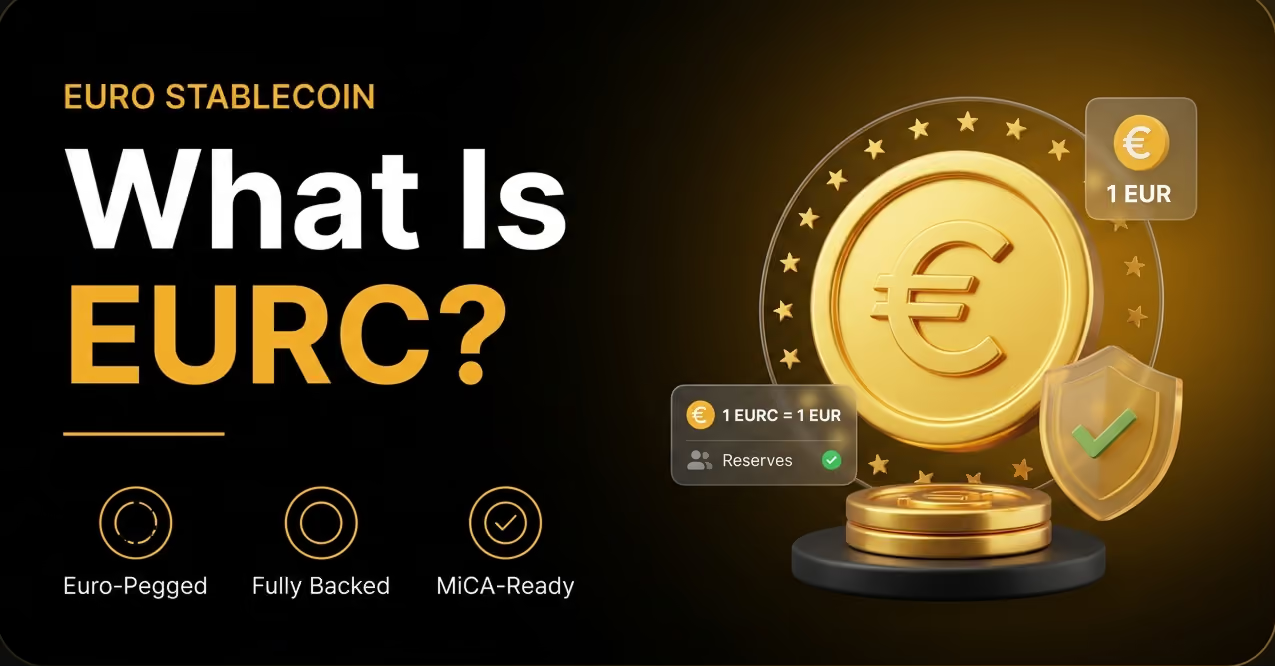
What Is EURC? Circle's Euro Stablecoin Explained for Business Payments
Most stablecoins track the US dollar. But if your revenue, costs, and recipients are in euros, paying in a dollar-pegged token means an FX round-trip on every transaction. EURC solves that: it's a euro-denominated stablecoin that lets euro-native businesses move money on blockchain rails without leaving the euro.
Most stablecoins track the US dollar. But if your revenue, costs, and recipients are in euros, paying in a dollar-pegged token means an FX round-trip on every transaction. EURC solves that: it's a euro-denominated stablecoin that lets euro-native businesses move money on blockchain rails without leaving the euro.
Here's what EURC is, how it works, and why it has become the default euro stablecoin for regulated business in 2026.
EURC in one sentence
EURC (Euro Coin) is a stablecoin pegged 1:1 to the euro, issued by Circle — the same company behind USDC — and backed fully by euro-denominated reserves. One EURC is designed to always be redeemable for one euro.
Think of it as a digital euro you can send anywhere in minutes, 24/7, without a bank wire.
Who issues EURC, and why that matters
EURC is issued by Circle, a regulated financial technology company. That matters for one reason above all: regulation. Circle holds an EU Electronic Money Institution (EMI) license in France, and that single authorization passports EURC across all 27 EU member states under MiCA, the EU's crypto framework.
In practice, EURC is a MiCA-compliant e-money token. When MiCA's rules took full effect and non-compliant stablecoins were removed from EU-regulated exchanges, EURC was one of the assets that stayed — and it captured much of the resulting demand. By 2026 it had become the dominant euro stablecoin, holding roughly 41% of the euro-stablecoin market, up from about 17% a year earlier.
For a business, that means EURC isn't a fringe experiment — it's the euro stablecoin most likely to be accepted, supported, and compliant across Europe.
What backs EURC?
EURC is 100% backed by euro reserves held in cash and cash-equivalent instruments under Circle's full-reserve model. Circle publishes regular reserve reporting, the same transparency approach it applies to USDC. Each token in circulation is matched by euros held in reserve, which is what keeps the 1:1 peg dependable.
As of 2026, EURC's circulation sits in the range of roughly €400–460 million — smaller than dollar stablecoins, but by far the largest in the euro category.
Which blockchains support EURC?
EURC is a multi-chain asset. It runs natively on:
- Ethereum (where the majority of euro-stablecoin supply sits)
- Base
- Solana
- Stellar
- Avalanche
- World Chain
The network you use determines transfer speed and fees. For payouts, low-fee chains like Solana, Base, or Stellar keep costs to cents; Ethereum is the most liquid but the most expensive to transact on.
Why businesses use a euro stablecoin
If you already operate in euros, why hold a euro on a blockchain instead of in a bank? A few concrete reasons:
- No FX round-trip. Paying euro-based recipients in a dollar stablecoin means converting EUR → USD → EUR, losing spread each way. EURC keeps euros as euros.
- Speed. EURC settles in minutes, any time — including weekends and holidays, when SEPA and bank rails are closed.
- Global reach. A recipient anywhere with a wallet can receive euros, without needing a European bank account.
- Programmability. EURC can be sent via API for automated payouts, something traditional euro rails don't offer natively.
- Regulatory comfort. As a MiCA-compliant token, EURC fits the compliance expectations of European banks, auditors, and partners.
EURC vs a bank euro balance
A euro in your bank and a euro in EURC are both euros — the difference is the rails.

EURC doesn't replace your bank — it complements it for fast, global, programmable euro movement.
Frequently asked questions
What is EURC? EURC (Euro Coin) is a euro-pegged stablecoin issued by Circle, backed 1:1 by euro reserves. It lets businesses hold and send euros on blockchain networks.
Is EURC the same as USDC? They share an issuer (Circle) and a full-reserve, MiCA-compliant model, but EURC is pegged to the euro while USDC is pegged to the US dollar. See our EURC vs USDC comparison.
Is EURC regulated? Yes. EURC is a MiCA-compliant e-money token. Circle's French EMI license passports it across all 27 EU member states.
What backs EURC? Euro-denominated reserves held 1:1 against tokens in circulation, under Circle's full-reserve model with regular reserve reporting.
Which networks support EURC? Ethereum, Base, Solana, Stellar, Avalanche, and World Chain. Choose a low-fee network for cost-efficient payouts.
Can businesses pay in EURC? Yes — EURC is widely used for euro-denominated payouts to contractors, suppliers, and partners, especially within the EU. Learn more in our guide to paying in EURC.
Move euros the modern way
If your business runs on euros, you can settle in euros on-chain — fast, global, and MiCA-compliant. INXY's EURC mass payouts let you fund and pay in euros without the FX round-trip or the crypto overhead. New to the asset? Compare it with the dollar option in EURC vs USDC.
This article is general information, not financial or legal advice.

How to Pay Contractors and Affiliates in USDC: A Practical 2026 Guide
Paying a global team through banks means FX spreads, 3–5 day waits, intermediary fees, and a recipient in another country who receives less than you sent. Paying them in USDC — a fully-reserved, dollar-pegged stablecoin — can turn that into a same-day transfer for cents. But doing it properly, at scale, and in a way your accountant accepts takes more than a wallet.
Paying a global team through banks means FX spreads, 3–5 day waits, intermediary fees, and a recipient in another country who receives less than you sent. Paying them in USDC — a fully-reserved, dollar-pegged stablecoin — can turn that into a same-day transfer for cents. But doing it properly, at scale, and in a way your accountant accepts takes more than a wallet.
This guide walks through how to pay contractors in USDC — the setup, the networks, the compliance basics, and how to keep your books in fiat.
Why businesses pay in USDC
USDC (issued by Circle) is a stablecoin pegged 1:1 to the US dollar and backed by cash and short-dated US Treasuries, with monthly attestations from Deloitte. For paying people, that combination is the point:
- Stable value. Recipients get dollars, not a volatile asset. 1 USDC ≈ $1 at send and at cash-out.
- Speed. Payments settle in minutes, 24/7, including weekends and holidays.
- Global reach. Anyone with a wallet can receive, regardless of local banking.
- Low cost. On low-fee networks, a payout costs cents rather than a wire fee.
- Regulatory standing. USDC is MiCA-compliant in the EU, which makes it a durable choice for European corridors (more on that below).
Before you start: four things to get right
1. Confirm the recipient can receive USDC. They need a wallet address on a network you both support (Ethereum, Solana, Base, Polygon, and others). Confirm the network explicitly — a USDC transfer sent to the wrong network can be lost.
2. Decide who bears the fee. Will you gross up payments so the contractor receives the full agreed amount after network fees, or net it out? Set this in the contract.
3. Handle tax and classification. Paying in stablecoin doesn't change worker classification or your reporting obligations. Contractors are still responsible for their own taxes; you still keep records. Treat USDC payouts like any other payment for compliance purposes.
4. Keep fiat records. Your accounting should capture the fiat value at the time of payout, the fee, the recipient, and the transaction hash — not just on-chain data.
Method 1: Manual USDC payments
For a few contractors, you can pay directly from a self-custody wallet or exchange.
Steps:
- Fund a wallet with USDC and the network's gas token.
- Confirm each contractor's address and network in writing.
- Send each payment; send a small test transfer first for new, large recipients.
- Record each transaction hash against the invoice and its fiat value.
Limits: no automation, no built-in screening, and manual reconciliation. It works for a handful of people and breaks down beyond that.
Method 2: Bulk USDC payouts via CSV or API
For a real team — dozens or thousands of contractors, affiliates, or creators — a payout platform is the practical route. You prepare a recipient list and process it as one batch.
A typical flow:
- Fund in fiat. With a fiat-native provider like INXY, top up in EUR or USD via SEPA or SWIFT — no need to buy crypto yourself.
- Upload a CSV or call the API. Include recipient, amount, and network. The API path lets you trigger payouts straight from your own platform or billing system.
- Automated compliance. The provider runs KYT and sanctions screening and validates addresses before sending.
- Recipients get paid. USDC lands in minutes on supported networks.
- Reconcile in fiat. Export batch-level records with fiat values, fees, payout IDs, and hashes.
This removes the two hardest parts of paying a global team in crypto: compliance and accounting. You never manage keys or gas, and your finance team works in EUR or USD.
Choosing the network for USDC payouts
USDC runs natively on several chains. For payouts:
- Solana / Base / Polygon: cents per transfer, fast — ideal for high-volume contractor and affiliate payments.
- Ethereum (ERC-20): the most liquid and widely integrated, but the most expensive — reserve it for recipients who require it.
Match the network to the recipient's wallet and the payout size; a platform can route this automatically.
Compliance: don't skip screening
Paying contractors across borders means you're exposed to sanctions and AML rules. Two non-negotiables:
- Sanctions screening of recipient wallets before payout.
- Transaction monitoring (KYT) to flag high-risk addresses.
Manual and script-based payouts leave this to you. A regulated payout provider builds it into the flow — which is often the difference between "using crypto rails" and "creating a banking-risk problem."
Frequently asked questions
Can I pay international contractors in USDC? Yes. Anyone with a compatible wallet can receive USDC in minutes, regardless of country, as long as it's legal in their jurisdiction. It's widely used for cross-border contractor, freelancer, and affiliate payments.
Do I need to hold crypto to pay contractors in USDC? No. A fiat-native platform lets you fund in EUR or USD and keep accounting in fiat while recipients receive USDC.
Is paying contractors in USDC legal? Paying in USDC is legal in most jurisdictions, but you remain responsible for worker classification, tax reporting, and AML/sanctions compliance — the same as any payment method. Check local rules for your recipients.
What does it cost to pay someone in USDC? On low-fee networks like Solana, Base, or Polygon, a USDC transfer costs cents. On Ethereum it can be several dollars. Choosing the network controls the cost.
How do I keep accounting clean when paying in USDC? Record the fiat value at payout time, the fee, and the transaction hash for each payment. Payout platforms generate these exports automatically.
Pay your global team without the crypto overhead
If you're paying contractors, affiliates, or creators at scale, you shouldn't be managing wallets, gas, and screening by hand. INXY's mass USDC payouts let you fund in fiat, pay globally in minutes, and reconcile in EUR or USD — with compliance built in. Building a broader payroll flow? See our contractor payroll solution, or weigh the assets in our USDT vs USDC comparison.
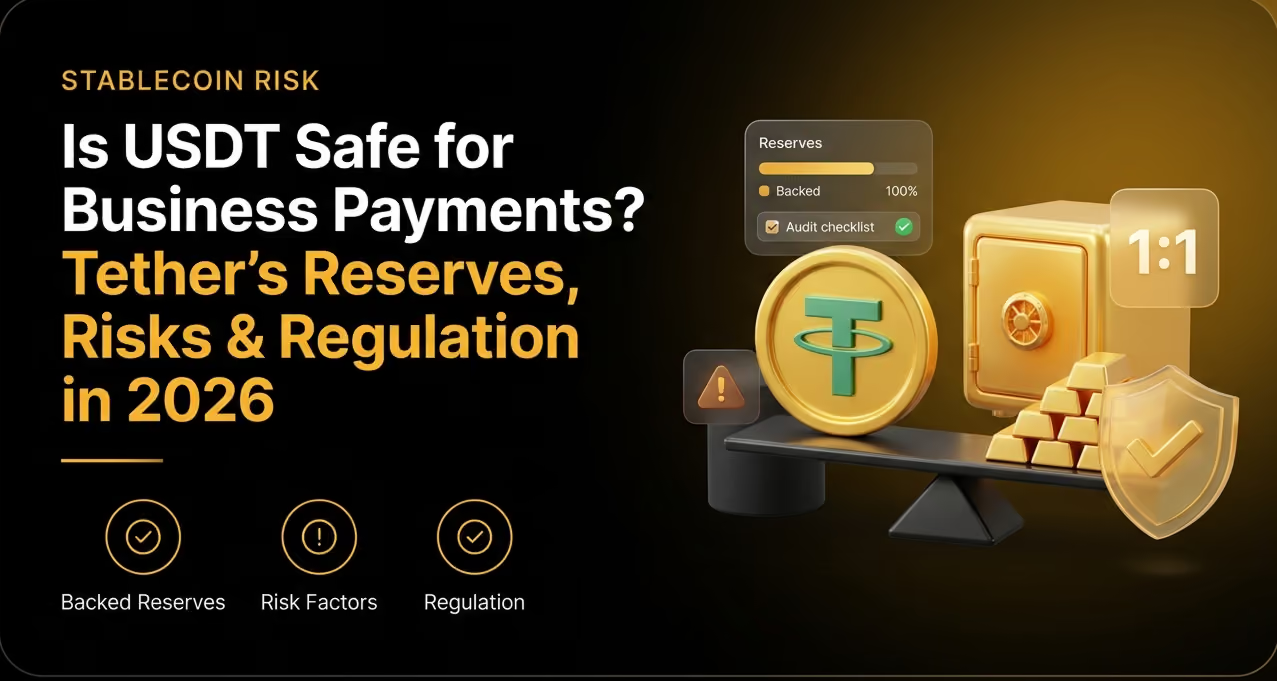
Is USDT Safe for Business Payments? Tether's Reserves, Risks & Regulation in 2026
If your business is about to move real money through USDT, "is USDT safe?" is the right question to ask first. Tether is the largest stablecoin in the world — roughly $188 billion in circulation and ~59% of the entire stablecoin market as of mid-2026 — but scale and safety aren't the same thing.
If your business is about to move real money through USDT, "is USDT safe?" is the right question to ask first. Tether is the largest stablecoin in the world — roughly $188 billion in circulation and ~59% of the entire stablecoin market as of mid-2026 — but scale and safety aren't the same thing.
This is a balanced look at what actually backs USDT, where the real risks sit, and how those risks apply specifically to a company using Tether for payouts rather than trading.
What USDT is — and what "safe" means here
USDT (Tether) is a stablecoin designed to hold a 1:1 peg to the US dollar. Each token is meant to be redeemable for one dollar, backed by reserves Tether holds. For a business, "safe" breaks into three practical questions:
- Peg risk — will 1 USDT still be worth ~$1 when my recipient cashes out?
- Counterparty risk — is the issuer solvent and are the reserves real?
- Operational and regulatory risk — can I legally and reliably use it where I operate?
Let's take them in order.
Peg stability: strong, with rare wobbles
In normal conditions, USDT trades within a fraction of a cent of $1. Its depth of liquidity is unmatched — it's the most traded crypto asset on earth, which makes the peg resilient.
It is not immune, though. During acute market stress (the 2022 Terra/UST collapse, the 2023 US regional-bank episode) USDT briefly de-pegged by a few percent before recovering. For a payout business, the takeaway is not "avoid USDT" but "don't sit on large idle balances." If you convert at payout time rather than warehousing Tether, short-lived wobbles rarely reach the recipient.
Reserves: what backs USDT in 2026
This is where scrutiny has historically been sharpest, and where transparency has improved.
Per Tether's Q1 2026 attestation (BDO Italia), the company reported roughly $191.8 billion in total assets against its liabilities, with a reserve mix heavily weighted toward liquid, low-risk holdings:
- ~$135 billion in US Treasuries — the bulk of reserves in the most liquid safe asset there is.
- ~$13 billion in gold, plus Bitcoin and other holdings.
- Reported net equity of around $8 billion, a buffer above the tokens in circulation.
Two honest caveats remain:
- Tether publishes attestations, not a full audit by a Big Four firm. An attestation confirms balances at a point in time; it's less rigorous than a continuous audit. Critics have pushed Tether on this for years.
- A minority of reserves has historically included assets beyond cash and Treasuries. The direction of travel is toward higher-quality, more liquid reserves, but it's worth knowing what you hold.
For most businesses, a reserve base dominated by US Treasuries is reassuring. The transparency gap versus a fully audited competitor is real but narrowing.
Regulatory risk: the biggest practical issue for EU businesses
Here's the risk that most directly affects where and how you can use USDT: Tether did not seek authorization under the EU's MiCA regulation.
The consequences are concrete. Through late 2024 and 2025, MiCA-regulated exchanges removed USDT for customers in the European Economic Area — Coinbase, Crypto.com, Binance (EEA) and others delisted or restricted it — because offering a non-authorized stablecoin put their own licenses at risk. USDT trading volumes on EU venues fell sharply, while MiCA-compliant alternatives like USDC and EURC gained share.
USDT is not banned to hold, but its regulated on/off-ramp availability in the EU has narrowed. Tether has instead pursued a US federal path (under the GENIUS Act) via a US-domiciled entity. If your recipients or your business are EU-based, this matters: a MiCA-compliant stablecoin may be the more durable choice for European corridors. (See "Is USDC regulated?" and our USDT vs USDC comparison.)
Operational risk: irreversibility and wrong-network errors
Independent of Tether the company, USDT carries the operational risks of any on-chain asset:
- Irreversibility. A payout sent to a wrong or wrong-network address is typically gone.
- Network fragmentation. USDT on Tron, Ethereum, Solana and others isn't interchangeable at the address level.
- Compliance exposure. Paying a sanctioned or high-risk wallet is a legal problem, not just a technical one.
These are managed with address validation, test transfers, and — at volume — KYT and sanctions screening built into your payout flow.
So, is USDT safe for business payouts?
A fair summary:
- Peg: Strong in normal conditions; convert at payout time to avoid stress-window exposure.
- Reserves: Large and Treasury-heavy, but attested rather than fully audited.
- Regulation: The real watch-item — limited MiCA standing constrains EU usage.
- Operations: Safe when you use validation, screening, and disciplined records.
For high-volume global payouts, USDT remains the most liquid and widely accepted stablecoin. The smart posture is to use it deliberately: don't warehouse it, screen your recipients, keep clean fiat records, and choose a MiCA-compliant asset where European regulation demands it.
Frequently asked questions
Is USDT backed by real dollars? USDT is backed by reserves that, per Tether's 2026 attestations, are dominated by US Treasuries plus cash equivalents, gold, and other assets. These are confirmed by attestation rather than a full independent audit.
Can USDT lose its peg? It can briefly deviate during extreme market stress, as it has a few times historically, but it has recovered each time. Deep liquidity supports the peg in normal conditions.
Is USDT legal in the EU? Holding USDT is not illegal, but Tether is not MiCA-authorized, and many EU-regulated exchanges have delisted it for EEA users. For EU corridors, a MiCA-compliant stablecoin is often more practical.
Is USDT safe enough for payroll and affiliate payouts? For most businesses, yes — provided you convert near payout time, screen recipients, and keep proper records. The controls matter as much as the asset.
Use USDT with the controls built in
The safest way to use USDT for business isn't to trust a single wallet — it's to run payouts through infrastructure that screens recipients, validates networks, and reports in fiat. That's how INXY's mass USDT payouts are designed: fund in EUR or USD, pay out globally, and keep audit-ready records — without warehousing crypto risk.
This article is general information, not financial or legal advice. Evaluate stablecoin exposure against your own jurisdiction and risk policy.
News

Unlock Global Scale: Meet INXY Payments at Affiliate World Asia in Bangkok


Building the Future of Finance: INXY Payments at TOKEN2049 Asia
Pracujmy razem
Pomoc ekspertów w celu zapewnienia sukcesu weryfikacji biznesowej