
Blog
In this dedicated blog page, we invite you to explore a wealth of knowledge, expertise, and inspiration that transcends traditional boundaries.

How to Integrate Crypto Payments into Your Business: A Practical Guide
Adding a crypto payment gateway to your business can open new doors. It lets you accept crypto payments from customers worldwide, bringing faster transactions, lower fees, and no chargebacks. But it’s not as simple as flipping a switch. To truly make crypto work for your business, there’s a list of things you need to get right.
Adding a crypto payment gateway to your business can open new doors. It lets you accept crypto payments from customers worldwide, bringing faster transactions, lower fees, and no chargebacks. But it’s not as simple as flipping a switch. To truly make crypto work for your business, there’s a list of things you need to get right.
Set Up a Digital Wallet
A wallet is where digital assets are stored. For daily operations, software wallets can be enough. But for larger amounts, businesses usually choose hardware wallets for added security.
Choose and Integrate a Payment Solution
You'll need a payment gateway that supports digital currencies. This might be a plugin for your e-commerce platform or a custom API integration. The goal is to make payment easy for customers and seamless for your team.
Handle Pricing and Exchange Rates
Decide how to display prices-directly in digital currency or by converting from your local currency at the moment of purchase. Make sure exchange rates are transparent for your customers.
Manage Volatility
Digital currencies are known for price swings. Have a strategy for dealing with this, such as converting to stablecoins or fiat currency immediately after payment.
Monitor Transaction Fees
Network fees can change depending on demand. Regularly review these costs to ensure they remain acceptable for your business.
Stay Compliant
Digital payments are subject to different rules in different regions. Make sure you understand your obligations around KYC (Know Your Customer), AML (Anti-Money Laundering), and other regulatory requirements.
Educate Your Team
Everyone involved should know how the system works-especially your customer service team, who may need to help customers with payment questions.
Communicate with Customers
Let your customers know that you now accept digital payments. Add clear messaging across your website, marketing materials, and checkout flow.
Test Before Launching
Run test payments to ensure the process is smooth from start to finish. This helps catch any issues before customers experience them.
Strengthen Security
Security is a top priority. Use strong authentication, multi-signature wallets, and cold storage for long-term holdings. Keep your security protocols updated.
Set Up Accounting Processes
Track every transaction carefully. Many tax authorities require detailed reporting of digital currency transactions, and having a solid system in place is essential.
Prepare Customer Support
Expect questions and occasional payment issues. Make it easy for customers to contact you and resolve problems quickly.
Stay Informed
The digital payments landscape evolves rapidly. Keep an eye on regulatory changes, new technologies, and market trends to stay ahead.
Get Tax Advice
Digital currency can create tax liabilities. Consult a tax advisor who understands how digital payments are handled in your jurisdiction.
Review and Optimize
Regularly review how digital payments are working for your business. Gather customer feedback and monitor performance to make improvements as needed.
How INXY Payments Supports These Steps
At INXY Payments, we've built our platform to address all these challenges in one place. Our service is designed for businesses that want to add digital currency payments with minimal friction and maximum compliance. Here's how we help:
- Auto-conversion: Incoming payments can be automatically converted to stablecoins or fiat currency to minimize volatility.
- Full Compliance: Our platform is fully compliant with MiCA and other EU regulations, with built-in tools for KYC and AML checks.
- Seamless Integration: Whether you use the API or our dashboard, setup is simple and fast.
- No Wallet Management: You don't need to create and maintain wallets on different blockchains or hold extra coins to pay network fees-we handle that for you.
- Custom Reports: We provide detailed, customized reports to simplify your accounting and tax filing.
- Security First: Advanced security features protect your funds at every step.
- Global Reach: We support payments worldwide and work across multiple industries.
- Expert Support: Our team offers personalized onboarding and ongoing assistance, including tax consultations and compliance help.
- Always Up-to-Date: We stay on top of blockchain updates and new infrastructure developments, so you don't have to worry about keeping up with tech changes.
Whether you want to accept bitcoin payments, send mass payouts in crypto, or add a seamless crypto billing option to your service, we've got you covered.
Articles

Best Payment Gateways for SaaS in 2026: From Traditional Fiat to Web3
Stop letting legacy payment bottlenecks kill your SaaS growth. 🚀 In 2026, relying solely on traditional credit card processing is a risk to your cash flow. High fees and chargebacks are outdated. Our latest guide breaks down the best payment gateways for B2B SaaS—from the reliability of Stripe to the borderless power of INXY Paygate. Inside this guide: Why crypto users have a 2x higher LTV and prefer annual plans. How the Auto-Convert Engine eliminates volatility risks for CFOs. The secret to Zero Chargebacks and instant global settlements. Future-proof your billing stack and tap into a global market of 800M+ digital asset users. Read more at INXY.io.
When closing high-ticket B2B SaaS deals or enterprise annual plans, traditional credit card processing often becomes a bottleneck rather than a solution. High cross-border fees and unexpected fund holds can paralyze your cash flow. In 2026, relying solely on legacy fiat processors is a risk. Your billing infrastructure needs to be as borderless and scalable as your software.
As we move deeper into 2026, SaaS billing has fundamentally evolved. While traditional fiat processors remain standard, the explosive demand for borderless, low-fee digital transactions makes cryptocurrency and stablecoin gateways a mandatory addition to any modern B2B tech stack. This guide breaks down the best payment gateways for SaaS businesses, comparing legacy providers with next-generation Web3 infrastructure to help you optimize your upfront revenue.
Key Features to Look for in a SaaS Payment Gateway
Before diving into the top providers, it is essential to define what makes a payment gateway effective for a SaaS and annual licensing model:
- Global Reach & Multi-Currency: Support for international clients without exorbitant cross-border foreign exchange (FX) fees.
- API & Native Integrations: Developer-friendly REST APIs and plugins for standard platforms (like WooCommerce, Shopify, or WHMCS).
- Chargeback Protection: Mechanisms to protect your business from fraudulent chargebacks that persistently plague the digital goods industry.
- Mass Payout Capabilities: Built-in tools to easily distribute affiliate commissions or international contractor payouts.
The Top Payment Gateways for SaaS in 2026
1. Stripe: The Traditional Fiat Giant
Stripe remains a dominant force in the SaaS ecosystem. Its robust API, advanced invoicing tools, and seamless checkout flows make it a default choice for many domestic startups.
- Pros: Incredible developer tools, widespread consumer trust, and deep analytics.
- Cons: High cross-border transaction fees and persistent vulnerability to chargeback fraud.
2. PayPal / Braintree: The Consumer Favorite
Braintree (owned by PayPal) offers extensive global brand recognition. It is an excellent choice for B2C software products looking for high conversion rates at checkout from everyday consumers.
- Pros: High consumer trust, easy integration, supports Venmo and Apple Pay.
- Cons: Strict compliance algorithms that can freeze funds without warning, high processing fees for international clients.

3. INXY Paygate: The Premier Web2 to Web3 Bridge
For modern SaaS companies, relying solely on traditional banking is a massive bottleneck. Enter INXY, a regulated, VC-backed cryptocurrency payment gateway that recently secured $3M from Flashpoint VC. INXY is specifically engineered for B2B enterprises and SaaS platforms looking to accept global payments without the friction of legacy banks. INXY acts as a seamless bridge, allowing you to offer a "Pay with Crypto" option while completely eliminating the technical risks normally associated with digital assets.
Boost Your Annual Payments: INXY Paygate strategically bypasses standard auto-billing. This is a massive advantage designed to boost your upfront cash flow. When dealing with high-ticket B2B software and large sums, utilizing stablecoins makes annual tariff plans the absolute most profitable option for both your business and your clients. You get the full yearly value immediately without the risk of monthly drop-offs.
- The Auto-Convert Engine: The biggest fear for SaaS CFOs is crypto volatility. With INXY, if a client pays a $1,000 or $10,000 annual software license in Ethereum, the gateway's Auto-Convert feature instantly converts the incoming volatile asset into stablecoins (USDT/USDC) or fiat (EUR/USD). You get exact, predictable revenue.
- Native SaaS Integrations: Instead of writing complex smart contracts, SaaS companies can use INXY’s robust APIs or ready-made plugins, including a native WHMCS module perfectly tailored for hosting, cloud services, and digital agencies.
- Zero Chargebacks: Blockchain transactions are irreversible, meaning your business is completely protected from friendly fraud.
- Built-in Mass Payouts: If you rely on an affiliate network, INXY allows you to automate global mass payouts via CSV uploads or API.
Feature Comparison Matrix
Choosing the right platform depends entirely on your target audience. Here is a high-level comparison of how these gateways stack up:

Why SaaS Businesses Are Adopting Crypto Invoicing
The shift toward stablecoin billing is not a temporary trend; it is a fundamental upgrade to global financial infrastructure. With over 824 million people globally owning crypto—representing more than 10% of the world's population—this is a massive, highly lucrative demographic ready to spend.
By integrating a Web3 gateway alongside your traditional fiat processors, you unlock several strategic advantages:
- Massive Upfront Cash Flow: 60% of crypto users prefer to pay upfront for 12–36 month plans, compared to only 20% of credit card users.
- Higher Spend & Unmatched LTV: Crypto buyers spend 2x more than traditional users. In fact, 43% of users spend more simply because crypto is offered as an option. Clients who pay in crypto consistently become the highest Lifetime Value (LTV) users—paying more and staying longer.
- New Customer Acquisition: 40% of crypto clients are entirely new to the merchant, and 56% of users actively choose to shop more frequently at crypto-friendly businesses.
- Lower Transaction Costs: Traditional gateways charge 2.9% + $0.30 per transaction, plus heavy cross-border fees. Crypto payments settle for fractions of a percent, saving high-volume companies thousands of dollars on annual contracts.
- Instant Global Settlement: Instead of waiting 3 to 5 business days for an international wire transfer to clear, stablecoin payments settle in minutes.

Conclusion: Future-Proof Your SaaS Billing
In an increasingly borderless digital economy, restricting your customers to legacy credit card processing is a critical mistake. While platforms like Stripe and Braintree excel in their respective domestic markets, the future of global SaaS billing relies on secure, instant, and borderless transactions.
By implementing a specialized gateway, you can bypass the traditional hurdles of international finance. You gain the ability to tap into a high-spending demographic, automate your affiliate mass payouts, and completely eliminate chargeback fraud—all while receiving predictable, auto-converted fiat or stablecoin settlements. It is time to expand your checkout options and embrace the next generation of digital payments.

The Future of Global Commerce: Cross-Border Crypto Payments vs. Bank Transfers
The Future of Global Commerce: Crypto Payments vs. Traditional Banking The $190 trillion cross-border payment market is undergoing a systemic shift. While traditional SWIFT transfers remain the bedrock of trade, blockchain-based solutions are no longer just an alternative—they are a strategic imperative. Key Takeaways: Settlement Velocity: Moving from 3-5 business days to near-instant, 24/7/365 availability. Cost Optimization: Reducing transaction fees by 60% to 80% by removing intermediary "hops." Risk Mitigation: Eliminating chargeback fraud through blockchain immutability and transparent tracking. As we move toward a hybrid financial ecosystem, understanding these digital rails is essential for any global enterprise. Read our full analysis on how to future-proof your payment stack.
The global cross-border payment market is a staggering financial behemoth, moving approximately $190 trillion annually across the world's economies. For decades, this massive flow of capital has been heavily dominated by traditional financial institutions, operating on infrastructure originally designed in the pre-digital era. However, the legacy correspondent banking system is currently facing unprecedented, systemic disruption from blockchain technology and digital assets. As global commerce accelerates and borders become increasingly blurred in the digital age, the debate between Cross-Border Crypto Payments vs. Bank Transfers has become one of the most critical conversations in the fintech and crypto processing industry.
While traditional bank transfers remain the undisputed bedrock of global trade—largely due to their established regulatory frameworks, institutional trust, and systemic stability—crypto payments are rapidly gaining ground. Driven primarily by the rise of stablecoins and decentralized finance (DeFi) networks, these digital alternatives are emerging as a significantly faster, cheaper, and more inclusive alternative for businesses operating on an international scale.
For Chief Financial Officers, treasury managers, and e-commerce leaders, understanding the nuances of these two fundamentally different financial rails is no longer optional; it is a strategic business imperative. In this comprehensive, deep-dive guide, we will break down exactly how these two systems compare across key operational metrics, the roadblocks that remain, and how you can position your enterprise to leverage automated crypto processing for future growth.
Exploring the Great Divide: Cross-Border Crypto Payments vs. Bank Transfers
To truly understand the shifting paradigm in global finance, business leaders must look under the hood of how money actually moves across borders. The differences between legacy fiat rails and decentralized blockchain ledgers fundamentally alter how businesses manage cash flow, mitigate risk, and scale their operations globally. Let us examine the core operational differences.
1. The Mechanics of Speed and Settlement
Time is money, and in international trade, settlement delays can create cascading cash-flow bottlenecks that stifle growth, frustrate suppliers, and complicate supply chain management.
Traditional Bank Transfers: Traditional cross-border payments rely heavily on the SWIFT (Society for Worldwide Interbank Financial Telecommunication) messaging network and a highly complex "correspondent banking" model. Because it is logistically impossible for every bank in the world to hold direct, bilateral relationships with every other bank globally, a single international payment cannot simply travel from Point A to Point B. Instead, it often "hops" through multiple intermediary banks before reaching its final destination.
- Timeframe: Because of these necessary intermediary hops, and the manual reconciliation required at each step, settlements typically take anywhere from 2 to 5 business days to clear.
- Limitations: Traditional transactions are strictly bound by localized banking cut-off times, weekends, and regional bank holidays. If a company in London sends a payment to a supplier in Tokyo on a Friday afternoon, that payment will sit in limbo until the following Monday—or longer, if there is a local holiday. This creates highly unpredictable cash-flow gaps.
Crypto & Blockchain Payments: Blockchain networks operate on a fundamentally different, modern architecture: a decentralized, single-ledger system. This technology allows for direct, peer-to-peer (P2P) transfers that bypass traditional intermediary banks entirely.
- Timeframe: Settlements on blockchain networks occur in a matter of seconds or minutes, regardless of the geographic distance between the sender and the receiver. For example, enterprise-grade networks like Ripple (XRP) or major fiat-backed stablecoins settle almost instantly.
- Limitations (or lack thereof): Cryptocurrencies and blockchain networks operate 24/7/365. They do not sleep, they do not observe weekends, and they do not pause for national holidays. This effectively eliminates the delays caused by traditional operating hours, allowing businesses to execute just-in-time cross-border settlements.
Professional Takeaway: If your business relies on rapid inventory turnover or immediate supplier payments, integrating a crypto payment gateway to facilitate stablecoin settlements can drastically improve your working capital cycles.

2. Cost Efficiency and the Death of Intermediaries
Profit margins on international sales and B2B vendor payments are frequently eroded by the opaque and compounding costs associated with moving money across borders.
Traditional Bank Transfers: The multi-hop nature of correspondent banking means that each intermediary institution involved in the transfer process extracts its own toll. This can come in the form of a flat processing fee, an unfavorable foreign exchange (FX) spread, or a network messaging fee.
- Impact: Transaction costs can be prohibitively high, especially for smaller retail payments, B2B micro-transactions, and remittances. According to recent data from the World Bank and the International Monetary Fund (IMF) [source: worldbank.org], high legacy banking fees remain one of the most significant barriers to global financial inclusion and frictionless international trade.
Crypto & Blockchain Payments: By systematically removing the middlemen from the transaction lifecycle, blockchain payments drastically reduce the costs associated with moving capital. The network validates the transaction programmatically, requiring only a small fraction of the fee traditionally charged by banks.
- Impact: Comprehensive market research indicates that utilizing crypto or stablecoin rails can reduce cross-border transaction fees by a staggering 60% to 80%. This reduction is particularly transformative for the global remittance market and for small-to-medium enterprises (SMEs) that were previously priced out of efficient global trade due to prohibitive SWIFT fees. For businesses processing thousands of international transactions monthly, these savings directly, and heavily, impact the bottom line.
Professional Takeaway: Audit your current cross-border payment flows. Calculate the total annual cost of FX spreads and wire fees. For many e-commerce and SaaS platforms, migrating even 20% of cross-border volume to a crypto processing solution yields immediate, measurable ROI.

3. Security, Transparency, and Finality
How businesses track their funds in transit, and how they protect themselves from fraud, differs wildly between traditional banking and blockchain processing.
Traditional Bank Transfers: While the legacy banking system is highly secure, stringently regulated, and heavily insured, traditional transfers can be notoriously opaque for the end-user. Businesses often experience high levels of uncertainty regarding the exact status of a payment mid-transit. Furthermore, they frequently lack visibility into the final fees that will be deducted by intermediary banks before the funds arrive.
Additionally, traditional systems allow for chargebacks and settlement reversals. While designed to protect consumers, chargebacks pose significant administrative burdens and financial risks for online merchants who fall victim to "friendly fraud."
Crypto & Blockchain Payments: Blockchain ledgers are mathematically immutable. Once a transaction is algorithmically verified and recorded on the chain, it is permanent and cannot be altered, spoofed, or deleted.
- Pros: This immutability provides total, unprecedented transparency. Anyone with the transaction hash can track the payment on the public ledger in real-time, eliminating the "where is my money?" anxiety. Furthermore, the irreversible nature of blockchain transactions entirely eliminates chargeback fraud—a massive relief for merchants, protecting businesses from unexpected revenue losses and malicious consumer behavior.
- Cons: The absolute finality of the blockchain is a double-edged sword. If funds are mistakenly sent to the wrong wallet address due to human error, they are generally unrecoverable. Unlike a bank, there is no centralized customer service hotline to reverse an erroneous blockchain transaction.
Professional Takeaway: To mitigate the risk of lost funds via human error, utilize automated crypto payment gateways that generate dynamic, single-use QR codes and exact-amount payment links, removing the need for manual address entry by your clients.
Key Risks and Roadblocks to Mainstream Adoption
While crypto payments offer operational superiority in speed and cost, they face significant hurdles that prevent total mainstream displacement of traditional banking. A balanced fintech strategy must acknowledge and navigate these challenges.
1. The Volatility Dilemma Legacy cryptocurrencies like Bitcoin (BTC) or Ethereum (ETH) are highly speculative assets. A 10% price swing during a brief transaction window makes them highly impractical for standard corporate functions, such as payroll distribution or invoice settlements. This is exactly why the market is pivoting heavily toward stablecoins—digital assets pegged 1:1 to fiat currencies like the US Dollar, combining the technological speed of crypto with the economic stability of traditional money.
2. Regulatory Uncertainty & Compliance Protocols Traditional banks have spent decades building robust, globally recognized Anti-Money Laundering (AML) and Know Your Customer (KYC) compliance frameworks. The pseudonymous nature of foundational cryptocurrencies complicates these essential compliance measures. Inconsistent, fragmented regulatory frameworks across different global jurisdictions make enterprise-level adoption risky for heavily audited corporations. Processing platforms must provide built-in compliance tools to bridge this gap safely.
3. Wholesale Dominance and Institutional Inertia Traditional financial systems are purpose-built to safely handle massive, multi-billion-dollar wholesale transactions between sovereign nations and multinational conglomerates. Currently, crypto payments represent only a small fraction of total global volume, primarily capturing retail, SME, and remittance flows. Unseating a $190 trillion entrenched system takes time.
The Future: Convergence Over Replacement
The consensus among top economic researchers and fintech analysts is that blockchain will not immediately replace traditional bank transfers; rather, the two systems are destined to integrate. We are moving toward a hybrid financial ecosystem.
Major financial institutions are already adopting blockchain infrastructure to modernize their own rails. For instance, J.P. Morgan has developed its own blockchain networks to facilitate 24/7 cross-border settlements for institutional clients. Additionally, global authorities and central banks are heavily researching and piloting Central Bank Digital Currencies (CBDCs). These sovereign digital assets aim to combine the speed, transparency, and efficiency of blockchain technology with the absolute trust, stability, and regulatory backing of traditional fiat money.
The future of the fintech processing industry lies in interoperability—systems that allow a business to accept a payment in a stablecoin from a client in Brazil, and have it instantly settled as fiat in a corporate bank account in Europe, entirely seamlessly.

Automating Business Processes with INXY
Navigating the transition from legacy finance to digital assets doesn't have to be a logistical nightmare. To stay competitive, modern businesses need payment infrastructure that is as dynamic and global as their customer base.
At INXY, we understand that navigating the complexities of Cross-Border Crypto Payments vs. Bank Transfers requires robust, reliable, and secure technology. Our cutting-edge payment gateway solutions are designed specifically to help forward-thinking enterprises automate their business processes, effortlessly bridging the gap between traditional fiat banking and the emerging crypto economy.
Whether you are looking to eliminate exorbitant SWIFT fees, accept cross-border stablecoin payments with zero volatility risk, or implement comprehensive cross-domain tracking for your payment flows, INXY provides the enterprise-grade infrastructure to make it happen seamlessly.
Ready to modernize your financial stack and expand your global reach without the friction of traditional banking? Explore our comprehensive suite of payment gateway solutions at INXY.io and discover how we can tailor an automated crypto processing strategy for your specific business needs. Contact our integration team today to future-proof your payment operations.

How to Verify a Merchant Account? Step-by-Step Guide
Navigating the regulatory landscape of 2026 is crucial for any business accepting digital assets. This guide provides a comprehensive, step-by-step walkthrough of the merchant verification process for crypto payment gateways in the European Union. From understanding the Markets in Crypto-Assets (MiCA) regulation to mastering the Know Your Business (KYB) documentation requirements, we detail exactly how to secure a verified, bank-grade account. Whether you are in e-commerce, hosting, or high-risk industries, this unified framework ensures your business is compliant, secure, and ready for the global economy.
The institutionalization of the digital asset economy within the European Union has reached a definitive stage. As the financial sector navigates the complexities of the mid-2020s, regulatory compliance and operational excellence are no longer optional for businesses seeking to leverage blockchain-based financial rails.
For crypto payment gateways based in the EU, such as INXY Payments, the verification workflow represents the first and most critical touchpoint in establishing a secure, bank-grade relationship with professional partners. This report provides an exhaustive analysis of the merchant verification process, grounded in the primary directives of the Markets in Crypto-Assets (MiCA) Regulation and the practical requirements of the Know Your Business (KYB) standards.
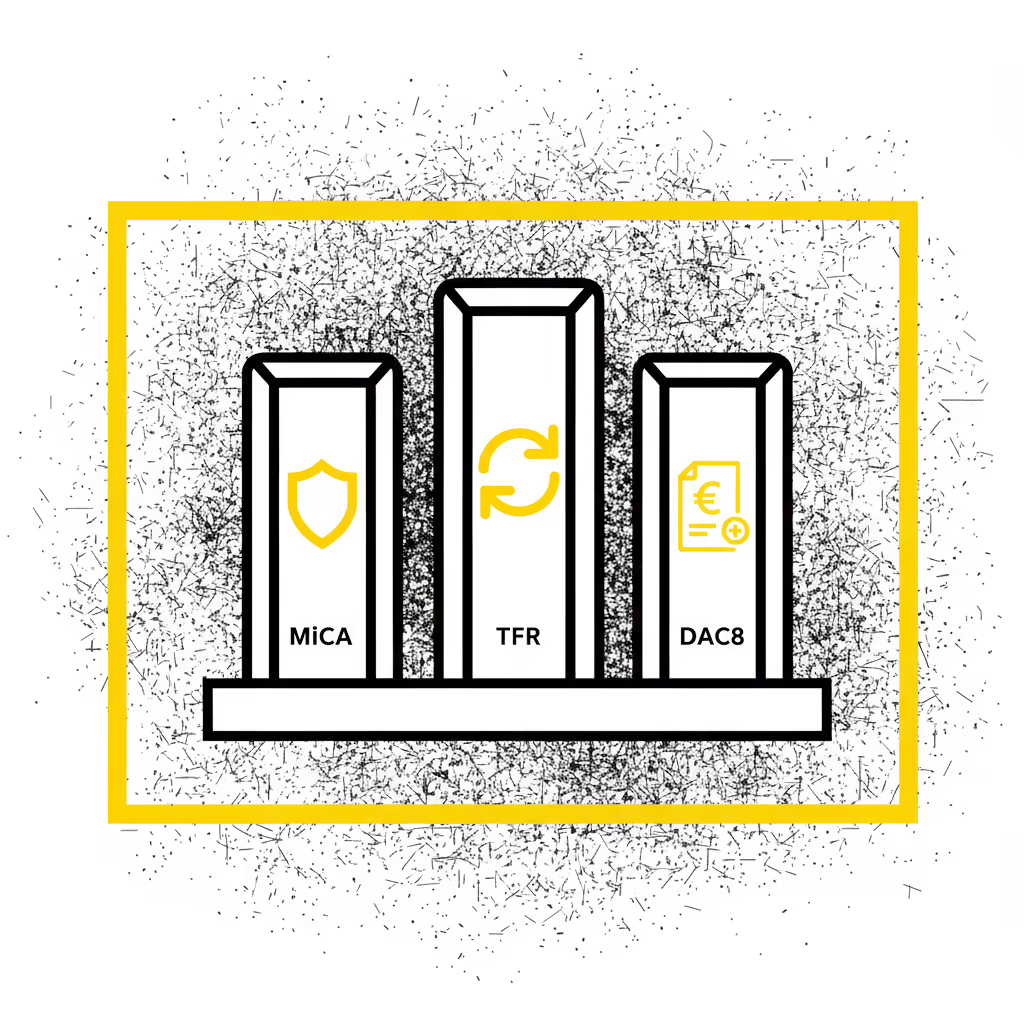
The Regulatory Landscape: MiCA, TFR, and DAC8
The "Regulatory Rubicon" has been crossed, shifting the focus of European authorities from drafting policy to aggressive enforcement. Central to this environment is the Markets in Crypto-Assets Regulation (MiCA), which has successfully harmonized the rules for digital assets across all 27 EU member states.
The verification process is now governed by three key frameworks:
- MiCA Authorization: Eliminates the "Wild West" era, ensuring only fully authorized providers operate within the EEA.
- Transfer of Funds Regulation (TFR): Enforces a "Zero Threshold" policy for the "Travel Rule," requiring detailed data on the originator and beneficiary for every transaction.
- DAC8: Mandates strict tax reporting and the collection of Tax Identification Numbers (TINs) to ensure fiscal transparency.
Architecture of the Know Your Business (KYB) Process
Know Your Business (KYB) is the primary defensive mechanism used by fintech gateways. Unlike Know Your Customer (KYC), which focuses on individuals, KYB requires a deeper exploration of corporate hierarchies.
The Verification Objectives:
- Legal Existence: Proving the business is a real, registered entity.
- Control Disclosure: Identifying the Ultimate Beneficial Owners (UBOs) to prevent the use of shell companies for illicit activities.
- Risk Scoring: Evaluating the industry, geography, and transaction profile of the merchant.
The INXY Payments Verification Workflow: A Step-by-Step Guide
The verification process is designed to be rigorous yet streamlined, ensuring all participants meet EU compliance standards. This is a unified process applicable to all merchants, regardless of their industry or integration method.
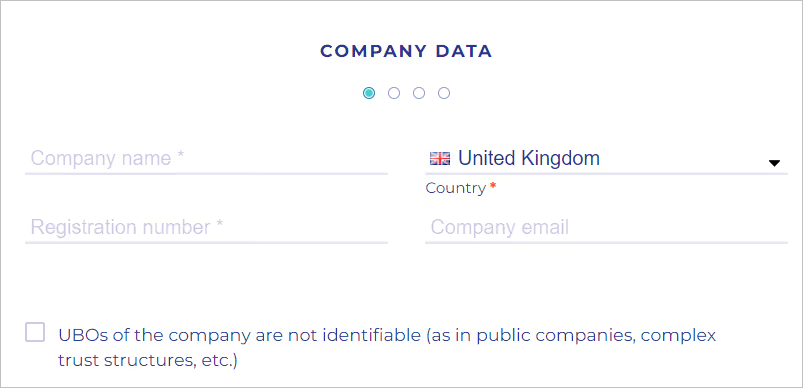
Step 1: Initial Company Data Intake
The process commences with the "Company data form." The merchant must enter fundamental identifying information, including the legal Company Name, official Registration Number, and Country of Registration.
Note: Providing a direct company email is recommended to ensure a clear line of communication with compliance officers.

Step 2: Comprehensive Documentation Upload
Merchants must validate their legal status by uploading a robust evidentiary file. Mandatory documents typically include:
- Certificate of Incorporation / Business Registration: Proof that the entity exists in a government registry.
- Articles of Association (AOA): Defines the entity's operations and leadership structure.
- Operating License: Required only if the merchant operates in a specifically regulated sector (e.g., gambling, forex).
Step 3: Ultimate Beneficial Owner (UBO) Identification
Identifying the natural persons who ultimately control the entity is the cornerstone of EU AML regulations.
- The 25% Rule: Merchants must identify any natural person holding more than 25% of ownership shares or voting rights.
- Verification: For each UBO, the system requires their full name, date of birth, and contact details. Identity verification can be performed live or via a secure link sent to the stakeholder.

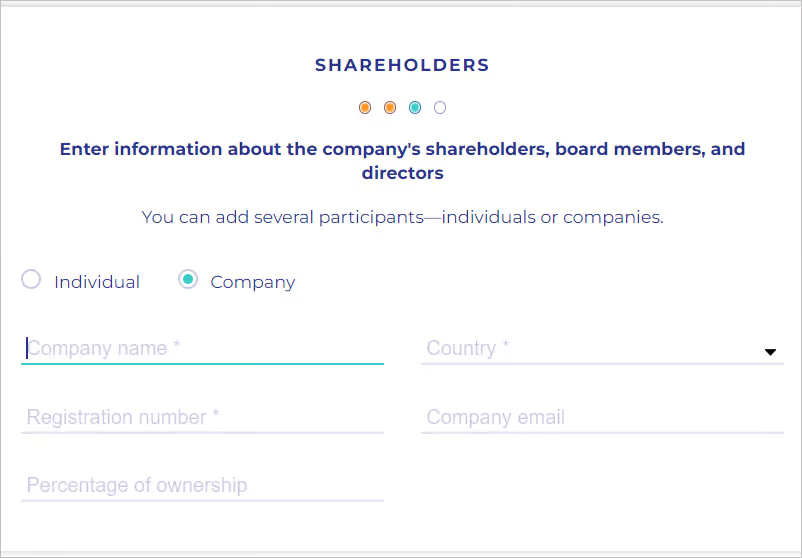
Step 4: Shareholder and Representative Verification
- Corporate Shareholders: If a shareholder is another company, the merchant must provide that entity's Articles of Association and trace the ownership chain back to a natural person.
- Legal Representative: Data must be provided for the person acting on behalf of the company, ensuring they have the legal authority (e.g., Director status or Power of Attorney) to open financial accounts.
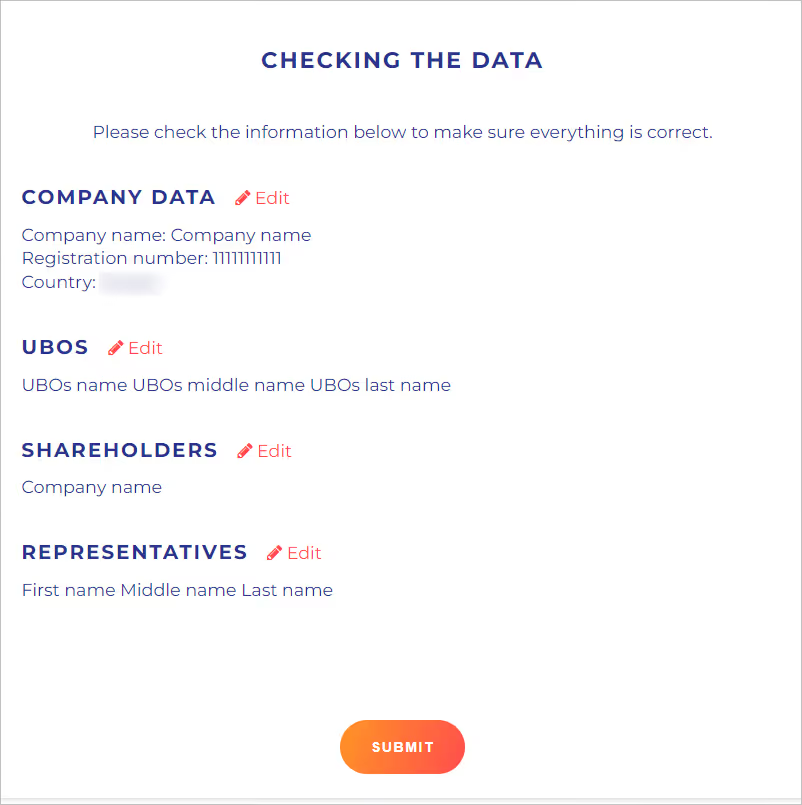
Step 5: Final Validation and Submission
The penultimate step is a thorough review of all provided data. Once confirmed, the application enters the compliance review queue. Thanks to automated systems, merchants can track their status in real-time via their dashboard.
Document Requirements and Authentication Standards
The integrity of the verification process relies entirely on the quality of the documentation. The European fintech environment maintains a high bar for validity.
Mandatory Conditions for Approval:
- Language: All documents must be in English. If the original is in another language, a notarized translation is required.
- Authentication: Documents must be "official," bearing the necessary stamps, signatures, or qualified electronic seals as per local laws.
- Recency: Extracts from commercial registries generally should not be older than 3 months to ensure the data is current.
Common Reasons for Rejection:
- Typos: Mismatches between the input form and the uploaded PDF.
- Missing Pages: Uploading incomplete Articles of Association.
- Low Quality: Blurry scans or photos where text is illegible.
Security and Data Protection (GDPR & DORA)
The sensitive nature of KYB data requires the highest levels of protection.
- GDPR Compliance: Data is used solely for client identification and activity justification, adhering to the principle of "Purpose Limitation."
- DORA (Digital Operational Resilience Act): Mandates that payment gateways demonstrate resilience against cyber threats. Data is encrypted at rest and in transit, with role-based access ensuring only authorized compliance personnel can view identity files.
Conclusion: Compliance as a Competitive Advantage
Completing the merchant verification process is more than a regulatory hurdle; it is a strategic move that positions a business as a credible player in the global economy. By adhering to this standardized verification workflow, merchants—whether they are hosting providers, e-commerce stores, or digital service agencies—secure a stable, bank-grade foundation for their financial operations.
In the mature crypto economy of 2026, a verified account is the key to unlocking global markets, ensuring seamless settlements, and protecting business capital from regulatory friction.

Accept Crypto Payments on WHMCS
Gemini said Here is a concise blog summary optimized for readability and engagement, designed to pull readers into the full guide. Blog Summary: Integrating Crypto via INXY for WHMCS In 2026, cryptocurrency has moved beyond speculation to become a primary "production" currency for global digital services. For hosting providers and agencies using WHMCS, the shift toward stablecoins—the "Internet’s dollar"—is a critical competitive advantage. This guide explores how to integrate the INXY Payment Gateway, a robust solution designed to bridge the gap between traditional billing and the modern crypto economy.
In 2026, the fintech landscape is shifting from speculation to production. For hosting providers, VPN services, and digital agencies using WHMCS, the question is no longer if you should accept cryptocurrency, but how efficiently you can do it. With stablecoins becoming the "Internet’s dollar" for cross-border flows, integrating a robust payment gateway is essential for maintaining a competitive edge in the EU and global markets.
One of the most seamless ways to bridge the gap between traditional billing and the crypto economy is through the INXY Payment Gateway. This guide provides a detailed walkthrough for setting up the INXY module on your WHMCS platform.
1. Why Crypto for WHMCS in 2026?
Integrating crypto payments into your billing system offers several strategic advantages:
- Lower Fees: Traditional processors often charge 2–4% for international payments, while gateways like INXY provide more cost-effective alternatives.
- Chargeback Protection: Blockchain transactions are immutable; once confirmed, they cannot be reversed by the sender, eliminating the administrative burden of fraudulent chargebacks.
- Global Reach: Crypto allows you to accept payments from customers in regions with restrictive banking or unstable local currencies without multi-day delays.

2. System Requirements
Before installation, ensure your environment meets the following criteria for the INXY module (Version 1.0.3):
- WHMCS Version: 8.0 up to 8.13.1.
- PHP Version: 7.4 or higher with ionCube Loader.
- Merchant Account: A valid account on the INXY platform.
- Security: An SSL certificate is recommended to ensure secure webhook notifications.
3. Step-by-Step Installation
Step 1: Download the Module
Download the official module archive from the INXY distribution folder.
Step 2: Upload Files
Using FTP or your hosting file manager, upload the files to your WHMCS directory following this structure:
- /modules/gateways/inxy.php
- /modules/gateways/inxy/ (including assets, pages, and config files)
- /modules/gateways/callback/inxy.php
Step 3: Activation
- Log in to your WHMCS Admin Panel.
- Go to Apps & Integrations and find the INXY Payment Gateway.
- Click Activate.
4. Configuration and API Setup
Navigate to System Settings → Payment Gateways → INXY Payment Gateway to finalize your settings:
Field
Description
Display Name
What customers see at checkout (e.g., "Pay with Crypto").
API & Secret Key
Found in your INXY Dashboard.
Convert To
Select USD or EUR for processing fiat invoices.
Test Mode
Enable this to use the Sandbox environment for testing.
Setting Up Webhooks
To ensure your invoices are marked as paid automatically, you must configure the Postback URL in your INXY Merchant Dashboard:
- URL Format: https://yourdomain.com/modules/gateways/callback/inxy.php
- Location: Go to Merchant settings → API in the INXY dashboard and paste the URL.

5. Advanced Matching and Underpayment Rules
Crypto transactions can sometimes result in minor amount differences due to network fees. INXY handles this through the config.php file:
- Amount Deviation: By default, the module accepts payments within 1% of the requested amount. For WHMCS, it is recommended to set 'amount_deviation_percentage' = 49 to reduce unnecessary top-up attempts and align with WHMCS's partial payment flow.
- Time Window: Payments must arrive within 2 hours in production (30 minutes in Sandbox) to be automatically matched.

6. Summary of Payment Outcomes
Status
Customer Experience
WHMCS Admin Status
Paid in Full
Invoice shows "Paid".
Order marked as paid.
Overpaid
Extra amount added as credit.
Visible credit in account.
Partially Paid
"Awaiting payment" status.
Balance reduced by amount received.
Expired
"Expired" status on page.
Order remains unpaid.
By implementing INXY, you provide your users with a modern, 24/7 payment rail that settles in seconds, ensuring your hosting or digital business stays ahead of the curve in 2026.
Would you like me to draft a series of social media posts to announce your new crypto payment options to your customers?

How to Integrate a Crypto Payment API: A Developer’s Guide for 2026
Integrating crypto payments is no longer just about generating a wallet address—it’s about building a robust, scalable financial pipeline. In this 2026 Developer’s Guide, we strip away the complexity of blockchain interactions and provide a clear roadmap for API integration.
How to Integrate a Crypto Payment API: A Developer’s Guide for 2026
In the fast-moving world of fintech, the question is no longer if a business should accept cryptocurrency, but how seamlessly it can be integrated. As we move through 2026, the European market has reached a point of high maturity. With the full enforcement of MiCA (Markets in Crypto-Assets) regulations, crypto payments have transitioned from a niche experiment to a standardized financial tool for EU-based enterprises.
For developers and product managers, integrating a crypto payment API is now as streamlined as traditional fiat gateways, provided you follow the right architectural patterns.
1. Understanding the 2026 Integration Workflow
Modern crypto integration follows a predictable RESTful pattern. Unlike the early days of manual wallet monitoring, today’s gateways handle the blockchain's complexity, allowing your backend to interact with simple JSON payloads.
The standard lifecycle of a crypto payment includes:
- Initialization: Your server requests a unique payment address for a specific order.
- Monitoring: The gateway monitors the blockchain (Bitcoin, Ethereum, Tron, etc.) for incoming transactions.
- Confirmation: The gateway verifies the transaction depth (number of block confirmations).
- Webhook Notification: Your system receives an asynchronous callback to update the order status.

2. Step-by-Step API Integration
Phase A: Environment Setup
Before hitting production, high-quality gateways provide a Sandbox environment. This allows you to simulate successful payments, timeouts, and underpayments without risking real capital. You’ll typically need two headers for every request:
- X-API-KEY: Your unique identifier.
- X-PAY-SIGNATURE: A HMAC-SHA512 hash to ensure data integrity.
Phase B: Creating the Payment
To start a checkout, your backend sends a POST request to the /invoices or /payments endpoint.
JSON
{
"amount": 150.00,
"currency": "EUR",
"order_id": "ORDER-9921",
"callback_url": "https://yourstore.com/api/webhooks/crypto"
}
The gateway responds with a destination address and a QR code URL. In 2026, the best UX practice is to offer "Invisible Crypto"—where the user sees a familiar interface, and the gateway handles the real-time conversion behind the scenes.
Phase C: Handling the Webhook
This is the most critical part of the integration. Since blockchain transactions are asynchronous, your server must be ready to receive a POST callback.
Pro Tip: Always verify the webhook signature. Never update an order status based solely on the incoming payload without checking that the request actually originated from your provider.
3. Security and Compliance in the EU
In the 2026 fintech landscape, security isn't just about encryption; it's about regulatory alignment. Within the EU, businesses must ensure their payment partner adheres to Transfer of Funds Regulation (TFR) and AML (Anti-Money Laundering) standards.
When choosing a provider, look for features like:
- Auto-Conversion: Instantly swapping volatile assets into stablecoins or EUR to protect your margins.
- Audit-Ready Reporting: Financial statements that your accounting team can actually use for VAT and tax filings.
This is where specialized gateways like INXY (inxy.io) excel. Built specifically for the EU market, INXY acts as a regulated bridge. It doesn't just provide an API; it provides a compliant infrastructure that allows Web2 companies to scale into Web3 without the headache of managing private keys or worrying about crypto volatility. By integrating a solution like INXY, businesses can reduce processing fees by up to 70% compared to traditional card networks, while benefiting from instant SEPA settlements.

4. Testing and Optimization
Before going live, run "Chaos Tests" on your integration. What happens if a user sends too little? What if they pay after the 20-minute price-lock window? A robust API should provide clear error codes for these scenarios, allowing your frontend to guide the user toward a resolution—such as a partial refund or a top-up payment.
Conclusion
Integrating a crypto payment API in 2026 is a strategic move that opens your business to a global, tech-savvy audience. By utilizing professional gateways that handle the heavy lifting of compliance and conversion, your team can focus on what matters: the product.
Ready to modernize your payment stack? Would you like me to draft a technical checklist for your dev team to use during the INXY sandbox testing phase?

Crypto Payment Gateway vs. Processor: What’s the Difference?
While the terms are often used interchangeably, choosing between a Crypto Payment Gateway and a Crypto Processor can fundamentally change how your business handles digital assets. One acts as the technical bridge, while the other serves as a comprehensive financial engine.
If you’ve spent any time navigating the fintech landscape in 2026, you’ve likely noticed that "crypto payment gateway" and "crypto payment processor" are thrown around like synonyms. In casual conversation, that’s fine. But if you’re a business owner in the EU trying to optimize your checkout or manage a complex treasury, the distinction matters. It’s the difference between a sleek front-end interface and the heavy-duty engine room that actually moves the money.
Let’s break down the technicalities of these two components and see how they work together to modernize your business.
The Crypto Payment Gateway: Your Digital Storefront

Think of the Crypto Payment Gateway as the "front-end" layer. It is the bridge between your website and the blockchain. Its primary job is to handle the customer-facing part of the transaction.
When a customer clicks "Pay with Crypto," the gateway jumps into action:
- Checkout UI: It displays the QR code or wallet address.
- Real-time Rate Locking: It calculates the exact exchange rate between, say, Bitcoin and the Euro, and freezes it for a few minutes so the customer knows exactly what they’re paying.
- Data Transmission: It securely passes the transaction details to the processor.
Essentially, the gateway is the digital equivalent of a Point-of-Sale (POS) terminal. It’s all about user experience and making sure the "handshake" between the customer and the merchant is secure and seamless.
The Crypto Payment Processor: The Engine Room

While the gateway handles the "hello," the Crypto Payment Processor handles the "settlement." This is the back-end infrastructure that manages the lifecycle of the funds after the customer hits send.
The processor’s responsibilities are significantly broader:
- Blockchain Validation: It monitors the network to confirm the transaction has reached the required number of blocks.
- Settlement & Conversion: This is the big one. If you invoiced for €1,000 but the customer paid in Bitcoin, the processor handles the conversion and ensures those funds are ready for your bank account.
- Compliance (KYC/AML): It runs the necessary checks to ensure the transaction isn't linked to illicit activity—a non-negotiable for EU-based businesses under current regulations.
- Payouts: It manages the transfer of funds from the crypto ecosystem into your corporate SEPA or SWIFT account.
Comparison at a Glance
Feature
Crypto Payment Gateway
Crypto Payment Processor
Primary Role
Front-end UI / Communication
Back-end settlement / Logistics
Focus
User Experience (UX)
Compliance & Fund Movement
Key Output
QR Codes, API Callbacks
Fiat Payouts, Tax Reporting
Analogy
The Card Reader on the counter
The Bank/Clearing House
Why the Distinction Matters for EU Businesses
In the European fintech market, precision is everything. If you only use a "gateway" without a robust processing layer, you might find yourself with a wallet full of crypto but no easy way to pay your local taxes or suppliers in fiat.
Conversely, a processor without a good gateway might provide great liquidity, but your customers will struggle with a clunky, manual checkout process that kills your conversion rate.
This is where integrated solutions come in. Platforms like INXY bridge this gap by functioning as a unified ecosystem. By combining an EU-licensed gateway (the part your customers see) with a powerful processing engine (the part your accountant loves), it removes the friction of managing two separate services.
Why "All-in-One" is the 2026 Standard
Modern fintech has moved past fragmented tools. For instance, INXY Payments focuses heavily on high-conversion gateways specifically for e-commerce, infrastructure and hosting providers. Because they operate as an EU-authorized VASP (Virtual Asset Service Provider), the processing side is built-in.
For a merchant, this means:
- Zero Volatility: The rate is locked at the gateway level and settled instantly at the processor level.
- Mass Payouts: You can collect payments via the gateway and immediately use those funds to pay global affiliates or remote teams via the processor’s API.
- Legal Clarity: Since the processor handles the KYB (Know Your Business) and AML checks, the funds landing in your bank account are "clean" and fully documented for tax purposes.
Summary
A gateway gets you paid; a processor keeps you in business. While they serve different technical functions, the most successful companies in 2026 are those that don’t make their customers (or their dev teams) choose between the two.
By using an integrated platform like INXY, you get the best of both worlds: a checkout experience that converts and a back-end that settles without the headaches of traditional banking delays.
News
.avif)
INXY Releases Cinematic Short Film on the Future of Global Mass Payouts

Unlock Global Scale: Meet INXY Payments at Affiliate World Asia in Bangkok

Let’s work together
See how easy it is to start with crypto payments without interrupting your current business flow
By clicking "Accept", you agree to the storing of cookies on your device to enhance site navigation, analyze site usage, and assist in our marketing efforts. View our Privacy Policy for more information.