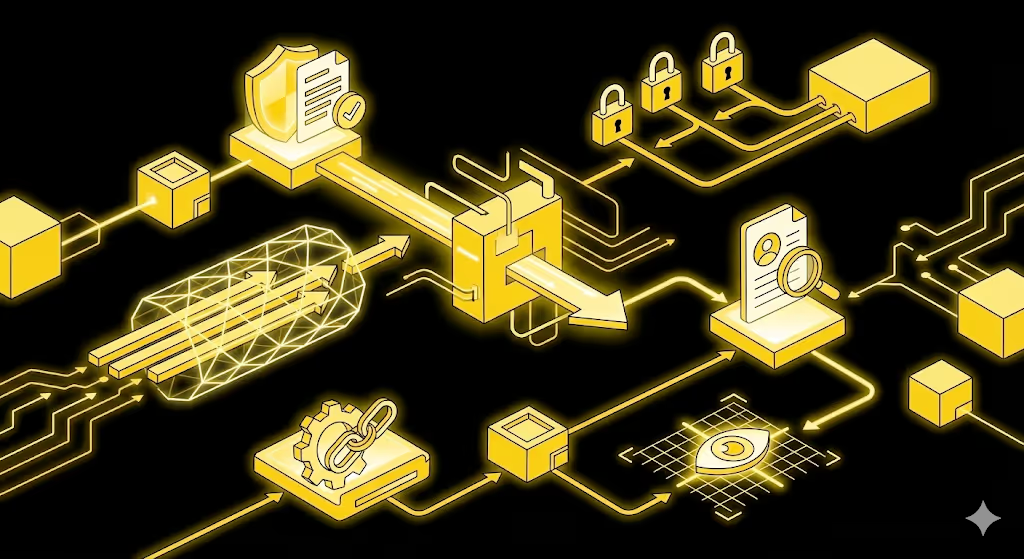
Adding a crypto payment gateway to your business can open new doors. It lets you accept crypto payments from customers worldwide, bringing faster transactions, lower fees, and no chargebacks. But it’s not as simple as flipping a switch. To truly make crypto work for your business, there’s a list of things you need to get right.
Set Up a Digital Wallet
A wallet is where digital assets are stored. For daily operations, software wallets can be enough. But for larger amounts, businesses usually choose hardware wallets for added security.
Choose and Integrate a Payment Solution
You'll need a payment gateway that supports digital currencies. This might be a plugin for your e-commerce platform or a custom API integration. The goal is to make payment easy for customers and seamless for your team.
Handle Pricing and Exchange Rates
Decide how to display prices-directly in digital currency or by converting from your local currency at the moment of purchase. Make sure exchange rates are transparent for your customers.
Manage Volatility
Digital currencies are known for price swings. Have a strategy for dealing with this, such as converting to stablecoins or fiat currency immediately after payment.
Monitor Transaction Fees
Network fees can change depending on demand. Regularly review these costs to ensure they remain acceptable for your business.
Stay Compliant
Digital payments are subject to different rules in different regions. Make sure you understand your obligations around KYC (Know Your Customer), AML (Anti-Money Laundering), and other regulatory requirements.
Educate Your Team
Everyone involved should know how the system works-especially your customer service team, who may need to help customers with payment questions.
Communicate with Customers
Let your customers know that you now accept digital payments. Add clear messaging across your website, marketing materials, and checkout flow.
Test Before Launching
Run test payments to ensure the process is smooth from start to finish. This helps catch any issues before customers experience them.
Strengthen Security
Security is a top priority. Use strong authentication, multi-signature wallets, and cold storage for long-term holdings. Keep your security protocols updated.
Set Up Accounting Processes
Track every transaction carefully. Many tax authorities require detailed reporting of digital currency transactions, and having a solid system in place is essential.
Prepare Customer Support
Expect questions and occasional payment issues. Make it easy for customers to contact you and resolve problems quickly.
Stay Informed
The digital payments landscape evolves rapidly. Keep an eye on regulatory changes, new technologies, and market trends to stay ahead.
Get Tax Advice
Digital currency can create tax liabilities. Consult a tax advisor who understands how digital payments are handled in your jurisdiction.
Review and Optimize
Regularly review how digital payments are working for your business. Gather customer feedback and monitor performance to make improvements as needed.
How INXY Payments Supports These Steps
At INXY Payments, we've built our platform to address all these challenges in one place. Our service is designed for businesses that want to add digital currency payments with minimal friction and maximum compliance. Here's how we help:
Auto-conversion: Incoming payments can be automatically converted to stablecoins or fiat currency to minimize volatility.
Full Compliance: Our platform is fully compliant with MiCA and other EU regulations, with built-in tools for KYC and AML checks.
Seamless Integration: Whether you use the API or our dashboard, setup is simple and fast.
No Wallet Management: You don't need to create and maintain wallets on different blockchains or hold extra coins to pay network fees-we handle that for you.
Custom Reports: We provide detailed, customized reports to simplify your accounting and tax filing.
Security First: Advanced security features protect your funds at every step.
Global Reach: We support payments worldwide and work across multiple industries.
Expert Support: Our team offers personalized onboarding and ongoing assistance, including tax consultations and compliance help.
Always Up-to-Date: We stay on top of blockchain updates and new infrastructure developments, so you don't have to worry about keeping up with tech changes.
Whether you want to accept bitcoin payments, send mass payouts in crypto, or add a seamless crypto billing option to your service, we've got you covered.
Industry insiders call it "death by a thousand cuts." Whether it's inflated spreads or high withdrawal fees, processing digital assets can be surprisingly expensive if you're using the wrong tools.
In our latest guide, we break down: The Anatomy of Fees: Maker vs. Taker and the "Silent Cost" of spreads. Top Retail Exchanges: Where to find the lowest rates for day trading. The Business Trap: Why using a retail exchange for merchant payments is a costly mistake. For enterprises, the secret to cost-efficiency isn't a cheaper exchange—it's specialized infrastructure. Learn how INXY eliminates volatility risks and provides transparent, flat-rate processing.
Imagine closing a $100,000 international deal or executing a perfectly timed crypto trade, only to discover that thousands of dollars vanished into thin air before the funds even settled. The money wasn't stolen by hackers, nor was it lost to a sudden market crash. It was silently siphoned off by the very platform you trusted to process it.
This is the reality of hidden cryptocurrency fees—a silent killer often described by industry insiders as "death by a thousand cuts." Whether you are an active trader watching your portfolio bleed or a business owner seeing profit margins shrink, ignoring the complex fee structures of digital asset platforms is an expensive mistake. Finding the cheapest crypto exchange is not just about clicking the marketing banner that screams "0% trading fees"—it requires a deep understanding of how these platforms actually generate their revenue behind the scenes. In this guide, we will uncover the true costs of digital transactions, highlight the platforms offering the best rates, and reveal why modern businesses must use an entirely different infrastructure to protect their bottom line.
The Anatomy of Cryptocurrency Fees
To navigate the market effectively and keep more of your own money, you first need to understand the different tolls you pay along the way. Most users only look at the baseline trading fee, but the reality is much more complex:
Maker and Taker Fees: This is the most common and transparent pricing model. A "Maker" provides liquidity to the market by placing a limit order that isn't immediately filled. A "Taker" removes liquidity by executing a market order against the existing order book. Because exchanges desperately want deep, active order books, Maker fees are almost always significantly cheaper than Taker fees.
The Spread (The Silent Cost): This is the hidden difference between the highest price a buyer is willing to pay and the lowest price a seller is willing to accept. Platforms that aggressively advertise "zero fee trading" almost always make their money by inflating this spread. This means you are essentially getting a much worse exchange rate than the actual global market price.
Deposit and Withdrawal Fees: Getting your money onto an exchange might be free, but taking it off rarely is. Depending on network congestion and the exchange's internal corporate policies, moving your Bitcoin or USDT to a private wallet or a bank account can carry shockingly high flat fees, completely negating any money you saved on trades.
Top Contenders: Where Retail Traders Pay Less
If you are an individual investor or a day trader, choosing the right platform can save you thousands of dollars over a year of active trading. While fee structures frequently evolve, a few industry giants consistently offer the most competitive rates:
Binance: Globally recognized as the heavyweight champion of low fees. With baseline spot trading fees often starting around 0.1% (and dropping even lower if you hold their native BNB token), it remains the premier destination for high-volume traders seeking maximum cost-efficiency.
Kraken (Pro): While Kraken's standard application is highly user-friendly, switching to the Kraken Pro interface unlocks heavily discounted maker and taker fees. It is widely praised for its strict transparency, meaning traders won't be blindsided by unexpected spread inflations during highly volatile market swings.
KuCoin: Often hailed as the "people's exchange," KuCoin maintains a highly competitive baseline fee structure. It is particularly popular for investors dealing in micro-cap altcoins who want to maximize their purchasing power without being drained by high transactional costs.
The Business Trap: Why Cheap Exchanges Are Expensive for Merchants
Here is where the narrative sharply pivots. If you are an individual trading for personal profit, the exchanges listed above are perfect. But what if you are a business owner? What if you run an e-commerce store, a digital agency, or an international SaaS company, and you want to accept crypto payments from your clients?
Many businesses make the fatal mistake of directing customer payments directly into a standard retail exchange account. They assume that because the trading fees are low, it must be a cost-effective collection solution. In reality, it is a logistical and financial nightmare. When a business uses a retail exchange to process payments, they face a costly "Triple Threat":
Customers are forced to pay unpredictable network gas fees just to send funds to your specific exchange wallet.
The business faces severe volatility risks between the time the customer pays and the time the company manually logs in to convert the crypto to stable fiat.
The company is eventually crushed by high, flat-rate withdrawal fees when attempting to move that accumulated revenue into a corporate bank account.
The Cost-Effective Enterprise Solution
To truly minimize fees and maximize corporate revenue, modern businesses do not use speculative trading exchanges to accept payments. Instead, they rely on specialized, enterprise-grade infrastructure: a dedicated crypto payment gateway like INXY PAYMENTS.
Engineered explicitly for B2B and merchant needs, INXY completely bypasses the predatory spread structures and withdrawal traps of retail exchanges. By integrating INXY into your business framework, you unlock a fundamentally superior economic model:
Transparent Processing Rates: Unlike exchanges that hide exorbitant costs in the spread, a premium gateway like inxy.io offers flat, highly transparent processing fees. You know exactly what it costs to process a payment, allowing for accurate, predictable financial forecasting.
Instant Conversion, Zero Volatility: To avoid the hidden, devastating cost of a sudden market crash, the gateway can instantly convert incoming crypto payments into stablecoins or fiat currency at the exact point of sale.
Automated Accounting: Time is money. Instead of paying accountants to manually track individual wallet deposits across a retail exchange, INXY provides automated invoicing, robust reporting, and mass payout features, drastically reducing expensive administrative overhead.
Conclusion
Navigating the complex world of cryptocurrency fees requires looking past bold marketing slogans and understanding the actual mechanics of the platform. For individual investors, optimizing maker and taker fees on retail platforms is the key to maximizing portfolio returns. However, the corporate world requires a drastically different toolset. By shifting away from retail exchanges and leveraging a powerful crypto payment gateway like INXY, forward-thinking businesses can process global payments with minimal friction, absolute transparency, and unparalleled cost-efficiency.
Annual vs. Monthly SaaS Billing: Why Upfront Crypto Payments Win on Cash Flow
For most SaaS companies, monthly billing is the unexamined default. It lowers the barrier to entry, so it feels like the safe choice. But for B2B and high-ticket software, that default quietly works against you: it spreads revenue thin, exposes every renewal to a payment failure, and hands a chunk of your SaaS billing and payments flow to card networks that were never built for recurring, cross-border charges.
For most SaaS companies, monthly billing is the unexamined default. It lowers the barrier to entry, so it feels like the safe choice. But for B2B and high-ticket software, that default quietly works against you: it spreads revenue thin, exposes every renewal to a payment failure, and hands a chunk of your SaaS billing and payments flow to card networks that were never built for recurring, cross-border charges.
There is a structurally better model for B2B: annual upfront billing settled in crypto. Paid in stablecoins, an annual plan lands the full year of revenue immediately, removes eleven future points of failure, and eliminates chargebacks entirely. This article makes the cash-flow and retention case for upfront annual billing, and shows how stablecoin payments make it easy to offer.
The Hidden Cost of Monthly Card Subscriptions
A monthly subscription is not one payment — it is twelve chances per customer, per year, for something to go wrong. Card-based SaaS payment processing carries failure rates that compound across a subscriber base:
Involuntary churn — customers lost to failed payments rather than active cancellation — accounts for 20–40% of total churn, and up to 48% in higher-risk sectors.
Left unmanaged, failed payments can quietly consume up to 9% of total revenue.
Expired cards alone cause roughly 42% of failed subscription payments; the customer never chose to leave, the card simply lapsed.
Cross-border recurring charges are frequently flagged or declined by issuing banks, and chargebacks on digital goods drain revenue plus dispute fees.
Each monthly cycle re-exposes you to all of this. Annual billing collapses twelve renewal events into one — shrinking the failure surface by an order of magnitude — and, just as importantly, pulls a full year of cash forward instead of metering it out month by month.
Why Annual Upfront Billing Changes the Math
Upfront annual plans are not just an accounting convenience; they change the unit economics of the business. The advantage is sharpest when the customer actually prefers to pay this way — and crypto buyers do.
Cash flow now, not later. Collecting twelve months upfront strengthens working capital and reduces dependence on outside funding to finance growth.
A smaller churn surface. One payment per year means one renewal decision per year — and far fewer involuntary drop-offs from card failures.
Higher lifetime value. Industry data shows crypto buyers spend roughly 2x more than traditional users, and around 43% spend more simply because crypto is offered as an option.
A buyer base that wants annual. About 60% of crypto users prefer to pay upfront for 12–36 month plans, versus only 20% of credit-card users — so offering crypto and annual pricing together is a natural fit.
With more than 824 million people globally owning crypto — over 10% of the world's population — the segment that prefers upfront, borderless payment is large and high-value, not niche.
Why Crypto Makes Annual Billing Easy to Sell
Blockchain payments are push-based and final — one confirmed transfer, no scheduled pulls. That property, which makes crypto awkward for monthly auto-billing, is exactly what you want for an annual upfront plan: a single, irreversible settlement that closes the deal.
Predictable Revenue Through Auto-Conversion
The usual objection — volatility — is solved at the gateway. When a client pays an annual license in a volatile asset, an auto-convert engine instantly settles it into stablecoins (USDT/USDC) or fiat (EUR/USD), so you book exact, predictable revenue. Stablecoins themselves are pegged 1:1 to the dollar, keeping SaaS payment management clean and auditable.
No Chargebacks, Global Reach, Instant Settlement
Zero chargebacks. On-chain payments are irreversible, eliminating friendly fraud and dispute fees on digital goods.
Borderless billing. A single settlement layer reaches customers who lack the international cards your checkout depends on, with no per-currency FX overhead.
Minutes, not days. Stablecoin payments settle in minutes instead of the 3–5 business days an international wire takes to clear.
Lower processing cost. Versus the typical 2.9% + $0.30 card fee plus cross-border markups, stablecoin transfers on networks like TRON (TRC-20) and Polygon cost a fraction of a percent.
How to Structure Annual Crypto Billing for Your SaaS
Adopting upfront annual crypto billing is a pricing-and-integration exercise, not a blockchain project:
Lead with discounted annual pricing. Make the annual plan the headline option and price the upfront discount so the cash-flow gain outweighs it.
Add crypto as a checkout option, not a replacement. Offer “Pay with Crypto” alongside fiat so you capture the high-LTV segment without disrupting existing customers.
Default to stablecoins on low-fee networks. Present USDT and USDC on TRC-20 and Polygon to keep customer-side network fees negligible and value stable.
Integrate via API or plugins, not smart contracts. Use a gateway's REST API or ready-made modules — including a native WHMCS module for hosting, cloud, and agency billing — to issue invoices and confirm payment automatically.
Auto-convert and reconcile. Convert incoming payments to stablecoins or fiat at the point of sale, and use transaction hashes plus CSV exports so finance can match every annual payment to an account.
Compliance and Accounting
Choosing a regulated gateway keeps annual crypto billing inside the regulatory perimeter rather than outside it. The essentials are KYC/AML on counterparties, transaction monitoring, and jurisdiction-aware handling — for example the EU's MiCA framework, which favors transparent, fully-backed stablecoins like USDC. Because stablecoins are dollar-pegged and settlements can auto-convert to fiat, your revenue stays denominated in a unit your accountants already use, with detailed reporting and exports for clean books.
How INXY Supports Annual Crypto Billing for SaaS
INXY is a regulated, enterprise-grade crypto payment gateway engineered for B2B and SaaS billing. Rather than forcing crypto into a monthly auto-billing mold, it leans into what the rail does best — high-value, upfront settlement:
Built for upfront cash flow. INXY deliberately bypasses standard auto-billing, making annual tariff plans the most profitable option for high-ticket B2B software — you receive the full yearly value immediately.
Auto-Convert Engine. Incoming payments in volatile assets convert instantly to stablecoins or fiat, so a $1,000 or $10,000 annual license books as predictable revenue.
Native SaaS integrations. Robust APIs and ready-made plugins, including a native WHMCS module tailored for hosting, cloud services, and digital agencies.
Zero chargebacks and built-in mass payouts. Irreversible settlement protects revenue, while CSV- or API-driven payouts handle affiliate and contractor disbursements.
A compliance-first stack. EU VASP (Poland), Canadian MSB, MiCA readiness, AML/KYT/KYC, and audit-friendly fiat reporting.
Does crypto support automatic monthly subscriptions?
Crypto payments are push-based, so they are not built for monthly card-style auto-charges. That is why the model that works best for B2B SaaS is annual upfront billing — a single, final payment that also improves cash flow.
How do we avoid volatility on a large annual payment?
A gateway with an auto-convert engine settles incoming crypto into stablecoins or fiat at the point of sale, so a five-figure annual license is booked at an exact, predictable value.
Will offering crypto cannibalize our fiat plans?
No — it is an additional checkout option. It tends to attract new, higher-LTV customers rather than shift existing ones, since a large share of crypto buyers are new to the merchant.
How hard is integration?
You connect a REST API or use ready-made plugins such as a native WHMCS module, rather than writing smart contracts. Most teams launch faster than opening a traditional merchant account.
Conclusion
Monthly card billing spreads SaaS revenue thin and re-exposes it to failed payments and chargebacks twelve times a year. Annual upfront billing — settled in crypto — flips that: a full year of cash collected now, one renewal decision instead of twelve, no chargebacks, and a high-LTV buyer base that prefers to pay this way. The rail's push-based finality is a feature here, not a limitation.
Ready to add upfront annual crypto billing to your checkout? See how INXY can power it at inxy.io.
Crypto mass payouts in 2026 enable businesses to pay thousands of freelancers quickly and globally using stablecoins and automated blockchain infrastructure. This article explains how modern payout platforms abstract network complexity, handle compliance and accounting, and turn large-scale crypto payouts into a reliable, repeatable payment process.
Crypto mass payouts sound like a big, fancy term, but the basic idea is simple. Imagine you have a large list of freelancers, say 10,000, and you need to pay them. Doing this one by one would take a huge amount of time. That’s where crypto mass payouts come in. They allow businesses to send payments to a large group at once, instead of processing thousands of individual transfers.
At a high level, the process relies on blockchain technology. Blockchains like Bitcoin, Ethereum, TRON, and others act as shared public ledgers. Every transaction is recorded and can be verified, which makes the system transparent and hard to manipulate. This is one of the reasons crypto payments are trusted for global payouts.
However, while the concept of mass payouts is straightforward, execution becomes much more complex as volume grows. Paying 10 freelancers is one thing. Paying 10,000 introduces operational challenges that are easy to underestimate at first.
For businesses, crypto mass payouts can save time and reduce fees compared to traditional bank transfers, especially for international payments. A freelancer in another country might receive funds in minutes instead of waiting days for a wire transfer. Stablecoins like USDT and USDC are commonly used because they are tied to the US dollar, which helps avoid sharp price swings.
At the same time, real-world payout operations involve much more than just “sending crypto.” Network fees, compliance checks, reconciliation, and reporting all become part of the picture.
The Rise of Freelancing in 2026
Freelancing has taken the world by storm in 2026. What used to be a niche career path is now a mainstream way of working. More professionals are choosing flexible, remote work, and companies are increasingly comfortable hiring freelancers across borders.
Technology has played a major role in this shift. Platforms that connect freelancers with clients have matured, and global collaboration tools are now standard. Payment systems have also evolved, making it easier to send money across countries.
As freelancer volumes increase, payments turn into a scaling challenge. A system that works well for a few dozen payouts often breaks down when a company needs to pay hundreds or thousands of people on a regular basis. Delays, errors, or failed payments quickly impact trust and retention.
This is one reason why crypto and stablecoin payouts have gained traction. They offer speed and global reach, but only when supported by the right infrastructure.
Choosing the Right Crypto for Payouts
When deciding which cryptocurrency to use for mass payouts, several factors matter. Speed and transaction fees are important, which is why stablecoins such as USDT and USDC are popular choices. Their value remains relatively stable, making them suitable for salary-like payments.
Security and reliability are also critical. Businesses typically prefer assets and networks with a strong track record and wide adoption.
An often-overlooked factor is the blockchain network itself. USDT on TRON, USDT on Ethereum, and USDT on other networks may share the same name, but operationally they behave very differently. Each network has its own fee structure, speed, and technical requirements. Choosing the wrong network or mixing them up can lead to failed or lost payments.
As payout volumes grow, these differences become more important, not less.
Tech Solutions for Fast Payouts
In the fast-paced world of freelancing, getting paid quickly is a top priority. Blockchain technology makes this possible by allowing transactions to be processed directly between parties, without traditional banking intermediaries. This often results in faster settlement and lower fees.
Smart contracts can add another layer of automation by executing payments when predefined conditions are met. Crypto wallets store assets like USDT and USDC and allow recipients to receive funds from anywhere in the world.
That said, these tools alone are not enough for large-scale payouts. Wallets and smart contracts do not automatically handle gas fees, currency conversion, compliance checks, or accounting. Without additional systems, finance teams still end up doing a lot of manual work.
This is why modern payout platforms focus on orchestration rather than just transactions.
Step-by-Step Process for Mass Payouts
When companies first explore crypto mass payouts, they often follow a simple process. They collect wallet addresses from freelancers, prepare a payout list, and upload it as a CSV file to a payout tool. After reviewing the data, they initiate the transfer and notify recipients.
While this approach may work for small batches, it becomes risky and inefficient at scale. Each payout requires the correct wallet address, the correct blockchain network, and sufficient funds to cover transaction fees. With hundreds or thousands of rows, manual verification takes significant time and mistakes are hard to avoid.
Another major challenge is gas fees. Every blockchain requires transaction fees to be paid in its native token. For example, sending USDT on the TRON network requires TRX, while sending USDT on Ethereum requires ETH. This means businesses must constantly monitor and replenish balances of multiple native tokens just to keep payouts running.
Modern payout infrastructure solves this by abstracting gas management entirely. The platform ensures that all required native tokens are available behind the scenes, so businesses can execute payouts without worrying about blockchain-specific fee mechanics. From the user’s perspective, the process feels much closer to sending fiat payments.
At scale, this level of automation dramatically reduces both time spent and the risk of human error.
Automatic Conversion and Simplified Operations
Another important improvement in modern payout systems is automatic currency conversion. Freelancers and partners often prefer different payout assets. Some want USDT, others USDC, and some may request different networks.
Manually handling these preferences requires holding multiple crypto balances, performing frequent swaps, and tracking exchange rates. This adds complexity and exposes businesses to accounting challenges.
With modern platforms, companies can fund payouts in EUR or USD. Conversions happen automatically at the time of payout, using optimized rates, and recipients receive their preferred asset. The business does not need external exchange accounts or manual balance management.
As a result, crypto becomes almost invisible to internal teams.
Ensuring Security and Compliance
Handling large volumes of payouts requires strong security and compliance practices. Regulations vary by country, but AML and KYT requirements are now standard expectations, not optional extras.
Without automated screening, businesses risk sending funds to sanctioned or high-risk wallets. In real-world cases, this has led to frozen balances, blocked withdrawals, and strained banking relationships.
Modern payout platforms integrate compliance checks directly into the payout flow, ensuring that every transaction is screened before it is executed. This protects both the business and its partners.
Accounting and Reporting Without Disruption
One of the biggest concerns for finance teams is accounting. Tracking crypto movements manually can create reporting and tax complications, especially when exchange rates fluctuate.
Modern systems address this by providing fiat-denominated reporting, even when payouts are made in crypto. Finance teams can continue to work in EUR or USD, with clean, audit-ready reports that fit into existing accounting processes.
This allows companies to introduce crypto payouts without redesigning their entire financial workflow.
Support and Operational Reality
Crypto payouts often run outside standard business hours. Many providers offer support only during weekdays, which can be problematic when large payout batches are scheduled over weekends or holidays.
Live, responsive support during payout windows becomes a critical operational factor. When something goes wrong, delays of several hours can have a significant impact on trust and operations.
Future Trends in Crypto Payouts
Looking ahead, crypto mass payouts are becoming faster, more stable, and more automated. Stablecoins continue to gain popularity, and clearer regulations are helping businesses feel more confident adopting crypto-based payment rails.
One of the most important trends is abstraction. Businesses increasingly expect crypto payouts to behave like traditional payments: funded in fiat, delivered in the recipient’s chosen asset, and reported in fiat terms.
Platforms focused on infrastructure, such as INXY, reflect this shift by hiding blockchain complexity and allowing companies to scale payouts without increasing operational overhead.
Final Thoughts
Crypto mass payouts in 2026 are no longer about experimenting with blockchain. They are about running reliable, global payment operations.
When supported by proper automation, compliance, and reporting, paying 10,000 freelancers becomes a routine process rather than a source of stress. For businesses operating at scale, this is the real value of modern crypto payout infrastructure.
FAQ
What are crypto mass payouts and why are they important for businesses with large freelance workforces?
Crypto mass payouts are a method of disbursing payments to a large number of recipients simultaneously using cryptocurrencies. They are crucial for businesses with extensive freelance workforces because they offer speed, cost-efficiency, and global reach, which traditional banking systems may lack.
How has the rise of freelancing in 2026 affected payment systems?
The growth of the freelancing economy in 2026 has led to increased demand for flexible and efficient payment systems. This shift necessitates faster, more reliable ways to pay freelancers worldwide, driving the adoption of crypto mass payouts as a viable solution.
What cryptocurrencies are popular for mass payouts and what are their benefits?
Popular cryptocurrencies for mass payouts include USDT and USDC. These stablecoins are favored due to their price stability, which minimizes the risk of value fluctuations during transactions, making them an ideal choice for businesses and freelancers alike.
What technologies facilitate rapid crypto payouts to freelancers?
Innovative platforms and technologies, such as blockchain-based payment systems and smart contract automation, enable businesses to conduct rapid crypto payouts. These solutions streamline the payment process, reduce transaction times, and ensure transparency and accuracy in disbursements.
How can businesses execute mass payouts effectively within a tight timeframe?
To execute mass payouts efficiently, businesses should follow a step-by-step process: select a reliable crypto payment platform, integrate necessary APIs, prepare and verify recipient wallet addresses, choose the appropriate cryptocurrency, and initiate the payout using automated systems for accuracy and speed.
Why are security measures and compliance important in crypto payrolls?
Security measures and compliance are vital in crypto payrolls to protect sensitive financial data, prevent fraud, and adhere to legal regulations. Ensuring robust encryption, multi-factor authentication, and compliance with international financial laws helps maintain trust and reliability in crypto transactions.
What future trends in crypto payouts should businesses be aware of beyond 2026?
Beyond 2026, businesses should be prepared for trends such as the integration of AI in payment processes, increased regulatory scrutiny, and the rise of decentralized finance (DeFi) solutions. Staying informed and adaptable will allow businesses to leverage these trends for more efficient and secure payment systems.