Two tokens hold roughly 84% of the stablecoin market between them, and most comparisons of USDT vs USDC are written for someone deciding what to hold. This one is written for someone deciding what to pay with. The questions that matter for a finance team are different: what backs the token, how you get out of it at scale, what happened the last time each one broke its peg, and whether the counterparty on the other side of your invoice will actually accept it.
Where the two tokens stand, in numbers
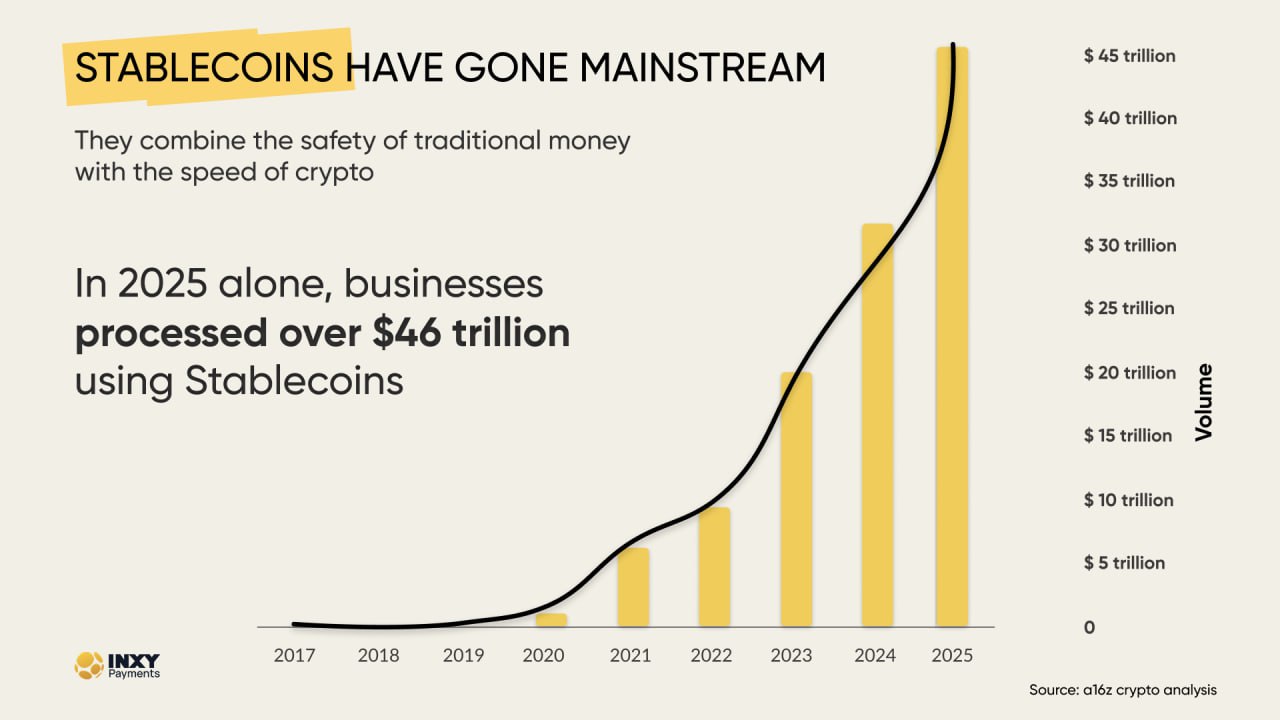
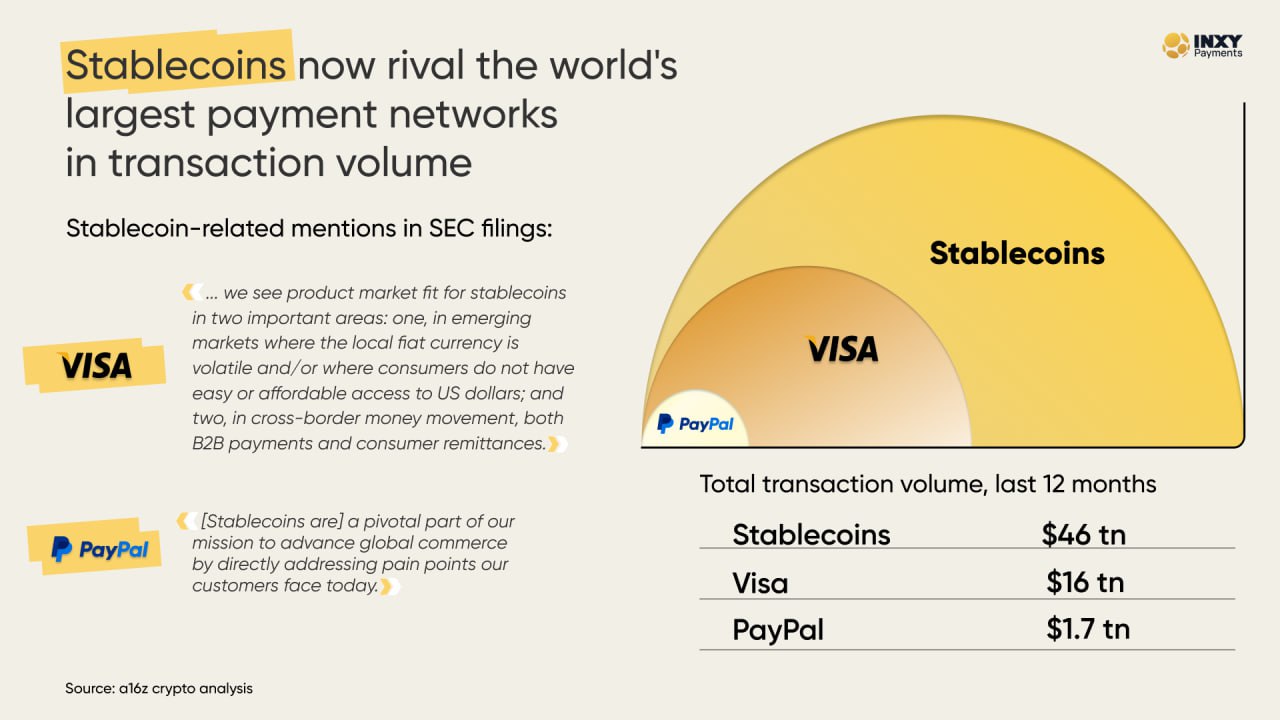
As of 15 September 2026, USDT circulates at approximately $183.4 billion and USDC at approximately $74.3 billion, against a total stablecoin market of roughly $305.1 billion (DeFiLlama, 15 September 2026). Read that as market structure rather than a scoreboard: USDT is the liquidity layer of the non-Western crypto economy, and USDC is the regulated instrument of the Western one. For a payments business, that split is the entire story.
Both are dollar-denominated, both are redeemable at par from their issuers under stated conditions, and both move on the same networks. The differences that affect a payout programme are in the reserve, the redemption door, the regulatory status and the acceptance, in that order.
Understanding USDT
Tether's USDT is the oldest and by far the largest dollar stablecoin. It is issued by Tether and is available across most major networks, including Ethereum (ERC-20), Tron (TRC-20) and BNB Smart Chain (BEP-20), which is why network selection is a live operational decision rather than a detail. TRC-20, ERC-20 and BEP-20 network costs compared covers what each network actually costs to send.
Tether states that its tokens are backed 100% by its reserves and publishes attestation reports along with daily circulation figures on its transparency page. It publishes attestations rather than a full financial-statement audit of the reserve, and the distinction matters to a CFO: an attestation is a point-in-time examination against stated criteria, not a continuous audit opinion.
What a business should take from this: USDT's strength is liquidity and acceptance depth, particularly across Asia and LatAm, where it functions as a de facto settlement currency between counterparties whose banks do not talk to each other. Its weakness for an EU-facing business is regulatory status, covered below.
Understanding USDC
Circle's USDC is the regulated alternative. Its reserves are held primarily in the Circle Reserve Fund, an SEC-registered 2a-7 government money market fund managed by BlackRock holding cash, short-dated US Treasuries and overnight US Treasury repurchase agreements, with the remainder as bank deposits held mostly at the largest banks. Circle publishes monthly third-party assurance reports from a Big Four accounting firm, prepared under AICPA attestation standards, and states that Deloitte & Touche LLP has been its independent auditor since fiscal 2022 (circle.com/transparency, read 15 September 2026, showing composition as of 10 September 2026).
That structure is the practical difference. A 2a-7 money market fund has a published holdings schedule, a defined maturity profile and a regulator; a reserve disclosed only through a periodic attestation does not give a treasurer the same visibility into duration and counterparty concentration.
Reserve composition: what a treasurer actually asks
The question is not "is it backed." The question is backed by what, at what maturity, held with whom, and how quickly does it convert to cash under stress.
| Question | USDC | USDT |
|---|---|---|
| Primary reserve vehicle | Circle Reserve Fund: SEC-registered 2a-7 government money market fund managed by BlackRock | Reserves disclosed via Tether's own attestation reports |
| Disclosure cadence | Monthly third-party assurance, AICPA attestation standards | Periodic attestations; circulation published daily |
| Independent auditor of the issuer | Deloitte & Touche LLP (since fiscal 2022) | Attestation provider named in each report |
| Visibility into holdings | Fund-level holdings schedule and maturity profile | Category-level breakdown in the attestation |
| Bank-deposit concentration | Disclosed as deposits at large institutions | Disclosed in the attestation |
Honest limitation: we have not restated Tether's reserve percentages here because we could not read them from Tether's own primary disclosure at the time of writing. Do not take a reserve breakdown for either token from a blog, including this one. Read the latest attestation on the issuer's transparency page before you make a treasury decision, because the composition changes every quarter.
Redemption mechanics: the door you leave through
Holding a stablecoin is easy. Converting several million dollars of it back to bank money on a specific date is where the difference shows up, and almost no comparison article covers it.
Tether's terms state that redemption is at one unit of the pegged fiat currency per token, less fees where applicable, paid to a bank account in your own name; that you must be a verified customer of Tether to redeem directly; that redemptions are subject to minimum redemption amounts and other requirements; that fees are set out in a separate Fee Schedule updated from time to time; and that Tether may delay or suspend access to purchases and redemptions in defined circumstances (Tether terms of service, read 15 September 2026).
Circle operates direct minting and redemption for business customers through Circle Mint, alongside the monthly attestation regime described above. Circle publishes its redemption structure in its own help documentation; the settlement tiers and any associated fees should be read there directly rather than taken second-hand. We could not retrieve the current figures at the time of writing and will not guess them.
The operational point is the same for both: direct redemption with the issuer requires an onboarded relationship, and most businesses never build one. They redeem through an exchange, an OTC desk or a payment provider, which means the price they actually get is the provider's spread, not the issuer's par. When you model your off-ramp cost, model the route you will really use.
Depeg history: what actually happened, and what it cost
Both tokens have traded away from a dollar. Neither event was a failure of backing, and both are instructive about where the risk actually sits.
USDT, 12 May 2022. During the Terra collapse USDT traded down to approximately $0.945 on exchanges as the market tested whether the reserve could absorb a redemption wave. It recovered the same day; the deviation lasted under 24 hours, and Tether processed billions in redemptions across that week.
USDC, 10–13 March 2023. Circle disclosed that $3.3 billion of USDC reserves, roughly 8% of backing, were held at Silicon Valley Bank when the bank failed. USDC traded to approximately $0.87 and remained off par for around three days across a weekend, recovering after the US deposit guarantee was announced (CoinDesk and CNN Business, 11 March 2023; S&P Global, Stablecoins: A Deep Dive into Valuation and Depegging, 2023).
The insight that matters operationally: the larger and longer depeg happened to the more transparent, more regulated token, and it was caused by ordinary banking counterparty risk, not by anything crypto-specific. Transparency told the market exactly how bad it was, quickly, which is precisely why it repriced so sharply. Regulatory status is not a peg guarantee. Anyone selling it as one is selling something else.
What this means for a payout programme: your exposure window is the time value spends in the token, not the token itself. A payout batch that funds in EUR, converts, settles on-chain and delivers within the same day carries minutes of exposure. A treasury that parks a float in stablecoins for three weeks carries three weeks of it. The rail is not the risk; the holding period is.
Which one to hold for a payout float
This is the question finance teams actually have, and it has a structural answer rather than a preference.
Hold the token your obligations are denominated in, for the shortest period that operationally works. If you pay 3,000 affiliates in USDT because that is what they accept, holding USDC as your float means you carry a conversion leg and its spread on every batch. If your counterparties are EEA-facing businesses invoicing in euro, the conversion you are optimising is a different one entirely; see EURC explained for business payments.
Three practical rules:
- Minimise the holding period before you optimise the token. Float duration dominates token choice in every risk model we have run in practice.
- Do not hold a float in a token your off-ramp route prices badly. The spread you pay to exit is a real, recurring cost; the peg risk is an occasional one.
- Split rather than choose, if your payee base is split. Running both USDT and USDC is normal for payout programmes covering both Asia/LatAm and the EEA. The cost of running two is lower than the cost of forcing every payee onto one.
And the honest limit: if your payout float is large enough that the choice of stablecoin materially changes your risk position, the correct answer is probably to hold less float, not to pick a better token. Pre-funding requirements are a working-capital cost that most providers never quote.
The regulatory divergence in the EU
Under Regulation (EU) 2023/1114 (MiCA), the provisions governing asset-referenced tokens and e-money tokens became applicable on 30 June 2024. Issuers of e-money tokens offered in the EU must be authorised, and authorised issuers appear in ESMA's public register.
Circle's USDC and EURC are among the authorised e-money tokens in that register. Tether's USDT is not: Tether has not been authorised as an e-money token issuer in the EU (ESMA register of e-money token issuers and white papers, checked 11 September 2026). The consequence is that regulated EEA trading venues and service providers have removed or restricted USDT for EEA users, and a compliant EU-facing business generally cannot treat USDT as a routine settlement instrument with regulated EU counterparties.
This is a distributional fact, not a judgement about either token's backing. It reshapes acceptance rather than safety.
This article describes regulatory and market conditions for general information. It is not legal, tax, or financial advice. INXY Payments is a payment infrastructure provider, not a law or accountancy firm, and decisions with regulatory consequence should be reviewed by qualified counsel in the relevant jurisdiction.
Where each one is actually accepted
Acceptance, not backing, is what determines whether a payment completes. Both tokens are among INXY's supported cryptocurrencies, and the right default depends on who is on the other side of the payment.
| Counterparty type | Practical default | Why |
|---|---|---|
| Affiliates, media buyers and contractors in Asia and LatAm | USDT, usually TRC-20 | Deepest local liquidity and the widest informal acceptance; local off-ramps quote it best |
| EEA-regulated businesses and PSPs | USDC | Authorised as an e-money token under MiCA; USDT is restricted on regulated EEA venues |
| Euro-denominated EEA invoicing | EURC | Removes the EUR/USD conversion leg entirely |
| Gaming, iGaming and ad-network payees | Mixed; USDT dominant, USDC growing | Follow the payee base, not the treasury preference |
| Exchange and OTC settlement | USDT by depth, USDC by regulatory fit | The venue's own restrictions usually decide |
The pattern is consistent: USDT wins on reach, USDC wins on regulatory fit, and most payout programmes of any size end up running both. If your payees are split across both worlds, the mass payout mechanics are set out in mass payout in USDT and mass payout in USDC.
A six-step check before you settle in either token
Most teams pick a stablecoin and discover the constraints afterwards. Run this sequence first; it takes an afternoon.
- Pull your payee list and segment it by jurisdiction and counterparty type. Split EEA-regulated counterparties from everyone else. That single line usually decides more than any reserve analysis, because it determines which token your counterparties are permitted to accept.
- Confirm token and network per payee, in writing, before the first batch. Not "USDT" but "USDT on TRC-20, at this address." Free-text address entry with an implied network is the most common unrecoverable error in stablecoin payouts, and it is a data-collection problem, not a technology problem.
- Price your exit before you price your entry. For each token, get a real quote on the route you will actually use to convert back to bank money (your provider, your OTC desk, your exchange) at the size you will actually convert. The issuer's par redemption is irrelevant if you are never going to use it.
- Read the current attestation yourself. Both issuers publish to their own transparency pages, and the composition changes every reporting period. Check the reserve vehicle, the maturity profile and the bank-deposit concentration: the same three things you would check on any counterparty holding your cash.
- Define the maximum float and the maximum holding period as policy, not as practice. Write down how much value may sit in stablecoin and for how long, and have the payout system enforce it. Exposure that nobody owns is exposure that grows quietly until a treasury review finds it.
- Run a small live batch per token and per network, including a deliberate failure, and hand the settlement export to whoever closes your books. If the export does not carry the FX rate and fee per row, the reconciliation cost will exceed whatever you saved on the token decision.
Step three is the one teams skip, and it is the one that costs money every month rather than once.
What breaks in practice
Assuming the payee's preference matches yours. The most common cause of a failed stablecoin payout is not the token; it is sending a token or a network the payee's own off-ramp does not support. Collect and confirm both, per payee, before the first batch.
Treating "regulated" as "won't depeg." March 2023 settled that. Regulatory status changes where you can use a token and who will accept it; it does not remove counterparty risk from the reserve's bank.
Holding float in the wrong token for your off-ramp. The spread on the leg you did not plan for is a recurring cost that never appears in the provider's pricing page.
Forgetting that the network is a separate decision. USDT on ERC-20 and USDT on TRC-20 are the same token with materially different cost and settlement characteristics, and a payee address on the wrong network is an unrecoverable error.
The decision, plainly stated
Do not choose between USDT and USDC as if it were a portfolio decision. It is a distribution decision. Start from your payee list and your counterparties' constraints, pick the token each of them can actually receive and exit, and then minimise how long you hold either one. If your payees are in Asia and LatAm, that is USDT and you should optimise the network. If your counterparties are EEA-regulated, that is USDC and the MiCA register is why. If they are both, run both and treat the conversion leg as a line item you manage rather than a problem you solve once.
INXY Payments settles in 20 supported cryptocurrencies across ERC-20, TRC-20, BEP-20, Polygon, Tron, TON, Bitcoin, Litecoin and DAI, converts to fiat automatically so your accounting never leaves EUR or USD, and runs Travel Rule and AML screening as part of the flow. If you want to see which token and network your own payee list actually resolves to, book a demo with the list in hand. That conversation takes twenty minutes and usually changes somebody's assumption.
FAQ
Is USDT or USDC safer for business payments?
They carry different risks. USDC offers more visibility, with monthly third-party assurance and a 2a-7 money market fund reserve, while USDT offers deeper liquidity and wider acceptance. The larger historical depeg happened to USDC, caused by bank counterparty risk. For payments, exposure is driven mainly by how long you hold either token, not by which one you choose.
Why is USDT restricted in the EU?
Under Regulation (EU) 2023/1114 (MiCA), issuers of e-money tokens offered in the EU must be authorised and appear in ESMA's public register. Tether has not been authorised as an e-money token issuer, so USDT does not appear in that register, and regulated EEA venues have restricted or removed it for EEA users.
Which stablecoin should we use to pay contractors?
Use the one your contractors can actually receive and convert locally. In most of Asia and LatAm that is USDT, commonly on TRC-20. For EEA-facing counterparties it is USDC, and for euro-denominated invoicing, EURC removes the conversion leg. Confirm token and network per payee before the first batch.
Has USDC ever lost its peg?
Yes. Between 10 and 13 March 2023, USDC traded to approximately $0.87 after Circle disclosed that $3.3 billion of reserves, around 8% of backing, sat at Silicon Valley Bank. It returned to par after the US deposit guarantee was announced. The cause was ordinary banking counterparty risk, not a flaw in the token's design.
Can we redeem USDT or USDC directly with the issuer?
Both issuers support direct redemption for onboarded, verified customers, subject to their own minimums, fees and terms. Most businesses never build that relationship and instead exit through an exchange, OTC desk or payment provider, which means the effective rate is that provider's spread. Model the route you will actually use.
Should we hold a stablecoin float for payouts?
Only as much as your payout cycle genuinely requires. Float duration is the dominant variable in stablecoin exposure, ahead of token choice. A same-day fund-convert-settle cycle carries minutes of exposure; a multi-week treasury float carries weeks. Pre-funding requirements are also a working-capital cost that providers rarely quote.



.png)