USDT is a single asset, but it lives on more than a dozen blockchains — and the network you choose can change the cost of a transfer by 100x or more. For a one-off payment that's a rounding error. For a business sending thousands of payouts a month, picking the wrong chain quietly burns thousands of dollars.
This is a practical breakdown of the cheapest network to send USDT in 2026, what drives the fee on each chain, and how to match the network to the payout.
Why USDT fees vary so much
The fee to move USDT has nothing to do with Tether itself. It's the network's gas fee — paid in the chain's native token — that varies:
On Ethereum (ERC-20) you pay ETH gas, which is priced by network congestion and can spike sharply.
On Tron (TRC-20) you pay in TRX energy/bandwidth, which is low and stable.
On Solana, TON, and BNB Chain, base fees are engineered to be very small.
So "how much does it cost to send USDT" is really "which network did you send it on."
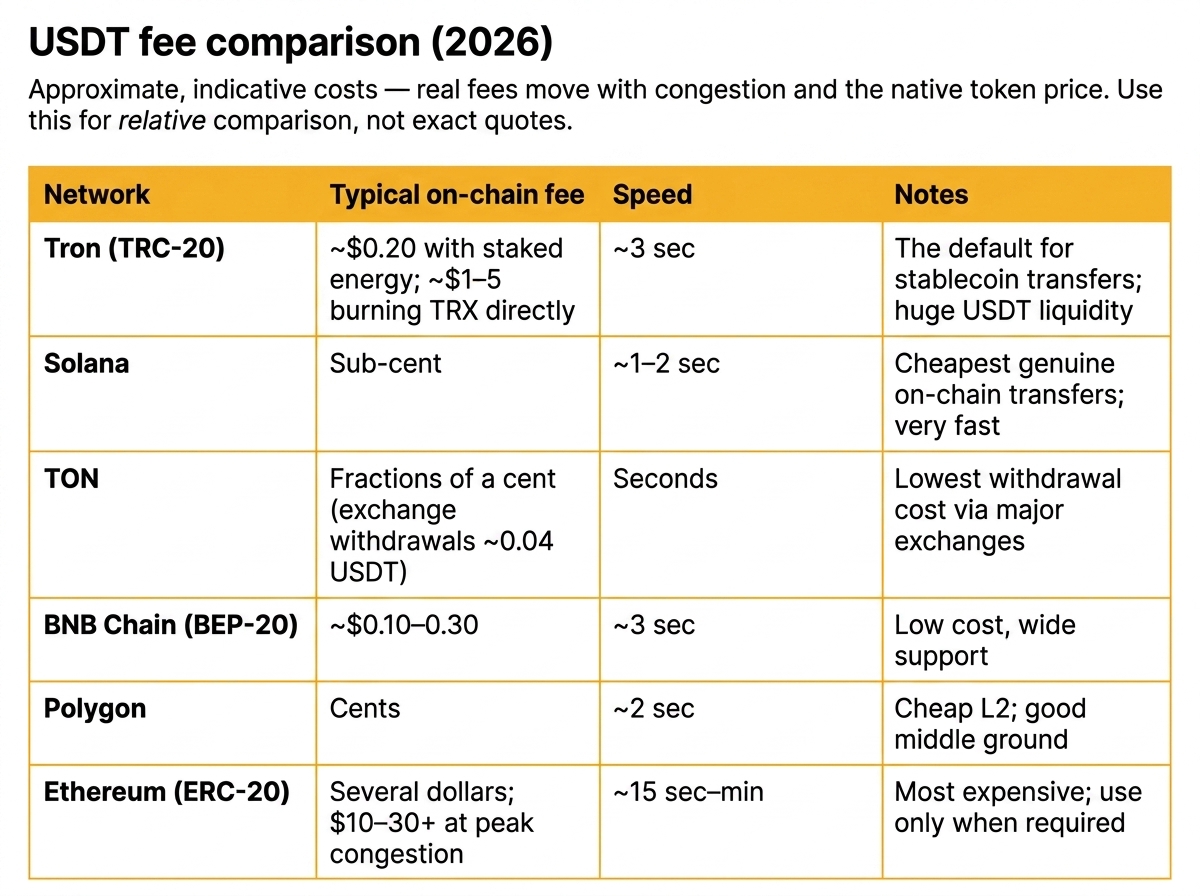
USDT fee comparison (2026)
Approximate, indicative costs — real fees move with congestion and the native token price. Use this for relative comparison, not exact quotes.
The short version: for pure on-chain cost, Solana and TRC-20 lead, with TON unbeatable for exchange withdrawals. ERC-20 is the most expensive and should be reserved for recipients who specifically need it.
Match the network to the payout amount
Cheapest isn't always "correct." The right network depends on the size of the transfer and where the recipient wants the funds.
Micro-payouts (under ~$50): TRC-20, Solana, or TON. Fees would otherwise eat a meaningful slice of the payment.
Standard payouts ($50–$5,000): Solana, Polygon, or TRC-20 keep costs to pennies while settling fast.
Large transfers (over ~$5,000): Cost matters less relative to the amount. ERC-20 is acceptable if the counterparty requires it — the $10–20 fee is small against the principal, and Ethereum's liquidity and integrations are unmatched.
Beyond the headline fee
Fee-per-transfer is the obvious number. Three others matter just as much at scale:
1. Recipient acceptance. The cheapest network is useless if the recipient's wallet or exchange doesn't support it. Always confirm the network before sending — cross-network mistakes are irreversible.
2. Native-token overhead. Every network needs its gas token in your wallet. Running payouts across five chains means monitoring and topping up five different balances — an operational cost that doesn't show up in the per-transfer fee.
3. Failed and stuck transfers. Underpriced gas on congested networks means stuck transactions and support tickets. Reliability has a cost, too.
How platforms cut costs further
When you run payouts through a fiat-native platform instead of manually, network fees stop being your problem in two ways:
Automatic routing. The platform sends each payout on a supported low-fee network without you managing gas on every chain.
No native-token juggling. You fund a balance in EUR or USD; the provider handles conversion and gas. Your reporting stays in fiat.
That removes the hidden operational cost of multi-chain payouts, not just the visible per-transfer fee.
Frequently asked questions
What is the cheapest network to send USDT? For on-chain self-custody transfers, Solana and Tron (TRC-20) are cheapest, and TON offers the lowest withdrawal fees on major exchanges. Ethereum (ERC-20) is the most expensive.
Is TRC-20 always the cheapest for USDT? Not always. TRC-20 is very cheap and has the deepest USDT liquidity, but Solana and TON can be cheaper still per transfer. TRC-20 remains the most widely accepted low-fee option.
Why is sending USDT on Ethereum so expensive? ERC-20 transfers pay ETH gas, priced by network demand. During congestion, a single USDT transfer can exceed $30 in gas.
Does the network affect how much USDT the recipient receives? The network sets the fee you pay to send. Choosing a low-fee chain means more of your budget reaches recipients, especially across many small payouts.
Can I send USDT across networks? An address is tied to one network. To move USDT between chains you need a bridge or an exchange — you can't send TRC-20 USDT directly to an ERC-20 address.
Send on the right network, automatically
If you're running regular USDT payouts, you shouldn't be managing gas tokens across five blockchains. INXY's mass USDT payouts route each transfer over low-fee networks and report everything back in EUR or USD — so you get the cheapest path without the multi-chain overhead. New to bulk sending? Start with our step-by-step USDT payout guide.
MiCA Is Here: How INXY Built a Multi-Jurisdiction Model — and Migrated Every Client Before July 1
1 July 2026. Today marks the beginning of a new chapter for Europe's digital asset industry. The transitional period under the EU's Markets in Crypto-Assets Regulation (MiCA) has ended, and the standard for operating a crypto business in Europe has been raised for good.
1 July 2026. Today marks the beginning of a new chapter for Europe's digital asset industry. The transitional period under the EU's Markets in Crypto-Assets Regulation (MiCA) has ended, and the standard for operating a crypto business in Europe has been raised for good.
For years, much of the industry was built around a single jurisdiction. One license. One operating model. That worked while the rules were still evolving. It works less well now.
We want to be transparent with our clients about where INXY stands and what we did about it. INXY did not obtain a MiCA authorization in Poland. So rather than depend on any single jurisdiction, we moved to a multi-jurisdiction operating model — and before 1 July, we completed the migration of every client off our Polish entity. No payments paused. No settlement stopped.
Here's what MiCA is, what changed on 1 July, and how our model is built to keep your payments running through moments exactly like this one.
What is MiCA?
MiCA (Markets in Crypto-Assets Regulation) is the European Union's comprehensive framework for regulating crypto-assets and the companies that provide crypto services. It replaces a patchwork of national rules with a single, harmonized rulebook across all 27 member states.
In practice, MiCA does three main things:
Licenses providers. Any company offering crypto-asset services — custody, exchange, transfers, payouts — must be authorized as a Crypto-Asset Service Provider (CASP) by a national regulator. A CASP license can then be "passported" across the EU.
Regulates stablecoins. Issuers of stablecoins ("e-money tokens") must be authorized and hold strict, fully-backed reserves. This is why compliant stablecoins like USDC and EURC stayed available on EU-regulated venues while non-authorized ones were delisted. (More on this in "Is USDC regulated?")
Sets conduct and transparency standards for how services are marketed and delivered.
MiCA's rules for service providers began applying on 30 December 2024, with a transitional window for existing firms.
What changed on 1 July 2026
MiCA included a transitional ("grandfathering") period under Article 143. Firms already operating legally under national regimes before 30 December 2024 could continue serving clients — but only until they obtained a CASP license or until 1 July 2026, whichever came first. That date has now passed, and there is no extension mechanism in the regulation.
From today, any provider serving EU clients must hold a MiCA CASP authorization. A legacy national registration no longer provides cover.
The situation in Poland made this especially clear. Poland has not yet enacted the national Crypto-Asset Market Act needed for its regulator (KNF) to issue CASP licenses — the act has been vetoed repeatedly, most recently in June 2026. In practice, that left Polish-registered providers with no domestic path to a CASP license before the deadline.
The limits of a single-jurisdiction model
MiCA is not simply making it harder to launch a crypto business. It is redefining what it means to run one: no longer just "get a license and go," but "operate reliably inside a regulated financial system."
That shift began well before 1 July. Across the market, some companies are spending the coming months restructuring. Some are migrating clients. Some are rethinking how they serve Europe altogether. The common thread is that betting an entire operation on one jurisdiction has become a single point of failure.
INXY's response: a multi-jurisdiction operating model
For payment infrastructure providers, continuity is not optional. Payments cannot pause because the regulatory landscape changes. Businesses still need to settle funds. Cross-border commerce continues every day. Infrastructure should adapt so that businesses don't have to.
That is why INXY expanded beyond a single jurisdiction and built a multi-jurisdiction operating model, spanning:
Canada — registered Money Services Business (FINTRAC MSB M23375535)
El Salvador
Cyprus
Switzerland
We did not build this because a deadline forced our hand at the last minute. We built it because our B2B clients need reliability that does not depend on the regulatory status of any one country. When the Polish route closed, that model is what let us complete the migration of all clients off our Polish entity before 1 July 2026 — with no interruption to payouts, settlement, or reporting.
What this means for you
Your service continues. Clients were migrated ahead of the deadline and are served through our appropriately licensed entities. There is no gap in payouts or settlement.
Your funds and reporting are unaffected. Fiat-denominated reporting, payout records, and reconciliation continue exactly as before.
Your compliance standards are unchanged. Full KYB, KYC where needed, real-time transaction monitoring (KYT), and sanctions screening remain in force across every jurisdiction we operate in.
Regulation is becoming the foundation, not the obstacle
One conclusion runs through all of this: regulation is no longer just about compliance. It is becoming the foundation that enables institutional adoption of stablecoin infrastructure at scale. The businesses that treat regulatory resilience as core infrastructure — not paperwork — are the ones that will serve the next phase of the market.
That's the central theme of our latest research, Stablecoins 2026: The New Global Financial Settlement Layer, which maps the regulatory landscape and what it means for businesses building on stablecoin rails. (Link / request the report: [add URL].)
Frequently asked questions
Did INXY obtain a MiCA license? No. INXY did not obtain a MiCA authorization in Poland. Instead of relying on a single jurisdiction, we operate a multi-jurisdiction model across Canada, El Salvador, Cyprus, and Switzerland, chosen to give our B2B clients continuity.
What happened to clients on the Polish entity? All clients were migrated off our Polish entity before 1 July 2026. The migration was completed ahead of the MiCA transitional deadline, with no interruption to payments.
What is MiCA, in simple terms? MiCA is the EU's single set of rules for crypto companies and crypto-assets. It requires service providers to be licensed as CASPs and sets strict standards for stablecoins, consumer protection, and transparency across all member states.
What happened on 1 July 2026? MiCA's transitional period ended. From this date, providers serving EU clients must hold a MiCA CASP license; legacy national registrations no longer provide cover.
Will my payments pause? No. Continuity was the entire point of moving to a multi-jurisdiction model. Client migration was completed before the deadline, and settlement continues without interruption.
Talk to us
Regulatory change raises real questions for any business that moves money across borders. If you'd like to understand how our multi-jurisdiction model supports your payouts, contact our team — and we'd be glad to share our perspective as the industry enters this new phase.
This update is provided for information and does not constitute legal advice. Regulatory details are accurate as of 1 July 2026 and may evolve.
Choosing the best crypto exchange in 2026 depends on fees, transaction speed, security, and overall user experience. This guide compares leading crypto exchanges, highlights platforms with low fees and fast performance, and explains what to look for to trade safely and efficiently in a rapidly evolving market.
Crypto exchanges are platforms where you can buy, sell, or trade cryptocurrencies. Imagine them like a stock market but for digital coins. They let you swap your Bitcoin for Ethereum or convert your dollars into a stablecoin.
These exchanges come in two main types: centralized and decentralized. Centralized ones, like Binance, have a company behind them that manages everything. They often offer better security and customer service. Decentralized exchanges, or DEXs, let you trade directly with others, giving you more control over your assets.
When choosing an exchange, look for low commission fees and fast transaction speed. Some platforms set withdrawal limits, so check those if you plan on moving large amounts. Mass payouts are a feature to seek if you need to distribute funds to many users. Each exchange has its pros and cons, so consider what's important to you before diving in.
Criteria for Selection
Choosing the best crypto exchange in 2026 isn't a walk in the park. It's all about weighing different aspects. First, let's talk about fees. Lower fees mean you keep more of your money. Some exchanges offer low commission rates, making them attractive to traders who buy and sell often.
Next up is transaction speed. Fast transaction times allow you to buy or sell quickly, which is crucial in the fast-moving world of crypto. Nobody wants to wait around while prices are changing.
Security is a big deal too. With the rise in cyber threats, knowing your money is safe is essential. Exchanges that invest in top-notch security measures, like two-factor authentication and cold storage, stand out.
Consider withdrawal limits as well. High limits mean you can access your funds whenever you want. It's important for those who deal with large amounts of cryptocurrency.
Mass payouts are another factor. If you're involved in crypto mining or other activities that require frequent payouts, you'll want an exchange that handles mass payouts efficiently.
Stablecoin availability is something to think about. Exchanges that support various stablecoins can provide more options for trading or holding value.
Each of these criteria plays a role in finding the best exchange. Balancing them based on your needs will help you make the right choice.
Top Crypto Exchanges for Low Fees
When it comes to buying and selling crypto, fees can really add up. That's why it's key to choose a cryptocurrency exchange that offers low fees. Some exchanges charge a flat fee for every trade, while others use a percentage of the trade amount. For instance, if you trade a large amount, a percentage fee might cost you more.
Binance and Kraken are often praised for their low fees. Binance, for example, charges a very small percentage for each trade. This can save you a lot over time, especially if you're trading frequently. Kraken also offers competitive fees, making it a favorite for many traders.
Another option to consider is using a stablecoin. Some exchanges offer discounts or lower fees when you trade with stablecoins. This can be a smart way to keep costs down. It's important to check each exchange's fee schedule before you start trading. This way, you won't get any nasty surprises down the road. Choosing the right exchange can help you maximize your investment without losing too much to fees.
Fastest Crypto Exchanges
When you're dealing with cryptocurrency, every second counts. Transaction speed is a big deal in the crypto world. It's all about how fast you can buy, sell, or transfer your digital coins. Some exchanges stand out because they let you do this super quickly. Let's dive into what makes these exchanges tick.
First off, why does speed matter? Imagine you're at a store, and you want to buy something. You hand over your money, but the cashier takes forever to process it. Frustrating, right? The same goes for crypto exchanges. A fast exchange means you can make trades when the market is right for you. It's like being the first in line for a new gadget release.
So, what makes an exchange fast? It's a mix of technology and strategy. These exchanges use cutting-edge servers and networks. They're always upgrading to handle more transactions at once. Think of it like a highway. More lanes and fewer traffic lights mean you get to your destination faster.
One example of a speedy exchange is Binance. Known for its lightning-fast transactions, Binance uses technology that can process over a million orders per second. This means you rarely have to wait to complete a trade. KuCoin is another name that pops up when we talk speed. They have a reputation for quick order processing, ensuring users can jump on market opportunities without delay.
But speed isn't just about the tech. It's also about the user experience. Fast exchanges have simple and intuitive interfaces. This means you spend less time figuring out how to make a trade and more time actually trading. It's like shopping online with a website that's easy to navigate.
However, don't forget about security. A fast exchange is great, but it must also be safe. The best exchanges balance speed with security measures to protect your money and information. After all, no one wants a fast transaction if it puts their assets at risk.
In 2026, the fastest exchanges will likely combine advanced technology with user-friendly designs. They'll cater to both beginners and experts, ensuring everyone can trade quickly and securely. As the crypto world evolves, speed will remain a key factor in choosing the right exchange for you.
Security Features of Leading Exchanges
When we talk about crypto exchanges, security is a big deal. In 2026, exchanges are stepping up their game to keep your digital assets safe. They use several strong security features, and here’s a look at some of them.
One of the main features is two-factor authentication (2FA). This adds an extra layer of protection by requiring not just a password but also a code sent to your phone. So, even if someone gets your password, they can't access your account without your phone.
Another key feature is cold storage. This means keeping most of the cryptocurrency offline, away from potential hackers. Cold storage is like a vault for your digital coins, making it much harder for online thieves to get to them.
Exchanges also use encryption to protect data. This scrambles information so that it can only be read by someone with the right key. It keeps your personal and financial details secure from prying eyes.
Some exchanges go even further by offering insurance to cover potential losses. This means if there’s a security breach, you might get compensated. It’s like having a safety net for your investments.
Regular audits are also part of the security measures. These audits check the exchange's systems for vulnerabilities. It's a way to catch and fix problems before they can be exploited by hackers.
Look out for exchanges that have a strong track record of keeping user funds secure. They often have security teams working around the clock to monitor for suspicious activity. These teams are crucial in preventing attacks and responding quickly if something goes wrong.
In 2026, exchanges are more prepared than ever to protect your assets. By using advanced security features, they aim to provide a safe environment for trading and investing in cryptocurrencies.
User Experience and Support
When choosing a crypto exchange, user experience is key. A well-designed platform helps users find what they need quickly. Imagine trying to trade in a cluttered market; it's confusing and stressful. Similarly, a clean and intuitive interface makes trading smoother. Many top exchanges offer easy navigation with clear labels. Even beginners can understand where to click and what to do next.
Support is another crucial factor. In the crypto world, issues can arise anytime, and quick help is often needed. Good exchanges offer 24/7 customer support, ready to assist whether it's a technical glitch or a simple question. Some exchanges even provide live chat, where you can get instant answers instead of waiting for an email reply.
Let's talk about mobile apps. Many users trade on the go, using phones or tablets. A good mobile app mirrors the desktop experience. It should be fast, not freeze, and support all functions, like buying, selling, or checking balances. Imagine being able to trade while waiting for a bus or during a lunch break.
Feedback from other users is valuable. Reviews and ratings give insights into what an exchange does well and where it might lack. If many users mention slow response times from support, it might be a red flag. On the other hand, praise for quick help boosts confidence in the platform.
Language support is also important. Crypto is global, and exchanges should support multiple languages. This makes it easier for non-English speakers to navigate and understand the platform. A user-friendly exchange speaks the user's language, not just literally but also figuratively, by making every step clear and simple.
Conclusion: Choosing the Right Exchange
Picking the right crypto exchange can feel like choosing the right tool for a job. Different exchanges offer different features, so it's crucial to know what you need. Let's break down the key factors to help you make an informed choice.
First, think about fees. Some exchanges charge high fees for transactions, which can eat into your profits. Look for exchanges with low commission rates. This is especially important if you plan to trade frequently. Compare the fee structures of various exchanges to find the most cost-effective option.
Next, consider transaction speed. If you're looking to make quick trades, an exchange with fast transaction processing is essential. Slow transaction speeds can lead to missed opportunities, especially in the fast-paced crypto market. Check user reviews or test the platform yourself to see how quickly it processes transactions.
Security is another critical factor. An exchange must have robust security measures to protect your funds. Look for exchanges that offer two-factor authentication and cold storage options. These features help safeguard your assets against hacks and breaches.
Withdrawal limits are also important. Some exchanges have strict limits on how much you can withdraw at one time. If you plan to move large amounts of crypto, ensure the exchange allows for mass payouts. Check the withdrawal policies of each exchange to avoid unexpected restrictions later.
Stablecoins can offer stability in a volatile market. If you want to minimize risk, consider an exchange that supports a wide range of stablecoins. Stablecoins retain their value better than other cryptocurrencies, making them a safer choice during market fluctuations.
Finally, think about user experience. A user-friendly interface can make trading smoother and less stressful. Look for exchanges with intuitive designs and helpful customer support. This can make a big difference, especially if you're new to cryptocurrency trading.
By focusing on these factors—fees, speed, security, withdrawal limits, stablecoins, and user experience—you can find a crypto exchange that meets your needs. Make sure to research thoroughly before making your choice. Each factor plays a part in ensuring a positive trading experience.
FAQ
What are crypto exchanges, and why are they important?
Crypto exchanges are platforms that facilitate the buying, selling, and trading of cryptocurrencies. They are crucial for the cryptocurrency ecosystem as they provide the necessary infrastructure for market liquidity and price discovery.
What factors should I consider when choosing a crypto exchange in 2026?
Key factors to consider include the exchange's fee structure, transaction speed, security measures, user experience, and customer support. These elements determine the overall efficiency and safety of your trading experience.
Which crypto exchanges are known for having the lowest fees?
Exchanges that offer low commission rates and competitive pricing are highlighted in the 'Top Crypto Exchanges for Low Fees' section. These platforms provide cost-effective trading solutions and are ideal for frequent traders.
What makes an exchange fast, and why is speed important?
An exchange's speed is determined by the efficiency of its transaction processing system. Fast exchanges enable quick buying and selling of cryptocurrencies, which is essential for taking advantage of market opportunities and minimizing slippage.
How do top exchanges ensure the security of user funds and data?
Leading exchanges implement advanced security measures such as two-factor authentication, encryption protocols, cold storage for assets, and regular security audits to safeguard user funds and sensitive information.
How can I evaluate the user experience and support of a crypto exchange?
Assess the platform's user interface for ease of navigation and accessibility. In addition, consider the quality and availability of customer support services, including responsiveness and the range of support channels offered.
What are some tips for choosing the right crypto exchange for my needs?
Consider your trading priorities, such as cost, speed, and security. Evaluate the exchange's reputation and reviews, and ensure it supports the cryptocurrencies you wish to trade. Tailor your choice based on your individual needs and trading strategy.
Accepting USDT is a two-day integration and a six-month operational commitment. This guide covers the full path from sandbox to production: choosing between direct wallet, crypto settlement and fiat settlement, picking networks and confirmation depth, a nine-step integration sequence, five webhook rules that prevent double-crediting, chart-of-accounts mapping through a settlement clearing account, and the failures that show up after go-live.
Accepting USDT is a two-day integration and a six-month operational commitment. The integration is the easy part: a checkout call, a webhook endpoint, a settlement report. What takes longer is everything after go-live — underpayments, wrong-network sends, a webhook that fired three times, and a finance team asking why the settlement total does not match the order total. This guide covers the full path: sandbox to production, webhook handling that survives retries, reconciliation, chart-of-accounts mapping, and the failures that show up in week three.
Decide the model first: direct wallet, gateway, or converted settlement
This decision determines everything downstream, and reversing it later means re-doing the reconciliation.
Direct wallet acceptance. You generate an address, the customer sends USDT, you hold USDT. No provider fee — but you now own address generation, network monitoring, confirmation logic, underpayment handling, refunds, key custody, KYT and sanctions screening. For most businesses that is not a saving; it is an unstaffed payments team.
Gateway with crypto settlement. The provider handles checkout, addresses and confirmation, then settles USDT to your wallet. You keep the token, the price exposure and a cryptoasset on your balance sheet.
Gateway with fiat settlement. Same checkout flow, but the provider auto-converts at confirmation and settles EUR or USD to your bank. Your ledger never holds a cryptoasset and your exposure window is minutes rather than days.
For most merchants the third option is correct, and the reason is not technical: the first two push a treasury and compliance function into a company that did not plan to have one. Crypto payment gateway vs processor sets out how the roles differ. The rest of this guide assumes a gateway integration with fiat settlement — the flow INXY Payments runs across 20 supported cryptocurrencies with next-day bank settlement.
Pick the networks before you write code
USDT is one token on several networks, and they are not interchangeable. A customer who sends TRC-20 USDT to an ERC-20 address has lost the funds, and no amount of support can recover them.
Network
Block time
Practical finality
Typical merchant use
Tron (TRC-20)
3 seconds
Solidified once at least 19 of 27 active super representatives have produced a block at that height or above — in practice about 1 minute (TRON developer documentation)
Default for low-value, high-volume checkout and for Asia/LatAm payers
Ethereum (ERC-20)
12-second slots, 32 slots per epoch (6.4 minutes)
Finalised across checkpoint epochs — roughly 13 minutes in practice (ethereum.org)
Higher-value payments, counterparties who require it
BNB Smart Chain (BEP-20)
Sub-second to seconds
Provider-defined confirmation depth
Cost-sensitive alternative where payers already hold BEP-20
Polygon
Seconds
Provider-defined confirmation depth
Cost-sensitive, increasingly requested
The practitioner's rule: support the networks your payers actually use, not every network you can. Each extra network is another address type, confirmation rule, support queue and reconciliation column. Start with two. How USDT network fees compare has the cost detail.
Confirmation depth is a commercial decision, not a technical one. Crediting at one confirmation is fast and carries reorg risk; waiting for finality is safe and costs the customer minutes. For instantly delivered digital goods most merchants credit at the provider's standard depth; for anything irreversible and high-value, wait for finality. Decide it explicitly and check that your provider's default matches.
The integration sequence: sandbox to production in nine steps
Complete KYB before you write anything. Gateway onboarding requires company documents, UBO identification, a description of your business model and often your website in a reviewable state. It is the longest-lead item in the project and teams routinely start it last. How to verify a merchant account sets out what is collected.
Get sandbox credentials and read the invoice lifecycle. Every gateway models a payment as an object with states — created, pending, underpaid, confirmed, expired, failed. Map those states to your own order states on paper before you write code. Most integration bugs are state-mapping bugs.
Create a payment on the server side, never the client. The amount, currency, order reference and callback URL are set by your backend. A client-settable amount is an open invitation, and it is the single most common security defect in crypto checkout integrations.
Handle the rate lock window explicitly. The gateway quotes a USDT amount against your fiat price and holds it for a fixed window. If the customer pays after expiry, the payment arrives short or long in fiat terms. Display the countdown, and decide in advance whether an expired-but-paid invoice is auto-recredited or manually reviewed.
Build the webhook endpoint before the checkout page. It is the part that carries the risk, and it needs to exist before you can test anything end to end. Details in the next section.
Test the failure cases, not the happy path. In sandbox, deliberately produce: an underpayment, an overpayment, a payment after invoice expiry, a duplicate webhook delivery, an out-of-order webhook delivery, and a webhook your endpoint rejects with a 500. If you have not seen all six in sandbox, you will see them in production instead.
Wire up the settlement report and hand it to finance before go-live. Not after. If the export does not carry, per row, the order reference, the gross fiat amount, the fee, the FX rate applied and the settlement date, your month-end will not close cleanly. This is the step teams skip and regret.
Go live with one network and a payment cap. Cap the maximum invoice value for the first two weeks. It converts a potential six-figure incident into a three-figure one while your confirmation and reconciliation logic proves itself.
Reconcile manually for one full cycle. Match every settlement line to an order by hand for the first month. It is how you find the edge case in your state mapping while the volume is still small enough to fix.
Webhook handling: five rules that prevent the expensive bugs
The webhook is where a payment integration succeeds or quietly breaks. Treat it as an untrusted network endpoint that will be called more than once, out of order, and occasionally by someone who is not your provider.
1. Verify the signature before parsing anything. Compute the expected signature over the raw request body — not a re-serialised object, because re-serialisation changes byte order and the signature will not match — and compare in constant time. Reject and log failures.
2. Make the handler idempotent. Key on the provider's payment identifier, not your order ID. Record processed identifiers and return success without re-processing. Webhook delivery is at-least-once by design, so retries are normal, and a non-idempotent handler will credit the same order twice.
3. Never treat the payload amount as your source of truth. Verify server-side against the provider's API before fulfilling. A signature proves the message came from your provider; fetching the object proves the current state.
4. Respond fast, process asynchronously. Return 2xx as soon as the event is persisted, then fulfil on a queue. Inline fulfilment times out under load, the provider retries, and you are back to rule two.
5. Do not assume ordering. A confirmed event can arrive before the pending event preceding it. Drive order state from the event's own state field and a timestamp, never from arrival order.
And make sure the endpoint is reachable. IP allowlists, WAF rules and leftover staging basic-auth are a recurring go-live failure. Confirm delivery from the provider's dashboard on day one, not from your own logs.
Reconciliation and chart-of-accounts mapping
This is the part that determines whether your finance team supports the project in month three.
With fiat settlement, a USDT payment produces three distinct economic events that arrive at different moments: the customer's on-chain payment, the conversion to fiat, and the bank settlement. If your ledger treats them as one event, you will carry an unexplained variance every month.
A mapping pattern that works in practice:
Event
Debit
Credit
Invoice issued
Trade receivable
Revenue
Payment confirmed on-chain, converted
Settlement clearing account (asset)
Trade receivable
Provider fee applied
Payment processing fees (expense)
Settlement clearing account
Conversion difference vs invoiced rate
FX gain/loss
Settlement clearing account
Bank settlement received
Bank
Settlement clearing account
The clearing account is the control. It should net to zero once every batch has settled, and a persistent non-zero balance tells you exactly where the break is — unsettled, unmatched, or mis-rated. Without it, differences disappear into revenue and nobody finds them until audit.
Four requirements to put in the provider evaluation, not discover afterwards:
Row-level settlement export with order reference, gross amount, fee, FX rate and settlement timestamp on every line.
A stable order reference that survives from invoice creation to bank settlement. If the reference is lost at conversion, matching becomes manual.
Consistent timezone handling. A settlement timestamp in the provider's timezone against orders in yours produces month-end cut-off differences every single period.
Fees itemised, not netted. A net figure hides the fee and makes cost analysis impossible.
Accounting treatment for digital assets varies by jurisdiction and by reporting framework, and it changes. The mapping above is an operational pattern, not accounting or tax advice — confirm the treatment with your own auditors before you book it.
What breaks after go-live
Underpayments. The customer sends slightly less than invoiced, usually because their wallet deducted the network fee from the amount rather than adding it. Decide the policy before it happens: auto-accept below a tolerance threshold, hold for review above it, and make the threshold a configuration value rather than a code change.
Wrong-network sends. The dominant support burden in USDT acceptance. Mitigate at the interface: show the network prominently, use network-specific QR codes, never present a bare address without its network label, and put the warning next to the address rather than at the bottom of the page.
Duplicate order creation. A customer refreshes checkout and generates a second invoice for the same order, then pays the first one. Your order is now linked to an unpaid invoice. Key invoice creation on the order ID and return the existing invoice instead of creating a new one.
Refunds are outbound payments, not reversals. There are no chargebacks on this rail — a structural property, since there is no card scheme representment process — which removes a large category of loss. It also means a refund is a new payout to an address the customer supplies, with its own screening, its own network fee and its own operational process. Design the refund flow during integration, not on the first request.
Expired-invoice payments. A customer pays an hour after the rate window closed and the fiat value no longer matches the invoice. Without a written policy this lands on a support agent with no authority to decide it.
Staging credentials that outlive staging. Sandbox keys left in a production environment variable, or a production endpoint still pointing at a dev URL. Verify both directions on go-live day.
The decision framework
Do not start with the API documentation. Start with three questions, in this order:
Where do your payers sit, and what network do they already use? A payer-data question, not an engineering one, and it settles which networks you support.
Do you want a cryptoasset on your balance sheet? If no — and for most merchants the answer is no — the model is fiat settlement, which removes most of the treasury and accounting complexity before it exists.
Who owns reconciliation? If the answer is “we'll work it out after launch,” involve finance now. Every integration that goes badly goes badly at month-end, not at go-live.
Get those three right and the integration is a short piece of work. Get them wrong and no amount of clean code fixes it.
Where this is not the right answer: if you sell primarily to domestic consumers in a well-banked market with working card acceptance and a low decline rate, adding USDT acceptance will produce a small share of volume and a real amount of operational overhead. Stablecoin acceptance earns its keep when cards are failing you — regional declines, chargeback ratios threatening your acquirer relationship, or cross-border settlement measured in days. If none of those describe you, the honest answer is that this is not your priority this quarter.
If they do describe you, the fastest path is a sandbox integration against your real checkout flow rather than a proof of concept. Get started for credentials, or book a demo if the reconciliation model is the part you need to settle first. For the developer-side detail, integrating a crypto payment API goes deeper on the API surface, and checkout design that converts covers the payer-facing half.
This article describes regulatory and market conditions for general information. It is not legal, tax, or financial advice — INXY Payments is a payment infrastructure provider, not a law or accountancy firm, and decisions with regulatory consequence should be reviewed by qualified counsel in the relevant jurisdiction.
FAQ
How do I accept USDT payments on my website?
Integrate a crypto payment gateway: create the payment server-side with the fiat amount and order reference, display the gateway's checkout with the correct network, verify the signed webhook when the payment confirms, and settle either in USDT or converted to fiat. Most merchants choose fiat settlement so no cryptoasset touches the balance sheet.
Which USDT network should I accept?
Support the networks your payers already use rather than all of them. TRC-20 is the common default for low-value, high-volume checkout, with ERC-20 added where counterparties require it. Each extra network adds address handling, confirmation rules, support load and a reconciliation column, so start with two.
How long does a USDT payment take to confirm?
It depends on the network and your chosen confirmation depth. On Tron, a block is solidified in about a minute once at least 19 of 27 active super representatives have built on it. On Ethereum, finality is reached across checkpoint epochs — roughly 13 minutes. Many merchants credit earlier and accept the residual risk.
What happens if a customer underpays?
The gateway marks the payment underpaid rather than confirmed. Set a tolerance threshold in advance: auto-accept small shortfalls, hold larger ones for review. Underpayment is usually caused by a wallet deducting the network fee from the sent amount rather than adding it, so it is common rather than exceptional.
Are there chargebacks on USDT payments?
No. On-chain settlement has no card scheme representment process, so the chargeback category of loss does not exist. Refunds still do — but a refund is a new outbound payment to an address the customer supplies, with its own screening and network fee, so the refund flow needs designing during integration.
How do we reconcile USDT payments in our accounting?
Route everything through a settlement clearing account. The on-chain payment, the conversion and the bank settlement are three separate events arriving at different times; the clearing account should net to zero once a batch has settled, and any residual balance points straight at the break. Require a row-level export with fee and FX rate per line.