Converting USDT to EUR as a Business: What It Costs
 Robert Romaniuk
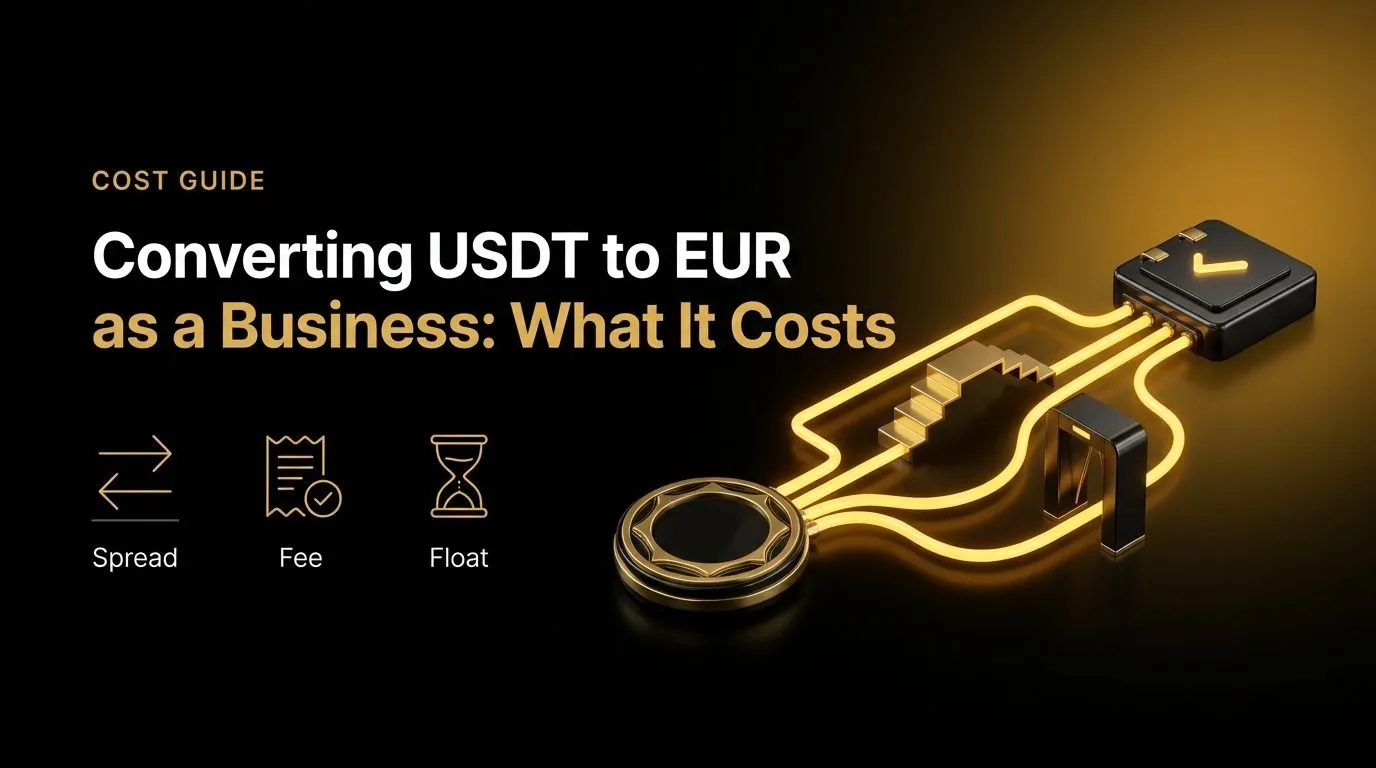
On 31 March 2025 Binance removed USDT from spot trading pairs for users in the European Economic Area, along with FDUSD, TUSD, USDP, DAI and several others, to comply with MiCA (Finance Magnates, April 2025). If you run a business that holds USDT and needs euros in a bank account, that single fact reorders the whole question of how to convert USDT to EUR as a business. This article prices the routes that remain, explains why the EU route is now a way out of USDT rather than a way to keep running on it, and names what your bank will ask before it accepts the wire.
The regulatory fact that reframes the question
Most content about converting USDT to EUR is written for a retail holder choosing an exchange. For a business, the first constraint is not price. It is that USDT’s issuer has not obtained MiCA authorisation for it. Tether’s chief executive said in May 2025 that the company had decided not to apply (Cointelegraph, 2025), and under MiCA Article 48(1) an e-money token may be offered to the public or admitted to trading in the EU only by an issuer authorised as a credit institution or electronic money institution. On 17 January 2025 ESMA told national authorities to bring CASP services in non-compliant tokens into line no later than the end of Q1 2025 (ESMA, 2025).
That is why EEA order books were cleaned out between December 2024 (Coinbase’s announced cut-off for non-compliant stablecoins for EEA users) and March 2025, not because the trade got more expensive.
In October 2026 ESMA went further. In an opinion addressed to national authorities, it said MiCA-authorised crypto-asset service providers should cease all services linked to stablecoins that do not comply with MiCA, including trading, exchange, custody and transfer. Existing positions are to be remedied within three months, which points to early January 2027. Only time-limited functions that protect clients remain: selling, converting, transferring out or withdrawing (ESMA opinion of 8 October 2026). The direction is clear. Inside the EU, a regulated provider can help you get out of a non-compliant stablecoin. It cannot keep you in one.
The contrast is instructive. Circle obtained an Electronic Money Institution licence from the ACPR in France on 1 July 2024, making USDC and EURC MiCA-compliant, with the redemption characteristic that defines the category: holders of an EMT “have the right of redemption against the issuer at any time and at par value” (Circle, 2024). An authorised EMT carries a redemption claim. A non-authorised stablecoin carries whatever the issuer’s terms say it carries, which is a different instrument from a treasury perspective even when the ticker trades at the same price.
The practical consequence for a treasury team. Treat converting USDT into euros as a one-off exit, not as a standing process. Your options inside the EEA are narrower than a search result suggests, and the routes that remain are intermediated by regulated counterparties rather than by a public order book. For a recurring euro flow in the EU, the durable answer is to receive and hold MiCA-compliant e-money tokens such as USDC or EURC from the start.
Can a business convert USDT to EUR in the EU? Yes, as a conversion out of USDT, but not usually on a public EEA spot order book. USDT’s issuer has not obtained MiCA authorisation, EEA venues removed it from spot pairs between December 2024 and March 2025, and ESMA now expects EU-authorised providers to limit non-compliant stablecoins to exit functions. For ongoing euro flows, MiCA-compliant stablecoins such as USDC or EURC are the durable route.
This article describes regulatory and market conditions for general information. It is not legal, tax, or financial advice. INXY Payments is a payment infrastructure provider, not a law or accountancy firm, and decisions with regulatory consequence should be reviewed by qualified counsel in the relevant jurisdiction.
INXY serves Europe, Asia and LatAm, and does not serve the UK, the US or sanctioned jurisdictions.
Four routes off the ramp, compared
| Route | How the price is formed | Typical size it suits | Where it breaks |
|---|---|---|---|
| Exchange spot order book | Visible book, you pay the spread plus a taker fee; price moves against you as you consume depth | Small, frequent, where a liquid pair exists for your asset and jurisdiction | EEA availability for non-authorised EMTs; slippage at size; the exchange is also your custodian while the order rests |
| OTC desk (request for quote) | A single all-in quote against a reference rate; you see one number and not the components | Large, infrequent, where certainty of execution beats visible price | You cannot audit the spread unless you demand the reference rate; settlement timing is negotiated, not guaranteed |
| Regulated payment provider | Conversion and settlement priced as one service, usually a percentage | Recurring operational flow: incoming customer payments, outgoing payouts | Not designed for opportunistic treasury execution; you take the provider’s rate at the provider’s time |
| Direct banking relationship | Your bank does the fiat leg only; the crypto leg happens elsewhere | Businesses with an existing crypto-aware banking partner | Most banks will not do the crypto leg at all, and the account relationship becomes a single point of failure |
The losing use case for each, including ours. An order book loses when your size exceeds visible depth, which happens earlier than most teams expect in euro pairs. An OTC desk loses when your flow is small and regular: you will pay for certainty you do not need. A regulated payment provider, the model behind INXY’s exchange and conversion service, loses when you want to time the market: it is built for operational conversion at a predictable rate, not for execution strategy. A direct bank relationship loses the day your relationship manager changes.
Where the cost actually is
Three components, and only one of them is usually quoted.
The conversion spread against mid-market. Mid-market is the midpoint between the best bid and best offer; it is a reference, not a price you can trade at. Every route charges a spread against it. In a quoted all-in rate the spread is invisible by construction, which is the point of quoting that way. Ask for the reference rate and the timestamp alongside the quote. A provider who will give you both is telling you something about how they price; a provider who will not is telling you something else.
The explicit fee. A percentage, a flat charge, or a taker fee. This is the number that appears in comparisons, and it is often the smallest of the three.
The float. The period between you sending the stablecoin and euros arriving in the account. During that window you hold neither asset usefully, and if the rate was struck at the start and settlement is T+1, you also hold the basis risk. Most cost comparisons ignore this entirely. On a recurring monthly conversion it is a working-capital line, not a rounding error.
A fourth cost applies only sometimes but is worth naming: network fees on the incoming transfer, which differ by chain and are denominated in a different asset from the payment. Our breakdown of TRC-20, ERC-20 and BEP-20 network costs covers that side.
INXY is licensed across multiple jurisdictions and authorised as a crypto-asset service provider under MiCA. It converts between euros and MiCA-compliant stablecoins such as USDC, with SEPA and SWIFT settlement. Pricing starts from 0.1%, depending on volume, currency and corridor, with no setup or monthly fees. If you want the three components broken out against your own monthly volume, talk to a payments specialist.
SEPA or SWIFT: the euro leg
Once the conversion is done, the euros still have to arrive. This leg is now materially better regulated than it was two years ago, and the dates are worth knowing because they determine what you can demand of your provider.
Under Regulation (EU) 2024/886, the Instant Payments Regulation adopted on 13 March 2024 (ECB):
- Euro-area payment service providers had to be able to receive instant credit transfers from 9 January 2025, and to send them from 9 October 2025. Non-euro-area deadlines are 9 January 2027 and 9 July 2027. Electronic money and payment institutions in the euro area have until 9 April 2027.
- Charges for an instant transfer may not exceed charges for a regular credit transfer of the same type, from 9 January 2025 in the euro area. A provider quoting a premium for instant euro settlement should be asked why.
- Verification of Payee must be offered free of charge, for both standard and instant transfers, from 9 October 2025 in the euro area. This is the control that catches a wrong IBAN before the money leaves, and it is why beneficiary-name accuracy in your payment file now matters more than it did.
- Providers offering instant transfers must screen their own users against targeted financial restrictive measures at least daily, rather than screening every transaction in flight. That is the design change that makes instant settlement compatible with sanctions compliance.
What this means in practice. For a euro settlement inside the single euro payments area, SEPA Instant should now be the default and same-day should be the expectation. SWIFT remains the route for non-euro settlement, for counterparties outside the SEPA area, and for amounts or structures a provider will not put through an instant rail. If your provider settles euros by SWIFT to a euro-area account, ask why. There may be a good reason, and you should hear it.
What your bank will actually ask
The conversion is the easy part. The incoming wire is where businesses get stuck, and it is almost never because the bank objects to crypto in principle.
The EBA’s position is that de-risking should be the result of an ML/TF risk assessment, and that rejecting a customer or an entire category “without due consideration” of individual risk profiles may itself indicate ineffective risk management. Its Guidelines on policies and controls for effective management of ML/TF risks when providing access to financial services have applied since 3 November 2023, alongside the ML/TF Risk Factors Guidelines updated in March 2023 (EBA, 2023). In plain terms: your bank is expected to assess you, not your category. That is a reasonable thing to say, politely, in writing, if you are refused without one.
Prepare these before the first conversion, not after the wire is held:
- Source of the funds, documented. Not “crypto sales”: invoices, a customer contract, a settlement report from the provider that reconciles to the amount arriving.
- The provider’s authorisation, in writing, for the service it performed: the licensed entity and its regulator. Your bank’s financial crime team will ask for this and will not accept a website.
- The transaction chain. Which counterparty converted, on which date, at which rate, settling from which account. A settlement report that shows the fee as a separate line makes this conversation short.
- Your own screening evidence. If you received the stablecoins from customers, show what KYT and sanctions screening ran. Travel Rule data under Regulation (EU) 2023/1113 is part of this, and the EBA’s Travel Rule Guidelines have applied since 30 December 2024.
- Expected volume and frequency, stated up front and then adhered to. The single commonest trigger for a held payment is a wire that does not match the pattern the business described at onboarding.
- A named second banking relationship. Not because the first will fail, but because a treasury function with one euro account and a crypto-derived inflow has a concentration risk it has not priced.
The thing no provider will put in a deck
The institution on the other side of your wire has read the Bank for International Settlements’ 2025 Annual Economic Report, and that report is not friendly. It assesses stablecoins against three tests (singleness, elasticity and integrity) and concludes they “typically fail the test of singleness”, “also fail the elasticity test”, and have “significant shortcomings when it comes to promoting the integrity of the monetary system”. It states plainly that “in practice, stablecoins are attractive for use by criminal and terrorist organisations”, attributing this partly to the absence of KYC standards comparable to the traditional system. On cross-border use it allows “anecdotal evidence of lower costs for some corridors” while warning that lower cost and higher speed “are not always guaranteed” (BIS, 2025).
You do not have to agree with that assessment to need a position on it. Your bank’s credit and financial crime committees have very likely read it, and the quality of your answer determines whether your account survives a review. The answer that works is not an argument about monetary theory. It is documentation: a named licensed counterparty, screening that ran before the transfer and not after, a reconciliation that ties to the cent, a stablecoin your bank’s regulator recognises, and a pattern of behaviour that matches what you told them at onboarding.
What breaks in production
- Rate struck, settlement delayed. The quote was good for a window; the transfer confirmed outside it. Agree in advance what happens (re-quote, or honour, and at whose cost).
- The incoming wire reference does not reconcile. Your bank sees a euro credit from a payment institution with a reference nobody in finance recognises. It is held pending enquiry and the enquiry sits in a queue.
- Beneficiary name mismatch under Verification of Payee. Since 9 October 2025 in the euro area, a mismatch is surfaced before sending. A legal name that differs from your trading name will now generate a warning on every transfer until someone fixes the master data.
- A USDT balance left past the wind-down window. If your counterparty is an EU-authorised provider, ask now what it will do with non-compliant stablecoin balances once the remediation period ends: sell, convert, or return them, and by when. Find out before the date, not on it.
- Chain chosen for cheapness, not for off-ramp depth. The network fee saved is smaller than the spread paid when the receiving desk has thin liquidity on that chain.
- Month-end concentration. Everyone converts on the last business day. Depth is worse and quotes are wider on exactly the day your process says to convert.
- The asset held is not the asset your provider quotes. Confirm which stablecoins and which networks your counterparty accepts before you fund. Our comparison of USDT and USDC for business use covers the differences that matter here.
Decision framework
1. Is the conversion operational or opportunistic? Operational (a predictable monthly flow of customer receipts) belongs with a regulated payment provider priced as a service. Opportunistic (a one-off treasury decision at size) belongs with an OTC desk where you negotiate the quote.
2. Is this an exit or a standing flow? Converting an existing USDT position into euros is an exit. A flow you will repeat every month should run on a MiCA-compliant stablecoin from the start, so you are not converting out of a token your provider is winding down.
3. Can you see the reference rate? If not, you cannot know your spread, which means you cannot compare two quotes. Make it a procurement requirement rather than a conversation.
4. Does your banking partner know what is coming? The cheapest conversion in the market is worthless if the euros sit in a held-payment queue for three weeks. Solve the banking leg first; it is the one with no technical workaround.
5. What is your second route? One desk, one bank, one chain is three single points of failure on a flow your business depends on.
Where INXY is not the answer. If you convert large amounts infrequently and your objective is execution quality on the day (tight spread at size, negotiated settlement, a dealer relationship), a dedicated OTC desk will serve you better than a payment provider, and you should use one; our piece on institutional OTC flow explains why that market exists. A regulated payment rail earns its keep when conversion is a recurring operational step inside a payment flow, where predictability, reconciliation quality and a single compliance perimeter are worth more than the last few basis points. If that is the shape of your flow, compare your current flow with our team and bring your monthly volume and settlement currency.
FAQ
Can a business still convert USDT to EUR in the EU?
Yes, as a conversion out of USDT, but not usually on a public EEA spot order book. USDT’s issuer has not obtained MiCA authorisation, EEA venues removed it from spot pairs between December 2024 and March 2025, and ESMA now expects EU-authorised providers to limit non-compliant stablecoins to exit functions. For ongoing euro flows, use a MiCA-compliant stablecoin such as USDC or EURC.
What does it cost to convert USDT to EUR as a business?
Three components, of which usually only one is quoted: the spread against the mid-market reference rate, the explicit fee, and the float between sending the stablecoin and receiving the euros. Ask for the reference rate and its timestamp alongside any all-in quote, or you cannot compare two offers.
Is USDC different from USDT for EU businesses?
Yes, in regulatory status. Circle received an Electronic Money Institution licence from the French ACPR on 1 July 2024, making USDC and EURC MiCA-compliant e-money tokens with a right of redemption against the issuer at par. Tether has said it did not apply for MiCA authorisation for USDT, which is why EEA availability differs and why EU-authorised providers are winding down USDT services.
Should euros settle by SEPA or SWIFT?
For a euro-area account, SEPA Instant should be the default. Under Regulation (EU) 2024/886, euro-area providers had to receive instant transfers from 9 January 2025 and send them from 9 October 2025, and may not charge more than for a regular credit transfer. SWIFT remains the route outside the SEPA area.
Why do banks hold incoming wires from crypto conversions?
Usually because the wire does not match the behaviour described at onboarding, or because source of funds is not documented to the standard the financial crime team needs. The EBA expects de-risking to follow an individual ML/TF risk assessment rather than category refusal, so a documented, consistent pattern is the practical remedy.
What is Verification of Payee and does it affect me?
It is a free payee-verification service that euro-area providers have had to offer since 9 October 2025 under Regulation (EU) 2024/886, for both standard and instant credit transfers. It flags a mismatch between the account name and the name you entered, so inconsistent legal and trading names in your payment data will now generate warnings.