Circle Q2 2026: Stablecoins Are Becoming Financial Infrastructure
Stablecoins have spent years sitting somewhere between crypto markets and traditional finance.
Circle’s Q2 2026 results suggest that line is becoming much harder to see.
USDC circulation continues to grow. Transaction volume is growing much faster. Banks and financial institutions are moving closer to public blockchain infrastructure. Circle is expanding from stablecoin issuance into payments, tokenized assets, c
ustody, and its own blockchain infrastructure.
The bigger story is not simply that USDC had another strong quarter.
It is that stablecoins are starting to look like a real financial rail.
Here are the developments from Circle’s Q2 2026 Earnings Presentation that we believe matter most.
USDC is growing, but usage is growing much faster
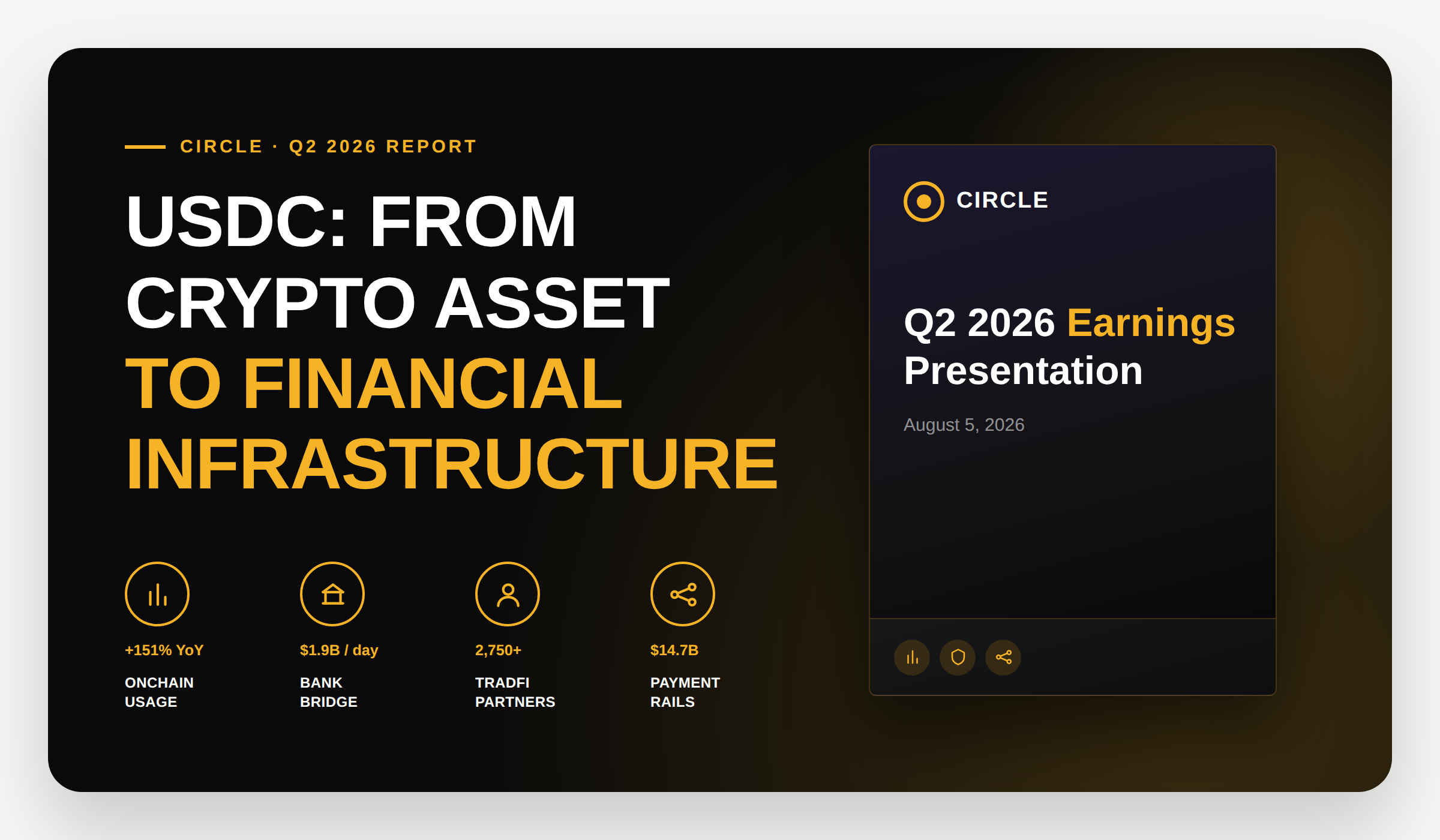
USDC in circulation reached $73.3 billion at the end of Q2 2026, up 19% year over year.
That is significant growth on its own.
But transaction activity tells a more interesting story.
USDC recorded $14.8 trillion in onchain transaction volume during Q2, representing 151% year-over-year growth.
Circle also reported approximately:
- $163 billion in daily onchain transaction volume.
- $1.9 billion in daily minting and redemptions.
- $2.9 billion in daily USDC notional trading volume.
Daily minting and redemption activity increased 105% year over year.
This distinction between supply and activity is important.
A stablecoin can grow because more capital is being stored in it. But when transaction activity grows much faster than circulation, it suggests that the same digital dollars are being used more actively.
Money is not simply entering the system.
It is moving through it.
The wider market shows a similar pattern. Circle’s presentation, using CoinMarketCap and Visa Onchain Analytics data, shows stablecoin circulation growing 22% year over year, while reported transaction volumes grew 84%.
That may be one of the clearest signals that the stablecoin story is moving beyond holding and trading.
The bridge between banking and blockchain is becoming more important
Blockchain transaction speed gets much of the attention around stablecoins.
For businesses, however, a fast blockchain is only useful if money can also move efficiently into and out of it.
Circle reported $170 billion of USDC mint and redeem volume in Q2, compared with $83 billion one year earlier.
Circle’s network now includes more than 15 partner banks, 150 distribution partnerships, and 2,750 direct relationships.
The goal is straightforward.
Make it easier to move between fiat money and USDC across major markets.
This matters because the real business use case rarely ends on a blockchain.
A company may receive stablecoins but need EUR or USD for operating expenses.
A fintech may collect fiat but need stablecoins for international settlement.
A platform may need to move between both depending on the recipient, geography, or payment route.
The blockchain is one part of the journey.
The bridge between traditional money and digital money can be just as important as the rail itself.
Traditional finance is moving closer to stablecoins
One of the strongest themes in Circle’s report is the number of traditional financial institutions appearing throughout it.
The presentation highlights continued adoption involving names including BNY Mellon, Standard Chartered, Kakao, and JCB.
The Arc section goes even further.
Circle lists more than 100 private mainnet partners and shows a validator set that includes financial and infrastructure companies such as BlackRock, DTCC, Global Payments, ICE, Mastercard, MoneyGram, Standard Chartered, Sumitomo Mitsui, and Visa.
This changes the old narrative.
For years, crypto was often presented as an alternative financial system that would replace banks and traditional payment infrastructure.
What is emerging looks different.
Banks, card networks, asset managers, payment companies, and blockchain infrastructure are increasingly connecting to one another.
Stablecoins do not necessarily need to replace traditional finance.
They can become another rail inside it.
Regulation is becoming an infrastructure advantage
The report also makes regulation a central part of Circle’s strategy.
Circle reports USDC across 35 blockchain networks, more than 55 registrations and licenses, and availability across 185 countries.
The company also highlights:
- 1:1 reserve backing.
- Segregated reserve accounts.
- Monthly reserve-asset attestations by a Big Four accounting firm.
- AML and BSA controls.
- Real-time monitoring.
- OFAC screening.
Another major development came in July 2026.
Circle received final OCC approval to establish Circle National Trust under direct US federal oversight.
Circle describes this as a regulated foundation for digital asset custody and a future capability for USDC reserve management.
The strategic message is important.
Regulation is often described as friction for digital assets.
For institutional adoption, the opposite can also be true.
Banks and large businesses need clear rules, reserve transparency, compliance controls, and accountable counterparties before they can move meaningful financial activity onto new rails.
In that context, regulation becomes less of a brake and more of a bridge to adoption.
Stablecoins are becoming payment infrastructure
Perhaps the most relevant development for the payments industry is the growth of Circle Payments Network, or CPN.
CPN connects financial institutions around stablecoin-based payment flows.
Its annualized transaction volume reached $14.7 billion in Q2, growing 76% quarter over quarter. Circle reported 175 financial institutions enrolled by the end of June.
Circle is also working on the less visible parts of payment infrastructure.
The presentation highlights unified onboarding and liquidity, faster corridor activation, automatic rerouting when routes fail, and integrations with Circle Mint, StableFX, and Arc.
These details matter.
Moving a token from one wallet to another is relatively easy.
Building reliable payment infrastructure around it is harder.
Businesses need liquidity.
They need fiat settlement.
They need compliance.
They need reconciliation.
They need reliable payment routes.
They need reporting.
And they need systems that still work when something goes wrong.
That is where stablecoin payments start becoming less about crypto and more about financial operations.
USDC is becoming increasingly cross-chain
Another part of the infrastructure story is interoperability.
USDC is now supported across 35 blockchain networks.
Circle reports 756 CCTP routes across supported networks. Its Cross-Chain Transfer Protocol allows native USDC to move between chains without relying on traditional wrapped-token bridges.
Circle describes the goal as unified liquidity without fragmentation across blockchain ecosystems.
This may sound technical, but the business implication is simple.
Companies generally do not want to think about which blockchain their money is sitting on.
They want liquidity to be available where it is needed.
The more invisible this complexity becomes, the easier stablecoins become to use as ordinary financial infrastructure.
The story is expanding beyond the digital dollar
USDC remains Circle’s core product, but the Q2 presentation points toward a much broader strategy.
EURC circulation reached €382 million, compared with €172 million one year earlier.
That represents approximately 2.2x year-over-year growth.
Circle also reported $3.1 billion in USYC assets, compared with $0.3 billion a year earlier, representing growth of more than 10x. Circle describes USYC as the world’s largest tokenized money market fund.
This is an important expansion of the stablecoin thesis.
The opportunity may not stop with tokenized cash.
Cash can become digital.
Treasury assets can become digital.
Securities can become digital.
Settlement can move onto the same infrastructure.
That brings us to one of the most ambitious parts of Circle’s strategy.
Arc shows where Circle thinks financial infrastructure is heading
Circle plans to launch the Arc mainnet on September 16, according to the Q2 presentation.
Its testnet had already processed 502 million transactions across 2.8 million transacting wallets, with reported uptime of 99.99%.
Arc is not presented as another general-purpose blockchain.
Circle describes it as infrastructure designed specifically for regulated finance.
The network is designed around features such as:
- USDC-denominated gas.
- Sub-second finality.
- Configurable privacy.
- Built-in FX.
- Institutional validators.
Two partnerships show what Circle is aiming for.
DTCC integration is expected to bring tokenized real-world assets onto Arc, including selected equities, ETFs, and Treasuries. Circle also describes potential use cases around securities lending and collateral settlement.
Meanwhile, BlackRock’s BUIDL tokenized treasury fund is expected to deploy on Arc, with BlackRock also participating as a founding validator.
This suggests a much larger ambition.
Circle is not only trying to issue a successful stablecoin.
It is building an environment where money, assets, payments, liquidity, and settlement can increasingly exist on the same infrastructure.
AI agents may become another source of payment demand
One of the more experimental parts of the report is Circle’s work around AI agents.
Circle reports that 99.3% of x402 agent-payment volume settles in USDC, with more than 900 paid services already available in its agent marketplace as of July 31.
The idea is that software agents can hold spending policies, purchase services, settle payments onchain, earn money, and build reputation from completed transactions.
It is still early.
But it highlights something important about digital money.
Traditional payment systems were designed primarily around people and companies.
Software increasingly needs to transact as well.
Always-on, programmable money may therefore find use cases that do not map neatly onto today's card or banking infrastructure.
The financial results show a real business behind the narrative
Circle generated $701 million in total revenue and reserve income in Q2, up 7% year over year.
Adjusted EBITDA reached $143 million, up 8% year over year.
Other revenue grew 41% year over year, although reserve income remains the dominant part of Circle's revenue mix.
Circle continues to guide toward approximately 40% multi-year CAGR in USDC circulation.
The wider market expectations are even broader.
Third-party forecasts cited by Circle put the stablecoin market somewhere between $0.9 trillion and $4 trillion by 2030.
That range is huge.
But perhaps that is the point.
Nobody knows exactly how large the market will become.
The direction is easier to see than the final number.
What we think this means for businesses
Our main takeaway from Circle’s Q2 report is not that every company suddenly needs USDC.
It is that the distinction between “crypto infrastructure” and “financial infrastructure” is starting to disappear.
Stablecoins are becoming useful where they solve an actual financial problem.
That can mean accepting payments from customers who prefer digital assets.
It can mean paying contractors or partners internationally.
It can mean moving liquidity outside banking hours.
It can mean converting between fiat and digital currencies.
It can mean reaching markets where traditional payment rails are expensive or limited.
And increasingly, it can happen behind the scenes without the end user needing to understand blockchain at all.
This is also how we think about the market at INXY Payments.
We started with crypto processing and built products around accepting, converting, and sending digital money.
But businesses do not have a “crypto problem”.
They have a money problem.
They need to receive money, hold it, convert it, pay people, move it internationally, and keep control of the whole process.
Stablecoins are becoming one of the rails that can make those jobs easier.
The technology matters.
But as the infrastructure improves, businesses should need to think about it less.
That may be the clearest sign that stablecoins are growing up.
Explore the full Circle Q2 2026 report
We have highlighted the developments we found most relevant for payments and global businesses.
There is much more in the original 35-page Circle Q2 2026 Earnings Presentation, including detailed data on USDC circulation, liquidity, Arc, CPN, tokenized assets, AI, financial performance, and Circle’s outlook.
The full Circle Q2 2026 report is available below.