The end of fiat friction: Why strategic merchants are switching to stablecoin payments
The legacy financial system imposes a structural tax on growth. For decades, merchants have absorbed correspondent banking fees, 3% interchange costs, and chargeback losses that erode margin on every transaction. In a global economy, waiting T+3 or T+5 for settlement is not an inconvenience — it is a liquidity problem.
To accept crypto once meant exposure to price volatility. That is no longer the case. Stablecoins — pegged to the US Dollar or Euro — deliver the settlement efficiency of blockchain without the speculation. For C-level executives, the question is no longer whether to integrate digital assets, but how quickly legacy bottlenecks can be replaced with purpose-built infrastructure.
1. Settlement velocity: From days to seconds
Traditional cross-border settlements move through a chain of intermediate banks, accumulating fees and losing transparency at every hop. SWIFT provides no real-time visibility into where funds are or when they will arrive.
Stablecoins operate on a 24/7/365 ledger with near-instant finality. Settling on Ethereum, Polygon, or TRON, merchants are no longer bound by banking hours or cut-off windows. Capital lands, clears, and is available for redeployment immediately — not in a pending queue.
inxy.io integrates directly into this settlement layer, giving merchants the operational continuity that traditional finance structurally cannot offer.
2. Eliminating the chargeback tax
Chargeback fraud costs merchants billions annually. Credit card networks are centralised by design, which means any transaction can be reversed — often at the merchant's expense, with little recourse.
Blockchain transactions are push-based and immutable. When a business chooses to accept crypto in the form of stablecoins, payment finality is guaranteed by the protocol, not by a bank's dispute resolution team.
No chargebacks: Once confirmed on-chain, a transaction cannot be reversed by a third party.
Reduced fraud overhead: No need for aggressive fraud filters that block legitimate customers.
Revenue sovereignty: You control your income stream without intermediary intervention.
3. Technical infrastructure: Beyond the hype
A payment gateway needs to be a piece of production-grade fintech infrastructure, not just a wallet interface. High-volume merchants require an API that abstracts blockchain complexity without sacrificing control.
What inxy.io provides:
1. No crypto management overhead: Merchants do not handle tokens or gas fees. That layer is abstracted entirely.
2. Volatility protection: Pay-ins convert to stablecoins or fiat instantly, locking in value at the moment of transaction.
3. Multi-chain support: USDT, USDC, DAI, EURC, TON, BTC, ETH, LTC, TRX, BNB, DOGE across ERC-20, TRC-20, Polygon, and BSC — customers transact on the network that works best for them.
4. Real-time webhooks: Instant payment status notifications to your backend, enabling automated fulfilment or shipping triggers without polling.
5. Compliance stack: EU VASP (Poland), Canadian MSB, MiCA-ready, AML/KYT/KYC, sanctions screening via Elliptic and Sumsub, Big-4-friendly fiat reporting.
4. Drastic reduction in operational costs
Managing global payments typically means maintaining multiple local currency accounts and navigating FX spreads on every cross-border transfer. Stablecoins provide a single settlement layer that works across jurisdictions without currency conversion overhead.
Consolidating payment rails through inxy.io can reduce payment processing Opex by up to 80%. Instead of paying a chain of intermediaries for the movement of value, you pay for efficient infrastructure. That margin stays in the business.
FAQ: Navigating the stablecoin shift
Is it difficult to integrate a stablecoin gateway into an existing platform?
No. inxy.io integrates via a REST API or pre-built plugins for major e-commerce engines. Documentation and technical support are included, and most teams go live faster than a standard merchant bank account setup.
How do we handle gas fee volatility?
inxy.io routes transactions through high-throughput networks to keep fees minimal. Customers can select the most cost-effective network for their transaction — the infrastructure handles the routing logic.
How does accepting stablecoins affect our accounting?
USDT and USDC are pegged 1:1 to the dollar, which makes them materially simpler to account for than traditional cryptocurrencies. inxy.io provides detailed reporting and CSV exports compatible with standard accounting software and ERP systems.
What about regulatory compliance?
inxy.io is built with compliance as a core component, not an afterthought — EU VASP registration, MiCA readiness, AML/KYT screening, and Big-4-auditable reporting. Your business stays within the regulatory framework while operating at full velocity.
Scalability Without Compromise
The merchant of 2026 cannot run on 1970s banking rails. The competitive advantage belongs to businesses that eliminate payment friction and capture the full value of their transactions across borders.
inxy.io is the infrastructure layer for that transition — robust APIs, multi-chain settlement, and a compliance stack built for global scale.
Partner with INXY — secure your payment infrastructure and lead the market.
The most important shift in digital payments this year is not a new chain or a new token. It is the quiet realisation that stablecoins have crossed from speculation into infrastructure. The Paypers’ Global Stablecoins Report 2026 puts total stablecoin market capitalisation at roughly USD 317.9 billion, with projections that it could exceed USD 2 trillion as institutional participation accelerates — and some contributors put the figure closer to USD 4 trillion by 2030. At INXY, we read those numbers differently from most. The headline is not the size of the market. It is that stablecoins have become one of the first blockchain-based instruments to show clear product-market fit in payments.
The most important shift in digital payments this year is not a new chain or a new token. It is the quiet realisation that stablecoins have crossed from speculation into infrastructure. The Paypers’ Global Stablecoins Report 2026 puts total stablecoin market capitalisation at roughly USD 317.9 billion, with projections that it could exceed USD 2 trillion as institutional participation accelerates — and some contributors put the figure closer to USD 4 trillion by 2030. At INXY, we read those numbers differently from most. The headline is not the size of the market. It is that stablecoins have become one of the first blockchain-based instruments to show clear product-market fit in payments.
That single fact reframes the question every finance team, PSP, and merchant should be asking. It is no longer “should we look at stablecoins?” It is “which payment flows should run on them, and what stablecoin payment infrastructure do we need to make that safe, compliant, and economical?” This article is our read of the report’s data — and what it means for businesses that want to accept stablecoin payments, automate payouts, and move value across borders without rebuilding the financial stack from scratch.
Stablecoins have reached product-market fit in payments
For a decade, crypto payments were a promise: faster, cheaper money movement that never quite arrived at scale. What changed is not the blockchain — it is the infrastructure wrapped around it. The report is blunt on this point, describing stablecoins as one of the first blockchain-based instruments to demonstrate clear product-market fit in payments, increasingly used for cross-border settlement, treasury operations, merchant payouts, and everyday commerce.
The adoption base is real, not theoretical. Triple-A’s data cited in the report shows cryptocurrency ownership rising from around 560 million people in 2024 to roughly 700 million in 2026 — about 8.5% of the global population. These are not all traders. A growing share are freelancers, remote workers, and businesses that earn and hold digital dollars and want to spend or settle them without friction. Demand for a usable rail already exists; the constraint has been supply of trustworthy infrastructure.
Our view is simple. The metric that matters is not the market cap of crypto. It is the number of businesses that can use stablecoins to solve a concrete money problem — a supplier that needs paying today, a payout that needs to clear over a weekend, a treasury balance stranded behind a banking cut-off. That is the lens we apply to every number below.
Enterprise adoption is at an inflection point
Awareness of stablecoins among enterprises is now nearly universal, yet active production use remains modest. That gap is exactly what an inflection point looks like. In the EY-Parthenon survey referenced in the report (n=350), a majority of current non-users said they expect to begin using stablecoins within the next six to twelve months. The conversation inside finance teams has moved from “should we look at this?” to “where should we use it first?”
The intent is concentrated, not scattered. Among corporates asked which use cases they are most interested in over the next five years, the top answers were paying suppliers cross-border (77%), accepting cross-border business payments (49%), and accepting domestic business payments (37%). In financial services specifically, 91% of respondents said stablecoins would become a top priority or receive more attention. This is a back-office, treasury-first story — the place where return on investment is clearest and operational risk can be tightly controlled.
One data point matters more than any other for how this market will be served. When corporates were asked how important it is that their existing banking or payments provider supports stablecoins, 81% said it was critical or important, and 68% said they would prefer a bank-grade issuer. In other words, most businesses do not want to become crypto companies. They want to reach stablecoin capability through providers they already trust, embedded into the ERP and treasury systems they already run. Interoperability beats novelty every time.
Cross-border is the killer use case — but only where legacy rails fail
Cross-border payments lead enterprise adoption for a practical reason: this is where the old process is genuinely broken. A traditional international transfer can take days, pass through several correspondent banks, and leave money stranded in transit. Stablecoins offer near real-time settlement, 24/7 availability, and on-chain visibility — and the economics can be decisive. Among organisations already using stablecoins, 41% report cost savings of 10% or more compared with traditional methods, with the largest gains in cross-border B2B, where correspondent fees, FX spreads, and reconciliation costs stack up.
But the honest version of this story is geographic, and we insist on telling it that way. In Europe, where SEPA Instant already moves money in seconds at near-zero cost, the incremental advantage of a stablecoin for a domestic transfer is small. The value appears on corridors where legacy infrastructure fails. The report cites OpenPayd’s point that a USD 200 remittance to Sub-Saharan Africa can cost more than 8%, against a global average above 6% — and that stablecoins can cut that by over 75%, going as low as 0.5% when paired with reliable on- and off-ramps. MetaComp describes a payment from the UAE to Singapore that takes two to five days through correspondent banking settling in roughly 20 minutes at about half the cost.
So the right question is not “will stablecoins replace banks?” It is “which payment flow should run on which rail?” Stablecoins are not a universal upgrade; they are a precise tool for corridors that are slow, expensive, or fragmented. Matching the right rail to the right flow, market by market, is the actual work — and it is the work we build infrastructure to automate.
The cost nobody talks about: on-ramp and off-ramp economics
Here is the trap that sinks naive stablecoin projects, and the report is refreshingly direct about it. The blockchain fee is only a fraction of the true cost. Moving money into a stablecoin (the on-ramp) and back into local fiat (the off-ramp) is not free. Depending on provider, corridor, and volume, conversion fees run from 0.5% to more than 2% per leg — 1% to 4% on a full round trip. For a business with thin margins, that can erase the headline saving entirely.
The lesson we draw is one we design around every day: the cheapest blockchain transaction does not automatically produce the cheapest payment. Any honest assessment of stablecoin economics must include the full on/off-ramp cost, not just the on-chain fee. This is precisely why liquidity, FX, conversion, and settlement infrastructure matter so much — and why the industry is consolidating around orchestration layers such as Circle’s Payments Network (CPN) and cross-chain protocols like CCTP that move USDC between blockchains without costly bridges. The economics only work when at least one party can hold and route stablecoins natively, and when conversion is priced in basis points rather than percentage points.
For most businesses, building that liquidity and conversion layer in-house is neither realistic nor wise. The competitive edge is not owning a wallet; it is reaching deep, well-priced liquidity through infrastructure that already has it.
The hard part is no longer the blockchain — it is everything around it
If there is one theme the report returns to again and again, it is this: the technology is ready and has been for years. What was missing was the infrastructure required to run stablecoin flows safely, at scale, through systems businesses already understand. Companies need compliance, liquidity, fiat connectivity, reconciliation, custody, and orchestration wrapped around the stablecoin rail. That is where the market gets interesting — and where the winners will be decided.
Compliance is becoming part of the product
Regulation has flipped from the biggest barrier to an adoption enabler. Frameworks such as the GENIUS Act in the US and MiCA in the EU now give issuers and providers a clearer operational footing, especially for bank-issued or bank-distributed stablecoins that meet defined reserve, compliance, and governance standards. The question is no longer whether stablecoins are “too risky.” It is whether a company’s infrastructure is good enough to use them safely.
That raises the bar on operations. KYC, AML, Travel Rule obligations, wallet screening, and transaction monitoring all still apply — and adapting them to on-chain flows is a genuine engineering challenge. The report notes that redundant, repeated KYC is a real drag on growth: across the industry, 25–35% of users abandon onboarding when asked to upload an ID and selfie, while modern compliance engines can screen over 99% of transactions within seconds. Compliance is no longer a checkbox bolted on at the end. It is part of the product, and it has to be fast enough not to kill conversion.
Orchestration and the multi-rail future
The report’s central strategic conclusion — and ours — is that stablecoins will not replace every payment rail. The likely future is multi-rail: bank transfers, instant-payment networks, and stablecoins operating side by side, each carrying the flows it serves best. Stablecoins shine where traditional rails are slow, costly, or fragmented; in highly efficient domestic markets, their edge narrows.
That makes orchestration the decisive capability. Orchestration is the end-to-end management of a payment’s journey — deciding, for each transaction, whether to use a stablecoin, which issuer and chain to select, and when to convert between fiat and digital assets, based on value, urgency, liquidity conditions, and counterparty location. As more rails become available, this routing layer is where cost, speed, and compliance are won or lost. The industry examples in the report make the point: the SG-FORGE and Swift live trial settled tokenised bonds using both traditional financial infrastructure and regulated digital currencies, and Nexus Global Payments is interlinking domestic instant-payment systems like India’s UPI and Singapore’s FAST. None of these efforts replace the old system. They make the whole system work together.
What this means for businesses evaluating stablecoin payments
This report describes, almost line for line, the problem we built INXY to solve. INXY provides the infrastructure businesses need to accept stablecoin payments, automate payouts, convert between crypto and fiat, and move money across borders — without building blockchain, liquidity, compliance, and settlement systems from scratch. We operate the layer behind the customer experience, so the complexity stays out of sight.
Concretely, that means:
The merchant does not need to become a crypto company to accept stablecoin payments — acceptance runs through familiar checkout and settlement flows, with conversion to fiat handled behind the scenes.
The fintech does not need to build the entire compliance stack — KYC, AML, Travel Rule, and wallet screening are part of the rail, fast enough to protect conversion rather than throttle it.
The finance team does not need to manage a collection of wallets and chains — payouts, multi-currency treasury, and on/off-ramp conversion are orchestrated through a single integration, priced to keep the full round-trip economics intact.
If you are evaluating stablecoins, we would frame the decision the way the report’s data suggests. Start with the corridors and flows where traditional rails genuinely fail — cross-border supplier payments, international payouts, multi-currency treasury — not with the flows your domestic bank already handles well. Model the full on/off-ramp cost, not just the on-chain fee. And treat compliance and orchestration as core product requirements, not afterthoughts. The businesses that win with stablecoins are not the ones that move tokens; they are the ones that make different payment systems work together.
The winners will be the integrators, not the disruptors
The biggest shift captured in the Global Stablecoins Report 2026 is not from fiat to crypto. It is from crypto product to financial infrastructure — banks, PSPs, and processors integrating stablecoins into systems that already exist. Stablecoins do not need to destroy the old rails to matter. They need to make the whole system move value better.
That is the future we are building for at INXY. Not one payment rail, but many — with an infrastructure layer that decides, routes, converts, and settles across all of them, so businesses get the speed and cost of stablecoins with the trust and control finance teams require. The stablecoin era will not be won by whoever shouts loudest about disruption. It will be won by whoever quietly makes the rails work together.
The Travel Rule for Crypto Payouts: What B2B Senders Must Know in 2026
The Travel Rule requires sender and recipient identity data to accompany crypto transfers, and in 2026 it directly affects any business paying contractors, suppliers, or partners in crypto. This guide breaks down the regulatory picture by region — the EU's no-threshold TFR, the US $3,000 BSA rule plus new GENIUS Act stablecoin obligations, and FATF's $1,000 baseline — and the exact originator/beneficiary data each payout must carry, including the extra step for self-hosted wallets. It then shows how a regulated crypto gateway runs pre-send screening, KYT/AML checks, and the Travel Rule inside the payout flow, so B2B senders stay compliant without building their own compliance stack.
If your business sends crypto payouts — to contractors, suppliers, affiliates, or partners — the crypto Travel Rule now sits between you and every transfer. It is the single piece of kyc aml crypto payments regulation most likely to delay, freeze, or return a B2B payout in 2026, and most senders only learn about it after a payment is held. This guide explains what the Travel Rule is, how the 2026 rules differ by region, what data must accompany each payout, and how a regulated crypto gateway runs the checks so you don't have to build a compliance stack yourself.
What the crypto Travel Rule is (and why it now applies to your payouts)
The Travel Rule is an anti-money-laundering standard that requires identifying information about the sender (originator) and recipient (beneficiary) to "travel" alongside a transfer of value. It originated in traditional banking and now applies to crypto.
FATF Recommendation 16, extended to crypto
The rule comes from the Financial Action Task Force (FATF), whose Recommendation 16 was extended in 2019 to cover virtual assets. The principle is simple: when a regulated provider moves crypto on a customer's behalf, it must collect, transmit, and retain originator and beneficiary details so that law enforcement can trace funds. FATF recommendations are influential but not law in themselves — each jurisdiction decides how to implement them, which is why the picture is fragmented (more on that below).
Who counts as a VASP — and when you are the originator
The obligation falls on Virtual Asset Service Providers (VASPs): exchanges, custodial wallet providers, and crypto payment gateways. When your business initiates a payout through such a provider, the provider is the "originating institution" and carries the Travel Rule duty — but it can only meet that duty with your data. In practice this means the gateway must know who you are paying and why, and you must be able to supply recipient details on demand. The compliance burden is shared: the provider operates the machinery, but incomplete sender data is the most common reason a payout stalls.
The 2026 regulatory picture: crypto compliance and regulations by region
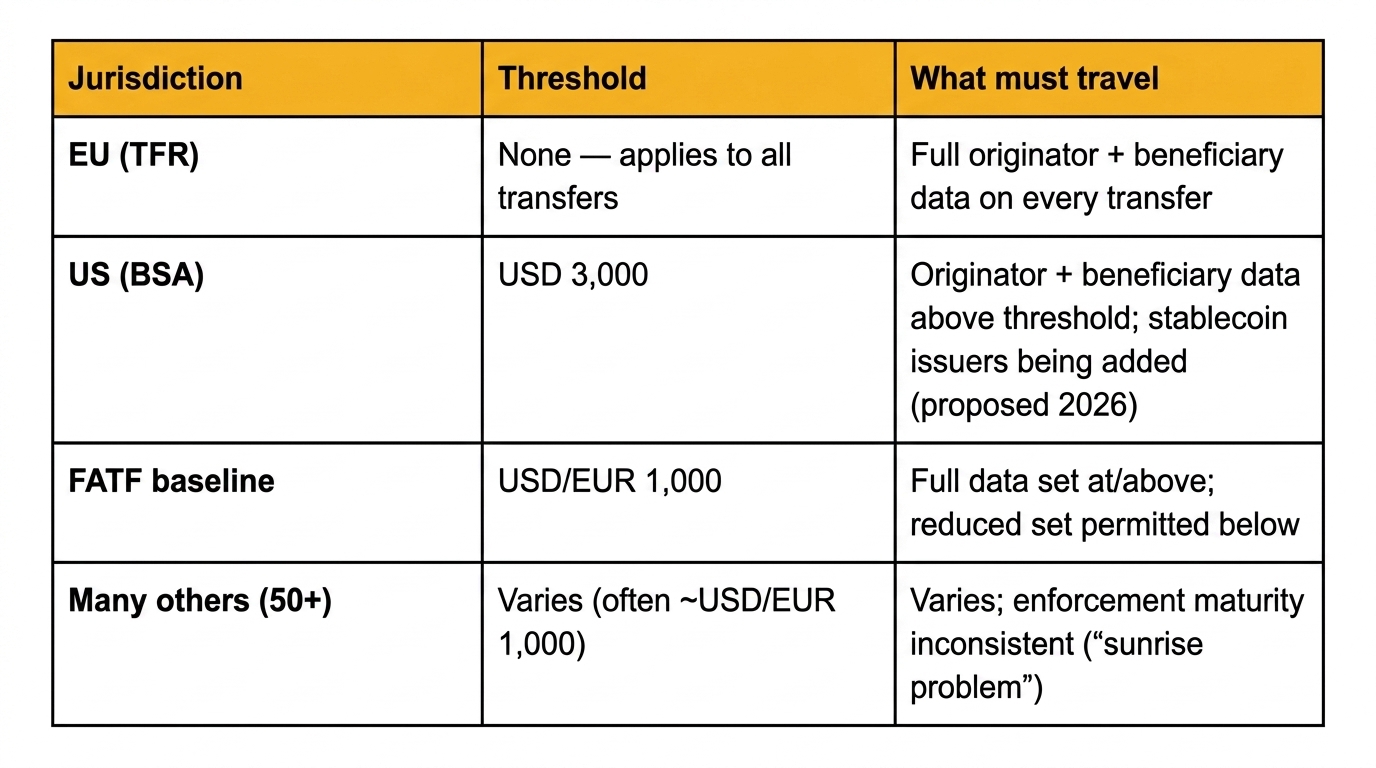
By 2026, over 50 jurisdictions have enacted Travel Rule legislation — roughly 73% of FATF-assessed jurisdictions, up from a far smaller base two years earlier. Enforcement maturity, thresholds, and required data still vary widely, so a payout that is routine in one corridor can be blocked in another.
EU — Transfer of Funds Regulation (TFR), no de-minimis threshold
The EU's recast Transfer of Funds Regulation (TFR) took effect on 30 December 2024. It is the strictest major regime: full originator and beneficiary data must accompany every crypto-asset transfer handled by a regulated provider, with no minimum threshold. A €5 payout and a €500,000 payout carry the same data obligation. The TFR operates alongside MiCA, the EU's broader crypto-asset framework, which governs licensing of providers.
US — Bank Secrecy Act Travel Rule, USD 3,000 threshold
In the United States the Travel Rule lives under the Bank Secrecy Act (BSA), administered by FinCEN, with a threshold of USD 3,000 — notably higher than FATF's recommendation. A 2026 development matters for stablecoin senders: following the GENIUS Act (signed July 2025), the U.S. Treasury proposed a rule on 8 April 2026 treating permitted stablecoin issuers as BSA financial institutions, subject to AML programs, recordkeeping, and the Travel Rule, with compliance expected around April 2027. The direction of travel is clear — stablecoin rails are being pulled fully into the same compliance perimeter as the banking system.
FATF global threshold and the "sunrise problem"
FATF recommends a standard threshold of USD/EUR 1,000, below which a reduced data set may apply. Because jurisdictions adopt the rule at different speeds, the industry faces the "sunrise problem": a compliant provider in a regulated market may need to send Travel Rule data to a counterparty in a market that has not yet implemented the rule and cannot receive it. For B2B senders this means a payout's success can depend on the recipient platform's jurisdiction, not just your own.
What data must "travel" with a B2B crypto payout
The required data set is consistent across regimes, even where thresholds differ.
Required originator (sender) fields
Name of the originator (your business or the paying entity).
Wallet address used for the transfer (or a transaction reference).
Physical/registered address, and in some regimes an official identifier or account number.
Required beneficiary (recipient) fields
Name of the recipient.
Wallet address receiving the funds.
In addition, the transaction amount, execution date, and a unique transaction identifier are recorded with every transfer. For your operations, the practical takeaway is that recipient name + wallet must be accurate and verifiable before you send — a mismatch is a hold.
Self-hosted (unhosted) wallet payouts — the extra step
Paying out to a self-hosted (non-custodial) wallet — common when paying contractors or partners who hold their own keys — changes the mechanics. There is no counterparty VASP to receive the Travel Rule message, so the data isn't transmitted onward; instead, your provider must still collect originator and beneficiary information from you, and above the relevant threshold may require verification of wallet ownership based on a risk assessment. Expect to attest that the recipient controls the destination address for larger payouts.
How a regulated crypto gateway runs the Travel Rule on outbound payouts
This is where a regulated crypto gateway earns its keep. Rather than connecting to Travel Rule messaging protocols, screening providers, and sanctions lists yourself, the gateway runs the controls inside the payout flow. Using INXY's outbound model as a concrete example, an outgoing payout passes through several gates before any transfer is created.
Pre-send checks — address risk and blacklist screening
A payout starts as a withdrawal request, not an immediate send. A pre-send validation stage runs first and can stop the operation with an error so that no transaction is ever formed. As part of this, the recipient address is looked up against historical risk data: a previously unseen address is treated cautiously, while a known address carries its last risk result. This means a problematic payout is caught at draft stage, not after funds have left.
KYT/AML screening of the recipient
Next is the outbound KYT (Know Your Transaction) sequence. The recipient address is checked against a blacklist; a match fails the request outright with no transaction created. If it clears, a risk provider screens the address and returns an outcome:
Low or Medium → the payout draft passes and proceeds.
High → the request fails, no transaction is created, and an error is returned.
This is the kyc aml crypto payments layer working in real time on the money leaving your account.
The Travel Rule message exchange
Only after screening passes does the Travel Rule step run, packaging and exchanging the required originator/beneficiary information with the counterparty provider where one exists. The payout then proceeds to settlement. The sequence matters: screen first, transmit data, then send.
Approved contacts and recipient allow-lists
Gateways typically maintain a contact list of approved recipients. A recipient flagged as declined blocks the payout regardless of other checks — a useful control for finance teams that want a vetted, reusable set of payees for recurring or mass payouts.
KYB is the gate to the platform; KYT is the gate to each transaction; the Travel Rule is the data that rides along with it. A gateway that handles all three is what "secure crypto payments" actually means in operational terms.
Compliance risks of getting payouts wrong
For a B2B sender, Travel Rule failures are not abstract — they hit cash flow and counterparties directly:
Held or returned transfers. Missing or mismatched recipient data is the most common cause of a stalled payout. Funds can sit in review or be returned, delaying contractor and supplier payments.
Counterparty refusal. If the receiving platform can't accept Travel Rule data (the sunrise problem) or flags your transfer, it may bounce the payment.
Regulatory exposure. Operating outbound flows without proper screening and recordkeeping exposes the business to AML penalties — increasingly so as stablecoin issuers are folded into BSA-style obligations.
Operational drag. Building and maintaining screening, sanctions, and Travel Rule messaging in-house is expensive and never "done," because rules and thresholds keep shifting.
How to automate crypto payouts without owning the compliance stack
The practical answer for most B2B senders is to run payouts through a regulated crypto gateway that treats the Travel Rule, KYT, and sanctions screening as part of the payout itself — not as something you bolt on.
With INXY, every outbound payout passes through pre-send validation, blacklist and KYT risk screening, and the Travel Rule step before settlement, and recurring payees can be managed through an approved contact list. Because the same flow is exposed via API and webhooks, you can run mass payouts — paying hundreds of contractors or partners at once — with compliance checks applied per recipient automatically, and receive status events back into your own systems. That is what "how to automate crypto payouts" looks like when compliance is built in rather than improvised.
If compliance posture is your priority, start with INXY's security & compliance capabilities; if payout mechanics are the focus, see crypto payouts and the cross-border and payroll options that build on the same rails.
FAQ
Does the Travel Rule apply to stablecoin payouts? Yes. Stablecoin transfers handled by a regulated provider are subject to the Travel Rule like any other virtual asset. In the EU, full data is required regardless of amount; in the US, stablecoin issuers are being brought explicitly into BSA Travel Rule obligations under a rule proposed in April 2026.
What is the Travel Rule threshold in 2026? It depends on the jurisdiction. FATF recommends USD/EUR 1,000; the US applies USD 3,000 under the BSA; the EU applies no threshold — every transfer carries full data.
Do I need to collect data for self-hosted (unhosted) wallet payouts? Yes. Even though there's no counterparty provider to receive the message, your gateway must still collect originator and beneficiary information, and above the relevant threshold may require proof that the recipient controls the destination wallet.
Is the Travel Rule the same as KYC? No. KYC/KYB verifies identity at onboarding. The Travel Rule governs the transmission of identity data alongside each transfer. They work together but are distinct obligations.
Who is responsible — the sender or the recipient platform? Both sides carry obligations. The originating provider must collect and transmit sender/recipient data; the beneficiary provider must receive and retain it. As the business initiating the payout, you're responsible for supplying accurate recipient information to your provider.
Cryptocurrency is a type of digital or virtual currency. It uses cryptography to secure transactions. This makes it hard to counterfeit. Unlike traditional money, cryptocurrencies operate on a technology called blockchain. This is a decentralized system spread across many computers.
Bitcoin was the first and is the most well-known cryptocurrency. But now, there are thousands of different cryptocurrencies. Each has its own unique features. For example, some are used for fast, low-cost transactions. Others focus on privacy.
A popular feature of cryptocurrencies is their ability to be traded or exchanged easily. People can buy, sell, or trade them on different online platforms. These platforms are called exchanges. Some well-known exchanges are Binance and Coinbase.
Stablecoins are another type of cryptocurrency. They are designed to minimize price fluctuations. They achieve this by being pegged to stable assets like the US dollar. USDT and USDC are examples of stablecoins. They provide stability in the volatile crypto market.
Cryptocurrencies are stored in digital wallets. These can be online, offline, or even hardware devices. Each wallet has a unique address. This address is used to send and receive cryptocurrencies.
While cryptocurrencies offer many benefits, they also come with risks. Their prices can be very volatile. This means they can change quickly and unpredictably. Security is another concern. If a wallet is hacked, it can lead to loss of funds.
Understanding how cryptocurrencies work is important. It helps in making informed decisions. Whether you want to invest or accept crypto payments, knowing the basics is the first step.
Setting Up Your Digital Wallet
Setting up a digital wallet for accepting crypto is like opening a new bank account, but much simpler. First, choose a wallet that suits your needs—whether it's a software wallet for easy access on your phone or a hardware wallet for extra security. Software wallets are apps you can download, making them convenient for daily transactions. Hardware wallets, on the other hand, are devices you connect to your computer, keeping your crypto offline and safe from hackers.
Next, install your chosen wallet and follow the instructions to create an account. You'll be given a unique address, like your wallet's phone number, where people can send you cryptocurrency. It’s crucial to secure your wallet with a strong password and, if possible, enable two-factor authentication for added security. Keep your recovery phrase safe; it’s your lifeline if you forget your password.
Finally, explore the wallet's features. Some wallets let you exchange one cryptocurrency for another directly within the app, while others offer detailed transaction history. Getting familiar with these options ensures smooth management of your crypto payments.
Choosing the Right Payment Processor
Picking the best payment processor for accepting crypto can feel like choosing the right car. You want something reliable, fast, and easy to handle.
In 2026, the most important thing to check is stablecoin support, not just Bitcoin. Most companies now prefer USDT, USDC, or DAI, because they offer price stability and dominate real business payments. Stablecoins now power most B2B payment growth worldwide.
Next, look at fees. Some processors charge a flat rate, others a percentage, and some add hidden spreads when converting crypto to fiat. It’s like buying a concert ticket—sometimes the “service fee” costs more than the seat.
A modern processor should integrate smoothly into your existing systems—your checkout page, invoicing software, or backend platform. Ideally, it should support both plugins (Shopify, WooCommerce) and API integration so your business can scale later.
Security matters too. Look for processors that:
screen every transaction (KYT)
support strong encryptio
offer clear, audit-friendly reporting
This is especially important as more countries enforce stricter crypto regulations, especially in the EU under MiCA.
Integrating Crypto Payments into Your Business
Integrating crypto payments into your business is easier today than ever before. Most companies start by choosing a crypto payment gateway that works alongside their existing checkout or invoicing system. These gateways support major cryptocurrencies like Bitcoin, Ethereum, and stablecoins such as USDT and USDC.
Once you choose a provider, you connect it to your website or platform. Many services offer simple plugins for Shopify, WooCommerce, and other tools. If you prefer something custom, you can use their API to build your own flow.
One helpful feature offered by most payment gateways is automatic conversion. This means that when a customer pays in crypto, the gateway can instantly convert it into stablecoins or fiat currency. Your balance stays steady, which makes bookkeeping easier and avoids the need to monitor crypto price changes. You simply receive the amount in the currency you prefer.
It also helps to clearly show on your website that you accept crypto. Customers who use digital assets often look for businesses that support their preferred payment methods.
As with any payment method, security matters. Keep your accounts protected with two-factor authentication and make sure your systems are up to date. A good gateway will also include its own safeguards, such as blockchain monitoring and fraud checks.
Offering crypto payments is a simple way to expand your payment options, make checkout more flexible, and reach customers in more parts of the world.
Tax Implications and Legal Considerations
When you begin accepting crypto payments, it’s important to understand how taxes and regulations apply in your region. Rules vary from country to country, but most treat cryptocurrency as an asset or a form of taxable income. If your business receives crypto as payment, it may need to be reported to your local tax authority. Keeping clean records of all transactions makes this process easier.
Regulation is also evolving around the world.
European Union
MiCA is now active.
Strict AML and Travel Rule checks.
You must work with a licensed VASP/CASP.
United States
Rules differ by state.
A federal stablecoin law is expected soon.
Choose a partner who follows both federal and state-level compliance.
United Kingdom
New crypto rules expected in 2026.
FCA requires AML, Travel Rule, and Financial Promotions compliance from providers.
Singapore
Very clear regulation under the Payment Services Act.
You must work only with licensed Digital Payment Token providers.
Hong Kong
Strong VASP licensing since 2023.
New stablecoin rules start in 2025.
Middle East (UAE, Bahrain)
UAE’s VARA sets strict rules for crypto companies.
Follow AML/CFT and Travel Rule requirements.
Latin America
Rules vary by country.
Brazil and Mexico are building national frameworks.
Work with partners who apply strong AML controls.
Because the landscape changes quickly, many businesses choose crypto payment processors that are already licensed or registered in their operating regions. Working with a regulated partner often simplifies compliance, especially around AML, KYC, and reporting obligations.
It’s also helpful to consult a tax or legal advisor familiar with cryptocurrency. They can guide you on reporting requirements, record-keeping, and any local rules you may need to follow.
Finally, many companies prefer accepting stablecoins like USDT or USDC. These assets are tied to national currencies and are less volatile than traditional cryptocurrencies, which can make accounting and financial planning easier.
Marketing Your Crypto Payment Options
When it comes to accepting crypto, getting the word out is key. Let people know you accept crypto payments. It can attract a new group of customers who prefer using digital currencies. To make this happen, you need a solid marketing plan tailored to this unique payment method.
One way to start is by updating your website and social media profiles. Highlight your new payment option. Create eye-catching banners or badges that say you accept cryptocurrencies like Bitcoin, Ethereum, or stablecoins such as USDT and USDC. This visual cue can grab attention and encourage visitors to explore more.
Consider writing blog posts or articles about the benefits of accepting crypto. These can educate your audience and position you as a forward-thinking business. Explain why crypto payments are secure, fast, and cost-effective. Use simple language to break down complex concepts. This helps even those new to crypto understand its advantages.
Social media is a powerful tool. Use it to announce your new payment methods. Platforms like Twitter, Instagram, and Facebook allow you to reach a wide audience. Create engaging posts with hashtags related to cryptocurrency. These can help your posts appear in searches made by crypto enthusiasts.
Collaborations with crypto influencers can extend your reach. Find influencers who align with your brand. They can showcase your business to their followers, who might be interested in using crypto. A positive mention from a trusted voice can enhance your credibility.
Email marketing can also play a role. Send newsletters to your subscribers informing them about your new payment option. Offer exclusive promotions or discounts for those who choose to pay with crypto. This can motivate them to try out the new payment method.
Hosting events or webinars about cryptocurrency can engage your audience. These can be opportunities to answer questions and demonstrate how paying with crypto works. Educating potential customers can remove doubts and make them more comfortable using digital currencies.
By using these marketing strategies, you can effectively promote your crypto payment options. This can lead to increased customer engagement and potentially boost your sales.
Future Trends in Cryptocurrency Payments
Let's talk about the exciting trends in cryptocurrency payments as we look ahead to 2026. Cryptocurrencies are changing the way we think about money, and it's only going to get more interesting. Businesses and freelancers should keep an eye on these trends to stay ahead of the curve.
One major trend is the rise of stablecoins. These are digital currencies that are tied to real-world assets like the US dollar. Examples include USDT and USDC. They provide the benefits of cryptocurrencies without the wild price swings. This makes them attractive for businesses that want to accept crypto without worrying about losing value overnight. Stablecoins are becoming a popular choice for payments because they offer stability and trust.
Another trend is the growing acceptance of crypto by big companies. More and more large businesses are starting to accept crypto payments. This is because they see the potential of reaching new customers worldwide. When big players jump on board, smaller businesses often follow. This could lead to more widespread use of crypto in everyday transactions.
There's also a push for better technology to support crypto payments. Developers are working on making transactions faster and cheaper. Right now, some cryptocurrencies take too long to process or have high fees. But new technologies, like the Lightning Network, aim to solve these problems. They allow instant transactions with very low fees. This makes crypto more practical for everyday use.
Security is always a concern with cryptocurrencies. As we move forward, we can expect improvements in this area too. Developers are creating more secure wallets and platforms to protect users from scams and hacks. This is crucial for building trust in the system.
Regulations are another important factor. Governments around the world are trying to figure out how to handle cryptocurrencies. In 2026, we might see more clear rules and regulations. This could make it easier for businesses to accept crypto without worrying about legal issues.
Lastly, as more people become familiar with cryptocurrency, we'll likely see an increase in its use. Education is key here. The more people know about how crypto works, the more comfortable they'll feel using it. This could lead to a significant increase in crypto payments.
In summary, the future of cryptocurrency payments looks promising. With stablecoins, big company adoption, better technology, increased security, clear regulations, and greater awareness, businesses and freelancers have much to look forward to in 2026. Keep an eye on these trends to stay ahead in the evolving world of crypto.
FAQ
What is cryptocurrency, and why should I consider accepting it as a payment method?
Cryptocurrency is a digital or virtual form of currency that uses cryptography for security and operates on decentralized networks like blockchain technology. Accepting crypto payments can broaden your customer base, lower transaction fees, and enhance your business's image as forward-thinking and tech-savvy.
How do I choose the right digital wallet for my business?
When selecting a digital wallet, consider factors like security features, compatibility with multiple cryptocurrencies, user interface, and customer support. Look for wallets with strong encryption and backup options to ensure your funds remain secure.
What should I look for in a cryptocurrency payment processor?
Key considerations for choosing a crypto payment processor include transaction fees, supported cryptocurrencies, ease of integration with existing systems, and customer support. Compare different options to find a processor that aligns with your business needs and budget.
How can I integrate cryptocurrency payments into my existing payment systems?
To integrate cryptocurrency payments, you can use plugins or APIs provided by your chosen payment processor. These tools allow you to seamlessly add crypto payment options to your website or point-of-sale systems, offering customers a smooth checkout experience.
What are the tax implications of accepting cryptocurrency payments?
The tax implications can vary based on your location, but generally, cryptocurrencies are treated as property for tax purposes. This means you need to track transactions and report any capital gains or losses. Consult with a tax professional to ensure compliance with local regulations.
How can I effectively market my acceptance of crypto payments?
Promote your crypto payment options through your website, social media, and email marketing. Highlight the benefits, such as lower fees and enhanced security, to attract tech-savvy customers. Collaborating with crypto influencers and participating in blockchain events can also boost visibility.
What future trends should I be aware of in the cryptocurrency payment space?
Stay informed about trends like the rise of decentralized finance (DeFi), the increasing use of stablecoins, and advancements in blockchain technology. These developments could offer new opportunities for reducing costs and enhancing transaction security in the coming years.