If you make payments to Turkey (Türkiye), to suppliers or contractors, the corridor has a constraint most content on this subject omits: crypto assets cannot be used to make payments in Türkiye. The Central Bank prohibited it in 2021 and the prohibition still stands. That single fact settles the question in the title. For paying a Turkish supplier or contractor, the answer is a bank rail. This piece sets out what the corridor costs today, where the bank route fails and how to fix it, and the narrow cases where stablecoin settlement still has a role.
The constraint that defines the corridor
On 16 April 2021 the Central Bank of the Republic of Türkiye published the Regulation on the Disuse of Crypto Assets in Payments, which prohibits the use of crypto assets, directly or indirectly, as a means of payment, and prohibits payment service providers from developing business models in which crypto assets are used in payment services or e-money issuance (Central Bank of the Republic of Türkiye, 2021). Holding, trading and transferring crypto assets is not prohibited. Discharging a commercial obligation with one is.
The practical consequence for a payer outside Türkiye is simple. Paying a Turkish supplier or contractor in USDT, USDC or any other crypto asset is not a structure we recommend. Routing the value through an exchange account and converting it to lira does not change what the payment is for, and the regulation covers indirect use as well as direct use. Treat any provider that sells a “stablecoin to your Turkish supplier” route as a provider asking you to carry its legal risk.
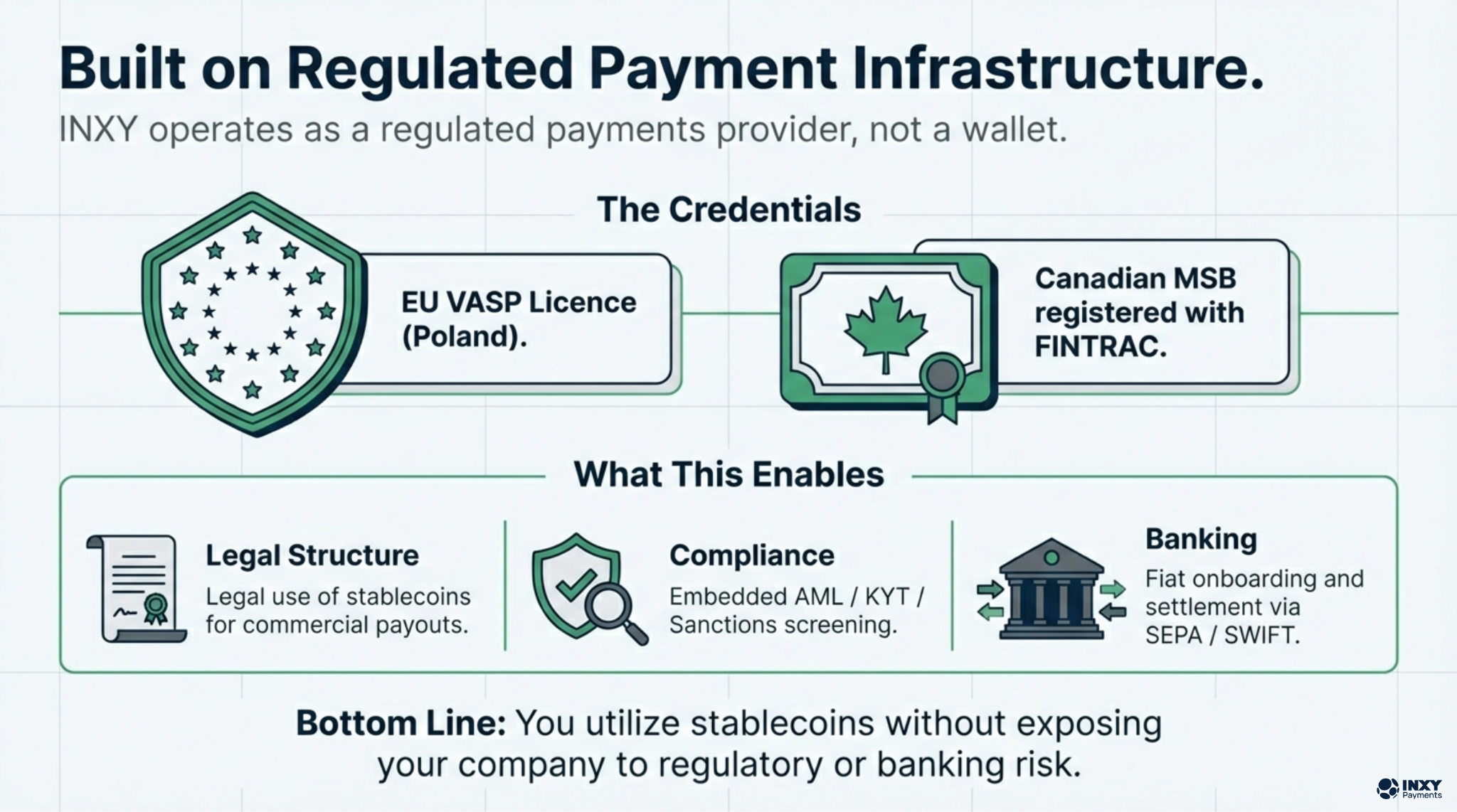
Since Law No. 7518 of 2024 amended Capital Markets Law No. 6362, crypto-asset service providers in Türkiye sit under the authorisation and supervision of the Capital Markets Board, with the Board’s secondary regulations following in 2025 (Law No. 7518, 2024). AML supervision runs through MASAK, the Financial Crimes Investigation Board. That regime governs crypto-asset businesses. It does not turn a crypto transfer into a lawful way to pay for goods or services.
Turkish providers also apply the Travel Rule to the transfers they receive. Since 25 February 2025, transfers of 15,000 lira or more need fuller originator information, and a transfer with missing data can be returned or rejected (MASAK guidance, as summarised by Notabene, 2024).
Türkiye was also removed from the FATF list of jurisdictions under increased monitoring at the June 2024 plenary (FATF, 2024), which matters less for your payment mechanics than for how your own bank’s correspondent chain prices and screens the corridor.
What the corridor actually costs today
Here is the uncomfortable part, stated honestly rather than papered over with a number: the only public benchmark measures consumer remittances, not commercial supplier payments. The World Bank’s Remittance Prices Worldwide put the average cost of sending USD 200 to Türkiye at 4.88% in Q3 2025, down from 5.31% in Q1 2025, and the cost of sending USD 500 at 2.97% (World Bank, 2025). The series does not break out individual corridors into Türkiye, and it says nothing about commercial ticket sizes. The UN’s policy target (reduce transaction costs of migrant remittances to less than 3% and eliminate corridors with costs above 5% by 2030; SDG target 10.c, indicator 10.c.1) tells you what “expensive” means directionally and nothing about your invoice.
So any provider quoting you a precise all-in cost for “the Turkey corridor” at your ticket size is quoting you a number they constructed. The useful move is to measure your own. The components are known even when the magnitudes are not:
| Cost component | Where it hides | How to measure it on your own data |
|---|---|---|
| Sending bank fee | On the statement | Already visible. Usually the smallest line. |
| Intermediary / lifting fees | Deducted in transit by correspondent banks | Compare the amount you sent with the amount your counterparty confirms they received. The gap is this plus the next row. |
| Beneficiary-side conversion spread | The Turkish bank’s own FX rate on an incoming hard-currency credit | Ask the counterparty for the lira amount credited and the rate applied; benchmark against the mid-market rate at that timestamp. |
| Your own FX spread | The rate your bank gives you, versus mid-market | Record the mid-market rate at the moment of instruction. The gap is the cost. Almost never quoted as a number. |
| Value-date lag | Cut-off times and weekends | Days between debit and the counterparty’s confirmed credit. Measure the distribution, not the average: the tail is what breaks terms. |
| Pre-funding float | Not on any fee schedule | Days of working capital held before execution, times your cost of capital. |
| Failed-payment rework | Payroll cost, not payment cost | Failed or returned payments per 100 sent, times the hours each one consumes. |
Run that against your last ninety days of Turkish payments and you will have a number nobody can argue with. Most finance teams discover the value-date tail and the beneficiary-side spread are larger than the fees they have been negotiating.
Where the bank route fails
Four failure modes that show up on this corridor.
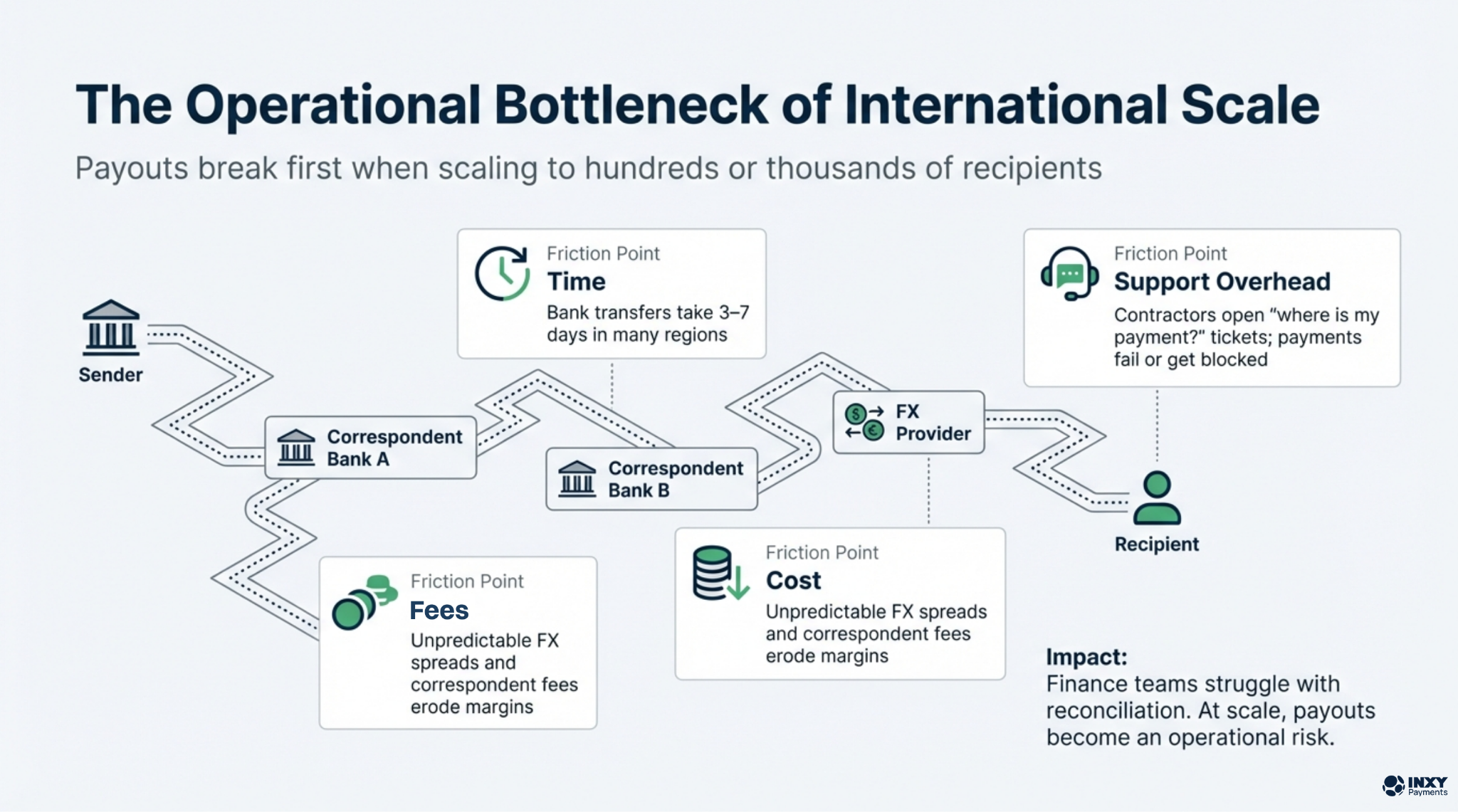
Hard-currency credits arriving as a lira surprise. The counterparty expected USD or EUR and their bank converted on arrival at a rate they did not choose. In an environment where the lira has depreciated persistently, a supplier who priced in hard currency and received lira at an unfavourable rate has effectively taken a discount, and they will ask you to make it up.
The value-date tail. Not the average settlement time: the tail. A payment instructed Thursday afternoon that lands the following Wednesday is a breached payment term, and correspondent chains produce those routinely around weekends and local holidays.
Documentation friction on commercial transfers. Incoming commercial payments commonly draw documentation queries from the receiving bank, and an incomplete reference or a mismatch between the payment narrative and the invoice generates queries that hold funds. The payment is not refused; it is parked, which is operationally worse because nobody is told.
Many small payments. If you are paying forty contractors rather than four suppliers, every cost above multiplies by forty while the per-payment fee stays fixed. On this corridor that is a reason to batch, schedule and document better, not a reason to change the rail.
What stablecoin settlement can and cannot do for payments to Turkey
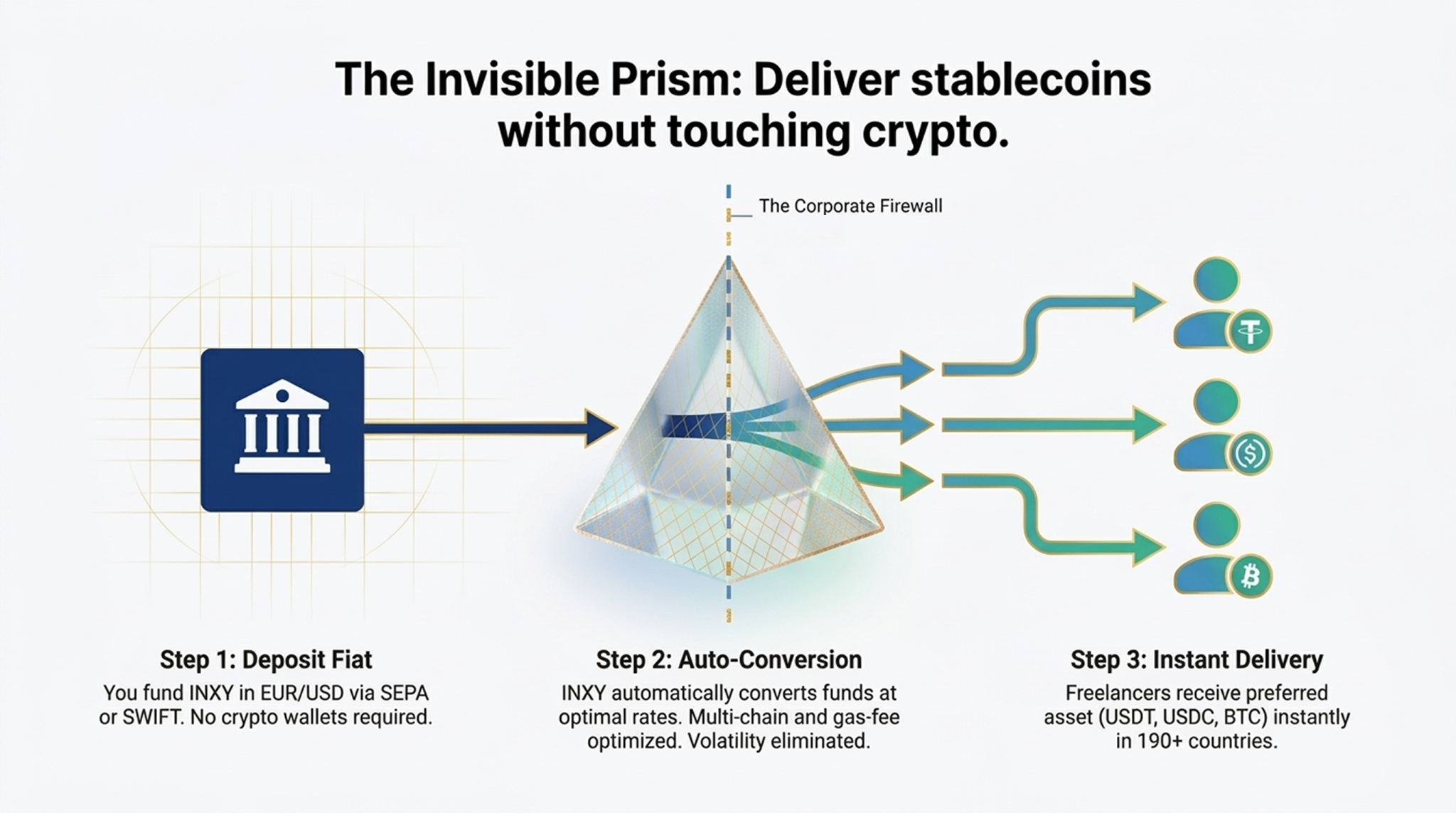
On other corridors, stablecoin settlement fixes several of the bank-route problems above: there is no correspondent chain to deduct from the transfer, chains do not observe cut-off times or weekends, and the network fee is flat per payout instead of a wire charge. On this corridor, those advantages do not apply to supplier and contractor payments, because the rail cannot lawfully be the payment.
Where stablecoin settlement still has a role:
Settling with licensed crypto-asset businesses. If your counterparty in Türkiye is itself an authorised crypto-asset service provider and the transfer is part of that licensed activity, such as settling a trade or moving liquidity, stablecoin settlement is the native rail, not a workaround.
Your corridors outside Türkiye. If Turkish payments are one line in a multi-country payout run, keep Türkiye on a bank rail and move the corridors where stablecoins work.
Where the stablecoin leg is used, it carries its own screening and information obligations. Your provider runs sanctions and wallet-risk screening and sends Travel Rule data before anything leaves; you supply accurate originator and beneficiary information. What the Travel Rule requires before a payout executes goes through the sequence, and Turkish providers check that data on arrival. Nothing about this corridor reduces KYC, sanctions screening or reporting obligations, and a provider suggesting otherwise is describing a future enforcement problem.
A six-step sequence to fix the bank route
Pull your last ninety days of Turkish payments. Count, value distribution, and (this is the one people skip) the confirmed credited amount and date from the counterparty’s side, not your own.
Calculate the two invisible components: amount sent minus amount credited, and your instructed rate versus mid-market at the same timestamp. Express both as a percentage of value.
Measure the value-date distribution, including the 90th percentile. Compare it against your contractual payment terms rather than against a target.
Fix the conversion in the contract. Agree the invoice currency and who carries the lira movement between invoice and payment. Where the counterparty holds a hard-currency account, pay into it.
Fix the documentation. Put the invoice number and a clear purpose in every payment reference, so the receiving bank has nothing to query.
Fix the timing. Instruct early enough to clear weekends and Turkish public holidays at your 90th-percentile settlement time, not your average.
For corridors where stablecoins do fit, our guide to cross-border B2B settlement with stablecoins covers the general mechanics, and the supported assets and networks page sets out what settles where.
The decision framework
Bank rails are the right answer when you pay suppliers or contractors in Türkiye. That covers nearly every commercial payment on this corridor. Optimise the route with the steps above.
Stablecoin settlement is the right answer when your counterparty is a licensed crypto-asset business and the transfer is part of its licensed activity, or when the corridor is not Türkiye at all.
Neither is the answer when the real problem is pricing in a depreciating currency. If your supplier’s complaint is the lira rate rather than the settlement time, changing the rail will not fix it. That is a contracting question (which currency the invoice is denominated in, and who carries the movement between invoice and payment) and it should be solved in the contract.
If Türkiye is one line in a wider payout run, the next step is to split the run by corridor. Mass payout infrastructure for repeating cross-border cycles covers the corridors where stablecoins fit, and you can compare your current payout flow with our team to see which corridors belong on which rail.
This article describes regulatory and market conditions for general information. It is not legal, tax, or financial advice. INXY Payments is a payment infrastructure provider, not a law or accountancy firm, and decisions with regulatory consequence should be reviewed by qualified counsel in the relevant jurisdiction.
FAQ
Can I pay a Turkish supplier directly in USDT?
No. The Central Bank of the Republic of Türkiye’s 2021 regulation prohibits using crypto assets in payments, directly or indirectly. Routing the value through a Turkish exchange account and converting it to lira does not change what the payment is for. Pay Turkish suppliers and contractors through a bank rail.
Is holding or receiving stablecoins legal in Türkiye?
Holding, trading and transferring crypto assets is not prohibited; using them to make payments is. Since Law No. 7518 of 2024, crypto-asset service providers operate under Capital Markets Board authorisation, with AML supervision through MASAK. Since February 2025 they also apply the Travel Rule to transfers they receive.
What does a payment to Türkiye cost through a bank?
The only public benchmark is the World Bank’s: sending USD 200 to Türkiye cost 4.88% on average in Q3 2025, and USD 500 cost 2.97%. Those are consumer remittances. For commercial payments, add up your sending fee, intermediary deductions, both FX spreads and the cost of the value-date lag, measured on your last ninety days.
How long does a bank transfer to Türkiye take?
It varies by correspondent route, sending bank and cut-off time, and the average matters less than the tail. Plan against your 90th-percentile settlement time rather than the typical case, because that is the figure that breaches payment terms around weekends and local holidays.
When does stablecoin settlement make sense for Türkiye?
Only in narrow cases: settling with licensed crypto-asset businesses as part of their licensed activity, such as trades or liquidity transfers. For supplier and contractor payments, the 2021 payment prohibition rules it out, and a bank rail is the right choice.
Do stablecoin transfers to Türkiye reduce compliance obligations?
No. Your provider acts as the sending service provider and runs sanctions screening, wallet-risk screening and Travel Rule data transfer; you supply accurate originator and beneficiary data. Turkish providers check that data on arrival. Nothing about this route reduces KYC, sanctions screening or reporting duties on either side.