
Treat Latin America as one region for LatAm contractor payouts and you will get at least one of these three markets wrong. Brazil has pulled stablecoin settlement inside its foreign-exchange rulebook and, since October 2026, out of reach of one whole class of payment provider. Mexico keeps crypto away from the banking channel entirely. Argentina has dismantled most of its FX controls and registered its virtual asset providers for the first time. Three regimes, three different right answers.
What the three corridors cost today
The only public benchmark that covers all three consistently is the World Bank’s Remittance Prices Worldwide series. Its Q3 2025 issue, the latest published, put the Latin America and Caribbean average at 5.64% of a USD 200 transfer, down from 5.72% in Q1 2025, against a global average of 6.36% (World Bank, 2025).
| Corridor direction | Average cost of USD 200 (Q3 2025) | Note |
|---|---|---|
| To Mexico | 4.53% | Cheapest G20 receiving market in the report |
| To Brazil | 5.38% | Below the regional average |
| From Brazil | 11.91% | Roughly double the regional average: paying out of Brazil is the expensive direction |
| To Argentina | Not reported in this issue | — |
| Regional average (LAC) | 5.64% | Down from 5.72% in Q1 2025 |
| Global average | 6.36% | Target: 3% by 2030, and 5% or less in every corridor |
Source: World Bank, Remittance Prices Worldwide, Q3 2025.
Two things fall out of that table immediately, and both run against the usual pitch.
First, the inbound Mexican corridor is already cheap. At 4.53% it is the lowest-cost G20 receiving market the World Bank measures. If someone tells you a stablecoin rail will transform your Mexican payout economics, ask them against which number. The corridor is competitive on price, and that will not change soon.
Second, the direction of travel matters more than the country. Paying into Brazil costs 5.38%; paying out of Brazil costs 11.91%. A Brazilian subsidiary paying contractors abroad has a materially worse problem than a European company paying contractors in Brazil, and the regulatory section below explains why those two problems are now also legally different.
The caveat to put in front of the table, not after it: this series prices a USD 200 consumer remittance. It is the best cross-country benchmark in existence and the wrong shape for a 2,000-payee business batch. Use it for structure (which direction is expensive, which receiving method costs more) and price your own volume against your own quotes.
Brazil: the regulated path just narrowed
Brazil is the most consequential regulatory change in this article, and it is moving in a direction most vendor content has not caught up with.
Resolution BCB No. 521/2025 was adopted on 10 November 2025 and published in the Diário Oficial da União on 11 November 2025, together with Resolutions 519 and 520. Most of its provisions took effect on 2 February 2026, with the reporting framework following on 4 May 2026 and reportable operations from 3 November 2026 under Resolution BCB 574 and IN BCB 756 (Banco Central do Brasil, 2025–2026).
What it does is bring virtual-asset service activity inside Brazil’s foreign-exchange and international-capital framework. In scope: international payments or transfers using virtual assets, transfers linked to international card use, transfers to and from self-custody wallets, and the purchase, sale or exchange of fiat-referenced virtual assets. Virtual asset service providers (PSAVs) may offer those services in the FX market only within the central bank’s authorisation framework. The resolution bars purchase or sale of virtual assets with payment or receipt in foreign currency, restricts the movement of third-party funds, requires a PSAV to identify the owner of a self-custody wallet and document origin and destination checks, and requires enhanced due diligence before transacting with a foreign VASP. Covered institutions report to the central bank monthly.
The transition window has closed. By 30 October 2026, providers already operating had to file for central bank authorisation, and authorised providers had to stop dealing with unauthorised ones (Felsberg Advogados, 2025; Decrypt, 2026). From here on, every Brazilian counterparty in your flow either has a PSAV application on file or is a counterparty your other counterparties may no longer touch.
Then the part that changes provider selection. Resolution BCB 561, published on 30 April 2026, rewrote the eFX framework, and its core rules took effect on 1 October 2026. eFX providers (payment institutions, e-money issuers and acquirers offering cross-border services) may not use stablecoins or crypto to settle with overseas counterparties. Settlement must run through a foreign-exchange operation or a non-resident BRL account (CoinDesk, 2026). Virtual-asset flows now sit with providers authorised under the PSAV framework of Resolutions 519–521, inside the FX rules described above.
What this means operationally. Brazil is no longer a question of whether stablecoin settlement is permitted. It is a question of which authorisation each party in your flow holds. A cross-border payment provider under the eFX framework can no longer settle in stablecoins at all. A PSAV can handle virtual-asset flows, but only inside the central bank’s FX rules, and it now checks foreign counterparties before it accepts their transfers.
The questions to ask, in writing: under which BCB authorisation does our Brazilian settlement leg operate, and has that entity filed for or received PSAV authorisation? A provider who cannot answer that in one sentence has not read the resolutions. If you want those answers for INXY’s Brazilian leg before you commit volume, talk to a payments specialist and ask them first.
On the last mile, Brazil is the easiest of the three. Pix, the central bank’s instant payment system, now carries the majority of Brazil’s retail payment transactions (Banco Central do Brasil data, reported 2026) and gives a contractor near-instant credit in reais once a local counterparty converts. The domestic leg is genuinely solved here, which is precisely why the authorisation question upstream is the one that decides your corridor.
Mexico: legal for your contractor, closed to your bank
Mexico’s position has been stable for years and is widely misunderstood. The Ley para Regular las Instituciones de Tecnología Financiera (the Fintech Law) was passed in March 2018 and was the first Latin American statute to define virtual assets. Article 30 is cited for the rule that virtual assets are not legal tender in Mexican territory.
The operative constraint is Banxico Circular 4/2019. Financial institutions need prior Banco de México authorisation for virtual asset operations, may only carry out internal operations even then, and are expressly prohibited from offering such services to the public (CCN, 2026, summarising Circular 4/2019). Non-financial exchanges, separately, may not hold client fiat funds for crypto purchases, because holding client money is reserved activity.
So the Mexican picture is: your contractor may hold and sell crypto legally; regulated Mexican banks may not intermediate it for them; exchanges operate as designated businesses under AML rules with KYC and UIF reporting obligations. The off-ramp therefore runs through non-bank regulated channels, and the quality of your corridor depends entirely on which of those your provider uses.
One reading worth flagging rather than asserting. Some practitioners argue USD-backed stablecoins fall outside the Fintech Law’s “virtual asset” definition, because they are denominated in foreign currency and represent a claim on an underlying asset, and are instead governed by banking and foreign exchange rules with Banxico as the relevant authority (CCN, 2026). That is a commentator’s reading, not a published Banxico determination, and it is the kind of classification question you want your own Mexican counsel to answer before it is load-bearing in your payout design.
Where the cost case is weakest. Mexico. At 4.53% inbound the incumbent rails are already competitive, and the corridor is one of the most contested remittance markets in the world. The stablecoin argument in Mexico is not primarily about price. It is about batch mechanics, payout frequency and not having each of 1,800 payouts priced individually. Say that, rather than implying a saving the benchmark does not support.
Argentina: controls lifted, providers registered
Argentina changed twice in 2025, and both changes cut against the simplest version of the stablecoin story.
Exchange controls. On 14 April 2025, through BCRA Communication “A” 8226 and Decree 269/2025, Argentina lifted much of its FX regime. Residents may buy and hold foreign currency without prior BCRA authorisation. Financial institutions may process transfers abroad of profits and dividends to non-resident shareholders based on audited financial statements from fiscal year 2025 onward. Import payments lost their minimum waiting periods and the SIRA/SIRASE system was eliminated. Payments to unrelated foreign service providers may be made as the services accrue. Restrictions that remain include a 90-day delay on related-party service payments and caps on advance payments for capital goods: 30% of FOB value, within an 80% overall cap (BCRA, 2025; Decree 269/2025).
Provider registration. The securities regulator published CNV General Resolution No. 1058/2025 on 14 March 2025, creating the PSAV registry. Individuals resident in Argentina and locally incorporated entities carrying out the activities listed in Section 4 bis of Law No. 25,246 must register; individuals below 35,000 UVAs are exempt. Registration deadlines ran to 1 July 2025 for individuals, 1 August 2025 for domestic legal entities and 1 September 2025 for foreign legal entities. Minimum net worth is USD 150,000 for exchange and custody categories, USD 75,000 for transfer, and USD 35,000 for ICO-related services, halved where transactions or assets under custody were below USD 2.5 million in the previous twelve months. Foreign entities must register where they carry out activities in Argentina directly (Beccar Varela, 2025, summarising CNV GR 1058/2025).
Why this matters more than it sounds. A large part of the historical Argentine case for stablecoins was FX access: the gap between official and parallel rates, and the difficulty of getting dollars at all. The April 2025 liberalisation narrowed that argument. What remains is still substantial: inflation-driven demand for dollar-denominated balances, a contractor base that genuinely prefers to be paid in dollars, and a payout rail that does not depend on a local bank’s willingness to process an inbound foreign-currency credit. But the “you cannot get dollars any other way” framing is out of date, and a provider still using it in 2026 is telling you how recently they looked.
What actually changes with stablecoin rails
Across all three markets, the same three things change and the same three do not.
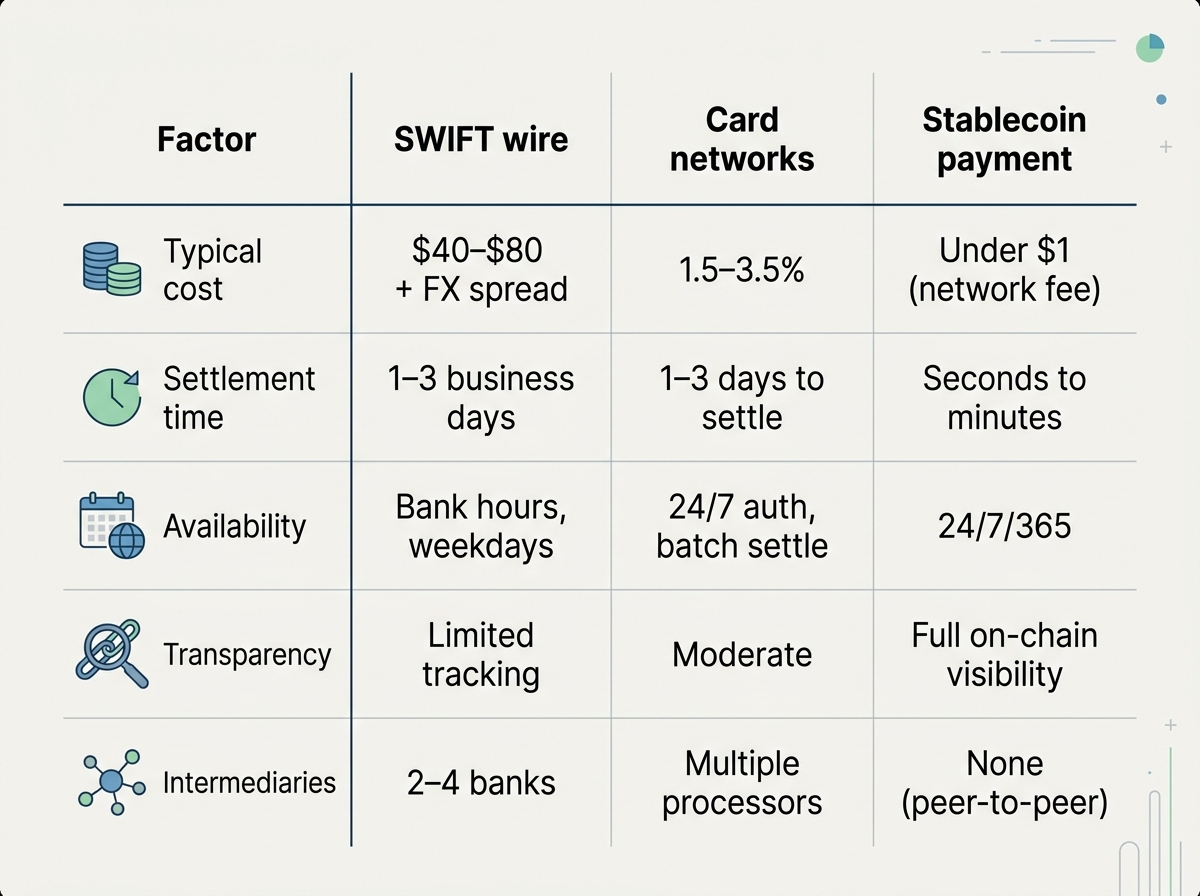
Changes: the international leg stops depending on a correspondent chain, so finality is a function of the chain rather than of a clearing calendar; the network fee is flat per payout, so batch shape and chain choice drive cost as much as the provider’s rate; and screening runs before the transfer leaves rather than inside somebody else’s queue. At INXY, payouts are priced from 0.1%, depending on volume, currency and corridor, with no setup or monthly fees.
Does not change: FX still happens, at a spread, somewhere. Compliance still happens: AML, KYT, sanctions and Travel Rule screening are not reduced by changing rails; our guide to what screening actually runs before a payout leaves sets out the data fields. And the contractor still needs reais, Mexican pesos or Argentine pesos in a local account, which means a licensed local counterparty converts and credits.
Standing up a LatAm corridor: the sequence
Confirm the authorisation per market, in writing. Brazil: which BCB authorisation, and is the local counterparty a PSAV authorised, or with an application filed, under Resolutions 519–521? Mexico: which non-bank regulated channel performs the peso leg? Argentina: is the counterparty on the CNV PSAV registry and in which category?
Decide where FX happens: at your end into stablecoin, or at the recipient’s end out of it. The spread and the accounting differ. Pick one deliberately.
Choose the settlement chain on landed cost, not headline fee. Network fee, finality and local off-ramp liquidity differ per chain; the tradeoffs are in our comparison of TRC-20, ERC-20 and BEP-20 network costs. For the batch model itself, see mass crypto payouts.
Collect payee data to Travel Rule standard before the first batch. FATF’s revised Recommendation 16 sets a de minimis threshold of no more than USD/EUR 1,000 and allows lower risk-based thresholds (FATF, 2025). Brazilian PSAVs must also identify the owners of self-custody wallets. Collect to the strictest applicable standard once rather than three times.
Pilot 20 payees per market, including one name mismatch and one payee whose local account is at a bank that holds inbound foreign-currency credits for review.
Reconcile the pilot to the cent, network fee line included, against your chart of accounts.
Write the failure path down: who re-issues a returned payout, in what currency, on what timeline, and who tells the contractor.
What breaks in production
Brazil, the eFX settlement leg. Since 1 October 2026, a provider operating under the eFX framework cannot settle with overseas counterparties in stablecoins. If your corridor still depends on one, this is not a planned change. It is a current outage.
Brazil, foreign-counterparty checks. Since 30 October 2026, authorised PSAVs may not deal with unauthorised providers, and they apply enhanced due diligence to foreign VASPs. A transfer from a counterparty the receiving PSAV has not assessed can be held or returned. Confirm the receiving side has cleared your provider before payout day.
Mexican bank rejection on the last mile. Because regulated institutions may not offer virtual asset services to the public, a payout path that implicitly assumes a bank will intermediate will fail, and the failure looks like an unexplained rejection rather than a compliance message.
Argentine registration status drifting. The PSAV registry is new and categories are specific. A counterparty registered for transfer but not custody cannot hold balances for you.
Related-party flows in Argentina. The 90-day delay on payments for services between related parties survived the liberalisation. Intercompany payout design that ignores it will stall.
Partial batch failure. Fifteen of 1,800 payouts fail. All-or-nothing reconciliation logic then puts your ledger out by fifteen payments across three countries and three time zones.
Name and tax-ID mismatches. CPF in Brazil, RFC/CURP in Mexico, CUIT/CUIL in Argentina. Local beneficiary validation checks these against the name, and a mismatch is a rejection, not a warning.
Decision framework
If you are paying into Brazil: the domestic leg is solved and the regulatory leg is not. Decide on authorisation category first and cost second. Confirm the authorisation of every party in the Brazilian leg, eFX and PSAV alike.
If you are paying into Mexico: do not buy on price. The incumbent inbound corridor at 4.53% is hard to beat. Buy on batch mechanics, payout frequency and the quality of the non-bank off-ramp. If you are paying twenty suppliers a quarter, keep what you have.
If you are paying into Argentina: the FX-access argument is weaker than it was in 2024 and the contractor-preference argument is not. Check CNV registration and category, and design around the surviving related-party restriction.
If you are paying out of Brazil: this is the expensive direction (11.91% on the World Bank benchmark) and the most likely place for a corridor change to pay for itself. It is also the direction where Resolutions 521 and 561 bite hardest, so get the authorisation answer before you get a quote.
Where INXY is not the answer. Low-volume, high-value, infrequent payouts into Mexico. The corridor is already cheap, the integration and governance effort of a new rail is real, and an existing bank or money transfer operator relationship is a defensible choice. Stablecoin rails earn their keep on payout count and frequency, not on the existence of a border.
To price your own volume rather than a USD 200 benchmark, start with USDT mass payouts for the asset-level detail and compare your current payout flow with our team, with your real payee counts per market.
This article describes regulatory and market conditions for general information. It is not legal, tax, or financial advice. INXY Payments is a payment infrastructure provider, not a law or accountancy firm, and decisions with regulatory consequence should be reviewed by qualified counsel in the relevant jurisdiction.
FAQ
Can I pay Brazilian contractors in stablecoins?
It depends on who is in the flow. Resolution BCB 521/2025 brought virtual-asset activity into Brazil’s FX framework from February 2026. Under Resolution BCB 561, since 1 October 2026 eFX providers such as payment institutions and acquirers may not use stablecoins to settle with overseas counterparties. Virtual-asset flows run through PSAVs authorised by the central bank.
Is crypto legal in Mexico for business payments?
Crypto is legal to hold and trade but is not legal tender under Article 30 of the 2018 Fintech Law. Banxico Circular 4/2019 prohibits financial institutions from offering virtual asset services to the public, so the payout channel runs through non-bank regulated providers rather than banks.
Does Argentina still have exchange controls?
Much of the regime was lifted on 14 April 2025 under BCRA Communication “A” 8226 and Decree 269/2025. Residents may buy and hold foreign currency freely, and import and dividend restrictions eased. A 90-day delay on related-party service payments and caps on advance payments for capital goods remain.
What does it cost to send a contractor payout to Latin America?
The World Bank put the Latin America and Caribbean average at 5.64% of a USD 200 transfer in Q3 2025, with Mexico at 4.53% and Brazil at 5.38% inbound. Sending from Brazil averaged 11.91%. These are consumer-remittance benchmarks, so price a business batch against your own quotes.
Do virtual asset providers need to register in Argentina?
Yes. CNV General Resolution No. 1058/2025, published 14 March 2025, created the PSAV registry, with deadlines through September 2025 and minimum net worth from USD 35,000 to USD 150,000 by category. Foreign entities must register where they carry out activities in Argentina directly.
Which LatAm corridor benefits most from changing rails?
Usually payouts out of Brazil, where the World Bank benchmark is roughly double the regional average, and any market where you are making hundreds of payouts a month rather than dozens. Inbound Mexico benefits least on price, because the incumbent corridor is already the cheapest the World Bank measures.