
Blog
In this dedicated blog page, we invite you to explore a wealth of knowledge, expertise, and inspiration that transcends traditional boundaries.

INXY Raises $7M to Expand Cross-Border Payment Infrastructure
INXY has secured new funding to continue building its global payments platform. The total round reached $7M. The company focuses on stablecoin infrastructure for businesses. Its tools help companies accept crypto and send payouts while keeping accounting in fiat.
INXY has secured new funding to continue building its global payments platform. The total round reached $7M.
The company focuses on stablecoin infrastructure for businesses. Its tools help companies accept crypto and send payouts while keeping accounting in fiat.
This funding comes at a time when global payments are changing. Traditional rails are slow and expensive. Cross-border transfers often take days and include multiple intermediaries.
Stablecoins offer a different path. They move value quickly and directly. They reduce friction in international transactions. Many businesses are starting to explore this model.
INXY builds infrastructure for this shift. The goal is simple. Let companies use crypto without becoming crypto companies.
The platform supports mass payouts, payment acceptance, and automated conversion. Funds can be sent globally and settled in EUR or USD.
The company has already processed over $2B in annual stablecoin volume. This shows growing demand for alternative payment rails.
The new capital will be used to:
– Expand the payments infrastructure.
– Strengthen compliance and regulatory alignment.
– Grow the team and product capabilities.
Regulation is also shaping the market. In Europe, frameworks like MiCA are creating clearer rules for crypto services. This makes it easier for businesses to adopt compliant solutions.
INXY positions itself in this new environment as a regulated infrastructure provider. It operates under EU and Canadian frameworks and focuses on low-risk business use cases.
The company believes the future of payments will be stablecoin-based, compliant, and invisible to the end user.
The work ahead is not about hype. It is about making payments simple, reliable, and global.
Articles

LatAm Contractor Payouts: Brazil, Mexico and Argentina
Brazil, Mexico and Argentina need three different answers for contractor payouts. World Bank corridor costs, Brazil’s 2026 BCB rules, Mexico’s closed bank channel, Argentina’s lifted FX controls, and a seven-step corridor setup.
Treat Latin America as one region for LatAm contractor payouts and you will get at least one of these three markets wrong. Brazil has pulled stablecoin settlement inside its foreign-exchange rulebook and, since October 2026, out of reach of one whole class of payment provider. Mexico keeps crypto away from the banking channel entirely. Argentina has dismantled most of its FX controls and registered its virtual asset providers for the first time. Three regimes, three different right answers.
What the three corridors cost today
The only public benchmark that covers all three consistently is the World Bank’s Remittance Prices Worldwide series. Its Q3 2025 issue, the latest published, put the Latin America and Caribbean average at 5.64% of a USD 200 transfer, down from 5.72% in Q1 2025, against a global average of 6.36% (World Bank, 2025).
| Corridor direction | Average cost of USD 200 (Q3 2025) | Note |
|---|---|---|
| To Mexico | 4.53% | Cheapest G20 receiving market in the report |
| To Brazil | 5.38% | Below the regional average |
| From Brazil | 11.91% | Roughly double the regional average: paying out of Brazil is the expensive direction |
| To Argentina | Not reported in this issue | — |
| Regional average (LAC) | 5.64% | Down from 5.72% in Q1 2025 |
| Global average | 6.36% | Target: 3% by 2030, and 5% or less in every corridor |
Source: World Bank, Remittance Prices Worldwide, Q3 2025.
Two things fall out of that table immediately, and both run against the usual pitch.
First, the inbound Mexican corridor is already cheap. At 4.53% it is the lowest-cost G20 receiving market the World Bank measures. If someone tells you a stablecoin rail will transform your Mexican payout economics, ask them against which number. The corridor is competitive on price, and that will not change soon.
Second, the direction of travel matters more than the country. Paying into Brazil costs 5.38%; paying out of Brazil costs 11.91%. A Brazilian subsidiary paying contractors abroad has a materially worse problem than a European company paying contractors in Brazil, and the regulatory section below explains why those two problems are now also legally different.
The caveat to put in front of the table, not after it: this series prices a USD 200 consumer remittance. It is the best cross-country benchmark in existence and the wrong shape for a 2,000-payee business batch. Use it for structure (which direction is expensive, which receiving method costs more) and price your own volume against your own quotes.
Brazil: the regulated path just narrowed
Brazil is the most consequential regulatory change in this article, and it is moving in a direction most vendor content has not caught up with.
Resolution BCB No. 521/2025 was adopted on 10 November 2025 and published in the Diário Oficial da União on 11 November 2025, together with Resolutions 519 and 520. Most of its provisions took effect on 2 February 2026, with the reporting framework following on 4 May 2026 and reportable operations from 3 November 2026 under Resolution BCB 574 and IN BCB 756 (Banco Central do Brasil, 2025–2026).
What it does is bring virtual-asset service activity inside Brazil’s foreign-exchange and international-capital framework. In scope: international payments or transfers using virtual assets, transfers linked to international card use, transfers to and from self-custody wallets, and the purchase, sale or exchange of fiat-referenced virtual assets. Virtual asset service providers (PSAVs) may offer those services in the FX market only within the central bank’s authorisation framework. The resolution bars purchase or sale of virtual assets with payment or receipt in foreign currency, restricts the movement of third-party funds, requires a PSAV to identify the owner of a self-custody wallet and document origin and destination checks, and requires enhanced due diligence before transacting with a foreign VASP. Covered institutions report to the central bank monthly.
The transition window has closed. By 30 October 2026, providers already operating had to file for central bank authorisation, and authorised providers had to stop dealing with unauthorised ones (Felsberg Advogados, 2025; Decrypt, 2026). From here on, every Brazilian counterparty in your flow either has a PSAV application on file or is a counterparty your other counterparties may no longer touch.
Then the part that changes provider selection. Resolution BCB 561, published on 30 April 2026, rewrote the eFX framework, and its core rules took effect on 1 October 2026. eFX providers (payment institutions, e-money issuers and acquirers offering cross-border services) may not use stablecoins or crypto to settle with overseas counterparties. Settlement must run through a foreign-exchange operation or a non-resident BRL account (CoinDesk, 2026). Virtual-asset flows now sit with providers authorised under the PSAV framework of Resolutions 519–521, inside the FX rules described above.
What this means operationally. Brazil is no longer a question of whether stablecoin settlement is permitted. It is a question of which authorisation each party in your flow holds. A cross-border payment provider under the eFX framework can no longer settle in stablecoins at all. A PSAV can handle virtual-asset flows, but only inside the central bank’s FX rules, and it now checks foreign counterparties before it accepts their transfers.
The questions to ask, in writing: under which BCB authorisation does our Brazilian settlement leg operate, and has that entity filed for or received PSAV authorisation? A provider who cannot answer that in one sentence has not read the resolutions. If you want those answers for INXY’s Brazilian leg before you commit volume, talk to a payments specialist and ask them first.
On the last mile, Brazil is the easiest of the three. Pix, the central bank’s instant payment system, now carries the majority of Brazil’s retail payment transactions (Banco Central do Brasil data, reported 2026) and gives a contractor near-instant credit in reais once a local counterparty converts. The domestic leg is genuinely solved here, which is precisely why the authorisation question upstream is the one that decides your corridor.
Mexico: legal for your contractor, closed to your bank
Mexico’s position has been stable for years and is widely misunderstood. The Ley para Regular las Instituciones de Tecnología Financiera (the Fintech Law) was passed in March 2018 and was the first Latin American statute to define virtual assets. Article 30 is cited for the rule that virtual assets are not legal tender in Mexican territory.
The operative constraint is Banxico Circular 4/2019. Financial institutions need prior Banco de México authorisation for virtual asset operations, may only carry out internal operations even then, and are expressly prohibited from offering such services to the public (CCN, 2026, summarising Circular 4/2019). Non-financial exchanges, separately, may not hold client fiat funds for crypto purchases, because holding client money is reserved activity.
So the Mexican picture is: your contractor may hold and sell crypto legally; regulated Mexican banks may not intermediate it for them; exchanges operate as designated businesses under AML rules with KYC and UIF reporting obligations. The off-ramp therefore runs through non-bank regulated channels, and the quality of your corridor depends entirely on which of those your provider uses.
One reading worth flagging rather than asserting. Some practitioners argue USD-backed stablecoins fall outside the Fintech Law’s “virtual asset” definition, because they are denominated in foreign currency and represent a claim on an underlying asset, and are instead governed by banking and foreign exchange rules with Banxico as the relevant authority (CCN, 2026). That is a commentator’s reading, not a published Banxico determination, and it is the kind of classification question you want your own Mexican counsel to answer before it is load-bearing in your payout design.
Where the cost case is weakest. Mexico. At 4.53% inbound the incumbent rails are already competitive, and the corridor is one of the most contested remittance markets in the world. The stablecoin argument in Mexico is not primarily about price. It is about batch mechanics, payout frequency and not having each of 1,800 payouts priced individually. Say that, rather than implying a saving the benchmark does not support.
Argentina: controls lifted, providers registered
Argentina changed twice in 2025, and both changes cut against the simplest version of the stablecoin story.
Exchange controls. On 14 April 2025, through BCRA Communication “A” 8226 and Decree 269/2025, Argentina lifted much of its FX regime. Residents may buy and hold foreign currency without prior BCRA authorisation. Financial institutions may process transfers abroad of profits and dividends to non-resident shareholders based on audited financial statements from fiscal year 2025 onward. Import payments lost their minimum waiting periods and the SIRA/SIRASE system was eliminated. Payments to unrelated foreign service providers may be made as the services accrue. Restrictions that remain include a 90-day delay on related-party service payments and caps on advance payments for capital goods: 30% of FOB value, within an 80% overall cap (BCRA, 2025; Decree 269/2025).
Provider registration. The securities regulator published CNV General Resolution No. 1058/2025 on 14 March 2025, creating the PSAV registry. Individuals resident in Argentina and locally incorporated entities carrying out the activities listed in Section 4 bis of Law No. 25,246 must register; individuals below 35,000 UVAs are exempt. Registration deadlines ran to 1 July 2025 for individuals, 1 August 2025 for domestic legal entities and 1 September 2025 for foreign legal entities. Minimum net worth is USD 150,000 for exchange and custody categories, USD 75,000 for transfer, and USD 35,000 for ICO-related services, halved where transactions or assets under custody were below USD 2.5 million in the previous twelve months. Foreign entities must register where they carry out activities in Argentina directly (Beccar Varela, 2025, summarising CNV GR 1058/2025).
Why this matters more than it sounds. A large part of the historical Argentine case for stablecoins was FX access: the gap between official and parallel rates, and the difficulty of getting dollars at all. The April 2025 liberalisation narrowed that argument. What remains is still substantial: inflation-driven demand for dollar-denominated balances, a contractor base that genuinely prefers to be paid in dollars, and a payout rail that does not depend on a local bank’s willingness to process an inbound foreign-currency credit. But the “you cannot get dollars any other way” framing is out of date, and a provider still using it in 2026 is telling you how recently they looked.
What actually changes with stablecoin rails
Across all three markets, the same three things change and the same three do not.
Changes: the international leg stops depending on a correspondent chain, so finality is a function of the chain rather than of a clearing calendar; the network fee is flat per payout, so batch shape and chain choice drive cost as much as the provider’s rate; and screening runs before the transfer leaves rather than inside somebody else’s queue. At INXY, payouts are priced from 0.1%, depending on volume, currency and corridor, with no setup or monthly fees.
Does not change: FX still happens, at a spread, somewhere. Compliance still happens: AML, KYT, sanctions and Travel Rule screening are not reduced by changing rails; our guide to what screening actually runs before a payout leaves sets out the data fields. And the contractor still needs reais, Mexican pesos or Argentine pesos in a local account, which means a licensed local counterparty converts and credits.
Standing up a LatAm corridor: the sequence
Confirm the authorisation per market, in writing. Brazil: which BCB authorisation, and is the local counterparty a PSAV authorised, or with an application filed, under Resolutions 519–521? Mexico: which non-bank regulated channel performs the peso leg? Argentina: is the counterparty on the CNV PSAV registry and in which category?
Decide where FX happens: at your end into stablecoin, or at the recipient’s end out of it. The spread and the accounting differ. Pick one deliberately.
Choose the settlement chain on landed cost, not headline fee. Network fee, finality and local off-ramp liquidity differ per chain; the tradeoffs are in our comparison of TRC-20, ERC-20 and BEP-20 network costs. For the batch model itself, see mass crypto payouts.
Collect payee data to Travel Rule standard before the first batch. FATF’s revised Recommendation 16 sets a de minimis threshold of no more than USD/EUR 1,000 and allows lower risk-based thresholds (FATF, 2025). Brazilian PSAVs must also identify the owners of self-custody wallets. Collect to the strictest applicable standard once rather than three times.
Pilot 20 payees per market, including one name mismatch and one payee whose local account is at a bank that holds inbound foreign-currency credits for review.
Reconcile the pilot to the cent, network fee line included, against your chart of accounts.
Write the failure path down: who re-issues a returned payout, in what currency, on what timeline, and who tells the contractor.
What breaks in production
Brazil, the eFX settlement leg. Since 1 October 2026, a provider operating under the eFX framework cannot settle with overseas counterparties in stablecoins. If your corridor still depends on one, this is not a planned change. It is a current outage.
Brazil, foreign-counterparty checks. Since 30 October 2026, authorised PSAVs may not deal with unauthorised providers, and they apply enhanced due diligence to foreign VASPs. A transfer from a counterparty the receiving PSAV has not assessed can be held or returned. Confirm the receiving side has cleared your provider before payout day.
Mexican bank rejection on the last mile. Because regulated institutions may not offer virtual asset services to the public, a payout path that implicitly assumes a bank will intermediate will fail, and the failure looks like an unexplained rejection rather than a compliance message.
Argentine registration status drifting. The PSAV registry is new and categories are specific. A counterparty registered for transfer but not custody cannot hold balances for you.
Related-party flows in Argentina. The 90-day delay on payments for services between related parties survived the liberalisation. Intercompany payout design that ignores it will stall.
Partial batch failure. Fifteen of 1,800 payouts fail. All-or-nothing reconciliation logic then puts your ledger out by fifteen payments across three countries and three time zones.
Name and tax-ID mismatches. CPF in Brazil, RFC/CURP in Mexico, CUIT/CUIL in Argentina. Local beneficiary validation checks these against the name, and a mismatch is a rejection, not a warning.
Decision framework
If you are paying into Brazil: the domestic leg is solved and the regulatory leg is not. Decide on authorisation category first and cost second. Confirm the authorisation of every party in the Brazilian leg, eFX and PSAV alike.
If you are paying into Mexico: do not buy on price. The incumbent inbound corridor at 4.53% is hard to beat. Buy on batch mechanics, payout frequency and the quality of the non-bank off-ramp. If you are paying twenty suppliers a quarter, keep what you have.
If you are paying into Argentina: the FX-access argument is weaker than it was in 2024 and the contractor-preference argument is not. Check CNV registration and category, and design around the surviving related-party restriction.
If you are paying out of Brazil: this is the expensive direction (11.91% on the World Bank benchmark) and the most likely place for a corridor change to pay for itself. It is also the direction where Resolutions 521 and 561 bite hardest, so get the authorisation answer before you get a quote.
Where INXY is not the answer. Low-volume, high-value, infrequent payouts into Mexico. The corridor is already cheap, the integration and governance effort of a new rail is real, and an existing bank or money transfer operator relationship is a defensible choice. Stablecoin rails earn their keep on payout count and frequency, not on the existence of a border.
To price your own volume rather than a USD 200 benchmark, start with USDT mass payouts for the asset-level detail and compare your current payout flow with our team, with your real payee counts per market.
This article describes regulatory and market conditions for general information. It is not legal, tax, or financial advice. INXY Payments is a payment infrastructure provider, not a law or accountancy firm, and decisions with regulatory consequence should be reviewed by qualified counsel in the relevant jurisdiction.
FAQ
Can I pay Brazilian contractors in stablecoins?
It depends on who is in the flow. Resolution BCB 521/2025 brought virtual-asset activity into Brazil’s FX framework from February 2026. Under Resolution BCB 561, since 1 October 2026 eFX providers such as payment institutions and acquirers may not use stablecoins to settle with overseas counterparties. Virtual-asset flows run through PSAVs authorised by the central bank.
Is crypto legal in Mexico for business payments?
Crypto is legal to hold and trade but is not legal tender under Article 30 of the 2018 Fintech Law. Banxico Circular 4/2019 prohibits financial institutions from offering virtual asset services to the public, so the payout channel runs through non-bank regulated providers rather than banks.
Does Argentina still have exchange controls?
Much of the regime was lifted on 14 April 2025 under BCRA Communication “A” 8226 and Decree 269/2025. Residents may buy and hold foreign currency freely, and import and dividend restrictions eased. A 90-day delay on related-party service payments and caps on advance payments for capital goods remain.
What does it cost to send a contractor payout to Latin America?
The World Bank put the Latin America and Caribbean average at 5.64% of a USD 200 transfer in Q3 2025, with Mexico at 4.53% and Brazil at 5.38% inbound. Sending from Brazil averaged 11.91%. These are consumer-remittance benchmarks, so price a business batch against your own quotes.
Do virtual asset providers need to register in Argentina?
Yes. CNV General Resolution No. 1058/2025, published 14 March 2025, created the PSAV registry, with deadlines through September 2025 and minimum net worth from USD 35,000 to USD 150,000 by category. Foreign entities must register where they carry out activities in Argentina directly.
Which LatAm corridor benefits most from changing rails?
Usually payouts out of Brazil, where the World Bank benchmark is roughly double the regional average, and any market where you are making hundreds of payouts a month rather than dozens. Inbound Mexico benefits least on price, because the incumbent corridor is already the cheapest the World Bank measures.
Payments to Turkey: Stablecoin vs Bank Rails
Crypto assets cannot be used to make payments in Türkiye, so supplier and contractor payments belong on a bank rail. What the corridor really costs, where the bank route fails, six steps to fix it, and the narrow cases where stablecoins still fit.
If you make payments to Turkey (Türkiye), to suppliers or contractors, the corridor has a constraint most content on this subject omits: crypto assets cannot be used to make payments in Türkiye. The Central Bank prohibited it in 2021 and the prohibition still stands. That single fact settles the question in the title. For paying a Turkish supplier or contractor, the answer is a bank rail. This piece sets out what the corridor costs today, where the bank route fails and how to fix it, and the narrow cases where stablecoin settlement still has a role.
The constraint that defines the corridor
On 16 April 2021 the Central Bank of the Republic of Türkiye published the Regulation on the Disuse of Crypto Assets in Payments, which prohibits the use of crypto assets, directly or indirectly, as a means of payment, and prohibits payment service providers from developing business models in which crypto assets are used in payment services or e-money issuance (Central Bank of the Republic of Türkiye, 2021). Holding, trading and transferring crypto assets is not prohibited. Discharging a commercial obligation with one is.
The practical consequence for a payer outside Türkiye is simple. Paying a Turkish supplier or contractor in USDT, USDC or any other crypto asset is not a structure we recommend. Routing the value through an exchange account and converting it to lira does not change what the payment is for, and the regulation covers indirect use as well as direct use. Treat any provider that sells a “stablecoin to your Turkish supplier” route as a provider asking you to carry its legal risk.
Since Law No. 7518 of 2024 amended Capital Markets Law No. 6362, crypto-asset service providers in Türkiye sit under the authorisation and supervision of the Capital Markets Board, with the Board’s secondary regulations following in 2025 (Law No. 7518, 2024). AML supervision runs through MASAK, the Financial Crimes Investigation Board. That regime governs crypto-asset businesses. It does not turn a crypto transfer into a lawful way to pay for goods or services.
Turkish providers also apply the Travel Rule to the transfers they receive. Since 25 February 2025, transfers of 15,000 lira or more need fuller originator information, and a transfer with missing data can be returned or rejected (MASAK guidance, as summarised by Notabene, 2024).
Türkiye was also removed from the FATF list of jurisdictions under increased monitoring at the June 2024 plenary (FATF, 2024), which matters less for your payment mechanics than for how your own bank’s correspondent chain prices and screens the corridor.
What the corridor actually costs today
Here is the uncomfortable part, stated honestly rather than papered over with a number: the only public benchmark measures consumer remittances, not commercial supplier payments. The World Bank’s Remittance Prices Worldwide put the average cost of sending USD 200 to Türkiye at 4.88% in Q3 2025, down from 5.31% in Q1 2025, and the cost of sending USD 500 at 2.97% (World Bank, 2025). The series does not break out individual corridors into Türkiye, and it says nothing about commercial ticket sizes. The UN’s policy target (reduce transaction costs of migrant remittances to less than 3% and eliminate corridors with costs above 5% by 2030; SDG target 10.c, indicator 10.c.1) tells you what “expensive” means directionally and nothing about your invoice.
So any provider quoting you a precise all-in cost for “the Turkey corridor” at your ticket size is quoting you a number they constructed. The useful move is to measure your own. The components are known even when the magnitudes are not:
| Cost component | Where it hides | How to measure it on your own data |
|---|---|---|
| Sending bank fee | On the statement | Already visible. Usually the smallest line. |
| Intermediary / lifting fees | Deducted in transit by correspondent banks | Compare the amount you sent with the amount your counterparty confirms they received. The gap is this plus the next row. |
| Beneficiary-side conversion spread | The Turkish bank’s own FX rate on an incoming hard-currency credit | Ask the counterparty for the lira amount credited and the rate applied; benchmark against the mid-market rate at that timestamp. |
| Your own FX spread | The rate your bank gives you, versus mid-market | Record the mid-market rate at the moment of instruction. The gap is the cost. Almost never quoted as a number. |
| Value-date lag | Cut-off times and weekends | Days between debit and the counterparty’s confirmed credit. Measure the distribution, not the average: the tail is what breaks terms. |
| Pre-funding float | Not on any fee schedule | Days of working capital held before execution, times your cost of capital. |
| Failed-payment rework | Payroll cost, not payment cost | Failed or returned payments per 100 sent, times the hours each one consumes. |
Run that against your last ninety days of Turkish payments and you will have a number nobody can argue with. Most finance teams discover the value-date tail and the beneficiary-side spread are larger than the fees they have been negotiating.
Where the bank route fails
Four failure modes that show up on this corridor.
Hard-currency credits arriving as a lira surprise. The counterparty expected USD or EUR and their bank converted on arrival at a rate they did not choose. In an environment where the lira has depreciated persistently, a supplier who priced in hard currency and received lira at an unfavourable rate has effectively taken a discount, and they will ask you to make it up.
The value-date tail. Not the average settlement time: the tail. A payment instructed Thursday afternoon that lands the following Wednesday is a breached payment term, and correspondent chains produce those routinely around weekends and local holidays.
Documentation friction on commercial transfers. Incoming commercial payments commonly draw documentation queries from the receiving bank, and an incomplete reference or a mismatch between the payment narrative and the invoice generates queries that hold funds. The payment is not refused; it is parked, which is operationally worse because nobody is told.
Many small payments. If you are paying forty contractors rather than four suppliers, every cost above multiplies by forty while the per-payment fee stays fixed. On this corridor that is a reason to batch, schedule and document better, not a reason to change the rail.
What stablecoin settlement can and cannot do for payments to Turkey
On other corridors, stablecoin settlement fixes several of the bank-route problems above: there is no correspondent chain to deduct from the transfer, chains do not observe cut-off times or weekends, and the network fee is flat per payout instead of a wire charge. On this corridor, those advantages do not apply to supplier and contractor payments, because the rail cannot lawfully be the payment.
Where stablecoin settlement still has a role:
Settling with licensed crypto-asset businesses. If your counterparty in Türkiye is itself an authorised crypto-asset service provider and the transfer is part of that licensed activity, such as settling a trade or moving liquidity, stablecoin settlement is the native rail, not a workaround.
Your corridors outside Türkiye. If Turkish payments are one line in a multi-country payout run, keep Türkiye on a bank rail and move the corridors where stablecoins work.
Where the stablecoin leg is used, it carries its own screening and information obligations. Your provider runs sanctions and wallet-risk screening and sends Travel Rule data before anything leaves; you supply accurate originator and beneficiary information. What the Travel Rule requires before a payout executes goes through the sequence, and Turkish providers check that data on arrival. Nothing about this corridor reduces KYC, sanctions screening or reporting obligations, and a provider suggesting otherwise is describing a future enforcement problem.
A six-step sequence to fix the bank route
Pull your last ninety days of Turkish payments. Count, value distribution, and (this is the one people skip) the confirmed credited amount and date from the counterparty’s side, not your own.
Calculate the two invisible components: amount sent minus amount credited, and your instructed rate versus mid-market at the same timestamp. Express both as a percentage of value.
Measure the value-date distribution, including the 90th percentile. Compare it against your contractual payment terms rather than against a target.
Fix the conversion in the contract. Agree the invoice currency and who carries the lira movement between invoice and payment. Where the counterparty holds a hard-currency account, pay into it.
Fix the documentation. Put the invoice number and a clear purpose in every payment reference, so the receiving bank has nothing to query.
Fix the timing. Instruct early enough to clear weekends and Turkish public holidays at your 90th-percentile settlement time, not your average.
For corridors where stablecoins do fit, our guide to cross-border B2B settlement with stablecoins covers the general mechanics, and the supported assets and networks page sets out what settles where.
The decision framework
Bank rails are the right answer when you pay suppliers or contractors in Türkiye. That covers nearly every commercial payment on this corridor. Optimise the route with the steps above.
Stablecoin settlement is the right answer when your counterparty is a licensed crypto-asset business and the transfer is part of its licensed activity, or when the corridor is not Türkiye at all.
Neither is the answer when the real problem is pricing in a depreciating currency. If your supplier’s complaint is the lira rate rather than the settlement time, changing the rail will not fix it. That is a contracting question (which currency the invoice is denominated in, and who carries the movement between invoice and payment) and it should be solved in the contract.
If Türkiye is one line in a wider payout run, the next step is to split the run by corridor. Mass payout infrastructure for repeating cross-border cycles covers the corridors where stablecoins fit, and you can compare your current payout flow with our team to see which corridors belong on which rail.
This article describes regulatory and market conditions for general information. It is not legal, tax, or financial advice. INXY Payments is a payment infrastructure provider, not a law or accountancy firm, and decisions with regulatory consequence should be reviewed by qualified counsel in the relevant jurisdiction.
FAQ
Can I pay a Turkish supplier directly in USDT?
No. The Central Bank of the Republic of Türkiye’s 2021 regulation prohibits using crypto assets in payments, directly or indirectly. Routing the value through a Turkish exchange account and converting it to lira does not change what the payment is for. Pay Turkish suppliers and contractors through a bank rail.
Is holding or receiving stablecoins legal in Türkiye?
Holding, trading and transferring crypto assets is not prohibited; using them to make payments is. Since Law No. 7518 of 2024, crypto-asset service providers operate under Capital Markets Board authorisation, with AML supervision through MASAK. Since February 2025 they also apply the Travel Rule to transfers they receive.
What does a payment to Türkiye cost through a bank?
The only public benchmark is the World Bank’s: sending USD 200 to Türkiye cost 4.88% on average in Q3 2025, and USD 500 cost 2.97%. Those are consumer remittances. For commercial payments, add up your sending fee, intermediary deductions, both FX spreads and the cost of the value-date lag, measured on your last ninety days.
How long does a bank transfer to Türkiye take?
It varies by correspondent route, sending bank and cut-off time, and the average matters less than the tail. Plan against your 90th-percentile settlement time rather than the typical case, because that is the figure that breaches payment terms around weekends and local holidays.
When does stablecoin settlement make sense for Türkiye?
Only in narrow cases: settling with licensed crypto-asset businesses as part of their licensed activity, such as trades or liquidity transfers. For supplier and contractor payments, the 2021 payment prohibition rules it out, and a bank rail is the right choice.
Do stablecoin transfers to Türkiye reduce compliance obligations?
No. Your provider acts as the sending service provider and runs sanctions screening, wallet-risk screening and Travel Rule data transfer; you supply accurate originator and beneficiary data. Turkish providers check that data on arrival. Nothing about this route reduces KYC, sanctions screening or reporting duties on either side.

Affiliate Network Payouts: Why the Batch Breaks
Affiliate network payouts rarely fail on price. They fail as a batch: small tickets, hard countries and a fixed payday. Five ways the run breaks, what stablecoin payouts fix and what they don’t, and eight steps to fix the batch.
Affiliate network payouts are a hard kind of payment. You pay hundreds of small amounts. You pay them in dozens of countries. You pay them on a fixed day that cannot slip. And your publishers notice a two-euro gap right away.
Most networks think they have a pricing problem. They don’t. They have a batch problem. One run goes out, and parts of it come back broken. It shows up as disputes, extra work and a mystery line in the books every month.
This article covers five ways the batch breaks. It shows what stablecoin payouts fix. It also shows what they don’t.
What affiliate network payouts actually look like
Affiliate payouts fail because of their shape. Not because someone picked a bad vendor. Three things do the damage, and they stack on top of each other.
Small tickets. A payout run is a long tail. A few big media buyers sit at the top. Below them are hundreds of publishers who earn 50 or 300 euros. Any rail with a fixed fee per payment hurts the tail. A 20-euro wire fee is noise on a 40,000-euro invoice. On a 90-euro payout, it eats more than a fifth. For the tail, the fee per payment matters more than the percentage. Few teams do this math before they pick a provider.
Hard countries. Media buyers often live in markets that banks serve worst. The bank is not saying no because of anything you did. It says no because the route into that country is slow, costly or closed.
A fixed payday. Weekly or bi-weekly payouts help you win publishers. They pick networks partly on how fast they get paid. So you reconcile 26 or 52 times a year, not 12. Every late payment is seen by the people who send you traffic.
Most networks already moved the small tail off bank wires. They use payout platforms and e-wallets. Those fix the fee per payment. They don’t always fix the countries, the payday or the batch.
| Payout shape | What it stresses | Rail that usually fits |
|---|---|---|
| Few payees, large amounts, EU only | Not much | SEPA Instant or a standard bank transfer |
| Many payees, large amounts, many countries | Cost per country, FX spread | Mixed: local rails where they exist |
| Many payees, small amounts, many countries, weekly | Fee per payment, country reach, batch behaviour | Stablecoin payouts with a local off-ramp |
| Many payees, small amounts, one country | Fee per payment only | A domestic rail or e-wallet |
The third row is an affiliate network. If your run looks like that, this article is about you.
Five ways the batch breaks
1. The tail is underpaid, and you can’t see it
What matters to a publisher is what lands in their account. Not what left yours. Bank wires sent with shared or payee charges lose money on the way. Middle banks take a cut. Then the payee’s bank converts at its own rate. Your report shows a full payment. Their statement does not.
A publisher says you underpaid. They are right. Your books say you paid in full. They are right too.
2. The country is refused, and nobody says why
A payment to a market your bank has left does not come back with a clear note. It comes back as a reject code, days later, after the cycle closed. The returned fee is small. The real cost is the call with a publisher who already took their next campaign to a competitor.
3. A short cycle leaves no room for mistakes
Monthly payouts give you a week to fix things. Weekly payouts give you hours. A batch sent on Thursday that half-settles leaves no time to look, fix and resend. That is why “payout Friday” is a real thing in this industry.
4. Disputes have nowhere to land
“I did not get paid” is hard to answer without one reference per row. That reference has to survive the whole trip: your books, the provider’s batch, the rail and the payee’s statement. On bank wires, the ID often changes at each step. So every dispute turns into detective work.
Take a run of 1,500 rows with a 2% failure rate. That is 30 cases per cycle. On a weekly cycle, it is about 1,500 cases a year. These numbers are an example, not market data.
5. The half-settled batch
This is the one that really hurts. The batch says “complete.” But only 1,446 of 1,500 rows went through. The report does not split rows that failed checks from rows that a bank rejected later. It does not give you a clean list to resend.
If you resend the file, you pay 1,446 publishers twice. If you rebuild the list by hand, you lose a day and make new mistakes. It is like reprinting a whole book to fix one page.
So ask for duplicate protection before you sign, not after. That means idempotency keys, or a check on your own payout reference that blocks the same payment twice. Raise it in the sales call, not the integration call.
Why banks and card acquirers are careful with this industry
Here is the plain version. Banks often turn down ad networks and affiliate platforms, or charge them more. The reason is risk in their portfolio, not bad behaviour on your side.
It happens on both sides of the business. When advertisers pay you by card, the acquirer carries the risk of refunds and chargebacks. Acquirers often put performance marketing in a higher-risk group, because those disputes are hard to predict. When you pay out, you send money to hundreds of people in many countries. Each payment needs sanctions and AML checks. On a thin-margin client, a bank would rather skip that work.
Stablecoins change the first side. If advertisers pay you in stablecoins, there are no chargebacks. The sender pushes the payment, and nobody can pull it back. Stablecoins do not change the second side. Payouts still need full checks. A provider that offers less screening for this industry is selling you a problem with the regulator later.
What stablecoin payouts fix, and what they don’t
| Problem | Do stablecoin payouts help? | Why |
|---|---|---|
| Fixed fee per payment on the tail | Yes, on low-fee networks | You pay a network fee plus a provider fee, not a bank wire charge. Network fees differ a lot by chain. Use a low-fee network for small payouts |
| Country refused | Usually | Money goes to the payee’s own off-ramp, not through a chain of banks |
| Slow settlement inside the cycle | Yes | On-chain confirmation takes minutes |
| Hidden deductions on the payee side | Partly | No middle-bank fees. But the payee’s off-ramp still charges them, and someone has to cover the network fee |
| Tracing disputes | Yes | A transaction hash is one ID that survives every step |
| Half-failed batch | Only with the right batch design | The rail does not fix this. The provider’s batch model does |
| Affiliate fraud | No | Faster payouts pay a fraudster faster |
| Payee onboarding and checks | No | Same work as before, plus Travel Rule data for each payee |
| Tax, self-billing, invoices | No | Still your job, in every country involved |
The last three rows are the honest limit. The first of them matters most.
Slow bank wires gave you a few days to spot a bad publisher. Stablecoins take those days away. A slow rail was never meant to be a fraud filter. But for many networks it worked like one, like a speed bump nobody installed on purpose. Remove it without better payee checks, and your risk goes up, not down. This is a common mistake when a network switches.
Price is only one part of the picture. INXY fees start from 0.1%, depending on volume, currency and corridor. For a payout run, the cost per row and the way the batch behaves matter more than the headline rate. That is what INXY’s mass payout infrastructure is built around.
What breaks in production
These issues create support tickets after launch. You won’t find them on a pricing page.
Wrong network. A publisher gives a correct address but picks the wrong chain. This is one of the most common payee errors on stablecoin rails. Fix it in the product. The network should come from the payee’s confirmed profile, not from a free-text field. That is worth more than a small fee difference.
The network fee nobody assigned. Every on-chain payout has a network fee. Decide in your publisher terms who pays it, you or the payee. Then set it the same way in every batch. If you don’t, a 100 USDT payout lands as a little less, and a publisher opens a ticket.
A screening hit in the middle of a batch. One payout matches a sanctions list or a high-risk wallet. That single row should be rejected or held. The rest of the batch should go through. Some platforms stop the whole batch. Ask which one you get before payout Friday answers for you.
A frozen wallet. USDT and USDC issuers can freeze wallet addresses. If a payee’s wallet is frozen, the money stops there. Screening payee wallets before each run lowers this risk. It does not remove it.
Old payee details. Wallets change. Accounts close. Without a regular recheck, failing rows pile up and nobody owns them. You find them during a run, never between runs.
The rate moves between approval and payment. Someone approves a batch in EUR. The payout runs later at a new rate. The total is a bit different every time. Approve on a fresh quote, and book the rate the payout actually used. Small gaps that repeat turn into a line in the books that nobody can explain.
Exports that don’t fit your books. Ask for the row-level export during the trial. Give it to the person who closes your books before you sign. If it does not fit your chart of accounts, the cost of fixing it is hidden in the quote.
Eight steps to fix the batch
Export your last three payout runs. Look at payee count, payout sizes, countries, currencies and failure rate. Most teams find their typical payout is smaller, and their country list longer, than they thought.
Split the run into head and tail. The top 10% by value and the bottom 70% are different problems. They may need different rails.
Price the real batch, not a sample. Count the full cost: the FX spread against the mid-market rate at the same moment, network fees, and any money you must pre-fund, in days.
Ask each provider for a decline list, by country and by method. Not a coverage map. A list of where they say no.
Get the failure rules in writing. Ask if the batch fails as a whole or row by row. Ask how duplicates are blocked and how retries work. Ask what happens when one row hits a screening match.
Run a test batch of at least 50 rows in your three hardest countries. Add a few broken rows on purpose. Add one duplicate on purpose to test duplicate protection.
Tighten payee onboarding before you speed up payouts. Set how often payee details get rechecked. Confirm the network for each payee. Add a block list that stops a payout no matter what.
Give the settlement export to your controller before the sales talk goes any further.
Our guide to paying contractors and affiliates in USDC covers step 6. The walkthrough on automating affiliate network payouts covers the API path. Read what the Travel Rule requires before a payout leaves before you design payee onboarding in step 7. If you want steps 4 and 5 answered for INXY, talk to a payments specialist.
The decision framework
Run four checks. If the first three are true, stablecoins are likely the right rail for your tail.
Your small payees pay too much per payout. If your typical tail payout is under about 200 EUR and you pay a fixed wire fee, this is true. You can check it this afternoon.
Your country list includes markets your bank has refused, delayed or left. One such country is a nuisance. Three is a rail problem.
You pay weekly or faster. The tighter the cycle, the more a slow rail costs you in disputes, not in fees.
You can tighten payee checks in the same release. If you can’t, fix that first. This check decides if the switch helps or hurts.
Where this is the wrong answer. If most of your publishers are in the euro area, SEPA Instant settles in seconds. It already lives in your bank. It needs no new partner and no new accounting. Using a stablecoin to move euros between two euro accounts adds work and saves no time. If your payees need a local bank credit or a card top-up and won’t use an off-ramp, that is a local-rail problem. And if your real problem is publisher fraud, no rail will fix it.
If two or three checks came out true, the next step is a talk with your real numbers. Mass payout infrastructure built for this batch shape explains the mechanics. The marketing and ad-network payment model covers the industry details. Payouts in USDT covers the most common asset for this case.
Or compare your current payout run with our team. Bring one cycle, your payee count and your all-in cost. Thirty minutes with real numbers beats any comparison table, this one included.
This article is general information about payment operations and market conditions. It is not legal, tax or financial advice. INXY Payments is a payment infrastructure provider, not a law or accounting firm. Check decisions with legal or tax effects with qualified advisers in the countries involved.
FAQ
What are affiliate network payouts?
Affiliate network payouts are the regular payments a network or advertiser sends to publishers, media buyers and partners who earned a commission. They have many payees, small amounts, many countries and short cycles. Bank rails price that mix badly and settle it slowly.
Why do affiliate payouts fail so often?
Most failures come from four causes. Payee details are out of date. The sending bank won’t serve a country. The batch file has data errors. Or the payee’s bank rejects the payment. The rail rarely tells you which one. That is why per-row status and one stable reference matter more than the headline fee.
What is a partial batch failure, and why is it dangerous?
It is a payout run where some rows settle and others don’t. The report does not split rows that failed checks from rows a bank rejected later. If you resend the file, you pay the settled rows twice. Per-row status and duplicate protection prevent this. Put both in the contract.
Do stablecoin payouts reduce affiliate fraud?
No. Faster payouts pay a fraudster faster. Stablecoins change cost, country reach and speed. They don’t change payee risk. If you shorten your payout window, tighten payee checks in the same release. The slow rail was never a fraud control, but it often acted like one.
Is a stablecoin payout final?
Mostly, yes. The sender pushes a stablecoin transfer. There are no chargebacks and no recall. To fix a mistake, you send a new payment under your own rules. One exception matters: USDT and USDC issuers can freeze wallet addresses. Screening payee wallets lowers that risk.
Does a crypto payout rail reduce compliance obligations?
No. Your provider acts as the sending service provider. It runs sanctions checks, wallet risk checks and Travel Rule data transfer on every row. You supply the sender and payee data. A licensed provider runs these checks inside the payout flow. It does not make them go away.

Payoneer Alternatives for Mass Contractor Payouts
Most companies searching for a Payoneer alternative are reacting to their contractors' fees, not their own. Five payout options compared on published fees, batch size and who pays for conversion, plus the cases where Payoneer is still the right answer.
Most companies that look for a Payoneer alternative are not annoyed about their own fee. They are annoyed about their contractors’ fees.
A contractor in Manila invoices 3,000 USD. You pay it in full. She withdraws to her peso account and loses up to 2%, or up to 60 USD, before her bank takes its own cut. Every month. You never see it in your P&L. In month six it comes back to you as a rate-increase request.
This article compares five payout options on published fees, batch size and who pays for conversion. It also names the cases where Payoneer is still the right answer.
All competitor figures below come from each vendor’s own pricing, product or support pages, read between 26 September and 6 October 2026. Prices change often. Re-check every number before it goes into a business case. “Not published” means the vendor does not disclose the figure, not that it is zero.
Diagnose the complaint before you shortlist anything
“Payoneer alternative” is one search for three different problems. Each one has a different answer.
The payee-side deduction. Your payees convert to local currency and lose a percentage you never see. Payoneer’s published fees include up to 2% to withdraw to a local bank account in a different currency, and a fixed 1.50 EUR or 1.50 GBP for a same-currency withdrawal (payoneer.com, read 26 September 2026). The payee carries that cost, and their bank may add its own.
The account, not the price. Ad networks, affiliate platforms and some marketplace models get offboarded, not overcharged. That is a risk decision about the provider’s portfolio. No pricing page will warn you it is coming.
The batch shape. Payoneer’s batch payments product takes up to 1,000 transfers to external accounts, or up to 500 Payoneer-to-Payoneer payments, per file. Recipients do not need a Payoneer account. Coverage is 190+ countries and territories and 70+ currencies. Payoneer-to-Payoneer transfers typically clear within 7 seconds. Batch fees are not published (payoneer.com/batch-payments, read 26 September 2026).
If your complaint is the third one, a cheaper vendor with the same setup will not fix it. Large, regular payout runs need an API, clear approvals and one clean reconciliation file. That is an operations problem dressed up as a pricing problem.
The comparison table
Figures as published by each vendor, read between 26 September and 6 October 2026.
| Option | Architecture | Published headline cost | Batch payouts | Who bears the conversion | Payee needs an account? |
|---|---|---|---|---|---|
| Payoneer | Fiat network + bank rails | Up to 2% cross-currency withdrawal; 1.50 EUR / 1.50 GBP same-currency withdrawal; batch fees not published | File: up to 1,000 external / 500 Payoneer-to-Payoneer per file | Usually the payee | No, for external bank transfers |
| Wise Business | Fiat multi-currency | Conversion from about 0.2%* against the mid-market rate; one-time account fee | Spreadsheet or API, up to 1,000 payments per batch | Sender, at the mid-market rate | No |
| PayPal Payouts | Wallet | 2% per payout, up to a maximum cap; caps vary by country and by domestic vs international; conversion charged on top | Up to 15,000 payments per API call | Sender pays the fee; conversion extra | Yes, the recipient must log in or create one |
| Deel / Remote (contractor admin & EOR) | Employment + admin layer | Deel: 49 USD per contractor / month, 599 USD per EOR employee / month. Remote: 29 USD per contractor / month, 699 USD per EOR employee / month (monthly billing) | Pays contractors in one run; priced per head | Built into the platform, not itemised | Yes, a platform account |
| Stablecoin rails (e.g. INXY Payments) | On-chain settlement, funded in EUR/USD | Fees from 0.1%, depending on volume, currency and corridor; no setup or monthly fees | CSV file or API | Sender funds in EUR/USD; payee bears their own off-ramp | A wallet address or an exchange deposit address |
*Wise prices differ by country page: 0.23–0.24% on the pages we checked. “From” is the best corridor, not the typical one.
Sources: payoneer.com pricing and batch-payments pages; wise.com/pricing/business and Wise batch payments; paypal.com merchant fees and developer.paypal.com Payouts docs; deel.com/pricing; remote.com pricing; inxy.io. Read 26 September – 6 October 2026.
Where Payoneer is still the better answer
Three cases. They are not edge cases.
Your payees are already inside the network. Payoneer-to-Payoneer transfers skip correspondent banking and typically clear within 7 seconds (payoneer.com, 26 September 2026). If most of your contractors already hold Payoneer accounts because a marketplace put them there, moving them elsewhere means re-onboarding thousands of people to save basis points. The migration costs more than the spread.
You need bank-account reach and the payee should not learn anything new. 190+ countries and 70+ currencies, paid to an ordinary local bank account. No wallet, no exchange, no new app. Nothing in the stablecoin category matches that for a payee who does not want to think about how the money moves.
Your payees receive as well as pay. Freelancers who invoice, get paid by several platforms and hold a multi-currency balance use Payoneer as an account, not as your payout rail. Replacing it on your side does not remove it from theirs.
Bottom line: Payoneer’s cost sits in the conversion legs. It is strongest where conversion is rare, and weakest where every payout ends in a conversion to a local currency.
Wise Business: clean FX, careful underwriting
Wise publishes conversion from about 0.2% against the mid-market rate. Its batch payments take up to 1,000 payments by spreadsheet or API. Recipients get paid into their own bank account in their own currency, and they do not need a Wise account (wise.com, read 26 September 2026).
For a company paying contractors in mainstream corridors, this is the clearest cost structure in this comparison. Reconciling against a published mid-market rate is also easier to defend in an audit than reconciling against a blended rate.
One caveat on the number. “From” is the best case. Conversion into many Asian, African and LatAm currencies costs more. Price your own corridors, not the headline.
Where Wise loses: fit, not price. Wise publishes an acceptable use policy that restricts a number of business types. If your vertical sits close to that list, test onboarding before you build an integration. A cheap rail you lose in month seven costs more than a dearer rail you keep. Wise also runs on bank rails. Where correspondent banking is slow or rejects the destination, the software cannot fix the rail underneath.
PayPal Payouts: a small fee, a costly conversion
PayPal charges 2% per payout, up to a maximum cap. Caps vary by sending country and by domestic versus international payouts. On the US fee page, the USD cap is 1.00 USD per payout, or 0.25 USD through the Payouts API. Currency conversion is charged on top. The sender pays the fee, not the recipient (paypal.com and developer.paypal.com, read 6 October 2026).
You can send up to 15,000 payments in one API call. Per-payment limits are 60,000 USD for registered and 20,000 USD for unregistered recipients (55,000 / 17,000 EUR; 50,000 / 15,000 GBP). Payouts support 24 currencies. Recipients are identified by email, phone number or PayPal ID.
The cap changes the math. Where it applies, the fee on a 4,000 USD payout is a fraction of a percent. The real cost sits elsewhere: currency conversion, and what the recipient pays to move money out of PayPal and into a bank.
Where PayPal loses: the recipient must have a PayPal account, or create one, to get the money. An unclaimed payout is a payout that has not happened. Account holds on the recipient side are a real operational risk, and they never show up in a fee table.
Deel and Remote solve a different problem
Deel publishes 49 USD per contractor per month, 325 USD per contractor of record per month and 599 USD per EOR employee per month (deel.com/pricing, read 26 September 2026). Remote publishes 29 USD per contractor per month for contractor management and 699 USD per employee per month for EOR on monthly billing (remote.com, read 6 October 2026).
These are prices for employment and admin work: contracts, onboarding, tax forms, local compliance and, for EOR, being the legal employer. If you need that, buy it.
But look at the unit. You pay per person, per month, no matter how much you pay that person. On a 4,000 USD monthly invoice, 49 USD is about 1.2%. On a 40 USD affiliate payout, it is more than the payout. Run 2,000 small, irregular payees through a per-head platform to fix a payment problem, and you have bought the wrong product.
Changing the rail does not change anyone’s employment status. Classification depends on control, integration, exclusivity and who carries business risk. It does not depend on the currency or the network of the payment. For digital labour platforms, the EU Platform Work Directive, Directive (EU) 2024/2831, introduces a presumption of employment where the facts show direction and control. The platform has to prove otherwise. Member states must transpose it by 2 December 2026. That date belongs on the payments roadmap, not only the legal one.
Stablecoin rails: what changes, and what does not
What changes: settlement stops depending on correspondent banks. Value moves in minutes, on any day, including to destinations your bank may decline. With a hybrid rail you fund in EUR or USD, and your books never leave fiat.
INXY Payments works this way. You fund the payout in EUR or USD. INXY converts and sends USDT, USDC or other supported assets on networks such as Ethereum, Tron, BNB Chain, Polygon and TON. Fees start from 0.1%, depending on volume, currency and corridor, with no setup or monthly fees. Under the hood, each flow is routed to the regulated entity and rails that fit it. You see one account, one balance and one report.
Screening runs before a payout leaves, not after it lands. That covers KYT, sanctions and Travel Rule checks, with Elliptic, Sumsub and Notabene in the stack. The Travel Rule comes from FATF Recommendation 16: originator and beneficiary data travel with crypto transfers. In the EU it is written into Regulation (EU) 2023/1113, with no minimum amount between crypto service providers.
What does not change: the payee still converts. Their local exchange, their spread, their bank’s view of crypto-origin deposits. You have moved the conversion, not removed it. And unlike with Payoneer, you now cannot see it at all. Before you roll anything out, ask a sample of payees per corridor what they net after conversion.
Nor is the rail a default for everyone. BCG and Allium put business-to-individual payouts (contractor pay, creator earnings, refunds and rebates) at about 10% of real-economy stablecoin payment volume. They name strong domestic fiat rails in developed markets, regulation and tax treatment as the brakes (Stablecoin Payments: The Truth Behind the Numbers). Stablecoin rails win where a bank corridor is failing, not because the rail is newer. The mechanics of running one are in our guide to stablecoin payroll, and the wider vendor landscape is in best mass payout platforms in 2026.
What breaks in production
Five failures that show up in month three, not in the demo.
The right address on the wrong chain. Ethereum, BNB Chain and Polygon share the 0x address format, so one address is valid on all three. A payee watching one chain reports a missing payout that is sitting on another. Put the network in the contract and in the batch file. Never guess it from the address format.
The wallet-change email. Shortly before payday, a message that looks like it comes from a contractor asks you to update their payout details. On-chain transfers cannot be recalled. A new address takes effect only after confirmation through a separate, already-verified channel. That rule is the only control you have.
The payday screening hold. KYT flags a recipient address for indirect exposure, and the hold lands on payday. The hold is correct. Screen at onboarding, re-screen before each batch, and decide in advance who resolves a flag and how fast.
Rate drift between preparing and approving. A batch in EUR prepared on Thursday and approved on Monday reprices on a fresh quote. The approver signs a different total from the one the preparer built. Approve on the refreshed quote.
The network fee nobody assigned. Every on-chain payout carries a network fee. Decide in the contract who covers it, you or the payee, and set it the same way in every batch. Otherwise a 500 USDT invoice arrives as slightly less, and someone opens a ticket. See mass crypto payouts for how file and API batches handle fees and statuses.
How to run the evaluation
- Export your last three payout runs. Payee count, ticket sizes, destination countries, currencies. The distribution decides the architecture, and the architecture rules out most of the market.
- Split the file by payout shape. Many small payouts and a few large ones rarely belong on the same rail.
- Ask each payee where the money actually goes: a local bank account, an exchange, a wallet or an existing platform account.
- Price the payee’s leg, not only yours. Sample five payees per corridor and record what they net.
- Ask for the funding-to-execution window. Treat pre-funding as a financing line, not an operational detail.
- Ask how batches run at your volume: file, API or both. Then ask what happens to the other rows when row 14 is rejected.
- Ask what the reconciliation export contains: transaction reference, fiat value at execution, rate used, and fee lines broken out by type.
- Test underwriting early. Name your vertical in the first call, not after integration.
- Run one real batch in parallel with your current provider for a full cycle before you migrate. One month of double fees beats one quarter of clean-up.
Which one, when
| Your situation | The answer |
|---|---|
| Payees already hold Payoneer accounts; moderate volume | Payoneer. Transfers inside the network skip correspondent banking, and re-onboarding costs more than the spread |
| Mainstream corridors; transparent FX is the priority; your vertical onboards easily | Wise Business. From about 0.2% against the mid-market rate, batch payouts by file or API |
| Payees already use PayPal; payouts mostly stay in one currency | PayPal Payouts. The capped fee is low. The costs start when money changes currency |
| You need contracts, tax forms, onboarding or a legal employer | Deel, Remote or another EOR. The rail is not your problem; employment admin is |
| Dozens to thousands of contractors across Asia, LatAm and non-euro Europe; the bank corridor is slow, costly or rejected; accounting must stay in EUR/USD | A hybrid stablecoin rail such as INXY Payments. Corridor reach without handing finance a crypto ledger |
| Payees in the euro area with EUR accounts | SEPA or SEPA Instant. A token adds two conversions and gains nothing |
| Payees in the UK or the US | Usually a domestic bank rail. Both markets have strong local rails, and a stablecoin adds conversions without solving a problem |
| Payees with no reliable local off-ramp | Not a stablecoin rail. You would move cost and risk onto the person you pay, not remove it |
| Mixed base | Two rails, split by corridor. One rail for everyone is a preference, not a requirement |
Start from your own payout export, not from a vendor list. If the rows sit in corridors your bank handles badly, and your finance team needs the ledger to stay in EUR or USD, that is the case INXY Payments is built for. The token mechanics for a USDT-heavy file are in mass payout in USDT. If the rows sit in Frankfurt and Madrid, keep SEPA and spend the time elsewhere.
Either way, bring real data to the conversation. Compare your current payout flow with our team: three months of payout exports are worth more than any pricing page.
This article describes regulatory and market conditions for general information. It is not legal, tax or financial advice. INXY Payments is a payment infrastructure provider, not a law or accountancy firm. Decisions with regulatory consequences should be reviewed by qualified counsel in the relevant jurisdiction.
FAQ
What is the best Payoneer alternative for mass contractor payouts?
There is no single answer, because three different complaints drive the search. If the problem is payee-side conversion cost, compare Wise Business. If it is corridor reach or settlement speed, compare stablecoin rails. If it is contracts and tax admin, you need an EOR or contractor platform, not a payout rail. Diagnose the complaint first.
Does Payoneer charge the sender or the recipient?
Both, in different places. The sending company pays for the payout product; batch fees are not published. The payee pays to withdraw: up to 2% into a different currency, or a fixed 1.50 EUR or 1.50 GBP in the same currency (payoneer.com, 26 September 2026). You will not see the payee’s part.
Can I pay contractors abroad without a local entity?
For genuine independent contractors on a business-to-business contract, yes. No entity is needed to pay them, on any rail. If the people in fact work like employees, you need your own entity or an employer of record, and no payment method changes that. Classification depends on control, integration and exclusivity, not on the rail.
How many payees can I pay in one batch?
It depends on the product and the method. Payoneer publishes up to 1,000 external transfers or 500 Payoneer-to-Payoneer payments per file. PayPal allows up to 15,000 payments per API call. Wise batch payments take up to 1,000. For large, regular runs, an API usually beats file uploads.
Is a stablecoin rail cheaper than Payoneer or Wise?
On the sending side it often is: INXY’s fees start from 0.1%, depending on volume, currency and corridor, with no setup or monthly fees. The comparison is only honest once you add the payee’s own conversion, which no provider quotes. Sample real payees per corridor and compare what they net, not the headline percentages.
Where are stablecoin payouts the wrong choice?
Where payees are in the euro area with EUR accounts, where they are in the UK or the US with strong domestic rails, where they have no reliable local off-ramp, where you pay only a handful of people, or where your real problem is approvals and tax forms rather than the rail. In those cases a bank rail or AP automation is the better buy.

Stablecoin Payroll Fixes the Rail, Not the Employer
Stablecoin payroll moves contractor pay in minutes instead of days, but it does not change who your team legally works for. How to pay a global team in USDC or USDT without a local entity, when you need a payroll platform versus just a payment rail, and a nine-step batch sequence.
A contractor in Manila invoices EUR 3,000. You send it by SWIFT on the 28th. It arrives days later, an intermediary bank has taken its cut, and the amount that lands matches neither the invoice nor your ledger. Stablecoin payroll fixes that part: value moves in minutes, on any day of the week, and arrives at the amount you sent. What it does not fix is who your team legally works for. This article covers both: how to pay a global team in USDC or USDT without a local entity, and where the rail stops being the answer.
What stablecoin payroll is, and what it is not
Stablecoin payroll is paying people, usually contractors, in a fiat-pegged token such as USDC or USDT instead of by bank transfer. The company funds in EUR or USD, the payment settles on-chain in minutes, and the recipient holds the token or converts it to local currency. It changes the payment rail, not the employment relationship or its tax obligations.
The word "payroll" oversells it. Payroll for employees means withholding income tax, paying social contributions, issuing payslips and filing returns in the employee's country. You cannot do any of that without being registered as an employer there, either through your own entity or through an employer of record (EOR). A stablecoin transfer does none of it.
So in practice, "stablecoin payroll without a local entity" means one of two things: paying independent contractors directly, or paying through an EOR that itself funds or disburses in stablecoins. Everything else is marketing.
The honest size of the opportunity is also smaller than the headlines. BCG's analysis of on-chain real-economy payments puts business-to-individual payouts (contractor payments, creator earnings, refunds and rebates) at about 10% of stablecoin payment volume. It names the brakes: strong domestic fiat rails in developed markets, regulatory considerations and tax treatment (BCG and Allium, Stablecoin Payments: The Truth Behind the Numbers). Stablecoin payroll wins where a bank corridor is failing, not because the rail is new.
Three ways to pay a team abroad without an entity
Before choosing a rail, choose the legal structure. The rail follows from it.
| Model | Legal employer | Who handles tax withholding | Role of the stablecoin | Where it breaks |
|---|---|---|---|---|
| Own local entity | You | You, in each country | Optional, for funding the entity | Months of setup per country; overkill for a handful of people |
| Employer of record (EOR) | The EOR | The EOR | Some EORs accept funding or pay out in stablecoins; salary obligations are unchanged | Per-head monthly cost; you still need a cross-border route to fund the EOR |
| Direct contractor payouts on a stablecoin rail | Nobody. It is a B2B contract | The contractor, in their own country | The rail itself | Misclassification, if the contractor in fact works like an employee |
| Freelance platform or marketplace | Nobody, unless local rules say otherwise | The contractor | The platform's payout rail | Platform fees; EU platform-work rules from December 2026 |
For most companies reading this, row three is the relevant one: a contractor base spread across Asia, LatAm and non-euro Europe, paid monthly or per milestone. The mechanics of that row are covered in our practical guide to paying contractors and affiliates in USDC. This article covers the decisions around it.
Do you need a payroll platform, or just a payment rail?
Before choosing how to pay international contractors, ask a blunter question: what are you actually paying the intermediary for?
Contractor and payroll platforms such as 4DEV, Garna, Finboo and EasyStaff can do much more than move the money. Depending on the provider and the arrangement, they may handle contracts, invoices, closing documents and contractor administration. For a company that needs that layer, the service has real value.
Not every company does. Some already manage their contractor relationships themselves: the contracts are signed, the amount due is known, and nobody needs a third party to produce the supporting documents for each payment.
The cost of that layer is easy to miss. A typical contractor payment platform may charge around 3% for the service, with another 1–2% where currency conversion is required. That can bring the total cost of the flow close to 5%. For a company paying $1,000,000 a month to international contractors, the difference is material.
| Contractor platform | INXY payment infrastructure | |
|---|---|---|
| Monthly payouts | $1,000,000 | $1,000,000 |
| Example total cost | ~5% | ~0.5% |
| Monthly cost | ~$50,000 | ~$5,000 |
| Annual cost | ~$600,000 | ~$60,000 |
In this example, the payment flow through INXY costs 10x less, and in many payment flows the gap is 5x or more. The reason is the model, not a discount. A contractor platform sits between the company and the contractor and charges for the administrative layer around the transaction. INXY provides the infrastructure for the payment itself: you pay your contractors directly, and INXY handles conversion, the blockchain infrastructure, AML, KYT, transaction monitoring and reporting behind the scenes.
AI is making the administrative layer cheaper to run in-house. Creating one invoice was always easy. Creating hundreds of correctly structured invoices and payment records every month used to mean hours of repetitive finance work, which is why outsourcing the whole workflow made sense. AI and modern finance tools now automate much of the generating, checking and processing of that documentation. That does not remove legal, tax or employment obligations, but for a company that already manages its contractors internally, it changes the economics of paying a platform to do it.
So the question becomes: are you paying 3–5% because you need contractor administration, or because it was the easiest way to make the payment? If you need an EOR, employment administration, tax handling, contracts or local compliance support, use a provider that offers those services. If your contractors are genuine independent businesses, your contracts are in place and you can manage the documentation yourself, you may not need another company between you and the people you pay. You may only need a better payment rail.
The risk no payment vendor puts on the landing page
Paying someone in USDC does not make them a contractor. Classification depends on how the work is done: who controls the hours, whether the person is integrated into your organisation, whether they work only for you, and who carries the commercial risk. The currency of the invoice plays no part in it.
Someone paid the same amount on the same day every month, working your hours, with a company email address and a line manager, looks like an employee to a tax authority. That holds whether the money arrived over SEPA or TRON. A cheap, fast rail makes it easy to scale a contractor base in a country where you have no entity, and that is exactly when the classification question tends to get skipped.
For platforms, 2026 has a hard date. The EU Platform Work Directive, Directive (EU) 2024/2831, introduces a legal presumption of employment for people working through digital labour platforms where the facts indicate control and direction. The burden of rebutting that presumption sits with the platform. Member states must transpose it by 2 December 2026. For a freelance marketplace or payroll platform paying through stablecoin rails, this matters more this year than any crypto regulation does.
INXY Payments is payment infrastructure. We move, screen and settle the money; we do not determine anyone's employment status, and neither does any other payment provider. That decision belongs to you and your counsel, and it should come before the first batch, not after the first audit letter.
How the money moves: three legs, one of which you do not control
Every stablecoin payroll run has three legs. Most evaluations only look at the middle one.
Leg 1: funding, which runs on banking hours
You fund in EUR or USD from your company bank account. On INXY, conversion is automatic and your accounting stays in EUR or USD; the finance team never has to hold a wallet or pay gas.
The catch is timing. The chain settles 24/7, but your bank does not. To pay on Monday the 1st, the funding has to clear before Friday's banking cut-off. That means holding a pre-funded balance over the weekend: a small treasury float that nobody puts in the business case, and that every payroll calendar has to allow for.
Leg 2: on-chain settlement, which is the easy part
The transfer itself settles in minutes. The decisions are which token and which network.
On network, the market has already chosen for most corridors. BCG and Allium find TRON carries 60–80% of real-economy stablecoin payment flows, though its share fell from about 74% to about 60% across 2025 as Ethereum, Solana, BNB Smart Chain and Polygon gained. USDT on TRC-20 is still what most contractors in Asia and LatAm can receive and cash out locally. For EEA-facing counterparties, USDC is the practical default because it is authorised as an e-money token under MiCA. The trade-offs are covered in USDT vs USDC for business payments and what each USDT network actually costs.
INXY settles across 20 supported cryptocurrencies on ERC-20, TRC-20, BEP-20, Polygon, TON and other networks, so a single batch can pay each contractor on the network they actually use.
Leg 3: the payee's off-ramp, which sets their real pay
The contractor turns USDT into pesos, lira or rupiah through a local exchange, an OTC desk or a payment app. Their spread, their exchange's reliability and their bank's attitude to crypto-origin deposits all apply here, and you see none of it.
This is the leg that decides whether the programme lasts. A payout that is cheap on your side and expensive on theirs comes back six months later as a rate-increase request. Ask a sample of payees what they actually net after conversion, per corridor, before you roll out.
Who carries the exchange-rate move
Decide this in the contract, not on payday. There are three common set-ups:
- Invoice in EUR, pay the USDT equivalent at payout time. The contractor receives the EUR value; you carry the conversion.
- Invoice in USD, pay USDC one to one. Clean for USD-based companies. A company with EUR books carries the EUR/USD move.
- Invoice in the contractor's local currency. This gives you the most exchange-rate exposure and the most reconciliation work. Avoid it unless the contractor insists.
Running a stablecoin payroll batch: the sequence
This is the order that holds up under an audit. Steps 1–4 happen once per payee; steps 5–9 happen every cycle.
- Classify and contract. A written B2B contract that states the invoice currency, the token and network of payment, who pays the network fee, and which exchange rate applies.
- Onboard each payee. Collect identity data, the wallet address, the token and the network. The EU Transfer of Funds Regulation, Regulation (EU) 2023/1113, requires originator and beneficiary information to travel with crypto-asset transfers regardless of amount, with additional checks where a self-hosted wallet is involved. It implements FATF Recommendation 16. Collect this once, at onboarding, not at 17:00 on payday.
- Verify the address with a test transfer, and confirm receipt through a channel other than the one the address came in on.
- Put wallet changes behind a second channel. A new address takes effect only after a call or a confirmation in a separate, already-verified channel.
- Fund the balance before the banking cut-off that precedes payday.
- Build the batch. One row per payee, amounts in fiat or in tokens, uploaded as a file or sent by API.
- Let validation and screening run. On INXY, a batch passes format checks, address and network compatibility checks, KYT screening of recipient addresses, and balance and exchange-rate checks before it can be executed. A flag here is a held payment, not a bug. Decide in advance who resolves it and how quickly.
- Approve and execute, with a second approver for anything above a threshold you set.
- Reconcile each payout and send each payee a statement showing the amount, token, network, transaction hash, and the fiat value and exchange rate used. Contractors need the fiat value at receipt for their own tax records. Sending it proactively costs less than answering forty emails in April.
For the batch mechanics in more depth, see mass crypto payouts.
What breaks in production
These are the failures that show up in month three, not in the demo.
The right address on the wrong chain. Ethereum, BNB Smart Chain and Polygon share the same 0x address format, so an address is valid on all three. A payee who watches only one chain reports a "missing" payout that is in fact sitting on another. With self-custody the funds can usually be reached; with an exchange deposit address that does not support that network, recovery is at the exchange's discretion. Put the network in the contract and in the batch file, and never infer it from the address format.
The wallet-change email. Shortly before payday, an email that appears to come from a contractor asks you to update their wallet. On-chain transfers cannot be recalled. Payroll redirection fraud already happens on bank rails; on a stablecoin rail, the second-channel rule in step 4 is the only control you have.
The payday screening hold. KYT flags a recipient address because an exchange deposit address has had indirect exposure to a risky counterparty. The hold is correct, but it lands at the worst moment. Screen at onboarding, re-screen before each batch, and tell affected payees before they notice.
Rate drift between preparing and approving. A fiat-denominated batch is prepared on Thursday and approved on Monday. By then the quote has expired, the re-quote changes the total, and the approver signs off a different number from the one the preparer built. Approve on the refreshed quote, not the original.
The payee's off-ramp disappears. A local exchange pauses withdrawals, or a payee's bank starts rejecting crypto-origin deposits. You paid on-chain on time, but in practice the contractor has not been paid. Keep a fallback rail on file for every payee.
Network fees broken out by chain. A batch that pays across three networks produces three different fee lines. If your ledger books a single "contractor payroll" line, someone will chase the difference every month. Map the network fee to its own account from the first run.
When stablecoin payroll is the wrong answer
This is the section a vendor would normally leave out, so here it is plainly.
- Your team is in the euro area and has EUR bank accounts. SEPA and SEPA Instant are cheap and fast, and every accountant understands them. Adding a token adds two conversions and gains nothing.
- Your people are employees. Use an EOR or your own entity. The rail is a detail; the employment obligations are not.
- Your payees are in the UK or the US. INXY Payments does not serve those markets. Both also have strong domestic rails, which removes most of the reason to switch.
- Your payees have no clean off-ramp. If the only way to cash out is informal peer-to-peer trading, you have not removed cost and risk; you have moved them onto the person you are paying.
- You pay three people once a month. Onboarding, screening set-up and wallet verification are a fixed cost. At that scale, the bank transfer you already have may simply be cheaper to run.
Stablecoin payroll earns its place where the bank rail is weakest: contractors across Asia and LatAm with long correspondent chains, countries your bank rejects or delays, payees who want dollar-denominated pay in a volatile local currency, and contractor bases of dozens to thousands paid on a fixed cycle.
Decision framework
Pick by payee, not by rail.
| Your situation | Use |
|---|---|
| You need employment, tax or contractor administration | An EOR or a contractor management platform |
| You need invoices and document administration handled for you | A contractor or payroll platform |
| You already manage contracts and documents internally and mainly need to pay contractors globally | Direct stablecoin payouts through payment infrastructure |
| Employees in a country where you have no entity | An EOR or your own entity. Stablecoins are optional, for funding only |
| Contractors in the euro area with EUR accounts | SEPA |
| 10+ contractors in Asia or LatAm, and the bank corridor is slow or rejected | A stablecoin rail: USDT on TRC-20 where payees cash out locally, USDC where counterparties are EEA-regulated |
| A mixed team | Run both rails and let each payee's corridor decide |
| A freelance platform paying thousands of workers in the EU | A stablecoin rail, plus a classification review before 2 December 2026 |
If the third, sixth or last row describes you, that is the problem INXY Payments is built for. You fund in EUR or USD. Payouts settle on-chain across the networks your contractors use. Each payout passes KYT, sanctions and Travel Rule screening before it leaves, with Elliptic and Sumsub in the compliance stack. Your books stay in fiat. Pricing is a transaction fee below 1%, with no setup, monthly or hidden fees. See how it works for crypto payroll and contractor payouts for global teams, or book a demo and bring your payee list. Knowing which corridors your team is actually in is usually enough to tell whether stablecoin payroll will pay for itself.
This article describes regulatory and market conditions for general information. It is not legal, tax, or financial advice — INXY Payments is a payment infrastructure provider, not a law or accountancy firm, and decisions with regulatory consequence should be reviewed by qualified counsel in the relevant jurisdiction.
FAQ
Is it legal to pay contractors in USDC or USDT?
In many jurisdictions, paying an independent contractor in a stablecoin is permitted when both parties agree to it in the contract. How the contractor must report that income, and at what fiat value, varies by country and changes over time. Check the position for each country where you have contractors with qualified counsel, and give every payee the fiat value at receipt.
Can I pay employees in stablecoins?
Employee pay is governed by local wage, tax and social-security rules, and many countries regulate the form in which wages can be paid. Withholding obligations apply whatever the payment method. If you have employees in a country without a local entity, use an employer of record. Some EORs work with stablecoins, but the employer obligations stay with the EOR.
Do I need a local entity to pay contractors in stablecoins?
No, not for genuine independent contractors on a B2B contract. You need an entity or an EOR if the people are in fact employees, and the payment rail does not change which one they are. Classification depends on control, integration and exclusivity, not on whether the invoice is paid over SEPA or on-chain.
Should stablecoin payroll use USDT or USDC?
Use whichever token each payee can actually receive and convert locally. In most of Asia and LatAm that is USDT, commonly on TRC-20. For counterparties in the EEA it is USDC, which is authorised as an e-money token under MiCA. Many contractor programmes run both and record each payee's token and network at onboarding.
How do contractors convert stablecoins to local currency?
Through a local exchange, an OTC desk or a payment app that supports withdrawal to a local bank account. The conversion spread is paid by the contractor and is invisible to you, so ask a sample of payees what they net after conversion in each corridor. An off-ramp that is expensive for them eventually shows up as a higher rate for you.
How fast is stablecoin payroll?
The on-chain transfer typically settles within minutes and runs 24/7. The slower legs are at either end: your fiat funding, which follows banking hours and cut-offs, and the payee's conversion to local currency. Fund before the last banking day ahead of payday so the batch can run on schedule.

Best Mass Payout Platforms in 2026: Crypto, Fiat, Hybrid
Fiat AP software, crypto-native payout providers and hybrid stablecoin rails solve different payout problems. This comparison covers published 2026 fees, batch limits, settlement timing, the cost lines nobody quotes, what breaks in production, and an eleven-step evaluation sequence.
A payout batch does not fail loudly. It fails as fourteen rejected rows out of 3,000, a Friday afternoon, and a finance lead reconciling by hand on Saturday. Choosing a mass payout platform is a choice about which failure mode you are willing to own. This article compares the three architectures on the market — fiat mass-payout software, crypto-native payout providers, and hybrid stablecoin rails — on published pricing, corridor reach, settlement timing and what each one costs you when it goes wrong.
Competitor pricing and product capability in this article were read from each vendor's own published pricing, product and support documentation on 15 and 17 September 2026. Every platform named was checked for a published bulk-payout product, not just a payment gateway. Payment pricing changes constantly — re-check every figure before you quote it in a business case.
What a mass payout platform actually is — three architectures, not one market
The phrase "best mass payout platform" returns three different product categories that solve overlapping problems in incompatible ways. Confusing them is the most common reason a procurement process ends with the wrong tool.
Fiat mass-payout software (Tipalti, Trolley, Payoneer, Wise Business, PayPal Payouts) sits on top of correspondent banking and card networks. It automates payee onboarding, tax-form collection, approval workflow and AP reconciliation, then hands the actual value transfer to banks. Its strength is the workflow and the accounting integration. Its constraint is the rail underneath: where the bank cannot go, the software cannot go either.
Crypto-native payout providers (CoinGate, NOWPayments, Cryptomus and similar) move value on-chain. The rail is fast and geographically indifferent. The surrounding product, however, is usually built first for merchants accepting payments, with payouts added alongside — sometimes as a well-documented module, sometimes as a page you have to go looking for. Payee experience frequently assumes the recipient already holds a wallet, or is willing to open an account somewhere to receive one.
Hybrid stablecoin rails (INXY Payments, BVNK and others in this category) settle on-chain but present a fiat-denominated product: you fund in EUR or USD, the recipient receives value, and your chart of accounts never leaves fiat. INXY's own framing is wallet-free, gas-free, blockchain-free — the buyer is not being sold exposure to a cryptoasset, they are being sold a settlement rail.
The architectural question is simple and it comes before the vendor question: is your payout problem a workflow problem, a corridor problem, or both? Workflow problems — approvals, tax forms, ERP sync, multi-entity AP — are solved well by fiat software. Corridor problems — payees in markets your bank declines, five-day settlement, payouts that arrive net of three intermediary deductions — are not solved by better software on the same rail.
The eight criteria that actually decide it
Most comparison articles rank on headline fee. Headline fee is rarely the variable that decides whether a payout stack works.
| Criterion | Why it decides the outcome | What to ask the vendor |
|---|---|---|
| Corridor coverage | A rail that cannot reach 6% of your payees creates a permanent manual process for that 6% | Give me your decline list by country and payout method, not your marketing map |
| Batch capacity | A published per-batch cap turns one payout run into many, each with its own approval and reconciliation artefact | How many rows in a single batch, and what happens at the limit — reject, split, or queue? |
| Settlement timing | T+0 vs T+3 is a working-capital cost, not a convenience feature | What is the time from batch approval to payee availability, per method, at the 95th percentile? |
| True cost per payout | Headline fee, FX spread, network fee, intermediary deductions and pre-funding float are five separate line items | Quote me the all-in cost of a 1,200-payout batch averaging 340 EUR, landing in six countries |
| Failure semantics | What happens to rows 400–420 when row 399 fails | Is a batch atomic or per-row? What is the retry model? Are payout requests idempotent? |
| Reconciliation output | If the export does not map to your chart of accounts, you have bought a data-entry job | Show me the settlement report, at row level, with FX rate and fee broken out per payout |
| Compliance posture | KYB depth, KYT screening, sanctions and PEP screening, Travel Rule handling | Which screening runs pre-send, and what happens to a payout that hits a true positive? |
| Payee experience | Payee-side friction is the single largest driver of support cost in payouts | What does the payee do on first receipt, and what percentage complete it without support? |
The two questions in that table that vendors answer worst are reconciliation output and failure semantics. Ask them first.
Fiat mass-payout platforms: strong workflow, inherited rail
Tipalti
Tipalti is AP automation with a mass-payments module attached, and it is genuinely good at the part most crypto providers ignore entirely: supplier onboarding, tax-form collection, approval hierarchies and ERP synchronisation. Published pricing starts at $99/month for Accounts Payable and $249/month for Mass Payments (tipalti.com/pricing, read 15 September 2026). Per-invoice and per-payment transaction fees exist but are not itemised publicly; FX is described as built into the payment workflow rather than quoted as a separate spread.
Where Tipalti loses: a company paying 2,000 small-value affiliates monthly in markets its bank underwrites poorly. The subscription plus per-transaction economics are built for a supplier ledger of hundreds, not a payee ledger of thousands, and the underlying rail still has to reach the payee.
Payoneer
Payoneer's advantage is the network: where both sides hold accounts, value moves inside the network rather than across correspondent banking. Published fees include fixed bank withdrawal fees of 1.50 USD, 1.50 EUR or 1.50 GBP for local-currency withdrawals, 0.5% of the withdrawal amount above a $50,000 monthly threshold, up to 3% for non-local currency transactions, and a 29.95 USD annual fee on dormant accounts (payoneer.com/about/pricing, read 15 September 2026).
Where Payoneer loses: the "up to 3%" non-local-currency line is where the money goes, and it is borne by the payee. If your payees are price-sensitive contractors converting to local currency, the deduction they see is the number that generates support tickets — not your platform fee.
Wise Business
Wise publishes the most transparent FX pricing in the category: conversion from 0.24%, with a mid-market reference rate, free domestic payments in nine listed currencies, and named receive fees for SWIFT inbound (6.11 USD, 2.16 GBP, 2.39 EUR) plus a 50 GBP one-off charge for receiving-account details (wise.com/gb/pricing/business, read 15 September 2026).
Where Wise loses: high-risk verticals. Wise underwrites its customer book conservatively, and ad networks, iGaming affiliates and some marketplace models find the account itself is the constraint — not the pricing. A cheap rail you get offboarded from in month seven is more expensive than a slightly dearer rail you keep.
PayPal Payouts
PayPal Payouts applies a variable fee of 2%, with caps that vary by sending country and by domestic versus international payout type; currency conversion is charged additionally (developer.paypal.com/payouts/fees, read 15 September 2026). Per-payout transaction limits are published by currency — for example $60,000 for registered USD recipients and $20,000 for unregistered ones.
Where PayPal loses: anything with a real corridor problem. The capped 2% is competitive for small payouts into well-served markets and uncompetitive for large ones; recipient-side availability and account holds are the operational risk, and they are not visible in the fee table.
Crypto-native payout providers: right rail, merchant-shaped product
CoinGate
CoinGate publishes the clearest crypto payout pricing in the comparison set: 1% per transaction on the Standard plan, crypto payouts at 0.50 EUR + 0.5%, or 0.50 EUR + 1.5% where conversion is involved, free SEPA and crypto withdrawals above a 50 EUR minimum, 0.50% on SWIFT withdrawals, and a 1% exchange fee on manual conversions (coingate.com/pricing, read 15 September 2026).
Its bulk capability is Batch Payouts: a CSV upload capped at up to 300 payouts per file, available to verified business accounts only, charged as a fixed 0.50 EUR plus a percentage that depends on whether a conversion was applied, with no minimum per individual payout and an optional four-eye approval step before a batch executes (CoinGate support documentation, read 17 September 2026).
Where CoinGate loses: the 300-row cap. A 3,000-payee affiliate run becomes ten CSV files, ten approvals and ten reconciliation artefacts — which is not a pricing problem, it is an operational one, and it is invisible on the pricing page. CoinGate also ships the strongest control in the crypto-native set, the four-eye approval, so the honest reading is that it is built for controlled, moderate-volume batches rather than for scale.
NOWPayments
On acquiring, NOWPayments publishes 1% for payments without exchange and 1.5% for multi-currency, fixed-rate or "fee paid by user" payments, with network fees passed through as variable blockchain cost (nowpayments.io help centre, read 15 September 2026).
Its mass payout product is headlined "Zero-fee crypto mass payouts", scaling from 1 to 100,000 recipients by CSV upload or API, and is powered by ChangeNOW. The mechanism behind the zero is the part that matters: each recipient is given a ChangeNOW account, into which the payout lands (nowpayments.io/mass-payments, read 17 September 2026).
Where NOWPayments loses: that recipient account is a real constraint, not a detail. You are asking every payee to onboard to a third-party exchange to receive their money, which moves your payee-support burden onto someone else's KYC queue and someone else's supported-country list. For an affiliate base that already uses it, that is free scale. For a contractor base that does not, it is the highest-friction option in this comparison.
Cryptomus
Cryptomus does not surface mass payouts among the headline products on its homepage — the navigation leads with the payment gateway, cards and trading — but it publishes a dedicated Mass Payouts product page and a payout API. The page advertises batches by file upload or API, states no restriction on the number of addresses, claims "100,000+ transactions in 3 clicks", and publishes "Commissions — 0%" (cryptomus.com/mass-payout, read 17 September 2026).
Where Cryptomus loses: the same place its headline wins. A published 0% commission on a payout product means the cost lives somewhere else — network fee treatment, conversion spread, or the balance you have to hold on-platform to fund the batch. None of those are quantified on the page. A rate you cannot model is not cheaper than a rate you can; it is just unpriced until the first invoice.
Two zeros, one lesson. Both Cryptomus and NOWPayments headline their payout products at zero fee, and neither publishes what replaces it. That is not an accusation — it is the reason the "line items nobody quotes" section below exists, and the reason your evaluation should price a real batch rather than compare headline rates.
Hybrid stablecoin rails: fiat in, fiat out, on-chain in the middle
This is the category INXY Payments operates in, so read the following knowing where it comes from.
The hybrid model exists because the two categories above each solve half the problem. Fiat software gives you workflow and accounting on a rail with corridor limits. Crypto-native gives you the rail without the finance-team product. Hybrid rails fund in fiat, settle on-chain, and deliver in a form the payee can use, with the accounting staying denominated in EUR or USD.
INXY's published position is a transaction fee from 0.1% with no setup, monthly or hidden fees, and reduced rates available for large volumes, same-day global settlement with next-day fiat to bank, and no chargebacks — a structural property of the rail rather than a policy, because there is no card scheme representment process to lose. Compliance screening runs through partners including Elliptic and Sumsub, with Travel Rule and AML handling built into the flow rather than bolted on. INXY supports 20 cryptocurrencies across ERC-20, TRC-20, BEP-20, Polygon, Tron, TON, Bitcoin, Litecoin and DOGE.
Where INXY loses — and this matters more than anything above it. If your payout problem is a domestic one — 400 suppliers in a single SEPA country, paid monthly, with invoice matching and approval chains as the real work — a stablecoin rail solves a problem you do not have. SEPA Instant already settles in seconds at near-zero cost, and what you actually need is AP automation. Buy Tipalti. Similarly, if your payees are consumer-grade recipients with no appetite for anything unfamiliar and your corridors are all well-served, the migration cost outweighs the settlement gain. INXY is the right answer when the corridor is the constraint, the volume is real, and the settlement delay is costing you working capital — not when the workflow is the constraint.
The geographic constraint is not a footnote. INXY serves Europe, Asia and LatAm and does not serve the UK, the US, or sanctioned jurisdictions. If a material share of your payee base sits in those markets, this rail does not solve your problem regardless of how well it prices, and no vendor including us should sell you around that.
The comparison table
Figures as published by each vendor on 15 September 2026, with the crypto-native payout rows re-checked and expanded on 17 September 2026. "Not published" means the vendor does not disclose the figure — not that the cost or the limit is zero.
| Platform | Architecture | Published headline fee | Published batch capacity | Settlement | Published FX handling | Public pricing? |
|---|---|---|---|---|---|---|
| Tipalti | Fiat / AP automation | From $99/mo (AP), from $249/mo (Mass Payments) + per-transaction fees not itemised | Not published | Bank rails | Built into workflow, not itemised | Partial |
| Payoneer | Fiat / network | 1.50 USD/EUR/GBP local withdrawal; 0.5% above $50k/mo; up to 3% non-local | Not published | Network-internal instant; bank withdrawal varies | Up to 3% | Yes |
| Wise Business | Fiat / multi-currency | Conversion from 0.24%; 50 GBP account details; SWIFT receive 6.11 USD / 2.39 EUR | Batch payments supported; cap not published | Varies by corridor | From 0.24%, mid-market reference | Yes |
| PayPal Payouts | Fiat / wallet | Variable 2%, capped by country and payout type | Per-payout currency limits published; batch cap not | Wallet-instant, withdrawal varies | Charged additionally | Partial |
| CoinGate | Crypto-native | Batch Payouts: 0.50 EUR fixed + % depending on conversion; acquiring 1% | Up to 300 per CSV batch | On-chain; weekly settlement on Standard | 1% on manual conversion | Yes |
| NOWPayments | Crypto-native | Mass payouts headlined at zero fee; acquiring 1% / 1.5% | 1 to 100,000 recipients | On-chain, via ChangeNOW recipient accounts | Not itemised for payouts | Partial |
| Cryptomus | Crypto-native | Mass payouts published as "Commissions — 0%"; cost basis not stated | No published limit on addresses | On-chain | Not published | Partial |
| BVNK | Hybrid stablecoin | No public pricing page; quote-based | Not published | On-chain + fiat rails | Not published | No |
| INXY Payments | Hybrid stablecoin | From 0.1% transaction fee; no setup, monthly or hidden fees; reduced rates at large volume | File or API batch; no published row cap | Same-day global settlement; next-day fiat to bank | Auto-conversion to fiat | Partial |
The line items nobody quotes
Five costs sit outside every pricing page in the table above, and together they usually exceed the headline fee.
Pre-funding float. If the rail requires you to pre-fund a balance before a batch executes, you are lending the provider working capital. On a monthly payout run of 1.2M EUR with a three-day funding lead, that is three days of capital cost every month, permanently. Ask what the funding-to-execution window is and treat it as a financing line, not an operational detail.
FX spread versus mid-market. A "0.5% fee" applied to a rate already marked 0.8% off mid-market is a 1.3% cost. Wise publishes against the mid-market rate explicitly; most of the others do not. Always benchmark the rate you are quoted against the mid-market rate at the same timestamp, not against the previous vendor's rate.
Network fee pass-through. On-chain payouts carry a network fee that varies with congestion. Whether the provider absorbs it, passes it through at cost, or marks it up is a real commercial term and it is rarely on the pricing page. On a 3,000-row batch, a few cents of markup per row is not a rounding error. This is usually where a "0% commission" payout product recovers its margin — both Cryptomus and NOWPayments headline their payout products at zero fee, and neither publishes the network-fee or spread treatment that sits behind it.
Failed-payout rework. The genuine cost of a failed row is not the fee — it is the finance analyst who investigates it, contacts the payee, corrects the record and re-submits. At a 2% failure rate on a 3,000-payout batch, that is 60 manual investigations per run. Ask every vendor for their observed first-attempt success rate on your corridor mix, in writing.
Payee-side deduction. The number that determines whether your affiliates complain is what lands in their account, not what leaves yours. Intermediary bank deductions on SWIFT and non-local-currency conversion charges are invisible in your reporting and highly visible in theirs.
What breaks in production
Partial batch failure with unclear semantics. The batch reports "completed," 2,946 of 3,000 rows settled, and the report does not distinguish rows that failed validation from rows that were submitted and rejected downstream. Rerunning the file double-pays the 2,946. This is why idempotency keys on payout requests are a procurement requirement, not a developer preference.
Wrong-network sends. A payee supplies an address and selects the wrong network. On stablecoin rails this is the single most common payee-side error. The mitigation is product-level — network selection derived from the payee's own confirmed profile rather than free-text entry — and it is worth more than a 0.1% fee difference.
Screening true positives mid-batch. A payout hits a sanctions or KYT match. The correct behaviour is that the payout stops, is escalated for review, and the rest of the batch proceeds. Some platforms halt the entire batch. Ask which, before you find out on a payout Friday. And to be unambiguous: the right answer is that the payout stops and is reviewed. Any provider positioning reduced screening as a feature is selling you a future enforcement problem, not a payment rail.
Month-end reconciliation drift. Settlement timestamps in the provider's timezone, FX applied at execution rather than at approval, and fees netted rather than itemised — three small mismatches that produce an unexplained variance line every single month. Demand the row-level export during evaluation and hand it to whoever closes your books before you sign.
Payee onboarding decay. Payee details go stale. Bank accounts close, addresses rotate. A platform with no re-verification prompt accumulates a growing tail of failing rows that nobody owns.
An eleven-step evaluation sequence
- Export your last three payout runs and build the real distribution: payee count, value distribution, country mix, currency mix, and observed failure rate. Most teams discover their average payout is far smaller and their corridor list far longer than they assumed.
- Classify the problem: workflow-constrained, corridor-constrained, or both. This eliminates two of the three architectures immediately.
- Request a corridor decline list from each shortlisted vendor, by country and method. Not a coverage map — a decline list.
- Price the real batch, not a sample: all-in cost including FX spread benchmarked to mid-market at the same timestamp, network fees, and any pre-funding requirement expressed as days of float.
- Ask for the per-batch row limit and what happens at it. A cap of 300 against a 3,000-row run means ten files, ten approvals and ten reconciliation artefacts every cycle. Get the number in writing; it is rarely on the pricing page.
- Ask for failure semantics in writing: atomic or per-row, idempotency support, retry model, and what happens to a batch when one row hits a screening match.
- Run a sandbox batch of at least 50 rows covering your three hardest corridors, including deliberately malformed rows.
- Hand the settlement export to your controller before the commercial conversation goes further. If it does not map to the chart of accounts, the integration cost is a hidden line item.
- Test the payee path yourself, end to end, as a payee in your largest corridor. Time it. Count the steps. Include any account the payee is required to open — if receiving your payout means onboarding to a third-party exchange, that is part of your payout product whether you chose it or not.
- Verify the compliance posture: KYB depth, which screening runs pre-send, Travel Rule handling, and how a true positive is escalated. Our guide to Travel Rule and crypto payouts covers what actually runs.
- Run one real batch in parallel with your incumbent for a full cycle before migrating. Parallel running costs one month of double fees and saves one quarter of remediation.
Which one, when
| Your situation | The answer | Why |
|---|---|---|
| Hundreds of suppliers, one or two well-served currencies, approvals and tax forms are the real work | Tipalti or similar AP automation | Your problem is workflow, not rail. A stablecoin rail adds nothing. |
| Payees already inside one network, moderate volume, price-sensitive recipients | Payoneer | Network-internal transfer avoids correspondent banking entirely |
| Transparent FX is the priority, corridors are mainstream, underwriting is straightforward | Wise Business | Best published FX transparency in the set |
| Small-value payouts into well-served markets, payees already hold wallets | PayPal Payouts | The 2% cap works in your favour at low ticket sizes |
| Controlled batches under 300 rows, crypto-first business, approval discipline matters | CoinGate Batch Payouts | Clearest published pricing in the set and four-eye approval — but the 300-row cap is hard |
| Large affiliate base that already lives on exchange accounts | NOWPayments mass payouts | Scales to 100,000 recipients at a headline zero fee, if your payees accept a ChangeNOW account |
| Thousands of payees across Europe, Asia and LatAm; settlement delay is a working-capital cost; accounting must stay in EUR/USD | A hybrid stablecoin rail such as INXY mass crypto payouts | Corridor reach without handing your finance team a crypto ledger |
| Material payee base in the UK or US | None of the stablecoin options here | INXY does not serve those markets; solve it on a rail that does |
If your batch is mostly USDT and the corridor is the constraint, the mechanics are set out in mass payout in USDT, and the same flow for dollar-denominated payees who require a MiCA-authorised token is in mass payout in USDC. For contractor and payroll-shaped batches specifically, crypto payroll and contractor payouts is the relevant page, and how to automate mass crypto payouts covers the automation layer.
The decision, stated plainly
Do not start from the vendor list. Start from your own last three payout runs, because the distribution in that export determines the architecture, and the architecture eliminates most of the market before you speak to anyone. If the constraint is workflow, buy AP automation and stop reading comparison articles about stablecoins. If the constraint is the corridor — payees your bank will not reach, settlement measured in days, deductions you cannot see — then the rail has to change, and the only question left is whether you want the on-chain complexity on your side of the wall or the provider's.
If it is the second, the shortest useful next step is a scoped batch against your real corridor mix rather than a demo against theirs. Book a demo with your last payout export in hand, and ask for the row-level settlement report before anything else.
This article describes regulatory and market conditions for general information. It is not legal, tax, or financial advice — INXY Payments is a payment infrastructure provider, not a law or accountancy firm, and decisions with regulatory consequence should be reviewed by qualified counsel in the relevant jurisdiction.
FAQ
What is a mass payout platform?
A mass payout platform executes many outbound payments from a single instruction — a file upload or an API call — instead of one payment at a time. The category covers three architectures: fiat AP automation software, crypto-native payout providers, and hybrid stablecoin rails that fund in fiat and settle on-chain. They solve different problems and are not interchangeable.
How much does a mass payout cost?
Published headline fees across the platforms compared here range from zero-fee headlines on some crypto payout products to a capped 2% per payout, as published by each vendor in September 2026. The headline fee is rarely the largest cost. FX spread against mid-market, network fee pass-through, pre-funding float and failed-payout rework typically add more than the quoted rate.
Are crypto mass payouts faster than bank transfers?
On-chain settlement completes in minutes rather than the multi-day window typical of correspondent banking, and it does not observe banking hours or cut-off times. The constraint moves from the rail to compliance screening and payee-side availability, which is why pre-send screening design matters more than raw block time.
What happens if one payment in a batch fails?
It depends entirely on the platform's failure semantics, and this is the question most buyers skip. Some platforms process per-row and continue; others halt the batch. Ask for the behaviour in writing, confirm that payout requests support idempotency keys, and test it with deliberately malformed rows in a sandbox before go-live.
Which stablecoin should we use for payouts?
It depends on where your payees are and what their counterparties accept. USDT has the deepest liquidity and the widest informal acceptance in Asia and LatAm; USDC is authorised as an e-money token under MiCA and is the practical choice for EEA-facing counterparties. Many payout programmes run both rather than choosing.
Can we keep our accounting in EUR if we pay out in stablecoins?
Yes, on a hybrid rail. You fund in fiat, the provider handles conversion and on-chain settlement, and the settlement report returns in your base currency. Insist on a row-level export with FX rate and fee broken out per payout — if the export does not map to your chart of accounts, you have bought a data-entry job.
News
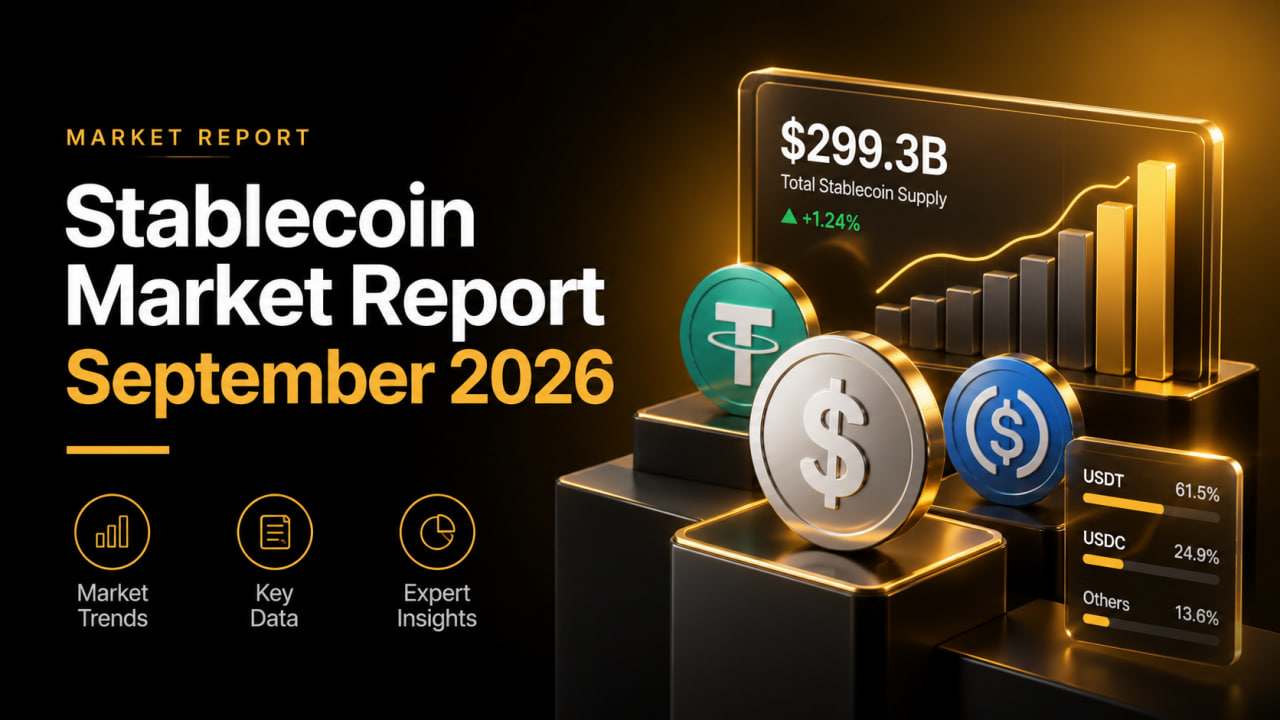
Stablecoin Market Report: September 2026 — Key Trends and Data

Stablecoins Report 2026: The New Global Financial Settlement Layer

INXY at Money 20/20 Europe 2026: Key Trends in Payments Infrastructure
Let’s work together
See how easy it is to start with crypto payments without interrupting your current business flow