
Coincub's Europe Crypto Report 2026 frames the last fourteen months as the arrival of a post-MiCA world. The numbers are striking: the EU went from 12 licensed CASPs to 183, a 15x increase, while roughly 3,167 national VASP registrations collapsed to a fraction of that count. MiCA did what it was designed to do — it delivered legal certainty, consumer protection, a public registry of accountable entities, and a single passporting architecture across 30 EU/EEA markets.
But underneath the regulatory success sits a more practical question for the businesses that actually use crypto rails — merchants, marketplaces, ad networks, hosting providers, gaming platforms, payroll operators. The report's data points to an uncomfortable conclusion: the cost of being a regulated entity in Europe has moved out of reach for most companies that simply need to accept and send money. That gap is exactly where regulated payment infrastructure becomes the rational choice.
This piece reads the Coincub findings through that operational lens: not "who won the license race," but "what does a company that just needs to move value across borders do now?"
The compliance floor priced out everyone but the giants
The single most important structural fact in the report is the split MiCA created. Of 183 licensed CASPs, 78 (42%) cover just 1–5 countries — almost exclusively German banks bolting crypto onto existing compliance infrastructure — while 84 (45%) hold near-full EU passports covering 26–30 countries, disproportionately offshore-originated firms that hired EU counsel and passported across the single market. The middle ground is nearly empty.
Why? Because the entry ticket is steep. The report puts the compliance cost floor at €50,000–€150,000 in minimum capital, plus mandatory physical substance, dedicated compliance staff, banking relationships, and 9–18 months of preparation for authorization. As Coincub bluntly notes, that is survivable for a Cayman entity backed by $500M in VC but certainly not survivable for a European pre-seed startup.
Lithuania is the cautionary tale: 345 registered firms fell to 4 MiCA CASP licenses — a 99% wipeout. The cheap-registration model that once let small firms onboard fast didn't survive contact with substance requirements.
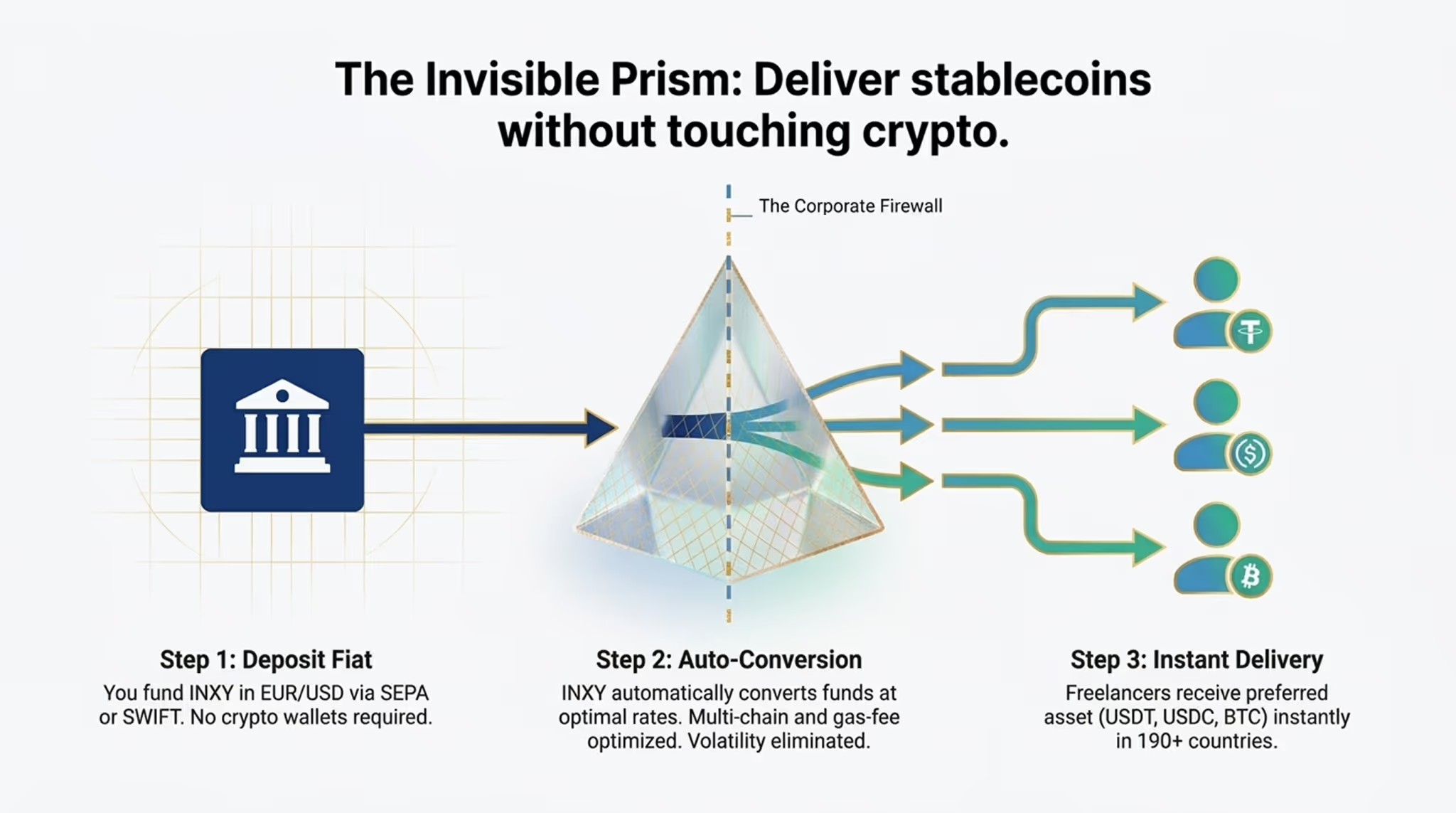
The operational read: the businesses that most need crypto and stablecoin payments — merchants, marketplaces, ad networks, payroll operators — were never trying to become crypto companies in the first place. Their job is to accept money and pay people, not to run regulated infrastructure. In a market where the compliance floor is this high, the practical answer is the same one they already use for cards and cloud: consume the capability through a provider that carries the licensing for them. This is the core case for a regulated payment gateway like INXY Payments, which lets a business accept, send, and convert digital money without building or operating crypto infrastructure itself.
Only 14 firms can run an exchange — but most businesses never needed one
One of the report's most under-discussed numbers: of 183 licensed CASPs, only 14 are authorized to operate a centralized exchange with an order book and matching engine. That's 7% of the total.
It's a useful reminder that "crypto business" is not one thing. The overwhelming majority of companies touching digital assets don't want to run a trading venue. They want to accept payment from a customer, settle in euros or dollars the next day, and pay out affiliates, contractors, or suppliers across borders — without holding volatile assets or managing wallets and gas.
That distinction matters because it reframes the licensing panic. The scarce, hard-to-get authorization is the exchange license. The thing most businesses actually need is payment and settlement infrastructure — and they can consume it as a service. INXY's positioning sits precisely here: wallet-free, gas-free, blockchain-free acceptance and payouts, with automatic conversion to stablecoins or fiat to minimize volatility, and same-day bank settlement with audit-ready reporting.
USDT left regulated venues. Businesses still need a stable unit of account.
Few 2025 developments were as visible as the stablecoin reshuffle. Coinbase Europe delisted USDT in December 2024; Binance followed on 31 March 2025; Kraken, OKX, and Revolut did the same. The world's largest stablecoin was removed from every regulated EU exchange.
Globally, Tether barely flinched — its market cap held around $138B as Asian markets absorbed the volume. But inside the EU, the report notes, USDC became the dollar stablecoin of choice, and EURC spiked in April 2025, driven partly by MiCA compliance and partly by shifting US tariff politics. Meanwhile France's finance minister has openly backed more euro-pegged stablecoins, welcoming plans by ING, UniCredit, and BNP Paribas to launch a joint euro stablecoin in H2 2026.
The operational read: for a European business, the question is no longer "which stablecoin is biggest globally" but "which regulated stablecoin rails keep me compliant and keep my accounting clean in EUR or USD." A payment provider that natively handles USDC, EURC, and automatic crypto-to-fiat conversion insulates a merchant from exactly this kind of regulatory reshuffle — the business keeps operating in a stable unit of account while the underlying compliant instrument shifts around it. This is a structural argument for consuming stablecoin settlement as managed infrastructure rather than picking a token and hoping it stays listed.
MiCA is rarely just one license — and the compliance stack keeps growing
For businesses dealing in e-money tokens (EMTs), the report highlights a trap that catches even well-funded firms: one license is often not enough. The EBA intervened twice on the overlap between MiCA and PSD2, because CASPs transacting e-money tokens can also fall within payment-services territory. The practical message for many firms, as Coincub puts it, is "get MiCA, then clear PSD2 too."
This is why the same names keep winning — only groups with the structure to absorb double compliance survive it. For a business whose core job is selling a product or paying a global team, layering two regulatory regimes on top of that was never a realistic path, and shouldn't have to be their problem to solve.
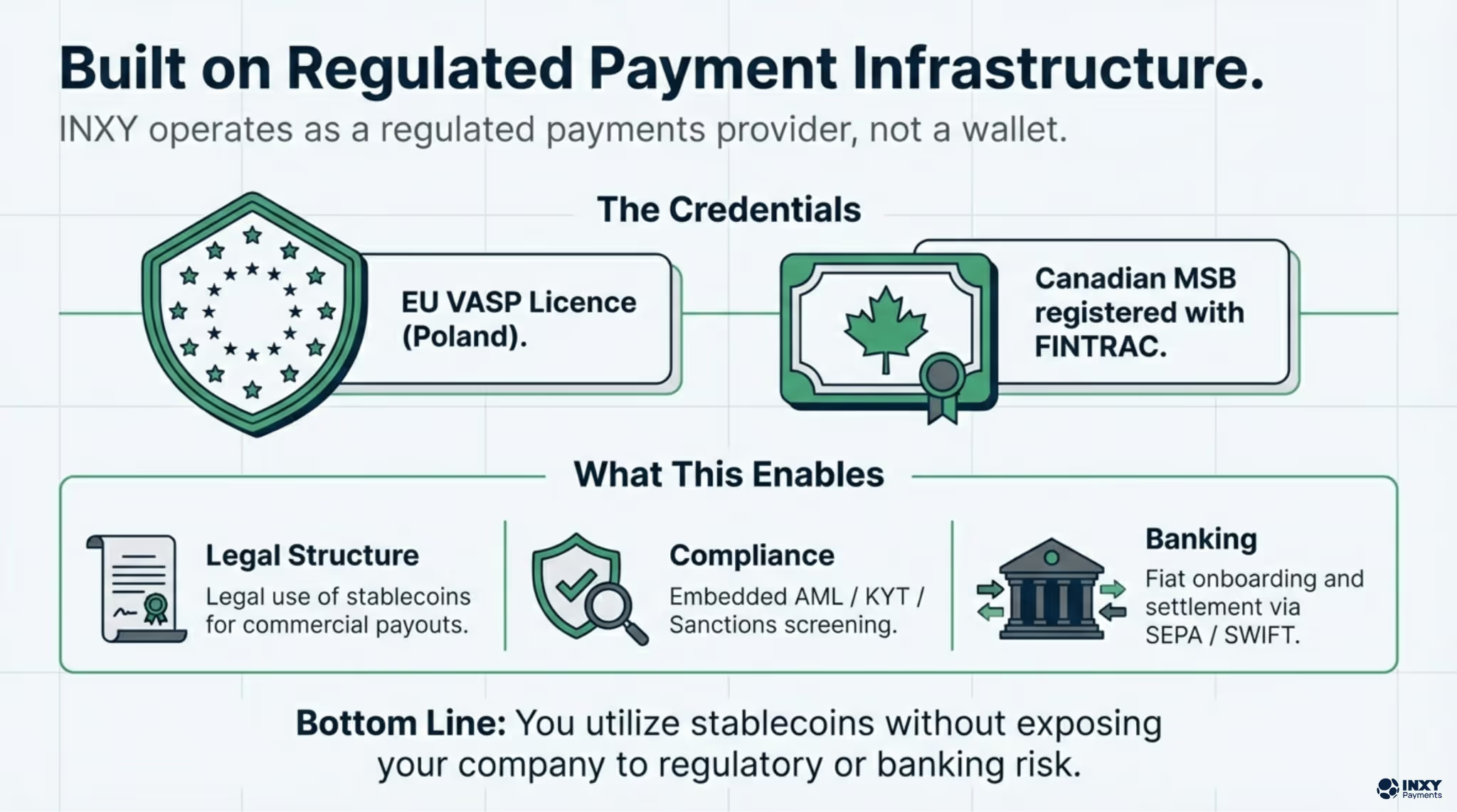
The operational read: the more the EU layers overlapping regimes (MiCA, PSD2, Travel Rule, AML/KYT), the stronger the case for accepting and sending money through a provider that has already absorbed those obligations. INXY builds Travel Rule, AML, and KYT monitoring into the platform and operates under licensing across multiple jurisdictions, so a business gets compliant payment and payout rails without standing up that machinery in-house.
The July 1, 2026 cliff makes reliability a procurement decision
The report is unambiguous about the near-term risk: the grandfathering period ends July 1, 2026. Every entity that hasn't secured MiCA authorization by then must cease operations. Poland — with 1,800+ VASPs and still no MiCA implementation in national law — has no path at all. Estonia's queue is moving but unfinished. Romania's competent-authority designation is still "to be announced." And preparation-to-submission takes 9–18 months, so for anyone still on transitional status without an application already in progress, the window is practically closed.
For a business relying on a crypto payment partner, this is not abstract. A provider operating on borrowed transitional time is a continuity risk. After July 1, some counterparties will simply stop being able to process. The report also flags a tightening trend: the European Commission's Market Integration Package would move direct supervision of all CASPs to ESMA in Paris, and license-lending and white-labeling models built on permissive hubs are directly threatened.
The operational read: vendor due diligence in 2026 has to include a hard look at licensing durability. The question "will my payment provider still be legally operating in Q3?" belongs on every procurement checklist. Choosing a properly licensed, substance-backed provider — rather than a thin white-label wrapper — is now a risk-management decision, not a nice-to-have.
Cross-border fragmentation is the everyday problem passporting doesn't solve
Passporting fixed market access on paper — 183 CASPs now carry access to 30 markets, preserving about 86% of pre-MiCA coverage with a fraction of the entities. But for an operating business, day-to-day friction isn't about legal access; it's about actually moving money to a lot of people, quickly, across borders, at a predictable cost.
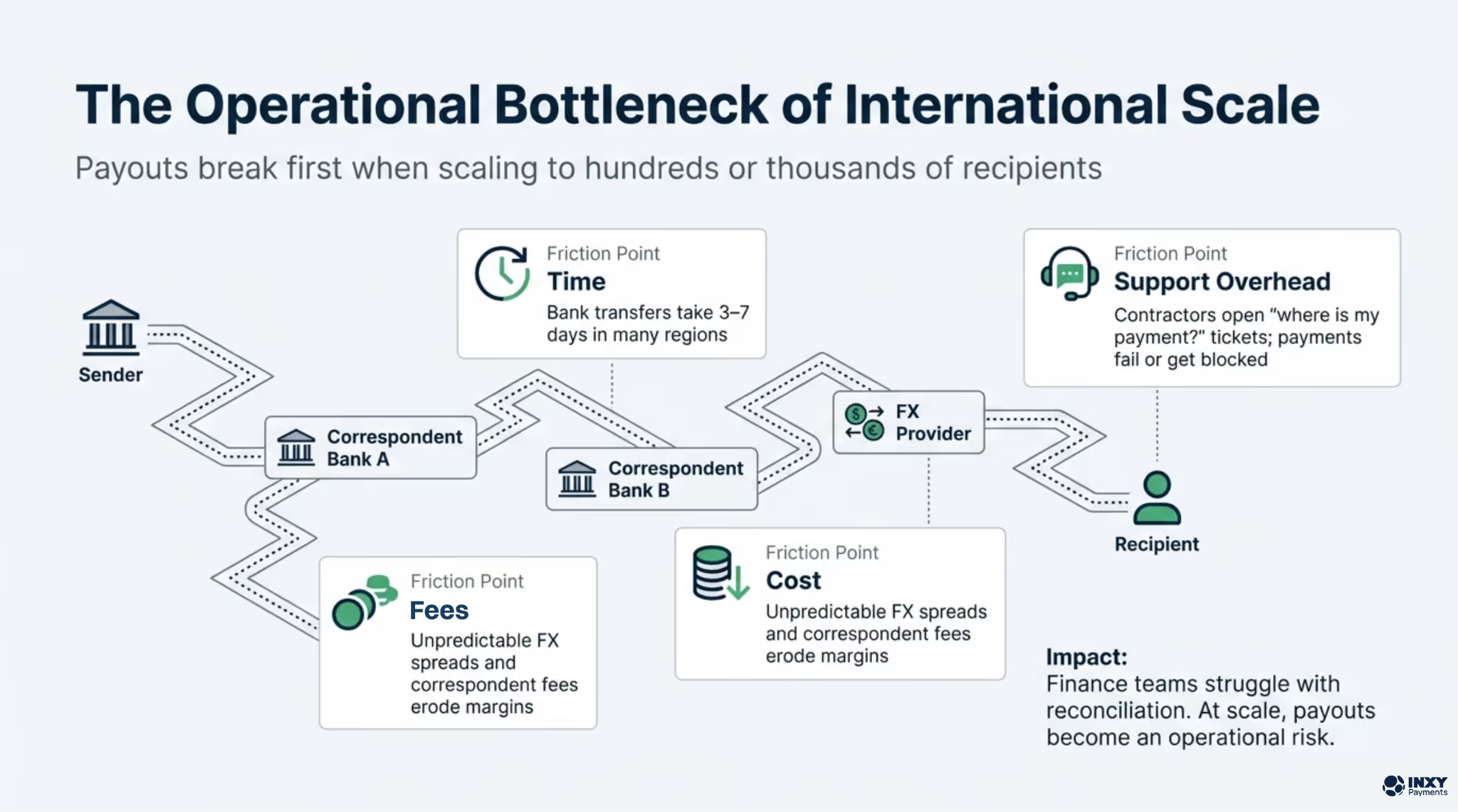
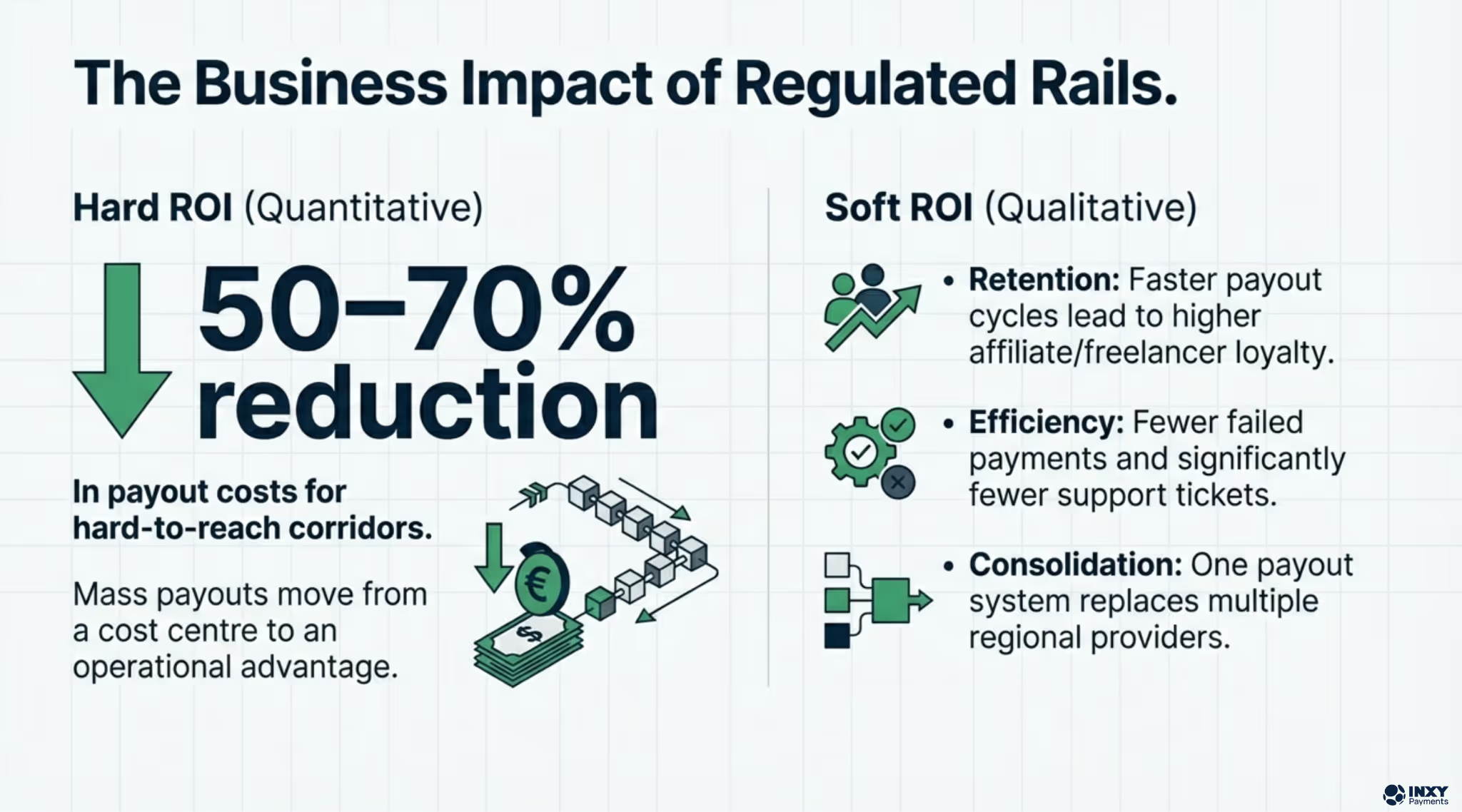
That's the gap ordinary payment operations live in: paying affiliates, freelancers, contractors, suppliers, and partners worldwide; reconciling it all; keeping fees down. Traditional rails are slow and expensive here, and the report's broader theme — a market where value increasingly routes through a handful of large, often non-European intermediaries — only sharpens the case for automated, API-driven payout infrastructure that settles in minutes rather than days. Mass payouts by file or API, on-the-fly conversion from a fiat balance, and consolidated reporting are the practical answer to a fragmented single market.
Conclusion: the market told businesses to stop building regulatory overhead
Read strategically, the Europe Crypto Report 2026 is a story about concentration. MiCA raised the floor so high that being a licensed crypto entity is now the domain of large groups and well-capitalized offshore giants. USDT's exit, the MiCA-plus-PSD2 stack, the July 2026 cliff, and the drift toward ESMA supervision all point the same way: the regulatory burden of operating crypto rails in Europe is rising, not falling.
For the businesses that simply need to accept payments, settle in fiat, and pay people globally, the answer isn't to take on crypto's regulatory machinery themselves. It is to treat regulated crypto and stablecoin capability the way they already treat cloud, KYC, or card processing — as infrastructure they plug into. That is the position a provider like INXY Payments occupies: a licensed, compliance-first platform that lets a Web2 business accept and send money on modern stablecoin rails without operating regulated crypto infrastructure itself.
In a post-MiCA Europe, most companies don't need to become a crypto company to use crypto. They need working, compliant rails to move money across borders — and that is something they can simply plug in.
Sources: Coincub, "Europe Crypto Report 2026 — An Outlook of a Post-MiCA World"; INXY Payments (inxy.io).