
Blog
In this dedicated blog page, we invite you to explore a wealth of knowledge, expertise, and inspiration that transcends traditional boundaries.

INXY Raises $7M to Expand Cross-Border Payment Infrastructure
INXY has secured new funding to continue building its global payments platform. The total round reached $7M. The company focuses on stablecoin infrastructure for businesses. Its tools help companies accept crypto and send payouts while keeping accounting in fiat.
INXY has secured new funding to continue building its global payments platform. The total round reached $7M.
The company focuses on stablecoin infrastructure for businesses. Its tools help companies accept crypto and send payouts while keeping accounting in fiat.
This funding comes at a time when global payments are changing. Traditional rails are slow and expensive. Cross-border transfers often take days and include multiple intermediaries.
Stablecoins offer a different path. They move value quickly and directly. They reduce friction in international transactions. Many businesses are starting to explore this model.
INXY builds infrastructure for this shift. The goal is simple. Let companies use crypto without becoming crypto companies.
The platform supports mass payouts, payment acceptance, and automated conversion. Funds can be sent globally and settled in EUR or USD.
The company has already processed over $2B in annual stablecoin volume. This shows growing demand for alternative payment rails.
The new capital will be used to:
– Expand the payments infrastructure.
– Strengthen compliance and regulatory alignment.
– Grow the team and product capabilities.
Regulation is also shaping the market. In Europe, frameworks like MiCA are creating clearer rules for crypto services. This makes it easier for businesses to adopt compliant solutions.
INXY positions itself in this new environment as a regulated infrastructure provider. It operates under EU and Canadian frameworks and focuses on low-risk business use cases.
The company believes the future of payments will be stablecoin-based, compliant, and invisible to the end user.
The work ahead is not about hype. It is about making payments simple, reliable, and global.
Articles

Pay Employees and Contractors in Bitcoin
Automate BTC payouts for global teams with INXY Payments — no crypto infrastructure required. Fast, compliant, and built for business.
Why Businesses Are Choosing Bitcoin for Payroll and Contractor Payments
As remote work becomes the global standard, companies face a common challenge: paying international teams through traditional banking is slow, expensive, and geographically limited. Bitcoin payouts eliminate SWIFT delays, excessive conversion fees, and banking restrictions — letting businesses pay employees and contractors in Bitcoin within minutes, regardless of their location.
From affiliate networks and iGaming platforms to SaaS companies and freelancer marketplaces, paying in Bitcoin is no longer a niche practice. Paying employees in Bitcoin and contractors in BTC is no longer reserved for crypto-native startups — it is a competitive edge in global talent acquisition that reduces operational costs across the board. INXY Payments makes this straightforward: no need to buy Bitcoin in advance, no separate exchange accounts, no manual compliance work — everything runs through a single B2B platform built for exactly this use case.
How to Pay Employees in Bitcoin with INXY: 3 Simple Steps
- Create an INXY Account & Complete KYB — Sign up as a business, submit your company documents, and pass KYB verification through the INXY dashboard. Your organisation is reviewed and activated within 1–3 business days — no crypto expertise required.
- Add Recipients or Connect the Payouts API — Upload a CSV file with recipient BTC addresses via the INXY dashboard, or integrate the Payouts API directly into your platform for fully automated workflows. The API is built to handle payouts at scale — no hard limit on the number of recipients per cycle. Real-time webhook notifications keep your system updated on each payout status.
- Send BTC Payouts — from Crypto or Fiat — Trigger single or mass BTC payouts from your balance. If you hold EUR or USD, INXY's buy_crypto flag auto-converts your fiat to Bitcoin at the moment of each payout — no pre-purchased BTC required, no exchange accounts to manage.
Benefits of Bitcoin Payouts for Business
Global Reach Without Banking Limits
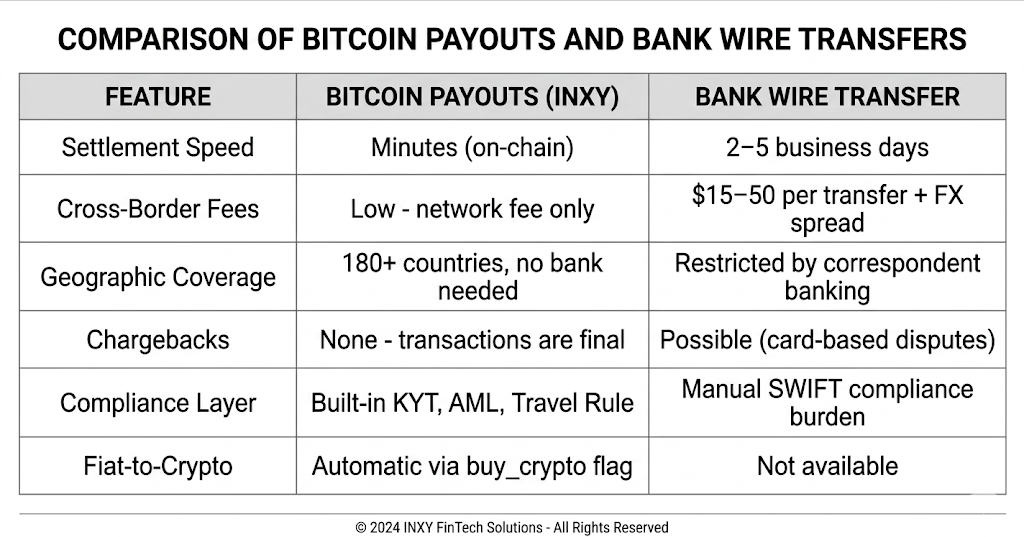
Bitcoin payouts via INXY work for recipients in any country, with or without a bank account. No correspondent bank fees, no SWIFT delays, no rejected transfers due to local banking restrictions. Your payroll operates globally, on your schedule.
No Chargebacks
Crypto transactions are final and immutable. Once a BTC payout is broadcast to the network, it cannot be reversed or disputed — a critical advantage for high-volume affiliate and iGaming payouts where chargeback fraud is a constant risk.
Instant Settlement
BTC payouts initiated through INXY are broadcast on-chain within minutes. Compared to international wire transfers that take 2–5 business days, Bitcoin delivers settlement speed that matches the pace of modern business operations.
Pay from Fiat, Send in Bitcoin
If your treasury operates in EUR or USD, there is no need to pre-purchase Bitcoin on an exchange. INXY's buy_crypto feature handles the fiat-to-BTC conversion automatically at the moment each payout is triggered — the exchange rate is locked at execution time, and the full flow is recorded in your transaction history.
Built-In Compliance — KYT, AML, Travel Rule
Every BTC payout processed through INXY goes through KYT (Know Your Transaction) screening before broadcast. High-risk addresses are blocked automatically. For recipients in your Contact List, Travel Rule data exchange via Notabene is handled by the platform — no manual compliance burden on your team.
Who Uses Bitcoin Payouts?
Affiliate Networks & CPA Platforms
Affiliate networks need to pay hundreds or thousands of publishers worldwide, often weekly or bi-weekly. INXY supports batch processing of up to hundreds of recipients per API call, with full webhook notifications on payout status. Mass payouts that previously took 5 banking days now complete in minutes — and companies that pay employees and contractors in Bitcoin report significantly lower operational overhead.
iGaming & Online Gaming Platforms
Gaming and gambling platforms regularly pay out winnings and contractor fees in crypto. Bitcoin is the preferred payout currency for many players and partners due to its universal recognition and broad wallet support. INXY's compliance layer — KYT screening, AML review, Travel Rule — ensures platforms stay clean without building their own infrastructure.
Remote-First Companies & Tech Teams
Companies with globally distributed engineering, design, or operations teams use INXY to offer Bitcoin as an alternative compensation option. Contractors who prefer crypto over bank transfers get paid faster, while the company avoids currency conversion overhead and cross-border banking fees.
Freelancer Marketplaces & Gig Economy Platforms
For platforms managing large pools of independent contractors, mass Bitcoin payouts through INXY reduce the operational cost of international payroll significantly. One file upload or one API call pays thousands of contractors in a single batch — with per-recipient status tracking and exportable CSV reports.
Frequently Asked Questions
Is it legal to pay employees in Bitcoin?
In most jurisdictions, paying contractors in Bitcoin is fully legal. For full-time employees, regulations vary: many countries — including the US, UK, and EU member states — allow crypto salary supplements or contractor payments in crypto, but typically require that the minimum statutory wage be paid in local fiat currency. Consult local labour law before switching your primary payroll to Bitcoin.
Can you pay employees in Bitcoin in the US?
Yes. The Fair Labor Standards Act (FLSA) requires that the federal minimum wage be paid in US dollars, but additional compensation — including contractor payments and performance bonuses — can be made in Bitcoin. Many US-based companies and DAOs already pay freelancers and contractors in BTC without legal issues.
Which companies pay employees in Bitcoin?
A growing number of global businesses pay employees and contractors in Bitcoin, particularly in tech, gaming, and affiliate marketing industries. Remote-first companies, crypto-native startups, and platforms with large contractor networks were early adopters. With infrastructure like INXY, any B2B business can now add BTC payouts without building crypto capabilities in-house.
How does INXY's buy_crypto flag work for BTC payouts?
If your INXY balance is in EUR or USD, the buy_crypto: true flag triggers an automatic fiat-to-BTC exchange at the moment each payout is initiated. The exchange rate is locked at execution time, and the network fee is deducted from the payout amount. You do not need to hold Bitcoin in advance — INXY handles the conversion in the same transaction flow.
What happens if a BTC address is flagged as high-risk?
Before any payout is created, INXY screens the recipient's BTC address through KYT. If the address is flagged as high-risk, the payout is blocked automatically and you receive an error notification via webhook and dashboard. You can review the case and contact the INXY compliance team if needed.
What is the maximum number of Bitcoin payouts per batch?
INXY's infrastructure handles payout cycles of any size — from small partner networks to programs with hundreds of recipients — all processed in minutes, with full webhook notifications on each transaction.
Start Sending Bitcoin Payouts with INXY
Ready to pay your global team in Bitcoin? Join hundreds of businesses that use INXY Payments to run fast, compliant BTC payouts — from a single contractor to thousands of recipients. No crypto expertise required, no pre-purchased Bitcoin needed, no separate exchange accounts.
Get Started with INXY — Free Setup
Already have an account? Go to Send Crypto → Payouts in your INXY dashboard.

Crypto Mass Payouts for Affiliate Networks: Automate BTC, USDT & ETH Partner Payments
Running an affiliate network means managing dozens — or hundreds — of payment relationships simultaneously. When those partners operate across different countries and expect crypto compensation, the bottleneck isn't traffic or conversions: it's payout infrastructure. Manual crypto transfers don't scale. Exchange withdrawal APIs are built for single recipients. And treasury teams shouldn't be copying wallet addresses one by one every payout cycle.
Running an affiliate network means managing dozens — or hundreds — of payment relationships simultaneously. When those partners operate across different countries and expect crypto compensation, the bottleneck isn't traffic or conversions: it's payout infrastructure. Manual crypto transfers don't scale. Exchange withdrawal APIs are built for single recipients. And treasury teams shouldn't be copying wallet addresses one by one every payout cycle.
INXY's Mass Payouts API solves this at the infrastructure level — letting affiliate programs send BTC, USDT, ETH, and other crypto assets to hundreds of recipients in a single payout cycle — with AML/KYT compliance handled automatically on every transaction.
Why Affiliate Networks Are Moving to Crypto Payouts
Cross-Border Friction with Traditional Rails
Bank wires and PayPal are the default — but they're slow, regionally inconsistent, and expensive for international affiliate programs. SWIFT transfers take 2–5 business days and carry correspondent bank fees. PayPal blocks accounts in dozens of jurisdictions. For an affiliate network paying partners in Southeast Asia, Eastern Europe, or Latin America, these aren't edge cases — they're the norm.
Crypto payouts bypass this entirely. On-chain settlement means funds arrive in minutes regardless of recipient geography, with no correspondent banking dependencies.
Affiliates Demanding Crypto Compensation
Across iGaming, Forex, and SaaS verticals, crypto-denominated affiliate commissions have shifted from a niche perk to a standard expectation. High-volume affiliates — those generating meaningful revenue for programs — increasingly prefer USDT or BTC over fiat because it sidesteps local banking restrictions, enables faster compounding, and reduces currency risk on earnings held in volatile local currencies.
Speed and Cost Advantages of On-Chain Settlement
For affiliate programs running weekly or bi-weekly payout cycles, speed matters. Crypto settlements are typically confirmed within minutes to hours — compared to the 2–5 day window of international bank transfers. On-chain fees, while variable, are often lower than the cumulative cost of wire fees multiplied across a partner base of 100+ recipients.
How INXY's Mass Payout API Works for Affiliate Programs
The INXY affiliate payout workflow is designed to run without manual intervention once integrated:
1. Register your company and pass KYB verification — powered by Sumsub, typically completed within 1–2 business days.
2. Fund your INXY account — deposit BTC, USDT, ETH, or hold EUR/USD and use the buy_crypto flag to auto-convert at payout time.
3. Build your payout batch — compile affiliate wallet addresses, amounts, and optional memo fields. There is no hard cap on the total number of recipients per payout cycle.
4. Submit via the INXY Mass Payouts API — a single REST call with a JSON payload covering your entire affiliate payment run.
5. INXY runs AML/KYT screening automatically on every outgoing transaction — no manual review required from your team.
6. Funds are broadcast on-chain and confirmed — affiliates receive their payouts directly to their wallets.
Webhook callbacks notify your system of each transaction status in real time. No per-transaction dashboards. No manual approvals. No treasury team bottleneck.
Supported Cryptocurrencies for Affiliate Payouts
Bitcoin (BTC)
Bitcoin remains the preferred settlement currency for affiliates in iGaming and high-risk verticals. INXY sends BTC payouts on the Bitcoin mainnet — no Lightning Network at this stage. Settlement time depends on network congestion and the fee tier selected at submission. Affiliates receive BTC directly to any standard Bitcoin wallet address.
USDT (TRC-20 / ERC-20)
USDT is the dominant stablecoin for affiliate compensation — it eliminates volatility risk while preserving the speed and borderless nature of crypto settlement. INXY supports USDT on both TRC-20 (Tron network, low fees) and ERC-20 (Ethereum network). For programs where affiliates prefer stable value, USDT payouts via INXY are the most practical option.
ETH and Other Supported Assets
Ethereum (ETH) and additional crypto assets are supported through INXY's payment infrastructure. Programs can diversify payout currencies based on affiliate preference or treasury composition. INXY's buy_crypto flag means programs can hold EUR or USD in their INXY balance and auto-convert to whichever asset the affiliate batch requires at payout time.
INXY vs Manual Crypto Payouts vs Exchange APIs
Not all crypto payout methods are equivalent. Here's how INXY's Mass Payouts infrastructure compares to alternatives affiliate programs typically try first:
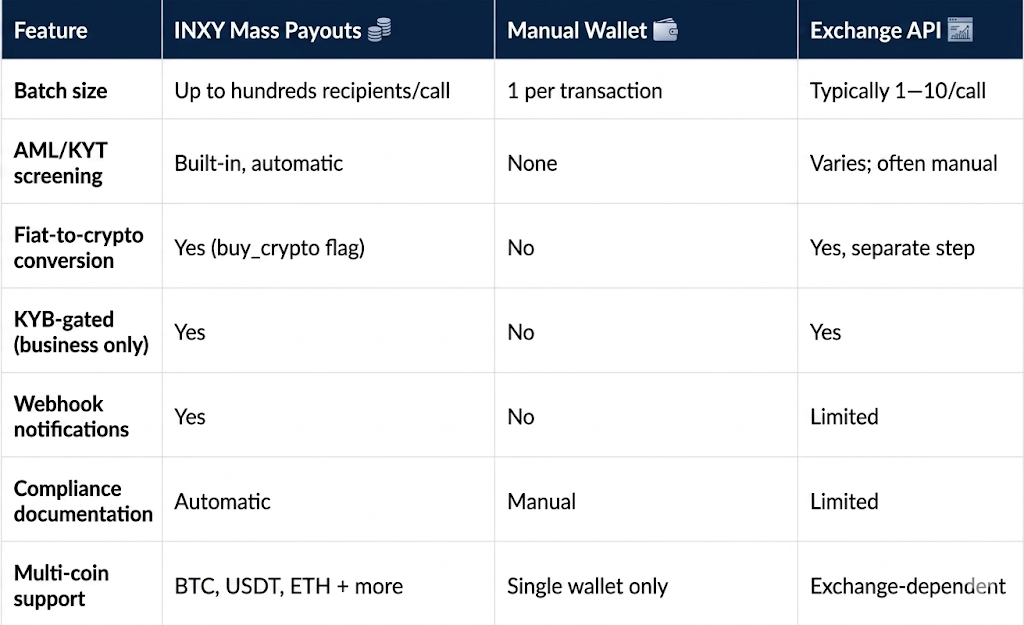
For affiliate programs paying more than 10 partners per cycle, the operational gap between INXY and manual methods compounds rapidly. A single API call replacing 200 individual wallet transactions isn't a marginal improvement — it's a different category of infrastructure.
For affiliate programs paying more than 10 partners per cycle, the operational gap between INXY and manual methods compounds rapidly. A single API call replacing 200 individual wallet transactions isn't a marginal improvement — it's a different category of infrastructure.
Compliance and AML Screening — Built for Regulated Affiliate Programs
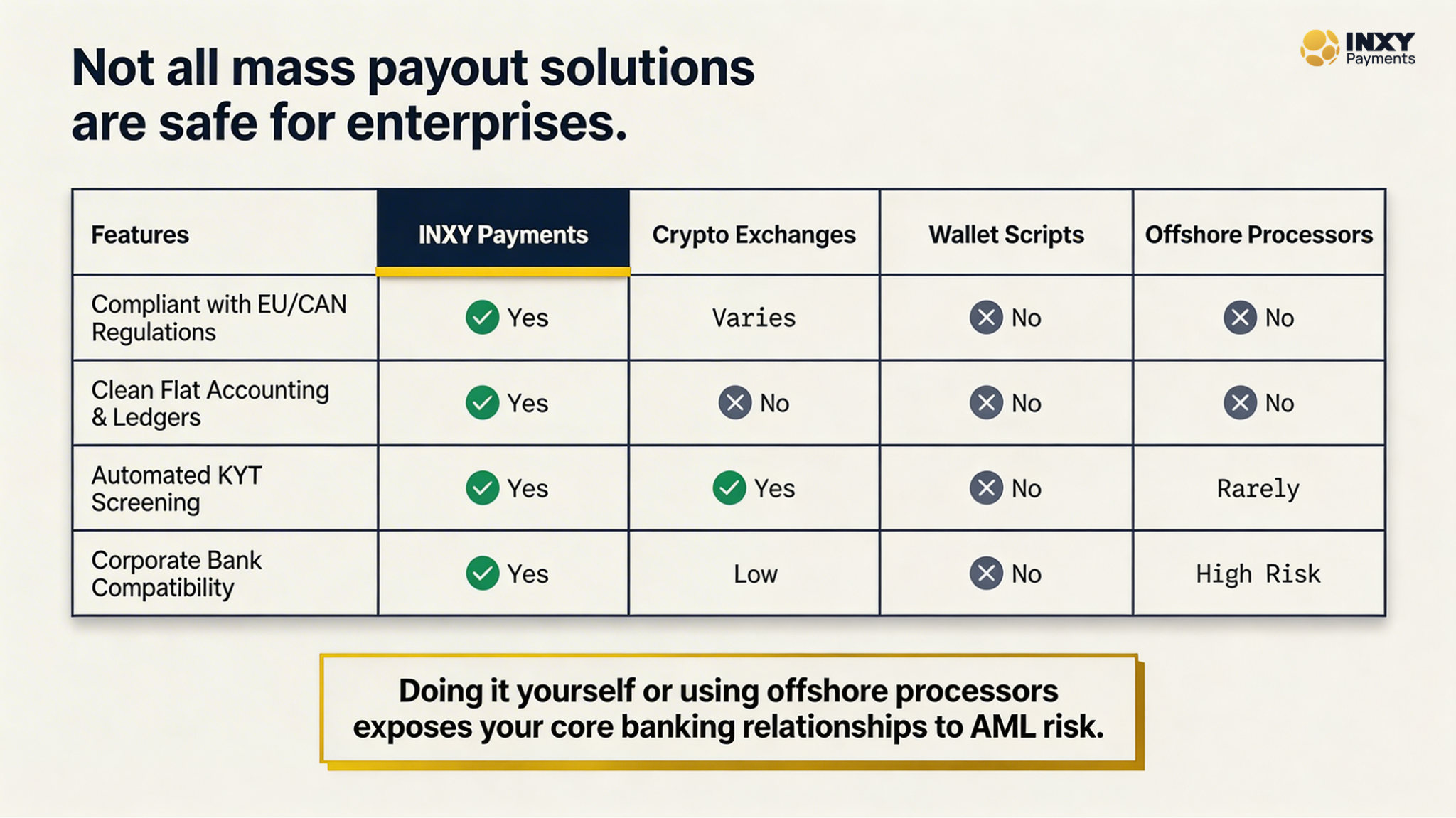
Affiliate networks operating in regulated verticals — iGaming, Forex, fintech — face increasing scrutiny on outgoing payment flows. INXY's compliance stack handles this automatically, without requiring programs to build their own AML logic.
KYT Screening on Every Outgoing Transaction
Every crypto payout processed through INXY is screened using KYT (Know Your Transaction) analysis. KYT evaluates the risk profile of recipient wallet addresses — flagging addresses associated with sanctions lists, mixers, or high-risk counterparties — before funds are broadcast on-chain.
Transaction Statuses: Cleared / Pending Review / On Hold
Each transaction is assigned a compliance status automatically: Cleared (processed immediately), Pending Review (flagged for manual review before settlement), On Hold (suspended pending investigation), or in rare cases Seized. Programs receive status updates via webhook, allowing downstream systems to handle edge cases programmatically.
Compliance Documentation for Your Records
INXY generates compliance documentation for all processed transactions. For affiliate programs that need to demonstrate AML controls to regulators, payment processors, or banking partners, this documentation provides an audit trail without requiring programs to build their own reporting infrastructure.
Who Uses INXY for Affiliate Crypto Payouts?
iGaming and Betting Affiliate Networks
iGaming is the highest-volume use case for crypto affiliate payouts. Programs managing hundreds of partners across multiple jurisdictions use INXY to run weekly BTC and USDT payment cycles. We handle payout cycles of any size — from dozens to hundreds of partners — without manual intervention; larger programs run sequential batches. KYT compliance is particularly valuable here, given the regulatory environment iGaming programs operate in.
Forex and Fintech Referral Programs
Forex brokers and fintech companies running IBs (Introducing Brokers) or referral programs use INXY to settle USDT and ETH commissions with partners globally. These programs often have partners in jurisdictions where receiving USD via wire is slow or restricted — crypto settlement sidesteps that friction entirely.
SaaS Partner and Reseller Programs
SaaS companies with global reseller networks use INXY to pay partner commissions in crypto as an alternative to Stripe payouts or wire transfers. The buy_crypto flag is particularly practical here: finance teams hold EUR or USD in the INXY balance, and INXY handles conversion and disbursement at the scheduled payout date — no active crypto treasury management required.
Frequently Asked Questions
How many affiliates can I pay in one batch?
INXY's Mass Payouts API is designed to handle payout cycles of any scale. There is no hard limit on the total number of recipients per cycle — whether you're paying dozens or hundreds of partners, the infrastructure scales to match your program's volume.
Do I need to hold crypto to pay affiliates?
No. If your INXY account holds EUR or USD, you can use the buy_crypto flag on any payout request. INXY will automatically purchase the required crypto at current market rates and disburse it to the recipient batch — without requiring you to manage a live crypto treasury.
Is KYB required to use INXY?
Yes. INXY is a B2B platform and requires KYB (Know Your Business) verification for all accounts. The KYB process is powered by Sumsub and typically completes within 1–2 business days. Individual accounts are not supported.
What cryptocurrencies can I pay affiliates in?
INXY supports BTC (Bitcoin mainnet), USDT (TRC-20 and ERC-20), ETH, and additional crypto assets. Different currencies can be used across different batches depending on affiliate preference and treasury composition.
How does AML compliance work for affiliate payouts?
Every outgoing transaction is screened using KYT (Know Your Transaction) analysis before broadcast. Transactions are assigned a status — Cleared, Pending Review, or On Hold — and INXY provides compliance documentation for all processed payments. Your team receives webhook notifications for any transactions that require attention.
Can I integrate INXY with my affiliate platform or ERP?
Yes. INXY provides a RESTful API with JSON payloads, webhook callbacks, and detailed transaction logs. Integration with affiliate tracking platforms, payroll systems, or ERP/treasury tools is straightforward for any engineering team familiar with REST APIs.
Ready to Automate Your Affiliate Crypto Payouts?
INXY is purpose-built for B2B programs that need reliable, compliant crypto disbursements at scale. Whether you're running a weekly iGaming payout cycle, a monthly Forex IB settlement, or a SaaS partner commission run — INXY's mass payout infrastructure handles the complexity so your team doesn't have to.
Get started at inxy.io — KYB takes 1–2 business days and your first affiliate payout batch can go out the same week.

The end of fiat friction: Why strategic merchants are switching to stablecoin payments
To accept crypto once meant exposure to price volatility. That is no longer the case. Stablecoins — pegged to the US Dollar or Euro — deliver the settlement efficiency of blockchain without the speculation. For C-level executives, the question is no longer whether to integrate digital assets, but how quickly legacy bottlenecks can be replaced with purpose-built infrastructure.
The legacy financial system imposes a structural tax on growth. For decades, merchants have absorbed correspondent banking fees, 3% interchange costs, and chargeback losses that erode margin on every transaction. In a global economy, waiting T+3 or T+5 for settlement is not an inconvenience — it is a liquidity problem.
To accept crypto once meant exposure to price volatility. That is no longer the case. Stablecoins — pegged to the US Dollar or Euro — deliver the settlement efficiency of blockchain without the speculation. For C-level executives, the question is no longer whether to integrate digital assets, but how quickly legacy bottlenecks can be replaced with purpose-built infrastructure.

1. Settlement velocity: From days to seconds
Traditional cross-border settlements move through a chain of intermediate banks, accumulating fees and losing transparency at every hop. SWIFT provides no real-time visibility into where funds are or when they will arrive.
Stablecoins operate on a 24/7/365 ledger with near-instant finality. Settling on Ethereum, Polygon, or TRON, merchants are no longer bound by banking hours or cut-off windows. Capital lands, clears, and is available for redeployment immediately — not in a pending queue.
inxy.io integrates directly into this settlement layer, giving merchants the operational continuity that traditional finance structurally cannot offer.
2. Eliminating the chargeback tax
Chargeback fraud costs merchants billions annually. Credit card networks are centralised by design, which means any transaction can be reversed — often at the merchant's expense, with little recourse.
Blockchain transactions are push-based and immutable. When a business chooses to accept crypto in the form of stablecoins, payment finality is guaranteed by the protocol, not by a bank's dispute resolution team.
- No chargebacks: Once confirmed on-chain, a transaction cannot be reversed by a third party.
- Reduced fraud overhead: No need for aggressive fraud filters that block legitimate customers.
- Revenue sovereignty: You control your income stream without intermediary intervention.
3. Technical infrastructure: Beyond the hype
A payment gateway needs to be a piece of production-grade fintech infrastructure, not just a wallet interface. High-volume merchants require an API that abstracts blockchain complexity without sacrificing control.
What inxy.io provides:
- No crypto management overhead: Merchants do not handle tokens or gas fees. That layer is abstracted entirely.
- Volatility protection: Pay-ins convert to stablecoins or fiat instantly, locking in value at the moment of transaction.
- Multi-chain support: USDT, USDC, DAI, EURC, TON, BTC, ETH, LTC, TRX, BNB, DOGE across ERC-20, TRC-20, Polygon, and BSC — customers transact on the network that works best for them.
- Real-time webhooks: Instant payment status notifications to your backend, enabling automated fulfilment or shipping triggers without polling.
- Compliance stack: EU VASP (Poland), Canadian MSB, MiCA-ready, AML/KYT/KYC, sanctions screening via Elliptic and Sumsub, Big-4-friendly fiat reporting.

4. Drastic reduction in operational costs
Managing global payments typically means maintaining multiple local currency accounts and navigating FX spreads on every cross-border transfer. Stablecoins provide a single settlement layer that works across jurisdictions without currency conversion overhead.
Consolidating payment rails through inxy.io can reduce payment processing Opex by up to 80%. Instead of paying a chain of intermediaries for the movement of value, you pay for efficient infrastructure. That margin stays in the business.
FAQ: Navigating the stablecoin shift
Is it difficult to integrate a stablecoin gateway into an existing platform?
No. inxy.io integrates via a REST API or pre-built plugins for major e-commerce engines. Documentation and technical support are included, and most teams go live faster than a standard merchant bank account setup.
How do we handle gas fee volatility?
inxy.io routes transactions through high-throughput networks to keep fees minimal. Customers can select the most cost-effective network for their transaction — the infrastructure handles the routing logic.
How does accepting stablecoins affect our accounting?
USDT and USDC are pegged 1:1 to the dollar, which makes them materially simpler to account for than traditional cryptocurrencies. inxy.io provides detailed reporting and CSV exports compatible with standard accounting software and ERP systems.

What about regulatory compliance?
inxy.io is built with compliance as a core component, not an afterthought — EU VASP registration, MiCA readiness, AML/KYT screening, and Big-4-auditable reporting. Your business stays within the regulatory framework while operating at full velocity.
Scalability Without Compromise
The merchant of 2026 cannot run on 1970s banking rails. The competitive advantage belongs to businesses that eliminate payment friction and capture the full value of their transactions across borders.
inxy.io is the infrastructure layer for that transition — robust APIs, multi-chain settlement, and a compliance stack built for global scale.
Partner with INXY — secure your payment infrastructure and lead the market.

Institutional fiat on-ramps: How to procure and manage stablecoin liquidity at scale
Interchange fees, multi-day settlement windows, and chargeback exposure are not just operational annoyances - they are compounding structural costs on every transaction. Stablecoin payments eliminate that friction: near-instant finality, zero reversal risk, and a single cross-border settlement layer operating 24/7. This piece lays out the business and technical case for executives evaluating a shift from legacy fiat rails to purpose-built blockchain infrastructure.
The end of fiat friction: Why strategic merchants are switching to stablecoin payments
The legacy financial system imposes a structural tax on growth. For decades, merchants have absorbed correspondent banking fees, 3% interchange costs, and chargeback losses that erode margin on every transaction. In a global economy, waiting T+3 or T+5 for settlement is not an inconvenience — it is a liquidity problem.
To accept crypto once meant exposure to price volatility. That is no longer the case. Stablecoins — pegged to the US Dollar or Euro — deliver the settlement efficiency of blockchain without the speculation. For C-level executives, the question is no longer whether to integrate digital assets, but how quickly legacy bottlenecks can be replaced with purpose-built infrastructure.
1. Settlement velocity: From days to seconds
Traditional cross-border settlements move through a chain of intermediate banks, accumulating fees and losing transparency at every hop. SWIFT provides no real-time visibility into where funds are or when they will arrive.
Stablecoins operate on a 24/7/365 ledger with near-instant finality. Settling on Ethereum, Polygon, or TRON, merchants are no longer bound by banking hours or cut-off windows. Capital lands, clears, and is available for redeployment immediately — not in a pending queue.
inxy.io integrates directly into this settlement layer, giving merchants the operational continuity that traditional finance structurally cannot offer.
2. Eliminating the chargeback tax
Chargeback fraud costs merchants billions annually. Credit card networks are centralised by design, which means any transaction can be reversed — often at the merchant's expense, with little recourse.
Blockchain transactions are push-based and immutable. When a business chooses to accept crypto in the form of stablecoins, payment finality is guaranteed by the protocol, not by a bank's dispute resolution team.
- No chargebacks: Once confirmed on-chain, a transaction cannot be reversed by a third party.
- Reduced fraud overhead: No need for aggressive fraud filters that block legitimate customers.
- Revenue sovereignty: You control your income stream without intermediary intervention.
3. Technical infrastructure: Beyond the hype
A payment gateway needs to be a piece of production-grade fintech infrastructure, not just a wallet interface. High-volume merchants require an API that abstracts blockchain complexity without sacrificing control.
What inxy.io provides:
- 1. No crypto management overhead: Merchants do not handle tokens or gas fees. That layer is abstracted entirely.
- 2. Volatility protection: Pay-ins convert to stablecoins or fiat instantly, locking in value at the moment of transaction.
- 3. Multi-chain support: USDT, USDC, DAI, EURC, TON, BTC, ETH, LTC, TRX, BNB, DOGE across ERC-20, TRC-20, Polygon, and BSC — customers transact on the network that works best for them.
- 4. Real-time webhooks: Instant payment status notifications to your backend, enabling automated fulfilment or shipping triggers without polling.
- 5. Compliance stack: EU VASP (Poland), Canadian MSB, MiCA-ready, AML/KYT/KYC, sanctions screening via Elliptic and Sumsub, Big-4-friendly fiat reporting.
4. Drastic reduction in operational costs
Managing global payments typically means maintaining multiple local currency accounts and navigating FX spreads on every cross-border transfer. Stablecoins provide a single settlement layer that works across jurisdictions without currency conversion overhead.
Consolidating payment rails through inxy.io can reduce payment processing Opex by up to 80%. Instead of paying a chain of intermediaries for the movement of value, you pay for efficient infrastructure. That margin stays in the business.
FAQ: Navigating the stablecoin shift
Is it difficult to integrate a stablecoin gateway into an existing platform?
No. inxy.io integrates via a REST API or pre-built plugins for major e-commerce engines. Documentation and technical support are included, and most teams go live faster than a standard merchant bank account setup.
How do we handle gas fee volatility?
inxy.io routes transactions through high-throughput networks to keep fees minimal. Customers can select the most cost-effective network for their transaction — the infrastructure handles the routing logic.
How does accepting stablecoins affect our accounting?
USDT and USDC are pegged 1:1 to the dollar, which makes them materially simpler to account for than traditional cryptocurrencies. inxy.io provides detailed reporting and CSV exports compatible with standard accounting software and ERP systems.
What about regulatory compliance?
inxy.io is built with compliance as a core component, not an afterthought — EU VASP registration, MiCA readiness, AML/KYT screening, and Big-4-auditable reporting. Your business stays within the regulatory framework while operating at full velocity.
Scalability Without Compromise
The merchant of 2026 cannot run on 1970s banking rails. The competitive advantage belongs to businesses that eliminate payment friction and capture the full value of their transactions across borders.
inxy.io is the infrastructure layer for that transition — robust APIs, multi-chain settlement, and a compliance stack built for global scale.
Partner with INXY — secure your payment infrastructure and lead the market.
.png)
How to profitably accept crypto for low-cost VPS and micro-cloud services
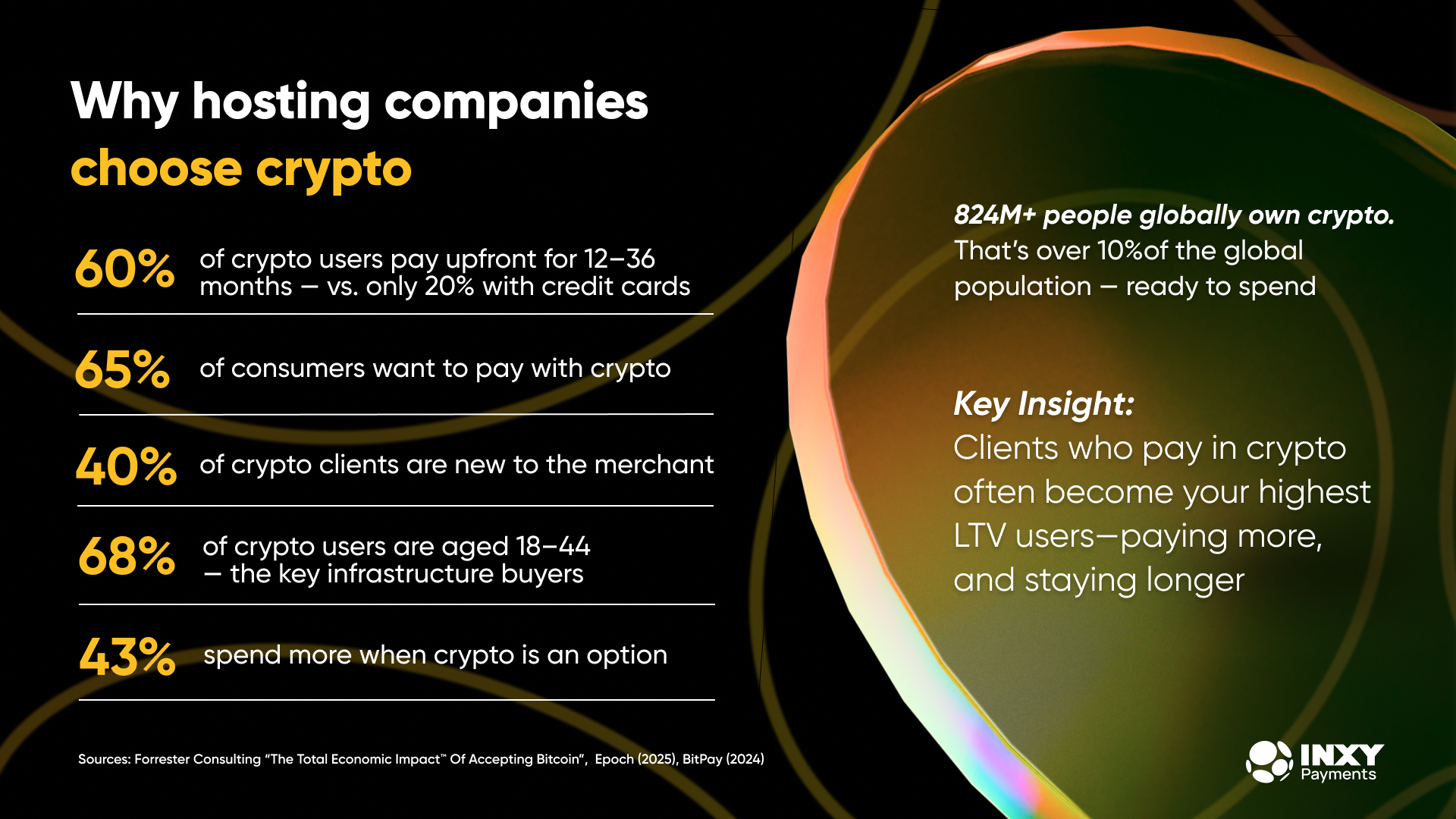
For budget VPS and micro-cloud providers, a $0.30 flat processing fee can wipe out nearly 10% of a $5 invoice before the server even boots. This guide breaks down how to accept crypto payments profitably — using stablecoins on low-fee networks like TRC-20 and Polygon, combined with a pre-paid balance model that eliminates micro-transaction overhead. Learn the operational blueprint for crypto-native billing that protects your margins and scales with your infrastructure.
How to profitably accept crypto for low-cost VPS and micro-cloud services
You provision a virtual machine, allocate the IP address, and send the customer an automated invoice for $4.99. Then, the traditional payment processor takes its cut: a standard $0.30 flat rate plus 2.9% of the total transaction. Just like that, nearly 10% of your gross revenue vanishes before the server even boots up. If you are operating in the micro-cloud and budget VPS market, your biggest competitor is not another hosting company; it is the legacy banking system actively eating your razor-thin profit margins.
Premium dedicated servers priced at $200 a month can easily absorb standard credit card fees. Low-cost infrastructure simply cannot. The survival and scalability of a budget IaaS (Infrastructure as a Service) provider depend entirely on extreme transaction efficiency. By strategically deploying cryptocurrency payments on low-fee blockchain networks, you can bypass fiat gateways, preserve your margins, and attract a global audience of developers who prefer decentralized payments.
Fiat gateways vs. Digital assets
To understand why traditional billing is fundamentally broken for micro-cloud services, we must examine the harsh mathematics of a $5 monthly transaction.
Scenario A: The Fiat Processing Trap When a client pays a $5 invoice via Stripe or PayPal, the fixed $0.30 fee disproportionately damages the transaction. The total fee amounts to roughly $0.45. If your baseline infrastructure cost (electricity, bandwidth, hardware depreciation) for that specific virtual machine is $3.50, your actual profit is immediately slashed. Furthermore, if that user initiates a chargeback, you lose the server resources, the original $5, and are penalized with a $15 dispute fee. You have effectively paid money to host a server for a stranger.
Scenario B: High-Speed Blockchain Routing Now, consider processing that same $5 transaction using a stablecoin like USDT routed through a Layer-2 blockchain network (such as Polygon) or a high-throughput chain (like Tron/TRC-20). The transaction fee drops from $0.45 to a fraction of a penny. There are zero chargeback risks, no rolling reserves held by acquiring banks, and the funds settle into your company’s digital wallet in a matter of seconds. You keep 100% of the revenue you earned.
The operational blueprint for micro-transactions
You cannot simply paste a Bitcoin wallet address on your checkout page and expect profitability. Bitcoin network fees can sometimes exceed the cost of the VPS itself. To succeed in the micro-cloud space, providers must adopt a specialized operational architecture:
- Implement the Account "Top-Up" Model: Instead of forcing users to process a $4 crypto transaction every single month, shift your billing panel to a credit system. Require a minimum deposit of $20 in cryptocurrency, which is added to their account balance. Your system then automatically deducts the $4 daily or monthly from that pre-paid internal ledger.
- Enforce Stablecoin Dominance: Volatile assets are dangerous for low-margin services. Restrict micro-payments strictly to stablecoins like USDT and USDC. This guarantees that a $5 payment today remains worth exactly $5 when you need to pay your own upstream datacenter bills next week.
- Mandate Low-Cost Networks: Disable legacy networks like Ethereum (ERC-20) for small checkouts, as the gas fees will frustrate your users. Only present checkout options for TRC-20, BEP-20, or Polygon networks, ensuring the customer pays almost nothing to send you the funds.
Overcoming the implementation hurdle with INXY
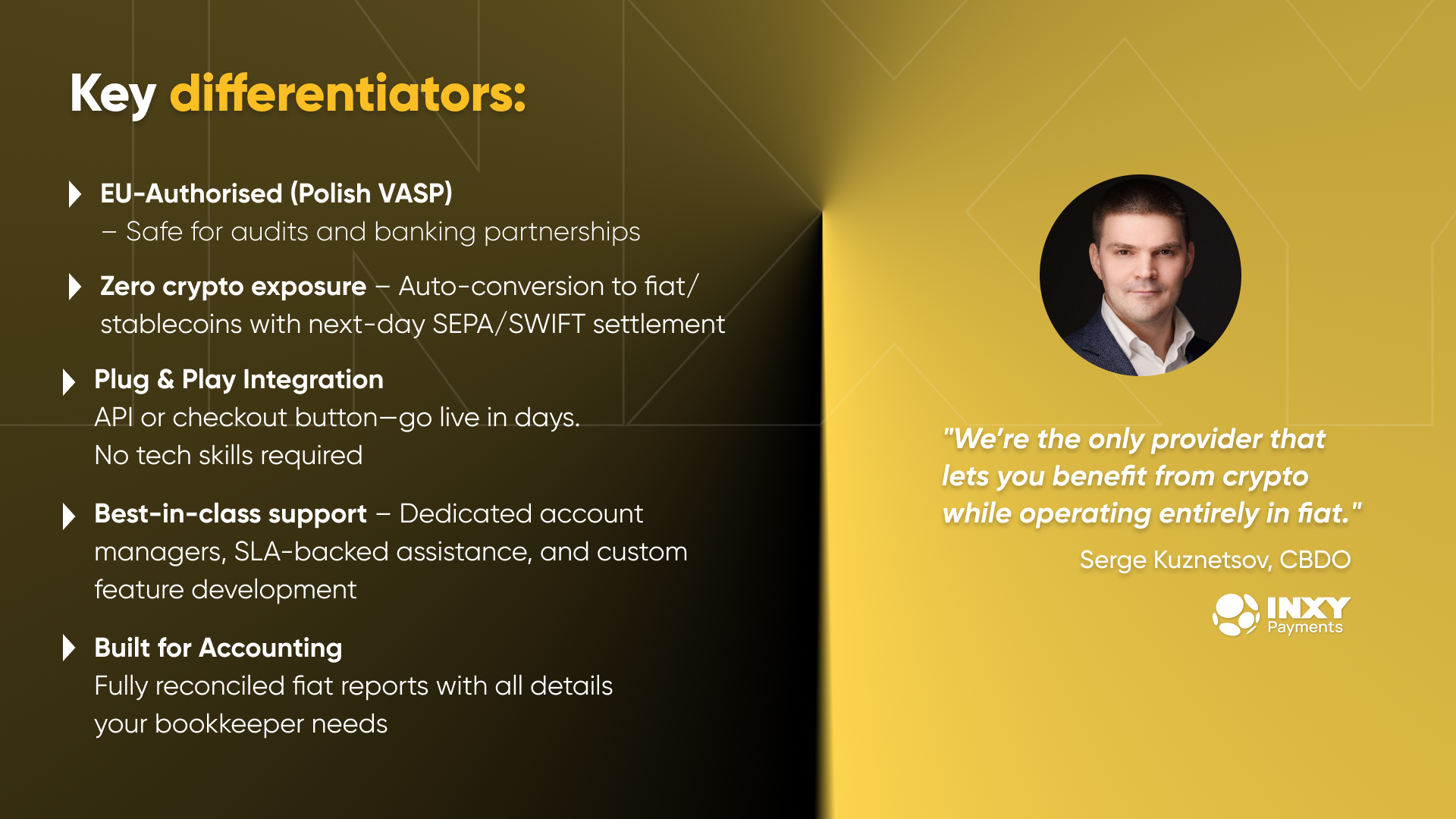
Many hosting providers hesitate to adopt digital payments because tracking microscopic network fees, managing multiple blockchain nodes, and building custom billing integrations sounds like an administrative nightmare. This is exactly where INXY transforms your entire billing architecture.
Unlike generic merchant processors, INXY is an enterprise-grade cryptocurrency payment gateway specifically designed to handle the high-frequency, low-cost routing required by modern cloud providers. We seamlessly integrate directly into your existing billing panels – whether you use WHMCS, HostBill, or a custom internal dashboard.
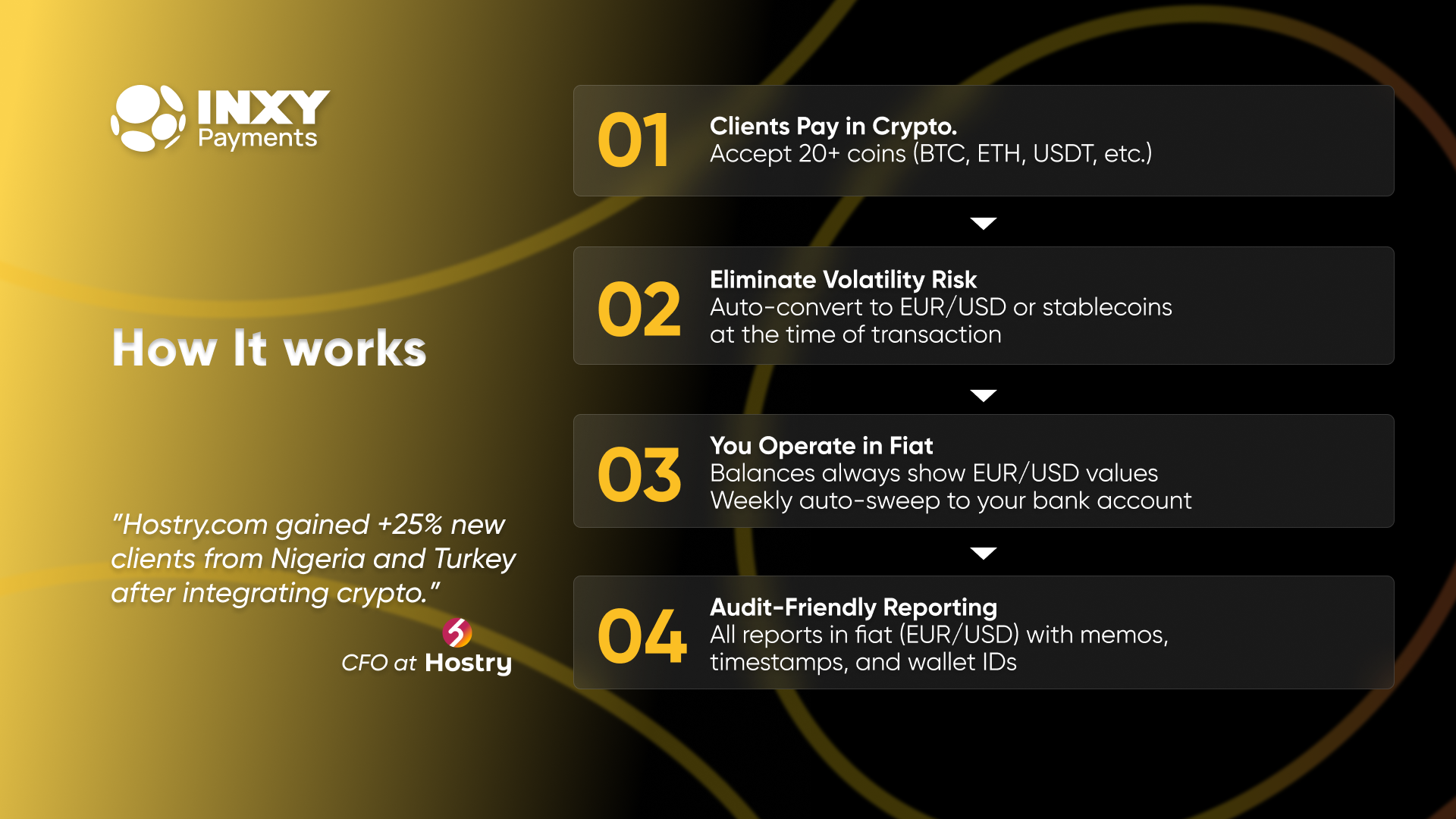
When you partner with INXY, you do not need to worry about manually verifying network confirmations or updating user balances. Our API automatically generates unique payment addresses, monitors the lowest-fee networks like Tron and Polygon, confirms the exact stablecoin deposit, and instantly updates the client's pre-paid balance on your server. INXY acts as your automated, invisible cashier, securing your revenue without the bloat of traditional banking.
Conclusion
The micro-cloud sector thrives on volume and automation. Continuing to rely on payment processors that penalize small transactions is an unsustainable business model. By shifting to a crypto-native, pre-paid balance structure, you eliminate crippling flat fees, protect yourself from chargeback fraud, and capture a rapidly growing demographic of privacy-conscious developers.
Ready to stop giving away your profit margins to payment processors? Discover how our automated payment gateway can drastically improve your server profitability by visiting https://www.inxy.io/ today.
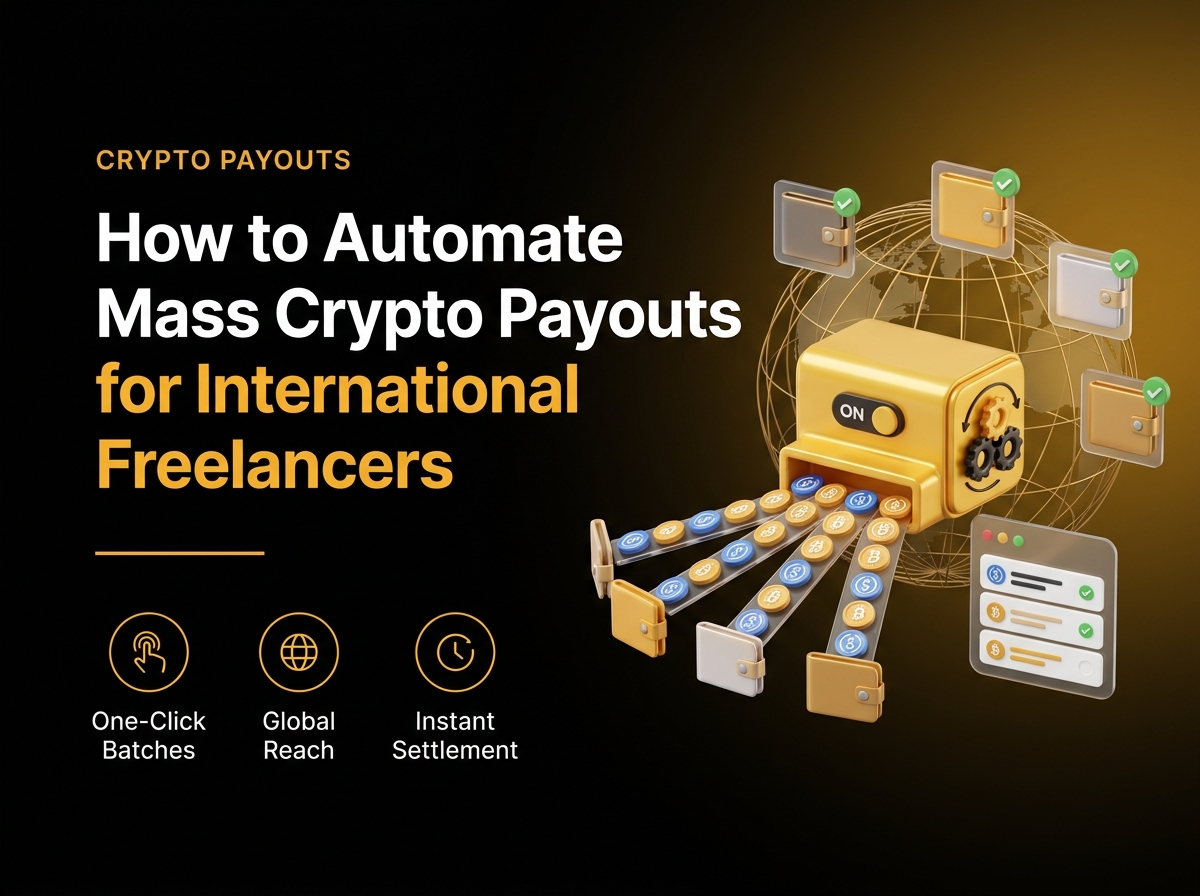
How to Automate Mass Crypto Payouts for International Freelancers
Wire transfers are draining freelance platform margins with high fees, opaque FX spreads, and week-long settlement delays. Automated mass crypto payouts via stablecoins like USDT and USDC eliminate these bottlenecks — processing thousands of global transactions in seconds through a single API call. This guide walks through the full transition: choosing the right digital assets, integrating a payout API, and automating reconciliation at scale.
It is payday, and your finance department is drowning in a massive spreadsheet filled with SWIFT codes, routing numbers, and fluctuating exchange rates. A few days later, your support channels are flooded with frustrated messages from international developers who still have not received their money because a correspondent bank mysteriously held the funds. If you operate a global freelance platform, a talent marketplace, or a remote agency, this logistical nightmare is likely your recurring reality. While hiring elite talent across borders is frictionless, compensating them remains stuck in the 1990s.
Legacy banking rails actively erode your profit margins with exorbitant fees and damage your reputation among top professionals. It is time to stop burning cash and developer hours on slow wire transfers. By transitioning to automated mass cryptocurrency payouts – specifically leveraging stablecoins you can execute thousands of global transactions simultaneously, settling payments in seconds rather than unpredictable weeks.
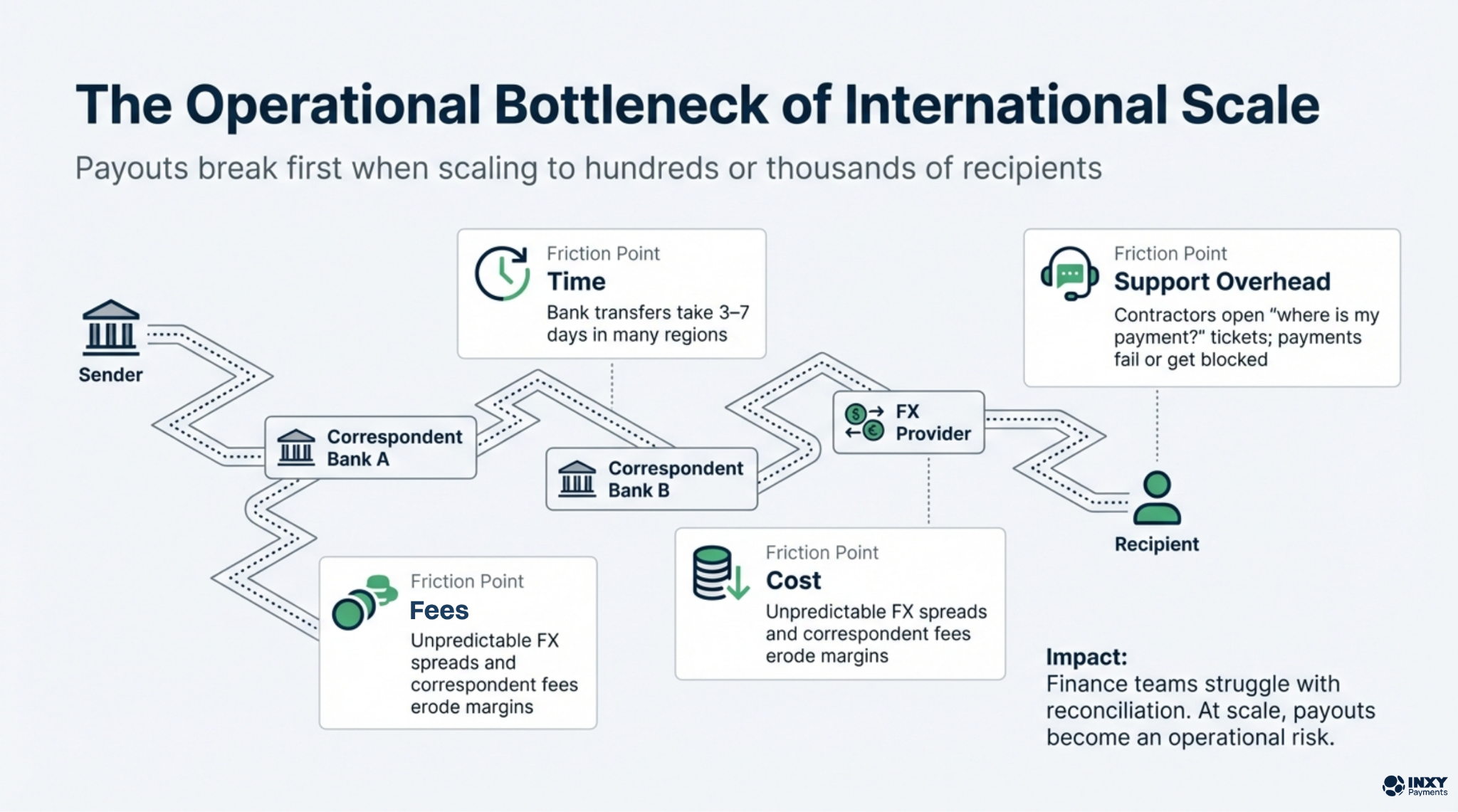
The Bottleneck of Traditional Global Payroll
Processing international payroll through fiat channels involves a convoluted chain of intermediary banks, each extracting a cut and adding days to the settlement timeline. The traditional system is plagued by critical operational pain points for freelance platforms:
- Exorbitant Transaction Fees: Standard wire transfers cost $15 to $50 per transaction. This makes frequent micro-payouts to temporary contractors or gig workers entirely unfeasible.
- Unpredictable Settlement Delays: Cross-border payments routinely take three to seven business days to clear, causing immense anxiety for freelancers relying on timely income.
- Hidden FX Markups: Banks apply highly unfavorable foreign exchange spreads, directly reducing the contractor's purchasing power and causing disputes over missing funds.
- Severe Financial Exclusion: Talented professionals in emerging markets are often completely locked out of standard, legacy payment methods like PayPal or Stripe.
The Mechanics of Crypto Payout Automation
Shifting platform operations to cryptocurrency, particularly utilizing stablecoins like USDT or USDC, neutralizes these flaws. Because they are securely pegged to the US Dollar, they eliminate the price volatility of digital assets like Bitcoin.
The true transformative power for your platform lies in API automation. Instead of a finance manager manually processing invoices one by one, a mass payout system allows your backend infrastructure to trigger hundreds of transactions simultaneously through a single API call. Executed via automated batch processing on high-speed blockchains like Tron or Polygon, network fees drop to mere pennies.
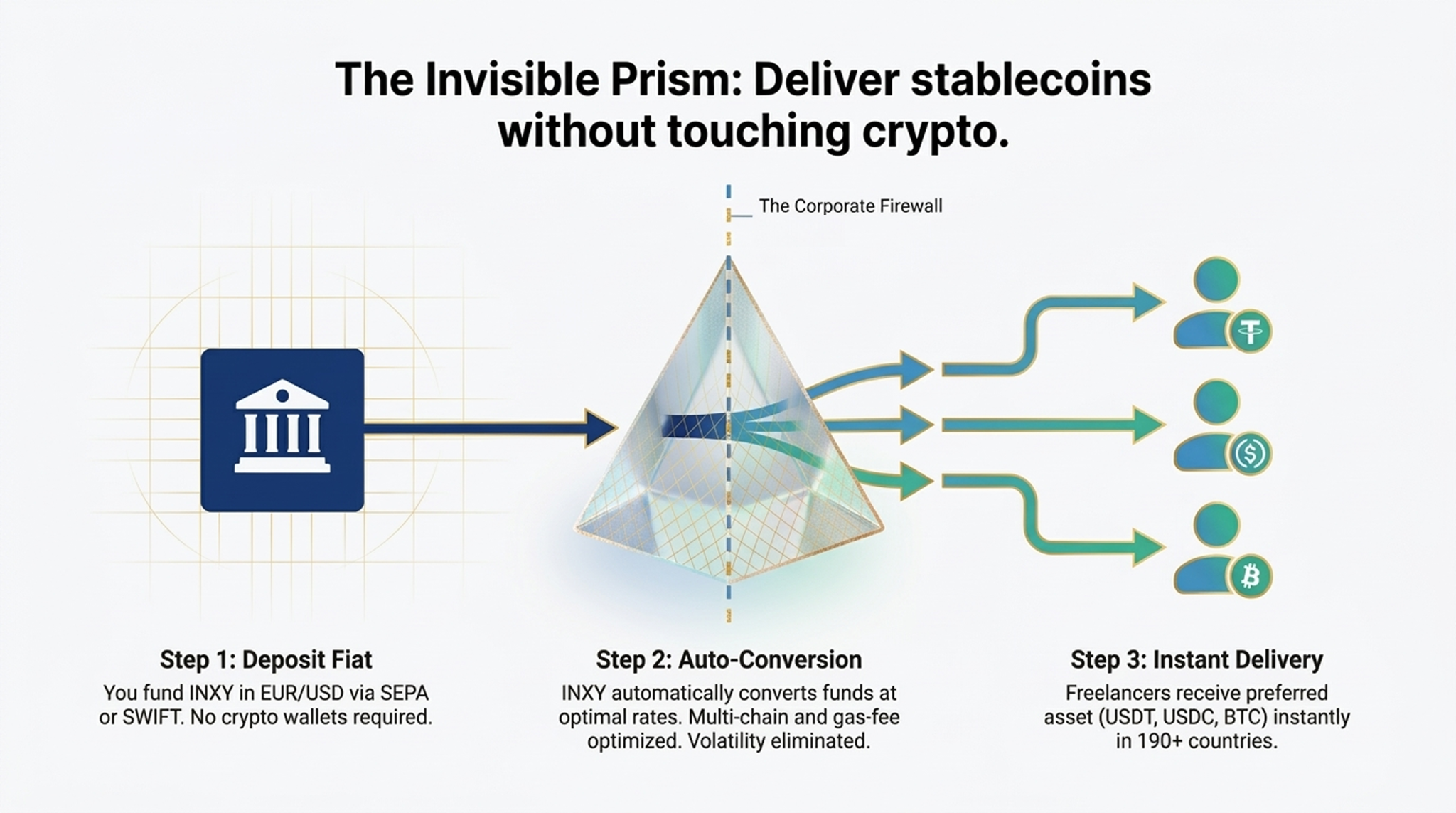
Step-by-Step Guide to Automating Global Payouts
Transitioning to a crypto-first compensation model requires a strategic technical approach to ensure smooth onboarding for your contractors:
- Select the Right Digital Assets: Default to stablecoins (USDT/USDC) on fast networks to ensure negligible gas fees and zero price volatility for the receiving party.
- Integrate a Payout API: Connect your backend directly to a dedicated crypto gateway supporting mass payout endpoints instead of trying to build and maintain complex nodes from scratch.
- Map Contractor Wallets: Update your platform onboarding flow to allow freelancers to securely save and verify their digital wallet addresses alongside their traditional profile data.
- Automate Trigger Events: Configure your platform's internal logic so that approved timesheets, completed milestones, or specific calendar dates automatically trigger the API payout calls.
- Streamline Reconciliation: Utilize a gateway that provides detailed transaction hashes and automated ledger updates so your accounting team can track successful disbursements in real-time.
INXY: The Premier Payout Gateway for Freelance Platforms
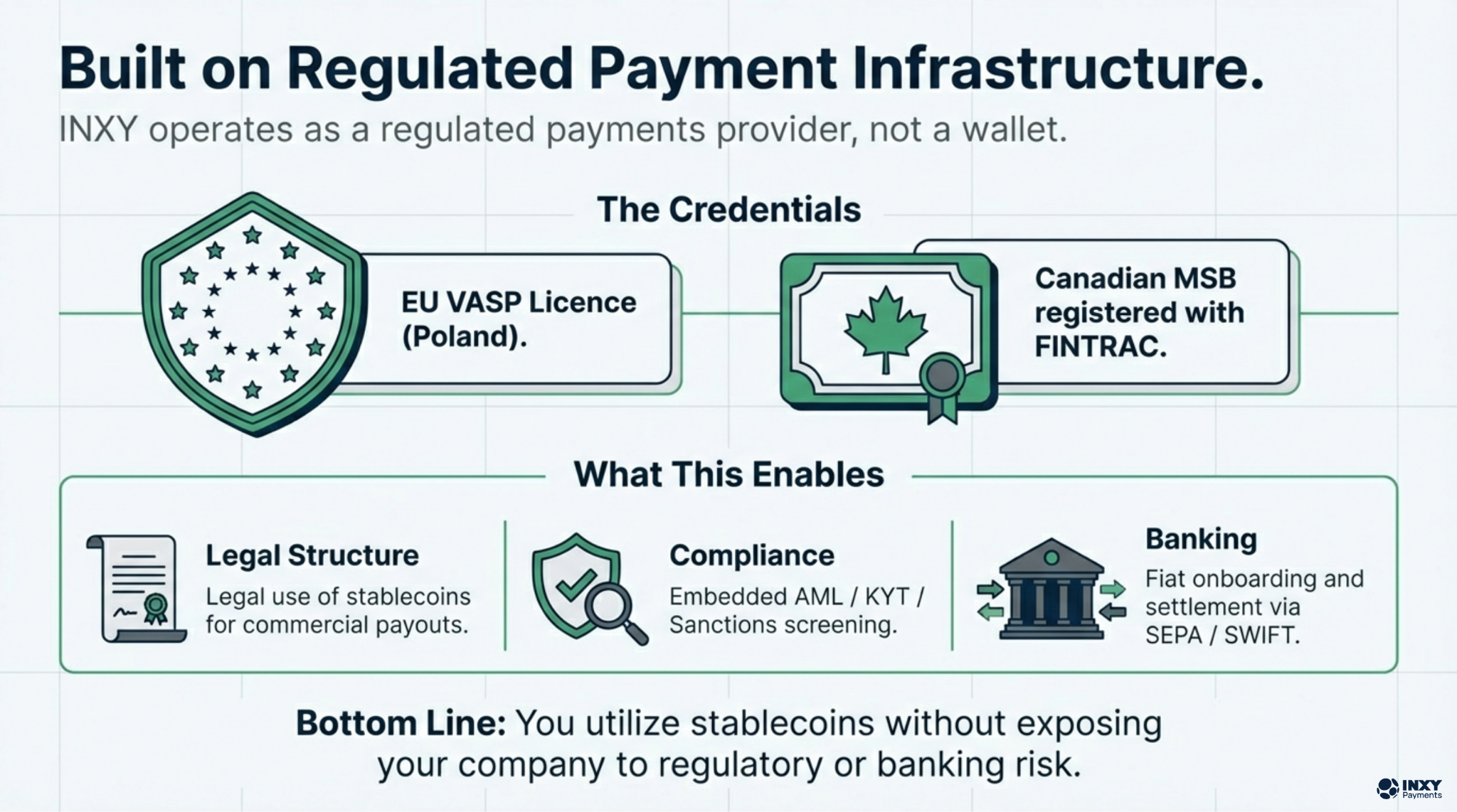
Implementing automated financial infrastructure requires an enterprise-grade technological backbone. For global talent marketplaces, remote agencies, and HR platforms modernizing their compensation systems, INXY stands out as the ultimate strategic partner.
INXY provides a powerful cryptocurrency payment gateway designed specifically for the high-volume, automated disbursement needs of the gig economy. By integrating the INXY API, your platform can automate mass crypto payroll effortlessly, completely removing the heavy lifting of blockchain node management. We act as the secure bridge between your administrative dashboard and the blockchain, ensuring rapid global settlement, automated transaction reconciliation, and flawless execution for every single contractor payout. Our infrastructure scales perfectly alongside your growing international workforce.
Conclusion
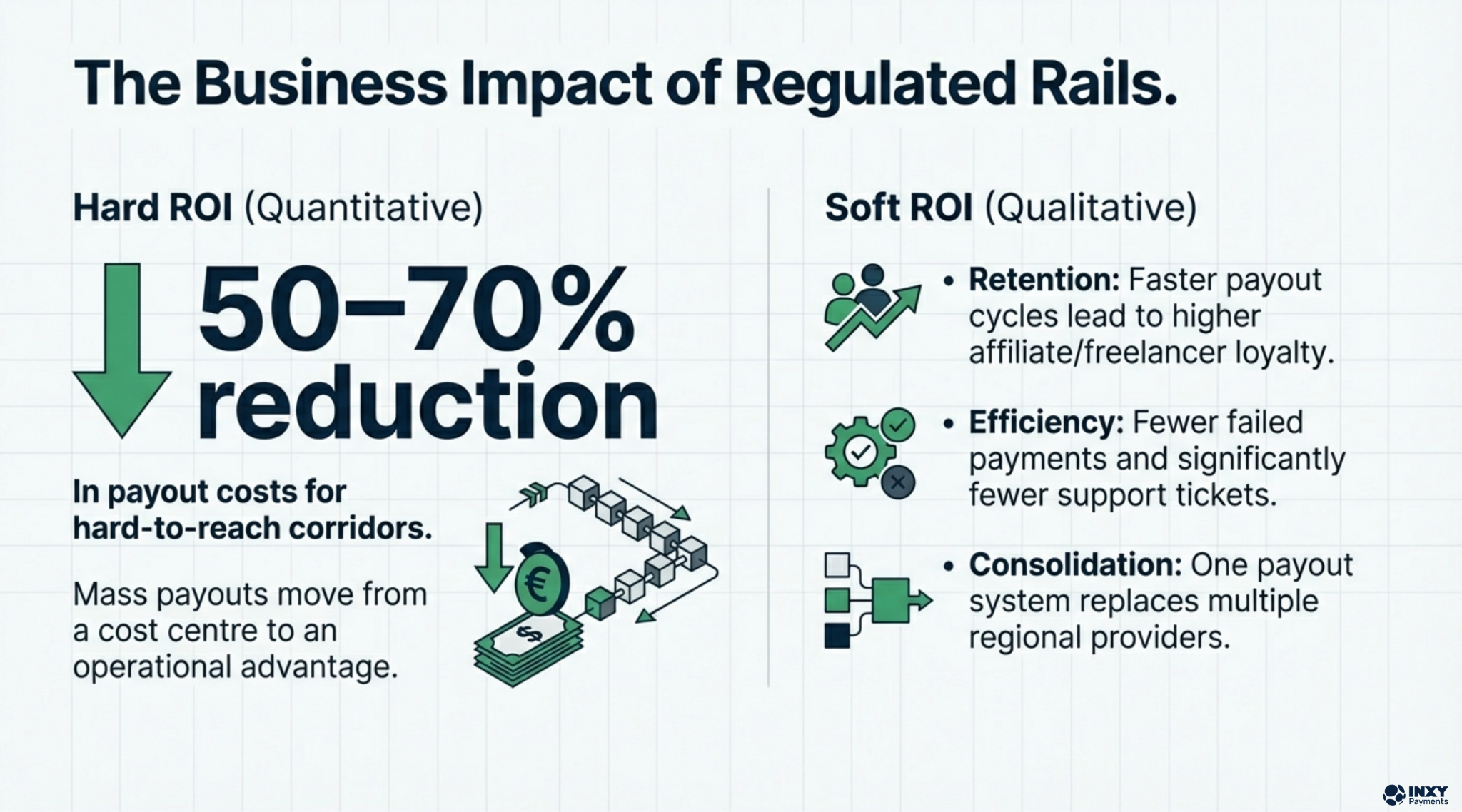
The future of global work is undeniably decentralized, and platform compensation methods must evolve to keep pace. Automating mass crypto payouts is not just an operational upgrade; it is a profound competitive advantage that attracts and retains top global talent who demand fast, transparent payments. Do not let outdated banking rails hold your platform's growth hostage.
Ready to revolutionize your payroll system and automate your global disbursements? Discover how our robust API solutions can scale your platform securely by visiting https://www.inxy.io/ today.
News

Unlock Global Scale: Meet INXY Payments at Affiliate World Asia in Bangkok


Building the Future of Finance: INXY Payments at TOKEN2049 Asia
Let’s work together
See how easy it is to start with crypto payments without interrupting your current business flow