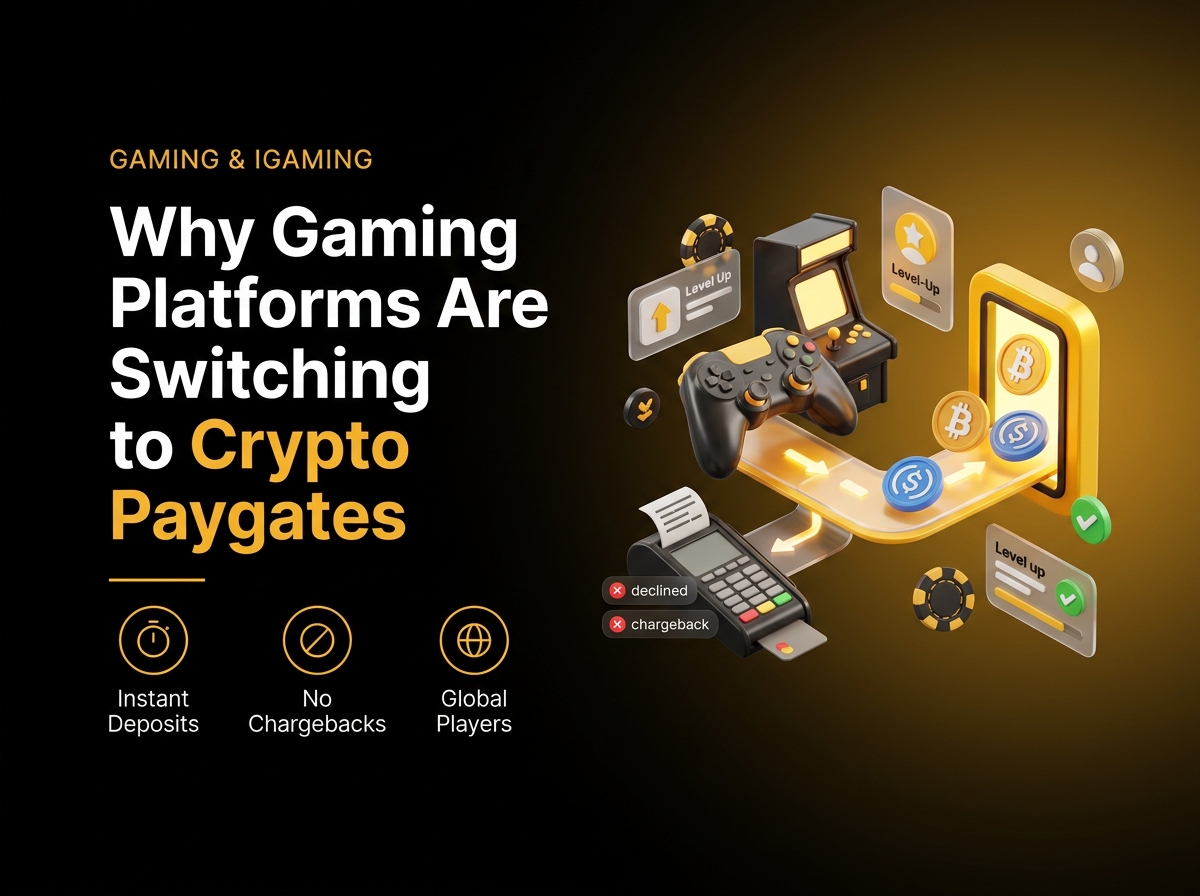
Why gaming platforms are switching to crypto paygates
Traditional payment processors expose gaming studios to crippling chargeback fraud and high fees on micro-transactions. This guide explores why top developers are rapidly switching to cryptocurrency payment gateways to secure irreversible transactions, completely eliminate "friendly fraud," and unlock a massive global market of unbanked players.
What if you are pouring years of development into a highly anticipated multiplayer game. Launch day arrives, your cosmetic shop is generating thousands of micro-transactions, and your dashboard shows record-breaking revenue. But thirty days later, the reality check hits: a massive wave of credit card chargebacks. Players who bought digital skins are falsely claiming the transactions were unauthorized. Suddenly, your payment processor hits you with steep penalty fees, turning your profitable launch into a financial sinkhole. Welcome to the dark side of traditional gaming monetization.
For modern studios, relying exclusively on legacy fiat networks means accepting an uncontrollable financial risk. To protect revenue, eliminate fraud, and unlock a truly global player base, the gaming industry is rapidly pivoting. Integrating a cryptocurrency payment gateway is no longer just a Web3 novelty; it is the ultimate cheat code for secure, unstoppable game monetization.
The Nightmare of friendly fraud in gaming
Unlike physical e-commerce, digital goods exist in a complex regulatory gray area. When a gamer issues a chargeback through their bank, the studio faces an incredibly steep uphill battle. Proving a specific user legitimately consumed virtual currency or activated a battle pass is difficult, and traditional banks almost universally side with the consumer.
This phenomenon, known as "friendly fraud," forces developers to suffer a double loss: the digital asset is gone, the original revenue is reversed, and the payment processor slaps the studio with a heavy penalty fee. If your chargeback ratio exceeds a strict threshold, processors will classify your game as high-risk, leading to frozen funds or suspended accounts.
Unlocking the global unbanked market
Beyond fraud protection, traditional banking rails actively restrict your total addressable market. Some of the most explosive growth in the gaming sector is happening in emerging regions like Southeast Asia and Latin America. However, millions of passionate gamers in these areas lack access to standard international credit cards or are burdened by exorbitant foreign exchange fees.
By restricting in-game purchases to fiat currencies, studios are leaving massive amounts of money on the table. Cryptocurrency transcends physical borders. It allows anyone with an internet connection to participate in your game's digital economy, transforming previously unbanked players into high-value, paying customers.
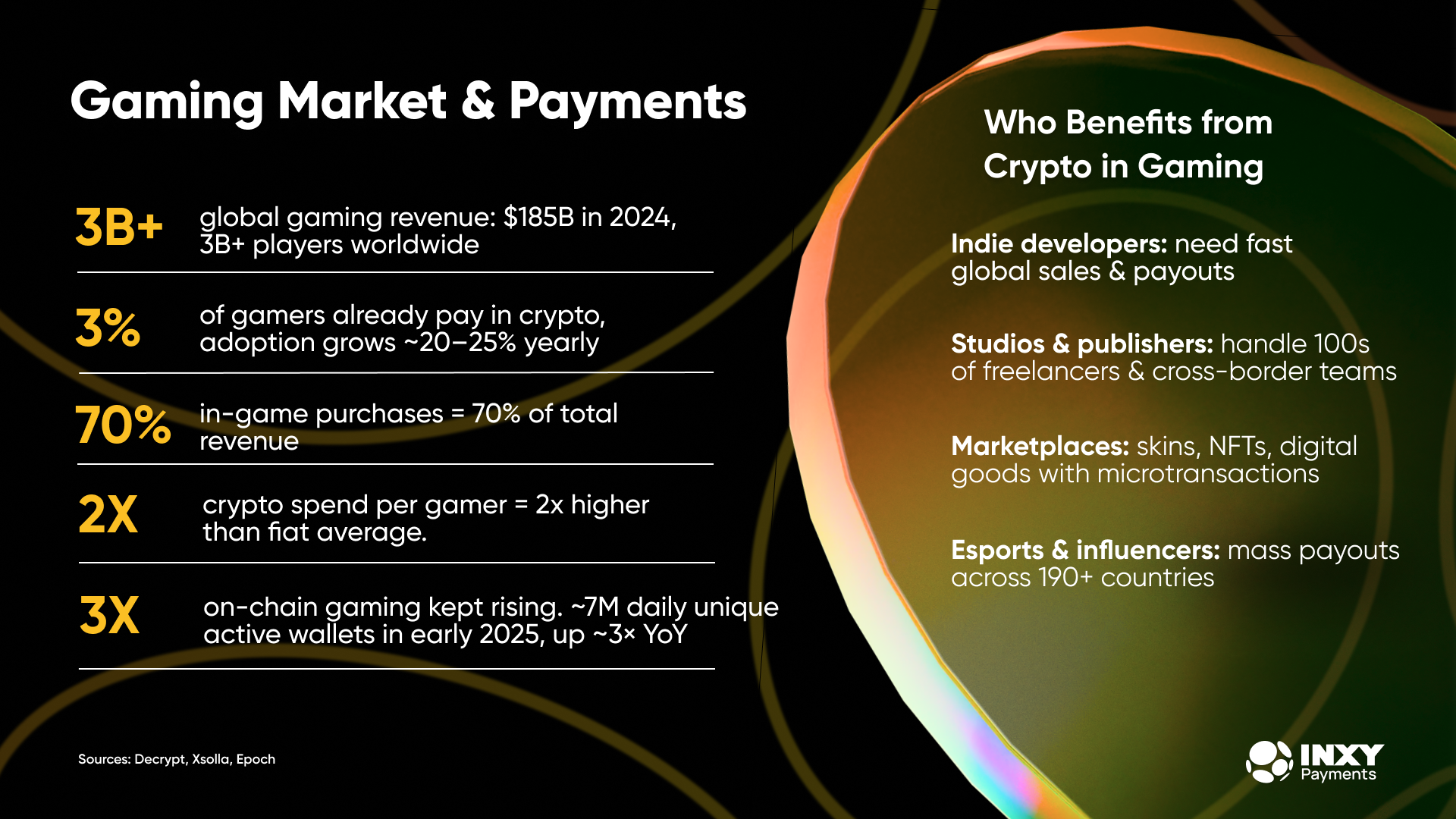
The core advantages of a crypto checkout
Transitioning your game's monetization model to include digital assets provides immediate, measurable benefits for your bottom line. Top studios are making the switch to crypto gateways for several critical reasons:
Zero Chargeback Risk: Blockchain transactions are mathematically irreversible. Once a player pays with crypto, the funds are permanently secured, completely neutralizing the threat of friendly fraud.
Profitable Micro-Transactions: Selling a $2 skin via credit card results in the processor taking a massive percentage. High-speed networks like Tron reduce transaction fees to mere pennies, preserving your margins.
Instant Financial Settlement: Instead of waiting weeks for international bank payouts to clear, crypto gateways settle funds instantly, providing studios with immediate liquidity for ongoing development.
Enhanced Player Privacy: Cryptocurrency allows gamers to purchase items without surrendering sensitive credit card details, reducing the risk of data breaches.
Game developer's gateway partner
Building robust Web3 infrastructure is complex, and your engineering team should be focused on crafting incredible gameplay, not managing blockchain nodes. This is where INXY steps in as the premier payment integration partner for the gaming industry.
INXY provides a developer-friendly, enterprise-grade gateway designed specifically to handle the high volume and instant execution required by online games. By integrating the INXY API into your game client, you instantly enable secure, irreversible crypto checkouts. INXY handles the complex routing, real-time price conversions, and instant network confirmations, ensuring your studio receives its revenue safely and automatically.
Conclusion
The gaming industry evolves rapidly, and clinging to expensive, easily manipulated credit card networks is a massive liability. By adopting cryptocurrency payments, you fortify your revenue streams, permanently eliminate chargeback fraud, and provide a frictionless payment option globally.
Ready to level up your monetization strategy? Discover how our robust API solutions can protect your studio by visiting https://www.inxy.io/gaming today.
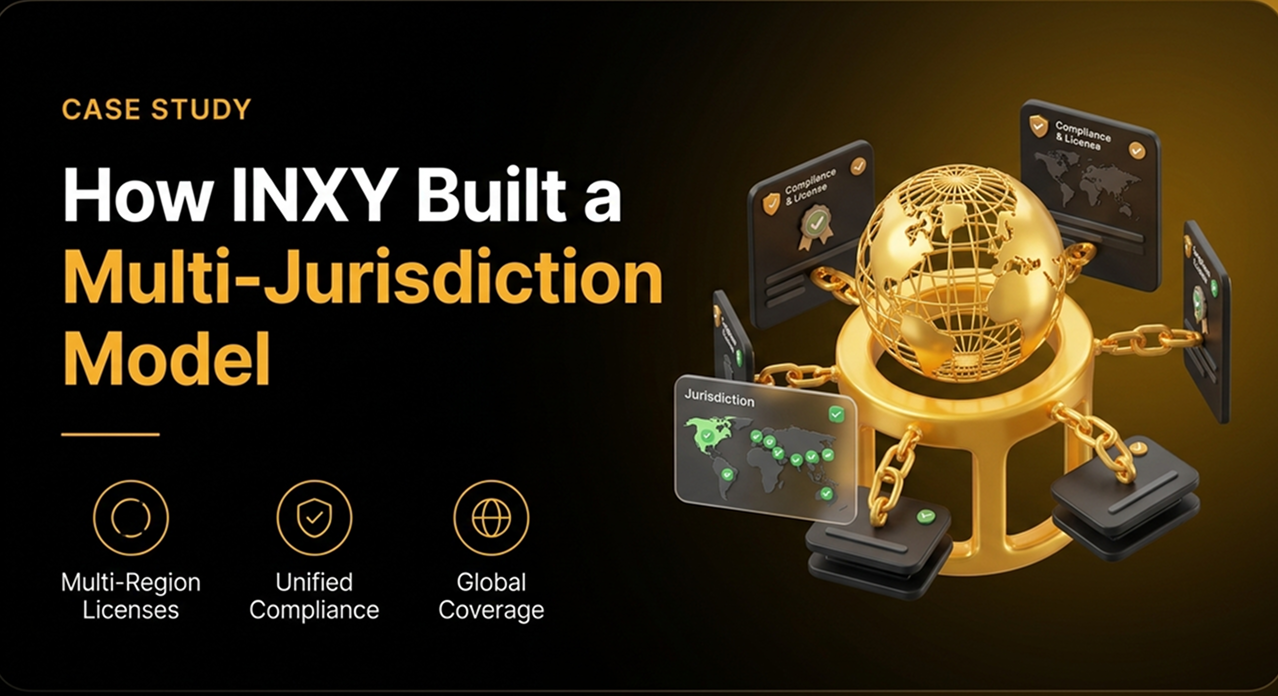
Navigating Crypto Compliance for Fintechs: How to Offer Stablecoins Safely
As global regulators tighten their grip on digital assets, offering stablecoins safely has become a critical challenge for fintechs. This guide explores how to navigate recent EU restrictions on USDT, why fully collateralized USDC is the gold standard for institutional compliance, and how integrating a multi-asset gateway like INXY protects your platform while providing seamless global transfers.
5 min read
6.5.2026
Navigating Crypto Compliance for Fintechs: How to Offer Stablecoins Safely
Imagine launching a killer feature that multiplies your transaction volume overnight, only to have regulators freeze your operations a week later. Welcome to the high-stakes reality of integrating stablecoins into your platform. Right now, digital dollars are powering the global economy, moving billions across borders daily. Your users are demanding it, and the business case for instant settlements is undeniable.
But there is a catch. Financial watchdogs globally are circling. Offering stablecoins is a massive growth lever for ambitious fintechs, but stepping into the crypto arena without an airtight compliance strategy is like walking a tightrope without a net. The ultimate challenge is navigating this regulatory minefield without sacrificing the seamless user experience your customers expect.
The Top Three: USDT, USDC, and DAI
Before diving into regulatory complexities, it is crucial to understand the stablecoin hierarchy and why diversifying your asset offerings is mandatory for compliance.
Tether (USDT): While it currently holds the number one spot for global trading volume, USDT faces severe regulatory headwinds. Notably, the European Union has implemented strict restrictions and effective bans on USDT exchanges under new frameworks, forcing fintechs to rethink relying on a single asset.
USD Coin (USDC): Sitting comfortably as the second most popular stablecoin, USDC is the gold standard for institutional compliance. It is a fully collateralized asset, genuinely backed 1:1 by actual US dollars and short-term assets, providing unparalleled transparency for strict regulators.
DAI: Holding the third position globally, DAI offers a robust, decentralized alternative that maintains its peg through smart contracts and over-collateralization, rounding out the essential stablecoins for any modern financial platform.
Key Regulatory Challenges in the Crypto Landscape
Offering stablecoins is not as simple as plugging into an API. Financial authorities are rapidly tightening their grip to prevent money laundering and systemic economic risks. First, stringent Know Your Customer (KYC) and Anti-Money Laundering (AML) directives require dynamic, ongoing monitoring. Second, the FATF Travel Rule mandates that institutions must securely share originator and beneficiary data for crypto transfers exceeding specific thresholds.
Finally, jurisdictional fragmentation creates a massive headache. The EU’s Markets in Crypto-Assets (MiCA) regulation perfectly exemplifies this, creating strict new rulebooks that directly restrict non-compliant stablecoins like USDT. This makes offering fully backed, transparent assets like USDC an absolute necessity for European operations.
Proven Strategies to Offer Stablecoins Compliantly
To protect your business from crippling fines while maximizing the incredible benefits of digital assets, you must follow these proven operational strategies:
Diversify Your Assets: Do not rely solely on USDT. Offer USDC to satisfy strict regulatory requirements in the EU, and provide DAI for users seeking decentralized options.
Implement Bank-Grade KYC/AML: Utilize automated identity verification systems that check users against global sanctions watchlists in real-time.
Integrate Transaction Monitoring: Deploy sophisticated blockchain analytics tools to trace wallets, ensuring incoming funds are not linked to illicit activities.
Geofence Restricted Jurisdictions: Utilize precise IP tracking to block specific stablecoin features in regions where they are explicitly banned or heavily restricted.
INXY as the Premier Crypto Payment Gateway Partner
Navigating this tangled web of regulations demands the right underlying technological infrastructure. This is where INXY steps in as the premier partner for fintech companies looking to integrate digital assets securely.
As a dedicated cryptocurrency payment gateway, INXY understands the exact pain points fintechs face. Most importantly, INXY natively supports all three of the top stablecoins: USDT, USDC, and DAI. Whether you need a reliable gateway to process fully backed USDC deposits in the heavily regulated EU market or high-speed APIs for global USDT and DAI transfers, INXY provides the robust backbone your application needs to scale while maintaining strict operational compliance.
Conclusion
The future of global payments is strictly digital, and stablecoins are leading the charge. While the fragmented regulatory environment is complex, it should not deter your business from innovating. By prioritizing proactive compliance, diversifying your asset offerings, and choosing the right technological allies, you can confidently offer secure stablecoin services to your users.
Ready to future-proof your financial platform? Discover how we can help you scale your operations compliantly by visiting https://www.inxy.io/fintech today.
The Future of Global Commerce: Cross-Border Crypto Payments vs. Bank Transfers
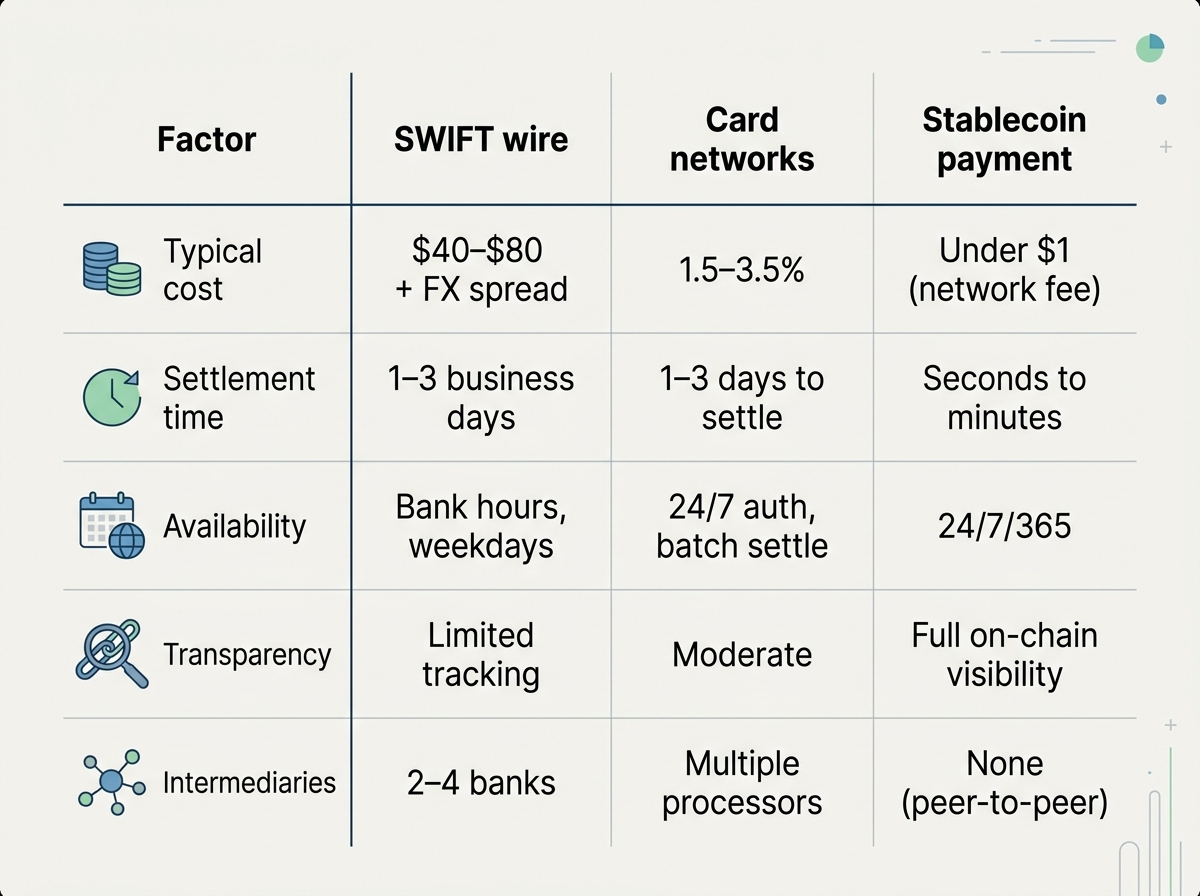
The Future of Global Commerce: Crypto Payments vs. Traditional Banking The $190 trillion cross-border payment market is undergoing a systemic shift. While traditional SWIFT transfers remain the bedrock of trade, blockchain-based solutions are no longer just an alternative—they are a strategic imperative. Key Takeaways: Settlement Velocity: Moving from 3-5 business days to near-instant, 24/7/365 availability. Cost Optimization: Reducing transaction fees by 60% to 80% by removing intermediary "hops." Risk Mitigation: Eliminating chargeback fraud through blockchain immutability and transparent tracking. As we move toward a hybrid financial ecosystem, understanding these digital rails is essential for any global enterprise. Read our full analysis on how to future-proof your payment stack.
The global cross-border payment market is a staggering financial behemoth, moving approximately $190 trillion annually across the world's economies. For decades, this massive flow of capital has been heavily dominated by traditional financial institutions, operating on infrastructure originally designed in the pre-digital era. However, the legacy correspondent banking system is currently facing unprecedented, systemic disruption from blockchain technology and digital assets. As global commerce accelerates and borders become increasingly blurred in the digital age, the debate between Cross-Border Crypto Payments vs. Bank Transfers has become one of the most critical conversations in the fintech and crypto processing industry.
While traditional bank transfers remain the undisputed bedrock of global trade—largely due to their established regulatory frameworks, institutional trust, and systemic stability—crypto payments are rapidly gaining ground. Driven primarily by the rise of stablecoins and decentralized finance (DeFi) networks, these digital alternatives are emerging as a significantly faster, cheaper, and more inclusive alternative for businesses operating on an international scale.
For Chief Financial Officers, treasury managers, and e-commerce leaders, understanding the nuances of these two fundamentally different financial rails is no longer optional; it is a strategic business imperative. In this comprehensive, deep-dive guide, we will break down exactly how these two systems compare across key operational metrics, the roadblocks that remain, and how you can position your enterprise to leverage automated crypto processing for future growth.
Exploring the Great Divide: Cross-Border Crypto Payments vs. Bank Transfers
To truly understand the shifting paradigm in global finance, business leaders must look under the hood of how money actually moves across borders. The differences between legacy fiat rails and decentralized blockchain ledgers fundamentally alter how businesses manage cash flow, mitigate risk, and scale their operations globally. Let us examine the core operational differences.
1. The Mechanics of Speed and Settlement
Time is money, and in international trade, settlement delays can create cascading cash-flow bottlenecks that stifle growth, frustrate suppliers, and complicate supply chain management.
Traditional Bank Transfers: Traditional cross-border payments rely heavily on the SWIFT (Society for Worldwide Interbank Financial Telecommunication) messaging network and a highly complex "correspondent banking" model. Because it is logistically impossible for every bank in the world to hold direct, bilateral relationships with every other bank globally, a single international payment cannot simply travel from Point A to Point B. Instead, it often "hops" through multiple intermediary banks before reaching its final destination.
Timeframe: Because of these necessary intermediary hops, and the manual reconciliation required at each step, settlements typically take anywhere from 2 to 5 business days to clear.
Limitations: Traditional transactions are strictly bound by localized banking cut-off times, weekends, and regional bank holidays. If a company in London sends a payment to a supplier in Tokyo on a Friday afternoon, that payment will sit in limbo until the following Monday—or longer, if there is a local holiday. This creates highly unpredictable cash-flow gaps.
Crypto & Blockchain Payments: Blockchain networks operate on a fundamentally different, modern architecture: a decentralized, single-ledger system. This technology allows for direct, peer-to-peer (P2P) transfers that bypass traditional intermediary banks entirely.
Timeframe: Settlements on blockchain networks occur in a matter of seconds or minutes, regardless of the geographic distance between the sender and the receiver. For example, enterprise-grade networks like Ripple (XRP) or major fiat-backed stablecoins settle almost instantly.
Limitations (or lack thereof): Cryptocurrencies and blockchain networks operate 24/7/365. They do not sleep, they do not observe weekends, and they do not pause for national holidays. This effectively eliminates the delays caused by traditional operating hours, allowing businesses to execute just-in-time cross-border settlements.
Professional Takeaway: If your business relies on rapid inventory turnover or immediate supplier payments, integrating a crypto payment gateway to facilitate stablecoin settlements can drastically improve your working capital cycles.
2. Cost Efficiency and the Death of Intermediaries
Profit margins on international sales and B2B vendor payments are frequently eroded by the opaque and compounding costs associated with moving money across borders.
Traditional Bank Transfers: The multi-hop nature of correspondent banking means that each intermediary institution involved in the transfer process extracts its own toll. This can come in the form of a flat processing fee, an unfavorable foreign exchange (FX) spread, or a network messaging fee.
Impact: Transaction costs can be prohibitively high, especially for smaller retail payments, B2B micro-transactions, and remittances. According to recent data from the World Bank and the International Monetary Fund (IMF) [source: worldbank.org], high legacy banking fees remain one of the most significant barriers to global financial inclusion and frictionless international trade.
Crypto & Blockchain Payments: By systematically removing the middlemen from the transaction lifecycle, blockchain payments drastically reduce the costs associated with moving capital. The network validates the transaction programmatically, requiring only a small fraction of the fee traditionally charged by banks.
Impact: Comprehensive market research indicates that utilizing crypto or stablecoin rails can reduce cross-border transaction fees by a staggering 60% to 80%. This reduction is particularly transformative for the global remittance market and for small-to-medium enterprises (SMEs) that were previously priced out of efficient global trade due to prohibitive SWIFT fees. For businesses processing thousands of international transactions monthly, these savings directly, and heavily, impact the bottom line.
Professional Takeaway: Audit your current cross-border payment flows. Calculate the total annual cost of FX spreads and wire fees. For many e-commerce and SaaS platforms, migrating even 20% of cross-border volume to a crypto processing solution yields immediate, measurable ROI.
3. Security, Transparency, and Finality
How businesses track their funds in transit, and how they protect themselves from fraud, differs wildly between traditional banking and blockchain processing.
Traditional Bank Transfers: While the legacy banking system is highly secure, stringently regulated, and heavily insured, traditional transfers can be notoriously opaque for the end-user. Businesses often experience high levels of uncertainty regarding the exact status of a payment mid-transit. Furthermore, they frequently lack visibility into the final fees that will be deducted by intermediary banks before the funds arrive.
Additionally, traditional systems allow for chargebacks and settlement reversals. While designed to protect consumers, chargebacks pose significant administrative burdens and financial risks for online merchants who fall victim to "friendly fraud."
Crypto & Blockchain Payments: Blockchain ledgers are mathematically immutable. Once a transaction is algorithmically verified and recorded on the chain, it is permanent and cannot be altered, spoofed, or deleted.
Pros: This immutability provides total, unprecedented transparency. Anyone with the transaction hash can track the payment on the public ledger in real-time, eliminating the "where is my money?" anxiety. Furthermore, the irreversible nature of blockchain transactions entirely eliminates chargeback fraud—a massive relief for merchants, protecting businesses from unexpected revenue losses and malicious consumer behavior.
Cons: The absolute finality of the blockchain is a double-edged sword. If funds are mistakenly sent to the wrong wallet address due to human error, they are generally unrecoverable. Unlike a bank, there is no centralized customer service hotline to reverse an erroneous blockchain transaction.
Professional Takeaway: To mitigate the risk of lost funds via human error, utilize automated crypto payment gateways that generate dynamic, single-use QR codes and exact-amount payment links, removing the need for manual address entry by your clients.
Key Risks and Roadblocks to Mainstream Adoption
While crypto payments offer operational superiority in speed and cost, they face significant hurdles that prevent total mainstream displacement of traditional banking. A balanced fintech strategy must acknowledge and navigate these challenges.
1. The Volatility Dilemma Legacy cryptocurrencies like Bitcoin (BTC) or Ethereum (ETH) are highly speculative assets. A 10% price swing during a brief transaction window makes them highly impractical for standard corporate functions, such as payroll distribution or invoice settlements. This is exactly why the market is pivoting heavily toward stablecoins—digital assets pegged 1:1 to fiat currencies like the US Dollar, combining the technological speed of crypto with the economic stability of traditional money.
2. Regulatory Uncertainty & Compliance Protocols Traditional banks have spent decades building robust, globally recognized Anti-Money Laundering (AML) and Know Your Customer (KYC) compliance frameworks. The pseudonymous nature of foundational cryptocurrencies complicates these essential compliance measures. Inconsistent, fragmented regulatory frameworks across different global jurisdictions make enterprise-level adoption risky for heavily audited corporations. Processing platforms must provide built-in compliance tools to bridge this gap safely.
3. Wholesale Dominance and Institutional Inertia Traditional financial systems are purpose-built to safely handle massive, multi-billion-dollar wholesale transactions between sovereign nations and multinational conglomerates. Currently, crypto payments represent only a small fraction of total global volume, primarily capturing retail, SME, and remittance flows. Unseating a $190 trillion entrenched system takes time.
The Future: Convergence Over Replacement
The consensus among top economic researchers and fintech analysts is that blockchain will not immediately replace traditional bank transfers; rather, the two systems are destined to integrate. We are moving toward a hybrid financial ecosystem.
Major financial institutions are already adopting blockchain infrastructure to modernize their own rails. For instance, J.P. Morgan has developed its own blockchain networks to facilitate 24/7 cross-border settlements for institutional clients. Additionally, global authorities and central banks are heavily researching and piloting Central Bank Digital Currencies (CBDCs). These sovereign digital assets aim to combine the speed, transparency, and efficiency of blockchain technology with the absolute trust, stability, and regulatory backing of traditional fiat money.
The future of the fintech processing industry lies in interoperability—systems that allow a business to accept a payment in a stablecoin from a client in Brazil, and have it instantly settled as fiat in a corporate bank account in Europe, entirely seamlessly.
Automating Business Processes with INXY
Navigating the transition from legacy finance to digital assets doesn't have to be a logistical nightmare. To stay competitive, modern businesses need payment infrastructure that is as dynamic and global as their customer base.
At INXY, we understand that navigating the complexities of Cross-Border Crypto Payments vs. Bank Transfers requires robust, reliable, and secure technology. Our cutting-edge payment gateway solutions are designed specifically to help forward-thinking enterprises automate their business processes, effortlessly bridging the gap between traditional fiat banking and the emerging crypto economy.
Whether you are looking to eliminate exorbitant SWIFT fees, accept cross-border stablecoin payments with zero volatility risk, or implement comprehensive cross-domain tracking for your payment flows, INXY provides the enterprise-grade infrastructure to make it happen seamlessly.
Ready to modernize your financial stack and expand your global reach without the friction of traditional banking? Explore our comprehensive suite of payment gateway solutions atINXY.io and discover how we can tailor an automated crypto processing strategy for your specific business needs. Contact our integration team today to future-proof your payment operations.
Stablecoin Payments: Why Businesses Switch in 2025
Discover why businesses worldwide are switching to stablecoin payments in 2025. Learn how stablecoins work, their benefits over traditional payments, real case studies, global regulations, and what the future of digital payments looks like
Stablecoin payments are a way to use digital currencies that are pegged to stable assets, like the US dollar. This means their value doesn't swing wildly like other cryptocurrencies. Imagine you're doing business online, and you want to avoid the ups and downs of Bitcoin's value. Stablecoins, like USDC, DAI and USDT, come in handy here. They offer the benefits of crypto without the same level of risk.
These payments work through a crypto payment gateway, which acts like a bridge. It lets businesses accept stablecoins and convert them into local currency if needed. This is helpful for companies that want to tap into the crypto market without holding onto volatile assets.
Think of stablecoin payments as a digital version of cash that you can use globally, without worrying about big price changes. They're fast, often cheaper than traditional methods, and open up new markets for businesses. This makes them a popular choice for companies looking to innovate in 2025. Stablecoins also help people in emerging markets who have no access to traditional banking. Many do not have a bank account, but almost everyone has a mobile phone. Stablecoins give these users a safe and simple way to pay online.
The Rise of Digital Transactions
Digital transactions have become increasingly popular as we move further into the 21st century. People use digital payments to buy things online, pay bills, and even send money to friends. This shift has been driven by the need for faster, more convenient ways to pay.
One example is mobile wallets, which let you store your credit or debit card information on your phone. This makes it easy to pay with just a tap. Businesses are also seeing the benefits. They can reach more customers who prefer digital payments, and they can process transactions more quickly.
Cryptocurrencies like Bitcoin and stablecoins like USDC and USDT offer new ways to pay digitally. These currencies are secure, and they don't rely on traditional banks. This can lower costs and increase access to financial services.
The growth of digital transactions is also supported by better technology. Faster internet speeds and improved security measures make it easier and safer for everyone to use digital payments. As more people and businesses adopt these methods, digital transactions are set to become the norm.
Today, more than 824 million people worldwide own cryptocurrency.
Stablecoins alone processed over $46 trillion last year — more than Visa and PayPal combined.
This shows that digital payments are not a niche trend. They are becoming the main way money moves online.
Benefits for Businesses
Stablecoin payments offer several advantages for businesses. They're less volatile than other cryptocurrencies like Bitcoin. Imagine you're a business owner. You want to know the value of your money won't change drastically overnight. Stablecoins, backed by assets like the US dollar, provide that peace of mind.
Transaction fees with stablecoins can be lower than traditional banking systems. This means businesses save money, especially on international transactions. For example, sending money across borders usually involves hefty fees. With stablecoins, these costs can be minimized.
Another perk is the speed. Traditional bank transfers can take days. Stablecoin transactions, on the other hand, can be processed in minutes. This speed is crucial for businesses that need quick access to funds. Plus, the use of stablecoins can open doors to new markets, reaching customers who prefer using digital currencies.
also let businesses reach new markets. Many people in emerging regions cannot use cards or access banks, but they can use digital wallets and stablecoins on their phones. This opens the door to millions of new customers who were previously locked out of traditional online payments.
Challenges of Traditional Payment Methods
When we talk about traditional payment methods, we're often referring to cash, credit cards, and bank transfers. While these methods have been the backbone of commerce for years, they come with their own set of challenges. Let's explore these issues to understand why businesses are looking at alternatives like stablecoin payments.
Traditional payments are slow and costly. Bank transfers and card payments can take days to settle, especially across borders. Fees are also high — from card fees to bank transfer fees to currency conversion charges — cutting into margins and slowing business growth.
Security is another concern. Credit card fraud and data breaches are not uncommon. When customers hand over their card details, there's always a risk of that information being misused. This situation not only affects the customers but can also damage the business's reputation. A single security breach might lead to a loss of customer trust, which takes a long time to rebuild.
Limited access is an issue too. Not everyone has access to credit cards or bank accounts. Some customers might prefer alternative payment methods like digital wallets or cryptocurrencies. Businesses that only accept traditional payments could miss out on potential sales from these customers. It's like having a store but keeping the door locked for some shoppers.
Traditional payments also lack transparency. It's often hard for both businesses and customers to track where the money is at any given moment. For example, if a payment is delayed, it can be challenging to pinpoint the reason or the stage at which it's stuck. This lack of visibility can cause frustration and distrust among customers.
Lastly, there's the issue of adaptability. As technology evolves, businesses need payment systems that can keep up with the changes. Traditional payment methods are often slow to adapt to new needs and innovations. For instance, they might struggle to integrate with new e-commerce platforms or to support emerging payment trends.
These challenges make it clear why businesses are exploring other options. Stablecoin payments offer solutions to some of these issues, providing a faster, more secure, and cost-effective alternative. As businesses continue to grow and change, finding flexible payment solutions becomes even more critical.
Case Studies: Companies Making the Switch
Let's dive into some real-world examples of businesses that have embraced stablecoin payments. Each company has its unique reasons, and their experiences offer valuable insights for others considering this path.
One notable case is a well-known online retailer. This company decided to accept USDC, DAI and USDT as part of their payment options. The primary motivation was the global reach of crypto. Customers from different countries found it easier to pay in stablecoins without worrying about currency conversion issues. It also allowed the retailer to reduce transaction fees, which were a burden when using traditional payment gateways.
Another interesting example is a tech startup focused on software development. They started accepting stablecoin payments for their services. The team found that using a crypto payment gateway streamlined their operations. It provided faster transaction times and reduced paperwork. The transparency of blockchain technology also appealed to their tech-savvy customers, who appreciated the added layer of security.
A third case involves a popular restaurant chain. The chain began to accept stablecoin payments during the pandemic. Traditional cash payments were less desirable due to health concerns. By adopting stablecoins, they not only offered a contactless payment solution but also attracted a younger clientele. Many of these customers were already familiar with crypto and eager to use it in everyday transactions.
Then there's a logistics company that made the switch. This company operates internationally, and stablecoins helped them manage cross-border payments more efficiently. The predictability of stablecoin values, unlike volatile cryptocurrencies, made financial planning easier. They could handle transactions with partners and vendors with greater confidence in cost predictability.
Lastly, a freelance platform adopted stablecoin payments to simplify payouts to freelancers around the globe. Freelancers appreciated receiving payments in USDC or USDT for their stability and ease of conversion to local currencies. This shift also solved issues related to delayed payments through traditional banking systems.
These examples illustrate the diverse motivations behind the switch to stablecoin payments. From reducing costs to improving speed and security, businesses find multiple benefits in adopting this modern approach. Each company's journey showcases how stablecoin payments can address specific challenges and open up new opportunities.
These stories reflect a broader trend. In 2024 and 2025, stablecoins became one of the fastest-growing payment methods worldwide, especially for online services and global businesses.
Regulatory Landscape in 2025
Stablecoin payments have been gaining traction, and 2025 is shaping up to be a pivotal year for their regulation. Governments around the world are crafting policies to manage these digital currencies. This is crucial as stablecoins like USDC and USDT become more popular in the business world.
One major development is the introduction of global standards. International bodies are working to create a unified framework for stablecoin regulation. This helps ensure that businesses using stablecoins can operate smoothly across borders. Without such standards, companies might face different rules in each country, making international trade complex.
Local governments are also busy. Each country is trying to balance innovation with security. They want to encourage the use of stablecoins while making sure that financial systems remain safe. For example, some countries are adopting stricter compliance measures. This means businesses need to ensure all transactions are transparent and traceable.
In the European Union, new laws are being drafted. These laws aim to protect consumers and prevent illegal activities. They require that stablecoin providers hold sufficient reserves. This ensures that the value of the stablecoins remains stable and reliable.
Meanwhile, in the United States, regulators are focusing on oversight. They want to ensure that stablecoin issuers are transparent about their operations. This includes regular audits and public disclosures. Such measures help build trust among users and businesses.
Asia is also seeing changes. Countries like Japan and Singapore are leading in creating crypto-friendly regulations. They are developing policies that encourage innovation while ensuring that user rights are protected.
These regulatory changes are significant for businesses. Companies need to stay informed and adapt to these new rules. Understanding the regulatory landscape is key to leveraging stablecoin payments effectively. As 2025 unfolds, businesses will need to navigate this evolving landscape carefully.
The Future of Payments: What’s Next?
Stablecoin payments are gaining popularity, and it's not hard to see why. They bring a fresh wave of possibilities to the table. Businesses are starting to notice how stablecoins can change the payment landscape. Let's explore what the future might hold.
One big reason stablecoins are appealing is their stability. Unlike other cryptocurrencies, stablecoins are tied to real-world assets like the US dollar. This means they don't bounce around in value as much. For businesses, this stability is a huge plus. They can accept payments without worrying about losing money due to market fluctuations.
Stablecoins also make international payments easier. In the past, sending money across borders was slow and costly. With stablecoins, transactions can be completed quickly and with lower fees. This is great news for companies working with international clients or suppliers. It allows them to save both time and money.
Security is another reason businesses are interested in stablecoins. Traditional payment systems can be vulnerable to fraud and hacking. Stablecoins offer a more secure option as transactions are recorded on a blockchain. This technology makes it difficult for unauthorized changes to occur.
Looking ahead, we might see stablecoins being used in more everyday transactions. Imagine buying a coffee or paying rent with stablecoins. As more businesses and consumers become comfortable with the technology, this could become a reality.
Stablecoins may also impact how we save and invest money. People are starting to explore options like earning interest on their stablecoin holdings. This could lead to new financial products and services emerging in the market.
In the coming years, regulations will play a crucial role in shaping the stablecoin landscape. Governments and financial institutions will likely establish rules to ensure safe and fair use. These regulations could boost trust and encourage more businesses to adopt stablecoin payments.
The future of payments is changing, and stablecoins are at the forefront. As technology continues to evolve, we can expect even more innovative uses for stablecoins. They have the potential to simplify and enhance the way we handle money.
Supported Stablecoins & Blockchains (2025)
Many stablecoins run on different blockchains. This makes payments fast and affordable anywhere in the world.
Supported stablecoins:
USDT — ERC20, TRC20, BEP20, Polygon
USDC — ERC20, TRC20, BEP20, Polygon
DAI — ERC20, BEP20, Polygon
Other popular coins: BTC · ETH · BNB · LTC · DOGE · TRX · MATIC
Supported blockchains: Bitcoin · Ethereum · Tron · Polygon · Binance Smart Chain · Litecoin · Ton · and others. The mix of currencies and blockchains makes stablecoin payments work for almost anyone, even in places where card payments fail.
FAQ
What are stablecoin payments and how do they work?
Stablecoin payments involve using digital currencies designed to minimize price volatility by pegging their value to a stable asset, like a fiat currency or commodity. They work like any other digital payment method but offer the added benefit of price stability, making them more reliable for transactions.
Why are stablecoins becoming popular in digital transactions?
Stablecoins are gaining popularity in digital transactions due to their ability to offer the benefits of cryptocurrencies, such as decentralization and transparency, while avoiding the price volatility associated with traditional cryptocurrencies. This makes them an attractive option for businesses looking for secure and stable payment methods.
What benefits do stablecoin payments offer to businesses?
Stablecoin payments provide several benefits, including lower transaction fees compared to traditional payment methods, faster processing times as transactions are often completed in seconds, and enhanced security due to blockchain technology, which reduces fraud and chargebacks.
What challenges do traditional payment methods face that stablecoins address?
Traditional payment methods often suffer from high transaction fees, lengthy processing times, and issues with cross-border payments. Stablecoins address these challenges by offering reduced fees, instantaneous transactions, and seamless international payments, thus providing a more efficient alternative.
Can you provide examples of businesses that have switched to stablecoin payments?
Many companies across various industries have transitioned to stablecoin payments. For instance, a tech company might use stablecoins to streamline international payroll, while an online retailer could adopt them to reduce transaction costs and improve payment processing speed.
How is the regulatory landscape for stablecoins evolving in 2025?
In 2025, the regulatory landscape for stablecoins is evolving to provide clearer guidelines and protections for businesses and consumers. Governments and financial bodies are working on frameworks to ensure stablecoin security and transparency, influencing business decisions towards stablecoin adoption.
In the European Union, the new MiCA framework brings clear rules for stablecoins and crypto service providers. These rules aim to protect users while supporting innovation. Similar frameworks are emerging in Asia, the U.S., and Latin America.
What does the future hold for stablecoin payments and their impact on the economy?
The future of stablecoin payments looks promising, with potential for widespread adoption as more businesses recognize their benefits. This could lead to significant changes in the payment industry, driving innovation and possibly reshaping economic structures by making transactions more efficient and accessible worldwide.