Crypto Payment Gateway vs. Processor: What’s the Difference?
While the terms are often used interchangeably, choosing between a Crypto Payment Gateway and a Crypto Processor can fundamentally change how your business handles digital assets. One acts as the technical bridge, while the other serves as a comprehensive financial engine.
If you’ve spent any time navigating the fintech landscape in 2026, you’ve likely noticed that "crypto payment gateway" and "crypto payment processor" are thrown around like synonyms. In casual conversation, that’s fine. But if you’re a business owner in the EU trying to optimize your checkout or manage a complex treasury, the distinction matters. It’s the difference between a sleek front-end interface and the heavy-duty engine room that actually moves the money.
Let’s break down the technicalities of these two components and see how they work together to modernize your business.
The Crypto Payment Gateway: Your Digital Storefront
Think of the Crypto Payment Gateway as the "front-end" layer. It is the bridge between your website and the blockchain. Its primary job is to handle the customer-facing part of the transaction.
When a customer clicks "Pay with Crypto," the gateway jumps into action:
Checkout UI: It displays the QR code or wallet address.
Real-time Rate Locking: It calculates the exact exchange rate between, say, Bitcoin and the Euro, and freezes it for a few minutes so the customer knows exactly what they’re paying.
Data Transmission: It securely passes the transaction details to the processor.
Essentially, the gateway is the digital equivalent of a Point-of-Sale (POS) terminal. It’s all about user experience and making sure the "handshake" between the customer and the merchant is secure and seamless.
The Crypto Payment Processor: The Engine Room
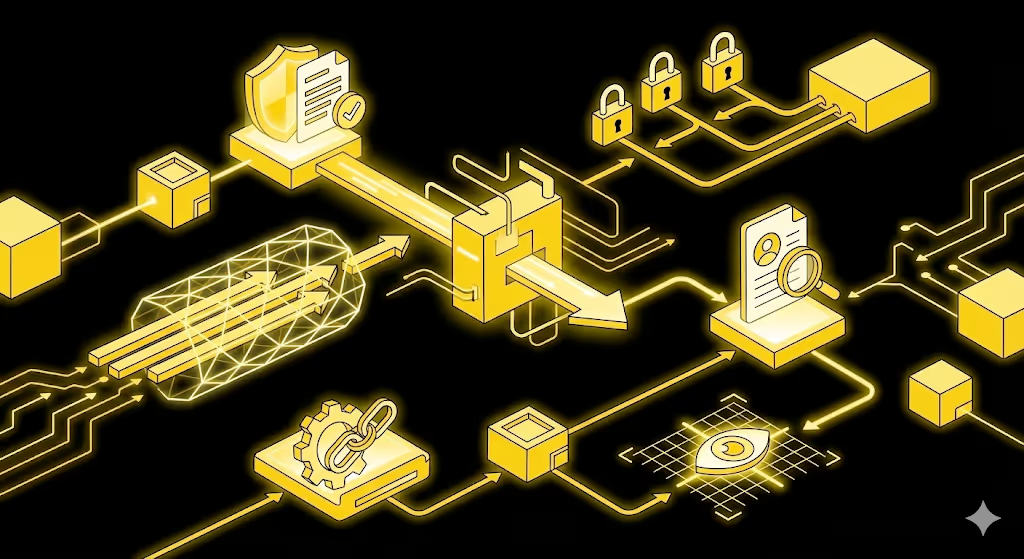
While the gateway handles the "hello," the Crypto Payment Processor handles the "settlement." This is the back-end infrastructure that manages the lifecycle of the funds after the customer hits send.
The processor’s responsibilities are significantly broader:
Blockchain Validation: It monitors the network to confirm the transaction has reached the required number of blocks.
Settlement & Conversion: This is the big one. If you invoiced for €1,000 but the customer paid in Bitcoin, the processor handles the conversion and ensures those funds are ready for your bank account.
Compliance (KYC/AML): It runs the necessary checks to ensure the transaction isn't linked to illicit activity—a non-negotiable for EU-based businesses under current regulations.
Payouts: It manages the transfer of funds from the crypto ecosystem into your corporate SEPA or SWIFT account.
Comparison at a Glance
Feature
Crypto Payment Gateway
Crypto Payment Processor
Primary Role
Front-end UI / Communication
Back-end settlement / Logistics
Focus
User Experience (UX)
Compliance & Fund Movement
Key Output
QR Codes, API Callbacks
Fiat Payouts, Tax Reporting
Analogy
The Card Reader on the counter
The Bank/Clearing House
Why the Distinction Matters for EU Businesses
In the European fintech market, precision is everything. If you only use a "gateway" without a robust processing layer, you might find yourself with a wallet full of crypto but no easy way to pay your local taxes or suppliers in fiat.
Conversely, a processor without a good gateway might provide great liquidity, but your customers will struggle with a clunky, manual checkout process that kills your conversion rate.
This is where integrated solutions come in. Platforms like INXY bridge this gap by functioning as a unified ecosystem. By combining an EU-licensed gateway (the part your customers see) with a powerful processing engine (the part your accountant loves), it removes the friction of managing two separate services.
Why "All-in-One" is the 2026 Standard
Modern fintech has moved past fragmented tools. For instance, INXY Payments focuses heavily on high-conversion gateways specifically for e-commerce, infrastructure and hosting providers. Because they operate as an EU-authorized VASP (Virtual Asset Service Provider), the processing side is built-in.
For a merchant, this means:
Zero Volatility: The rate is locked at the gateway level and settled instantly at the processor level.
Mass Payouts: You can collect payments via the gateway and immediately use those funds to pay global affiliates or remote teams via the processor’s API.
Legal Clarity: Since the processor handles the KYB (Know Your Business) and AML checks, the funds landing in your bank account are "clean" and fully documented for tax purposes.
Summary
A gateway gets you paid; a processor keeps you in business. While they serve different technical functions, the most successful companies in 2026 are those that don’t make their customers (or their dev teams) choose between the two.
By using an integrated platform like INXY, you get the best of both worlds: a checkout experience that converts and a back-end that settles without the headaches of traditional banking delays.
The world of payments is changing quickly, and crypto is leading the charge. As more people understand digital currencies, companies are eager to accept crypto payments. This shift is not just for tech giants; even small businesses are jumping on board. They see the benefits, like lower fees and faster transactions.
Consider a coffee shop that starts to accept crypto. They can attract tech-savvy customers who prefer using digital wallets over traditional money. There's also the appeal of stablecoins, which offer the stability of traditional currencies with the speed of crypto. These coins are less volatile, making them a safer choice for businesses.
In 2025 and 2026, more companies will likely join this trend. The rise of crypto payments is creating a new business landscape, where flexibility and innovation are key. As we move forward, this trend will reshape how we think about money and transactions.
Case Study 1: Tech Giant X
In 2025, Tech Giant X made a bold move by choosing to accept crypto payments. This decision came after noticing a rising trend in digital currencies. The company saw a chance to reach a broader audience, especially tech-savvy individuals keen on using cryptocurrencies.
At first, they focused on using Bitcoin and Ethereum, which were popular at the time. To manage the volatility of these currencies, they decided to use a stablecoin backed by real assets. This step ensured they kept financial stability while still embracing innovation.
The shift required some changes in their payment system. They partnered with a leading crypto payment processor to handle transactions smoothly. This partnership allowed them to offer a seamless shopping experience to users paying with crypto.
Tech Giant X's strategy paid off. They noticed an increase in sales among younger customers. The move also positioned them as a leader in the industry, inspiring other companies to explore cryptocurrencies.
Case Study 2: Retail Chain Y
Retail Chain Y, a well-known department store, made headlines in 2026 by deciding to accept crypto payments. This decision came after noticing a shift in customer preferences. More shoppers wanted to use digital currencies like Bitcoin and stablecoin. The management saw this as a chance to attract tech-savvy customers.
To make this happen, Retail Chain Y partnered with a blockchain payment provider. This allowed them to integrate crypto transactions easily. They set up user-friendly terminals at checkout points. Customers could now scan a QR code on their phones to pay with crypto.
The process was smooth and fast, making it popular among customers. This move not only boosted sales but also positioned the chain as a modern and innovative company. By accepting crypto, Retail Chain Y tapped into a growing market and won the loyalty of new customers.
Case Study 3: Food Delivery Service Z
In 2025, Food Delivery Service Z decided to accept crypto payments. This change was driven by the need to reach tech-savvy customers who value convenience and digital innovation. By accepting crypto, the company tapped into a growing customer segment that prefers using cryptocurrencies for everyday transactions.
To make the transition smooth, Service Z partnered with a crypto payment processor. This ensured transactions were quick and secure. Customers could pay using popular cryptocurrencies like Bitcoin and Ethereum, as well as stablecoins, which offer price stability.
Service Z’s decision to accept crypto also helped them stand out in the crowded food delivery market. They marketed this feature prominently, attracting more users who appreciated the flexibility and novelty of paying with digital currencies. This move not only boosted their customer base but also increased their brand visibility.
Case Study 4: Hosting Provider С
Instead of redesigning their whole billing system, the company added a stablecoin option through an external payment API. The goal wasn’t to replace their existing methods. They only wanted to give customers another way to pay without changing the rest of their workflow.
The technical setup was straightforward. Their team added a new payment route, tested a few transactions, and then made it available to users. Customers could now pay invoices in USDT or USDC. The hosting provider kept accounting in euros, which made reporting easier for their finance team.
A few patterns appeared after the first months:
A noticeable share of crypto users paid for 12 to 24 months upfront, far more than the typical card-paying customers.
Several new customers arrived who had never used the provider before, matching the trend that around 40% of crypto-paying users tend to be new to the merchant.
Some customers increased their spending slightly when crypto were available, which aligned with general industry data showing that crypto users often spend more when given the option.
The company also saw traffic from regions where card payments didn't always work well, and stablecoins offered a more reliable way to complete orders.
The change also highlighted an internal benefit: staff no longer had to manually track crypto receipts or confirm transaction hashes. The API returned all details in one place, which reduced back-and-forth during billing checks.
Hosting Provider Z did not run marketing campaigns around the new feature. They simply added it to their billing page. Still, it became a regular payment method for a specific segment of their clients — mostly developers who were already familiar with digital assets.
By the end of the year, the company concluded that stablecoin support didn’t transform their business, but it made payments smoother for a meaningful group of users. It also helped them understand how digital dollars fit into hosting, which gave them clearer ideas for future improvements
Case Study 5: E-commerce Platform B
In 2025, E-commerce Platform B made a bold move. They decided to accept crypto payments. This decision was not only innovative but also strategic. The world was moving towards digital currencies, and they wanted to be at the forefront.
The first step was to choose which cryptocurrencies to accept. They went with popular ones like Bitcoin and Ethereum. But they didn't stop there. They added stablecoins too. Stablecoins are digital currencies with a stable value, often linked to a currency like the US dollar. This way, they could offer their customers more options.
Next, they had to make sure their system could handle crypto payments. This wasn't simple. They needed to integrate a secure payment gateway. They partnered with a company specializing in crypto transactions. This ensured that all payments were safe and fast.
Training their staff was another important step. Many employees were new to cryptocurrencies. They needed to understand how to process these transactions. E-commerce Platform B held training sessions to teach them about different cryptocurrencies. They also learned how to deal with any issues that might arise during transactions.
Marketing played a vital role in this transition. They launched a campaign to inform customers about their new payment options. They used social media to reach a wider audience. The message was clear: customers could now pay with crypto.
The decision to accept crypto brought in new customers. Many people prefer using digital currencies for online shopping. E-commerce Platform B saw an increase in sales. Customers appreciated the variety of payment methods.
Accepting crypto payments also positioned them as a forward-thinking company. It showed they were ready to embrace new technology. This decision set them apart from competitors who were still wary of digital currencies.
E-commerce Platform B's journey was not without challenges. They faced technical issues and had to ensure compliance with regulations. But their determination paid off. By 2026, they were a leader in the e-commerce industry, thanks to their innovative approach to payments.
Case Study 6: Online Marketplace A
In 2025, Online Marketplace A, a well-known player in the e-commerce sector, decided to embrace cryptocurrency payments. This bold move aimed to attract tech-savvy consumers and stay ahead of the competition. With the growing interest in digital currencies, the marketplace saw an opportunity to expand its customer base.
To start, the company needed to choose which cryptocurrencies to accept. After thoughtful consideration, they opted for popular ones like Bitcoin and Ethereum, as well as stablecoins. Stablecoins, being less volatile, offered a more predictable value, making them appealing for both the company and its customers.
Integrating crypto payments required some technical upgrades. The company partnered with a payment processor specializing in digital currencies. This partnership ensured smooth transactions and reduced the risk of potential security issues. It was essential to make the payment system user-friendly, so customers could easily complete their purchases with crypto.
Online Marketplace A didn't stop at just accepting crypto payments. They launched a marketing campaign to promote this new feature. The campaign targeted tech enthusiasts and highlighted the benefits of using cryptocurrencies, such as lower transaction fees and increased privacy.
The results were impressive. Within months, the marketplace saw a surge in new customers, many of whom preferred crypto over traditional payment methods. Existing customers also expressed satisfaction with the added payment options, which improved their shopping experience.
This case shows how strategic planning and innovation can help companies adapt to changing market trends. By accepting crypto, Online Marketplace A not only attracted more customers but also positioned itself as a forward-thinking leader in the e-commerce industry.
Case Study 7: Nonprofit Organization D
In 2025, Nonprofit Organization D decided to accept crypto payments. Their goal was to reach a global audience and increase donations. Digital currencies provided a way to lower transaction fees and offer donors more options. By accepting crypto, they made it easier for people worldwide to contribute to their cause.
The organization started by exploring different cryptocurrencies. They chose to accept Bitcoin, Ethereum, and a stablecoin. Bitcoin and Ethereum were popular, while the stablecoin provided price stability. This combination allowed them to manage risk while offering flexibility to donors.
To integrate crypto payments, they partnered with a payment processor. This processor allowed them to convert crypto to local currency quickly. It was important to avoid the volatility of cryptocurrency markets. The conversion process ensured that funds remained stable and useful for their projects.
Nonprofit Organization D faced challenges in educating their team and donors. The team needed to understand how cryptocurrency works. They held training sessions to explain key concepts like wallets and blockchain. For donors, they created simple guides on how to donate using crypto. This helped remove confusion and encouraged more people to give.
The organization also highlighted the benefits of crypto donations. They promoted the transparency and security of blockchain technology. Donors appreciated the ability to track their contributions. This transparency built trust and strengthened relationships with supporters.
By accepting crypto, Nonprofit Organization D expanded their reach. They tapped into a new donor base interested in digital currencies. They also reduced overhead costs, allowing more funds to go directly to their programs. This case shows how nonprofits can benefit from embracing modern payment methods.
FAQ
Why are more companies starting to accept cryptocurrency payments?
Companies are increasingly accepting cryptocurrency due to its potential to attract tech-savvy customers, reduce transaction fees, and offer faster, borderless transactions. The growing popularity and acceptance of digital currencies among consumers also drive this trend.
What challenges did Tech Giant X face when integrating crypto payments?
Tech Giant X faced several challenges, including setting up secure and reliable crypto payment gateways, complying with regulatory requirements, and educating customers and staff about using cryptocurrencies.
How did Retail Chain Y's customers respond to the introduction of crypto payments?
Retail Chain Y saw a positive response from customers, with increased engagement and a boost in sales from crypto-enthusiastic consumers. However, they also encountered initial confusion, necessitating a targeted educational campaign.
What benefits did Food Delivery Service Z experience after adopting crypto payments?
Food Delivery Service Z benefited from faster transaction times and reduced payment processing costs. Additionally, the option to pay with crypto helped them attract a niche segment of tech-savvy customers, enhancing overall satisfaction.
How did accepting cryptocurrency impact Online Marketplace A's business operations?
Online Marketplace A experienced smoother international transactions and a reduction in fraud-related issues. The move also broadened their customer base by attracting users who prefer cryptocurrency for online shopping.
What was the effect of integrating stablecoins on E-commerce Platform B's sales?
E-commerce Platform B saw an increase in sales due to the stability and reliability of stablecoins, which appealed to customers wary of the volatility associated with other cryptocurrencies. This integration also simplified cross-border transactions.
How did Subscription Service C use crypto payments to increase customer retention?
Subscription Service C attracted a new demographic interested in paying with cryptocurrency, offering them exclusive benefits and promotions. This strategy not only improved retention rates but also expanded their subscriber base.
The Future of Global Commerce: Cross-Border Crypto Payments vs. Bank Transfers
The Future of Global Commerce: Crypto Payments vs. Traditional Banking The $190 trillion cross-border payment market is undergoing a systemic shift. While traditional SWIFT transfers remain the bedrock of trade, blockchain-based solutions are no longer just an alternative—they are a strategic imperative. Key Takeaways: Settlement Velocity: Moving from 3-5 business days to near-instant, 24/7/365 availability. Cost Optimization: Reducing transaction fees by 60% to 80% by removing intermediary "hops." Risk Mitigation: Eliminating chargeback fraud through blockchain immutability and transparent tracking. As we move toward a hybrid financial ecosystem, understanding these digital rails is essential for any global enterprise. Read our full analysis on how to future-proof your payment stack.
The global cross-border payment market is a staggering financial behemoth, moving approximately $190 trillion annually across the world's economies. For decades, this massive flow of capital has been heavily dominated by traditional financial institutions, operating on infrastructure originally designed in the pre-digital era. However, the legacy correspondent banking system is currently facing unprecedented, systemic disruption from blockchain technology and digital assets. As global commerce accelerates and borders become increasingly blurred in the digital age, the debate between Cross-Border Crypto Payments vs. Bank Transfers has become one of the most critical conversations in the fintech and crypto processing industry.
While traditional bank transfers remain the undisputed bedrock of global trade—largely due to their established regulatory frameworks, institutional trust, and systemic stability—crypto payments are rapidly gaining ground. Driven primarily by the rise of stablecoins and decentralized finance (DeFi) networks, these digital alternatives are emerging as a significantly faster, cheaper, and more inclusive alternative for businesses operating on an international scale.
For Chief Financial Officers, treasury managers, and e-commerce leaders, understanding the nuances of these two fundamentally different financial rails is no longer optional; it is a strategic business imperative. In this comprehensive, deep-dive guide, we will break down exactly how these two systems compare across key operational metrics, the roadblocks that remain, and how you can position your enterprise to leverage automated crypto processing for future growth.
Exploring the Great Divide: Cross-Border Crypto Payments vs. Bank Transfers
To truly understand the shifting paradigm in global finance, business leaders must look under the hood of how money actually moves across borders. The differences between legacy fiat rails and decentralized blockchain ledgers fundamentally alter how businesses manage cash flow, mitigate risk, and scale their operations globally. Let us examine the core operational differences.
1. The Mechanics of Speed and Settlement
Time is money, and in international trade, settlement delays can create cascading cash-flow bottlenecks that stifle growth, frustrate suppliers, and complicate supply chain management.
Traditional Bank Transfers: Traditional cross-border payments rely heavily on the SWIFT (Society for Worldwide Interbank Financial Telecommunication) messaging network and a highly complex "correspondent banking" model. Because it is logistically impossible for every bank in the world to hold direct, bilateral relationships with every other bank globally, a single international payment cannot simply travel from Point A to Point B. Instead, it often "hops" through multiple intermediary banks before reaching its final destination.
Timeframe: Because of these necessary intermediary hops, and the manual reconciliation required at each step, settlements typically take anywhere from 2 to 5 business days to clear.
Limitations: Traditional transactions are strictly bound by localized banking cut-off times, weekends, and regional bank holidays. If a company in London sends a payment to a supplier in Tokyo on a Friday afternoon, that payment will sit in limbo until the following Monday—or longer, if there is a local holiday. This creates highly unpredictable cash-flow gaps.
Crypto & Blockchain Payments: Blockchain networks operate on a fundamentally different, modern architecture: a decentralized, single-ledger system. This technology allows for direct, peer-to-peer (P2P) transfers that bypass traditional intermediary banks entirely.
Timeframe: Settlements on blockchain networks occur in a matter of seconds or minutes, regardless of the geographic distance between the sender and the receiver. For example, enterprise-grade networks like Ripple (XRP) or major fiat-backed stablecoins settle almost instantly.
Limitations (or lack thereof): Cryptocurrencies and blockchain networks operate 24/7/365. They do not sleep, they do not observe weekends, and they do not pause for national holidays. This effectively eliminates the delays caused by traditional operating hours, allowing businesses to execute just-in-time cross-border settlements.
Professional Takeaway: If your business relies on rapid inventory turnover or immediate supplier payments, integrating a crypto payment gateway to facilitate stablecoin settlements can drastically improve your working capital cycles.
2. Cost Efficiency and the Death of Intermediaries
Profit margins on international sales and B2B vendor payments are frequently eroded by the opaque and compounding costs associated with moving money across borders.
Traditional Bank Transfers: The multi-hop nature of correspondent banking means that each intermediary institution involved in the transfer process extracts its own toll. This can come in the form of a flat processing fee, an unfavorable foreign exchange (FX) spread, or a network messaging fee.
Impact: Transaction costs can be prohibitively high, especially for smaller retail payments, B2B micro-transactions, and remittances. According to recent data from the World Bank and the International Monetary Fund (IMF) [source: worldbank.org], high legacy banking fees remain one of the most significant barriers to global financial inclusion and frictionless international trade.
Crypto & Blockchain Payments: By systematically removing the middlemen from the transaction lifecycle, blockchain payments drastically reduce the costs associated with moving capital. The network validates the transaction programmatically, requiring only a small fraction of the fee traditionally charged by banks.
Impact: Comprehensive market research indicates that utilizing crypto or stablecoin rails can reduce cross-border transaction fees by a staggering 60% to 80%. This reduction is particularly transformative for the global remittance market and for small-to-medium enterprises (SMEs) that were previously priced out of efficient global trade due to prohibitive SWIFT fees. For businesses processing thousands of international transactions monthly, these savings directly, and heavily, impact the bottom line.
Professional Takeaway: Audit your current cross-border payment flows. Calculate the total annual cost of FX spreads and wire fees. For many e-commerce and SaaS platforms, migrating even 20% of cross-border volume to a crypto processing solution yields immediate, measurable ROI.
3. Security, Transparency, and Finality
How businesses track their funds in transit, and how they protect themselves from fraud, differs wildly between traditional banking and blockchain processing.
Traditional Bank Transfers: While the legacy banking system is highly secure, stringently regulated, and heavily insured, traditional transfers can be notoriously opaque for the end-user. Businesses often experience high levels of uncertainty regarding the exact status of a payment mid-transit. Furthermore, they frequently lack visibility into the final fees that will be deducted by intermediary banks before the funds arrive.
Additionally, traditional systems allow for chargebacks and settlement reversals. While designed to protect consumers, chargebacks pose significant administrative burdens and financial risks for online merchants who fall victim to "friendly fraud."
Crypto & Blockchain Payments: Blockchain ledgers are mathematically immutable. Once a transaction is algorithmically verified and recorded on the chain, it is permanent and cannot be altered, spoofed, or deleted.
Pros: This immutability provides total, unprecedented transparency. Anyone with the transaction hash can track the payment on the public ledger in real-time, eliminating the "where is my money?" anxiety. Furthermore, the irreversible nature of blockchain transactions entirely eliminates chargeback fraud—a massive relief for merchants, protecting businesses from unexpected revenue losses and malicious consumer behavior.
Cons: The absolute finality of the blockchain is a double-edged sword. If funds are mistakenly sent to the wrong wallet address due to human error, they are generally unrecoverable. Unlike a bank, there is no centralized customer service hotline to reverse an erroneous blockchain transaction.
Professional Takeaway: To mitigate the risk of lost funds via human error, utilize automated crypto payment gateways that generate dynamic, single-use QR codes and exact-amount payment links, removing the need for manual address entry by your clients.
Key Risks and Roadblocks to Mainstream Adoption
While crypto payments offer operational superiority in speed and cost, they face significant hurdles that prevent total mainstream displacement of traditional banking. A balanced fintech strategy must acknowledge and navigate these challenges.
1. The Volatility Dilemma Legacy cryptocurrencies like Bitcoin (BTC) or Ethereum (ETH) are highly speculative assets. A 10% price swing during a brief transaction window makes them highly impractical for standard corporate functions, such as payroll distribution or invoice settlements. This is exactly why the market is pivoting heavily toward stablecoins—digital assets pegged 1:1 to fiat currencies like the US Dollar, combining the technological speed of crypto with the economic stability of traditional money.
2. Regulatory Uncertainty & Compliance Protocols Traditional banks have spent decades building robust, globally recognized Anti-Money Laundering (AML) and Know Your Customer (KYC) compliance frameworks. The pseudonymous nature of foundational cryptocurrencies complicates these essential compliance measures. Inconsistent, fragmented regulatory frameworks across different global jurisdictions make enterprise-level adoption risky for heavily audited corporations. Processing platforms must provide built-in compliance tools to bridge this gap safely.
3. Wholesale Dominance and Institutional Inertia Traditional financial systems are purpose-built to safely handle massive, multi-billion-dollar wholesale transactions between sovereign nations and multinational conglomerates. Currently, crypto payments represent only a small fraction of total global volume, primarily capturing retail, SME, and remittance flows. Unseating a $190 trillion entrenched system takes time.
The Future: Convergence Over Replacement
The consensus among top economic researchers and fintech analysts is that blockchain will not immediately replace traditional bank transfers; rather, the two systems are destined to integrate. We are moving toward a hybrid financial ecosystem.
Major financial institutions are already adopting blockchain infrastructure to modernize their own rails. For instance, J.P. Morgan has developed its own blockchain networks to facilitate 24/7 cross-border settlements for institutional clients. Additionally, global authorities and central banks are heavily researching and piloting Central Bank Digital Currencies (CBDCs). These sovereign digital assets aim to combine the speed, transparency, and efficiency of blockchain technology with the absolute trust, stability, and regulatory backing of traditional fiat money.
The future of the fintech processing industry lies in interoperability—systems that allow a business to accept a payment in a stablecoin from a client in Brazil, and have it instantly settled as fiat in a corporate bank account in Europe, entirely seamlessly.
Automating Business Processes with INXY
Navigating the transition from legacy finance to digital assets doesn't have to be a logistical nightmare. To stay competitive, modern businesses need payment infrastructure that is as dynamic and global as their customer base.
At INXY, we understand that navigating the complexities of Cross-Border Crypto Payments vs. Bank Transfers requires robust, reliable, and secure technology. Our cutting-edge payment gateway solutions are designed specifically to help forward-thinking enterprises automate their business processes, effortlessly bridging the gap between traditional fiat banking and the emerging crypto economy.
Whether you are looking to eliminate exorbitant SWIFT fees, accept cross-border stablecoin payments with zero volatility risk, or implement comprehensive cross-domain tracking for your payment flows, INXY provides the enterprise-grade infrastructure to make it happen seamlessly.
Ready to modernize your financial stack and expand your global reach without the friction of traditional banking? Explore our comprehensive suite of payment gateway solutions atINXY.io and discover how we can tailor an automated crypto processing strategy for your specific business needs. Contact our integration team today to future-proof your payment operations.
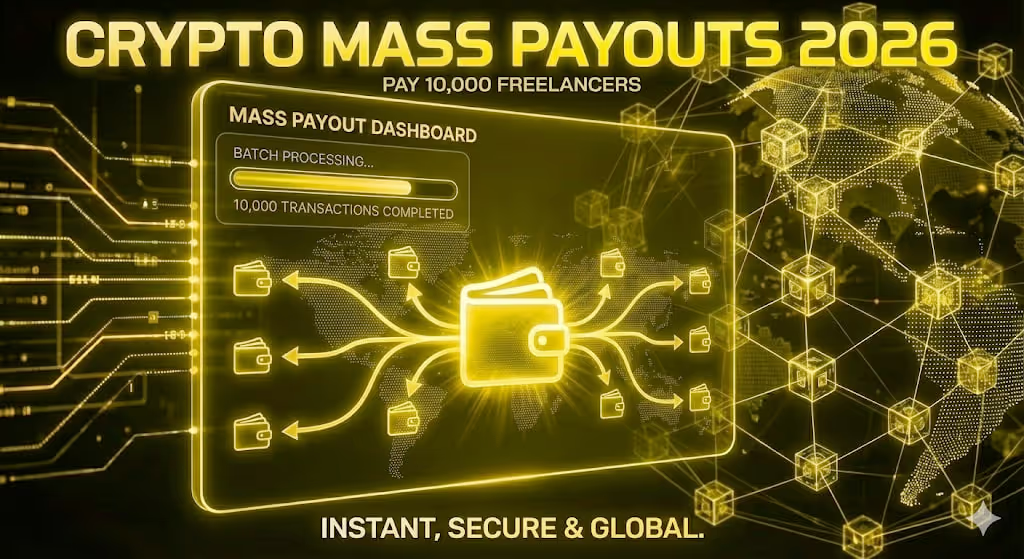
Crypto mass payouts in 2026 enable businesses to pay thousands of freelancers quickly and globally using stablecoins and automated blockchain infrastructure. This article explains how modern payout platforms abstract network complexity, handle compliance and accounting, and turn large-scale crypto payouts into a reliable, repeatable payment process.
Crypto mass payouts sound like a big, fancy term, but the basic idea is simple. Imagine you have a large list of freelancers, say 10,000, and you need to pay them. Doing this one by one would take a huge amount of time. That’s where crypto mass payouts come in. They allow businesses to send payments to a large group at once, instead of processing thousands of individual transfers.
At a high level, the process relies on blockchain technology. Blockchains like Bitcoin, Ethereum, TRON, and others act as shared public ledgers. Every transaction is recorded and can be verified, which makes the system transparent and hard to manipulate. This is one of the reasons crypto payments are trusted for global payouts.
However, while the concept of mass payouts is straightforward, execution becomes much more complex as volume grows. Paying 10 freelancers is one thing. Paying 10,000 introduces operational challenges that are easy to underestimate at first.
For businesses, crypto mass payouts can save time and reduce fees compared to traditional bank transfers, especially for international payments. A freelancer in another country might receive funds in minutes instead of waiting days for a wire transfer. Stablecoins like USDT and USDC are commonly used because they are tied to the US dollar, which helps avoid sharp price swings.
At the same time, real-world payout operations involve much more than just “sending crypto.” Network fees, compliance checks, reconciliation, and reporting all become part of the picture.
The Rise of Freelancing in 2026
Freelancing has taken the world by storm in 2026. What used to be a niche career path is now a mainstream way of working. More professionals are choosing flexible, remote work, and companies are increasingly comfortable hiring freelancers across borders.
Technology has played a major role in this shift. Platforms that connect freelancers with clients have matured, and global collaboration tools are now standard. Payment systems have also evolved, making it easier to send money across countries.
As freelancer volumes increase, payments turn into a scaling challenge. A system that works well for a few dozen payouts often breaks down when a company needs to pay hundreds or thousands of people on a regular basis. Delays, errors, or failed payments quickly impact trust and retention.
This is one reason why crypto and stablecoin payouts have gained traction. They offer speed and global reach, but only when supported by the right infrastructure.
Choosing the Right Crypto for Payouts
When deciding which cryptocurrency to use for mass payouts, several factors matter. Speed and transaction fees are important, which is why stablecoins such as USDT and USDC are popular choices. Their value remains relatively stable, making them suitable for salary-like payments.
Security and reliability are also critical. Businesses typically prefer assets and networks with a strong track record and wide adoption.
An often-overlooked factor is the blockchain network itself. USDT on TRON, USDT on Ethereum, and USDT on other networks may share the same name, but operationally they behave very differently. Each network has its own fee structure, speed, and technical requirements. Choosing the wrong network or mixing them up can lead to failed or lost payments.
As payout volumes grow, these differences become more important, not less.
Tech Solutions for Fast Payouts
In the fast-paced world of freelancing, getting paid quickly is a top priority. Blockchain technology makes this possible by allowing transactions to be processed directly between parties, without traditional banking intermediaries. This often results in faster settlement and lower fees.
Smart contracts can add another layer of automation by executing payments when predefined conditions are met. Crypto wallets store assets like USDT and USDC and allow recipients to receive funds from anywhere in the world.
That said, these tools alone are not enough for large-scale payouts. Wallets and smart contracts do not automatically handle gas fees, currency conversion, compliance checks, or accounting. Without additional systems, finance teams still end up doing a lot of manual work.
This is why modern payout platforms focus on orchestration rather than just transactions.
Step-by-Step Process for Mass Payouts
When companies first explore crypto mass payouts, they often follow a simple process. They collect wallet addresses from freelancers, prepare a payout list, and upload it as a CSV file to a payout tool. After reviewing the data, they initiate the transfer and notify recipients.
While this approach may work for small batches, it becomes risky and inefficient at scale. Each payout requires the correct wallet address, the correct blockchain network, and sufficient funds to cover transaction fees. With hundreds or thousands of rows, manual verification takes significant time and mistakes are hard to avoid.
Another major challenge is gas fees. Every blockchain requires transaction fees to be paid in its native token. For example, sending USDT on the TRON network requires TRX, while sending USDT on Ethereum requires ETH. This means businesses must constantly monitor and replenish balances of multiple native tokens just to keep payouts running.
Modern payout infrastructure solves this by abstracting gas management entirely. The platform ensures that all required native tokens are available behind the scenes, so businesses can execute payouts without worrying about blockchain-specific fee mechanics. From the user’s perspective, the process feels much closer to sending fiat payments.
At scale, this level of automation dramatically reduces both time spent and the risk of human error.
Automatic Conversion and Simplified Operations
Another important improvement in modern payout systems is automatic currency conversion. Freelancers and partners often prefer different payout assets. Some want USDT, others USDC, and some may request different networks.
Manually handling these preferences requires holding multiple crypto balances, performing frequent swaps, and tracking exchange rates. This adds complexity and exposes businesses to accounting challenges.
With modern platforms, companies can fund payouts in EUR or USD. Conversions happen automatically at the time of payout, using optimized rates, and recipients receive their preferred asset. The business does not need external exchange accounts or manual balance management.
As a result, crypto becomes almost invisible to internal teams.
Ensuring Security and Compliance
Handling large volumes of payouts requires strong security and compliance practices. Regulations vary by country, but AML and KYT requirements are now standard expectations, not optional extras.
Without automated screening, businesses risk sending funds to sanctioned or high-risk wallets. In real-world cases, this has led to frozen balances, blocked withdrawals, and strained banking relationships.
Modern payout platforms integrate compliance checks directly into the payout flow, ensuring that every transaction is screened before it is executed. This protects both the business and its partners.
Accounting and Reporting Without Disruption
One of the biggest concerns for finance teams is accounting. Tracking crypto movements manually can create reporting and tax complications, especially when exchange rates fluctuate.
Modern systems address this by providing fiat-denominated reporting, even when payouts are made in crypto. Finance teams can continue to work in EUR or USD, with clean, audit-ready reports that fit into existing accounting processes.
This allows companies to introduce crypto payouts without redesigning their entire financial workflow.
Support and Operational Reality
Crypto payouts often run outside standard business hours. Many providers offer support only during weekdays, which can be problematic when large payout batches are scheduled over weekends or holidays.
Live, responsive support during payout windows becomes a critical operational factor. When something goes wrong, delays of several hours can have a significant impact on trust and operations.
Future Trends in Crypto Payouts
Looking ahead, crypto mass payouts are becoming faster, more stable, and more automated. Stablecoins continue to gain popularity, and clearer regulations are helping businesses feel more confident adopting crypto-based payment rails.
One of the most important trends is abstraction. Businesses increasingly expect crypto payouts to behave like traditional payments: funded in fiat, delivered in the recipient’s chosen asset, and reported in fiat terms.
Platforms focused on infrastructure, such as INXY, reflect this shift by hiding blockchain complexity and allowing companies to scale payouts without increasing operational overhead.
Final Thoughts
Crypto mass payouts in 2026 are no longer about experimenting with blockchain. They are about running reliable, global payment operations.
When supported by proper automation, compliance, and reporting, paying 10,000 freelancers becomes a routine process rather than a source of stress. For businesses operating at scale, this is the real value of modern crypto payout infrastructure.
FAQ
What are crypto mass payouts and why are they important for businesses with large freelance workforces?
Crypto mass payouts are a method of disbursing payments to a large number of recipients simultaneously using cryptocurrencies. They are crucial for businesses with extensive freelance workforces because they offer speed, cost-efficiency, and global reach, which traditional banking systems may lack.
How has the rise of freelancing in 2026 affected payment systems?
The growth of the freelancing economy in 2026 has led to increased demand for flexible and efficient payment systems. This shift necessitates faster, more reliable ways to pay freelancers worldwide, driving the adoption of crypto mass payouts as a viable solution.
What cryptocurrencies are popular for mass payouts and what are their benefits?
Popular cryptocurrencies for mass payouts include USDT and USDC. These stablecoins are favored due to their price stability, which minimizes the risk of value fluctuations during transactions, making them an ideal choice for businesses and freelancers alike.
What technologies facilitate rapid crypto payouts to freelancers?
Innovative platforms and technologies, such as blockchain-based payment systems and smart contract automation, enable businesses to conduct rapid crypto payouts. These solutions streamline the payment process, reduce transaction times, and ensure transparency and accuracy in disbursements.
How can businesses execute mass payouts effectively within a tight timeframe?
To execute mass payouts efficiently, businesses should follow a step-by-step process: select a reliable crypto payment platform, integrate necessary APIs, prepare and verify recipient wallet addresses, choose the appropriate cryptocurrency, and initiate the payout using automated systems for accuracy and speed.
Why are security measures and compliance important in crypto payrolls?
Security measures and compliance are vital in crypto payrolls to protect sensitive financial data, prevent fraud, and adhere to legal regulations. Ensuring robust encryption, multi-factor authentication, and compliance with international financial laws helps maintain trust and reliability in crypto transactions.
What future trends in crypto payouts should businesses be aware of beyond 2026?
Beyond 2026, businesses should be prepared for trends such as the integration of AI in payment processes, increased regulatory scrutiny, and the rise of decentralized finance (DeFi) solutions. Staying informed and adaptable will allow businesses to leverage these trends for more efficient and secure payment systems.