
Blog
In this dedicated blog page, we invite you to explore a wealth of knowledge, expertise, and inspiration that transcends traditional boundaries.

INXY Raises $7M to Expand Cross-Border Payment Infrastructure
INXY has secured new funding to continue building its global payments platform. The total round reached $7M. The company focuses on stablecoin infrastructure for businesses. Its tools help companies accept crypto and send payouts while keeping accounting in fiat.
INXY has secured new funding to continue building its global payments platform. The total round reached $7M.
The company focuses on stablecoin infrastructure for businesses. Its tools help companies accept crypto and send payouts while keeping accounting in fiat.
This funding comes at a time when global payments are changing. Traditional rails are slow and expensive. Cross-border transfers often take days and include multiple intermediaries.
Stablecoins offer a different path. They move value quickly and directly. They reduce friction in international transactions. Many businesses are starting to explore this model.
INXY builds infrastructure for this shift. The goal is simple. Let companies use crypto without becoming crypto companies.
The platform supports mass payouts, payment acceptance, and automated conversion. Funds can be sent globally and settled in EUR or USD.
The company has already processed over $2B in annual stablecoin volume. This shows growing demand for alternative payment rails.
The new capital will be used to:
– Expand the payments infrastructure.
– Strengthen compliance and regulatory alignment.
– Grow the team and product capabilities.
Regulation is also shaping the market. In Europe, frameworks like MiCA are creating clearer rules for crypto services. This makes it easier for businesses to adopt compliant solutions.
INXY positions itself in this new environment as a regulated infrastructure provider. It operates under EU and Canadian frameworks and focuses on low-risk business use cases.
The company believes the future of payments will be stablecoin-based, compliant, and invisible to the end user.
The work ahead is not about hype. It is about making payments simple, reliable, and global.
Articles
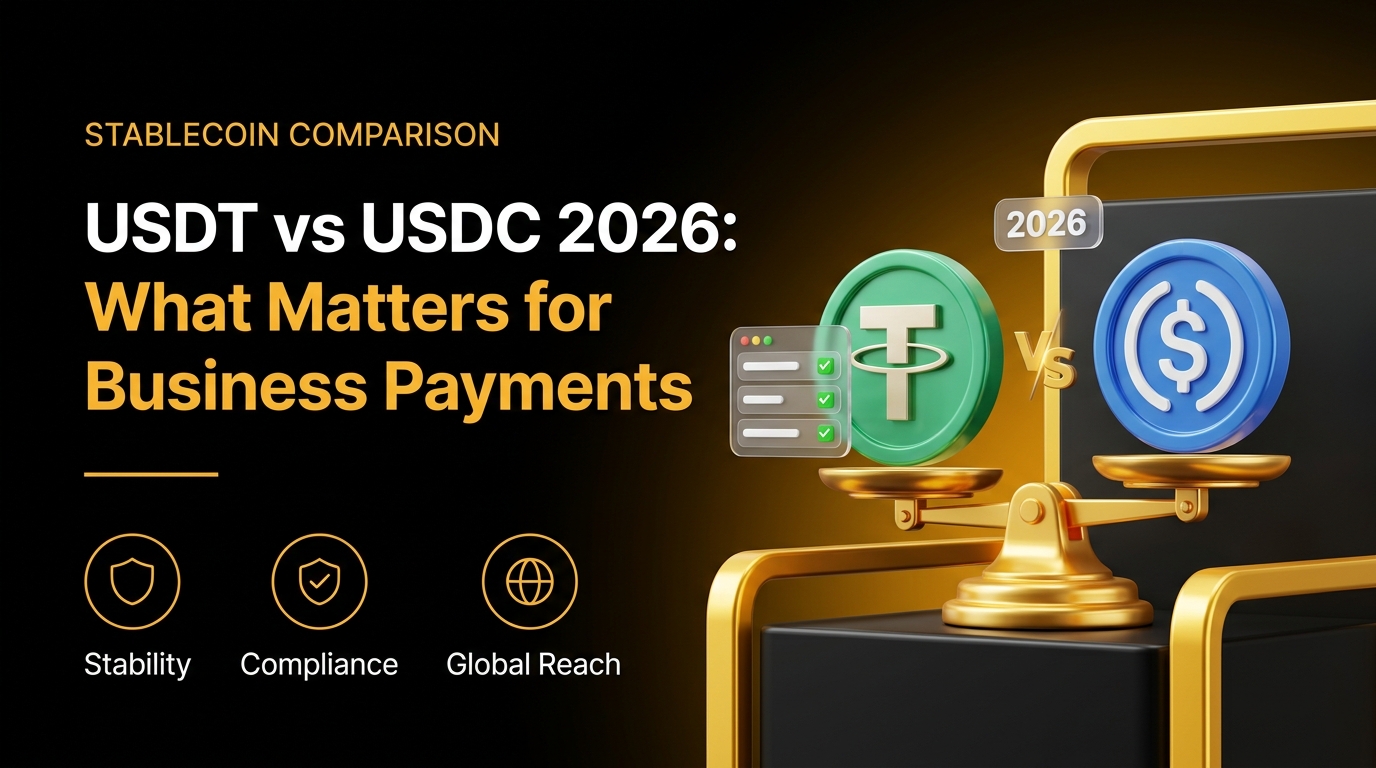
USDT vs USDC in 2026: What Matters for Business Payments
USDT vs USDC compared for finance teams deciding what to pay with, not what to hold. The article covers reserve backing, redemption routes, the 2022 and 2023 depeg events, MiCA status in the EU, and where each token is actually accepted, then sets out a six-step check and a decision framework for payout programmes.
Two tokens hold roughly 84% of the stablecoin market between them, and most comparisons of USDT vs USDC are written for someone deciding what to hold. This one is written for someone deciding what to pay with. The questions that matter for a finance team are different: what backs the token, how you get out of it at scale, what happened the last time each one broke its peg, and whether the counterparty on the other side of your invoice will actually accept it.
Where the two tokens stand, in numbers
As of 15 September 2026, USDT circulates at approximately $183.4 billion and USDC at approximately $74.3 billion, against a total stablecoin market of roughly $305.1 billion (DeFiLlama, 15 September 2026). Read that as market structure rather than a scoreboard: USDT is the liquidity layer of the non-Western crypto economy, and USDC is the regulated instrument of the Western one. For a payments business, that split is the entire story.
Both are dollar-denominated, both are redeemable at par from their issuers under stated conditions, and both move on the same networks. The differences that affect a payout programme are in the reserve, the redemption door, the regulatory status and the acceptance, in that order.
Understanding USDT
Tether's USDT is the oldest and by far the largest dollar stablecoin. It is issued by Tether and is available across most major networks, including Ethereum (ERC-20), Tron (TRC-20) and BNB Smart Chain (BEP-20), which is why network selection is a live operational decision rather than a detail. TRC-20, ERC-20 and BEP-20 network costs compared covers what each network actually costs to send.
Tether states that its tokens are backed 100% by its reserves and publishes attestation reports along with daily circulation figures on its transparency page. It publishes attestations rather than a full financial-statement audit of the reserve, and the distinction matters to a CFO: an attestation is a point-in-time examination against stated criteria, not a continuous audit opinion.
What a business should take from this: USDT's strength is liquidity and acceptance depth, particularly across Asia and LatAm, where it functions as a de facto settlement currency between counterparties whose banks do not talk to each other. Its weakness for an EU-facing business is regulatory status, covered below.
Understanding USDC
Circle's USDC is the regulated alternative. Its reserves are held primarily in the Circle Reserve Fund, an SEC-registered 2a-7 government money market fund managed by BlackRock holding cash, short-dated US Treasuries and overnight US Treasury repurchase agreements, with the remainder as bank deposits held mostly at the largest banks. Circle publishes monthly third-party assurance reports from a Big Four accounting firm, prepared under AICPA attestation standards, and states that Deloitte & Touche LLP has been its independent auditor since fiscal 2022 (circle.com/transparency, read 15 September 2026, showing composition as of 10 September 2026).
That structure is the practical difference. A 2a-7 money market fund has a published holdings schedule, a defined maturity profile and a regulator; a reserve disclosed only through a periodic attestation does not give a treasurer the same visibility into duration and counterparty concentration.
Reserve composition: what a treasurer actually asks
The question is not "is it backed." The question is backed by what, at what maturity, held with whom, and how quickly does it convert to cash under stress.
| Question | USDC | USDT |
|---|---|---|
| Primary reserve vehicle | Circle Reserve Fund: SEC-registered 2a-7 government money market fund managed by BlackRock | Reserves disclosed via Tether's own attestation reports |
| Disclosure cadence | Monthly third-party assurance, AICPA attestation standards | Periodic attestations; circulation published daily |
| Independent auditor of the issuer | Deloitte & Touche LLP (since fiscal 2022) | Attestation provider named in each report |
| Visibility into holdings | Fund-level holdings schedule and maturity profile | Category-level breakdown in the attestation |
| Bank-deposit concentration | Disclosed as deposits at large institutions | Disclosed in the attestation |
Honest limitation: we have not restated Tether's reserve percentages here because we could not read them from Tether's own primary disclosure at the time of writing. Do not take a reserve breakdown for either token from a blog, including this one. Read the latest attestation on the issuer's transparency page before you make a treasury decision, because the composition changes every quarter.
Redemption mechanics: the door you leave through
Holding a stablecoin is easy. Converting several million dollars of it back to bank money on a specific date is where the difference shows up, and almost no comparison article covers it.
Tether's terms state that redemption is at one unit of the pegged fiat currency per token, less fees where applicable, paid to a bank account in your own name; that you must be a verified customer of Tether to redeem directly; that redemptions are subject to minimum redemption amounts and other requirements; that fees are set out in a separate Fee Schedule updated from time to time; and that Tether may delay or suspend access to purchases and redemptions in defined circumstances (Tether terms of service, read 15 September 2026).
Circle operates direct minting and redemption for business customers through Circle Mint, alongside the monthly attestation regime described above. Circle publishes its redemption structure in its own help documentation; the settlement tiers and any associated fees should be read there directly rather than taken second-hand. We could not retrieve the current figures at the time of writing and will not guess them.
The operational point is the same for both: direct redemption with the issuer requires an onboarded relationship, and most businesses never build one. They redeem through an exchange, an OTC desk or a payment provider, which means the price they actually get is the provider's spread, not the issuer's par. When you model your off-ramp cost, model the route you will really use.
Depeg history: what actually happened, and what it cost
Both tokens have traded away from a dollar. Neither event was a failure of backing, and both are instructive about where the risk actually sits.
USDT, 12 May 2022. During the Terra collapse USDT traded down to approximately $0.945 on exchanges as the market tested whether the reserve could absorb a redemption wave. It recovered the same day; the deviation lasted under 24 hours, and Tether processed billions in redemptions across that week.
USDC, 10–13 March 2023. Circle disclosed that $3.3 billion of USDC reserves, roughly 8% of backing, were held at Silicon Valley Bank when the bank failed. USDC traded to approximately $0.87 and remained off par for around three days across a weekend, recovering after the US deposit guarantee was announced (CoinDesk and CNN Business, 11 March 2023; S&P Global, Stablecoins: A Deep Dive into Valuation and Depegging, 2023).
The insight that matters operationally: the larger and longer depeg happened to the more transparent, more regulated token, and it was caused by ordinary banking counterparty risk, not by anything crypto-specific. Transparency told the market exactly how bad it was, quickly, which is precisely why it repriced so sharply. Regulatory status is not a peg guarantee. Anyone selling it as one is selling something else.
What this means for a payout programme: your exposure window is the time value spends in the token, not the token itself. A payout batch that funds in EUR, converts, settles on-chain and delivers within the same day carries minutes of exposure. A treasury that parks a float in stablecoins for three weeks carries three weeks of it. The rail is not the risk; the holding period is.
Which one to hold for a payout float
This is the question finance teams actually have, and it has a structural answer rather than a preference.
Hold the token your obligations are denominated in, for the shortest period that operationally works. If you pay 3,000 affiliates in USDT because that is what they accept, holding USDC as your float means you carry a conversion leg and its spread on every batch. If your counterparties are EEA-facing businesses invoicing in euro, the conversion you are optimising is a different one entirely; see EURC explained for business payments.
Three practical rules:
- Minimise the holding period before you optimise the token. Float duration dominates token choice in every risk model we have run in practice.
- Do not hold a float in a token your off-ramp route prices badly. The spread you pay to exit is a real, recurring cost; the peg risk is an occasional one.
- Split rather than choose, if your payee base is split. Running both USDT and USDC is normal for payout programmes covering both Asia/LatAm and the EEA. The cost of running two is lower than the cost of forcing every payee onto one.
And the honest limit: if your payout float is large enough that the choice of stablecoin materially changes your risk position, the correct answer is probably to hold less float, not to pick a better token. Pre-funding requirements are a working-capital cost that most providers never quote.
The regulatory divergence in the EU
Under Regulation (EU) 2023/1114 (MiCA), the provisions governing asset-referenced tokens and e-money tokens became applicable on 30 June 2024. Issuers of e-money tokens offered in the EU must be authorised, and authorised issuers appear in ESMA's public register.
Circle's USDC and EURC are among the authorised e-money tokens in that register. Tether's USDT is not: Tether has not been authorised as an e-money token issuer in the EU (ESMA register of e-money token issuers and white papers, checked 11 September 2026). The consequence is that regulated EEA trading venues and service providers have removed or restricted USDT for EEA users, and a compliant EU-facing business generally cannot treat USDT as a routine settlement instrument with regulated EU counterparties.
This is a distributional fact, not a judgement about either token's backing. It reshapes acceptance rather than safety.
This article describes regulatory and market conditions for general information. It is not legal, tax, or financial advice. INXY Payments is a payment infrastructure provider, not a law or accountancy firm, and decisions with regulatory consequence should be reviewed by qualified counsel in the relevant jurisdiction.
Where each one is actually accepted
Acceptance, not backing, is what determines whether a payment completes. Both tokens are among INXY's supported cryptocurrencies, and the right default depends on who is on the other side of the payment.
| Counterparty type | Practical default | Why |
|---|---|---|
| Affiliates, media buyers and contractors in Asia and LatAm | USDT, usually TRC-20 | Deepest local liquidity and the widest informal acceptance; local off-ramps quote it best |
| EEA-regulated businesses and PSPs | USDC | Authorised as an e-money token under MiCA; USDT is restricted on regulated EEA venues |
| Euro-denominated EEA invoicing | EURC | Removes the EUR/USD conversion leg entirely |
| Gaming, iGaming and ad-network payees | Mixed; USDT dominant, USDC growing | Follow the payee base, not the treasury preference |
| Exchange and OTC settlement | USDT by depth, USDC by regulatory fit | The venue's own restrictions usually decide |
The pattern is consistent: USDT wins on reach, USDC wins on regulatory fit, and most payout programmes of any size end up running both. If your payees are split across both worlds, the mass payout mechanics are set out in mass payout in USDT and mass payout in USDC.
A six-step check before you settle in either token
Most teams pick a stablecoin and discover the constraints afterwards. Run this sequence first; it takes an afternoon.
- Pull your payee list and segment it by jurisdiction and counterparty type. Split EEA-regulated counterparties from everyone else. That single line usually decides more than any reserve analysis, because it determines which token your counterparties are permitted to accept.
- Confirm token and network per payee, in writing, before the first batch. Not "USDT" but "USDT on TRC-20, at this address." Free-text address entry with an implied network is the most common unrecoverable error in stablecoin payouts, and it is a data-collection problem, not a technology problem.
- Price your exit before you price your entry. For each token, get a real quote on the route you will actually use to convert back to bank money (your provider, your OTC desk, your exchange) at the size you will actually convert. The issuer's par redemption is irrelevant if you are never going to use it.
- Read the current attestation yourself. Both issuers publish to their own transparency pages, and the composition changes every reporting period. Check the reserve vehicle, the maturity profile and the bank-deposit concentration: the same three things you would check on any counterparty holding your cash.
- Define the maximum float and the maximum holding period as policy, not as practice. Write down how much value may sit in stablecoin and for how long, and have the payout system enforce it. Exposure that nobody owns is exposure that grows quietly until a treasury review finds it.
- Run a small live batch per token and per network, including a deliberate failure, and hand the settlement export to whoever closes your books. If the export does not carry the FX rate and fee per row, the reconciliation cost will exceed whatever you saved on the token decision.
Step three is the one teams skip, and it is the one that costs money every month rather than once.
What breaks in practice
Assuming the payee's preference matches yours. The most common cause of a failed stablecoin payout is not the token; it is sending a token or a network the payee's own off-ramp does not support. Collect and confirm both, per payee, before the first batch.
Treating "regulated" as "won't depeg." March 2023 settled that. Regulatory status changes where you can use a token and who will accept it; it does not remove counterparty risk from the reserve's bank.
Holding float in the wrong token for your off-ramp. The spread on the leg you did not plan for is a recurring cost that never appears in the provider's pricing page.
Forgetting that the network is a separate decision. USDT on ERC-20 and USDT on TRC-20 are the same token with materially different cost and settlement characteristics, and a payee address on the wrong network is an unrecoverable error.
The decision, plainly stated
Do not choose between USDT and USDC as if it were a portfolio decision. It is a distribution decision. Start from your payee list and your counterparties' constraints, pick the token each of them can actually receive and exit, and then minimise how long you hold either one. If your payees are in Asia and LatAm, that is USDT and you should optimise the network. If your counterparties are EEA-regulated, that is USDC and the MiCA register is why. If they are both, run both and treat the conversion leg as a line item you manage rather than a problem you solve once.
INXY Payments settles in 20 supported cryptocurrencies across ERC-20, TRC-20, BEP-20, Polygon, Tron, TON, Bitcoin, Litecoin and DAI, converts to fiat automatically so your accounting never leaves EUR or USD, and runs Travel Rule and AML screening as part of the flow. If you want to see which token and network your own payee list actually resolves to, book a demo with the list in hand. That conversation takes twenty minutes and usually changes somebody's assumption.
FAQ
Is USDT or USDC safer for business payments?
They carry different risks. USDC offers more visibility, with monthly third-party assurance and a 2a-7 money market fund reserve, while USDT offers deeper liquidity and wider acceptance. The larger historical depeg happened to USDC, caused by bank counterparty risk. For payments, exposure is driven mainly by how long you hold either token, not by which one you choose.
Why is USDT restricted in the EU?
Under Regulation (EU) 2023/1114 (MiCA), issuers of e-money tokens offered in the EU must be authorised and appear in ESMA's public register. Tether has not been authorised as an e-money token issuer, so USDT does not appear in that register, and regulated EEA venues have restricted or removed it for EEA users.
Which stablecoin should we use to pay contractors?
Use the one your contractors can actually receive and convert locally. In most of Asia and LatAm that is USDT, commonly on TRC-20. For EEA-facing counterparties it is USDC, and for euro-denominated invoicing, EURC removes the conversion leg. Confirm token and network per payee before the first batch.
Has USDC ever lost its peg?
Yes. Between 10 and 13 March 2023, USDC traded to approximately $0.87 after Circle disclosed that $3.3 billion of reserves, around 8% of backing, sat at Silicon Valley Bank. It returned to par after the US deposit guarantee was announced. The cause was ordinary banking counterparty risk, not a flaw in the token's design.
Can we redeem USDT or USDC directly with the issuer?
Both issuers support direct redemption for onboarded, verified customers, subject to their own minimums, fees and terms. Most businesses never build that relationship and instead exit through an exchange, OTC desk or payment provider, which means the effective rate is that provider's spread. Model the route you will actually use.
Should we hold a stablecoin float for payouts?
Only as much as your payout cycle genuinely requires. Float duration is the dominant variable in stablecoin exposure, ahead of token choice. A same-day fund-convert-settle cycle carries minutes of exposure; a multi-week treasury float carries weeks. Pre-funding requirements are also a working-capital cost that providers rarely quote.

What is a Stablecoin? Complete Beginner’s Guide 2025
A beginner-friendly guide to stablecoins in 2025. Learn what stablecoins are, how they work, their main types, benefits, risks, and how to buy, store, and use them safely — plus a look at their future in digital finance
Stablecoins are one of the fastest-growing parts of the crypto market. In the last year alone, stablecoins processed tens of trillions of dollars in payments and moved value across borders faster than traditional bank rails. This guide explains what stablecoins are, how they work, and why more people and businesses are using them in 2025.
Understanding Stablecoins
Stablecoins are a type of cryptocurrency designed to maintain a stable value. Unlike other cryptocurrencies, whose prices can be unpredictable, stablecoins aim to stay consistent. They are often tied to real-world assets like the US dollar, gold, or even other cryptocurrencies.
Common examples are Tether (USDT), USD Coin (USDC), and DAI. All of them aim to keep a value close to 1 US dollar.This means 1 USDT should always equal 1 USD. People use stablecoins to avoid the wild swings of the crypto market while still enjoying the benefits of digital currency.
Stablecoins can be classified into three main types: fiat-collateralized, crypto-collateralized, and algorithmic. Fiat-collateralized stablecoins hold reserves in traditional currency. Crypto-collateralized ones use other cryptocurrencies as backing. Algorithmic stablecoins rely on smart contracts to manage supply and demand.
Stablecoins offer a bridge between the traditional financial world and the new age of digital currency, providing stability and trust. They're used for trading, payments, and as a store of value, making them popular among both crypto enthusiasts and businesses. People use stablecoins to send money abroad, pay freelancers, move funds between exchanges, or simply sit in “digital dollars” during volatile markets.

Types of Stablecoins
Stablecoins come in various forms, each with its own way of maintaining value. One type is fiat-collateralized stablecoins. These are backed by traditional currencies like the US dollar. For example, Tether (USDT) is a well-known fiat-backed stablecoin. You deposit one dollar into a bank, and you get one digital token.
Then, there are crypto-collateralized stablecoins. Instead of using traditional money, they use other cryptocurrencies as reserves. A popular example here is DAI, which is backed by Ethereum. It's a bit more complex, but it offers greater transparency through smart contracts.
Finally, we have algorithmic stablecoins. These don't use collateral. Instead, they rely on algorithms to control the supply of the coin, similar to how central banks manage currencies. If the price goes up, the system releases more coins to lower the price. If it drops, coins are taken out of circulation to raise it. This method is innovative but can be risky.
How Stablecoins Work
Stablecoins are a type of cryptocurrency designed to keep their value stable. Unlike other cryptocurrencies, which can have wild price swings, stablecoins aim to stay around a fixed value. This stability often comes from linking the stablecoin to a real-world asset like the US dollar.
One common method is to hold reserves. For example, if a stablecoin is tied to the dollar, the issuer might keep one dollar in reserve for every stablecoin issued. This ensures that users can exchange stablecoins for real dollars at any time.
Another method involves using algorithms to manage supply. If demand for the stablecoin rises, the system may release more coins to keep the price steady. If demand falls, it might buy back coins to maintain balance.
These strategies help stablecoins stay steady, making them useful for trading, accepting payments, or cashing out without worrying about losing value.
Benefits of Using Stablecoins
Stablecoins have gained popularity for several reasons. One major advantage is their price stability. Traditional cryptocurrencies like Bitcoin and Ethereum can have wild price swings, making them less reliable for day-to-day transactions. In contrast, stablecoins are usually tied to stable assets like the US dollar, ensuring their value remains relatively constant.
Another benefit is the ease of international transactions. If you need to send money across borders, stablecoins can be a faster and cheaper alternative to traditional bank transfers. They don't require high fees and middlemen, making the process more efficient.
Stablecoins also provide a way to enter the crypto market without the risk of losing value quickly. For those new to crypto, they offer a stepping stone, allowing you to participate in the digital economy without the stress of market fluctuations. Plus, businesses can accept stablecoins as payment, knowing their value won't drop overnight.
Stablecoins are also helpful in places where banks do not work well or many people do not have bank accounts. A phone and a simple wallet app are often enough to receive stablecoins, which makes them useful in many emerging markets.
Lastly, stablecoins can be easily exchanged for other cryptocurrencies or even cashed out to traditional money. This flexibility makes them a practical choice for both consumers and businesses looking to explore digital currencies with minimal risk.

How to Buy Stablecoins
Buying stablecoins can seem tricky at first, but it’s pretty simple once you break it down. First, you need a crypto wallet. This is a digital tool to store, send, and receive stablecoins. You can find many wallets online, so pick one that suits your needs.
Next, choose a crypto exchange. This is a platform where you can buy and sell stablecoins. Popular exchanges are user-friendly, making it easy to trade. Once you pick an exchange, create an account and verify your identity.
Now, you’re ready to buy. Deposit money into your exchange account. Then, search for the stablecoin you want and make a purchase. You can buy with cash, or exchange other cryptocurrencies. After buying, transfer the stablecoins to your wallet for safekeeping. This ensures your coins are secure and easy to access when you need them.
You do not always need to buy stablecoins directly. Some people earn them by doing freelance work, selling online services, or getting paid by friends and family abroad.
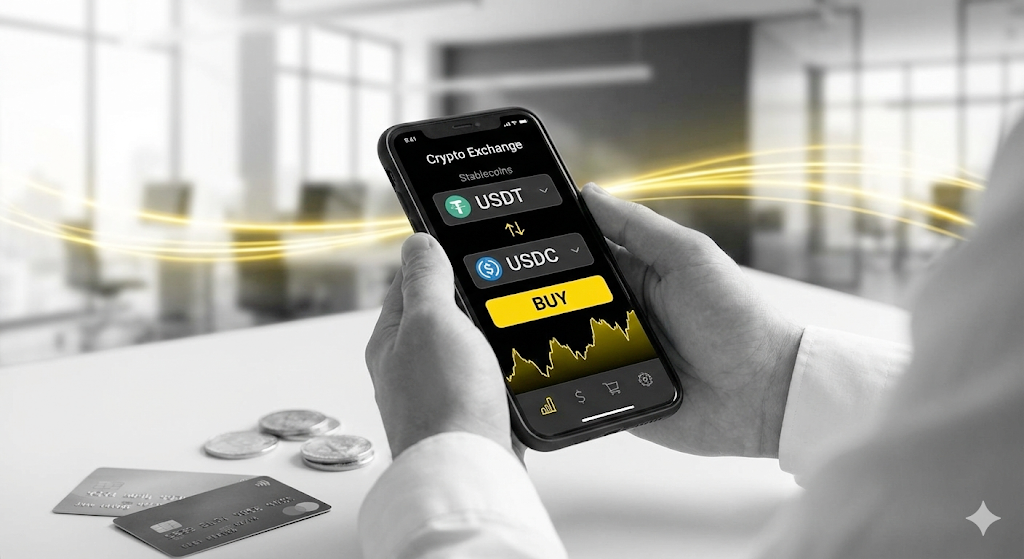
Exchanging Stablecoins for Cash
When you want to turn your stablecoins into cash, it's not as tricky as it may sound. First, you'll need to find a crypto exchange that accepts stablecoins. Many big exchanges do, like Binance or Coinbase. Once you're signed up, you can transfer your stablecoins to the exchange. It’s a bit like moving money from one bank to another.
After your stablecoins are on the exchange, you can find the option to cash out. This usually involves choosing a fiat currency like USD or EUR, and then selling your stablecoins for that currency. The exchange does the math and shows you how much money you'll receive.
Next, you need to decide how to receive your cash. Most exchanges offer a few ways: you can transfer it straight to your bank account, use a debit card linked to the exchange, or sometimes even get a physical check. Each method may have different fees, so it's wise to check those before you decide.
Lastly, be aware of the time it takes for the money to reach you. Some methods are quick, while others might take a few days. The speed often depends on your bank or the exchange. So, it's good to plan ahead, especially if you need the cash soon.
In some countries, people also use peer-to-peer (P2P) platforms or local fintech apps to swap stablecoins for local money.
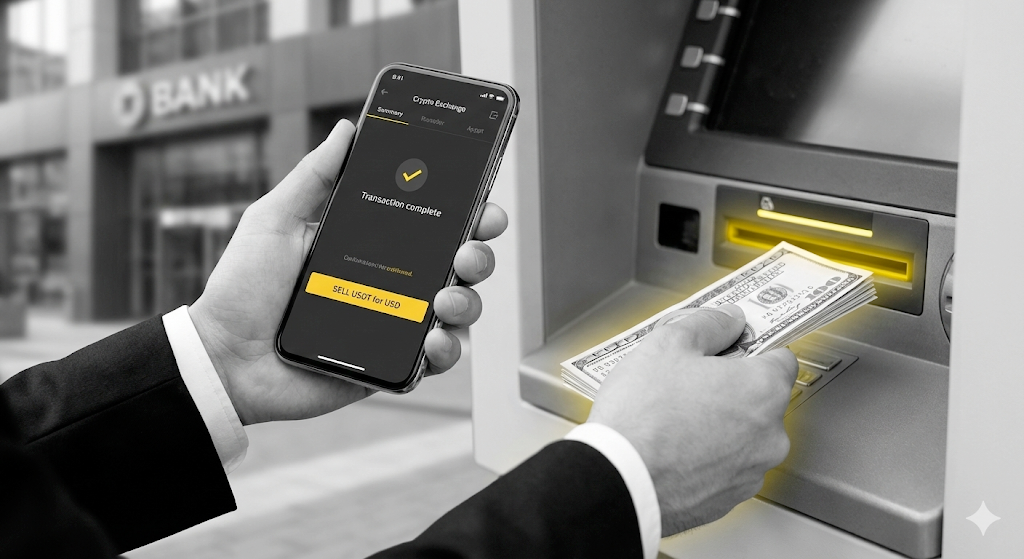
Storing Stablecoins Safely
When it comes to keeping your stablecoins, safety is key. Let's break it down into simple steps. First, think about where you want to store them. A crypto wallet is your go-to option. There are two main types: hot wallets and cold wallets.
Hot wallets are online. They are easy to access, making them perfect for frequent transactions. If you often exchange or accept crypto, this might be your choice. But, online wallets can be more vulnerable to hacks.
Cold wallets, on the other hand, are offline. They're like a digital vault, keeping your coins away from the internet. This makes them safer from online threats. If you're planning to hold onto your stablecoins for a while, this is a solid option.
Now, let's talk about setting up a wallet. It's not as hard as it sounds! Most wallets come with user-friendly apps. You download the app, create an account, and you're set. You'll receive a private key, a kind of password, which is crucial. Keep it safe and never share it.
Another way to secure your coins is by using two-factor authentication. This adds an extra layer of security. Even if someone gets your password, they can't access your wallet without the second factor.
Choosing a reliable wallet provider is important, too. Look for reviews and ensure the provider has a good track record. Some popular options include Ledger, Trezor, and Coinbase.
You should also back up your wallet. Most wallets allow you to do this through a recovery phrase. Write it down and store it in a safe place. If you lose access to your wallet, this phrase can help you get back in.
Lastly, stay informed. The crypto world changes fast. New security features and threats can emerge. Keep an eye on updates from your wallet provider and the stablecoin community.
By following these steps, you can store your stablecoins safely and with confidence.
Stablecoins vs. Traditional Cryptocurrencies
When we talk about stablecoins and traditional cryptocurrencies, it's like comparing apples and oranges. Both are fruits, but they taste different. Stablecoins are designed to keep their value steady, usually tied to a stable asset like the US dollar. This makes them less wild in terms of price swings. On the flip side, traditional cryptocurrencies, like Bitcoin, are known for their roller-coaster prices, which can go up or down sharply in a short time.
Stablecoins are great when you want to avoid the crazy ups and downs of traditional crypto. Think of them as a safe harbor in a stormy sea. They give you a way to hold digital assets without worrying about losing value overnight. This stability is why some people prefer them for daily transactions or saving.
Traditional cryptocurrencies can be exciting for those who enjoy high-risk, high-reward scenarios. If you buy a cryptocurrency like Bitcoin at the right time, you could make a lot of money. But, you could also lose a lot if the value drops. This unpredictability makes them less appealing for regular transactions but more attractive for investment.
Both types of digital assets have their uses. Stablecoins are often used for things like remittances or when users want to cash out of a volatile market without going back to regular money. Traditional cryptocurrencies are used for things like long-term investments or when someone wants to participate in a decentralized financial system.
It's important to choose the right one based on your needs. If you want stability and predictability, stablecoins are a good choice. If you are looking for potential big gains and can handle the risk, traditional cryptocurrencies might be more your style.
The Future of Stablecoins
The future of stablecoins looks promising yet complex. As we step into 2025, stablecoins are playing a bigger role in the financial world. More businesses are starting to accept them as payment. This trend is likely to continue, making stablecoins a significant part of global trade. Stablecoins are unique because they combine the benefits of cryptocurrency with the stability of traditional money. They are not as volatile as other cryptocurrencies, which makes them attractive for everyday transactions.
Governments around the world are also paying attention to stablecoins. Some are considering creating their own versions, often called Central Bank Digital Currencies (CBDCs). These digital currencies could change how we use money. For instance, they might make international payments faster and cheaper. While this is an exciting development, it also brings challenges. Governments must ensure these digital currencies are secure and private.
Technology is another important factor shaping the future of stablecoins. Innovations in blockchain technology can make stablecoins more efficient and secure. For example, improvements in smart contracts might automate many financial processes. This could reduce the need for intermediaries, like banks, in certain transactions. However, these technological advancements also require careful management. Developers must ensure these systems are safe from hacking and other threats.
There are also social aspects to consider. As more people use stablecoins, they might change how we think about money. Younger generations, who are more comfortable with digital technology, may adopt stablecoins more quickly. This could lead to a shift away from traditional cash. Yet, not everyone has access to the internet or digital devices. This digital divide could create inequality if stablecoins become too widespread.
Lastly, the regulatory landscape for stablecoins is still evolving. Different countries have different rules, which can create confusion. Clear and consistent regulations are essential for stablecoins to thrive. These rules can help protect users and ensure the financial system remains stable.
New rules like the European Union’s MiCA framework, and similar proposals in other regions, aim to make sure stablecoins are properly backed, audited, and safe for everyday use.
As we navigate these changes, it's clear that stablecoins will continue to develop. How we adapt to these changes will determine the role stablecoins play in our everyday lives.
Risks Associated with Stablecoins
Stablecoins may seem like the safer side of crypto, but they come with their own risks. One major concern is regulatory risk. Governments around the world are still figuring out how to regulate these digital currencies. This means rules can change quickly, affecting the value and legality of stablecoins.
Another risk is the trust in the issuer. Stablecoins are usually backed by assets like dollars or gold. But if the issuer doesn't actually hold enough assets, the stablecoin might not be as stable as it seems. It's important to check if an issuer undergoes regular audits to verify their reserves.
Technology risk is also significant. Stablecoins rely on blockchain technology, which can have vulnerabilities. Hackers could exploit these to steal funds. While security measures improve over time, no system is completely safe.
There is also platform risk. If you keep stablecoins on an exchange or lending platform and that company fails or gets hacked, you can lose access to your funds even if the stablecoin itself still works.
Market risk is another factor to consider. Even if a stablecoin is backed by a strong asset, the market value of that asset can fluctuate. For example, if a stablecoin is pegged to the dollar, and the dollar's value drops, the stablecoin could lose value as well.
Finally, there's the risk of liquidity. In times of financial stress, there might not be enough buyers for the stablecoin. This can make it hard to exchange or cash out quickly. Always evaluate if a stablecoin has ample liquidity before investing.
Understanding these risks can help you make better decisions about using or investing in stablecoins. Being aware of potential pitfalls helps in navigating the world of crypto with more confidence.
Conclusion: Embracing Stablecoins
Stablecoins are becoming more important in the world of digital money. They offer a mix of the best things about traditional currency and cryptocurrencies. These coins are designed to keep a stable value. This makes them less risky than other cryptocurrencies like Bitcoin, which can change in value a lot.
Stablecoins are tied to something stable, often the US dollar or a similar asset. This link helps them keep their value steady. Stablecoins can be used for many things. You can use them to buy things, send money to friends, or even save money. They make it easy to trade goods and services without worrying about the value going up or down too much.
If you want to start using stablecoins, first you need a digital wallet. Many online platforms let you create one quickly. Once you have a wallet, you can buy stablecoins with your regular money. You can also exchange them with other cryptocurrencies. When you want to use your stablecoins, you can send them to someone else or cash them out to your bank account.
Stablecoins can be accepted by many online stores and businesses. Some people use them to pay for everyday things, like groceries or bills. Others might use them for bigger purchases, like electronics or travel. The flexibility of stablecoins makes them appealing to many people, especially those who regularly use digital money.
Stablecoins also have a role in the world of finance. They are often used in lending and borrowing. Some people use them to earn interest, similar to a savings account. Others might take loans in stablecoins, knowing the value won't change too much. This stability is one of the main reasons stablecoins are trusted by many.
As the popularity of stablecoins grows, more people and businesses will likely start accepting them. This trend could lead to a future where stablecoins become a common part of everyday life. They offer a bridge between traditional money and the digital world, making financial transactions easier and more secure.
They are also useful in places where banking is weak. A simple mobile phone is enough to receive stablecoins, so people in emerging markets can get paid or send money online even without a bank account.
FAQ
What exactly is a stablecoin?
A stablecoin is a type of cryptocurrency designed to have a stable value, often pegged to a fiat currency like the US dollar, a commodity like gold, or a basket of assets. This stability makes them unique compared to more volatile cryptocurrencies like Bitcoin.
How are stablecoins different from traditional cryptocurrencies?
Stablecoins are designed to maintain a consistent value, reducing volatility, while traditional cryptocurrencies like Bitcoin and Ethereum can experience significant price fluctuations. This makes stablecoins more suitable for transactions and savings.
What are the main types of stablecoins?
The main types of stablecoins include fiat-collateralized, which are backed by a reserve of fiat currency; crypto-collateralized, which use other cryptocurrencies as collateral; and algorithmic stablecoins, which rely on algorithms to manage supply and demand and maintain their peg.
Why should I use stablecoins?
Stablecoins offer the stability of fiat currencies with the advantages of cryptocurrencies, such as fast and low-cost transactions. They are useful for trading, remittances, and as a hedge against cryptocurrency volatility.
How can I buy stablecoins?
You can purchase stablecoins on cryptocurrency exchanges using other cryptocurrencies or fiat currency. Once bought, they can be stored in a digital wallet that supports stablecoins.
Can I exchange stablecoins for cash?
Yes, you can convert stablecoins back into fiat currency through various platforms, including cryptocurrency exchanges and some financial services. The process usually involves selling your stablecoins for fiat currency, which can then be withdrawn to a bank account.
What are the risks associated with using stablecoins?
While stablecoins offer stability, they also come with risks such as regulatory scrutiny, potential de-pegging from their intended value, and the reliability of the backing assets. It's important to research and choose reputable stablecoins to mitigate these risks.
Who uses stablecoins today?
Stablecoins are used by traders, online shops, freelancers, remittance senders, and people in emerging markets who want a simple way to hold “digital dollars”. Many crypto platforms and fintech apps also use them as a base currency for payments.
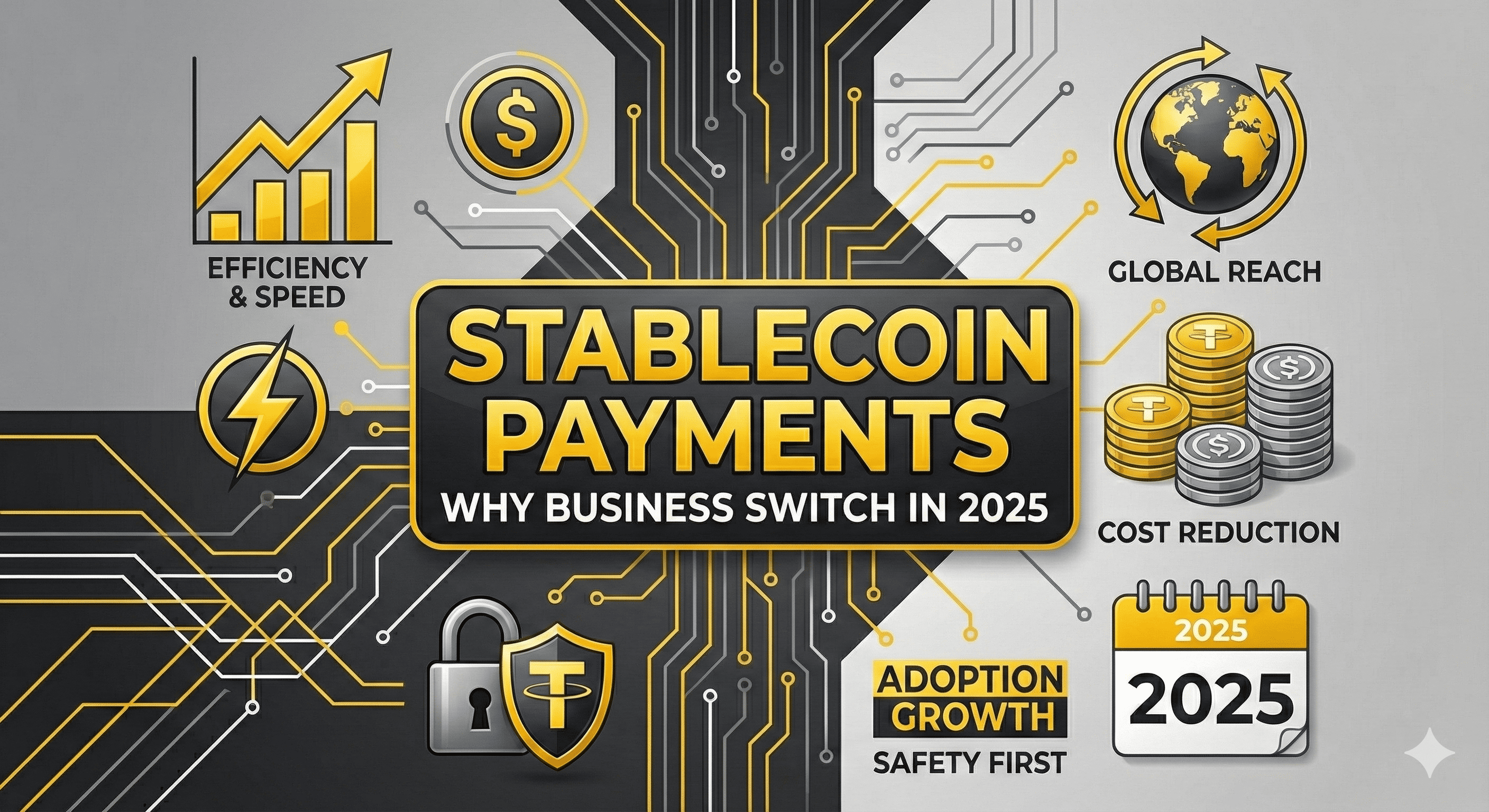
Stablecoin Payments: Why Businesses Switch in 2025
Discover why businesses worldwide are switching to stablecoin payments in 2025. Learn how stablecoins work, their benefits over traditional payments, real case studies, global regulations, and what the future of digital payments looks like
What Are Stablecoin Payments?
Stablecoin payments are a way to use digital currencies that are pegged to stable assets, like the US dollar. This means their value doesn't swing wildly like other cryptocurrencies. Imagine you're doing business online, and you want to avoid the ups and downs of Bitcoin's value. Stablecoins, like USDC, DAI and USDT, come in handy here. They offer the benefits of crypto without the same level of risk.
These payments work through a crypto payment gateway, which acts like a bridge. It lets businesses accept stablecoins and convert them into local currency if needed. This is helpful for companies that want to tap into the crypto market without holding onto volatile assets.
Think of stablecoin payments as a digital version of cash that you can use globally, without worrying about big price changes. They're fast, often cheaper than traditional methods, and open up new markets for businesses. This makes them a popular choice for companies looking to innovate in 2025. Stablecoins also help people in emerging markets who have no access to traditional banking. Many do not have a bank account, but almost everyone has a mobile phone. Stablecoins give these users a safe and simple way to pay online.
The Rise of Digital Transactions
Digital transactions have become increasingly popular as we move further into the 21st century. People use digital payments to buy things online, pay bills, and even send money to friends. This shift has been driven by the need for faster, more convenient ways to pay.
One example is mobile wallets, which let you store your credit or debit card information on your phone. This makes it easy to pay with just a tap. Businesses are also seeing the benefits. They can reach more customers who prefer digital payments, and they can process transactions more quickly.
Cryptocurrencies like Bitcoin and stablecoins like USDC and USDT offer new ways to pay digitally. These currencies are secure, and they don't rely on traditional banks. This can lower costs and increase access to financial services.
The growth of digital transactions is also supported by better technology. Faster internet speeds and improved security measures make it easier and safer for everyone to use digital payments. As more people and businesses adopt these methods, digital transactions are set to become the norm.
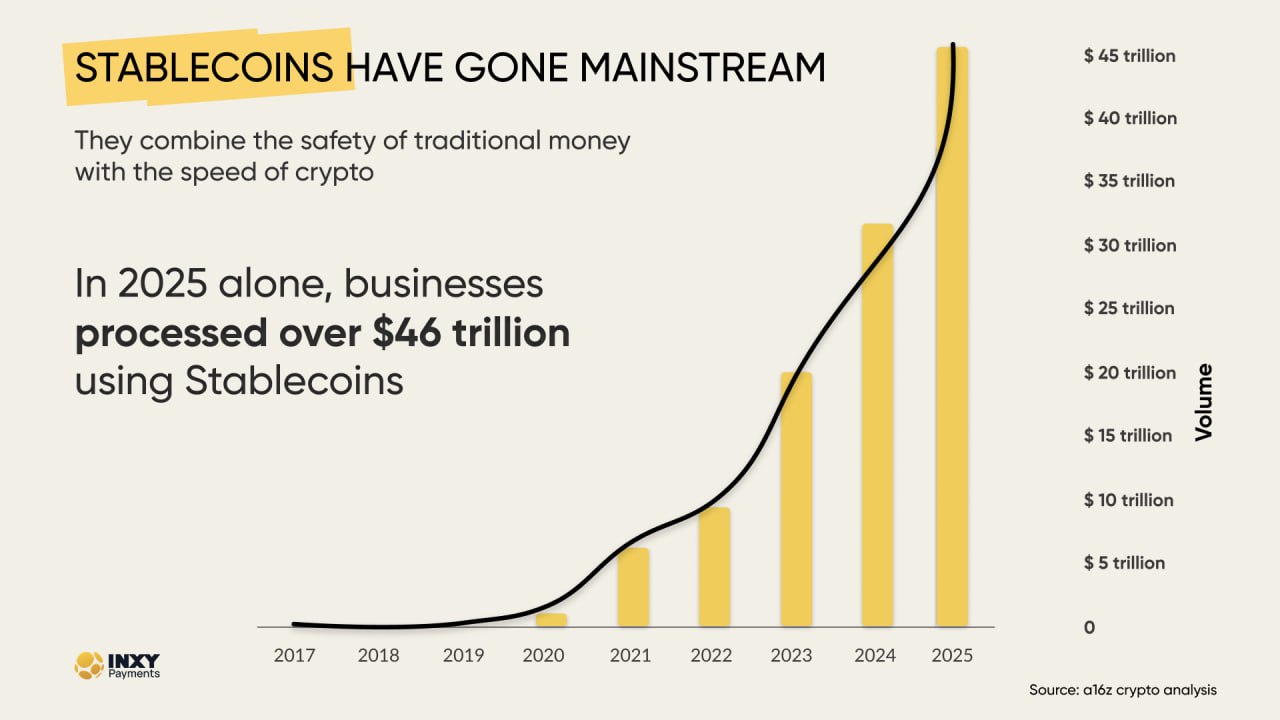
Today, more than 824 million people worldwide own cryptocurrency.
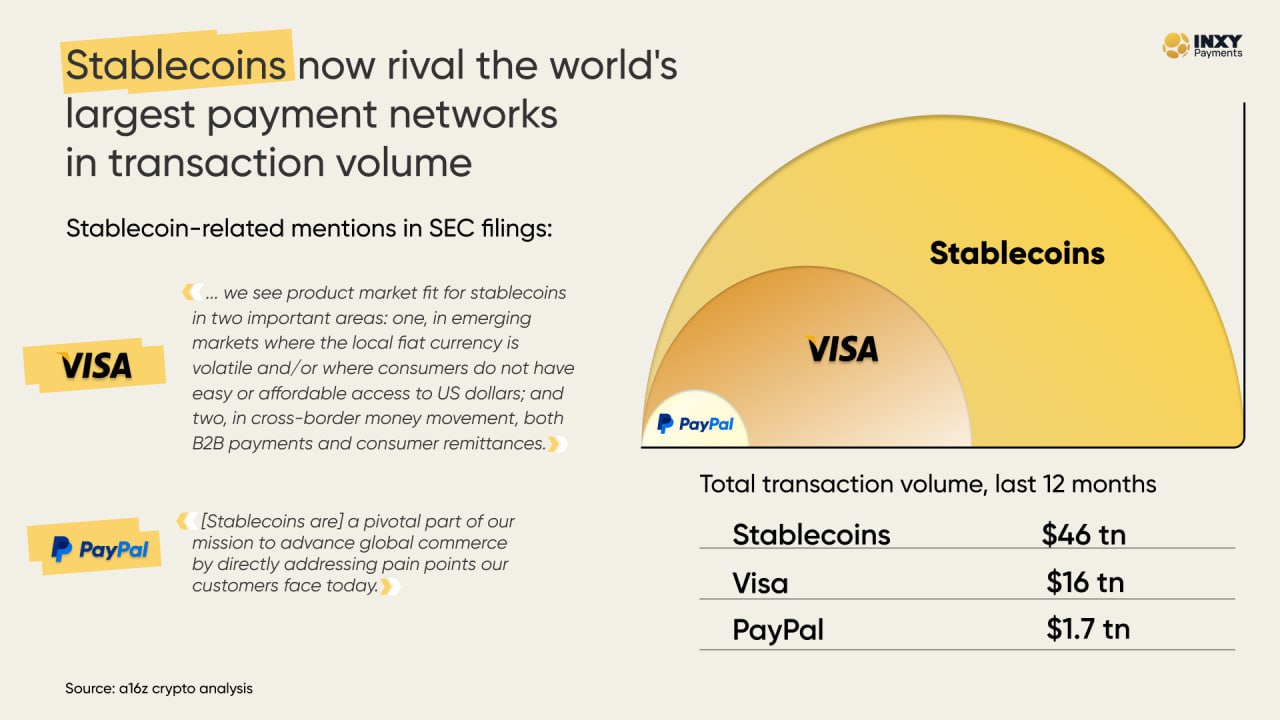
Stablecoins alone processed over $46 trillion last year — more than Visa and PayPal combined.
This shows that digital payments are not a niche trend. They are becoming the main way money moves online.
Benefits for Businesses
Stablecoin payments offer several advantages for businesses. They're less volatile than other cryptocurrencies like Bitcoin. Imagine you're a business owner. You want to know the value of your money won't change drastically overnight. Stablecoins, backed by assets like the US dollar, provide that peace of mind.
Transaction fees with stablecoins can be lower than traditional banking systems. This means businesses save money, especially on international transactions. For example, sending money across borders usually involves hefty fees. With stablecoins, these costs can be minimized.
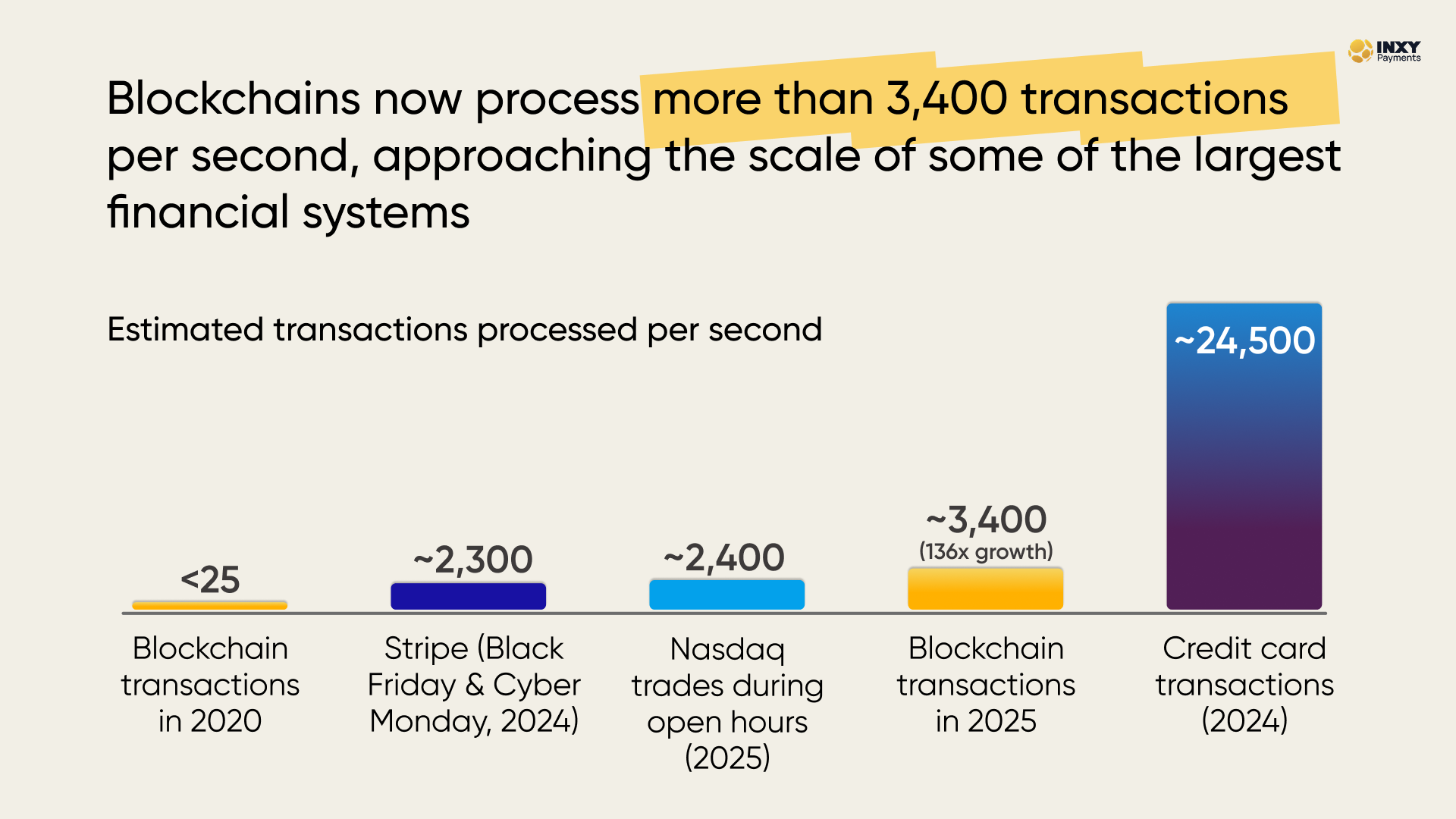
Another perk is the speed. Traditional bank transfers can take days. Stablecoin transactions, on the other hand, can be processed in minutes. This speed is crucial for businesses that need quick access to funds. Plus, the use of stablecoins can open doors to new markets, reaching customers who prefer using digital currencies.
also let businesses reach new markets. Many people in emerging regions cannot use cards or access banks, but they can use digital wallets and stablecoins on their phones. This opens the door to millions of new customers who were previously locked out of traditional online payments.
Challenges of Traditional Payment Methods
When we talk about traditional payment methods, we're often referring to cash, credit cards, and bank transfers. While these methods have been the backbone of commerce for years, they come with their own set of challenges. Let's explore these issues to understand why businesses are looking at alternatives like stablecoin payments.
Traditional payments are slow and costly. Bank transfers and card payments can take days to settle, especially across borders. Fees are also high — from card fees to bank transfer fees to currency conversion charges — cutting into margins and slowing business growth.
Security is another concern. Credit card fraud and data breaches are not uncommon. When customers hand over their card details, there's always a risk of that information being misused. This situation not only affects the customers but can also damage the business's reputation. A single security breach might lead to a loss of customer trust, which takes a long time to rebuild.
Limited access is an issue too. Not everyone has access to credit cards or bank accounts. Some customers might prefer alternative payment methods like digital wallets or cryptocurrencies. Businesses that only accept traditional payments could miss out on potential sales from these customers. It's like having a store but keeping the door locked for some shoppers.
Traditional payments also lack transparency. It's often hard for both businesses and customers to track where the money is at any given moment. For example, if a payment is delayed, it can be challenging to pinpoint the reason or the stage at which it's stuck. This lack of visibility can cause frustration and distrust among customers.
Lastly, there's the issue of adaptability. As technology evolves, businesses need payment systems that can keep up with the changes. Traditional payment methods are often slow to adapt to new needs and innovations. For instance, they might struggle to integrate with new e-commerce platforms or to support emerging payment trends.
These challenges make it clear why businesses are exploring other options. Stablecoin payments offer solutions to some of these issues, providing a faster, more secure, and cost-effective alternative. As businesses continue to grow and change, finding flexible payment solutions becomes even more critical.
Case Studies: Companies Making the Switch
Let's dive into some real-world examples of businesses that have embraced stablecoin payments. Each company has its unique reasons, and their experiences offer valuable insights for others considering this path.
One notable case is a well-known online retailer. This company decided to accept USDC, DAI and USDT as part of their payment options. The primary motivation was the global reach of crypto. Customers from different countries found it easier to pay in stablecoins without worrying about currency conversion issues. It also allowed the retailer to reduce transaction fees, which were a burden when using traditional payment gateways.
Another interesting example is a tech startup focused on software development. They started accepting stablecoin payments for their services. The team found that using a crypto payment gateway streamlined their operations. It provided faster transaction times and reduced paperwork. The transparency of blockchain technology also appealed to their tech-savvy customers, who appreciated the added layer of security.
A third case involves a popular restaurant chain. The chain began to accept stablecoin payments during the pandemic. Traditional cash payments were less desirable due to health concerns. By adopting stablecoins, they not only offered a contactless payment solution but also attracted a younger clientele. Many of these customers were already familiar with crypto and eager to use it in everyday transactions.
Then there's a logistics company that made the switch. This company operates internationally, and stablecoins helped them manage cross-border payments more efficiently. The predictability of stablecoin values, unlike volatile cryptocurrencies, made financial planning easier. They could handle transactions with partners and vendors with greater confidence in cost predictability.
Lastly, a freelance platform adopted stablecoin payments to simplify payouts to freelancers around the globe. Freelancers appreciated receiving payments in USDC or USDT for their stability and ease of conversion to local currencies. This shift also solved issues related to delayed payments through traditional banking systems.
These examples illustrate the diverse motivations behind the switch to stablecoin payments. From reducing costs to improving speed and security, businesses find multiple benefits in adopting this modern approach. Each company's journey showcases how stablecoin payments can address specific challenges and open up new opportunities.
These stories reflect a broader trend. In 2024 and 2025, stablecoins became one of the fastest-growing payment methods worldwide, especially for online services and global businesses.
Regulatory Landscape in 2025
Stablecoin payments have been gaining traction, and 2025 is shaping up to be a pivotal year for their regulation. Governments around the world are crafting policies to manage these digital currencies. This is crucial as stablecoins like USDC and USDT become more popular in the business world.
One major development is the introduction of global standards. International bodies are working to create a unified framework for stablecoin regulation. This helps ensure that businesses using stablecoins can operate smoothly across borders. Without such standards, companies might face different rules in each country, making international trade complex.
Local governments are also busy. Each country is trying to balance innovation with security. They want to encourage the use of stablecoins while making sure that financial systems remain safe. For example, some countries are adopting stricter compliance measures. This means businesses need to ensure all transactions are transparent and traceable.
In the European Union, new laws are being drafted. These laws aim to protect consumers and prevent illegal activities. They require that stablecoin providers hold sufficient reserves. This ensures that the value of the stablecoins remains stable and reliable.
Meanwhile, in the United States, regulators are focusing on oversight. They want to ensure that stablecoin issuers are transparent about their operations. This includes regular audits and public disclosures. Such measures help build trust among users and businesses.
Asia is also seeing changes. Countries like Japan and Singapore are leading in creating crypto-friendly regulations. They are developing policies that encourage innovation while ensuring that user rights are protected.
These regulatory changes are significant for businesses. Companies need to stay informed and adapt to these new rules. Understanding the regulatory landscape is key to leveraging stablecoin payments effectively. As 2025 unfolds, businesses will need to navigate this evolving landscape carefully.
The Future of Payments: What’s Next?
Stablecoin payments are gaining popularity, and it's not hard to see why. They bring a fresh wave of possibilities to the table. Businesses are starting to notice how stablecoins can change the payment landscape. Let's explore what the future might hold.
One big reason stablecoins are appealing is their stability. Unlike other cryptocurrencies, stablecoins are tied to real-world assets like the US dollar. This means they don't bounce around in value as much. For businesses, this stability is a huge plus. They can accept payments without worrying about losing money due to market fluctuations.
Stablecoins also make international payments easier. In the past, sending money across borders was slow and costly. With stablecoins, transactions can be completed quickly and with lower fees. This is great news for companies working with international clients or suppliers. It allows them to save both time and money.
Security is another reason businesses are interested in stablecoins. Traditional payment systems can be vulnerable to fraud and hacking. Stablecoins offer a more secure option as transactions are recorded on a blockchain. This technology makes it difficult for unauthorized changes to occur.
Looking ahead, we might see stablecoins being used in more everyday transactions. Imagine buying a coffee or paying rent with stablecoins. As more businesses and consumers become comfortable with the technology, this could become a reality.
Stablecoins may also impact how we save and invest money. People are starting to explore options like earning interest on their stablecoin holdings. This could lead to new financial products and services emerging in the market.
In the coming years, regulations will play a crucial role in shaping the stablecoin landscape. Governments and financial institutions will likely establish rules to ensure safe and fair use. These regulations could boost trust and encourage more businesses to adopt stablecoin payments.
The future of payments is changing, and stablecoins are at the forefront. As technology continues to evolve, we can expect even more innovative uses for stablecoins. They have the potential to simplify and enhance the way we handle money.
Supported Stablecoins & Blockchains (2025)
Many stablecoins run on different blockchains.
This makes payments fast and affordable anywhere in the world.
Supported stablecoins:
- USDT — ERC20, TRC20, BEP20, Polygon
- USDC — ERC20, TRC20, BEP20, Polygon
- DAI — ERC20, BEP20, Polygon
Other popular coins:
BTC · ETH · BNB · LTC · DOGE · TRX · MATIC
Supported blockchains:
Bitcoin · Ethereum · Tron · Polygon · Binance Smart Chain · Litecoin · Ton · and others.
The mix of currencies and blockchains makes stablecoin payments work for almost anyone, even in places where card payments fail.
FAQ
What are stablecoin payments and how do they work?
Stablecoin payments involve using digital currencies designed to minimize price volatility by pegging their value to a stable asset, like a fiat currency or commodity. They work like any other digital payment method but offer the added benefit of price stability, making them more reliable for transactions.
Why are stablecoins becoming popular in digital transactions?
Stablecoins are gaining popularity in digital transactions due to their ability to offer the benefits of cryptocurrencies, such as decentralization and transparency, while avoiding the price volatility associated with traditional cryptocurrencies. This makes them an attractive option for businesses looking for secure and stable payment methods.
What benefits do stablecoin payments offer to businesses?
Stablecoin payments provide several benefits, including lower transaction fees compared to traditional payment methods, faster processing times as transactions are often completed in seconds, and enhanced security due to blockchain technology, which reduces fraud and chargebacks.
What challenges do traditional payment methods face that stablecoins address?
Traditional payment methods often suffer from high transaction fees, lengthy processing times, and issues with cross-border payments. Stablecoins address these challenges by offering reduced fees, instantaneous transactions, and seamless international payments, thus providing a more efficient alternative.
Can you provide examples of businesses that have switched to stablecoin payments?
Many companies across various industries have transitioned to stablecoin payments. For instance, a tech company might use stablecoins to streamline international payroll, while an online retailer could adopt them to reduce transaction costs and improve payment processing speed.
How is the regulatory landscape for stablecoins evolving in 2025?
In 2025, the regulatory landscape for stablecoins is evolving to provide clearer guidelines and protections for businesses and consumers. Governments and financial bodies are working on frameworks to ensure stablecoin security and transparency, influencing business decisions towards stablecoin adoption.
In the European Union, the new MiCA framework brings clear rules for stablecoins and crypto service providers. These rules aim to protect users while supporting innovation. Similar frameworks are emerging in Asia, the U.S., and Latin America.
What does the future hold for stablecoin payments and their impact on the economy?
The future of stablecoin payments looks promising, with potential for widespread adoption as more businesses recognize their benefits. This could lead to significant changes in the payment industry, driving innovation and possibly reshaping economic structures by making transactions more efficient and accessible worldwide.

Best Stablecoins 2026: Top Picks
A quick guide to the best stablecoins of 2026. Learn what stablecoins are, how they work, their risks, yields, and which top coins to watch this year.
What Are Stablecoins?
Stablecoins are a type of cryptocurrency designed to keep a stable value. Unlike regular cryptocurrencies like Bitcoin, which can rise and fall in value quickly, stablecoins aim to stay consistent. They are often tied to real-world assets like the US dollar or gold. This connection helps prevent large price changes, making them useful for transactions and savings.
Think of stablecoins as digital versions of traditional money. They can be used for paying, saving, and trading without the worry of sudden value drops. Some stablecoins use algorithms to adjust their supply and maintain stability. Others hold reserves of the assets they are linked to. This dual approach helps users trust and rely on them for their financial needs.
Ranking by Market Capitalization
Market capitalization, often called "market cap," is a way to measure the total value of a stablecoin. Imagine it as the total worth of all the coins in circulation. When we talk about the best stablecoin in 2026, market cap is a key factor. It shows how popular and trusted a stablecoin is in the crypto world.
Let's break it down with an example. Think about two stablecoins, Coin A and Coin B. If Coin A has a market cap of $1 billion and Coin B has $500 million, Coin A is bigger. It means more people have invested in Coin A, showing more trust and usage.
Big market caps often mean more stability. Why? It is usually harder for someone to manipulate a large market. Plus, a bigger market cap can attract more traders and investors. But a higher market cap does not always mean less risk. It is still important to look at other factors, like the technology behind the coin and its management team.
In 2026, to find the best stablecoin by market cap, check which coins have grown the most. Look at their history and how they have performed over time. This can give you clues about which stablecoins might continue to grow and provide stability.

Yield Potential of Stablecoins
Exploring the yield potential of stablecoins can be quite the journey. Let's break it down. Some stablecoins offer staking options. This means you can earn interest by simply holding them in a specific wallet. It's like putting money in a bank account that gives you a little extra over time.
Another option is yield farming. This involves providing liquidity to certain platforms. You get rewarded with more coins. It's a bit like lending your coins to a friend and getting interest back.
But, be careful. While the potential for profit exists, risks are also there. Market conditions can change, affecting your returns. Always consider these factors when evaluating stablecoin yields.
Understanding Risks Involved
When we talk about stablecoins, the term "stable" often gives a sense of security. But is it really that simple? While stablecoins are designed to maintain a steady value, they come with their own set of risks. Let's break them down.
First up, we have the risk of losing the peg. Stablecoins are pegged to another asset, like the US dollar. But what if they lose this peg? When the market is volatile, the value of a stablecoin can drift away from its intended peg. This can happen due to insufficient reserves or sudden market shifts.
Next, consider regulatory risks. Governments around the world are still figuring out how to regulate cryptocurrencies, including stablecoins. Changes in laws can affect how stablecoins are used, traded, or even banned in certain regions. This uncertainty can impact their value and usability.
Then there's the risk of issuer default. Stablecoins are often backed by a reserve of fiat currency or other assets. If the issuer fails to manage these reserves properly, or if they face financial trouble, the stablecoin might not hold its value.
Also, technology plays a big role. Stablecoins operate on blockchain technology. While secure, blockchains can have bugs or be subject to cyber-attacks. If a stablecoin's technology is compromised, it can lead to loss of funds or trust.
Finally, liquidity risk shouldn't be overlooked. If there's a sudden rush to sell a particular stablecoin, there might not be enough buyers. This can make it hard to sell the stablecoin at its intended value, leading to potential losses.
Each of these risks reminds us that while stablecoins aim to offer stability, they are not without challenges. Understanding these risks can help you make informed decisions when dealing with stablecoins.
Top 5 Stablecoins for 2026
Stablecoins are digital currencies that aim to maintain a stable value. In 2026, the best stablecoins will likely be those that offer a good balance between security, yield, and risk. Here, we'll explore the top five stablecoins you might want to keep an eye on.
First up is Tether (USDT). Tether is one of the most used stablecoins. It's pegged to the US dollar, which means its value stays close to $1. Many people use Tether for trading because it offers stability in the volatile world of cryptocurrencies. However, some investors worry about its lack of transparency.
Next, we have USD Coin (USDC). Similar to Tether, USDC is also pegged to the US dollar. It's known for being transparent, as it undergoes regular audits. This makes it a popular choice for those who value security and trust.
Dai is another stablecoin to consider. Unlike USDT and USDC, Dai is not backed by US dollars in a bank account. Instead, it uses smart contracts on the Ethereum blockchain to keep its value stable. This decentralized approach appeals to those who prefer not to rely on traditional banking systems.
Binance USD (BUSD) is a stablecoin issued by Binance, one of the largest cryptocurrency exchanges in the world. BUSD is also pegged to the US dollar and is regulated, which provides an extra layer of security. It's a good choice for users who trade on the Binance platform.
Lastly, TrueUSD (TUSD) is a stablecoin that offers transparency and regular audits. Like other stablecoins, it is pegged to the US dollar. TrueUSD is popular among investors who prioritize a transparent and regulated approach to stablecoins.
These five stablecoins each offer something unique, from transparency to decentralization. As 2026 unfolds, these stablecoins might be the ones leading the charge in the crypto space.

Comparative Analysis of Stablecoins
When it comes to understanding stablecoins, comparing them can help you see the differences and similarities. Let's take a closer look at some popular stablecoins in 2026, focusing on capitalization, yield, and risks. This way, you can get a better idea of what makes each one unique.
Every stablecoin has its own market capitalization. This is the total value of all coins in circulation. For example, Tether (USDT) often has a large market cap, making it a strong player in the stablecoin field. In contrast, newer stablecoins might have smaller market caps, which can mean they are still gaining popularity.
Yield is another important factor. It refers to the return you might get from holding or staking the stablecoin. Some stablecoins offer attractive yields through different financial platforms. For instance, USDC might provide a steady yield for those who choose to lend or stake their coins. This makes it appealing to users looking for extra income.
Now, let's talk about risks. Every stablecoin carries some risk, but they differ in type and level. For instance, algorithmic stablecoins may face risks due to changes in their algorithms or market conditions. On the other hand, fiat-backed stablecoins like USDT and USDC might be exposed to regulatory risks. Understanding these risks can help you decide which stablecoin suits your needs.
To illustrate, consider Dai, an algorithmic stablecoin. Its value is maintained through smart contracts and collateralized assets. This makes Dai less dependent on traditional banks but more sensitive to market fluctuations. In comparison, fiat-backed coins like BUSD rely on reserves in a bank, offering more stability but less independence.
Stablecoin innovation doesn't stop here. New models and technologies are constantly emerging. These developments aim to address current limitations and provide new benefits. By staying informed about these changes, you can make smarter choices in the stablecoin market.
In summary, the best stablecoin for you depends on your goals and risk tolerance. Whether you prioritize high yield, market stability, or innovation, there's likely a stablecoin that fits your criteria. Keep exploring, and you'll find the one that aligns with your financial strategy.

Future of Stablecoins: Trends to Watch
As we look ahead to 2026, the stablecoin landscape is poised for significant changes. These digital assets, designed to maintain a stable value, are becoming an integral part of the financial ecosystem. Let's explore the trends that are shaping their future.
One major trend is the growing interest in central bank digital currencies (CBDCs). Governments around the world are exploring their own digital currencies, which could impact the role of stablecoins. For instance, if a country launches a successful CBDC, it may affect how private stablecoins are used within that economy. This could lead to a shift in demand and new regulatory challenges.
Another trend to watch is the rise of algorithmic stablecoins. Unlike traditional stablecoins backed by reserves, these use complex algorithms to maintain stability. TerraUSD and similar projects are examples of this innovation. While they offer potential benefits like decentralization, they also come with risks, as seen in past fluctuations. As technology improves, we may see more robust and reliable algorithmic stablecoins.
Regulation will play a crucial role in the stablecoin market. Authorities are keen to ensure that these digital currencies are safe and transparent for users. We can expect more comprehensive regulations to emerge, focusing on areas like reserve transparency and consumer protection. This could lead to increased trust and wider adoption.
The integration of stablecoins with decentralized finance (DeFi) platforms is another exciting development. Stablecoins provide liquidity and stability within these platforms, enabling more complex financial products. As DeFi grows, so will the demand for stablecoins, making them even more essential.
Finally, the use of stablecoins for cross-border transactions is likely to expand. Their ability to offer fast and low-cost transfers makes them attractive for international payments. This could challenge traditional banking systems and reshape how global transactions are conducted.
As these trends unfold, stablecoins will continue to evolve, playing a pivotal role in the future of finance.
FAQ
What are stablecoins and why are they important?
Stablecoins are a type of cryptocurrency designed to maintain a stable value, typically pegged to a reserve of assets like fiat currencies (e.g., USD) or commodities. They are important because they offer a refuge from the volatility typical of cryptocurrencies, making them a useful tool for transactions, savings, and as a base currency in trading.
How are stablecoins ranked by market capitalization in 2026?
Stablecoins in 2026 are ranked by market capitalization based on the total value of their circulating supply. This ranking reflects their adoption and trust within the market. Factors such as the size of reserves, transparency, and liquidity contribute to their market capitalization.
What yield opportunities do stablecoins offer?
Stablecoins provide yield opportunities through mechanisms such as interest-bearing accounts, staking, and lending platforms. These methods allow investors to earn returns in a low-risk environment, with yields often depending on the platform and specific stablecoin used.
What risks are involved in investing in stablecoins?
Investing in stablecoins involves risks such as regulatory changes, which can impact their legality and usage. Market volatility, while less than traditional cryptocurrencies, can still affect stablecoin value indirectly. Additionally, the stability of the assets backing the stablecoin is crucial, as poor management can lead to value fluctuation.
Which are the top 5 stablecoins to watch in 2026?
The top 5 stablecoins for 2026 are selected based on their market performance, adoption rate, and stability mechanisms. These include well-established names with strong backing and innovative newcomers offering unique features. Their strengths and weaknesses are analyzed to provide a comprehensive overview.
How can I compare different stablecoins effectively?
A comparative analysis involves examining stablecoins based on market capitalization, yield potential, and associated risks. Factors such as reserve transparency, regulatory compliance, and technological infrastructure are considered to help investors make informed decisions.
What future trends should we watch for stablecoins?
Future trends for stablecoins include increased integration into traditional financial systems, technological innovations such as enhanced privacy features, and evolving regulatory frameworks. These trends will shape their role in the financial ecosystem and influence their utility and adoption.
News

INXY Payments at Blockchain Life Dubai 2025: Building Bridges in the Heart of the Web3 Industry
Let’s work together
See how easy it is to start with crypto payments without interrupting your current business flow