If your business is about to move real money through USDT, "is USDT safe?" is the right question to ask first. Tether is the largest stablecoin in the world — roughly $188 billion in circulation and ~59% of the entire stablecoin market as of mid-2026 — but scale and safety aren't the same thing.
This is a balanced look at what actually backs USDT, where the real risks sit, and how those risks apply specifically to a company using Tether for payouts rather than trading.
What USDT is — and what "safe" means here
USDT (Tether) is a stablecoin designed to hold a 1:1 peg to the US dollar. Each token is meant to be redeemable for one dollar, backed by reserves Tether holds. For a business, "safe" breaks into three practical questions:
Peg risk — will 1 USDT still be worth ~$1 when my recipient cashes out?
Counterparty risk — is the issuer solvent and are the reserves real?
Operational and regulatory risk — can I legally and reliably use it where I operate?
Let's take them in order.
Peg stability: strong, with rare wobbles
In normal conditions, USDT trades within a fraction of a cent of $1. Its depth of liquidity is unmatched — it's the most traded crypto asset on earth, which makes the peg resilient.
It is not immune, though. During acute market stress (the 2022 Terra/UST collapse, the 2023 US regional-bank episode) USDT briefly de-pegged by a few percent before recovering. For a payout business, the takeaway is not "avoid USDT" but "don't sit on large idle balances." If you convert at payout time rather than warehousing Tether, short-lived wobbles rarely reach the recipient.
Reserves: what backs USDT in 2026
This is where scrutiny has historically been sharpest, and where transparency has improved.
Per Tether's Q1 2026 attestation (BDO Italia), the company reported roughly $191.8 billion in total assets against its liabilities, with a reserve mix heavily weighted toward liquid, low-risk holdings:
~$135 billion in US Treasuries — the bulk of reserves in the most liquid safe asset there is.
~$13 billion in gold, plus Bitcoin and other holdings.
Reported net equity of around $8 billion, a buffer above the tokens in circulation.
Two honest caveats remain:
Tether publishes attestations, not a full audit by a Big Four firm. An attestation confirms balances at a point in time; it's less rigorous than a continuous audit. Critics have pushed Tether on this for years.
A minority of reserves has historically included assets beyond cash and Treasuries. The direction of travel is toward higher-quality, more liquid reserves, but it's worth knowing what you hold.
For most businesses, a reserve base dominated by US Treasuries is reassuring. The transparency gap versus a fully audited competitor is real but narrowing.
Regulatory risk: the biggest practical issue for EU businesses
Here's the risk that most directly affects where and how you can use USDT: Tether did not seek authorization under the EU's MiCA regulation.
The consequences are concrete. Through late 2024 and 2025, MiCA-regulated exchanges removed USDT for customers in the European Economic Area — Coinbase, Crypto.com, Binance (EEA) and others delisted or restricted it — because offering a non-authorized stablecoin put their own licenses at risk. USDT trading volumes on EU venues fell sharply, while MiCA-compliant alternatives like USDC and EURC gained share.
USDT is not banned to hold, but its regulated on/off-ramp availability in the EU has narrowed. Tether has instead pursued a US federal path (under the GENIUS Act) via a US-domiciled entity. If your recipients or your business are EU-based, this matters: a MiCA-compliant stablecoin may be the more durable choice for European corridors. (See "Is USDC regulated?" and our USDT vs USDC comparison.)
Operational risk: irreversibility and wrong-network errors
Independent of Tether the company, USDT carries the operational risks of any on-chain asset:
Irreversibility. A payout sent to a wrong or wrong-network address is typically gone.
Network fragmentation. USDT on Tron, Ethereum, Solana and others isn't interchangeable at the address level.
Compliance exposure. Paying a sanctioned or high-risk wallet is a legal problem, not just a technical one.
These are managed with address validation, test transfers, and — at volume — KYT and sanctions screening built into your payout flow.
So, is USDT safe for business payouts?
A fair summary:
Peg: Strong in normal conditions; convert at payout time to avoid stress-window exposure.
Reserves: Large and Treasury-heavy, but attested rather than fully audited.
Regulation: The real watch-item — limited MiCA standing constrains EU usage.
Operations: Safe when you use validation, screening, and disciplined records.
For high-volume global payouts, USDT remains the most liquid and widely accepted stablecoin. The smart posture is to use it deliberately: don't warehouse it, screen your recipients, keep clean fiat records, and choose a MiCA-compliant asset where European regulation demands it.
Frequently asked questions
Is USDT backed by real dollars? USDT is backed by reserves that, per Tether's 2026 attestations, are dominated by US Treasuries plus cash equivalents, gold, and other assets. These are confirmed by attestation rather than a full independent audit.
Can USDT lose its peg? It can briefly deviate during extreme market stress, as it has a few times historically, but it has recovered each time. Deep liquidity supports the peg in normal conditions.
Is USDT legal in the EU? Holding USDT is not illegal, but Tether is not MiCA-authorized, and many EU-regulated exchanges have delisted it for EEA users. For EU corridors, a MiCA-compliant stablecoin is often more practical.
Is USDT safe enough for payroll and affiliate payouts? For most businesses, yes — provided you convert near payout time, screen recipients, and keep proper records. The controls matter as much as the asset.
Use USDT with the controls built in
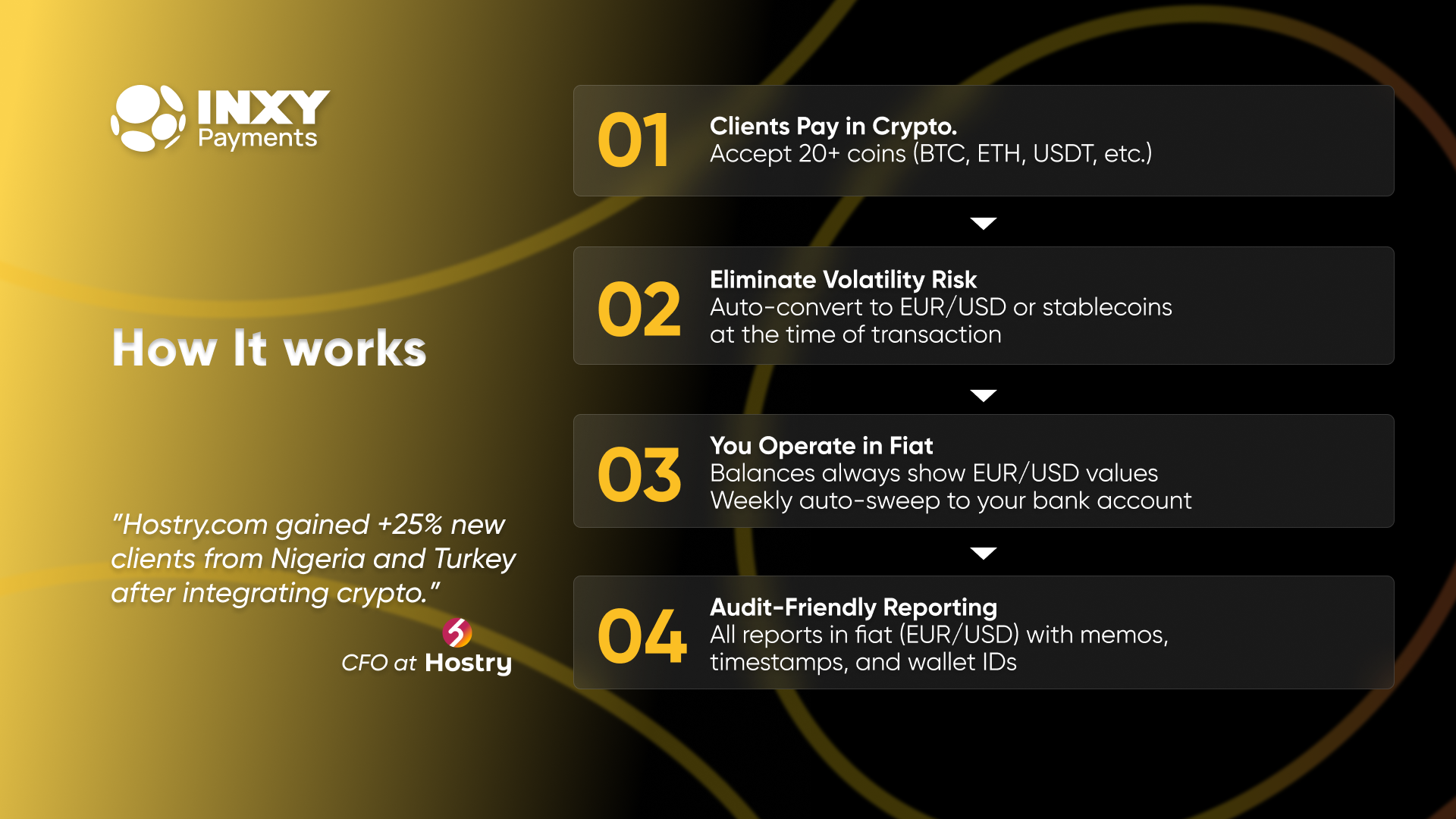
The safest way to use USDT for business isn't to trust a single wallet — it's to run payouts through infrastructure that screens recipients, validates networks, and reports in fiat. That's how INXY's mass USDT payouts are designed: fund in EUR or USD, pay out globally, and keep audit-ready records — without warehousing crypto risk.
This article is general information, not financial or legal advice. Evaluate stablecoin exposure against your own jurisdiction and risk policy.
How to profitably accept crypto for low-cost VPS and micro-cloud services
For budget VPS and micro-cloud providers, a $0.30 flat processing fee can wipe out nearly 10% of a $5 invoice before the server even boots. This guide breaks down how to accept crypto payments profitably — using stablecoins on low-fee networks like TRC-20 and Polygon, combined with a pre-paid balance model that eliminates micro-transaction overhead. Learn the operational blueprint for crypto-native billing that protects your margins and scales with your infrastructure.
How to profitably accept crypto for low-cost VPS and micro-cloud services
You provision a virtual machine, allocate the IP address, and send the customer an automated invoice for $4.99. Then, the traditional payment processor takes its cut: a standard $0.30 flat rate plus 2.9% of the total transaction. Just like that, nearly 10% of your gross revenue vanishes before the server even boots up. If you are operating in the micro-cloud and budget VPS market, your biggest competitor is not another hosting company; it is the legacy banking system actively eating your razor-thin profit margins.
Premium dedicated servers priced at $200 a month can easily absorb standard credit card fees. Low-cost infrastructure simply cannot. The survival and scalability of a budget IaaS (Infrastructure as a Service) provider depend entirely on extreme transaction efficiency. By strategically deploying cryptocurrency payments on low-fee blockchain networks, you can bypass fiat gateways, preserve your margins, and attract a global audience of developers who prefer decentralized payments.
Fiat gateways vs. Digital assets
To understand why traditional billing is fundamentally broken for micro-cloud services, we must examine the harsh mathematics of a $5 monthly transaction.
Scenario A: The Fiat Processing Trap When a client pays a $5 invoice via Stripe or PayPal, the fixed $0.30 fee disproportionately damages the transaction. The total fee amounts to roughly $0.45. If your baseline infrastructure cost (electricity, bandwidth, hardware depreciation) for that specific virtual machine is $3.50, your actual profit is immediately slashed. Furthermore, if that user initiates a chargeback, you lose the server resources, the original $5, and are penalized with a $15 dispute fee. You have effectively paid money to host a server for a stranger.
Scenario B: High-Speed Blockchain Routing Now, consider processing that same $5 transaction using a stablecoin like USDT routed through a Layer-2 blockchain network (such as Polygon) or a high-throughput chain (like Tron/TRC-20). The transaction fee drops from $0.45 to a fraction of a penny. There are zero chargeback risks, no rolling reserves held by acquiring banks, and the funds settle into your company’s digital wallet in a matter of seconds. You keep 100% of the revenue you earned.
The operational blueprint for micro-transactions
You cannot simply paste a Bitcoin wallet address on your checkout page and expect profitability. Bitcoin network fees can sometimes exceed the cost of the VPS itself. To succeed in the micro-cloud space, providers must adopt a specialized operational architecture:
Implement the Account "Top-Up" Model: Instead of forcing users to process a $4 crypto transaction every single month, shift your billing panel to a credit system. Require a minimum deposit of $20 in cryptocurrency, which is added to their account balance. Your system then automatically deducts the $4 daily or monthly from that pre-paid internal ledger.
Enforce Stablecoin Dominance: Volatile assets are dangerous for low-margin services. Restrict micro-payments strictly to stablecoins like USDT and USDC. This guarantees that a $5 payment today remains worth exactly $5 when you need to pay your own upstream datacenter bills next week.
Mandate Low-Cost Networks: Disable legacy networks like Ethereum (ERC-20) for small checkouts, as the gas fees will frustrate your users. Only present checkout options for TRC-20, BEP-20, or Polygon networks, ensuring the customer pays almost nothing to send you the funds.
Overcoming the implementation hurdle with INXY
Many hosting providers hesitate to adopt digital payments because tracking microscopic network fees, managing multiple blockchain nodes, and building custom billing integrations sounds like an administrative nightmare. This is exactly where INXY transforms your entire billing architecture.
Unlike generic merchant processors, INXY is an enterprise-grade cryptocurrency payment gateway specifically designed to handle the high-frequency, low-cost routing required by modern cloud providers. We seamlessly integrate directly into your existing billing panels – whether you use WHMCS, HostBill, or a custom internal dashboard.
When you partner with INXY, you do not need to worry about manually verifying network confirmations or updating user balances. Our API automatically generates unique payment addresses, monitors the lowest-fee networks like Tron and Polygon, confirms the exact stablecoin deposit, and instantly updates the client's pre-paid balance on your server. INXY acts as your automated, invisible cashier, securing your revenue without the bloat of traditional banking.
Conclusion
The micro-cloud sector thrives on volume and automation. Continuing to rely on payment processors that penalize small transactions is an unsustainable business model. By shifting to a crypto-native, pre-paid balance structure, you eliminate crippling flat fees, protect yourself from chargeback fraud, and capture a rapidly growing demographic of privacy-conscious developers.
Ready to stop giving away your profit margins to payment processors? Discover how our automated payment gateway can drastically improve your server profitability by visiting https://www.inxy.io/ today.
What is a Stablecoin? Complete Beginner’s Guide 2025
A beginner-friendly guide to stablecoins in 2025. Learn what stablecoins are, how they work, their main types, benefits, risks, and how to buy, store, and use them safely — plus a look at their future in digital finance
Stablecoins are one of the fastest-growing parts of the crypto market. In the last year alone, stablecoins processed tens of trillions of dollars in payments and moved value across borders faster than traditional bank rails. This guide explains what stablecoins are, how they work, and why more people and businesses are using them in 2025.
Understanding Stablecoins
Stablecoins are a type of cryptocurrency designed to maintain a stable value. Unlike other cryptocurrencies, whose prices can be unpredictable, stablecoins aim to stay consistent. They are often tied to real-world assets like the US dollar, gold, or even other cryptocurrencies.
Common examples are Tether (USDT), USD Coin (USDC), and DAI. All of them aim to keep a value close to 1 US dollar.This means 1 USDT should always equal 1 USD. People use stablecoins to avoid the wild swings of the crypto market while still enjoying the benefits of digital currency.
Stablecoins can be classified into three main types: fiat-collateralized, crypto-collateralized, and algorithmic. Fiat-collateralized stablecoins hold reserves in traditional currency. Crypto-collateralized ones use other cryptocurrencies as backing. Algorithmic stablecoins rely on smart contracts to manage supply and demand.
Stablecoins offer a bridge between the traditional financial world and the new age of digital currency, providing stability and trust. They're used for trading, payments, and as a store of value, making them popular among both crypto enthusiasts and businesses. People use stablecoins to send money abroad, pay freelancers, move funds between exchanges, or simply sit in “digital dollars” during volatile markets.
Types of Stablecoins
Stablecoins come in various forms, each with its own way of maintaining value. One type is fiat-collateralized stablecoins. These are backed by traditional currencies like the US dollar. For example, Tether (USDT) is a well-known fiat-backed stablecoin. You deposit one dollar into a bank, and you get one digital token.
Then, there are crypto-collateralized stablecoins. Instead of using traditional money, they use other cryptocurrencies as reserves. A popular example here is DAI, which is backed by Ethereum. It's a bit more complex, but it offers greater transparency through smart contracts.
Finally, we have algorithmic stablecoins. These don't use collateral. Instead, they rely on algorithms to control the supply of the coin, similar to how central banks manage currencies. If the price goes up, the system releases more coins to lower the price. If it drops, coins are taken out of circulation to raise it. This method is innovative but can be risky.
How Stablecoins Work
Stablecoins are a type of cryptocurrency designed to keep their value stable. Unlike other cryptocurrencies, which can have wild price swings, stablecoins aim to stay around a fixed value. This stability often comes from linking the stablecoin to a real-world asset like the US dollar.
One common method is to hold reserves. For example, if a stablecoin is tied to the dollar, the issuer might keep one dollar in reserve for every stablecoin issued. This ensures that users can exchange stablecoins for real dollars at any time.
Another method involves using algorithms to manage supply. If demand for the stablecoin rises, the system may release more coins to keep the price steady. If demand falls, it might buy back coins to maintain balance.
These strategies help stablecoins stay steady, making them useful for trading, accepting payments, or cashing out without worrying about losing value.
Benefits of Using Stablecoins
Stablecoins have gained popularity for several reasons. One major advantage is their price stability. Traditional cryptocurrencies like Bitcoin and Ethereum can have wild price swings, making them less reliable for day-to-day transactions. In contrast, stablecoins are usually tied to stable assets like the US dollar, ensuring their value remains relatively constant.
Another benefit is the ease of international transactions. If you need to send money across borders, stablecoins can be a faster and cheaper alternative to traditional bank transfers. They don't require high fees and middlemen, making the process more efficient.
Stablecoins also provide a way to enter the crypto market without the risk of losing value quickly. For those new to crypto, they offer a stepping stone, allowing you to participate in the digital economy without the stress of market fluctuations. Plus, businesses can accept stablecoins as payment, knowing their value won't drop overnight.
Stablecoins are also helpful in places where banks do not work well or many people do not have bank accounts. A phone and a simple wallet app are often enough to receive stablecoins, which makes them useful in many emerging markets.
Lastly, stablecoins can be easily exchanged for other cryptocurrencies or even cashed out to traditional money. This flexibility makes them a practical choice for both consumers and businesses looking to explore digital currencies with minimal risk.
How to Buy Stablecoins
Buying stablecoins can seem tricky at first, but it’s pretty simple once you break it down. First, you need a crypto wallet. This is a digital tool to store, send, and receive stablecoins. You can find many wallets online, so pick one that suits your needs.
Next, choose a crypto exchange. This is a platform where you can buy and sell stablecoins. Popular exchanges are user-friendly, making it easy to trade. Once you pick an exchange, create an account and verify your identity.
Now, you’re ready to buy. Deposit money into your exchange account. Then, search for the stablecoin you want and make a purchase. You can buy with cash, or exchange other cryptocurrencies. After buying, transfer the stablecoins to your wallet for safekeeping. This ensures your coins are secure and easy to access when you need them.
You do not always need to buy stablecoins directly. Some people earn them by doing freelance work, selling online services, or getting paid by friends and family abroad.
Exchanging Stablecoins for Cash
When you want to turn your stablecoins into cash, it's not as tricky as it may sound. First, you'll need to find a crypto exchange that accepts stablecoins. Many big exchanges do, like Binance or Coinbase. Once you're signed up, you can transfer your stablecoins to the exchange. It’s a bit like moving money from one bank to another.
After your stablecoins are on the exchange, you can find the option to cash out. This usually involves choosing a fiat currency like USD or EUR, and then selling your stablecoins for that currency. The exchange does the math and shows you how much money you'll receive.
Next, you need to decide how to receive your cash. Most exchanges offer a few ways: you can transfer it straight to your bank account, use a debit card linked to the exchange, or sometimes even get a physical check. Each method may have different fees, so it's wise to check those before you decide.
Lastly, be aware of the time it takes for the money to reach you. Some methods are quick, while others might take a few days. The speed often depends on your bank or the exchange. So, it's good to plan ahead, especially if you need the cash soon.
In some countries, people also use peer-to-peer (P2P) platforms or local fintech apps to swap stablecoins for local money.
Storing Stablecoins Safely
When it comes to keeping your stablecoins, safety is key. Let's break it down into simple steps. First, think about where you want to store them. A crypto wallet is your go-to option. There are two main types: hot wallets and cold wallets.
Hot wallets are online. They are easy to access, making them perfect for frequent transactions. If you often exchange or accept crypto, this might be your choice. But, online wallets can be more vulnerable to hacks.
Cold wallets, on the other hand, are offline. They're like a digital vault, keeping your coins away from the internet. This makes them safer from online threats. If you're planning to hold onto your stablecoins for a while, this is a solid option.
Now, let's talk about setting up a wallet. It's not as hard as it sounds! Most wallets come with user-friendly apps. You download the app, create an account, and you're set. You'll receive a private key, a kind of password, which is crucial. Keep it safe and never share it.
Another way to secure your coins is by using two-factor authentication. This adds an extra layer of security. Even if someone gets your password, they can't access your wallet without the second factor.
Choosing a reliable wallet provider is important, too. Look for reviews and ensure the provider has a good track record. Some popular options include Ledger, Trezor, and Coinbase.
You should also back up your wallet. Most wallets allow you to do this through a recovery phrase. Write it down and store it in a safe place. If you lose access to your wallet, this phrase can help you get back in.
Lastly, stay informed. The crypto world changes fast. New security features and threats can emerge. Keep an eye on updates from your wallet provider and the stablecoin community.
By following these steps, you can store your stablecoins safely and with confidence.
Stablecoins vs. Traditional Cryptocurrencies
When we talk about stablecoins and traditional cryptocurrencies, it's like comparing apples and oranges. Both are fruits, but they taste different. Stablecoins are designed to keep their value steady, usually tied to a stable asset like the US dollar. This makes them less wild in terms of price swings. On the flip side, traditional cryptocurrencies, like Bitcoin, are known for their roller-coaster prices, which can go up or down sharply in a short time.
Stablecoins are great when you want to avoid the crazy ups and downs of traditional crypto. Think of them as a safe harbor in a stormy sea. They give you a way to hold digital assets without worrying about losing value overnight. This stability is why some people prefer them for daily transactions or saving.
Traditional cryptocurrencies can be exciting for those who enjoy high-risk, high-reward scenarios. If you buy a cryptocurrency like Bitcoin at the right time, you could make a lot of money. But, you could also lose a lot if the value drops. This unpredictability makes them less appealing for regular transactions but more attractive for investment.
Both types of digital assets have their uses. Stablecoins are often used for things like remittances or when users want to cash out of a volatile market without going back to regular money. Traditional cryptocurrencies are used for things like long-term investments or when someone wants to participate in a decentralized financial system.
It's important to choose the right one based on your needs. If you want stability and predictability, stablecoins are a good choice. If you are looking for potential big gains and can handle the risk, traditional cryptocurrencies might be more your style.
The Future of Stablecoins
The future of stablecoins looks promising yet complex. As we step into 2025, stablecoins are playing a bigger role in the financial world. More businesses are starting to accept them as payment. This trend is likely to continue, making stablecoins a significant part of global trade. Stablecoins are unique because they combine the benefits of cryptocurrency with the stability of traditional money. They are not as volatile as other cryptocurrencies, which makes them attractive for everyday transactions.
Governments around the world are also paying attention to stablecoins. Some are considering creating their own versions, often called Central Bank Digital Currencies (CBDCs). These digital currencies could change how we use money. For instance, they might make international payments faster and cheaper. While this is an exciting development, it also brings challenges. Governments must ensure these digital currencies are secure and private.
Technology is another important factor shaping the future of stablecoins. Innovations in blockchain technology can make stablecoins more efficient and secure. For example, improvements in smart contracts might automate many financial processes. This could reduce the need for intermediaries, like banks, in certain transactions. However, these technological advancements also require careful management. Developers must ensure these systems are safe from hacking and other threats.
There are also social aspects to consider. As more people use stablecoins, they might change how we think about money. Younger generations, who are more comfortable with digital technology, may adopt stablecoins more quickly. This could lead to a shift away from traditional cash. Yet, not everyone has access to the internet or digital devices. This digital divide could create inequality if stablecoins become too widespread.
Lastly, the regulatory landscape for stablecoins is still evolving. Different countries have different rules, which can create confusion. Clear and consistent regulations are essential for stablecoins to thrive. These rules can help protect users and ensure the financial system remains stable.
New rules like the European Union’s MiCA framework, and similar proposals in other regions, aim to make sure stablecoins are properly backed, audited, and safe for everyday use.
As we navigate these changes, it's clear that stablecoins will continue to develop. How we adapt to these changes will determine the role stablecoins play in our everyday lives.
Risks Associated with Stablecoins
Stablecoins may seem like the safer side of crypto, but they come with their own risks. One major concern is regulatory risk. Governments around the world are still figuring out how to regulate these digital currencies. This means rules can change quickly, affecting the value and legality of stablecoins.
Another risk is the trust in the issuer. Stablecoins are usually backed by assets like dollars or gold. But if the issuer doesn't actually hold enough assets, the stablecoin might not be as stable as it seems. It's important to check if an issuer undergoes regular audits to verify their reserves.
Technology risk is also significant. Stablecoins rely on blockchain technology, which can have vulnerabilities. Hackers could exploit these to steal funds. While security measures improve over time, no system is completely safe.
There is also platform risk. If you keep stablecoins on an exchange or lending platform and that company fails or gets hacked, you can lose access to your funds even if the stablecoin itself still works.
Market risk is another factor to consider. Even if a stablecoin is backed by a strong asset, the market value of that asset can fluctuate. For example, if a stablecoin is pegged to the dollar, and the dollar's value drops, the stablecoin could lose value as well.
Finally, there's the risk of liquidity. In times of financial stress, there might not be enough buyers for the stablecoin. This can make it hard to exchange or cash out quickly. Always evaluate if a stablecoin has ample liquidity before investing.
Understanding these risks can help you make better decisions about using or investing in stablecoins. Being aware of potential pitfalls helps in navigating the world of crypto with more confidence.
Conclusion: Embracing Stablecoins
Stablecoins are becoming more important in the world of digital money. They offer a mix of the best things about traditional currency and cryptocurrencies. These coins are designed to keep a stable value. This makes them less risky than other cryptocurrencies like Bitcoin, which can change in value a lot.
Stablecoins are tied to something stable, often the US dollar or a similar asset. This link helps them keep their value steady. Stablecoins can be used for many things. You can use them to buy things, send money to friends, or even save money. They make it easy to trade goods and services without worrying about the value going up or down too much.
If you want to start using stablecoins, first you need a digital wallet. Many online platforms let you create one quickly. Once you have a wallet, you can buy stablecoins with your regular money. You can also exchange them with other cryptocurrencies. When you want to use your stablecoins, you can send them to someone else or cash them out to your bank account.
Stablecoins can be accepted by many online stores and businesses. Some people use them to pay for everyday things, like groceries or bills. Others might use them for bigger purchases, like electronics or travel. The flexibility of stablecoins makes them appealing to many people, especially those who regularly use digital money.
Stablecoins also have a role in the world of finance. They are often used in lending and borrowing. Some people use them to earn interest, similar to a savings account. Others might take loans in stablecoins, knowing the value won't change too much. This stability is one of the main reasons stablecoins are trusted by many.
As the popularity of stablecoins grows, more people and businesses will likely start accepting them. This trend could lead to a future where stablecoins become a common part of everyday life. They offer a bridge between traditional money and the digital world, making financial transactions easier and more secure.
They are also useful in places where banking is weak. A simple mobile phone is enough to receive stablecoins, so people in emerging markets can get paid or send money online even without a bank account.
FAQ
What exactly is a stablecoin?
A stablecoin is a type of cryptocurrency designed to have a stable value, often pegged to a fiat currency like the US dollar, a commodity like gold, or a basket of assets. This stability makes them unique compared to more volatile cryptocurrencies like Bitcoin.
How are stablecoins different from traditional cryptocurrencies?
Stablecoins are designed to maintain a consistent value, reducing volatility, while traditional cryptocurrencies like Bitcoin and Ethereum can experience significant price fluctuations. This makes stablecoins more suitable for transactions and savings.
What are the main types of stablecoins?
The main types of stablecoins include fiat-collateralized, which are backed by a reserve of fiat currency; crypto-collateralized, which use other cryptocurrencies as collateral; and algorithmic stablecoins, which rely on algorithms to manage supply and demand and maintain their peg.
Why should I use stablecoins?
Stablecoins offer the stability of fiat currencies with the advantages of cryptocurrencies, such as fast and low-cost transactions. They are useful for trading, remittances, and as a hedge against cryptocurrency volatility.
How can I buy stablecoins?
You can purchase stablecoins on cryptocurrency exchanges using other cryptocurrencies or fiat currency. Once bought, they can be stored in a digital wallet that supports stablecoins.
Can I exchange stablecoins for cash?
Yes, you can convert stablecoins back into fiat currency through various platforms, including cryptocurrency exchanges and some financial services. The process usually involves selling your stablecoins for fiat currency, which can then be withdrawn to a bank account.
What are the risks associated with using stablecoins?
While stablecoins offer stability, they also come with risks such as regulatory scrutiny, potential de-pegging from their intended value, and the reliability of the backing assets. It's important to research and choose reputable stablecoins to mitigate these risks.
Who uses stablecoins today?
Stablecoins are used by traders, online shops, freelancers, remittance senders, and people in emerging markets who want a simple way to hold “digital dollars”. Many crypto platforms and fintech apps also use them as a base currency for payments.
Choosing the best crypto exchange in 2026 depends on fees, transaction speed, security, and overall user experience. This guide compares leading crypto exchanges, highlights platforms with low fees and fast performance, and explains what to look for to trade safely and efficiently in a rapidly evolving market.
Crypto exchanges are platforms where you can buy, sell, or trade cryptocurrencies. Imagine them like a stock market but for digital coins. They let you swap your Bitcoin for Ethereum or convert your dollars into a stablecoin.
These exchanges come in two main types: centralized and decentralized. Centralized ones, like Binance, have a company behind them that manages everything. They often offer better security and customer service. Decentralized exchanges, or DEXs, let you trade directly with others, giving you more control over your assets.
When choosing an exchange, look for low commission fees and fast transaction speed. Some platforms set withdrawal limits, so check those if you plan on moving large amounts. Mass payouts are a feature to seek if you need to distribute funds to many users. Each exchange has its pros and cons, so consider what's important to you before diving in.
Criteria for Selection
Choosing the best crypto exchange in 2026 isn't a walk in the park. It's all about weighing different aspects. First, let's talk about fees. Lower fees mean you keep more of your money. Some exchanges offer low commission rates, making them attractive to traders who buy and sell often.
Next up is transaction speed. Fast transaction times allow you to buy or sell quickly, which is crucial in the fast-moving world of crypto. Nobody wants to wait around while prices are changing.
Security is a big deal too. With the rise in cyber threats, knowing your money is safe is essential. Exchanges that invest in top-notch security measures, like two-factor authentication and cold storage, stand out.
Consider withdrawal limits as well. High limits mean you can access your funds whenever you want. It's important for those who deal with large amounts of cryptocurrency.
Mass payouts are another factor. If you're involved in crypto mining or other activities that require frequent payouts, you'll want an exchange that handles mass payouts efficiently.
Stablecoin availability is something to think about. Exchanges that support various stablecoins can provide more options for trading or holding value.
Each of these criteria plays a role in finding the best exchange. Balancing them based on your needs will help you make the right choice.
Top Crypto Exchanges for Low Fees
When it comes to buying and selling crypto, fees can really add up. That's why it's key to choose a cryptocurrency exchange that offers low fees. Some exchanges charge a flat fee for every trade, while others use a percentage of the trade amount. For instance, if you trade a large amount, a percentage fee might cost you more.
Binance and Kraken are often praised for their low fees. Binance, for example, charges a very small percentage for each trade. This can save you a lot over time, especially if you're trading frequently. Kraken also offers competitive fees, making it a favorite for many traders.
Another option to consider is using a stablecoin. Some exchanges offer discounts or lower fees when you trade with stablecoins. This can be a smart way to keep costs down. It's important to check each exchange's fee schedule before you start trading. This way, you won't get any nasty surprises down the road. Choosing the right exchange can help you maximize your investment without losing too much to fees.
Fastest Crypto Exchanges
When you're dealing with cryptocurrency, every second counts. Transaction speed is a big deal in the crypto world. It's all about how fast you can buy, sell, or transfer your digital coins. Some exchanges stand out because they let you do this super quickly. Let's dive into what makes these exchanges tick.
First off, why does speed matter? Imagine you're at a store, and you want to buy something. You hand over your money, but the cashier takes forever to process it. Frustrating, right? The same goes for crypto exchanges. A fast exchange means you can make trades when the market is right for you. It's like being the first in line for a new gadget release.
So, what makes an exchange fast? It's a mix of technology and strategy. These exchanges use cutting-edge servers and networks. They're always upgrading to handle more transactions at once. Think of it like a highway. More lanes and fewer traffic lights mean you get to your destination faster.
One example of a speedy exchange is Binance. Known for its lightning-fast transactions, Binance uses technology that can process over a million orders per second. This means you rarely have to wait to complete a trade. KuCoin is another name that pops up when we talk speed. They have a reputation for quick order processing, ensuring users can jump on market opportunities without delay.
But speed isn't just about the tech. It's also about the user experience. Fast exchanges have simple and intuitive interfaces. This means you spend less time figuring out how to make a trade and more time actually trading. It's like shopping online with a website that's easy to navigate.
However, don't forget about security. A fast exchange is great, but it must also be safe. The best exchanges balance speed with security measures to protect your money and information. After all, no one wants a fast transaction if it puts their assets at risk.
In 2026, the fastest exchanges will likely combine advanced technology with user-friendly designs. They'll cater to both beginners and experts, ensuring everyone can trade quickly and securely. As the crypto world evolves, speed will remain a key factor in choosing the right exchange for you.
Security Features of Leading Exchanges
When we talk about crypto exchanges, security is a big deal. In 2026, exchanges are stepping up their game to keep your digital assets safe. They use several strong security features, and here’s a look at some of them.
One of the main features is two-factor authentication (2FA). This adds an extra layer of protection by requiring not just a password but also a code sent to your phone. So, even if someone gets your password, they can't access your account without your phone.
Another key feature is cold storage. This means keeping most of the cryptocurrency offline, away from potential hackers. Cold storage is like a vault for your digital coins, making it much harder for online thieves to get to them.
Exchanges also use encryption to protect data. This scrambles information so that it can only be read by someone with the right key. It keeps your personal and financial details secure from prying eyes.
Some exchanges go even further by offering insurance to cover potential losses. This means if there’s a security breach, you might get compensated. It’s like having a safety net for your investments.
Regular audits are also part of the security measures. These audits check the exchange's systems for vulnerabilities. It's a way to catch and fix problems before they can be exploited by hackers.
Look out for exchanges that have a strong track record of keeping user funds secure. They often have security teams working around the clock to monitor for suspicious activity. These teams are crucial in preventing attacks and responding quickly if something goes wrong.
In 2026, exchanges are more prepared than ever to protect your assets. By using advanced security features, they aim to provide a safe environment for trading and investing in cryptocurrencies.
User Experience and Support
When choosing a crypto exchange, user experience is key. A well-designed platform helps users find what they need quickly. Imagine trying to trade in a cluttered market; it's confusing and stressful. Similarly, a clean and intuitive interface makes trading smoother. Many top exchanges offer easy navigation with clear labels. Even beginners can understand where to click and what to do next.
Support is another crucial factor. In the crypto world, issues can arise anytime, and quick help is often needed. Good exchanges offer 24/7 customer support, ready to assist whether it's a technical glitch or a simple question. Some exchanges even provide live chat, where you can get instant answers instead of waiting for an email reply.
Let's talk about mobile apps. Many users trade on the go, using phones or tablets. A good mobile app mirrors the desktop experience. It should be fast, not freeze, and support all functions, like buying, selling, or checking balances. Imagine being able to trade while waiting for a bus or during a lunch break.
Feedback from other users is valuable. Reviews and ratings give insights into what an exchange does well and where it might lack. If many users mention slow response times from support, it might be a red flag. On the other hand, praise for quick help boosts confidence in the platform.
Language support is also important. Crypto is global, and exchanges should support multiple languages. This makes it easier for non-English speakers to navigate and understand the platform. A user-friendly exchange speaks the user's language, not just literally but also figuratively, by making every step clear and simple.
Conclusion: Choosing the Right Exchange
Picking the right crypto exchange can feel like choosing the right tool for a job. Different exchanges offer different features, so it's crucial to know what you need. Let's break down the key factors to help you make an informed choice.
First, think about fees. Some exchanges charge high fees for transactions, which can eat into your profits. Look for exchanges with low commission rates. This is especially important if you plan to trade frequently. Compare the fee structures of various exchanges to find the most cost-effective option.
Next, consider transaction speed. If you're looking to make quick trades, an exchange with fast transaction processing is essential. Slow transaction speeds can lead to missed opportunities, especially in the fast-paced crypto market. Check user reviews or test the platform yourself to see how quickly it processes transactions.
Security is another critical factor. An exchange must have robust security measures to protect your funds. Look for exchanges that offer two-factor authentication and cold storage options. These features help safeguard your assets against hacks and breaches.
Withdrawal limits are also important. Some exchanges have strict limits on how much you can withdraw at one time. If you plan to move large amounts of crypto, ensure the exchange allows for mass payouts. Check the withdrawal policies of each exchange to avoid unexpected restrictions later.
Stablecoins can offer stability in a volatile market. If you want to minimize risk, consider an exchange that supports a wide range of stablecoins. Stablecoins retain their value better than other cryptocurrencies, making them a safer choice during market fluctuations.
Finally, think about user experience. A user-friendly interface can make trading smoother and less stressful. Look for exchanges with intuitive designs and helpful customer support. This can make a big difference, especially if you're new to cryptocurrency trading.
By focusing on these factors—fees, speed, security, withdrawal limits, stablecoins, and user experience—you can find a crypto exchange that meets your needs. Make sure to research thoroughly before making your choice. Each factor plays a part in ensuring a positive trading experience.
FAQ
What are crypto exchanges, and why are they important?
Crypto exchanges are platforms that facilitate the buying, selling, and trading of cryptocurrencies. They are crucial for the cryptocurrency ecosystem as they provide the necessary infrastructure for market liquidity and price discovery.
What factors should I consider when choosing a crypto exchange in 2026?
Key factors to consider include the exchange's fee structure, transaction speed, security measures, user experience, and customer support. These elements determine the overall efficiency and safety of your trading experience.
Which crypto exchanges are known for having the lowest fees?
Exchanges that offer low commission rates and competitive pricing are highlighted in the 'Top Crypto Exchanges for Low Fees' section. These platforms provide cost-effective trading solutions and are ideal for frequent traders.
What makes an exchange fast, and why is speed important?
An exchange's speed is determined by the efficiency of its transaction processing system. Fast exchanges enable quick buying and selling of cryptocurrencies, which is essential for taking advantage of market opportunities and minimizing slippage.
How do top exchanges ensure the security of user funds and data?
Leading exchanges implement advanced security measures such as two-factor authentication, encryption protocols, cold storage for assets, and regular security audits to safeguard user funds and sensitive information.
How can I evaluate the user experience and support of a crypto exchange?
Assess the platform's user interface for ease of navigation and accessibility. In addition, consider the quality and availability of customer support services, including responsiveness and the range of support channels offered.
What are some tips for choosing the right crypto exchange for my needs?
Consider your trading priorities, such as cost, speed, and security. Evaluate the exchange's reputation and reviews, and ensure it supports the cryptocurrencies you wish to trade. Tailor your choice based on your individual needs and trading strategy.



.png)
.avif)