How to Integrate a Crypto Payment API: A Developer’s Guide for 2026
In the fast-moving world of fintech, the question is no longer if a business should accept cryptocurrency, but how seamlessly it can be integrated. As we move through 2026, the European market has reached a point of high maturity. With the full enforcement of MiCA (Markets in Crypto-Assets) regulations, crypto payments have transitioned from a niche experiment to a standardized financial tool for EU-based enterprises.
For developers and product managers, integrating a crypto payment API is now as streamlined as traditional fiat gateways, provided you follow the right architectural patterns.
1. Understanding the 2026 Integration Workflow
Modern crypto integration follows a predictable RESTful pattern. Unlike the early days of manual wallet monitoring, today’s gateways handle the blockchain's complexity, allowing your backend to interact with simple JSON payloads.
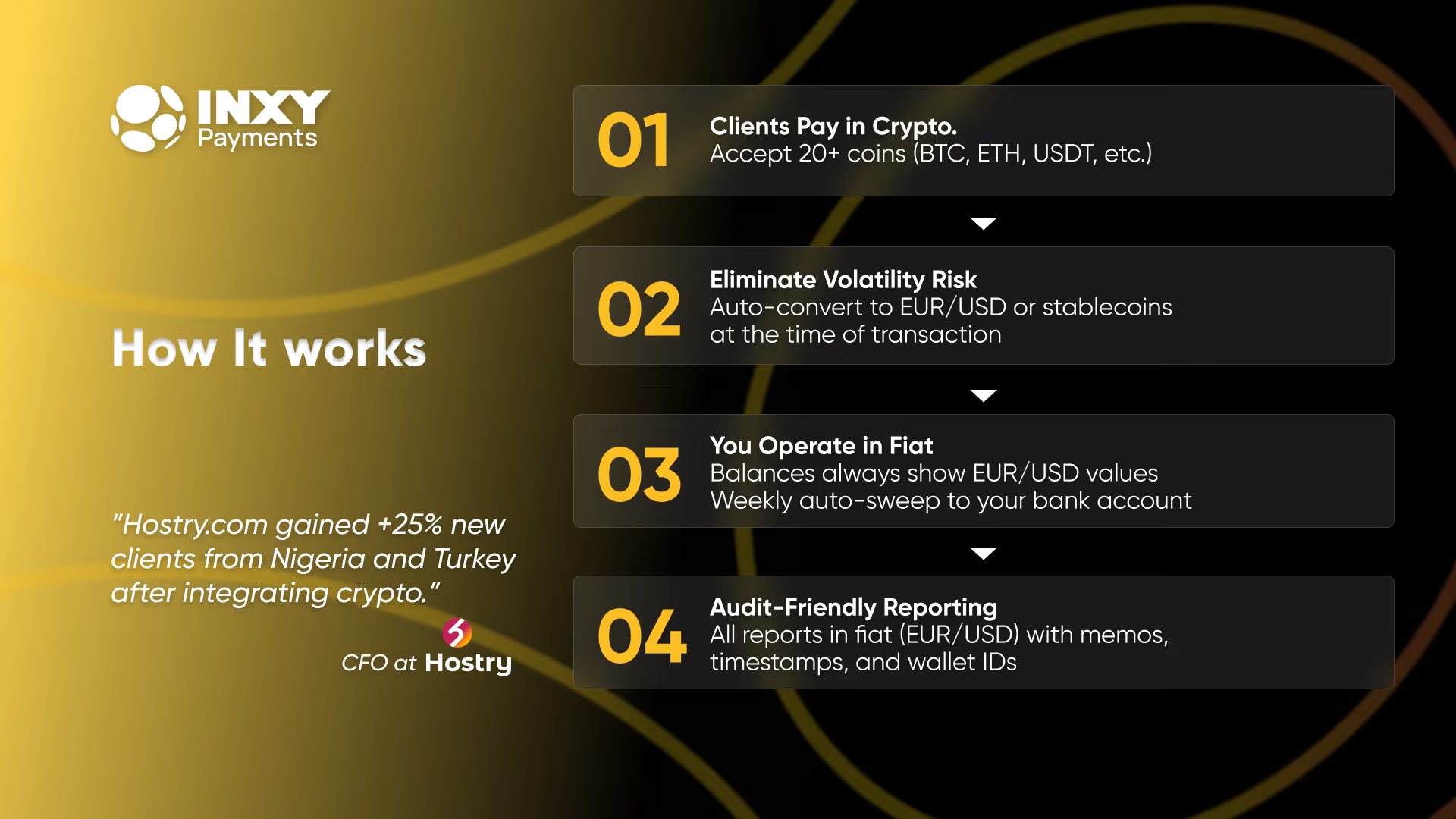
The standard lifecycle of a crypto payment includes:
Initialization: Your server requests a unique payment address for a specific order.
Monitoring: The gateway monitors the blockchain (Bitcoin, Ethereum, Tron, etc.) for incoming transactions.
Confirmation: The gateway verifies the transaction depth (number of block confirmations).
Webhook Notification: Your system receives an asynchronous callback to update the order status.
2. Step-by-Step API Integration
Phase A: Environment Setup
Before hitting production, high-quality gateways provide a Sandbox environment. This allows you to simulate successful payments, timeouts, and underpayments without risking real capital. You’ll typically need two headers for every request:
X-API-KEY: Your unique identifier.
X-PAY-SIGNATURE: A HMAC-SHA512 hash to ensure data integrity.
Phase B: Creating the Payment
To start a checkout, your backend sends a POST request to the /invoices or /payments endpoint.
The gateway responds with a destination address and a QR code URL. In 2026, the best UX practice is to offer "Invisible Crypto"—where the user sees a familiar interface, and the gateway handles the real-time conversion behind the scenes.
Phase C: Handling the Webhook
This is the most critical part of the integration. Since blockchain transactions are asynchronous, your server must be ready to receive a POST callback.
Pro Tip: Always verify the webhook signature. Never update an order status based solely on the incoming payload without checking that the request actually originated from your provider.
3. Security and Compliance in the EU
In the 2026 fintech landscape, security isn't just about encryption; it's about regulatory alignment. Within the EU, businesses must ensure their payment partner adheres to Transfer of Funds Regulation (TFR) and AML (Anti-Money Laundering) standards.
When choosing a provider, look for features like:
Auto-Conversion: Instantly swapping volatile assets into stablecoins or EUR to protect your margins.
Audit-Ready Reporting: Financial statements that your accounting team can actually use for VAT and tax filings.
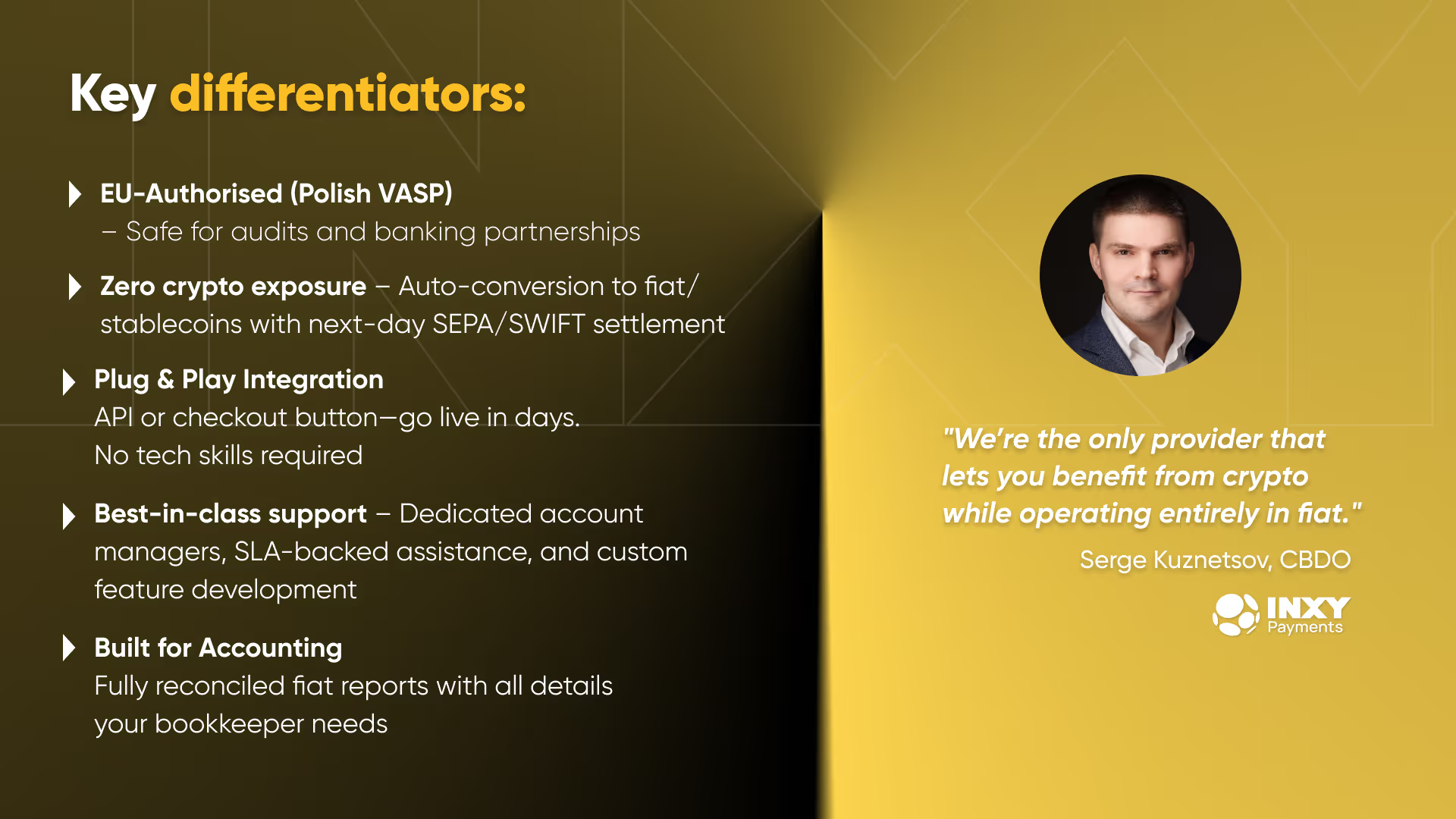
This is where specialized gateways like INXY (inxy.io) excel. Built specifically for the EU market, INXY acts as a regulated bridge. It doesn't just provide an API; it provides a compliant infrastructure that allows Web2 companies to scale into Web3 without the headache of managing private keys or worrying about crypto volatility. By integrating a solution like INXY, businesses can reduce processing fees by up to 70% compared to traditional card networks, while benefiting from instant SEPA settlements.
4. Testing and Optimization
Before going live, run "Chaos Tests" on your integration. What happens if a user sends too little? What if they pay after the 20-minute price-lock window? A robust API should provide clear error codes for these scenarios, allowing your frontend to guide the user toward a resolution—such as a partial refund or a top-up payment.
Conclusion
Integrating a crypto payment API in 2026 is a strategic move that opens your business to a global, tech-savvy audience. By utilizing professional gateways that handle the heavy lifting of compliance and conversion, your team can focus on what matters: the product.
Ready to modernize your payment stack? Would you like me to draft a technical checklist for your dev team to use during the INXY sandbox testing phase?
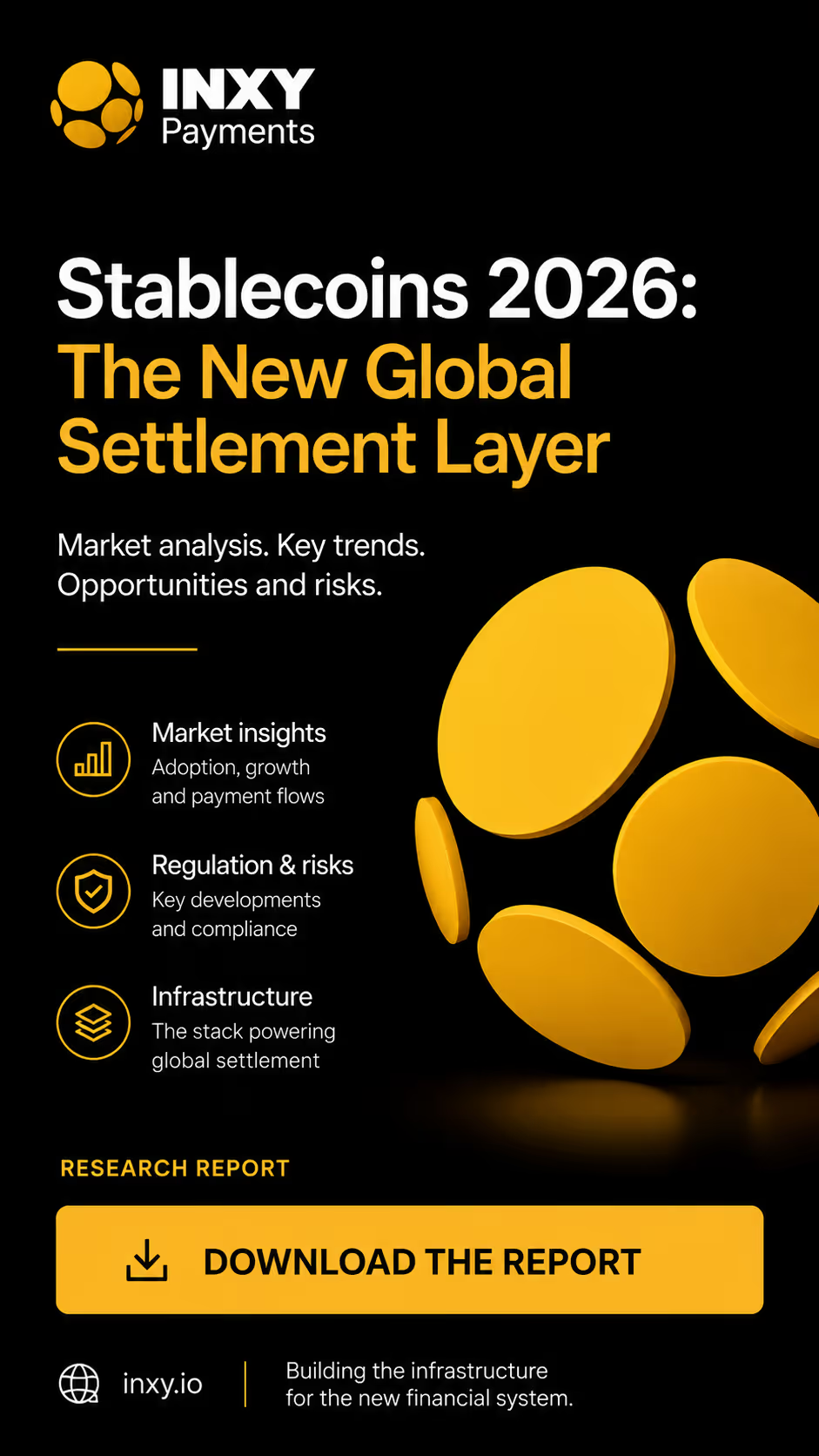
40 pages of market analysis, adoption trends, regulatory developments, infrastructure architecture, risks, and business opportunities.
Stablecoins are a type of cryptocurrency designed to keep a stable value. Unlike regular cryptocurrencies like Bitcoin, which can rise and fall in value quickly, stablecoins aim to stay consistent. They are often tied to real-world assets like the US dollar or gold. This connection helps prevent large price changes, making them useful for transactions and savings.
Think of stablecoins as digital versions of traditional money. They can be used for paying, saving, and trading without the worry of sudden value drops. Some stablecoins use algorithms to adjust their supply and maintain stability. Others hold reserves of the assets they are linked to. This dual approach helps users trust and rely on them for their financial needs.
Ranking by Market Capitalization
Market capitalization, often called "market cap," is a way to measure the total value of a stablecoin. Imagine it as the total worth of all the coins in circulation. When we talk about the best stablecoin in 2026, market cap is a key factor. It shows how popular and trusted a stablecoin is in the crypto world.
Let's break it down with an example. Think about two stablecoins, Coin A and Coin B. If Coin A has a market cap of $1 billion and Coin B has $500 million, Coin A is bigger. It means more people have invested in Coin A, showing more trust and usage.
Big market caps often mean more stability. Why? It is usually harder for someone to manipulate a large market. Plus, a bigger market cap can attract more traders and investors. But a higher market cap does not always mean less risk. It is still important to look at other factors, like the technology behind the coin and its management team.
In 2026, to find the best stablecoin by market cap, check which coins have grown the most. Look at their history and how they have performed over time. This can give you clues about which stablecoins might continue to grow and provide stability.
Yield Potential of Stablecoins
Exploring the yield potential of stablecoins can be quite the journey. Let's break it down. Some stablecoins offer staking options. This means you can earn interest by simply holding them in a specific wallet. It's like putting money in a bank account that gives you a little extra over time.
Another option is yield farming. This involves providing liquidity to certain platforms. You get rewarded with more coins. It's a bit like lending your coins to a friend and getting interest back.
But, be careful. While the potential for profit exists, risks are also there. Market conditions can change, affecting your returns. Always consider these factors when evaluating stablecoin yields.
Understanding Risks Involved
When we talk about stablecoins, the term "stable" often gives a sense of security. But is it really that simple? While stablecoins are designed to maintain a steady value, they come with their own set of risks. Let's break them down.
First up, we have the risk of losing the peg. Stablecoins are pegged to another asset, like the US dollar. But what if they lose this peg? When the market is volatile, the value of a stablecoin can drift away from its intended peg. This can happen due to insufficient reserves or sudden market shifts.
Next, consider regulatory risks. Governments around the world are still figuring out how to regulate cryptocurrencies, including stablecoins. Changes in laws can affect how stablecoins are used, traded, or even banned in certain regions. This uncertainty can impact their value and usability.
Then there's the risk of issuer default. Stablecoins are often backed by a reserve of fiat currency or other assets. If the issuer fails to manage these reserves properly, or if they face financial trouble, the stablecoin might not hold its value.
Also, technology plays a big role. Stablecoins operate on blockchain technology. While secure, blockchains can have bugs or be subject to cyber-attacks. If a stablecoin's technology is compromised, it can lead to loss of funds or trust.
Finally, liquidity risk shouldn't be overlooked. If there's a sudden rush to sell a particular stablecoin, there might not be enough buyers. This can make it hard to sell the stablecoin at its intended value, leading to potential losses.
Each of these risks reminds us that while stablecoins aim to offer stability, they are not without challenges. Understanding these risks can help you make informed decisions when dealing with stablecoins.
Top 5 Stablecoins for 2026
Stablecoins are digital currencies that aim to maintain a stable value. In 2026, the best stablecoins will likely be those that offer a good balance between security, yield, and risk. Here, we'll explore the top five stablecoins you might want to keep an eye on.
First up is Tether (USDT). Tether is one of the most used stablecoins. It's pegged to the US dollar, which means its value stays close to $1. Many people use Tether for trading because it offers stability in the volatile world of cryptocurrencies. However, some investors worry about its lack of transparency.
Next, we have USD Coin (USDC). Similar to Tether, USDC is also pegged to the US dollar. It's known for being transparent, as it undergoes regular audits. This makes it a popular choice for those who value security and trust.
Dai is another stablecoin to consider. Unlike USDT and USDC, Dai is not backed by US dollars in a bank account. Instead, it uses smart contracts on the Ethereum blockchain to keep its value stable. This decentralized approach appeals to those who prefer not to rely on traditional banking systems.
Binance USD (BUSD) is a stablecoin issued by Binance, one of the largest cryptocurrency exchanges in the world. BUSD is also pegged to the US dollar and is regulated, which provides an extra layer of security. It's a good choice for users who trade on the Binance platform.
Lastly, TrueUSD (TUSD) is a stablecoin that offers transparency and regular audits. Like other stablecoins, it is pegged to the US dollar. TrueUSD is popular among investors who prioritize a transparent and regulated approach to stablecoins.
These five stablecoins each offer something unique, from transparency to decentralization. As 2026 unfolds, these stablecoins might be the ones leading the charge in the crypto space.
Comparative Analysis of Stablecoins
When it comes to understanding stablecoins, comparing them can help you see the differences and similarities. Let's take a closer look at some popular stablecoins in 2026, focusing on capitalization, yield, and risks. This way, you can get a better idea of what makes each one unique.
Every stablecoin has its own market capitalization. This is the total value of all coins in circulation. For example, Tether (USDT) often has a large market cap, making it a strong player in the stablecoin field. In contrast, newer stablecoins might have smaller market caps, which can mean they are still gaining popularity.
Yield is another important factor. It refers to the return you might get from holding or staking the stablecoin. Some stablecoins offer attractive yields through different financial platforms. For instance, USDC might provide a steady yield for those who choose to lend or stake their coins. This makes it appealing to users looking for extra income.
Now, let's talk about risks. Every stablecoin carries some risk, but they differ in type and level. For instance, algorithmic stablecoins may face risks due to changes in their algorithms or market conditions. On the other hand, fiat-backed stablecoins like USDT and USDC might be exposed to regulatory risks. Understanding these risks can help you decide which stablecoin suits your needs.
To illustrate, consider Dai, an algorithmic stablecoin. Its value is maintained through smart contracts and collateralized assets. This makes Dai less dependent on traditional banks but more sensitive to market fluctuations. In comparison, fiat-backed coins like BUSD rely on reserves in a bank, offering more stability but less independence.
Stablecoin innovation doesn't stop here. New models and technologies are constantly emerging. These developments aim to address current limitations and provide new benefits. By staying informed about these changes, you can make smarter choices in the stablecoin market.
In summary, the best stablecoin for you depends on your goals and risk tolerance. Whether you prioritize high yield, market stability, or innovation, there's likely a stablecoin that fits your criteria. Keep exploring, and you'll find the one that aligns with your financial strategy.
Future of Stablecoins: Trends to Watch
As we look ahead to 2026, the stablecoin landscape is poised for significant changes. These digital assets, designed to maintain a stable value, are becoming an integral part of the financial ecosystem. Let's explore the trends that are shaping their future.
One major trend is the growing interest in central bank digital currencies (CBDCs). Governments around the world are exploring their own digital currencies, which could impact the role of stablecoins. For instance, if a country launches a successful CBDC, it may affect how private stablecoins are used within that economy. This could lead to a shift in demand and new regulatory challenges.
Another trend to watch is the rise of algorithmic stablecoins. Unlike traditional stablecoins backed by reserves, these use complex algorithms to maintain stability. TerraUSD and similar projects are examples of this innovation. While they offer potential benefits like decentralization, they also come with risks, as seen in past fluctuations. As technology improves, we may see more robust and reliable algorithmic stablecoins.
Regulation will play a crucial role in the stablecoin market. Authorities are keen to ensure that these digital currencies are safe and transparent for users. We can expect more comprehensive regulations to emerge, focusing on areas like reserve transparency and consumer protection. This could lead to increased trust and wider adoption.
The integration of stablecoins with decentralized finance (DeFi) platforms is another exciting development. Stablecoins provide liquidity and stability within these platforms, enabling more complex financial products. As DeFi grows, so will the demand for stablecoins, making them even more essential.
Finally, the use of stablecoins for cross-border transactions is likely to expand. Their ability to offer fast and low-cost transfers makes them attractive for international payments. This could challenge traditional banking systems and reshape how global transactions are conducted.
As these trends unfold, stablecoins will continue to evolve, playing a pivotal role in the future of finance.
FAQ
What are stablecoins and why are they important?
Stablecoins are a type of cryptocurrency designed to maintain a stable value, typically pegged to a reserve of assets like fiat currencies (e.g., USD) or commodities. They are important because they offer a refuge from the volatility typical of cryptocurrencies, making them a useful tool for transactions, savings, and as a base currency in trading.
How are stablecoins ranked by market capitalization in 2026?
Stablecoins in 2026 are ranked by market capitalization based on the total value of their circulating supply. This ranking reflects their adoption and trust within the market. Factors such as the size of reserves, transparency, and liquidity contribute to their market capitalization.
What yield opportunities do stablecoins offer?
Stablecoins provide yield opportunities through mechanisms such as interest-bearing accounts, staking, and lending platforms. These methods allow investors to earn returns in a low-risk environment, with yields often depending on the platform and specific stablecoin used.
What risks are involved in investing in stablecoins?
Investing in stablecoins involves risks such as regulatory changes, which can impact their legality and usage. Market volatility, while less than traditional cryptocurrencies, can still affect stablecoin value indirectly. Additionally, the stability of the assets backing the stablecoin is crucial, as poor management can lead to value fluctuation.
Which are the top 5 stablecoins to watch in 2026?
The top 5 stablecoins for 2026 are selected based on their market performance, adoption rate, and stability mechanisms. These include well-established names with strong backing and innovative newcomers offering unique features. Their strengths and weaknesses are analyzed to provide a comprehensive overview.
How can I compare different stablecoins effectively?
A comparative analysis involves examining stablecoins based on market capitalization, yield potential, and associated risks. Factors such as reserve transparency, regulatory compliance, and technological infrastructure are considered to help investors make informed decisions.
What future trends should we watch for stablecoins?
Future trends for stablecoins include increased integration into traditional financial systems, technological innovations such as enhanced privacy features, and evolving regulatory frameworks. These trends will shape their role in the financial ecosystem and influence their utility and adoption.
The end of fiat friction: Why strategic merchants are switching to stablecoin payments
To accept crypto once meant exposure to price volatility. That is no longer the case. Stablecoins — pegged to the US Dollar or Euro — deliver the settlement efficiency of blockchain without the speculation. For C-level executives, the question is no longer whether to integrate digital assets, but how quickly legacy bottlenecks can be replaced with purpose-built infrastructure.
The legacy financial system imposes a structural tax on growth. For decades, merchants have absorbed correspondent banking fees, 3% interchange costs, and chargeback losses that erode margin on every transaction. In a global economy, waiting T+3 or T+5 for settlement is not an inconvenience — it is a liquidity problem.
To accept crypto once meant exposure to price volatility. That is no longer the case. Stablecoins — pegged to the US Dollar or Euro — deliver the settlement efficiency of blockchain without the speculation. For C-level executives, the question is no longer whether to integrate digital assets, but how quickly legacy bottlenecks can be replaced with purpose-built infrastructure.
1. Settlement velocity: From days to seconds
Traditional cross-border settlements move through a chain of intermediate banks, accumulating fees and losing transparency at every hop. SWIFT provides no real-time visibility into where funds are or when they will arrive.
Stablecoins operate on a 24/7/365 ledger with near-instant finality. Settling on Ethereum, Polygon, or TRON, merchants are no longer bound by banking hours or cut-off windows. Capital lands, clears, and is available for redeployment immediately — not in a pending queue.
inxy.io integrates directly into this settlement layer, giving merchants the operational continuity that traditional finance structurally cannot offer.
2. Eliminating the chargeback tax
Chargeback fraud costs merchants billions annually. Credit card networks are centralised by design, which means any transaction can be reversed — often at the merchant's expense, with little recourse.
Blockchain transactions are push-based and immutable. When a business chooses to accept crypto in the form of stablecoins, payment finality is guaranteed by the protocol, not by a bank's dispute resolution team.
No chargebacks: Once confirmed on-chain, a transaction cannot be reversed by a third party.
Reduced fraud overhead: No need for aggressive fraud filters that block legitimate customers.
Revenue sovereignty: You control your income stream without intermediary intervention.
3. Technical infrastructure: Beyond the hype
A payment gateway needs to be a piece of production-grade fintech infrastructure, not just a wallet interface. High-volume merchants require an API that abstracts blockchain complexity without sacrificing control.
What inxy.io provides:
No crypto management overhead: Merchants do not handle tokens or gas fees. That layer is abstracted entirely.
Volatility protection: Pay-ins convert to stablecoins or fiat instantly, locking in value at the moment of transaction.
Multi-chain support: USDT, USDC, DAI, EURC, TON, BTC, ETH, LTC, TRX, BNB, DOGE across ERC-20, TRC-20, Polygon, and BSC — customers transact on the network that works best for them.
Real-time webhooks: Instant payment status notifications to your backend, enabling automated fulfilment or shipping triggers without polling.
Compliance stack: EU VASP (Poland), Canadian MSB, MiCA-ready, AML/KYT/KYC, sanctions screening via Elliptic and Sumsub, Big-4-friendly fiat reporting.
4. Drastic reduction in operational costs
Managing global payments typically means maintaining multiple local currency accounts and navigating FX spreads on every cross-border transfer. Stablecoins provide a single settlement layer that works across jurisdictions without currency conversion overhead.
Consolidating payment rails through inxy.io can reduce payment processing Opex by up to 80%. Instead of paying a chain of intermediaries for the movement of value, you pay for efficient infrastructure. That margin stays in the business.
FAQ: Navigating the stablecoin shift
Is it difficult to integrate a stablecoin gateway into an existing platform?
No. inxy.io integrates via a REST API or pre-built plugins for major e-commerce engines. Documentation and technical support are included, and most teams go live faster than a standard merchant bank account setup.
How do we handle gas fee volatility?
inxy.io routes transactions through high-throughput networks to keep fees minimal. Customers can select the most cost-effective network for their transaction — the infrastructure handles the routing logic.
How does accepting stablecoins affect our accounting?
USDT and USDC are pegged 1:1 to the dollar, which makes them materially simpler to account for than traditional cryptocurrencies. inxy.io provides detailed reporting and CSV exports compatible with standard accounting software and ERP systems.
What about regulatory compliance?
inxy.io is built with compliance as a core component, not an afterthought — EU VASP registration, MiCA readiness, AML/KYT screening, and Big-4-auditable reporting. Your business stays within the regulatory framework while operating at full velocity.
Scalability Without Compromise
The merchant of 2026 cannot run on 1970s banking rails. The competitive advantage belongs to businesses that eliminate payment friction and capture the full value of their transactions across borders.
inxy.io is the infrastructure layer for that transition — robust APIs, multi-chain settlement, and a compliance stack built for global scale.
Partner with INXY — secure your payment infrastructure and lead the market.
How to profitably accept crypto for low-cost VPS and micro-cloud services
For budget VPS and micro-cloud providers, a $0.30 flat processing fee can wipe out nearly 10% of a $5 invoice before the server even boots. This guide breaks down how to accept crypto payments profitably — using stablecoins on low-fee networks like TRC-20 and Polygon, combined with a pre-paid balance model that eliminates micro-transaction overhead. Learn the operational blueprint for crypto-native billing that protects your margins and scales with your infrastructure.
How to profitably accept crypto for low-cost VPS and micro-cloud services
You provision a virtual machine, allocate the IP address, and send the customer an automated invoice for $4.99. Then, the traditional payment processor takes its cut: a standard $0.30 flat rate plus 2.9% of the total transaction. Just like that, nearly 10% of your gross revenue vanishes before the server even boots up. If you are operating in the micro-cloud and budget VPS market, your biggest competitor is not another hosting company; it is the legacy banking system actively eating your razor-thin profit margins.
Premium dedicated servers priced at $200 a month can easily absorb standard credit card fees. Low-cost infrastructure simply cannot. The survival and scalability of a budget IaaS (Infrastructure as a Service) provider depend entirely on extreme transaction efficiency. By strategically deploying cryptocurrency payments on low-fee blockchain networks, you can bypass fiat gateways, preserve your margins, and attract a global audience of developers who prefer decentralized payments.
Fiat gateways vs. Digital assets
To understand why traditional billing is fundamentally broken for micro-cloud services, we must examine the harsh mathematics of a $5 monthly transaction.
Scenario A: The Fiat Processing Trap When a client pays a $5 invoice via Stripe or PayPal, the fixed $0.30 fee disproportionately damages the transaction. The total fee amounts to roughly $0.45. If your baseline infrastructure cost (electricity, bandwidth, hardware depreciation) for that specific virtual machine is $3.50, your actual profit is immediately slashed. Furthermore, if that user initiates a chargeback, you lose the server resources, the original $5, and are penalized with a $15 dispute fee. You have effectively paid money to host a server for a stranger.
Scenario B: High-Speed Blockchain Routing Now, consider processing that same $5 transaction using a stablecoin like USDT routed through a Layer-2 blockchain network (such as Polygon) or a high-throughput chain (like Tron/TRC-20). The transaction fee drops from $0.45 to a fraction of a penny. There are zero chargeback risks, no rolling reserves held by acquiring banks, and the funds settle into your company’s digital wallet in a matter of seconds. You keep 100% of the revenue you earned.
The operational blueprint for micro-transactions
You cannot simply paste a Bitcoin wallet address on your checkout page and expect profitability. Bitcoin network fees can sometimes exceed the cost of the VPS itself. To succeed in the micro-cloud space, providers must adopt a specialized operational architecture:
Implement the Account "Top-Up" Model: Instead of forcing users to process a $4 crypto transaction every single month, shift your billing panel to a credit system. Require a minimum deposit of $20 in cryptocurrency, which is added to their account balance. Your system then automatically deducts the $4 daily or monthly from that pre-paid internal ledger.
Enforce Stablecoin Dominance: Volatile assets are dangerous for low-margin services. Restrict micro-payments strictly to stablecoins like USDT and USDC. This guarantees that a $5 payment today remains worth exactly $5 when you need to pay your own upstream datacenter bills next week.
Mandate Low-Cost Networks: Disable legacy networks like Ethereum (ERC-20) for small checkouts, as the gas fees will frustrate your users. Only present checkout options for TRC-20, BEP-20, or Polygon networks, ensuring the customer pays almost nothing to send you the funds.
Overcoming the implementation hurdle with INXY
Many hosting providers hesitate to adopt digital payments because tracking microscopic network fees, managing multiple blockchain nodes, and building custom billing integrations sounds like an administrative nightmare. This is exactly where INXY transforms your entire billing architecture.
Unlike generic merchant processors, INXY is an enterprise-grade cryptocurrency payment gateway specifically designed to handle the high-frequency, low-cost routing required by modern cloud providers. We seamlessly integrate directly into your existing billing panels – whether you use WHMCS, HostBill, or a custom internal dashboard.
When you partner with INXY, you do not need to worry about manually verifying network confirmations or updating user balances. Our API automatically generates unique payment addresses, monitors the lowest-fee networks like Tron and Polygon, confirms the exact stablecoin deposit, and instantly updates the client's pre-paid balance on your server. INXY acts as your automated, invisible cashier, securing your revenue without the bloat of traditional banking.
Conclusion
The micro-cloud sector thrives on volume and automation. Continuing to rely on payment processors that penalize small transactions is an unsustainable business model. By shifting to a crypto-native, pre-paid balance structure, you eliminate crippling flat fees, protect yourself from chargeback fraud, and capture a rapidly growing demographic of privacy-conscious developers.
Ready to stop giving away your profit margins to payment processors? Discover how our automated payment gateway can drastically improve your server profitability by visiting https://www.inxy.io/ today.














.png)