
Stablecoin Market Report: September 2026 — Key Trends and Data
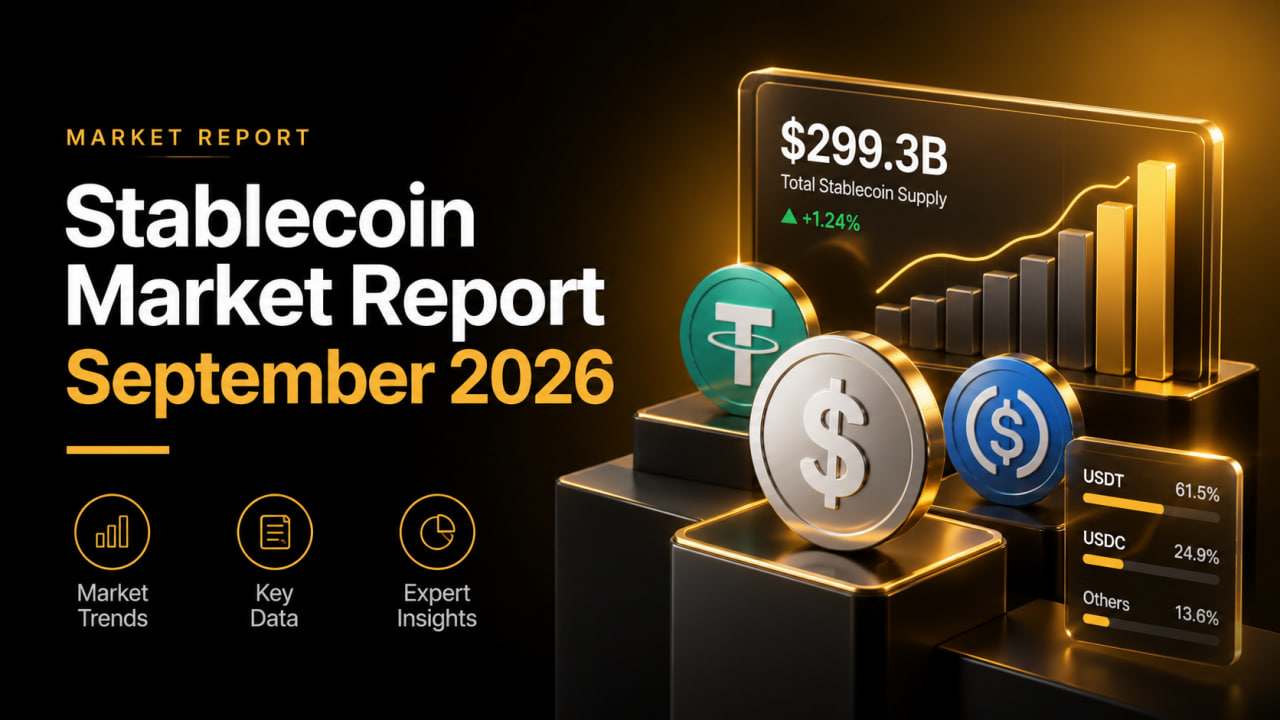
Stablecoin Market Report September 2026: The Market Is Growing, but the Story Is Changing
Stablecoins ended September 2026 with nearly $300 billion in Base Supply. But the most interesting part of the latest Stablecoin Beat report is not the headline number.
The market is becoming more regulated, more institutional, more distributed across issuers and networks, and more connected to traditional financial infrastructure.
At the same time, some of the old assumptions are starting to look less certain.
We reviewed the Stablecoin Market Report — September 2026 from Stablecoin Beat. The report tracks market size, issuer concentration, regulation, peg stability, trading activity, blockchain distribution, and the wider macro backdrop using a consistent monthly methodology.
The stablecoin market is now a $299 billion market
Base Supply reached $299.30B at the end of September. That was the second consecutive monthly increase. The market also expanded beyond its existing leaders.
But the growth needs some context.
Of the $3.65B monthly increase, $1.65B came from assets entering the report's coverage, not from pure like-for-like market growth. On a same-constituent basis, supply increased by $2.00B.
The market is growing. But not every increase in the headline number means existing stablecoins suddenly became more widely used.
USDT still dominates, but the market is slowly becoming less concentrated
But concentration is moving in the other direction. It was the second consecutive monthly decline.
HHI (Herfindahl–Hirschman Index) measures market concentration. Lower means the market is less concentrated.
This is not a dramatic reshaping of the market. But it is a useful signal. More stablecoins are entering the market, and some of them are finding meaningful traction.
The market is still dominated by a few large issuers. But the edges are getting more interesting.
Regulation is becoming part of the market structure
This may be one of the most important changes in the report. At the end of September, the report classified about a quarter of the market under each major framework. Both cohorts grew during the month.
The report is careful to note that these are market-data classifications, not legal determinations. That distinction matters.
Still, the direction is clear. Regulation is no longer something that sits outside the stablecoin market. It is becoming part of how the market itself is measured and compared.
September also brought more regulatory activity across the US, Europe, Singapore and other markets, with reserve, capital, deposit, and recognition rules all under discussion.
This is a necessary stage of market maturity. The next phase of stablecoin adoption will depend less on whether the technology works and more on whether businesses, banks, and institutions know how to use it inside clear rules.
Stablecoins are still overwhelmingly dollars
At the end of September, 99.64% of Base Supply was USD-pegged. That leaves almost no meaningful alternative-currency segment.
This is one of the clearest signals in the report.
Stablecoin adoption is global. Stablecoin currency exposure is not. The market is still essentially a digital dollar market.
This creates both an opportunity and a limitation. For global businesses, dollar stablecoins are extremely useful for cross-border settlement.
But the small size of non-USD stablecoins also shows how much room remains for euro and other local-currency digital money to develop.
EUR stablecoins are growing, but from a very small base
This is an interesting direction for Europe. The market remains tiny next to USD stablecoins, but most euro supply is already concentrated in MiCA-compliant instruments.
For businesses operating in Europe, this matters. If stablecoins are going to become part of mainstream European payments, the market will eventually need more than digital dollars.
It will need digital euros that fit naturally into regulated European payment flows.
Stability remained strong, but September was not perfectly quiet
That is an important reminder. A stablecoin can look completely stable at a monthly snapshot and still experience meaningful intramonth volatility.
For businesses, stablecoin selection cannot stop at market cap. Liquidity, reserves, regulation, redemption mechanics, and operational controls all matter.
Stablecoins are not simply sitting still
The report estimates trading turnover at 29.3% of Base Supply value on 30 September, for the stablecoins with unambiguous volume data.
The point is simple. Stablecoins are not just balances parked on-chain. They are actively circulating through markets.
This becomes more important as more businesses use stablecoins as payment and settlement infrastructure, rather than simply as crypto trading assets.
Ethereum and Tron still dominate the infrastructure
Stablecoin payments are already multi-chain. A business cannot assume that one network will work for every recipient, corridor, or use case.
The payment layer needs to abstract this complexity.
The next layer is starting to look more like financial products
The report tracks this as a separate segment. This is where the market begins to move beyond "stablecoin as payment token."
Yield-bearing wrappers and tokenized Treasury products increasingly sit next to stablecoins as alternative ways to hold and deploy dollar liquidity.
This creates a new regulatory question. Once stablecoin balances can generate yield, they start competing more directly with traditional deposits and savings products.
Regulation will increasingly need to deal not only with payment and redemption risk, but also with the economics of the financial system around those balances.
What this means for businesses
The report is useful because it moves the conversation away from the usual stablecoin headline. The question is no longer:
"How big is the stablecoin market?"
The more useful questions are:
- Which stablecoin is appropriate for the flow?
- Which network should carry it?
- How does it connect to fiat?
- How do compliance and reporting work?
- What happens when the recipient wants to cash out?
- Which payments should stay on traditional rails?
That is where stablecoins stop being a crypto topic and start becoming a financial infrastructure topic.
We see the same shift from the business side
Companies rarely come to us because they simply want to "use crypto." They come with a job to solve. They need to:
- Accept international payments.
- Pay contractors, partners, and suppliers.
- Move money across borders.
- Convert between fiat and stablecoins.
And they need to do all of this without building blockchain infrastructure or turning their finance team into a crypto operations team. That is the part of the market we care about.